
Educational content, not medical advice. Growth hormone therapy requires a prescription from a licensed clinician. Talk to a qualified provider before changing any hormone protocol.
Short answer: Yes. Human growth hormone (HGH) is a 191-amino acid single-chain polypeptide with a molecular weight of 22,124 daltons, which makes it technically both a peptide and a protein by most biochemistry definitions. The confusion arises because “growth hormone peptides” in the clinical and supplement world refers to a different category of shorter synthetic molecules, such as sermorelin, ipamorelin, and CJC-1295, that stimulate the pituitary gland to produce its own HGH. They are not the same compound. One is the hormone itself; the others are the signals that trigger its release.
Growth hormone is both a peptide and a protein by definition. Curious what your own growth hormone-related markers look like? One at-home Superpower draw checks 100+ biomarkers, physician-reviewed.
Why does everyone get confused about growth hormone being a peptide?
The word “peptide” has been annexed by the wellness industry to mean almost anything injectable and non-steroidal. When a telehealth clinic says “we offer peptide therapy,” they almost never mean they are prescribing you actual growth hormone. They mean sermorelin, ipamorelin, CJC-1295, or a similar secretagogue that works upstream of HGH. When a research-chemical site sells “growth hormone peptides,” the label is technically accurate but practically misleading, because HGH itself is sold separately under names like Norditropin or Genotropin and requires a different prescription pathway entirely.
The conflation matters because the two routes, replacing HGH directly versus stimulating your pituitary to make more, carry different regulatory statuses, different side-effect profiles, and dramatically different costs.
This is one of those cases where getting the vocabulary right before you spend money is genuinely important.
What is growth hormone at the molecular level?
The simplest way to actually get this done
Superpower is a full-body lab membership that runs 100+ biomarkers, has each result reviewed by a doctor, and tracks your numbers year over year (about $199/year). It is what we point readers to when they would rather get one clean, complete draw than chase single tests one at a time. Here is superpower reviewed in full.
Growth hormone is a single-chain polypeptide of 191 amino acids produced by somatotroph cells in the anterior pituitary gland. Biochemists typically draw the line between “peptide” and “protein” somewhere between 50 and 100 amino acids, though no universal cutoff exists. At 191 residues and 22 kDa, HGH sits firmly in the protein-sized range of the polypeptide family. The University of Queensland’s Institute for Molecular Bioscience frames it well: peptides and proteins are the same kind of molecule, amino acid chains connected by peptide bonds, and the word choice is largely a function of length.
Structurally, HGH folds into a four-helix bundle stabilized by two intramolecular disulfide bonds between four cysteine residues (positions 53, 165, 182, and 189). That folded structure is what allows it to bind the GH receptor. A smaller synthetic peptide like ipamorelin, which is only five amino acids long, cannot do that job. It does a different, upstream job instead.
One detail that trips up even careful readers: HGH is not a single molecule. The pituitary secretes at least two main isoforms of it. The dominant form is the 22 kDa, 191-amino acid chain described above. A second, the 20 kDa isoform, is produced by alternative splicing that removes 15 residues (amino acids 32 to 46) from the same gene transcript, leaving a shorter 176-amino acid variant that still binds the GH receptor but signals slightly differently. The 20 kDa form makes up roughly 5 to 10 percent of circulating growth hormone. This is not trivia. Different immunoassays recognize these isoforms to different degrees, which is one concrete reason two labs can report different GH values from the same blood draw.
Circulating GH does not travel entirely free either. Roughly half of it rides bound to growth hormone binding protein (GHBP), which is literally the cleaved extracellular portion of the GH receptor itself. GHBP levels loosely track how many GH receptors your tissues express, so a very low GHBP can point toward receptor-level resistance rather than a supply problem. None of this shows up on a basic panel, but it is the biochemical reason clinicians lean on IGF-1 and stimulation testing instead of trusting a single spot GH measurement.
So the technically precise answer: HGH is a peptide hormone in the same way that insulin is a peptide hormone. Calling it “a peptide” is not wrong. It is just the beginning of the story, not the whole one.
Full-body lab membership: 100+ biomarkers, doctor-reviewed, tracked over time.
How does the body actually produce and regulate growth hormone?
This is where the biology gets genuinely interesting, and where understanding it gives you real leverage over any peptide therapy decision.
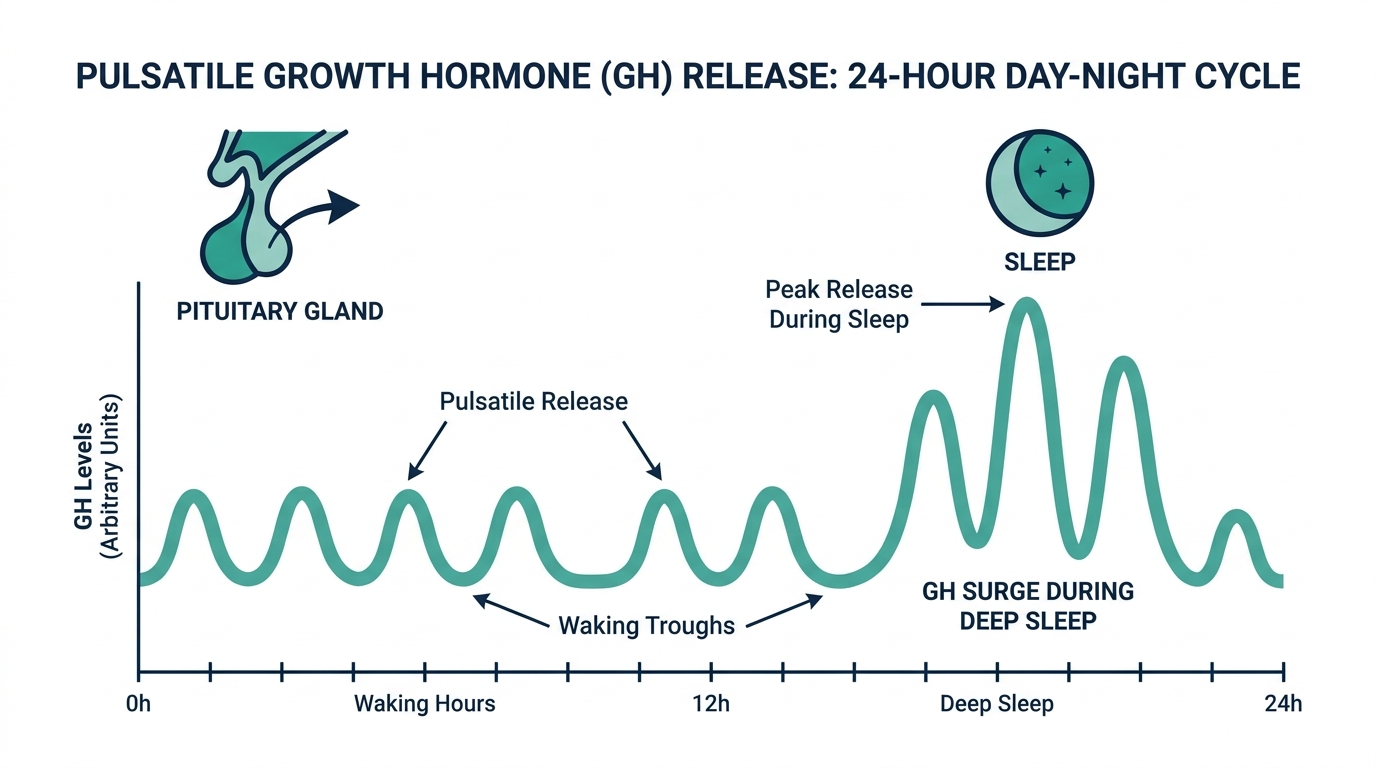
The hypothalamus runs a constant call-and-response with two opposing peptides: growth hormone-releasing hormone (GHRH), which pushes the pituitary to secrete GH, and somatostatin, which applies the brake. GH release is pulsatile, not continuous. The pituitary does not drip HGH into the bloodstream around the clock. It fires in bursts, with the largest burst occurring approximately one hour after sleep onset, when plasma GH levels peak between 13 and 72 ng/mL. Between pulses, basal levels typically stay below 5 ng/mL for most of the day and night.
Once released, HGH has a biological half-life of only 10 to 20 minutes. It travels to the liver, where it triggers production of IGF-1. IGF-1 is what actually drives most of the downstream effects on muscle, bone, fat metabolism, and cellular repair that people associate with “growth hormone benefits.”
Here is the insider insight that most coverage skips: the pulsatile pattern is not a quirk of physiology, it is a feature. GH receptors sensitize and desensitize depending on how they are activated. A steady, flat infusion of HGH, which is roughly what exogenous injection of recombinant HGH produces, does not replicate the natural surge-and-recede cycle. That is one mechanistic reason why some researchers argue that secretagogues preserving pulsatile release carry a different, potentially more favorable, risk profile than direct HGH replacement, though long-term comparative data is still limited.
What are “growth hormone peptides” and how are they different from HGH?
The term “growth hormone peptides” refers to secretagogues: small synthetic compounds that stimulate the pituitary gland to secrete more of its own GH. They do not replace HGH. They turn up the dial on the system that makes it.
The three you will encounter most often:
Sermorelin is a 29-amino acid synthetic analog of GHRH. It binds the same receptor your hypothalamus uses to signal the pituitary. Sermorelin is FDA-approved (NDC listed) and can be prescribed through licensed compounding pharmacies. It is the conservative, well-studied entry point into GH support. Cost runs $150 to $225 per month through telehealth platforms.
CJC-1295 is a modified GHRH analog engineered to have a much longer half-life than sermorelin (up to 8 days with the DAC modification, versus sermorelin’s roughly 10-minute half-life). Longer half-life means broader GH stimulation across the day rather than a single acute pulse.
Ipamorelin is a pentapeptide (five amino acids) that works on a completely different receptor: the ghrelin receptor (GHSR), discovered in 1999 when Masayasu Kojima and Kenji Kangawa identified ghrelin, the 28-amino acid stomach hormone, as the natural endogenous ligand. Ipamorelin mimics ghrelin’s GH-stimulating effect with high selectivity, without significantly raising cortisol, prolactin, or aldosterone. That selectivity is why clinicians increasingly prefer it over older, less selective peptides like GHRP-2 and GHRP-6.
The most common stack in clinical use today is CJC-1295 combined with Ipamorelin, which produces a larger, dual-pathway GH pulse than either molecule alone. Search volume for this stack climbed from roughly 27,000 queries per month in late 2025 to over 60,000 per month in 2026, tracking the growth of telehealth peptide clinics making it accessible.
| Compound | Type | Amino acids | Mechanism | Regulatory status (US, 2026) |
|---|---|---|---|---|
| HGH (somatropin) | Peptide hormone | 191 | Binds GH receptor directly | FDA-approved; prescription only (Norditropin, Genotropin, Omnitrope) |
| Sermorelin | GHRH analog | 29 | Stimulates pituitary via GHRH receptor | Prescription; compounding pharmacy |
| CJC-1295 | GHRH analog (modified) | 30 | Long-acting GHRH receptor agonist | Grey zone; Category 2 list pending reclassification |
| Ipamorelin | Ghrelin mimetic | 5 | Stimulates via GHSR (ghrelin receptor) | Grey zone; Category 2 list pending reclassification |
| Tesamorelin | GHRH analog | 44 | Stimulates pituitary; FDA-approved for HIV lipodystrophy | Prescription; narrow indication |
| Ghrelin | Natural peptide | 28 | Natural GHSR ligand; GH + appetite | Endogenous; no approved therapeutic form |
Does HGH still get classified as a biological drug or a peptide drug?
This is not a pedantic question. The regulatory classification determines what happens if a compounding pharmacy tries to make a copy.
The FDA’s 2018 final rule on the definition of “biological product” moved proteins with more than 40 amino acids into the biologics category. Somatropin (HGH) at 191 amino acids falls squarely there. Biologics cannot be compounded under the 503A or 503B pathways that cover small-molecule drugs. That single regulatory fact is why “compounded semaglutide” became a news story when shortages were declared, and why “compounded HGH” never did: you cannot compound HGH the same way. The brand-name somatropin products, Norditropin (Novo Nordisk), Genotropin (Pfizer), Omnitrope (Sandoz), Humatrope (Eli Lilly), Saizen (Merck Serono), and others, hold the legal market for exogenous GH almost exclusively.
Costs reflect this. Recombinant HGH injections average $300 to $1,500 per injection, with monthly therapy running several thousand dollars when dosed for deficiency conditions. Insurance covers it for diagnosed GH deficiency (pituitary adenoma, Turner syndrome, Prader-Willi syndrome, AIDS wasting) but almost never for anti-aging or body composition optimization.
Secretagogues like sermorelin sidestep the biologic classification because they are short synthetic peptides well under 40 amino acids, and some have FDA approval as finished drugs. That is part of why the telehealth industry built its GH optimization layer on sermorelin and the ipamorelin/CJC stack rather than on HGH itself.
Who actually has growth hormone deficiency, and should you get tested?
Adult growth hormone deficiency (AGHD) is rarer than the optimization industry implies. Estimates from Barrow Neurological Institute and published literature put it at roughly 6,000 to 13,000 diagnosed cases among US adults at any given time, with the most common cause being pituitary tumors or damage from surgery or radiation therapy.
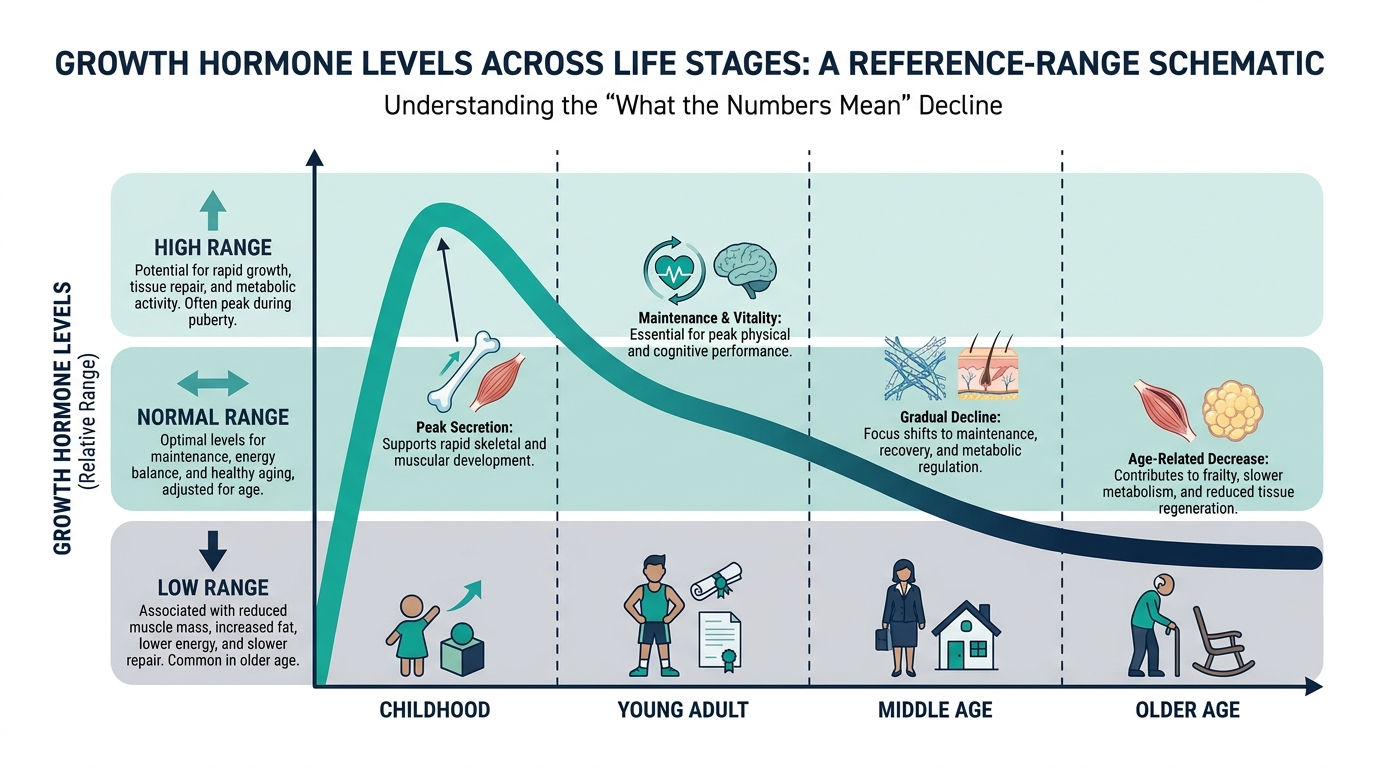
That number does not reflect the much larger group of adults who experience age-related GH decline, which is normal physiology: GH output peaks in the late teens and declines progressively through adulthood, with most people seeing the sharpest decline after age 30. This “somatopause” is not the same as deficiency, but it is the real driver of interest in secretagogue therapy. The symptoms, reduced lean mass, increased visceral fat, reduced bone density, impaired sleep architecture, and slower recovery, overlap considerably between true deficiency and age-related decline.
The first diagnostic step is an IGF-1 blood test, because IGF-1 reflects cumulative GH output over weeks and does not require catching a GH pulse. A key insider caution from the published literature: 30% to 40% of adults with true GH deficiency may have a normal IGF-1, so a normal result does not rule out deficiency if clinical suspicion is high. A GH stimulation test (where a provocative agent is administered and GH response is measured) is the gold standard for diagnosis.
Do not try to interpret IGF-1 in isolation and self-prescribe secretagogues. The number needs context: age, sex, nutritional status, thyroid function, and insulin sensitivity all affect it.
How is growth hormone deficiency actually tested in a clinic?
Because GH pulses and clears within about 20 minutes, no single random blood draw can confirm or exclude deficiency. Endocrinologists work around the pulsatility in two ways: they measure the stable downstream markers, and they provoke the pituitary on purpose.
IGF-1 and IGFBP-3. These are the screening labs. IGF-1 integrates GH output over days, and IGFBP-3, its main carrier protein, adds context, especially in children and adolescents. Both must be read against age and sex reference ranges, because IGF-1 falls naturally as you get older. A low-for-age IGF-1 raises suspicion. A normal one does not clear it, since a meaningful share of confirmed adult cases carry a normal IGF-1.
Provocative stimulation testing. When the screening labs plus the clinical picture warrant it, the diagnosis is confirmed with a stimulation test. The insulin tolerance test (ITT), in which controlled hypoglycemia is induced and the GH response measured, remains the reference standard, but it is unpleasant and unsafe for anyone with heart disease or a seizure history. The glucagon stimulation test is the common alternative. Since 2017 there has also been an oral option: macimorelin (Macrilen), a ghrelin-receptor agonist you drink, after which the GH response is measured. A blunted peak GH response across these tests is what actually defines deficiency, not a low spot value.
The practical takeaway is simple. If a clinic offers to start you on growth hormone or a secretagogue on the strength of one GH number and a symptom checklist, that is not how the diagnosis is made. A real workup begins with IGF-1 read in the context of a full metabolic and hormone panel, then escalates to stimulation testing only if the picture holds together.
What are the real risks of taking exogenous HGH without a legitimate deficiency diagnosis?
Personally, I think the wellness industry systematically underplays this side of the ledger.
When GH and IGF-1 rise above physiological ranges, the pattern starts to mirror acromegaly, the disease caused by a GH-secreting pituitary tumor. Research on acromegaly patients shows elevated risks of colorectal cancer, thyroid cancer, cardiovascular disease, type 2 diabetes, and joint destruction. No long-term randomized trial has established that supraphysiologic GH supplementation in non-deficient adults is safe over a 10-year horizon.
The shorter-term side effects of exogenous HGH at optimization doses include fluid retention (edema), carpal tunnel syndrome, joint pain, insulin resistance, and gynecomastia. These are not rare. They are common enough that most endocrinologists remain skeptical of off-label GH therapy for body composition without a documented deficiency.
Secretagogues at prescribed doses are generally considered to carry a more favorable short-term safety profile than direct HGH injection, primarily because they cannot push GH above what the pituitary gland’s own feedback loops allow. If somatostatin levels rise in response to excess GH, the pituitary brakes. Exogenous HGH bypasses that brake entirely.
Do not believe any clinic that frames HGH optimization for healthy adults as “low risk” without qualifying it with long-term data that does not exist yet.
Telehealth GLP-1 program with provider visits and pharmacy coordination.
How secretagogues work in practice: one clear example
Take ipamorelin dosed at bedtime, fasted. Ipamorelin binds the ghrelin receptor (GHSR) in the pituitary, triggering a GH pulse. The pulse lands on top of the natural sleep-onset GH peak, amplifying it rather than replacing it. Because ipamorelin is selective for GHSR and does not cross-activate receptors for cortisol, prolactin, or aldosterone (unlike the older, less selective GHRP-2 and GHRP-6), the cortisol spike that made earlier growth hormone peptides uncomfortable is largely absent. The GH pulse lasts roughly 20 to 30 minutes before the molecule is cleared. IGF-1 rises modestly over weeks of consistent dosing, and the downstream effects on sleep architecture, body composition, and soft-tissue recovery accumulate over months, not days.
That is the mechanism the telehealth ads are selling when they say “natural GH support.” Whether the effect size justifies the cost for any individual depends on baseline labs, age, lifestyle, and goals, and a clinician should make that call with real data in hand.
Don’t just read about your health, track it.
A single result is a snapshot. Superpower re-tests 100+ markers over time so you can watch them move as you change sleep, food, and training.
Frequently asked questions
Is HGH a peptide or a protein?
Both. Human growth hormone is a 191-amino acid single-chain polypeptide, which puts it in the size range where the terms “peptide,” “polypeptide,” and “protein” are used somewhat interchangeably in different contexts. Biochemists often call it a peptide hormone; pharmacologists and regulators classify it as a biologic protein. Neither is wrong.
What is the difference between HGH and growth hormone peptides?
HGH (somatropin) is the actual hormone, 191 amino acids, produced in the pituitary and available as an FDA-approved injectable biologic. “Growth hormone peptides” like sermorelin, ipamorelin, and CJC-1295 are much shorter synthetic molecules that stimulate the pituitary gland to produce its own HGH. One replaces the hormone; the others signal the body to make more of it.
What does IGF-1 tell you about your growth hormone status?
IGF-1 is the main downstream marker of GH activity. Because GH itself spikes and clears within 20 minutes, a random GH blood test is almost useless clinically. IGF-1 accumulates in the bloodstream for days and reflects average GH output, making it the practical proxy. A low IGF-1 warrants further investigation; however, 30% to 40% of adults with true GH deficiency may have a normal IGF-1, so clinical context matters.
Is all growth hormone in the blood the same molecule?
No. The pituitary releases a dominant 22 kDa, 191-amino acid isoform and a smaller 20 kDa, 176-amino acid isoform created by alternative splicing, plus a fraction bound to growth hormone binding protein. Different lab assays detect these forms differently, which is part of why a single spot GH value is unreliable and why IGF-1 is the preferred screening marker.
Is growth hormone a natural peptide in the human body?
Yes. HGH is synthesized and secreted by somatotroph cells in the anterior pituitary gland. Ghrelin, the 28-amino acid stomach hormone discovered in 1999 by Kojima and Kangawa, is a natural peptide that binds the same receptor (GHSR) that ipamorelin targets synthetically. Both are endogenous peptide signals within the body’s GH axis.
Can you get growth hormone peptides without a prescription?
Sermorelin and the GHRH-based secretagogues are prescription medications in the United States. Ipamorelin and CJC-1295 are currently listed on the FDA’s 503A Category 2 bulk substance list, which restricts compounding, though reclassification discussions are ongoing as of mid-2026. Buying injectable secretagogues from unregulated research vendors means obtaining a drug without clinical oversight, and many such vendors have failed independent purity testing.
What is the cost difference between HGH therapy and peptide secretagogue therapy?
Recombinant HGH (somatropin) costs $300 to $1,500 per injection and is generally not covered by insurance except for diagnosed deficiency conditions. Secretagogue therapy through licensed telehealth platforms runs $150 to $399 per month, including monitoring labs. Both paths require a prescription for legitimate clinical use.
Why do doctors prefer secretagogues over HGH for optimization?
Because secretagogues cannot push GH above what the pituitary’s own feedback system allows. Exogenous HGH bypasses the somatostatin brake entirely, making it easier to produce supraphysiologic IGF-1 levels with their associated risks (insulin resistance, fluid retention, elevated cancer risk at sustained high levels). Secretagogues stay within the physiological range for most patients, at the cost of a smaller and less predictable effect than direct HGH injection.
Telehealth GLP-1 program with provider visits and pharmacy coordination.
Author: Vital Signs Today Editorial Team, [credential]”]. Educational content, not medical advice. Sources linked inline.
Primary sources:
– Growth hormone, Wikipedia
– FDA Definition of “Biological Product”, Federal Register 2018
– Ghrelin: discovery of the natural endogenous ligand for the growth hormone secretagogue receptor, PubMed
– Neuroendocrine Control of Growth Hormone Secretion, Physiological Reviews
– Diagnosing Growth Hormone Deficiency in Adults, NCBI Bookshelf
– IGF-1 level is a poor diagnostic indicator of GHD, Scientific Reports / PMC
– Risk of cancer in acromegaly, PMC meta-analysis
– Recombinant Human Growth Hormones, GoodRx
– Sermorelin Cost 2026, IvyRx
– CJC-1295/Ipamorelin clinical guide, PerfectB
– Superpower biomarker testing
– Peptides vs proteins, University of Queensland IMB
Related reading
Vital Signs Today may earn a commission if you buy through links on this page. It does not affect our editorial assessments.