Last updated 18 June 2026. Educational content, not medical advice. Mounjaro is a prescription-only FDA-approved medication. Speak with a licensed clinician before starting or changing any treatment.
Short answer: Yes. Mounjaro is the brand name for tirzepatide, a 39-amino-acid synthetic peptide engineered by Eli Lilly with a molecular weight of 4,813.45 Daltons. What makes it unusual among weight-loss peptides is that it activates two separate gut hormone receptors at once, not just one, which is why its trial results look different from every GLP-1 drug that came before it.
Mounjaro is tirzepatide under a brand name. See what your own metabolic markers look like before that molecule ever does. One at-home Superpower draw checks 100+ biomarkers, physician-reviewed.
What exactly is Mounjaro made of?
Mounjaro is tirzepatide. The marketing name tells you nothing about the chemistry; the chemistry is where the story starts.
Tirzepatide is a synthetic linear peptide built from 39 amino acids, based loosely on the sequence of a gut hormone your body already produces called GIP (glucose-dependent insulinotropic polypeptide). Eli Lilly’s chemists took that natural sequence and modified it in three important ways: they swapped in two non-coded amino acids called aminoisobutyric acid (Aib) at positions 2 and 13 to slow degradation, they attached a C20 fatty diacid chain that binds to albumin in your blood and extends the drug’s half-life to roughly five days, and they grafted in GLP-1 receptor activity so the molecule could activate two separate hormone targets simultaneously.
The result is something that does not exist in nature. Native GIP and GLP-1, the hormones Mounjaro mimics, are also peptides, but both get destroyed by an enzyme called DPP-4 within minutes of being released. Mounjaro is the version engineered to survive for a week, delivered once weekly as a subcutaneous injection.
Calling it “a peptide” is technically accurate but undersells it. A collagen powder is also a peptide. The difference is that tirzepatide was designed from scratch to hijack two metabolic signaling pathways at once, which no drug had done before it received FDA approval in May 2022.
Why does hitting two receptors matter so much?
The simplest way to actually get this done
Superpower is a full-body lab membership that runs 100+ biomarkers, has each result reviewed by a doctor, and tracks your numbers year over year (about $199/year). It is what we point readers to when they would rather get one clean, complete draw than chase single tests one at a time. Here is superpower reviewed in full.
GLP-1 (glucagon-like peptide-1) and GIP are both incretin hormones, meaning your gut releases them after a meal to amplify insulin secretion and reduce blood sugar. But they do not do the same job in the same place.
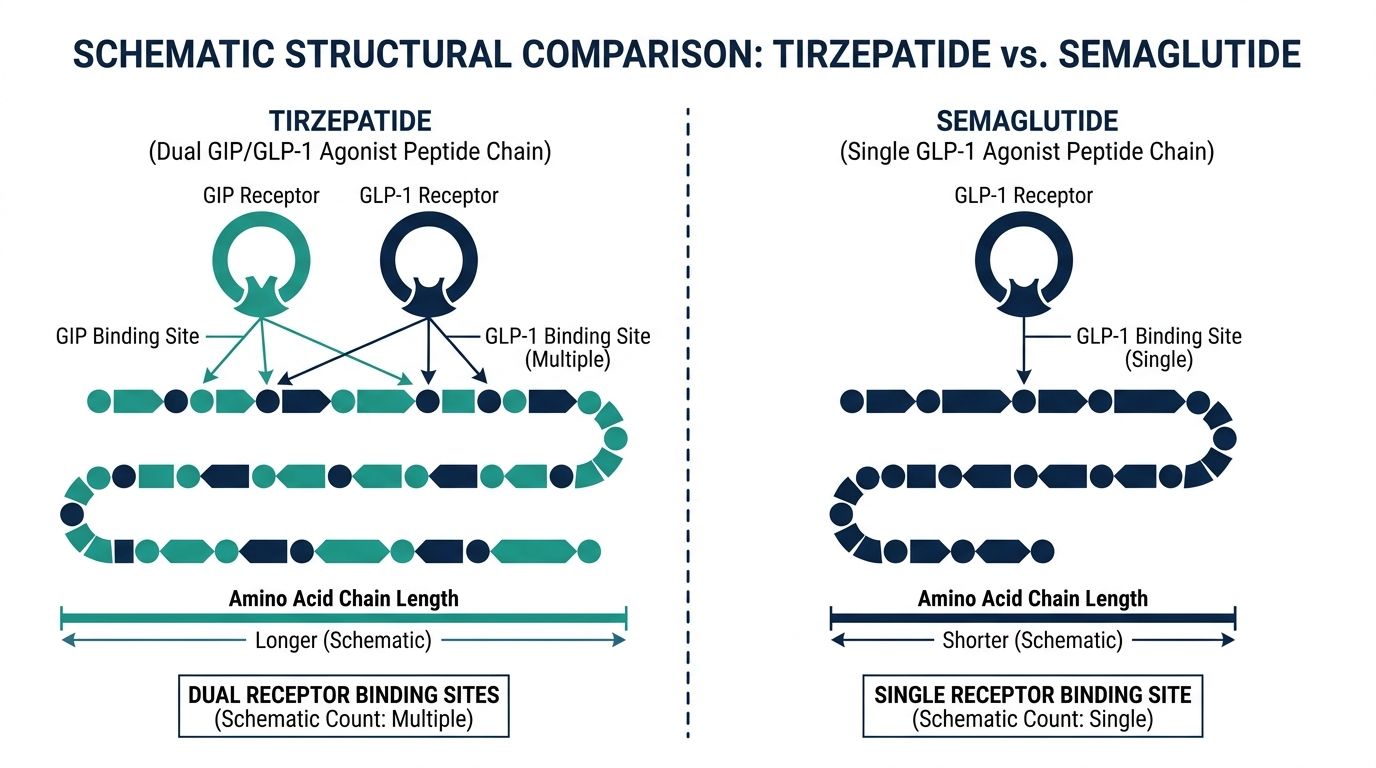
GLP-1 is secreted by L-cells in the distal small intestine and colon. It slows gastric emptying, suppresses glucagon, reduces appetite through brain receptors, and accounts for a significant share of the post-meal insulin response. Semaglutide (Ozempic, Wegovy) targets this pathway exclusively. GIP is secreted by K-cells in the proximal small intestine and is responsible for roughly 60 to 70 percent of the meal-stimulated insulin response in healthy people. It also acts on adipose tissue and the central nervous system in ways that appear to amplify the appetite-suppressing effects of GLP-1 stimulation.
When Mounjaro activates both pathways, the outcome is synergistic rather than additive. Tirzepatide shows equal affinity for the GIP receptor compared with native GIP, but binds the GLP-1 receptor with approximately five-fold weaker affinity than native GLP-1. That imbalanced, dual activation is what researchers believe accounts for the unprecedented weight loss numbers seen in trials.
Personally, the GIP story is the one the mainstream coverage keeps glossing over. Every article focuses on “GLP-1 drug” because Ozempic made the category famous, but tirzepatide is not a GLP-1 drug with a tweak. It is a fundamentally different molecule that happens to include GLP-1 activity as one of its two mechanisms.
Full-body lab membership: 100+ biomarkers, doctor-reviewed, tracked over time.
How does Mounjaro compare to Ozempic and Wegovy?
The short version: same category, different mechanism, meaningfully better weight loss results at head-to-head doses, with a higher rate of serious side effects.
| Feature | Mounjaro (tirzepatide) | Ozempic / Wegovy (semaglutide) |
|---|---|---|
| Mechanism | Dual GIP + GLP-1 receptor agonist | GLP-1 receptor agonist only |
| Amino acid length | 39 AA (synthetic) | 31 AA (synthetic) |
| Dosing | Once weekly injection | Once weekly injection |
| Peak weight loss (trial data) | 20.9% body weight (SURMOUNT-1, 72 weeks) | 14.9% body weight (STEP-1, 68 weeks) |
| SURMOUNT-5 head-to-head | 20.2% vs 13.7% mean body-weight loss | 13.7% at same timepoint |
| FDA approval for weight loss | Zepbound (Nov 2023) | Wegovy (Jun 2021) |
| FDA approval for T2 diabetes | Mounjaro (May 2022) | Ozempic (Dec 2017) |
| List price without insurance | ~$1,069 to $1,112 per month | ~$935 to $970 per month |
| Self-pay access program | LillyDirect: $299 to $449 per month (vials) | No comparable direct program |
| Serious side effects | 5.3 to 7% of participants | 2.8% of participants |
The SURMOUNT-5 trial, a direct head-to-head comparison published in 2025, showed 47 percent greater relative weight loss with tirzepatide versus semaglutide over 72 weeks, with nearly three times as many participants achieving 30 percent or more body weight reduction (19.7 percent vs 6.9 percent). That is not a marginal advantage. It is a different outcome class.
Do not believe anyone who tells you Mounjaro and Ozempic are interchangeable with different marketing. They share a category and a delivery method. The mechanisms, the trial outcomes, and the side-effect profiles are genuinely distinct.
What is the difference between Mounjaro and Zepbound?
This confuses almost everyone who encounters the two brand names for the first time, and the confusion is reasonable because Mounjaro and Zepbound are the same molecule. Both contain tirzepatide. Both are manufactured by Eli Lilly. Both come in identical KwikPen devices at identical doses (2.5 mg, 5 mg, 7.5 mg, 10 mg, 12.5 mg, and 15 mg).
The difference is entirely regulatory. Mounjaro received FDA approval in May 2022 for the treatment of type 2 diabetes. When Eli Lilly sought approval for chronic weight management, the FDA required a separate brand name to clearly distinguish the two indications and prevent prescribing confusion. Zepbound received that approval in November 2023.
The practical consequence is significant for insurance coverage. Insurance plans use the brand name to determine whether coverage applies based on your diagnosis. A patient with type 2 diabetes will typically find Mounjaro covered, often with a Lilly Savings Card that reduces the copay to $25 per month for commercially insured patients. A patient seeking weight loss without a diabetes diagnosis should be on Zepbound. Prescribing Mounjaro off-label for weight loss without diabetes usually triggers an insurance denial.
There is one more wrinkle worth knowing: Zepbound KwikPens are covered under the new Medicare GLP-1 Bridge program starting July 1, 2026, at a $50 monthly copay for qualifying beneficiaries. Mounjaro is not part of that program because it carries the diabetes label, not the weight-loss label.
Why did cheap compounded tirzepatide disappear?
For about 18 months after Mounjaro launched, a window existed to buy compounded tirzepatide from 503A and 503B pharmacies at dramatically lower prices, sometimes as little as $149 to $299 per month. That window is now closed.
The FDA declared the tirzepatide shortage resolved on October 2, 2024. Enforcement discretion for 503A state-licensed pharmacies ended on February 18, 2025. For 503B outsourcing facilities, it ended on March 19, 2025. Courts denied all injunctions challenging these deadlines, and the FDA received more than 320 adverse event reports linked to compounded tirzepatide, many involving dosing errors from patients self-administering from multi-dose vials without proper training.
On April 30, 2026, the FDA went further and proposed excluding tirzepatide, semaglutide, and liraglutide from the 503B bulks list entirely, with a public comment period open through June 29, 2026. The direction of travel is clear: the compounding window is closed for tirzepatide, and it is unlikely to reopen.
The only narrow exception that remains is a 503A pharmacy compounding for a specific patient with a documented allergy to an inactive ingredient in commercial Mounjaro or Zepbound, or a prescriber-documented clinical reason why the commercial product cannot meet the patient’s needs. Cost savings is explicitly not a qualifying reason.
What does Mounjaro actually do in your body?
Understanding the mechanism makes the side effects make more sense, which is useful when you are deciding whether to start.
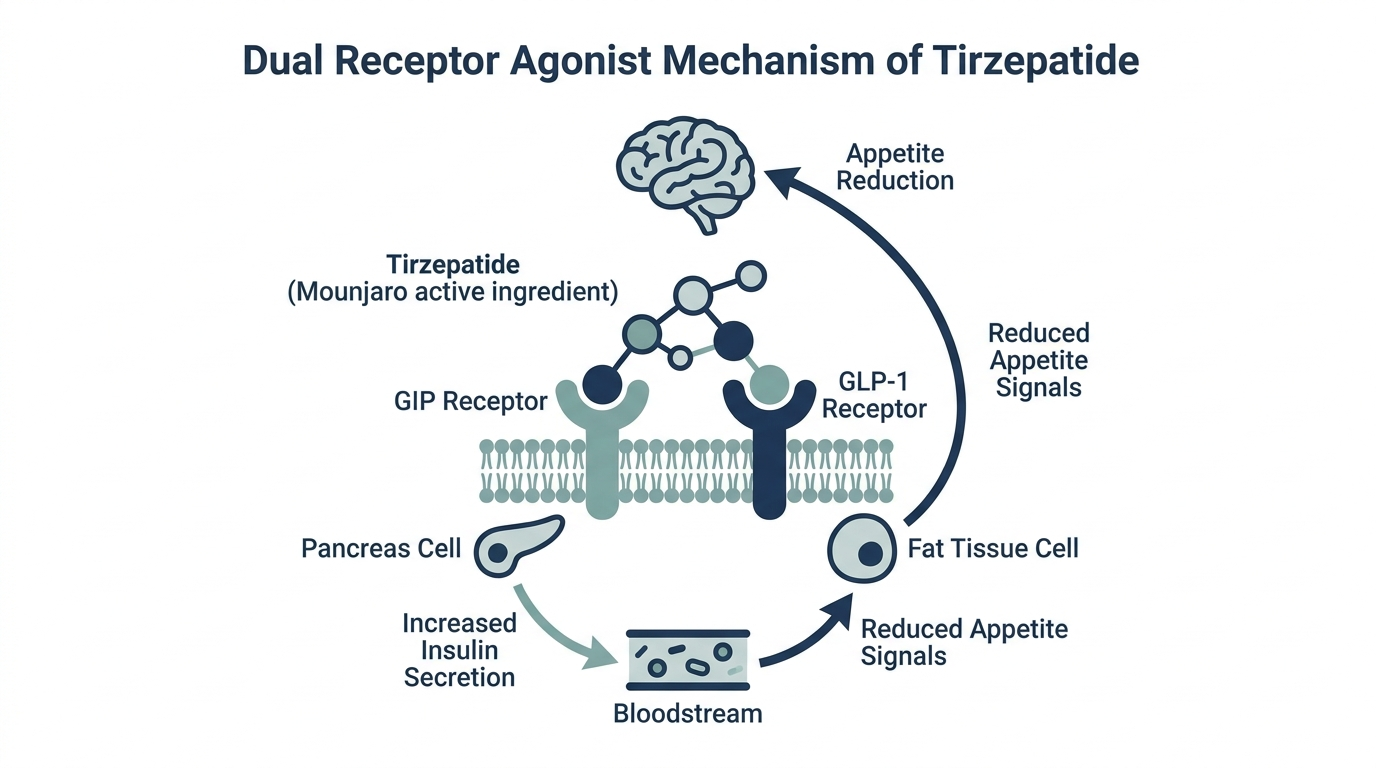
After a subcutaneous injection, tirzepatide binds simultaneously to the GIP and GLP-1 receptors in multiple tissues. In the pancreas, it triggers insulin secretion in a glucose-dependent manner, meaning it only stimulates insulin when blood sugar is elevated, which dramatically reduces hypoglycemia risk compared to older diabetes drugs. It also suppresses glucagon, the hormone that raises blood sugar between meals.
In the gut, the GLP-1 component slows gastric emptying. Food moves through your stomach more slowly, which extends the feeling of fullness after eating and blunts post-meal blood sugar spikes. This is the mechanism behind the nausea many people experience early on: your stomach is full longer than it used to be, and it takes time to adapt.
In the brain, both receptor pathways act on regions that regulate appetite and food reward. The appetite suppression from tirzepatide is not just “feeling full earlier.” Patients consistently report a reduction in food preoccupation, what clinicians sometimes call “food noise,” that goes beyond mechanical satiety.
The once-weekly dosing comes from the C20 fatty acid chain attached to the peptide backbone. That modification enables albumin binding, extending the half-life to approximately five days. One injection per week is pharmacologically equivalent to continuous daily exposure.
Telehealth GLP-1 program with provider visits and pharmacy coordination.
What happens if you stop taking Mounjaro?
This is the question that changes how you should think about starting, and it is the one the before-and-after photos never address. The appetite suppression exists only while the drug is circulating. When you stop, the GIP and GLP-1 signaling fades, appetite returns, and the food noise that went quiet comes back. Withdrawal trials in this drug class have consistently shown participants regaining a substantial share of the weight they lost over the year after discontinuation, unless a durable change in eating and activity was built during treatment.
That is why serious clinicians increasingly frame tirzepatide the way they frame a blood pressure medication: a long-term, potentially indefinite treatment for a chronic condition, not a short course you take until the scale hits a number and then quit. The honest planning question before you start is not just whether you can get it, but whether you can either stay on it or use the appetite window to rebuild habits that hold once the drug is gone. People who treat it as a temporary crash tool tend to end up back where they started, sometimes discouraged and heavier than before.
How do you actually access Mounjaro or Zepbound legally in 2026?
The compounding path is closed. The brand-name path has several distinct lanes depending on your insurance status and diagnosis.
Lane 1: Commercial insurance with type 2 diabetes. Mounjaro is the applicable brand, and most commercial plans cover it for this indication. The Lilly Savings Card can reduce your copay to $25 per month for eligible commercially insured patients. This is the lowest-cost path that exists.
Lane 2: Commercial insurance, weight loss without diabetes. Zepbound is the correct brand. Coverage is more variable and often requires prior authorization. Telehealth platforms like Hims, Hers, Ro, and Noom Med facilitate the prescription process and manage PA paperwork, with list prices around $1,069 to $1,112 per month without coverage.
Lane 3: Self-pay without insurance. LillyDirect’s Zepbound Self-Pay program is the most direct option. Pricing through the program runs $299 per month for the 2.5 mg starting dose, $399 for 5 mg, and $449 per month for all higher doses up to 15 mg, available with free home delivery or pickup at Walmart Pharmacy. You still need a valid prescription, but paired with a telehealth provider the all-in cost is more accessible than the retail list price suggests.
Lane 4: Medicare, starting July 1, 2026. The CMS Medicare GLP-1 Bridge program covers Zepbound KwikPens (not single-use pens or vials) at a $50 monthly copay for eligible Part D enrollees who meet clinical criteria: BMI of 27 or higher plus a qualifying condition such as cardiovascular disease or prediabetes. Mounjaro is not included in this program. The $50 copay does not count toward the Part D deductible or annual out-of-pocket cap, but it is still a significant cost reduction for qualifying Medicare patients.
What the clinics will tell you that the insurance explainers leave out: none of this is covered by insurance for “optimization” or “preventive metabolic health” framing. You need a diagnosable indication, type 2 diabetes, obesity (BMI 30+), or overweight (BMI 27+) with a qualifying comorbidity. Labs establishing your baseline metabolic status are not optional; they are the clinical record that justifies the prescription and protects both patient and prescriber if coverage is ever disputed.
Who is Mounjaro actually right for, and who should not take it?
The trial results are impressive, but tirzepatide is not a candidate for everyone who wants to lose a few pounds. The label and the trial inclusion criteria draw the lines fairly clearly.
It fits adults with type 2 diabetes needing better glucose control, and adults with obesity (BMI 30 or higher) or overweight (BMI 27 or higher) carrying a weight-related condition such as high blood pressure, sleep apnea, or cardiovascular disease. That is the population the SURMOUNT trials studied, and it is where the risk-benefit math is strongest.
There are firm reasons to stay away. Tirzepatide carries a boxed warning against use by anyone with a personal or family history of medullary thyroid carcinoma or Multiple Endocrine Neoplasia syndrome type 2, based on rodent thyroid tumor findings. A prior episode of pancreatitis is a serious caution flag worth a direct conversation with the prescriber. It is not indicated for type 1 diabetes. Women who are pregnant, planning pregnancy, or breastfeeding should not use it, and because it can slow the absorption of oral medications, anyone relying on oral birth control should ask about backup contraception during dose escalation. People with a history of gallbladder disease or severe gastrointestinal disorders like gastroparesis also need individual assessment rather than a rubber stamp.
Is Mounjaro safe? What the trial data actually shows
The SURMOUNT trials are the most rigorous source of safety data available. In SURMOUNT-1, participants taking tirzepatide 15 mg lost 20.9% of baseline body weight at 72 weeks versus 3.1% for placebo. The safety picture from those trials shows gastrointestinal side effects (nausea, diarrhea, vomiting, constipation) were the most common adverse events, affecting 15 to 20 percent of participants at the highest dose. They were mostly mild-to-moderate and most pronounced during dose escalation.
The serious adverse event rate across SURMOUNT trials was 5.3 to 7 percent for tirzepatide versus 2.8 percent for semaglutide in the SURMOUNT-5 head-to-head. That gap is worth discussing with a prescribing clinician rather than dismissing, particularly for patients with a history of pancreatitis, thyroid disease, or severe gastrointestinal conditions.
A less-discussed finding from the SURMOUNT-3 trial: patients who completed an intensive lifestyle intervention before starting tirzepatide lost an additional 18.4% body weight from randomization to week 72, compared to 2.5% for placebo. The drug works better on top of behavioral change, not instead of it. Clinicians who present tirzepatide as a replacement for lifestyle modification are giving you an incomplete picture.
There is a practical layer the trial summaries skip: how to actually get through the first weeks without quitting. The nausea and gut effects are worst during dose escalation, and most of them are manageable. Start at 2.5 mg and let each dose settle for a full four weeks before stepping up, even if the pace feels slow, because rushing the titration is the single most common reason people abandon the drug. Eat smaller portions and stop at the first sign of fullness, since the stomach is now emptying more slowly than your old habits assume. Lean on protein and fiber, go easy on greasy and very rich meals, keep fluids up to counter constipation, and avoid lying down right after eating. If nausea becomes severe or you cannot keep fluids down, that is a call to the prescriber, not a reason to push through silently.
Don’t just read about your health, track it.
A single result is a snapshot. Superpower re-tests 100+ markers over time so you can watch them move as you change sleep, food, and training.
Frequently asked questions
Is Mounjaro the same as Ozempic?
No. Mounjaro (tirzepatide) and Ozempic (semaglutide) are both injectable weight-management and diabetes drugs given once weekly, but they use different mechanisms. Ozempic activates only the GLP-1 receptor. Mounjaro activates both the GLP-1 and GIP receptors simultaneously, which produces meaningfully greater average weight loss in head-to-head trial data (20.2% vs 13.7% at 72 weeks in SURMOUNT-5).
Is Mounjaro a GLP-1 drug?
Partially. Mounjaro (tirzepatide) activates the GLP-1 receptor, but it is more accurately classified as a dual GIP/GLP-1 receptor agonist, sometimes called a “twincretin.” Calling it a GLP-1 drug, as many articles do, technically leaves out the GIP receptor activation, which accounts for much of its enhanced efficacy over pure GLP-1 agonists like semaglutide.
What is the difference between Mounjaro and Zepbound?
They are identical molecules at identical doses made by Eli Lilly, but they carry different FDA approvals. Mounjaro is approved for type 2 diabetes (since May 2022). Zepbound is approved for chronic weight management (since November 2023). The brand you are prescribed depends on your diagnosis and insurance situation.
Can you get Mounjaro without insurance in 2026?
Yes, through LillyDirect’s Zepbound self-pay program at $299 to $449 per month depending on dose, paired with a telehealth prescription. This is more accessible than the retail list price of around $1,069 to $1,112 per month. The savings apply to Zepbound (the weight-loss label), not Mounjaro.
Is compounded tirzepatide still available in 2026?
No, for practical purposes. The FDA ended enforcement discretion for compounded tirzepatide in February and March 2025 after declaring the shortage resolved in October 2024. As of April 2026, the FDA has also proposed removing tirzepatide from the 503B bulks list entirely. The only narrow exception is a 503A pharmacy compounding for a documented allergy to a commercial product’s inactive ingredients.
Does Medicare cover Mounjaro for weight loss in 2026?
Medicare Part D already covers Mounjaro for type 2 diabetes. For weight loss without diabetes, the applicable product is Zepbound (same drug, different label), and the new CMS Medicare GLP-1 Bridge program covers Zepbound KwikPens at a $50 monthly copay for eligible Part D enrollees starting July 1, 2026. Mounjaro is not included in the GLP-1 Bridge program.
What side effects should I expect from Mounjaro?
The most common side effects are gastrointestinal: nausea, diarrhea, vomiting, and constipation, typically appearing during dose escalation and decreasing over time. Serious adverse events occurred in 5.3 to 7% of tirzepatide participants across SURMOUNT trials. Prescribers typically start patients at 2.5 mg and increase monthly to manage tolerability. A licensed clinician should set your starting dose and escalation schedule.
Will I regain the weight if I stop Mounjaro?
Often, yes, unless habits changed during treatment. Withdrawal studies in this drug class show participants regaining a large portion of lost weight in the year after stopping, because the appetite suppression only works while the drug is active. Most clinicians now treat it as a long-term therapy for a chronic condition rather than a short course, and use the treatment window to build eating and activity patterns that can hold on their own.
Does Mounjaro cause muscle loss?
Some of the weight lost on any rapid weight-loss approach, including tirzepatide, is lean mass, not just fat. That is a known trade-off of losing weight quickly. Eating enough protein and doing resistance training during treatment is the practical way to protect muscle while the fat comes off, and it is worth planning from day one rather than after the scale drops.
How quickly does Mounjaro start working?
Appetite suppression usually shows up within the first week or two, even at the low 2.5 mg starting dose, but meaningful weight loss builds over months as the dose escalates. The trial results that make headlines came at 72 weeks, not 72 days. Judge it over months, and expect the early phase to be about tolerating the drug and letting appetite settle, not about the number on the scale.
Author: Vital Signs Today Editorial Team, [credential]”]. Educational content, not medical advice. Sources linked inline.
Primary sources:
– Tirzepatide: A New Era of Dual-Targeted Treatment, PMC (NCBl/NLM)
– FDA clarifies policies for compounders as GLP-1 supply stabilizes
– FDA proposes to exclude semaglutide, tirzepatide, liraglutide from 503B bulks list
– SURMOUNT-3 trial, Nature Medicine
– SURMOUNT-5 network meta-analysis, PMC
– Roles of incretin hormones GIP and GLP-1, PMC
– CMS Medicare GLP-1 Bridge program press release
– LillyDirect Zepbound self-pay pricing, FindHonestCare
– Mounjaro cost without insurance, Noom
– Compounded tirzepatide ban update, Recrea Health
– Tirzepatide dual GIP/GLP-1 co-agonist mechanism, PMC
Want a real clinician to run the numbers, not a guess?
Joi + Blokes is a telehealth clinic that prescribes GLP-1 medication (Zepbound, compounded semaglutide and tirzepatide), hormone therapy (TRT, HRT), thyroid care, and peptides after a real lab panel and clinician review, with no membership or consult fee (prescriptions from about $59/month, lab panels from $149). If the scale will not budge, this is where you find out whether insulin, thyroid, or hormones are the real reason. Here is Joi + Blokes reviewed in full.
Related reading
Vital Signs Today may earn a commission if you buy through links on this page. It does not affect our editorial assessments.