
Last updated 18 June 2026. Educational content, not medical advice. Retatrutide is an investigational drug with no approved indication in any country as of this writing. Nothing here substitutes for evaluation by a licensed clinician.
Short answer: As of June 2026 retatrutide is not FDA-approved, so the three realistic access routes are enrolling in one of Eli Lilly’s active TRIUMPH Phase 3 trials (free pharmaceutical-grade drug under medical supervision), telehealth clinics that prescribe compounded retatrutide (legally murky but widely offered, $200 to $650 a month), or grey-market research peptide vendors (no legal standing for human use, serious quality risk). For most people, a licensed telehealth GLP-1 clinic offering approved tirzepatide or semaglutide is the safer, cheaper, and fully lawful path while waiting for the NDA expected in late 2026.
Retatrutide isn’t approved yet, so most routes to it are limited or risky. See what your own metabolic markers look like right now instead. One at-home Superpower draw checks 100+ biomarkers, physician-reviewed.
Why is everyone suddenly searching for retatrutide?
On 21 May 2026, Eli Lilly announced that the 12 mg dose of retatrutide produced a mean weight loss of 28.3%, equal to 70.3 pounds, over 80 weeks in TRIUMPH-1, its pivotal Phase 3 obesity trial enrolling 2,339 adults (Eli Lilly press release). Nearly half of participants on that dose, 45.3%, lost at least 30% of their body weight. In a 104-week extension subgroup with BMI of at least 35, the 12 mg group averaged 85 pounds lost, reaching 30.3% of starting weight.
Those numbers are extraordinary. Bariatric surgery has historically been the only intervention that reliably moves weight loss past 25%. Retatrutide cleared that bar in a randomized controlled trial with a once-weekly injection. So the search spike makes sense. What does not follow logically from those results is that you can just “get” the drug today the same way you order Ozempic. You cannot, and confusing the data with availability is the mistake that costs people money or puts them at risk.
Retatrutide does not have a commercial name yet because it has no commercial approval. “LY3437943” is the Lilly identifier. Whatever a vendor labels its vial is a trade name they invented.
What makes retatrutide different from semaglutide and tirzepatide?
Understanding the mechanism matters for understanding the risk profile of grey-market versions, not just the clinical upside.
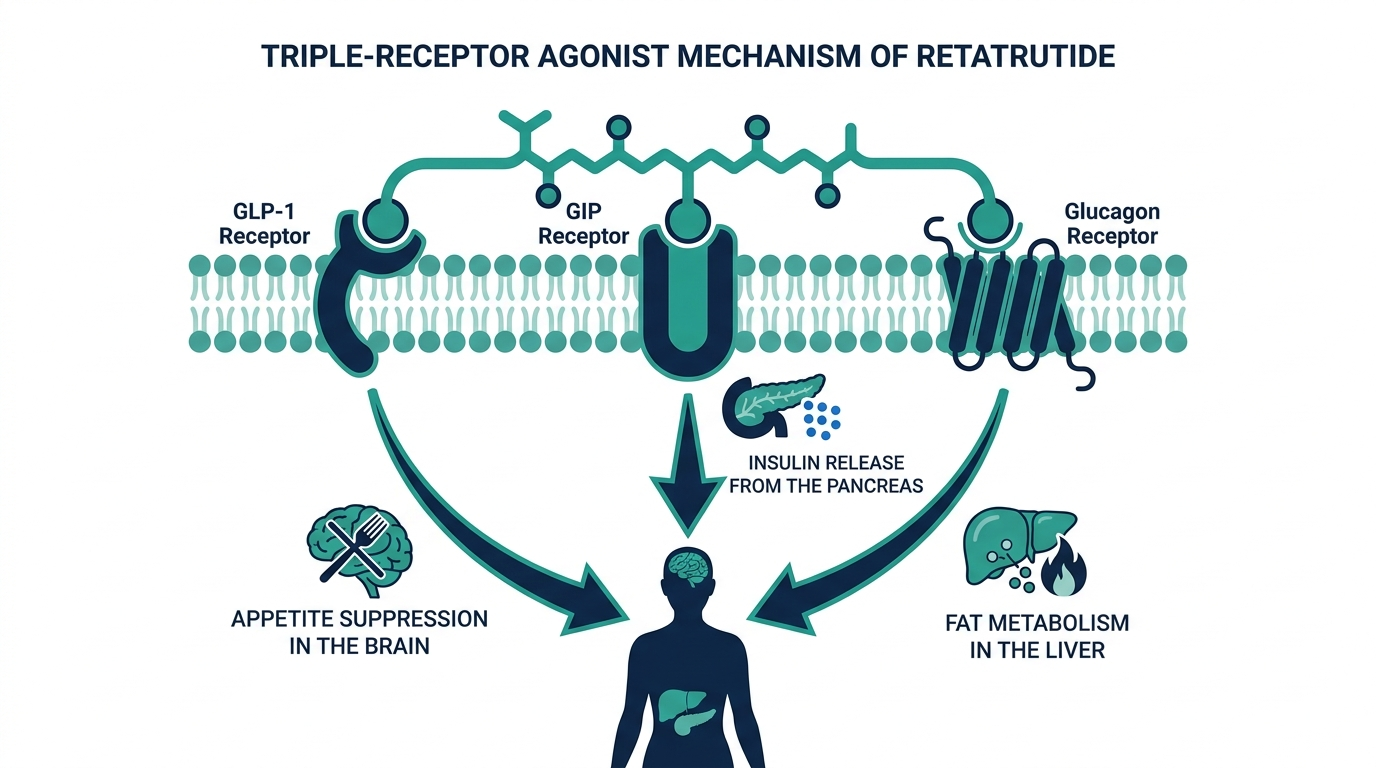
Semaglutide (Ozempic, Wegovy) targets a single receptor, GLP-1, which suppresses appetite centrally and slows gastric emptying. Tirzepatide (Mounjaro, Zepbound) adds GIP receptor agonism, which contributes additional appetite suppression and improves insulin sensitivity. That dual mechanism is why tirzepatide outperformed semaglutide in head-to-head data.
Retatrutide goes one step further by also activating the glucagon receptor, the third arm. Glucagon receptor agonism increases basal energy expenditure and promotes fat oxidation, which neither semaglutide nor tirzepatide does at therapeutic doses. That third mechanism is genuinely additive, not just incremental (Nature Medicine structural analysis). It is also why the glucagon component raises resting heart rate by roughly 5 to 10 BPM, an effect observed across all TRIUMPH dose groups that peaks at week 24 then declines, and why cardiovascular monitoring matters throughout treatment.
Personally, the glucagon arm is the most interesting piece of the mechanism, and the most underreported one. The appetite suppression story gets all the headlines, but the increase in resting energy expenditure is what explains why retatrutide’s results exceed what you would predict from tirzepatide’s trajectory.
Full-body lab membership: 100+ biomarkers, doctor-reviewed, tracked over time.
What is the actual FDA status of retatrutide in 2026?
No regulatory body, including the FDA, EMA, or TGA, has approved retatrutide as of June 2026. Eli Lilly has not yet submitted an NDA. The NDA submission is expected in Q4 2026 or Q1 2027, with FDA review adding roughly 10 months, pointing to a realistic approval date in late 2027 (Peptide Nerds timeline analysis). The projected commercial launch is Q1 to Q2 2028.
Five additional Phase 3 TRIUMPH readouts are expected throughout 2026, covering obesity with type 2 diabetes (TRIUMPH-2), obesity with established cardiovascular disease (TRIUMPH-3), knee osteoarthritis, obstructive sleep apnea, and metabolic dysfunction-associated steatohepatitis. The TRIUMPH-4 trial (obesity, 28.7% weight loss) reported in December 2025. Lilly is running this as a full registrational program, not just an approval-support trial, meaning the data package will be among the most comprehensive ever submitted for a weight-loss drug.
Do not believe any vendor or clinic that implies FDA approval is “imminent” or that their product is “FDA-reviewed retatrutide.” There is no such thing as of this writing. The compound is in trials. The NDA has not been filed. The only entity with pharmaceutical-grade retatrutide right now is Eli Lilly and the research sites enrolled in TRIUMPH.
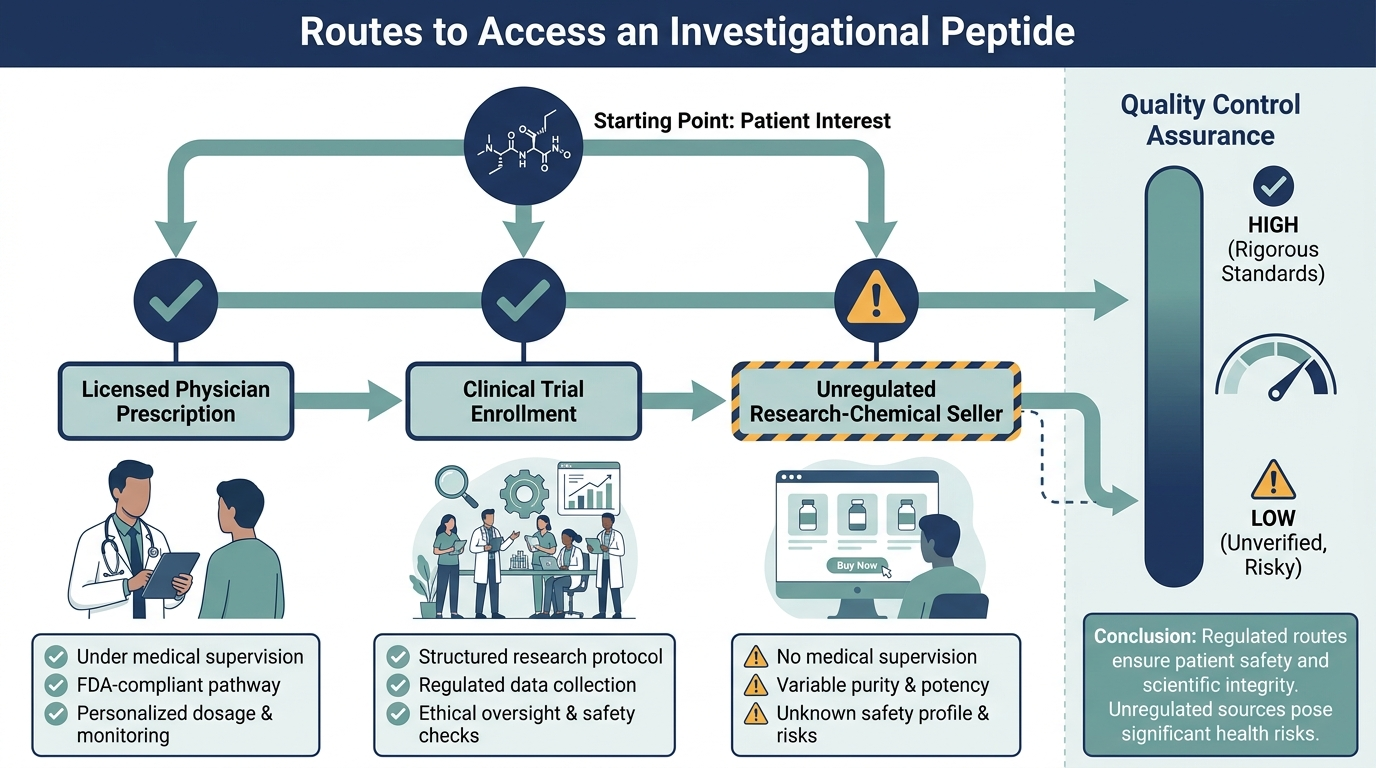
The three ways people actually access retatrutide in 2026
Route 1: Enroll in a TRIUMPH clinical trial (most legitimate, zero cost)
This is the route almost nobody considers, and it is objectively the best option for eligible patients. If you qualify, you receive pharmaceutical-grade retatrutide manufactured by Lilly, monitored lab work, clinical oversight, and no out-of-pocket drug cost. It is the only way to get the actual compound without any legal or quality ambiguity.
As of June 2026, multiple TRIUMPH Phase 3 trials remain open for enrollment. NCT05882045 is studying retatrutide in participants with obesity and cardiovascular disease. NCT07357415 is a Phase 3b study for participants without type 2 diabetes who have obesity or overweight, with enrollment opened in January 2026 (ClinicalTrials.gov).
General eligibility requirements across most TRIUMPH trials: BMI of at least 30, or BMI at least 27 with at least one weight-related comorbidity, no prior bariatric surgery, and meeting the specific comorbidity profile for whichever sub-study applies. Search “retatrutide” or specific NCT numbers on ClinicalTrials.gov to find sites near you and contact information for screening.
The TRIUMPH program has enrolled over 5,800 participants globally. The catch is that not every site is near every patient, and some trials have specific inclusion criteria. But if you are a candidate, this is the answer to “how to get retatrutide” that involves zero regulatory risk, zero quality risk, and zero out-of-pocket drug cost.
Route 2: Telehealth clinic prescribing compounded retatrutide (widely available, legally murky)
A growing number of telehealth platforms prescribe compounded retatrutide after an online consultation. The process typically runs: intake form, short video consult with a PA or NP, prescription written, vial shipped from a partner compounding pharmacy. Costs range from $200 to $650 per month depending on dose, with an initial consultation fee of $100 to $250 (GLP3 Planner cost guide).
Here is what those platforms will not prominently explain: the legal framing for compounded retatrutide is considerably shakier than what existed for compounded semaglutide or tirzepatide during the 2023 to 2024 shortage windows. Those compounds were FDA-approved drugs placed on shortage lists, which created a specific statutory pathway for compounding pharmacies to produce them. Retatrutide has never been approved, so it has never been placed on a shortage list. The 503A bulk drug substance pathway requires a compound to appear on an FDA-evaluated list, and retatrutide appears on neither 503A nor 503B frameworks (Newtropin regulatory analysis).
Clinics that do offer it are typically arguing a “patient-specific” compounding rationale under individualized medical need provisions, a legal grey area that has not been formally tested in enforcement action as of this writing. That is a meaningful distinction from outright illegal, but it is also not the same as “fully authorized.”
The practical upside of this route, compared to grey-market research vials, is that there is a named clinician, a named pharmacy, a dose written for your specific weight, and follow-up. The practical downside, beyond the legal question, is that the compounding pharmacy’s retatrutide is synthesized by a contract manufacturer, not Lilly, and quality varies significantly. The same verification framework that applies to research vials (see Route 3 below) applies here: demand the third-party Certificate of Analysis before accepting any shipment.
Route 3: Research peptide vendors (legal to purchase as research use only, not legal to use on yourself)
Grey-market vendors sell retatrutide labeled “research use only,” which is a legal fiction that allows sale while transferring every risk to the buyer. The “research use only” label is not fine print. It is the entire legal basis for the product’s existence as a purchasable item. The day you draw it into a syringe and inject it, you have stepped outside every protection that label pretended to offer.
This route costs $150 to $500 per month in vial costs alone, depending on vendor and dose, before bacteriostatic water, syringes, and alcohol swabs. The bigger issue is quality.
Retatrutide is technically demanding to synthesize correctly. It is a large, complex molecule, and compound substitution, selling a cheaper peptide mislabeled as retatrutide, is a documented risk, not a theoretical one. Independent testing by Finnrick Analytics flagged a counterfeit detection in retatrutide samples from Peptide Sciences in November 2025. Across 37 Peptide Sciences batches collected between December 2024 and March 2026, their retatrutide received an “E” (failing) rating, with purity dipping as low as 75% in some tests, and that vendor was for years the benchmark of the research-peptide community (Finnrick retatrutide page).
Mass spectrometry is the critical check for retatrutide specifically because HPLC measures purity but not molecular identity. A vial can be 99% pure and contain the wrong peptide. The only test that confirms the sample is actually LY3437943, the specific molecule Lilly developed, is mass spectrometry with identity confirmation. Any COA without a mass spec identity match is insufficient for a compound this recent and expensive.
How to evaluate a retatrutide source, whatever the route
Whether you are evaluating a compounding pharmacy through a telehealth clinic or a research vendor, these four checks apply. The questions are the same; the stakes in each context just differ.
| Check | What to look for | Red flag |
|---|---|---|
| COA test methods | HPLC purity AND mass spectrometry identity both present | HPLC only, or “in-house testing” language |
| Purity bar | HPLC purity of 96% or above; 99% considered excellent | Under 96%, or no numeric result listed |
| Batch specificity | COA batch number matches the vial label | Single generic PDF reused across all products |
| Third-party verifiability | Lab is Janoshik, MZ Biolabs, or Colmaric; report has a verification key you can check on the lab’s own site | Vendor’s own “QC lab” cited; no public key verification |
The additional check specific to retatrutide: search the vendor on Finnrick Analytics and look specifically at their retatrutide grade, not their overall vendor rating. A vendor with an A overall but an E on retatrutide is telling you exactly what you need to know. Given how many batches failed at what was considered the most reputable vendor in the space, do not assume a clean reputation on other compounds transfers to this one.
One thing the forums underweight: quantity accuracy matters for retatrutide more than for most peptides because the dose-response curve is steep. The difference between the 4 mg and 12 mg doses in TRIUMPH-1 was a 9.3 percentage point difference in weight loss, 19.0% versus 28.3%. Finnrick data shows vial quantity can diverge up to plus or minus 47% from the labeled amount in the research market. That range, applied to a steep dose-response curve, means you may be operating at a completely different dose than you believe.
What about the cost picture in 2026?
Pricing across the three routes as of mid-2026:
| Route | Monthly cost | What is included |
|---|---|---|
| TRIUMPH clinical trial | $0 drug cost | Pharmaceutical-grade LY3437943, labs, monitoring, clinician visits |
| Telehealth + compounded retatrutide | $200 to $650 | Consult, prescription, compounded vials, limited follow-up |
| Research peptide vendor | $150 to $500 | Vial only, no clinician, no labs, no monitoring |
| FDA-approved tirzepatide (telehealth, compounded, off-patent window) | $199 to $399 | Prescription, pharmacy-grade product, follow-up |
| Projected commercial retatrutide (2028 estimate) | $1,000 to $1,500 | Based on current Mounjaro/Zepbound pricing |
The clinical trial route dominates on every axis except geographic availability. If there is a TRIUMPH site within reasonable travel distance and you meet eligibility, the calculus is clear.
The comparison that matters most is the third row versus the fourth. A compounded tirzepatide from a reputable licensed telehealth clinic, running $199 to $399 per month, is a fully approved compound with a known safety profile, a legal supply chain, and a clinician behind it. Retatrutide from a grey-market vendor at a similar price point is an investigational molecule with a documented counterfeiting problem, no regulatory backstop, and no clinician. The extra 5 to 8 percentage points of potential weight loss that the TRIUMPH data shows over tirzepatide does not bridge that gap on the risk side.
Telehealth GLP-1 program with provider visits and pharmacy coordination.
The safety picture for retatrutide: what the TRIUMPH data actually shows
The TRIUMPH-1 trial data gives a clearer safety picture than most compounds at this stage. At the 12 mg dose, nausea occurred in 42.4% of participants, vomiting in 25.3%, and diarrhea in 32.0%. Those rates are high but follow the pattern seen with GLP-1 class drugs generally, are mostly mild to moderate in severity, and reflect a more aggressive dose escalation schedule than is used in clinical practice.
The cardiovascular signal worth knowing before you consider any source: retatrutide’s glucagon arm consistently elevated resting heart rate by approximately 5 to 10 BPM across all dose groups. This effect is real, dose-dependent, and peaks at week 24 before declining. For most trial participants with no pre-existing arrhythmia it was tolerable. For someone with undiagnosed tachycardia, starting on an unmonitored grey-market vial with no baseline ECG or heart rate tracking is a different situation.
Discontinuation due to adverse events ran 4.1%, 6.9%, and 11.3% for the 4 mg, 9 mg, and 12 mg doses respectively, versus 4.9% on placebo. Those numbers are manageable in a monitored clinical setting. They are harder to manage when the person guiding you on dose escalation is a forum thread.
The myth worth busting directly: retatrutide is not simply “stronger tirzepatide.” The glucagon arm is a mechanistically distinct addition that improves energy expenditure but also adds a cardiovascular signal that semaglutide and tirzepatide do not carry to the same degree. They are different compounds with overlapping but not identical risk profiles. Anyone extrapolating their tirzepatide experience to retatrutide without accounting for the glucagon component is skipping a relevant piece of the pharmacology.
Curious what your own levels look like?
Baseline 100+ biomarkers today and retest as life changes, all in one membership with physician review.
Frequently asked questions
Is retatrutide FDA-approved in 2026?
No. Retatrutide is still an investigational drug as of June 2026. Eli Lilly expects to submit the NDA in Q4 2026 or Q1 2027. FDA review adds roughly 10 months, pointing to a realistic approval date in late 2027 and commercial launch in Q1 to Q2 2028 (Peptide Nerds).
Can I get compounded retatrutide legally?
The legal situation is genuinely murky. Retatrutide has never been FDA-approved, so it has never appeared on a shortage list and cannot be lawfully compounded under the same pathway that applied to semaglutide and tirzepatide during their shortage windows. Telehealth clinics offering it are working from a patient-specific medical need argument that has not been tested in enforcement action. That is different from “illegal” but also not the same as “fully authorized.”
How much does retatrutide cost in 2026?
Through grey-market research vendors, $150 to $500 per month for vials alone. Through telehealth clinics offering compounded versions, $200 to $650 per month including consultation. Through a TRIUMPH clinical trial, $0 for the drug, with labs and monitoring provided. The projected commercial price upon FDA approval is $1,000 to $1,500 per month based on comparator drug pricing.
What is the best way to get retatrutide right now?
For eligible patients, enrolling in a TRIUMPH Phase 3 trial at ClinicalTrials.gov is the only route with pharmaceutical-grade product, zero legal ambiguity, and zero drug cost. For people who cannot access a trial site, a licensed telehealth program with a real prescription, a named compounding pharmacy, and a verifiable COA is the next tier. For most people, an FDA-approved tirzepatide or semaglutide program through a licensed clinic is the practical alternative while waiting for retatrutide approval in late 2027.
How does retatrutide compare to tirzepatide for weight loss?
TRIUMPH-1 showed 28.3% mean weight loss at 80 weeks on retatrutide 12 mg (Eli Lilly). Tirzepatide’s SURMOUNT-1 trial produced 22.5% mean weight loss. These were different trials with different populations and cannot be directly compared, but the direction is consistent with retatrutide’s triple mechanism outperforming tirzepatide’s dual mechanism. The tradeoff is an additional heart-rate elevation signal from the glucagon component that tirzepatide does not carry.
What should I check before buying retatrutide from any source?
Demand a Certificate of Analysis with both HPLC purity (96% minimum) and mass spectrometry identity confirmation from a named independent lab such as Janoshik, MZ Biolabs, or Colmaric. Check the vendor specifically for retatrutide on Finnrick Analytics. An A-grade vendor overall means nothing if their retatrutide tests are failing. Avoid any source without a verifiable batch-specific COA.
When will retatrutide be widely available?
Projected commercial availability is Q1 to Q2 2028, following an NDA submission expected in Q4 2026 or Q1 2027 and FDA review of roughly 10 months. Five additional Phase 3 TRIUMPH readouts are expected in 2026, and the full data package will be among the most comprehensive submitted for any weight-loss drug.
Telehealth GLP-1 program with provider visits and pharmacy coordination.
Author: Vital Signs Today Editorial Team, [credential]”]. Educational content, not medical advice. Sources linked inline.
Primary sources:
– Eli Lilly TRIUMPH-1 press release (May 21, 2026): https://investor.lilly.com/news-releases/news-release-details/lillys-triple-agonist-retatrutide-delivered-powerful-weight-loss
– AJMC TRIUMPH-1 results coverage: https://www.ajmc.com/view/retatrutide-achieves-up-to-30-3-average-weight-loss-in-phase-3-triumph-1-trial
– ClinicalTrials.gov NCT07357415 (active TRIUMPH enrollment): https://clinicaltrials.gov/study/NCT07357415
– ClinicalTrials.gov NCT05882045 (cardiovascular TRIUMPH): https://clinicaltrials.gov/study/NCT05882045
– Nature Medicine / PMC structural mechanism: https://www.ncbi.nlm.nih.gov/pmc/articles/PMC11255275/
– Finnrick Analytics retatrutide vendor testing: https://www.finnrick.com/products/retatrutide
– Peptide Nerds NDA timeline analysis: https://peptidenerds.com/blog/retatrutide-fda-approval-timeline
– Newtropin compounding legality analysis: https://newtropin.com/blog/retatrutide-compounding-2026-access-legality
– GLP3 Planner cost guide: https://glp3planner.com/resources/retatrutide-cost
– Venable LLP FDA GLP-1 crackdown: https://www.venable.com/insights/publications/2026/03/fdas-latest-glp-1-crackdown-what-compounders
Related reading
Vital Signs Today may earn a commission if you buy through links on this page. It does not affect our editorial assessments.