
Educational content, not medical advice. Sermorelin is a prescription-only compounded medication. This guide describes the mechanics of subcutaneous injection as it is clinically taught. Your actual dose, concentration, and protocol must come from a licensed prescriber.
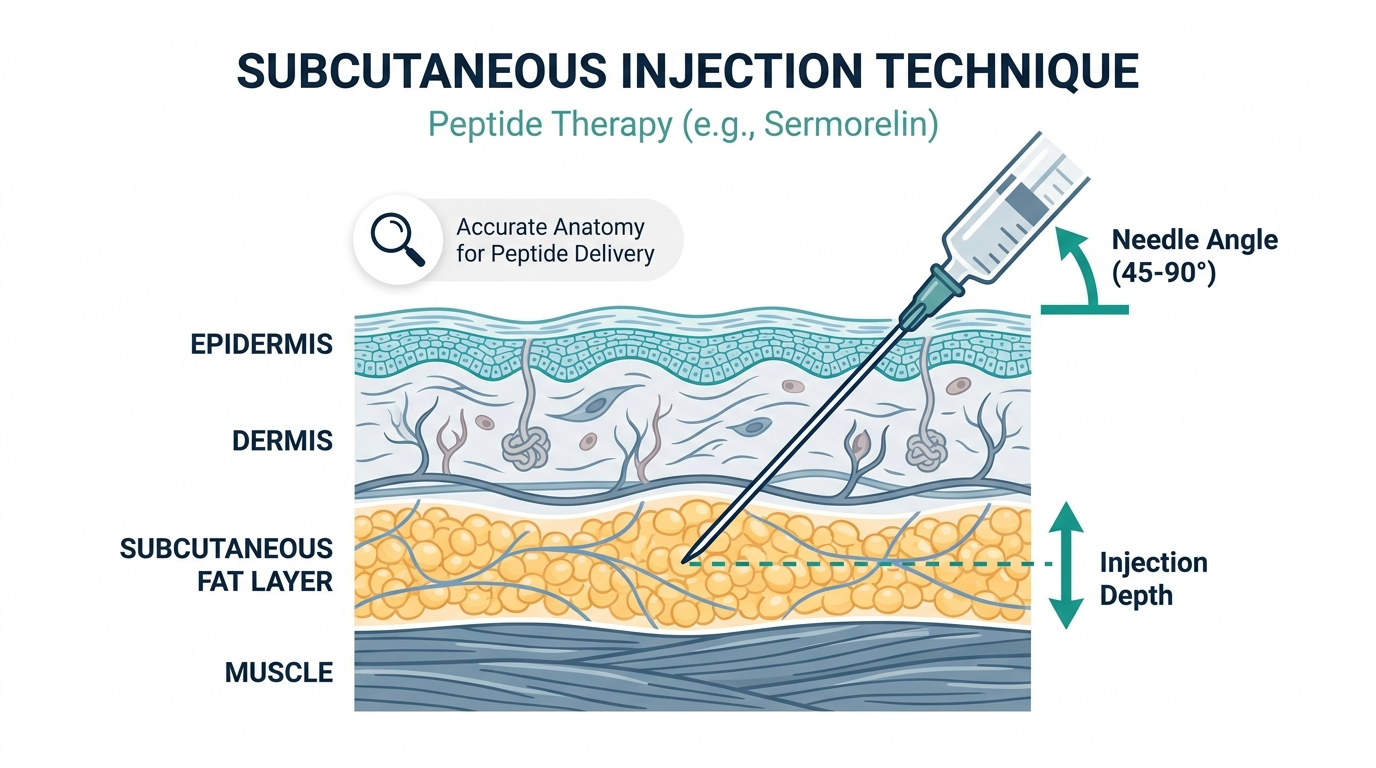
Short answer: Use a 29 to 31 gauge, 5/16-inch insulin syringe, pinch an inch of abdominal skin two inches from your navel, insert at 90 degrees (or 45 degrees if you are lean), depress the plunger over 3 to 5 seconds, hold 5 seconds, then withdraw. Inject once nightly at least 2 hours after your last meal. That is the core technique. The rest of this article covers the why, the math, the mistakes, and why the clinical route now costs less than the grey-market alternative once you account for everything involved.
Sermorelin injections are precise, needle angle and all. Before you start a hormone protocol, want to see your baseline hormone panel? One at-home Superpower draw checks 100+ biomarkers, physician-reviewed.
What exactly is sermorelin, and why does the injection method matter?
Sermorelin is a synthetic 29-amino-acid analog of growth hormone-releasing hormone (GHRH), the signal your hypothalamus sends when it wants the pituitary gland to release a pulse of growth hormone (GH). It is the only GH secretagogue that carries a prior FDA approval history: the branded form, Geref Diagnostic, was approved in 1997 as a diagnostic agent for GH deficiency testing, and was voluntarily discontinued in 2008 when the manufacturer exited the market (realpeptides.co). Every sermorelin prescribed in 2026 is compounded under 503A or 503B pharmacy law, legally dispensed via a physician’s prescription, and has no FDA-approved finished-drug equivalent.
That prior approval history matters procedurally. Because sermorelin once held FDA approval as a drug substance, compounding pharmacies have a stronger legal foundation to produce it than they do for many newer research peptides. It sits in a clearly different category from grey-market compounds like BPC-157 or TB-500, which are still working through the regulatory thawing described elsewhere on this site.
The injection method matters for one central reason: sermorelin is a peptide, meaning a string of amino acids, and it is destroyed by stomach acid before it could reach the bloodstream orally. Subcutaneous injection bypasses digestion entirely, delivering the molecule to the capillary bed under the skin, where it absorbs within 15 to 30 minutes and triggers a GH pulse from the pituitary. Get the injection technique wrong and you miss the window. Understand it and the whole nightly routine takes under three minutes.
Full-body lab membership: 100+ biomarkers, doctor-reviewed, tracked over time.
What supplies do you need before the first injection?
Getting the equipment right the first time eliminates the most common first-week problems. A legitimate telehealth clinic will ship all of this in a starter kit; if you are sourcing individually, here is the exact list.
Syringes: Use a 29 to 31 gauge, 5/16-inch (8 mm) insulin syringe for the abdomen. A 31 gauge needle has a diameter of roughly 0.26 mm, thinner than most human hairs, which is why most patients report the sensation as a mild pinch by day three (sermorelin.com). The finer gauge numbers (30G, 31G) are preferred over coarser ones (27G, 28G) for subcutaneous peptide work specifically because you are injecting into fat, not muscle. Each syringe is single-use. A used needle develops microscopic barbs during tissue contact, turning a near-painless insertion into a tear. The box of needles is cheap; do not reuse them.
Bacteriostatic water (BacW): Sermorelin ships as a lyophilized (freeze-dried) powder that must be reconstituted before use. Bacteriostatic water contains 0.9% benzyl alcohol, which prevents bacterial growth in a multi-draw vial. Do not substitute plain sterile water. Without the benzyl alcohol preservative, a reconstituted vial is at risk of bacterial colonization within 24 to 48 hours.
Alcohol swabs: One per injection for the vial stopper, one for the injection site. Wipe, let air-dry for 10 to 15 seconds before proceeding. Injecting through wet alcohol causes the sharpest sting in the whole process.
Sharps container: Required by law in most states and genuinely important. A used insulin syringe capped and tossed loose in trash creates a needlestick risk for anyone handling that waste.
Refrigerator storage: Reconstituted sermorelin is stored at 36 to 46 degrees Fahrenheit and maintains potency for 4 to 6 weeks when properly refrigerated, according to Defy Medical’s clinical instructions (Defy Medical). The unreconstituted powder in its sealed vial can be stored at room temperature until opened.
How do you reconstitute sermorelin correctly?
Reconstitution is where most first-time errors happen, and a single decimal mistake in the concentration math changes your dose by a factor of ten. Here is the process from beginning to end.
Step 1: Gather everything. Your sermorelin vial, bacteriostatic water vial, a fresh syringe, two alcohol swabs, and a clean flat surface. Remove the sermorelin vial from the refrigerator 5 to 10 minutes beforehand so the cold does not cause unnecessary stinging on injection.
Step 2: Swab both stoppers. Wipe the rubber stopper on the bacteriostatic water vial and the sermorelin vial with separate alcohol swabs. Let both air-dry.
Step 3: Draw the bacteriostatic water. Pull back the syringe plunger to draw air equal to the volume of bacteriostatic water you will transfer. Inject that air into the bacteriostatic water vial (pressure equalization), then draw the prescribed volume of water into the syringe.
Step 4: Inject water into the sermorelin vial slowly. Angle the needle so the water runs down the inner glass wall of the vial, not directly onto the powder. This prevents foaming and structural damage to the peptide. The water should be added slowly, over 5 to 10 seconds.
Step 5: Swirl, never shake. Gently rotate the vial between your palms until the powder fully dissolves. The solution should be clear and colorless. Cloudiness, particles, or color indicates a problem; do not inject a compromised vial.
Concentration math. This is the single most important skill, and your prescriber should specify it, but here is the logic so you can verify it yourself. If your vial contains 6 mg (6,000 mcg) of sermorelin and your provider instructs you to add 3 mL of bacteriostatic water, the resulting concentration is 2 mg per mL (2,000 mcg/mL). On a U-100 insulin syringe, 1 mL equals 100 units. So at 2,000 mcg/mL, each 10 units on the syringe equals 200 mcg of sermorelin. If your prescribed dose is 200 mcg, you draw to the “10 unit” line. If it is 300 mcg, you draw to “15 units.” Always verify this calculation against your prescription paperwork before every new vial (Defy Medical; sermorelin.com calculator).
Sermorelin.com calls incorrect reconstitution math “the single most common preparation mistake,” and after reviewing hundreds of patient accounts, that assessment tracks. The confusion is almost always between mg and mcg, and between mL and units on the syringe. Write out your numbers once, confirm with your provider, then use that same ratio every time.
Where do you inject sermorelin?
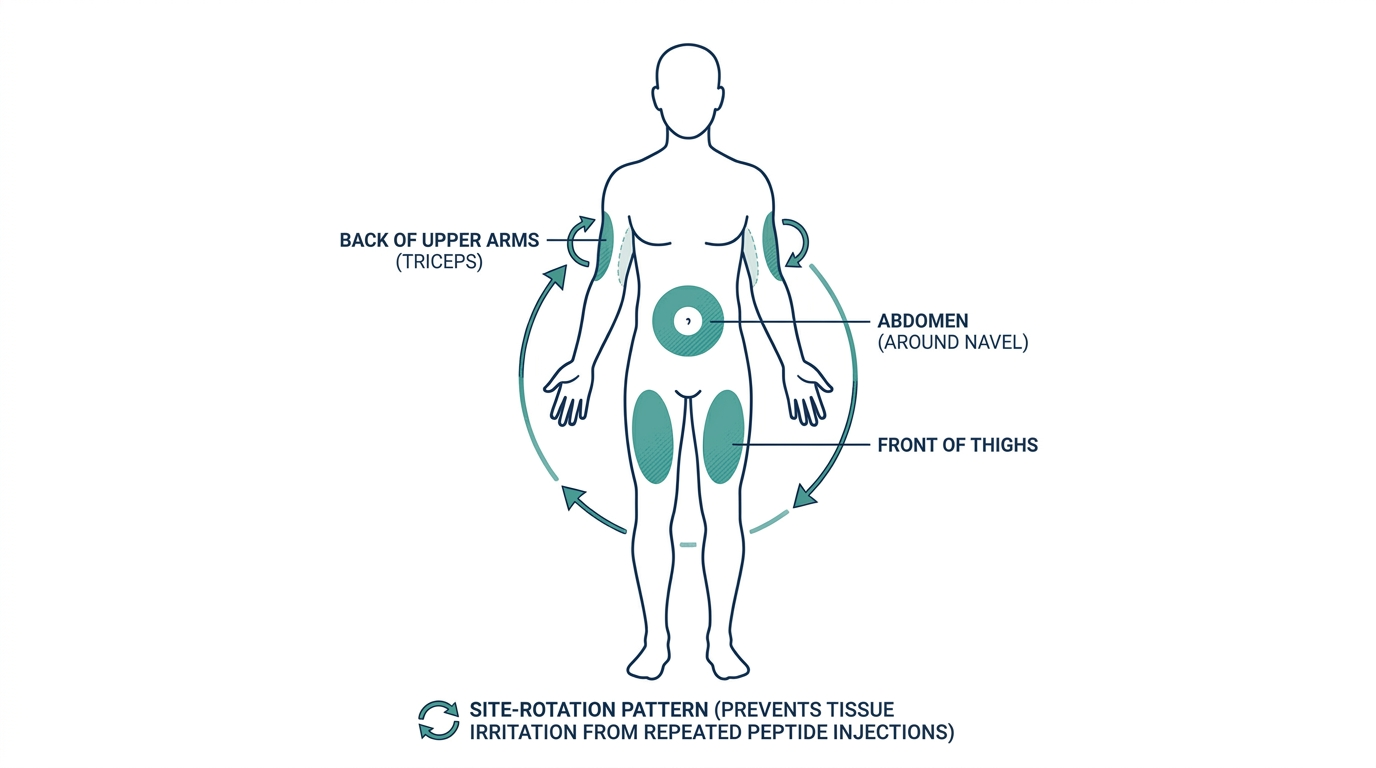
Subcutaneous injection sites for sermorelin are the same sites used for insulin, which means there is decades of clinical guidance behind the best practices. Rotate among these four zones to prevent lipohypertrophy (hardened fatty deposits from repeated injections at the same point).
| Injection Zone | Technique Notes | Best For |
|---|---|---|
| Lower abdomen (2 inches from navel) | 90 degrees for most; 45 degrees if lean; easiest visual access | Default site for most patients |
| Outer thigh (front and lateral surface) | 90 degrees; pinch firmly; slower absorption than abdomen | Second rotation zone |
| Flank (love handle area) | 90 degrees; naturally more subcutaneous fat; less visible | Good third-rotation option |
| Upper outer arm (posterior surface) | 45 degrees; may need assistance to reach correctly | Rotation variety only |
The abdomen is the clinical default because it offers the most consistent subcutaneous fat depth and fastest, most predictable absorption (sermorelin.com injection guide). The outer thigh works well as a second zone, especially for patients who want to avoid repeated manipulation of the same area.
One practical rotation system that works well: alternate sides of the abdomen nightly, moving in a small clock pattern at each side over two weeks before returning to the starting position. That gives each specific skin spot roughly two weeks of rest, which is enough time for any minor local inflammation to fully resolve.
Step-by-step injection technique
The full process, once you have your supplies ready and concentration confirmed:
1. Wash your hands thoroughly with soap and water for at least 20 seconds. This is not optional hygiene theater. Subcutaneous infections from contamination are real and painful.
2. Swab the vial stopper with an alcohol swab. Let it dry 10 seconds.
3. Draw air, then draw the dose. Pull the plunger back to draw air equal to your prescribed dose volume. Insert the needle into the vial stopper, push the air in, then invert the vial and draw your dose. Tap the barrel to raise any air bubbles to the top, then gently expel them back into the vial.
4. Choose and swab the injection site. Select your rotation site for that night. Wipe with an alcohol swab. Wait 10 to 15 seconds for the alcohol to dry completely.
5. Pinch and insert. With your non-dominant hand, gently pinch a fold of skin between thumb and forefinger, lifting the fat layer away from underlying muscle. Insert the needle at 90 degrees for most adults (45 degrees if you are lean with thin subcutaneous fat). Use a smooth, confident motion.
6. Depress the plunger slowly. Push the plunger down over 3 to 5 seconds. Rushing this step increases local stinging and disperses the medication less evenly.
7. Hold 5 seconds, then withdraw. After the plunger reaches the bottom, wait a full 5 seconds before withdrawing the needle in the same angle it entered. This allows the medication to disperse rather than tracking back up the needle channel. Do not recap the needle.
8. Dispose immediately in your sharps container. Do not recap, do not set the syringe down loose.
When should you inject sermorelin, and why does timing matter so much?
Sermorelin must be injected at night, specifically 30 to 60 minutes before sleep, and on an empty stomach (at least 2 hours after your last meal). This is not convention. It is physiology.
Growth hormone secretion follows a circadian pattern tightly coupled to deep, slow-wave sleep. The largest natural GH pulse of the day occurs 30 to 70 minutes after sleep onset, during the first slow-wave cycle. Sermorelin’s mechanism is to amplify that pulse by giving the pituitary an additional GHRH signal at exactly the right moment. Inject in the morning and you are firing that signal into the wrong part of the hormonal cycle. The pituitary is not primed for GH release midday the way it is at sleep onset.
The empty stomach requirement adds a second layer of physiology. Elevated insulin, which rises after meals, suppresses GH release. Eating carbohydrates two hours before injection can blunt GH response significantly, potentially halving the pulse amplitude you would otherwise achieve. Most clinicians teach patients to set a hard cutoff: no food after dinner if injection is at 10 pm. Protein shakes, sports drinks, and anything with caloric content count.
Sermorelin’s own half-life is only 10 to 12 minutes in circulation, the shortest of the major GH secretagogues (healingmaps.com comparison, 2026). That brevity is a feature, not a limitation. It produces a sharp, naturalistic GH pulse that mimics the body’s own hypothalamic signaling, then clears before the next meal. Compare that to CJC-1295 with DAC, which has a half-life measured in days and produces sustained, non-pulsatile GH elevation that some researchers believe suppresses the pituitary’s long-term sensitivity. Sermorelin’s short pharmacokinetics preserve the feedback loop. Personally, I find that argument for pulsatile signaling more compelling than the raw amplitude numbers that make the CJC-1295 stack look better on paper.
How does sermorelin compare to other GH secretagogues you might be prescribed?
If your clinic offers multiple protocols, here is what the actual clinical differences look like in practice.
| Peptide | Mechanism | Half-Life | GH Pulse Profile | Legal Status (2026) | Typical Monthly Cost |
|---|---|---|---|---|---|
| Sermorelin | GHRH receptor agonist | 10-12 min | Short, naturalistic pulse | Prescription/compounding (strongest legal footing) | $150-$225/month |
| CJC-1295 (no DAC) | GHRH receptor agonist | 30 min | Moderate pulse, fades quickly | Grey zone, pending PCAC review | $150-$250/month (telehealth) |
| CJC-1295 (with DAC) | GHRH receptor agonist | 6-8 days | Sustained GH elevation | Grey zone | $175-$300/month |
| Ipamorelin | Ghrelin receptor agonist | 2 hours | Clean selective pulse, no cortisol spike | Grey zone, pending PCAC review | $150-$250/month (telehealth) |
| Ipamorelin + CJC-1295 (stack) | Dual receptor | Combined | Synergistically amplified pulse | Grey zone | $200-$350/month |
Sermorelin’s advantage is straightforward: it has the cleanest regulatory standing of any injectable GH secretagogue you can get today. Many clinics that once led with CJC-1295/Ipamorelin stacks are now pivoting back to sermorelin precisely because it sits on firmer compounding ground, particularly given that CJC-1295 and Ipamorelin are still awaiting the Pharmacy Compounding Advisory Committee decision expected in late July 2026 (FDA bulk substances list).
Do not believe the common claim that sermorelin is simply a “weaker” or “older” choice. The pulsatile signaling argument has genuine clinical backing, and the legal stability has real-world value for anyone planning a protocol longer than three months.
What happens in the first month, and what should you monitor?
Week-by-week timelines that promise specific outcomes in specific weeks are mostly marketing. What is actually observable and clinically documented in the first 4 to 6 weeks of sermorelin therapy:
Weeks 1-2: The most commonly reported early effect is improved sleep quality, specifically more vivid dreams and an impression of deeper sleep. This is consistent with GH-regulated slow-wave sleep architecture and is often noted before any body composition changes. Transient injection-site redness or mild swelling affects roughly 1 in 6 patients in early weeks and typically resolves within 1 to 2 hours (sermorelin.com side effects).
Weeks 3-4: Some patients notice improved morning energy or reduced brain fog. These are secondary effects of better sleep, not direct GH action. Any body composition shift at week four would be minor and largely within noise.
Week 6: The standard clinical checkpoint is an IGF-1 blood draw at 4 to 6 weeks. IGF-1 is the downstream marker of GH secretion; the liver converts GH to IGF-1, and a rising IGF-1 level confirms the pituitary is responding to sermorelin. This lab tells your prescriber whether to maintain, adjust, or reconsider the dose. Most clinicians target IGF-1 in the upper third of the reference range for the patient’s age, not above it. Supraphysiologic IGF-1 is associated with joint stiffness and potentially unfavorable long-term signals, which is a real reason to take the monitoring seriously rather than treating it as a billing line item.
The side effect profile that distinguishes sermorelin from synthetic rHGH is the pituitary feedback ceiling. Because sermorelin stimulates the pituitary to secrete its own GH rather than supplying exogenous GH directly, the pituitary’s native feedback mechanisms remain intact. If GH rises too high, the pituitary down-regulates its own output. You cannot override the ceiling with sermorelin the way you can with direct rHGH injection, which is why the classic rHGH side effects (carpel tunnel, acromegalic bone changes, IGF-1 overshoot) are far rarer with sermorelin at clinical doses.
Telehealth GLP-1 program with provider visits and pharmacy coordination.
What are the most common injection mistakes, and how do you avoid them?
These five errors account for the majority of patient frustrations in the first month, based on a review of clinical patient-education materials from Defy Medical, sermorelin.com, and Eden Health:
1. Eating too close to injection time. The single most impactful variable you control. Carbohydrates raise insulin, and insulin blunts GH release. A 200 mcg dose on an empty stomach may produce twice the GH pulse of the same dose after a late dinner. Build the habit: dinner by 7, injection at 9 or 10.
2. Shaking the vial during reconstitution. Vigorous agitation causes foaming and can fragment peptide bonds, reducing the effective potency of the reconstituted solution. Swirl gently.
3. Reusing injection sites without rotation. Lipohypertrophy, the hard fatty lump that forms from repeated subcutaneous injections at the same spot, blunts absorption and is uncomfortable. A simple left-right nightly alternation prevents it.
4. Injecting through wet alcohol. The alcohol swab exists to kill surface bacteria, not to make the entry point antiseptic permanently. If you inject before the alcohol dries, you drive alcohol into the subcutaneous tissue, producing a sharp burn that can last 20 to 30 seconds and has nothing to do with the peptide itself. Wait 15 seconds after swabbing.
5. Self-adjusting dose without a lab draw. This is the mistake with the worst risk-to-reward ratio. If sleep quality or energy improves, doubling the dose will not double the benefit, because the pituitary’s response is governed by its own feedback ceiling. What it will do is push IGF-1 above the target range and increase side-effect risk. The 6-week lab draw exists precisely to guide dose adjustments based on actual IGF-1 data, not subjective impressions.
Curious what your own levels look like?
Baseline 100+ biomarkers today and retest as life changes, all in one membership with physician review.
Frequently asked questions
What needle do I use to inject sermorelin?
A 29 to 31 gauge, 5/16-inch (8 mm) insulin syringe is the clinical standard for subcutaneous sermorelin injection. The 31 gauge is preferred for thinner skin areas and produces minimal sensation. Never use a gauge coarser than 27G for subcutaneous peptide work. Your clinic will typically ship the correct syringes as part of the starter kit.
How deep does the needle need to go for a sermorelin injection?
For most adults injecting into the lower abdomen, 5/16 inch (8 mm) is sufficient to reach the subcutaneous fat layer. Lean individuals with minimal abdominal fat should inject at a 45-degree angle to ensure the needle lands in fat rather than muscle; most other adults can use 90 degrees. Pinching a fold of skin before inserting also helps ensure the correct tissue depth.
Can I inject sermorelin in the thigh instead of the abdomen?
Yes. The outer thigh is a commonly used second rotation zone. Use the same 29 to 31 gauge syringe, pinch the skin firmly, and inject at 90 degrees. Thigh absorption may be marginally slower than abdominal injection, but the clinical difference is small. Rotating between the abdomen and thigh helps prevent lipohypertrophy at any single site.
How long does a reconstituted sermorelin vial last?
Properly refrigerated at 36 to 46 degrees Fahrenheit, a reconstituted sermorelin vial remains potent for approximately 4 to 6 weeks (Defy Medical). Mark the reconstitution date on the vial with a marker. If the solution becomes cloudy, develops particles, or changes color at any point, discard it and open a new vial. Never freeze a reconstituted peptide solution.
Why does sermorelin have to be injected at bedtime?
The largest natural GH pulse of the day occurs during the first slow-wave sleep cycle, roughly 30 to 70 minutes after sleep onset. Sermorelin’s mechanism is to amplify that pulse by giving the pituitary a GHRH signal timed to that window. Injecting in the morning or evening without sleep proximity means the signal arrives when the pituitary is not primed for GH release, significantly reducing the therapeutic response. The empty stomach requirement works by the same logic: food-driven insulin elevation suppresses GH secretion directly.
How much does sermorelin therapy cost through a clinic?
Monthly pricing through legitimate telehealth providers in 2026 ranges from approximately $99 to $225 per month depending on dose, clinic, and what is included. Defy Medical runs $99 to $150/month with 40-plus biomarker panels; Marek Health runs $225 to $350/month with broader peptide options; Ivy Rx offers a 6-month plan at $175/month (ivyrx.com). None of this is covered by insurance for anti-aging or optimization purposes. For diagnosed growth hormone deficiency, coverage may apply but requires separate conversation with your insurer.
Is self-injecting sermorelin safe?
Subcutaneous injection is a skill well within most adults’ ability after one supervised demonstration or careful review of written instructions. The needle is small, the injection site is accessible, and the technique is the same one millions of insulin-dependent diabetics use daily without medical supervision. The procedural risk of a correctly executed subcutaneous injection is minimal. The larger risk is operating without clinical oversight on dose, IGF-1 monitoring, and protocol adjustments, which is the argument for the telehealth route rather than a concern about the injection technique itself.
Telehealth GLP-1 program with provider visits and pharmacy coordination.
Author: Vital Signs Today Editorial Team, [credential]”]. Educational content, not medical advice. Sources linked inline.
Primary sources:
– Defy Medical: Sermorelin Medication and Injection Instructions
– sermorelin.com: How to Self-Inject Sermorelin, Complete Step-by-Step Guide
– sermorelin.com: Dosage and Injection Guide
– IvyRx: Sermorelin Cost Guide 2026
– HealingMaps: Sermorelin vs CJC-1295 vs Ipamorelin Comparison 2026
– realpeptides.co: Is Sermorelin FDA Approved?
– FDA Bulk Drug Substances Under Section 503A
– PeptideDeck: Sermorelin Side Effects 2026
– sermorelin.com: Side Effects Overview
Related reading
Vital Signs Today may earn a commission if you buy through links on this page. It does not affect our editorial assessments.