
Last updated June 2026. Educational content, not medical advice. Peptide therapy ranges from FDA-approved medications to investigational compounds. Talk to a licensed clinician before starting any protocol.
Short answer: Yes, for the right peptide and the right person. GLP-1 peptides like tirzepatide produce an average 20.2% body-weight reduction at 72 weeks in clinical trials (SURMOUNT-5, NEJM). Sermorelin, a growth-hormone-releasing peptide, is FDA-approved and prescribed through licensed telehealth clinics starting around $175 a month. The nuance that matters: “peptide therapy” covers a spectrum from rigorously tested, FDA-approved drugs to compounds where the entire human evidence base is three small pilot studies. The answer to “does it work” is entirely different depending on which part of that spectrum you are asking about.
Wondering if peptide therapy is actually working for you? A full biomarker panel shows the evidence in your own blood. One at-home Superpower draw checks 100+ biomarkers, physician-reviewed.
Why does “peptide therapy” mean ten different things at once?
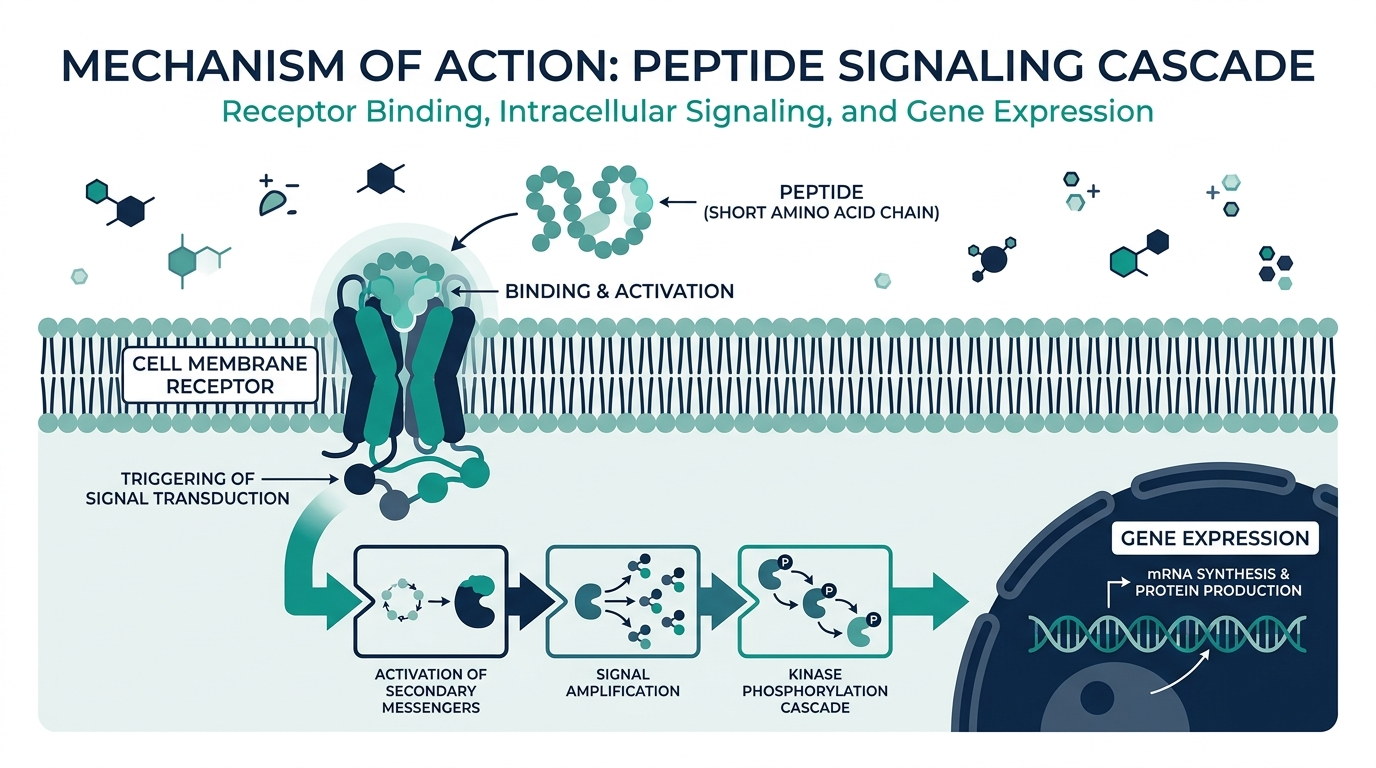
The word “peptide” describes any short chain of amino acids, two to fifty of them, linked in a specific sequence. Your body already runs on hundreds of peptides, insulin is one, so is GLP-1, so is the growth hormone your pituitary releases every night. “Peptide therapy” just means giving the body more of a specific one, or a synthetic analog that mimics the same receptor.
That definition is broad enough to cover both a blockbuster drug with a billion-dollar Phase III dataset and a vial of white powder a bodybuilder reconstitutes in his garage. The regulatory reality in 2026 is split across three lanes, and the lane determines the evidence.
The most important question before you evaluate any peptide claim is: which lane is it in?
What does the strongest evidence actually show?
The simplest way to actually get this done
Superpower is a full-body lab membership that runs 100+ biomarkers, has each result reviewed by a doctor, and tracks your numbers year over year (about $199/year). It is what we point readers to when they would rather get one clean, complete draw than chase single tests one at a time. Here is superpower reviewed in full.
GLP-1 Peptides: The most proven class in metabolic medicine
GLP-1 receptor agonists are peptide drugs, and their data is unambiguous. Tirzepatide, sold as Mounjaro for diabetes and Zepbound for obesity, produced a mean body-weight reduction of 22.8 kg (vs. 15.0 kg for semaglutide) in the 72-week SURMOUNT-5 head-to-head trial, with 31.6% of tirzepatide patients losing at least 25% of body weight (NEJM, 2025). Semaglutide’s SELECT cardiovascular outcomes trial established a 20% reduction in major adverse cardiovascular events in patients with obesity and prior cardiovascular disease.
These are not wellness claims. They are Phase III randomized controlled trials with thousands of patients, peer-reviewed in the New England Journal of Medicine. GLP-1 peptides work, and the numbers are large enough to be clinically meaningful, not just statistically significant.
The practical implication: if your goal is significant fat loss, and particularly if your BMI qualifies, GLP-1 therapy through a licensed telehealth clinic is the one category where “does peptide therapy work?” has a resoundingly clear answer backed by the kind of evidence cardiologists and endocrinologists accept without debate.
Sermorelin and growth hormone secretagogues
Sermorelin is a synthetic version of GHRH, the peptide your hypothalamus uses to signal the pituitary to release growth hormone. Unlike injecting synthetic HGH directly, sermorelin prompts your pituitary to release GH through its normal feedback loop, which means it self-limits. You cannot overshoot the way you can with exogenous HGH.
Telehealth clinics now prescribe sermorelin after an intake and labs, at roughly $175 to $225 a month, compared to $600 to $1,200 per month for synthetic recombinant HGH at similar doses (IvyRx). Clinically, patients typically report improved deep-wave sleep within two to four weeks, with lean body composition changes taking three to six months of consistent use. The evidence base for sermorelin is not as robust as for GLP-1s, but it is FDA-approved, it has a known pharmacology, and it is dispensed through compounding pharmacies with a prescription.
Ipamorelin and CJC-1295 are frequently combined with sermorelin, operating through a complementary receptor pathway to produce a larger, more sustained GH pulse. As of mid-2026, these are among the peptides HHS has signaled may return to Category 1 compounding status, pending the FDA’s Pharmacy Compounding Advisory Committee meeting set for July 23 to 24, 2026.
The honest truth about BPC-157 and the popular recovery peptides
BPC-157 is the most-purchased research peptide in the world, and the gap between what people believe about it and what the evidence actually shows is larger than almost any other compound in this space.
The animal data is genuinely impressive. Rodent studies show accelerated tendon healing, gut repair, and anti-inflammatory effects across dozens of experiments. The problem is translation. As of early 2026, a STAT News review documented only three published human studies on BPC-157, all pilot studies, all without placebo controls, with fewer than 30 people studied across the entire published literature combined. A 2026 narrative review in PMC (Regeneration or Risk?) concluded that no randomized controlled trials exist for BPC-157 in humans.
This is not the same as saying BPC-157 does not work. It is saying the evidence gap is real, large, and currently unfilled. In April 2026, the UK Medicines and Healthcare products Regulatory Agency opened an investigation into clinics making health claims about BPC-157, citing a lack of credible scientific evidence for its advertised uses.
The regulatory wind is shifting, though. BPC-157 was removed from the FDA’s Category 2 restricted compounding list on April 22, 2026. HHS signaled in February 2026 that BPC-157 and approximately 13 other peptides, including TB-500, CJC-1295, and thymosin alpha-1, are expected to move toward Category 1 (permitted for compounding), pending the July 2026 advisory committee meeting. That regulatory change does not create evidence. It does mean these compounds may soon be accessible through licensed pharmacies with clinical oversight, which is a different risk profile than ordering from a grey-market vendor.
Personally, I think the honest framing for BPC-157 is “plausible and promising, with an evidence gap that deserves real trials, not a marketing budget.” Anyone claiming guaranteed results is outrunning the data.
Full-body lab membership: 100+ biomarkers, doctor-reviewed, tracked over time.
How long does peptide therapy take to work? A realistic timeline
One of the most consistent frustrations people report is expecting results in two weeks and quitting at week three. The timeline depends almost entirely on the peptide class and your goal.
| Peptide / class | First noticeable shift | Meaningful change | Full effect |
|---|---|---|---|
| GLP-1 (semaglutide, tirzepatide) | Appetite reduction, week 1-2 | 5-10% body weight, months 2-4 | 15-22% body weight, months 6-12 |
| Sermorelin / ipamorelin | Improved sleep, weeks 2-4 | Energy, recovery, months 1-3 | Body composition, months 3-6 |
| BPC-157 (research, anecdotal) | Acute injury: days to weeks | Tissue repair: weeks to months | Gut healing: 4-12 weeks reported |
| Collagen peptides (oral) | Skin hydration, weeks 4-8 | Wrinkle reduction, months 2-4 | Full collagen remodeling, 6+ months |
| NAD+ (IV or oral) | Acute energy/clarity, hours to days | Cellular energy markers, weeks | Long-term: unknown, evidence limited |
Two things stand out in that table. GLP-1 results are front-loaded in appetite effect and gradual in body-weight change, meaning patience matters even in the best-evidenced category. And NAD+, despite its popularity, has a clinical evidence base that a 2026 PRISMA systematic review in ScienceDirect described as “promising yet still speculative,” with no human trial demonstrating lifespan extension or verified biological-age reversal.
What factors determine whether peptide therapy works for you?
The honest answer is that individual variation is enormous, and most wellness marketing ignores it entirely.
Three factors the forums underweight:
Starting hormonal and metabolic status. Sermorelin produces the most noticeable GH-related benefits in people who have measurable GH deficiency to begin with. Someone in their 50s with genuinely suppressed IGF-1 levels and poor sleep architecture will have a very different experience than a 28-year-old with normal GH who is chasing “optimization.” The clinical application and the optimization application are not the same protocol.
Peptide quality and source. This matters more than most people want to hear. Independent testing by Finnrick across thousands of batches has found consistent purity problems in grey-market research peptides, including a retatrutide lot from what was then the market’s most trusted vendor testing as low as 75% pure (Finnrick). You cannot evaluate whether a peptide works if you cannot verify what you are injecting.
Whether your baseline lifestyle supports the protocol. Peptides that stimulate GH release require the pituitary to function, which means chronic sleep deprivation, high cortisol, and poor nutrition all blunt the response. GLP-1 therapy works faster and sticks better with resistance training and adequate protein, not because the drug requires it, but because the drug lowers appetite while the training preserves muscle mass.
Myth-busting: what peptide therapy cannot do
Do not believe the claim that any peptide replaces base-level health fundamentals. No current peptide reverses cellular aging in a measured, validated way in humans. No peptide produces GLP-1-level fat loss results from a non-GLP-1 compound. Collagen peptides taken orally do not directly deposit collagen in your joints; they provide amino acid building blocks, and whether that improves joint pain is a weaker, less consistent signal than the marketing suggests.
The biggest misconception in the category, echoed by the AMA’s guidance on injectable peptides in 2026, is that “it’s natural because it’s what my body already makes.” Your body makes insulin too. Giving yourself synthetic insulin when you are not diabetic does not improve health; it causes hypoglycemia. The biological origin of a compound does not tell you whether adding more of it is beneficial for a person who does not have a documented deficiency.
That framing sounds harsh, but it is exactly what separates a legitimate clinical use case from a wellness narrative that happens to sound scientific.
The evidence gap by category: a plain scorecard
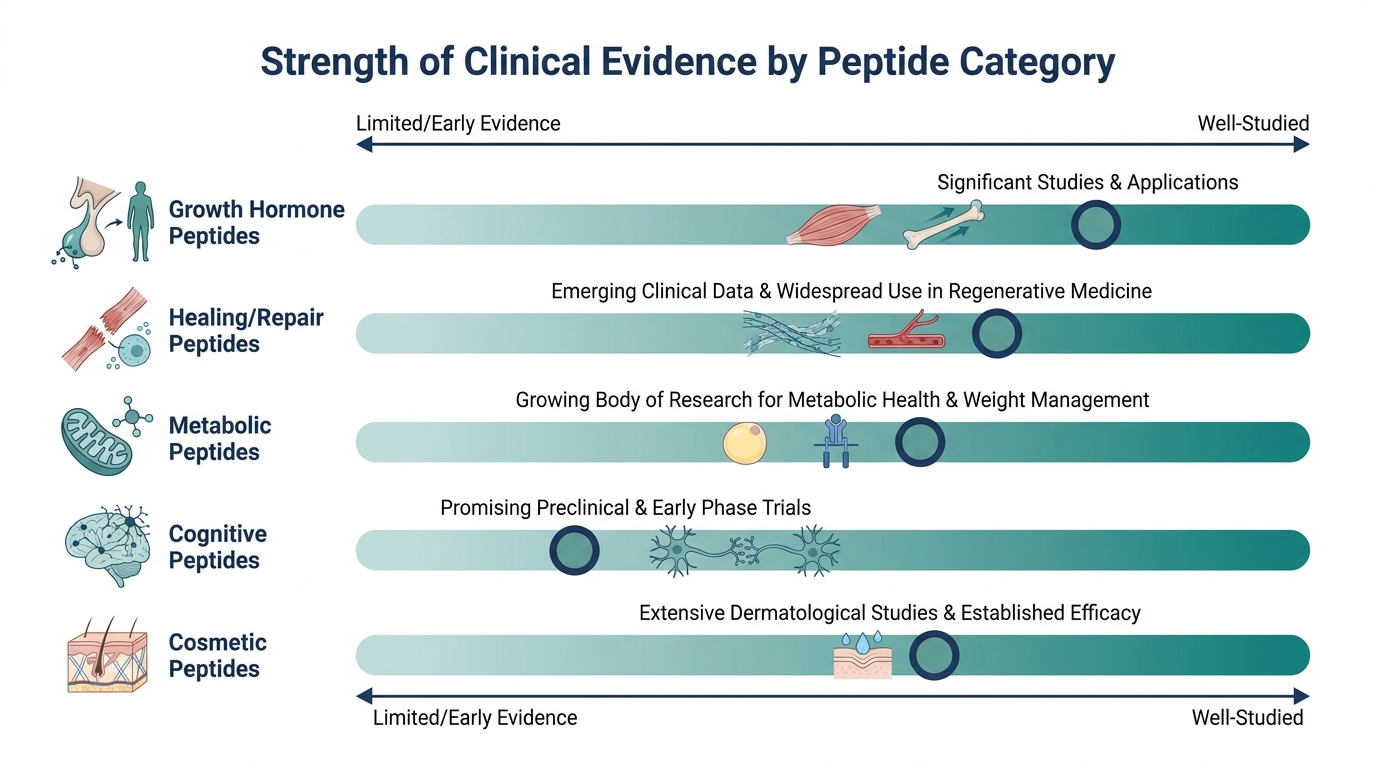
Peptide therapy is not a monolith. Here is where the evidence actually stands:
Strong evidence (Phase III RCTs, FDA-approved):
Semaglutide, tirzepatide, sermorelin, tesamorelin, insulin analogs, bremelanotide. These have gone through full clinical development, have known dosing, known side-effect profiles, and are dispensed through licensed channels.
Moderate evidence (Phase I/II, approved in other countries, or strong mechanistic data):
Sermorelin and ipamorelin combinations have prescription use and accumulated clinical experience, even if large-scale RCTs are limited. Thymosin alpha-1 has regulatory approval in several Asian and Eastern European countries for immunological indications.
Weak evidence (animal studies, case reports, no human RCTs):
BPC-157, TB-500, retatrutide (as a grey-market compound), melanotan II. Promising in animals; human trials essentially absent.
Marketing ahead of any real evidence:
Most “anti-aging peptide stacks” sold online. Longevity framing for NAD+ injections. Claims of cancer-fighting or immune-resetting properties. These are extrapolating from mechanistic biology to clinical outcomes without the middle step, human trials.
Telehealth GLP-1 program with provider visits and pharmacy coordination.
What are the real risks and side effects?
For FDA-approved peptides through licensed clinics, the risk profile is well-characterized. GLP-1 medications carry a 31 to 44% rate of transient gastrointestinal side effects (nausea, vomiting, diarrhea), which are dose-dependent and typically resolve with gradual titration. Sermorelin’s side effects are mild, primarily injection site reactions and transient water retention, because the pituitary’s natural feedback prevents excessive GH elevation.
For research-grade peptides sourced outside clinical oversight, three risks compound each other:
First, identity and purity risk. The same compound at the wrong purity can be ineffective (too low) or overdosed relative to stated concentration (too high). Without third-party mass spectrometry, you are trusting a label.
Second, immunogenicity. Synthetic peptides can trigger immune responses, particularly if the formulation is impure. This is rare but unpredictable in the absence of pharmaceutical-grade manufacturing controls.
Third, no clinical accountability. If you experience an adverse reaction to a research-chemical peptide, you have no prescriber to call, no compounding pharmacist on record, and no pharmacovigilance data to draw on. Your GP cannot prescribe an antidote for something that was never in the prescription system.
The practical risk hierarchy: FDA-approved peptides through licensed telehealth carry known, manageable risk. Research peptides through verifiable third-party-tested vendors occupy a grey zone of unknown but possibly manageable risk if COA verification is rigorous. Grey-market vials from unverified sources with no COA carry risk that is neither known nor manageable.
Who is peptide therapy most likely to actually work for?
Based on current evidence, peptide therapy has the clearest benefit for:
People with documented metabolic risk (overweight, prediabetic, high cardiovascular risk): GLP-1 therapy is here, the data is overwhelming, and the legitimate clinical route is straightforward.
Adults with measurable GH-axis decline (typically 40+, with low IGF-1, poor sleep quality, and body-composition changes consistent with somatopause): Sermorelin has a plausible mechanism, a reasonable evidence base, and a clinical-grade delivery route through telehealth.
People recovering from specific injuries, as an adjunct to physiotherapy: BPC-157’s animal evidence in tendon and soft-tissue healing is strong enough that some sports medicine physicians are willing to discuss it in the context of an honest risk-benefit conversation. The evidence gap is real; so is the fact that standard-of-care often offers limited options for chronic soft-tissue injuries.
Peptide therapy is probably the wrong tool for: healthy people in their 20s and 30s seeking marginal performance gains who do not have a documented deficiency the peptide addresses, anyone who cannot or will not get baseline labs before starting, and anyone relying on grey-market vials without rigorous COA verification.
Turn what you just learned into action.
Superpower lets you test 100+ biomarkers from home, then re-check them over time so you can actually see progress, physician-reviewed at every step.
Frequently asked questions
Does peptide therapy really work, or is it hype?
Both, depending on the peptide. GLP-1 medications are among the most effective weight-loss drugs ever studied in Phase III trials. Sermorelin has a legitimate clinical track record for GH-axis support. BPC-157 has impressive animal data and almost no human RCT evidence. The answer to “does it work” is meaningless without specifying which compound, for which condition, in which person.
How long until I feel results from peptide therapy?
GLP-1 peptides reduce appetite within one to two weeks; meaningful weight loss takes two to four months. Sermorelin typically improves sleep quality within two to four weeks, with body-composition changes taking three to six months. Most peptide effects require consistent use measured in months, not days.
Is peptide therapy safe?
FDA-approved peptides prescribed through licensed clinicians have well-characterized safety profiles. Research-use-only peptides sourced from grey-market vendors carry unknown risks, because they lack pharmaceutical manufacturing standards, clinical oversight, and pharmacovigilance data. The word “natural” does not mean safe at any dose or source.
Can I get peptide therapy without a doctor?
Not legitimately. Research-use-only peptides are sold online with no prescription, but they are legally labeled “not for human use,” and no licensed clinician has prescribed or overseen them. Cosmetic and supplement peptides like collagen and topical GHK-Cu are available over the counter. Injectable therapeutic peptides require a prescription.
What peptides have the most human clinical evidence?
In descending order of evidence quality: semaglutide and tirzepatide (large Phase III RCTs), sermorelin (FDA-approved, decades of clinical use), tesamorelin (Phase III in HIV-associated lipodystrophy), CJC-1295 and ipamorelin (limited but growing clinical use through telehealth), BPC-157 and TB-500 (mostly preclinical, three small human pilots).
Does BPC-157 work for injury healing?
The animal evidence is compelling enough that sports medicine physicians take it seriously. The human evidence is three small uncontrolled pilot studies, all without placebo groups. Calling it proven in humans would be wrong. Calling it plausible enough to discuss with a physician for a hard-to-treat soft-tissue injury is a reasonable framing.
How much does peptide therapy cost?
GLP-1 medications through telehealth run $200 to $500 a month, no longer covered by most insurance for obesity. Sermorelin through a telehealth clinic like Defy Medical or Marek Health runs $175 to $350 a month with labs. Broader peptide therapy protocols range from $200 to $600 a month depending on the compounds and monitoring included. None of this is covered by standard health insurance, as it is classified as elective or experimental.
Author: Vital Signs Today Editorial Team, [credential]”]. Educational content, not medical advice. Sources linked inline.
Telehealth GLP-1 program with provider visits and pharmacy coordination.
Primary sources
- SURMOUNT-5 tirzepatide vs. semaglutide head-to-head trial, NEJM
- BPC-157: The peptide with big claims and scant evidence, STAT News, February 2026
- Regeneration or Risk? Narrative Review of BPC-157, PMC 2026
- NAD+ supplementation PRISMA systematic review, ScienceDirect 2026
- FDA bulk drug substances under 503A compounding list
- What doctors want patients to know about injectable peptides, AMA
- Finnrick independent peptide testing database
- Sermorelin cost and telehealth access, IvyRx
- Defy Medical peptide therapy pricing, Telehealth Ally
- Influencers are promoting peptides for better health. What does the science say? NPR, February 2026
- Peptide therapy clinical evidence and reality, KevinMD, April 2026
Want a real clinician to run the numbers, not a guess?
Joi + Blokes is a telehealth clinic that prescribes GLP-1 medication (Zepbound, compounded semaglutide and tirzepatide), hormone therapy (TRT, HRT), thyroid care, and peptides after a real lab panel and clinician review, with no membership or consult fee (prescriptions from about $59/month, lab panels from $149). If the scale will not budge, this is where you find out whether insulin, thyroid, or hormones are the real reason. Here is Joi + Blokes reviewed in full.
Related reading
Vital Signs Today may earn a commission if you buy through links on this page. It does not affect our editorial assessments.