
Last updated June 2026. Educational content, not medical advice. Peptide compounds vary widely in approval status. Consult a licensed clinician before using any injectable or prescription peptide.
Short answer: Yes, peptides affect women, and often differently than men. Collagen peptides at 2.5 to 10 g per day improve skin elasticity and reduce wrinkle depth in women, with documented results in postmenopausal women in particular. GLP-1 receptor agonists like semaglutide and tirzepatide help normalize menstrual cycles in up to 80% of women with PCOS. PT-141 (bremelanotide) is the only injectable peptide with full FDA approval specifically for women, cleared in June 2019 for hypoactive sexual desire disorder. The catch: most other peptides are either “research use only” with no completed human RCTs, or require a prescription through a licensed telehealth clinic.
Curious exactly how peptides are showing up in your hormones, skin, and weight? Your own numbers tell the real story. One at-home Superpower draw checks 100+ biomarkers, physician-reviewed.
Why do women ask about peptides differently than men?
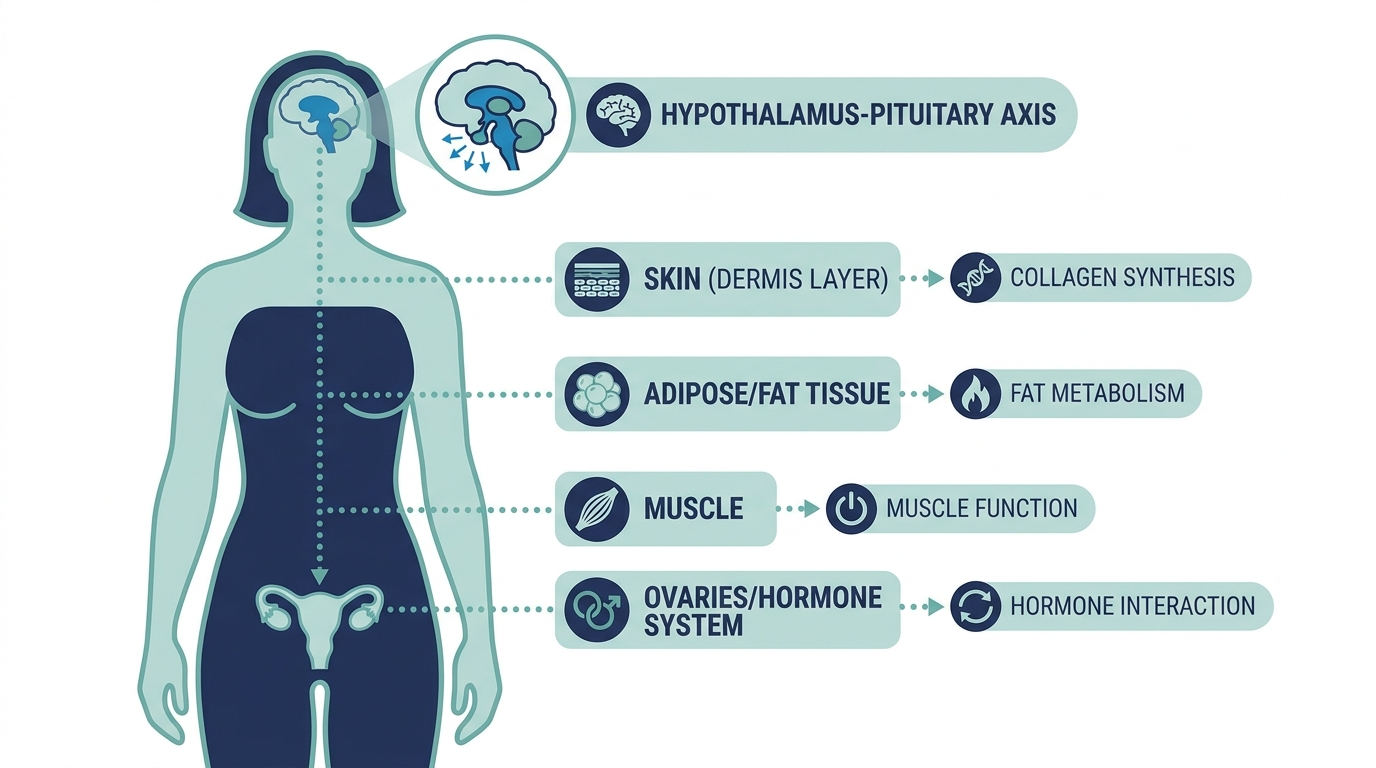
Because estrogen changes everything. Estrogen regulates collagen synthesis, insulin sensitivity, fat distribution, bone density, and appetite signaling. When estrogen levels shift, during the menstrual cycle, in perimenopause, or after surgical menopause, the signaling environment that peptides interact with shifts too.
A 2025 RAND analysis found that women aged 50 to 64 have the highest GLP-1 use of any demographic, with 20% reporting current or past use. The fastest-growing group searching for peptide therapy is not 25-year-old bodybuilders. It is women in their 40s and 50s trying to hold on to lean mass, sleep quality, and skin integrity as hormonal architecture changes underneath them.
What nobody in this conversation says plainly: peptides are not a hormonal replacement strategy. They interact with a hormonal system. If that system is depleted or dysregulated, the peptide works in a different environment than the one the research studied. That context gap is where a lot of disappointment and some real risk lives.
Full-body lab membership: 100+ biomarkers, doctor-reviewed, tracked over time.
What does the research actually say about collagen peptides and women?
This is the category with the most human evidence, and the evidence is genuinely solid. Collagen makes up about 30% of total protein in the human body, and women lose roughly 1 to 2% of skin collagen per year after menopause, with a steeper 30% loss in the first five years after estrogen withdrawal.
Several randomized controlled trials confirm measurable results from oral collagen peptide supplementation:
- A 12-week trial of GHK-Cu copper peptide facial cream on 71 women with mild to advanced photoaging found increased skin density and thickness, reduced laxity, and improved clarity compared to placebo. A separate eye cream trial in 41 women outperformed vitamin K cream on lines and wrinkle depth reduction.
- A 2026 clinical trial (NCT07302789, currently active) is testing two oral bioactive collagen peptides on skin properties and aging hallmarks in a double-blind, randomized, placebo-controlled design, specifically in postmenopausal women.
- A 2025 study in the Journal of Microbiology and Biotechnology found bioactive collagen peptides improved skin health in middle-aged women through immune-modulatory effects.
The effective dose in most completed trials sits at 2.5 to 10 g per day of hydrolyzed collagen peptides, with improvements in skin elasticity and hydration appearing at 4 to 12 weeks. Wrinkle reduction, especially around the eyes, appears later, typically by week 8 to 12.
The important caveat: collagen peptides are a supplement and cosmetic ingredient, not a drug. They are legal, available over the counter, and about as well-studied as any wellness supplement gets. The results are real but modest, and they do not compensate for very low estrogen states in postmenopausal women without hormonal support.
Personally, I find the collagen evidence more convincing than almost anything else in this category, precisely because it has been tested in real women with real skin measurements, not just in animal models.
How do GLP-1 peptides affect women specifically?
GLP-1 receptor agonists, semaglutide (Ozempic, Wegovy) and tirzepatide (Mounjaro, Zepbound), are the most consequential peptides in women’s health right now, and the data is striking.
On PCOS: No GLP-1 drug has a specific FDA-approved PCOS indication yet, but prescribing in this population increased from 2.4% in 2021 to 17.6% in 2025, a more than sevenfold increase in four years, according to Truveta Research. Among PCOS responders, GLP-1s normalize menstrual cycles in roughly 80% of cases, drive measurable reductions in free testosterone, and improve insulin sensitivity, which is impaired in up to 80% of women with PCOS. The “Ozempic baby boom” is real: fertility clinics have documented unexpected pregnancies in women who had previously been classified as infertile, because weight loss and restored insulin sensitivity can restart ovulation.
On menopause and perimenopause: A January 2026 Mayo Clinic retrospective cohort found postmenopausal women on tirzepatide plus hormone therapy lost 19.2% of starting body weight, compared to 14% on tirzepatide alone, roughly 35% more weight loss when HRT was added. Dr. Beverly Tchang’s post-hoc SURMOUNT analysis found premenopausal women lost 26% of body weight on tirzepatide, versus 23% in peri- and postmenopausal groups. The gap is meaningful, and it confirms what endocrinologists have suspected: estrogen deficiency blunts the effect.
On the fertility warning nobody reads: If you are on a GLP-1 drug and using hormonal contraception, be aware that the weight loss and metabolic normalization can restore fertility in women who thought they did not need contraception. This is not hypothetical. Reproductive endocrinologists now routinely ask women about GLP-1 use during fertility intake.
Which peptides are specifically approved for women?
The honest answer is two, with a lot of fine print.
| Peptide | Brand | FDA Status for Women | What It Does | Key Number |
|---|---|---|---|---|
| Semaglutide | Wegovy, Ozempic | Approved (weight, T2D) | GLP-1 agonist, weight loss | 14.9% avg body weight reduction (STEP 1 trial) |
| Tirzepatide | Zepbound, Mounjaro | Approved (weight, T2D) | GLP-1/GIP dual agonist | 22.5% mean weight loss (SURMOUNT-1) |
| Bremelanotide (PT-141) | Vyleesi | Approved (HSDD, premenopausal) | Melanocortin receptor agonist, libido | ~$250 per dose, 1.75 mg SC |
| Sermorelin | Compound | Prescription (off-label in women) | GHRH analogue, GH support | $175 to $225/month via telehealth |
| Collagen peptides | Multiple brands | Supplement / cosmetic | Skin, hair, nail support | 2.5 to 10 g/day, 4 to 12 week onset |
| GHK-Cu (topical) | Multiple serums | Cosmetic (topical formulation) | Copper carrier, collagen / elastin | Reduced wrinkle volume 55.8% in one 8-week trial |
| BPC-157 | Research only | Not approved; thawing legal status | Gut, tissue repair | Category 2 removed April 2026, FDA review July 2026 |
| CJC-1295 + Ipamorelin | Compound | Off-label, contested status | GH secretagogue stack | Status contested; CJC cardiac concern flagged |
PT-141 (bremelanotide) deserves a closer look because it is genuinely the first FDA-approved drug to treat low sexual desire in women by acting on the brain rather than hormones. The RECONNECT trials demonstrated statistically significant improvement in desire scores in premenopausal women with HSDD. The trade-off is a 40% nausea rate and a price of roughly $250 per dose, with no more than eight doses per month on the approved label. Postmenopausal use is off-label and requires a clinician willing to prescribe it outside the labeled population.
How do peptides interact with the menstrual cycle?
This is the piece most guides skip, and it matters for women who intend to take injectable peptides seriously.
Estrogen levels influence how the body responds to growth hormone secretagogues like CJC-1295 and ipamorelin. Estrogen increases the sensitivity of pituitary somatotrophs to GHRH stimulation, which means the same dose of a GH secretagogue can produce a different GH pulse depending on where a woman is in her cycle. The practical implication: women in the follicular phase (days 1 to 14, rising estrogen) may see more pronounced responses to GH-stimulating peptides than in the luteal phase.
Nobody in the research peptide community talks about this because almost no human data exists for women specifically. The 2006 Alba et al. study in the Journal of Clinical Endocrinology and Metabolism that is most cited for CJC-1295 dose-response enrolled predominantly male subjects. That is the single most under-discussed gap in the entire peptide-for-women conversation.
Do not believe any vendor, influencer, or protocol guide that tells you the dose is the same for women and men with GH secretagogues. The evidence base for that claim is essentially zero for women.
What are the risks that affect women specifically?
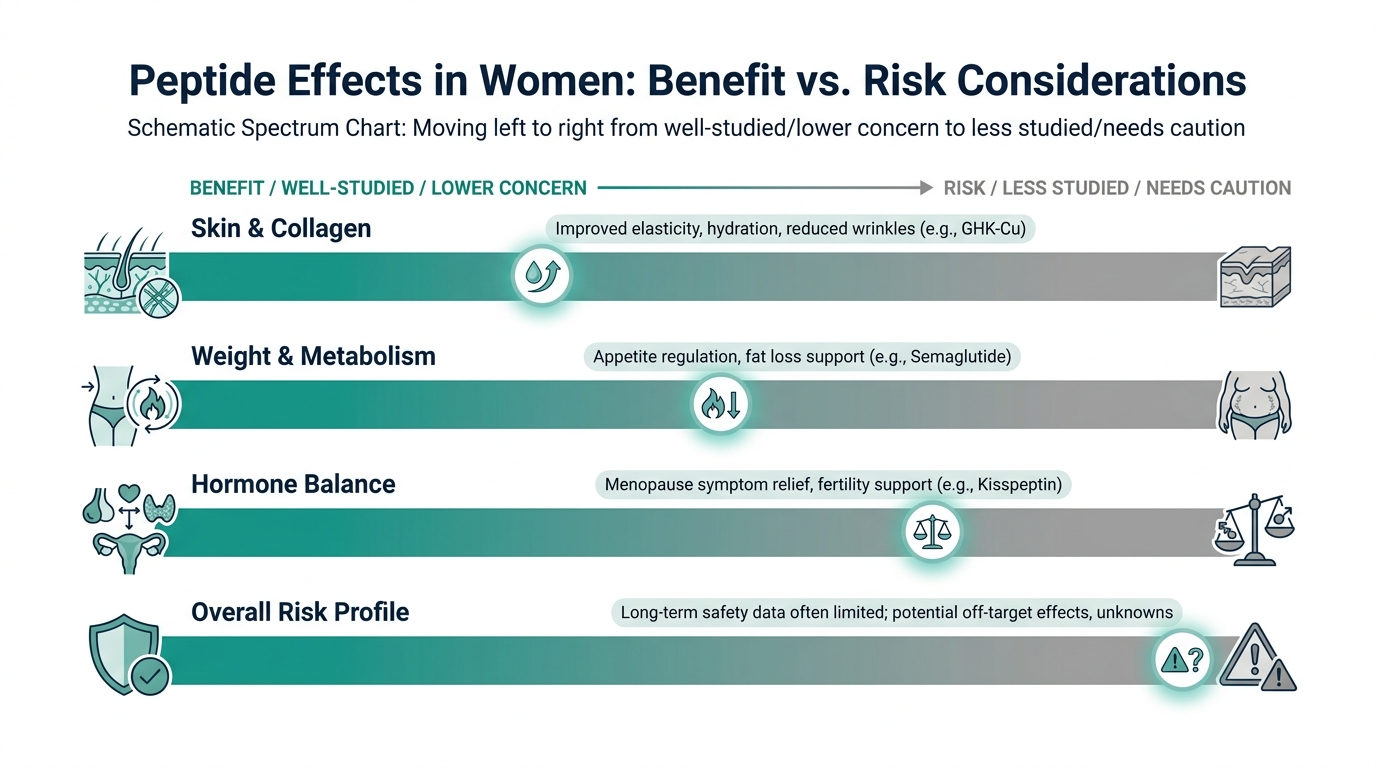
Several peptide risk profiles are sex-specific and are not mentioned in general-purpose guides.
Thymosin Alpha-1 and autoimmune thyroid disease: Autoimmune thyroid conditions, including Hashimoto’s thyroiditis, affect women seven to ten times more than men. Thymosin Alpha-1 has been studied for immune modulation in viral hepatitis and oncology contexts for decades, but its use in women with Hashimoto’s is entirely off-label and without meaningful human trial data. That population-specific risk is real.
TB-500 and cancer risk: Dr. Sarah Bonza, MD, MPH, FAAFP, a Menopause Society Certified Practitioner writing from clinical practice, flags TB-500 as concerning for women with cancer history, noting it has been identified as overexpressed in human pancreatic cancer cells and associated with upregulation in colorectal, gastric, and lung cancers. She categorically advises against recommending it. That is a physician-level opinion, not paranoia.
Melanotan II and skin cancer risk: Melanotan II is not FDA-approved for any use. Dermatology clinics and DermNet NZ report at least five cases of melanoma during or after melanotan II use, all in individuals with pre-existing risk factors (fair skin, tanning bed history, family history). In women specifically, the compound also causes unpredictable genital sensitivity and has no safety data for pregnancy or lactation. It is not a tanning drug. It is a research chemical with a documented melanoma signal, and no woman with fair skin or any cancer family history should be anywhere near it.
Pregnancy and any injectable peptide: The safety of injectable research peptides during pregnancy is unknown for virtually every compound in this category. The only safe policy is discontinuation before attempting conception, and that includes BPC-157, CJC-1295, ipamorelin, and all other non-FDA-approved compounds. For GLP-1 drugs, the FDA label recommends stopping one to two months before planned pregnancy to allow washout.
Full-body lab membership: 100+ biomarkers, doctor-reviewed, tracked over time.
What about peptides for skin, specifically for women?
The topical peptide category is the most commercially crowded and, unusually, also the most evidence-backed for everyday use. GHK-Cu (copper tripeptide-1) has the most robust human evidence of any cosmetic peptide, and most of that evidence comes from trials in women.
Specific, verifiable results from published trials:
- A 12-week double-blind study in 71 women using a GHK-Cu cream: increased skin density and thickness, reduced laxity, improved clarity, reduced fine lines.
- A 12-week eye cream trial in 41 women with mild to advanced photodamage: outperformed both placebo and vitamin K cream on lines, wrinkle depth, and skin thickness around the eyes.
- One clinical dataset reports a 55.8% reduction in wrinkle volume and a 32.8% reduction in wrinkle depth with GHK-Cu topical application over eight weeks.
The reason GHK-Cu works at the skin level is its role as a small copper carrier that modulates gene expression in tissue remodeling, upregulating collagen and elastin genes while suppressing inflammatory cytokines. It does not cross into systemic circulation at meaningful levels when applied topically, which is why the topical version is classified as a cosmetic and carries no prescription requirement.
The injectable form of GHK-Cu is a completely different risk class. Research-use injectable GHK-Cu has no completed human RCTs and is not approved for clinical use. The results people are citing come from the topical product, and that distinction matters.
Do peptides affect hormones in women beyond GLP-1?
Yes, though the mechanisms and evidence vary widely.
Kisspeptin is a hypothalamic neuropeptide that drives gonadotropin-releasing hormone (GnRH) release, which in turn triggers LH and FSH. A 2014 study in the Journal of Clinical Investigation confirmed kisspeptin mediates sex steroid feedback to the hypothalamus. In women with PCOS, elevated early-follicular kisspeptin contributes to excess LH drive and disrupted ovulation. Kisspeptin analogs are currently in Phase I/II human trials for reproductive axis regulation but are not commercially available.
MOTS-c, a peptide encoded in mitochondrial DNA, shows sex-dimorphic expression patterns, confirmed in a 2022 Cell Reports study by Kim et al. Endogenous MOTS-c, which regulates glucose and insulin sensitivity, is reliably increased by physical exercise. Early-phase human trials are underway, but it is not commercially available.
CJC-1295 and ipamorelin: The 2006 Alba et al. study showed 2 to 10-fold increases in growth hormone after CJC-1295 injection. In the context of perimenopause, when natural GH pulsatility declines along with estrogen, this stack has become one of the most frequently prescribed off-label protocols at longevity and women’s health clinics. The regulatory status is complicated: in February 2026, HHS indicated that ipamorelin may return to 503A Category 1 compounding status pending a July 2026 FDA Pharmacy Compounding Advisory Committee meeting, but CJC-1295’s status remains contested due to reported cardiac concerns.
The insider thing worth saying here: the GH secretagogue conversation in women’s health has been almost entirely driven by clinic marketing, not peer-reviewed evidence. There is still no Phase 3 randomized controlled trial of CJC-1295 plus ipamorelin specifically in perimenopausal women. The clinical enthusiasm is outrunning the data by a significant margin.
When should women avoid peptides?
Not every peptide is appropriate for every woman, and several situations call for an explicit pause:
Avoid injectable research peptides entirely if:
– You are pregnant, planning conception, or breastfeeding.
– You have a personal or strong family history of cancer, particularly cancers with established angiogenesis involvement (colon, pancreatic, breast), because pro-angiogenic peptides like BPC-157 and TB-500 carry a theoretical (not yet proven in humans) risk of supporting tumor growth.
– You have active autoimmune disease, without clear guidance from a rheumatologist or specialist who is aware of the specific compound.
– You are looking for a substitute for unaddressed foundational issues. Dr. Sarah Bonza’s clinical framework is worth quoting directly: hormonal optimization, nutritional deficiency correction, nervous system regulation, and consistent strength training should come before any peptide protocol. Layering an expensive compound onto a depleted, sleep-deprived, hormonally unsupported system is a poor investment.
The myth to bust: “Peptides are natural so they are safe for women.” This is false on two counts. First, “natural” does not mean safe or effective at a pharmacologically relevant dose. Insulin is a peptide; it will kill you if dosed incorrectly. Second, the research base for most injectable peptides is in male rodent models. The assumption that female-specific physiology responds identically is untested and probably wrong for at least some compounds.
Don’t just read about your health, track it.
A single result is a snapshot. Superpower re-tests 100+ markers over time so you can watch them move as you change sleep, food, and training.
FAQ: Peptides and Women
Do peptides affect estrogen levels?
Not directly in most cases. Most peptides studied for women work on parallel pathways: GLP-1 peptides improve insulin sensitivity and weight, which can normalize sex hormone balance indirectly. GH secretagogues support IGF-1 and GH, which decline with age alongside estrogen. None of the commonly used peptides are estrogen agonists, and none replace HRT. The interaction is indirect rather than hormonal substitution.
Are peptides safe during pregnancy?
No injectable research or off-label peptides are considered safe during pregnancy. The data simply does not exist. GLP-1 drugs (semaglutide, tirzepatide) carry an FDA recommendation to stop one to two months before planned conception. Collagen peptides from food-grade sources are generally considered safe during pregnancy, though always worth confirming with your OB.
Can women use BPC-157?
As of June 2026, BPC-157 is in a regulatory transition period. The FDA removed it from 503A Category 2 in April 2026, and a Pharmacy Compounding Advisory Committee meeting in July 2026 may restore the pathway for licensed compounding pharmacies to prepare it under prescription. The grey-market injectable version remains “research use only” with no completed human RCTs. Women with cancer history should avoid it pending more data.
Does PT-141 (bremelanotide) work for postmenopausal women?
PT-141 (Vyleesi) is FDA-approved specifically for premenopausal women with HSDD. Postmenopausal use is off-label, and the RECONNECT clinical trials that supported the approval did not specifically study postmenopausal women. Some clinicians prescribe it off-label in postmenopausal patients, but the evidence base for that use is thinner.
Do collagen peptides help with menopause symptoms?
Collagen peptides address one aspect of menopause, which is the accelerated skin and connective tissue breakdown driven by falling estrogen. They do not address vasomotor symptoms (hot flashes), sleep disruption, mood, vaginal dryness, or bone density on their own. They are a reasonable add-on to a comprehensive approach, not a standalone menopause treatment.
Is semaglutide safe for women with PCOS?
Semaglutide is FDA-approved for weight management and type 2 diabetes, but not specifically for PCOS. However, it is one of the most rapidly growing off-label uses in the PCOS population, and the indirect evidence from insulin sensitization, weight loss, and androgen normalization is strong. A Phase 3 PCOS-specific trial was recruiting in 2025 to 2026. If you have PCOS, this is a conversation to have with a reproductive endocrinologist or OB-GYN, not a decision to make based on a forum.
How much do peptides cost for women?
Collagen and topical copper peptide products run $20 to $80 for a one-month supply. Prescription GLP-1 drugs (Wegovy, Zepbound) run $900 to $1,200 per month without insurance coverage, though compounding was available at lower prices before the FDA resolved the shortage status. Telehealth peptide therapy for sermorelin or GH secretagogue stacks runs $175 to $399 per month, including labs and physician oversight. PT-141 (Vyleesi) is approximately $250 per dose, brand name, with no generic available. None of these, except GLP-1 drugs in specific metabolic indications, are covered by standard insurance.
Author: Vital Signs Today Editorial Team, MD”]. Educational content, not medical advice. Sources linked inline.
Full-body lab membership: 100+ biomarkers, doctor-reviewed, tracked over time.
Primary sources:
- Truveta Research: Rising use of GLP-1 medications among women with PCOS
- Meto.co: 8 Peptides Being Studied for Women’s Hormonal and Metabolic Health in 2026
- Bonza Health: Peptides in Perimenopause, A Physician’s Perspective
- Superpower: Peptides for Menopause
- Middleway Nutrition: GLP-1 Benefits for Women including PCOS and Menopause
- FDA: Bremelanotide (Vyleesi) approval, June 2019
- Drugs.com: Bremelanotide dosage guide
- DermNet NZ: Melanotan II
- GHK-Cu clinical evidence: Grand Ingredients
- NIH PMC: Regenerative and Protective Actions of GHK-Cu
- ClinicalTrials.gov NCT07302789: Oral Bioactive Collagen Peptides on Skin Properties
- ClinicalTrials.gov NCT07529249: Collagen Peptides on Skin Barrier Function in Women
- PNOE: Peptides for Menopause, What the Evidence Actually Supports
- Swolverine: Best Peptides for Women, Fat Loss, Recovery, Skin, Anti-Aging
- FDA 503A Bulk Drug Substances list
Related reading
Vital Signs Today may earn a commission if you buy through links on this page. It does not affect our editorial assessments.