Educational content, not medical advice. BPC-157 is not FDA-approved for human use. Consult a licensed clinician before beginning any peptide protocol.
Short answer: For most people, a 29 to 31 gauge, 0.5-inch insulin syringe inserted subcutaneously at a 45-degree angle into the abdomen is the default BPC-157 injection method, pinch the skin, push the plunger over 3 to 5 seconds, wait 5 seconds before withdrawing. That is the mechanics. Whether you should be doing it yourself at all, with a grey-market vial and no clinical oversight, is the longer conversation this article is here to have.
BPC-157 injection technique matters, but so does knowing your baseline. Want to see your inflammation and recovery markers first? One at-home Superpower draw checks 100+ biomarkers, physician-reviewed.
What makes BPC-157 different from most other injectable peptides?
BPC-157, short for Body Protection Compound 157, is a synthetic 15-amino-acid peptide derived from a protein found in gastric juice. Most injectable peptides in the longevity space (sermorelin, CJC-1295, Ipamorelin) target a single hormonal axis. BPC-157 works across several: it activates the VEGFR2/Akt-eNOS pathway to stimulate angiogenesis, modulates ERK1/2 signaling for endothelial repair, shifts macrophages from the pro-inflammatory M1 phenotype to the reparative M2 phenotype, and preserves acetylcholine receptors at neuromuscular junctions (PMC, 2025 narrative review).
That breadth is both the appeal and the complexity. A peptide doing five jobs at once is harder to dose, harder to monitor, and harder to source correctly than one with a narrow target. Injecting it casually without understanding the mechanism is a bit like rewiring a house because you watched a YouTube video about light switches.
The evidence base also matters before you pick up a syringe. As of mid-2026, only three published human studies exist: a 2021 knee-pain pilot (14 of 16 patients improved), a 2024 interstitial cystitis trial (12 of 12 patients reached significant improvement on Global Response Assessment), and a 2025 IV safety study where two adults tolerated up to 20 mg intravenously with no adverse cardiac, hepatic, renal, or thyroid signals (PMC, 2025). Three studies, two of them tiny, is not a lot to build a self-administration protocol around.
Full-body lab membership: 100+ biomarkers, doctor-reviewed, tracked over time.
What is the difference between subcutaneous and intramuscular injection for BPC-157?
These are the two injection routes used with BPC-157, and most of the confusion comes from misunderstanding what each one is actually doing.
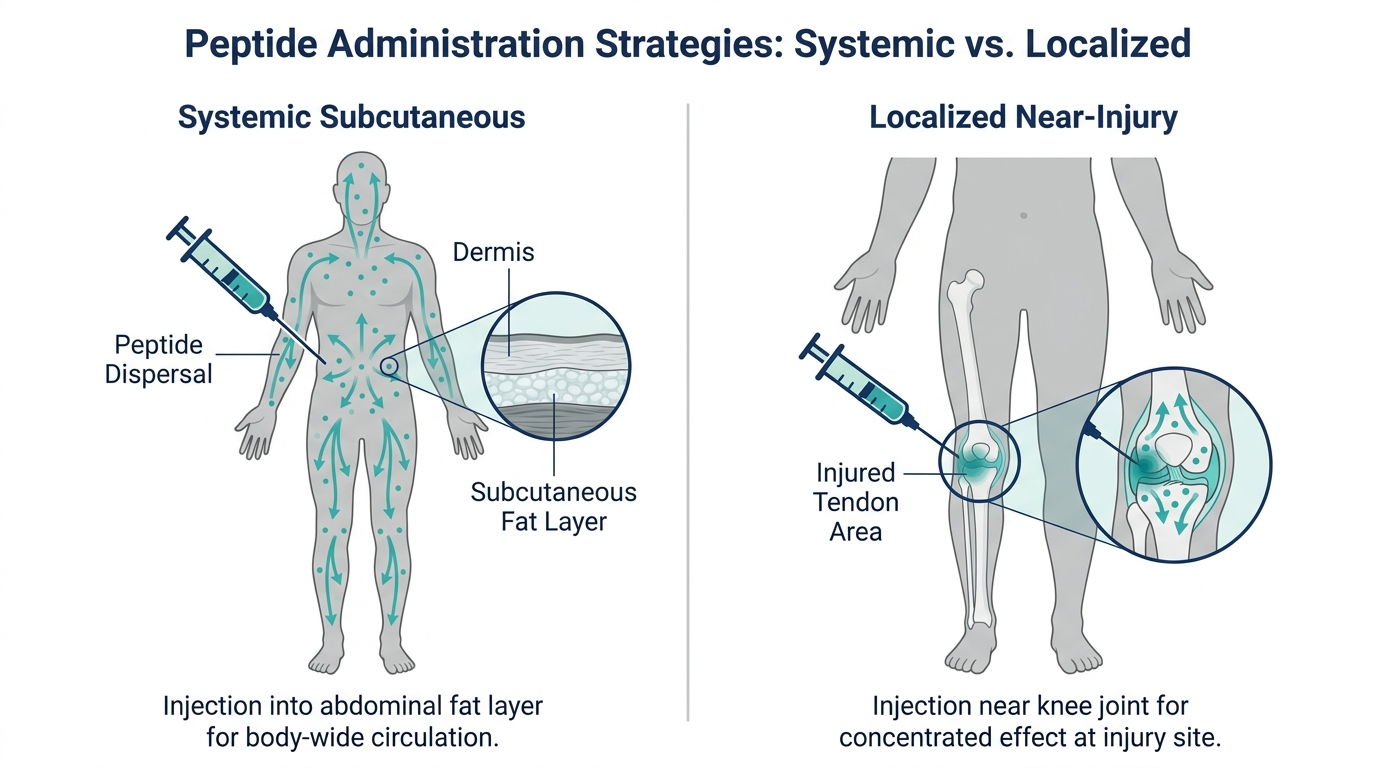
Subcutaneous (SubQ) means injecting into the layer of fat just beneath the skin. The peptide absorbs through the subcutaneous capillary bed and enters systemic circulation over roughly 15 to 30 minutes. This is the default for BPC-157, and nearly every preclinical study that produced positive tendon, gut, and vascular outcomes used subcutaneous or intraperitoneal delivery. Bioavailability via the subcutaneous route runs approximately 14 to 51% depending on the formulation and the study methodology cited (PeakedLabs, 2026).
Intramuscular (IM) means injecting directly into muscle tissue, typically with a longer, larger-gauge needle at a 90-degree angle. The argument for IM in BPC-157 protocols is local delivery: if you have a quad tear or a deep hamstring strain, placing the peptide closer to the damaged fiber might accelerate local repair. Practically speaking, IM is more painful, carries a higher bruising risk, and requires more technique. The community consensus in 2026 is that SubQ produces equivalent systemic levels with far less risk, and that IM should only be considered for deep muscle injuries under clinical guidance, not in a bathroom mirror.
The distinction matters most for joint and tendon injuries close to the skin surface. For those, some practitioners recommend injecting subcutaneously within 1 to 3 cm of the damaged structure, rotating injection sites around the injury in a clock pattern (12, 3, 6, 9 o’clock positions) rather than always hitting the same spot. For deep structures (hip joint, internal organ, vertebral disk), a distant subcutaneous site in the lower abdomen delivers systemically and eliminates the risk of placing a needle near vessels or nerves you cannot see.
What equipment do you actually need before injecting BPC-157?
This is the part research vendors never walk you through in enough detail, and it is where most first-time users make their most consequential mistakes.
Syringes: The standard recommendation is a 28 to 31 gauge, 0.5-inch insulin syringe for SubQ injection. A 31-gauge needle is preferred for thin-skin areas near joints (wrist, elbow, knee). Never exceed 27 gauge for SubQ administration. The finer the gauge number, the thinner the needle, and a 31G U-100 insulin syringe is a barely perceptible pinch for most people. Each syringe is single-use, not because you will run out, but because used needles develop microscopic barbs that tear tissue rather than part it, dramatically increasing pain, bruising, and infection risk (PeptidesExplorer, 2026).
Bacteriostatic water (BacW): This is sterile water containing 0.9% benzyl alcohol, which inhibits bacterial growth and lets you draw from a reconstituted vial repeatedly over 30 days. Do not substitute plain sterile water. Without the benzyl alcohol preservative, a reconstituted vial supports bacterial colonization within 24 to 48 hours, creating abscess risk at every injection site (PeptidesExplorer, 2026). Plain water is not a cost-saving shortcut. It is a contamination vector.
Alcohol swabs, sharps container, refrigerated storage: These are not optional. The alcohol swab must be dry before you inject. Injecting through wet alcohol is the most commonly reported, and most preventable, source of injection-site stinging, producing a sharp burn that lasts 10 to 20 seconds. Swab the vial stopper, let it air-dry 10 seconds. Swab the skin, let it air-dry 15 seconds. Then inject.
How do you reconstitute BPC-157 correctly?
Lyophilized (freeze-dried) BPC-157 powder arrives as a white pellet in a sealed glass vial. You add bacteriostatic water to create an injectable solution. The math here is not complicated, but one decimal error changes your dose by a factor of ten.
Standard reconstitution: Add 2 mL of bacteriostatic water to a 5 mg (5,000 mcg) vial. That produces a concentration of 2,500 mcg per mL. On a standard U-100 insulin syringe, where 100 units equals 1 mL, you get 25 mcg per unit. A 250 mcg dose is 10 units (0.1 mL). A 500 mcg dose is 20 units (0.2 mL).
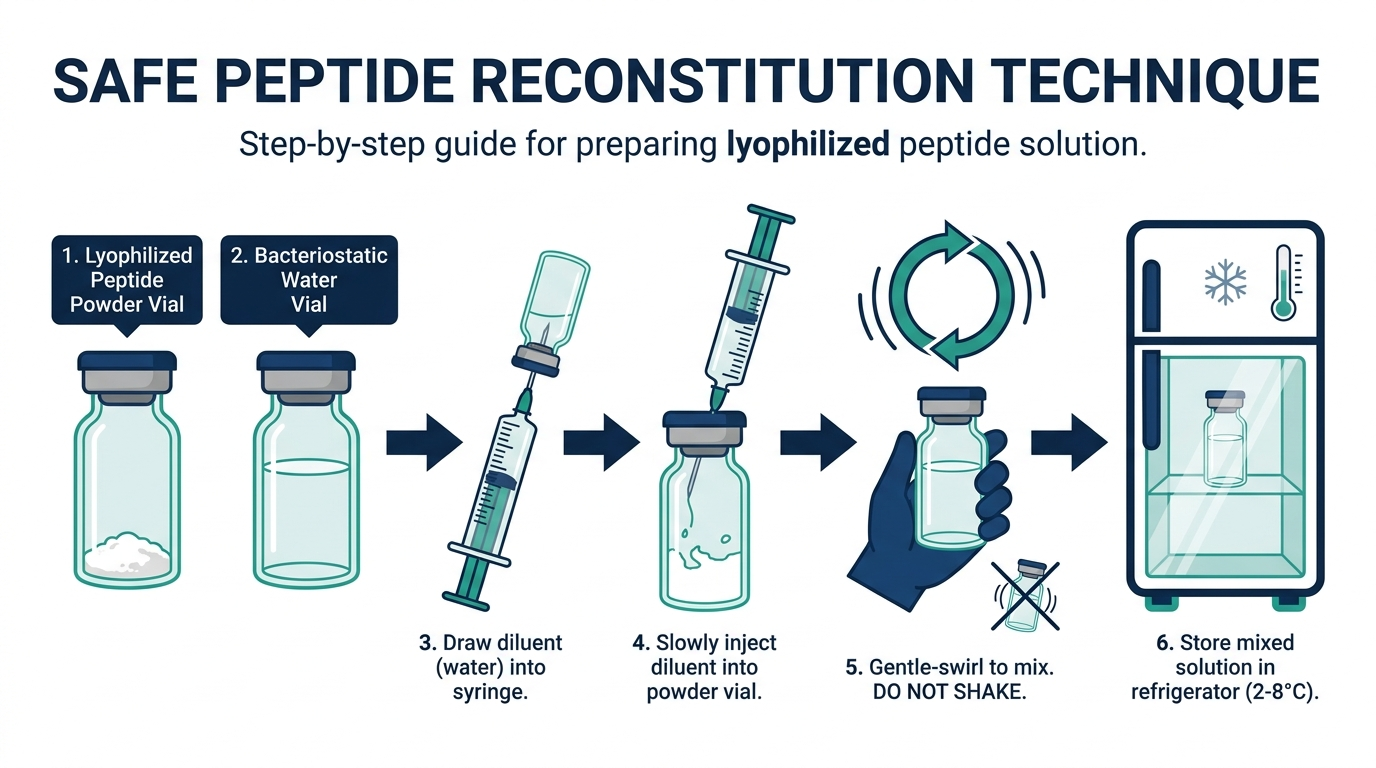
Technique for adding the water: Draw your bacteriostatic water into the syringe. Insert the needle into the BPC-157 vial at a 45-degree angle. Inject the water slowly down the inside glass wall of the vial. Never push the stream directly onto the powder. Direct impact can damage the peptide chain structure. Let the powder dissolve on its own, swirling the vial gently in your palm until the solution runs fully clear. Do not shake. Agitation introduces air bubbles and mechanical stress that degrades the peptide (PeakedLabs, 2026).
Once reconstituted, store in the refrigerator. Discard after 30 days regardless of how much remains.
Personally, I find the reconstitution step to be a useful reality check. If you are not comfortable doing that math correctly and executing the sterile technique without shortcuts, that discomfort is information. It means you are probably better served in a clinical setting where a pharmacist and nurse have already handled every one of those steps before the vial reaches you.
What are the correct injection sites for BPC-157?
Site selection is determined by whether you want systemic delivery or localized delivery near an injury.
For systemic use: The lower abdomen is the default, 1 to 2 inches from the navel on either side. Avoid the 2-inch perimeter directly around the navel (the skin is tighter and more vascularized there). The outer thigh and the back of the upper arm are acceptable alternatives when you need to rotate away from the abdomen. Choose sites with pinchable subcutaneous fat.
For localized injury delivery: Inject subcutaneously as close to the damaged structure as accessible. The clock rotation method keeps rotation disciplined: if today is 12 o’clock, tomorrow is 3, the day after is 6, then 9, before cycling back. This prevents lipodystrophy (structural changes in fat tissue from repeated local trauma) and the nodule formation that appears when the same site takes daily mechanical insult.
The injection technique itself: pinch the skin firmly to lift the fat layer away from the muscle below. Insert the needle at 45 degrees. Push the plunger over 3 to 5 seconds, not faster. Pause with the needle in place for 5 seconds after the plunger reaches the end, which prevents backflow and dose loss as you withdraw. Release the skin pinch and withdraw the needle.
One thing the forum guides consistently understate: if you are lean, a standard 0.5-inch needle at 45 degrees can reach muscle and deliver IM by accident when you intended SubQ. For lean individuals or low-body-fat areas, use a 5/16-inch (8 mm) needle at 45 degrees to stay reliably in the fat layer.
Oral BPC-157: Is it a real alternative to injecting?
For gut-specific goals, oral BPC-157 has a mechanistic argument injections cannot replicate. When BPC-157 is taken orally, it delivers high local concentrations directly to the intestinal epithelium, which is exactly the tissue you want it touching for ulcerative colitis, leaky gut, or IBD. A Phase 1 study found that no quantifiable BPC-157 was detected in plasma after oral dosing, meaning it does not reach measurable systemic levels through the gut wall (PeptideInjections.ai, 2026).
The arginate salt form (BPC-157 arginate) dramatically improves oral stability. While the standard acetate form degrades in stomach acid with roughly 3% bioavailability, the arginate form resists gastric pH far better, with some sources citing absorption up to 90% locally in GI tissue (Peptide Deck, 2026). The practical summary: for gut healing, oral arginate form. For tendon, muscle, ligament, and systemic vascular targets, subcutaneous injection using the standard acetate form is the route used in virtually all preclinical research that produced positive outcomes.
Do not believe the forums that say oral BPC-157 is equivalent to injectable for musculoskeletal applications. It is not equivalent. The evidence base for the systemic and structural healing claims is entirely built on subcutaneous delivery.
What are the real contamination and safety risks of self-injection?
This is the section grey-market vendors do not include in the product listing, and it is the most important one.
A Drug Testing and Analysis study found that 30% of online peptides contained incorrect amino acid sequences, and 65% had endotoxin levels above safety thresholds (New Regeneration Orthopedics, 2025). USADA testing in 2017 found over 20% of black-market peptide products were mislabeled or contaminated. The specific contaminants found in real-world vials include endotoxins (bacterial byproducts that can trigger systemic inflammation or sepsis), residual synthesis solvents like trifluoroacetic acid and acetonitrile, heavy metals, degradation products from poor storage, and in some cases complete mislabeling where the vial contained a different compound entirely.
The independent testing platform Finnrick has now run over 8,000 tests across 225 vendors (Finnrick). Its database is the most honest record available of what is actually inside research vials. The results are not reassuring. Even vendors with strong forum reputations have had batches fail purity thresholds. The community minimum for research-grade peptides is HPLC purity of 96% or higher. Anything below that means over 4% of what you inject is something other than the peptide on the label.
Beyond the vendor-quality risk, BPC-157 specifically interacts with blood pressure regulation via the nitric oxide system. People with hypertension or those taking antihypertensive medications need clinical oversight before starting, because the nitric oxide upregulation that makes BPC-157 useful for vascular repair also affects systemic blood pressure. That interaction is not theoretical. It is one of the documented mechanisms.
And for competitive athletes: BPC-157 has been on the WADA prohibited list since 2022 under both S0 (Non-Approved Substances) and S2 (Peptide Hormones and Growth Factors), prohibited at all times including off-season (USADA). Detection triggers Anti-Doping Rule Violations with sanctions of two to four years. The NFL and UFC also prohibit it by name. This is not a substance you can use casually in training and expect to compete clean.
What does the 2026 regulatory shift mean for people who want BPC-157?
The regulatory picture for BPC-157 changed meaningfully in the first half of 2026, and it changes the smart approach for most people.
The FDA placed BPC-157 on its 503A Category 2 list in 2023, effectively banning it from compounding pharmacies. On 22 April 2026, the FDA removed it from Category 2, citing procedural reclassification (Loti Labs, 2026). On 27 February 2026, HHS Secretary Robert F. Kennedy Jr. announced a review of 14 restricted peptides, including BPC-157, under the Make America Healthy Again initiative. A Pharmacy Compounding Advisory Committee (PCAC) meeting is scheduled for 23 to 24 July 2026 at the FDA White Oak Campus in Silver Spring, Maryland, where the committee will evaluate both BPC-157 free base and BPC-157 acetate, with ulcerative colitis as the proposed therapeutic indication (FDA docket FDA-2025-N-6895).
Until the PCAC recommendation is finalized and published as final FDA rulemaking, state-licensed 503A pharmacies technically cannot yet formulate BPC-157 freely. However, clinics like Marek Health, Defy Medical, Ways2Well, and Restorative Wellness reportedly resumed BPC-157 prescribing in March 2026 based on the April removal from Category 2 (PeakedLabs, 2026).
Here is what that means practically: the legitimate clinical route is opening, and it is closer to cost-competitive with grey-market sourcing than most people realize.
A research vial runs $30 to $120 with zero oversight. A full supervised clinic program (initial consult, baseline labs, monthly medication from a named 503A compounding pharmacy) runs $350 to $900 for a first course, with ongoing monthly medication from specialist-tier practices like Marek Health or Defy Medical typically $200 to $500 per month (PeakedLabs, 2026). The clinic price bundles a clinician’s prescription, pharmacy-sourced medication with a documented chain of custody, correct dosing, and a human being accountable for your outcomes. None of it is covered by insurance. But you are paying for everything the grey-market vial is not: the pharmacist, the QC lab, the prescriber, and the paper trail if something goes wrong.
Telehealth GLP-1 program with provider visits and pharmacy coordination.
What mistakes do first-time injectors most commonly make?
These are the errors that show up repeatedly in clinical intake notes and community threads, ranked by the damage they cause.
Injecting through wet alcohol. Swabbing the skin and injecting before the alcohol dries causes a sharp 10 to 20-second burn that first-timers often attribute to the peptide itself. The fix is free: wait 15 seconds.
Using plain sterile water instead of bacteriostatic water. Sterile water has no preservative. After 24 to 48 hours a reconstituted vial prepared with plain water is a bacterial culture medium. The resulting injection-site infection or abscess is genuinely dangerous. Bacteriostatic water is inexpensive and non-negotiable.
Reconstitution math errors. Adding 1 mL of water to a 5 mg vial gives you 5 mg/mL (5,000 mcg/mL). Adding 2 mL gives you 2,500 mcg/mL. The same 10-unit (0.1 mL) draw delivers 500 mcg on the first concentration but 250 mcg on the second. These two standard setups are both widely cited and both correct, for different situations. Using the wrong math doubles or halves every dose you take. Write the concentration on a label and stick it to the vial.
Reusing syringes. Used needles develop microscopic barbs. The second and third injections with the same needle produce noticeably more pain, bruising, and local tissue damage. Lipodystrophy from repeated needle trauma is not reversible.
Not rotating sites. Daily injection into the same 2-centimeter spot produces persistent nodules and eventually lipodystrophy. Use a written rotation schedule, not memory.
Skipping the 5-second post-injection pause. Withdrawing the needle immediately after the plunger bottoms out allows backflow of the solution through the needle track. You lose dose and gain surface bruising. The pause costs five seconds and prevents both.
BPC-157 injection methods compared
| Feature | Subcutaneous (SubQ) | Intramuscular (IM) | Oral (Arginate) |
|---|---|---|---|
| Needle gauge | 29 to 31G | 25 to 27G | N/A |
| Needle length | 0.5 inch | 1 inch | N/A |
| Insertion angle | 45 degrees | 90 degrees | N/A |
| Pain level | Mild (pinch) | Moderate to high | None |
| Onset | 15 to 30 min absorption | Faster local delivery | Slow, local gut action |
| Best for | Systemic delivery, most injuries | Deep muscle injuries (clinical only) | GI healing (IBD, ulcers) |
| Systemic bioavailability | 14 to 51% | Higher locally | Not measurable in plasma |
| Clinical supervision needed? | Recommended | Strongly recommended | Recommended |
| Purity verification required? | Yes | Yes | Yes |
The table makes the asymmetry clear. Oral administration avoids every injection risk but produces no systemic BPC-157. IM delivers locally but is harder to execute safely. SubQ threads the needle: systemic delivery with a minimal skill threshold. That is why it dominates both the clinical and grey-market protocols.
Turn what you just learned into action.
Superpower lets you test 100+ biomarkers from home, then re-check them over time so you can actually see progress, physician-reviewed at every step.
Frequently asked questions
Is subcutaneous or intramuscular BPC-157 injection better?
Subcutaneous is the preferred default. It delivers systemically with less pain, no neurovascular risk, and the same efficacy for most applications. Intramuscular may offer a localized advantage for deep muscle injuries, but it should only be performed with clinical guidance because incorrect needle placement near tendons or vascular structures carries real harm potential.
What needle do you use to inject BPC-157?
A 29 to 31 gauge, 0.5-inch U-100 insulin syringe for subcutaneous injection. Use 31 gauge for thin-skin areas near joints. Never exceed 27 gauge for SubQ. Intramuscular injection uses a 25 to 27 gauge, 1-inch needle, always under medical supervision.
How do you reconstitute BPC-157 for injection?
Add bacteriostatic water slowly down the inside wall of the vial (not directly onto the powder), swirl gently until clear, and never shake. Standard concentration: 2 mL water into a 5 mg vial yields 2,500 mcg/mL. A 10-unit draw (0.1 mL on a U-100 syringe) at that concentration delivers 250 mcg. Store refrigerated, discard after 30 days.
Where do you inject BPC-157?
The lower abdomen (1 to 2 inches from the navel) is the standard subcutaneous site. Outer thigh and back of the upper arm are alternatives. For localized injury delivery, inject within 1 to 3 cm of the accessible damaged structure, rotating clock-position sites daily to prevent lipodystrophy.
Is BPC-157 legal to inject in 2026?
BPC-157 is not FDA-approved for human use and is not a controlled substance. It sits in a rapidly evolving regulatory zone: removed from FDA Category 2 restriction on 22 April 2026, with a PCAC advisory meeting scheduled for 23 to 24 July 2026 to evaluate its return to Category 1 (permitted for 503A compounding). As of mid-2026, licensed telehealth clinics are prescribing it through compounding pharmacies in many states. Self-injection of grey-market “research use only” vials is legal to purchase but not legal for human use under the research exemption.
Can you inject BPC-157 without a clinic?
Physically, yes. Legally and practically, grey-market DIY carries purity risk (30% incorrect amino acid sequences in one published study), no baseline monitoring, and no accountability if something goes wrong. The licensed clinical route is now more accessible than at any point since 2023, and for most people the risk-adjusted value favors a prescription.
Does BPC-157 show up on drug tests for athletes?
Yes. WADA has prohibited BPC-157 since 2022 under both S0 and S2, at all times including off-season. Detection triggers ADRVs with two to four-year sanctions. The NFL and UFC also ban it by name. No Therapeutic Use Exemption exists for BPC-157 because it has no approved therapeutic indication.
Telehealth GLP-1 program with provider visits and pharmacy coordination.
Author: Vital Signs Today Editorial Team, [credential]”]. Educational content, not medical advice. Sources linked inline.
Primary sources:
– PMC: “Regeneration or Risk? A Narrative Review of BPC-157 for Musculoskeletal Healing” (2025)
– FDA bulk drug substances under 503A (docket FDA-2025-N-6895)
– Loti Labs: BPC-157 Legal Status 2026 FDA Update
– PeakedLabs: BPC-157 Dosage and Protocol Guide 2026
– PeakedLabs: BPC-157 Cost Guide 2026
– PeptidesExplorer: How to Inject BPC-157
– New Regeneration Orthopedics: Hidden Risks of BPC-157
– USADA: BPC-157 Peptide Prohibited
– Finnrick: Independent Peptide Vendor Testing
– Peptide Deck: BPC-157 Oral vs Injectable 2026
Related reading
Vital Signs Today may earn a commission if you buy through links on this page. It does not affect our editorial assessments.