Last updated June 2026. Educational content only, not medical advice. Several peptides discussed here are investigational or unapproved for obesity. Talk to a licensed clinician before starting anything.
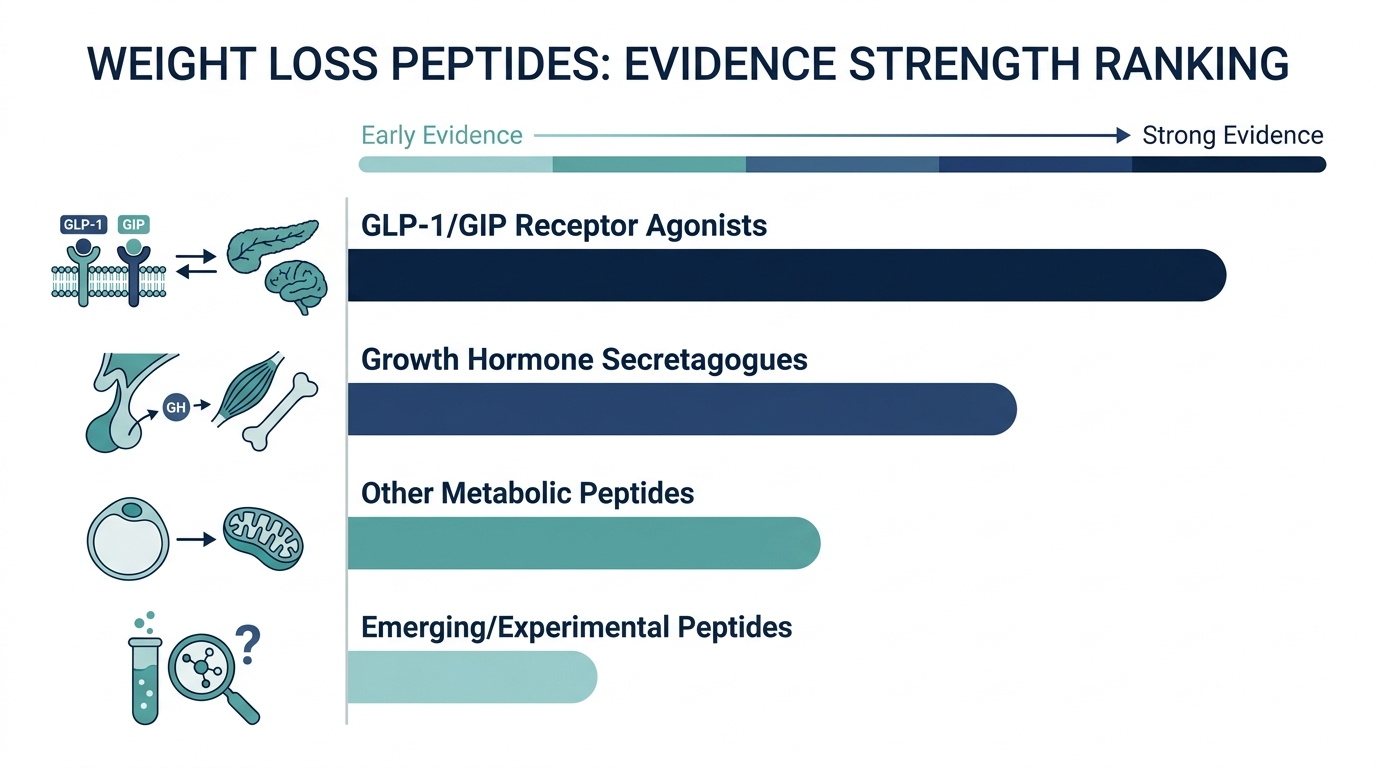
Short answer: Yes, but the answer depends almost entirely on which peptide you mean. FDA-approved GLP-1 receptor agonists like tirzepatide and semaglutide produce 14 to 22 percent body-weight loss in controlled trials, results no diet pill has ever matched. A second tier of peptides such as tesamorelin reduces visceral fat by 15 to 18 percent but is approved only for a specific HIV condition. A third tier, including CJC-1295, ipamorelin, and AOD 9604, is widely marketed for fat loss but lacks meaningful human trial data. The word “peptides” covers all three of those very different situations, and most people searching this question have no idea which tier they are looking at.
Peptides for weight loss work differently for everyone. Want to see how your own metabolic markers respond? One at-home Superpower draw checks 100+ biomarkers, physician-reviewed.
Why is the answer so confusing?
Every peptide is a short chain of amino acids. That is the whole biological definition. Semaglutide (Wegovy) is a peptide. Collagen powder is made of peptides. The fragment of growth hormone called AOD 9604 is a peptide. The hormone your gut releases after a meal, GLP-1, is a peptide. They share a chemistry class and almost nothing else.
The confusion is profitable. A supplement company can write “peptides for weight loss” on a tub of collagen powder and technically be accurate while implying the clinical results of a GLP-1 drug. Research-chemical vendors do the same thing with injectable vials. That gap between the word and the evidence is where a lot of money changes hands.
This article ranks the actual evidence by peptide class, from the most proven to the least, so you know which tier you are actually looking at.
Full-body lab membership: 100+ biomarkers, doctor-reviewed, tracked over time.
Tier 1: GLP-1 peptides that genuinely work
The simplest way to actually get this done
Superpower is a full-body lab membership that runs 100+ biomarkers, has each result reviewed by a doctor, and tracks your numbers year over year (about $199/year). It is what we point readers to when they would rather get one clean, complete draw than chase single tests one at a time. Here is superpower reviewed in full.
These are not grey-market compounds. They are FDA-approved prescription medications with large, well-controlled trials behind them.
Semaglutide: the first real proof
Semaglutide (marketed as Wegovy for obesity, Ozempic for type 2 diabetes) is a synthetic version of GLP-1, a gut-hormone peptide your body naturally secretes after eating. The drug was engineered to have a half-life of roughly seven days so a single weekly injection keeps blood levels stable throughout the week, something your natural GLP-1 cannot do since it breaks down in minutes.
In the STEP 1 Phase 3 trial, adults with obesity who took 2.4 mg semaglutide weekly for 68 weeks lost a mean of 14.9 percent of body weight compared to 2.4 percent on placebo. That is roughly 15 kg for a 100 kg person. More than 86 percent of participants on semaglutide achieved at least 5 percent weight loss; 32 percent achieved 20 percent or more.
In December 2025, the FDA approved the first oral GLP-1 medication for weight loss: a once-daily semaglutide 25 mg tablet (also branded Wegovy). The OASIS 4 trial showed 16.6 percent mean weight loss at 64 weeks with full adherence, and 34.4 percent of participants achieved 20 percent or more weight loss. A pill that works nearly as well as the injection is not a minor development. It changes who can realistically use this class.
Personally, the oral approval was the single most clinically significant peptide news of 2026, more so than the retatrutide Phase 3 readout, because access was always the bottleneck, not efficacy.
Tirzepatide: the current leader
Tirzepatide (Mounjaro for diabetes, Zepbound for obesity) is a dual agonist, hitting both the GLP-1 receptor and the GIP receptor. Adding GIP on top of GLP-1 enhances the insulin response and appears to amplify fat cell lipolysis beyond what GLP-1 alone achieves.
In SURMOUNT-1, tirzepatide at the highest dose (15 mg/week) produced a mean 22.5 percent body-weight reduction at 72 weeks, compared to 2.5 percent on placebo. At 20 months in SURMOUNT-4, weight loss approached 25 percent in those who continued. For a 250-pound person, 22.5 percent is 56 pounds. That number, produced by a peptide administered once a week, has no precedent in non-surgical obesity treatment.
Tirzepatide costs approximately $499 to $1,086 for a 28-day supply at retail list price. Without insurance or manufacturer discount programs, it can exceed $14,000 per year. Through telehealth platforms and compounded versions (where still available), monthly costs can drop to $299 or below, though the legal landscape for compounded tirzepatide tightened significantly after the FDA declared the shortage resolved in October 2024.
Starting July 1, 2026, eligible Medicare members may access select GLP-1 medications including Zepbound for $50 per month through the Medicare GLP-1 Bridge Program, a policy shift that will meaningfully change access for older Americans.
Retatrutide: the next level
Retatrutide is Eli Lilly’s triple agonist, hitting GLP-1, GIP, and the glucagon receptor simultaneously. Glucagon activation increases energy expenditure by the liver. Adding it to the GLP-1 plus GIP combination appears to drive fat loss beyond what dual agonism achieves.
Lilly announced TRIUMPH-1 Phase 3 results on May 21, 2026: participants on the 12 mg dose lost a mean of 28.3 percent of body weight at 80 weeks versus placebo. In participants with a BMI of 35 or higher who continued to 104 weeks, weight loss reached a mean of 30.3 percent, equivalent to an average 85 pounds. All three doses met primary and secondary endpoints. Seven more TRIUMPH readouts are expected in Q3 and Q4 2026 covering type 2 diabetes, cardiovascular disease, and other indications. Lilly has not yet filed an NDA; realistic FDA approval is 2027 to 2028 at the earliest.
Retatrutide is not available by prescription, not from a licensed pharmacy, not from any legitimate telehealth clinic, and not compounded legally. The only “retatrutide” you can buy today is a research-chemical vial, and the independent testing platform Finnrick’s sample testing of research-grade retatrutide batches has found purity failures in a significant percentage of samples. It is the peptide with the most impressive clinical data and, right now, the most unreliable supply chain of any peptide you could actually obtain.
Tier 2: the FDA-approved peptide with a catch
Tesamorelin: real visceral fat data, narrow approval
Tesamorelin is a synthetic version of growth-hormone-releasing hormone (GHRH). It stimulates the pituitary to release more growth hormone, which in turn increases IGF-1 and promotes visceral fat lipolysis. The FDA approved it in 2010 under the brand Egrifta SV, specifically for excess abdominal fat in HIV patients with lipodystrophy.
In the pivotal clinical trial published in the New England Journal of Medicine, patients on tesamorelin 2 mg daily for 26 weeks reduced visceral adipose tissue by approximately 15 percent compared to a 5 percent increase in the placebo group. A 52-week follow-up confirmed reductions were sustained with continued treatment and that visceral fat began to return after stopping, suggesting it is a maintenance drug rather than a one-time course.
The catch is the label. Tesamorelin is FDA-approved for HIV lipodystrophy, not general obesity. Off-label use in non-HIV patients exists and is not uncommon in longevity clinics, but it operates outside the drug’s approved indication. It also does not produce the kind of total body-weight reductions that tirzepatide or semaglutide generate; it is a targeted visceral fat intervention, not a systemic weight-loss drug.
Do not believe any clinic that positions tesamorelin as a replacement for a GLP-1 drug in a patient with general obesity. The mechanisms and data are fundamentally different.
Tier 3: peptides widely sold but with thin evidence
This tier covers the compounds you find most often in research-chemical shops, anti-aging clinic menus, and supplement marketing: CJC-1295, ipamorelin, and AOD 9604. All three generate substantial online discussion, genuine clinical curiosity, and very little high-quality human trial data on body-weight outcomes.
| Peptide | Claimed mechanism | Human trial evidence for weight loss | FDA status |
|---|---|---|---|
| CJC-1295 | GHRH analogue, raises GH and IGF-1 | One Phase 1 trial confirmed GH elevation (2 to 10-fold); no weight loss endpoint | Not approved; research only |
| Ipamorelin | Ghrelin mimetic, selective GH secretagogue | No published RCT on body weight or fat mass as primary endpoint | Not approved; research only |
| AOD 9604 | Fragment of HGH (177-191), claimed to target fat without GH effects | Animal data positive; Phase 2/3 human trials for obesity did not produce results justifying FDA approval | Not approved; FDA explicit it is not an approved treatment |
| CJC-1295 + Ipamorelin stack | Synergistic GH pulse | Combined use is common in clinics; no controlled trial isolating the stack on weight | Not approved |
The honest summary: CJC-1295 demonstrably raises growth hormone. Growth hormone does shift body composition toward more muscle and less fat over years of use. The step from “GH goes up” to “meaningful weight loss occurs at 12 weeks” is not one the published literature supports. Clinics that sell these as weight-loss peptides are extrapolating from a mechanism, not reporting an outcome.
That is not the same as saying they never do anything. It means the evidence is insufficient to tell you whether the thing they do is worth the cost and the risk of injecting an unregulated compound.
AOD 9604 is the clearest example of hype exceeding evidence. It was originally developed as an obesity drug candidate by Monash University and Metabolic Pharmaceuticals in the 2000s. It progressed to human trials. Those trials did not generate results sufficient to support FDA approval for obesity, which is why it is not an approved drug in that indication. The compound got repurposed into the research-chemical market and has been sold as a fat-loss peptide ever since, but the sponsor who ran the actual clinical trials did not succeed in proving it works in humans.
How GLP-1 peptides actually produce weight loss (the mechanism matters)
Understanding the mechanism helps you evaluate claims for every other “fat-burning peptide” you encounter.
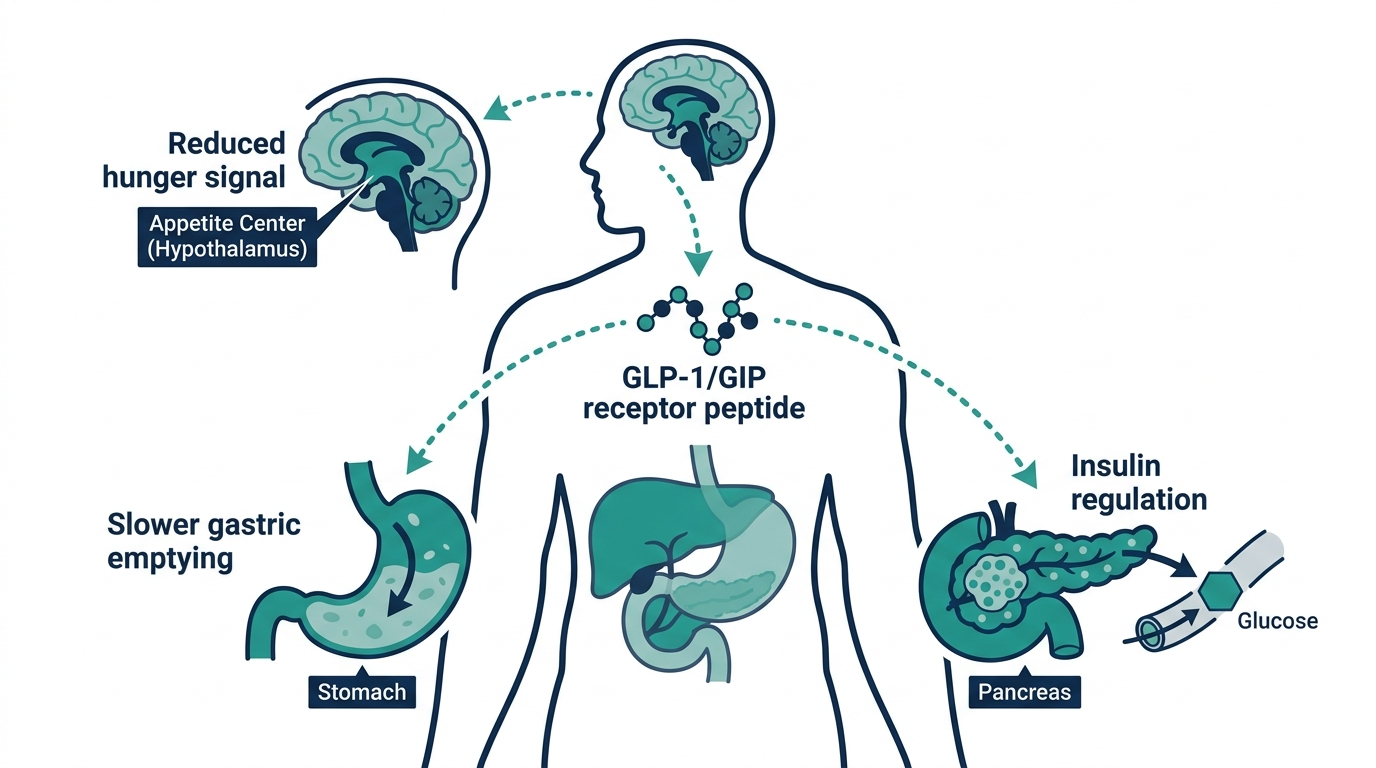
GLP-1 is a hormone your gut secretes in response to food. It signals the pancreas to release insulin, signals the stomach to slow emptying (which extends satiety), and crosses the blood-brain barrier to act on the hypothalamus and brainstem, reducing hunger signals and increasing the sense of fullness.
A 2025 review in the American Journal of Medicine identified multiple central nervous system pathways: GLP-1 receptor agonists modulate the arcuate nucleus and the dorsal vagal complex, regions that integrate energy signals and hunger drive, and they reduce the reward salience of high-calorie foods. That last point is the one that surprises most new users. GLP-1 drugs do not just reduce appetite in a general sense. Many patients report that the pull toward overeating feels muted in a way that feels neurological, not simply “I ate enough.” That effect has no analogue in any Tier 3 peptide.
The research-grade “fat-burning” peptides lack this central mechanism. They work, if at all, through growth hormone pathways that are slower, subtler, more dependent on body composition baseline, and much harder to capture in a 12-week trial endpoint.
What GLP-1 weight loss actually looks like vs. diet alone
A key biomarker reality that most weight-loss peptide articles skip: GLP-1 drugs produce weight loss from both fat mass and lean mass, while exercise-focused weight loss preserves lean mass more effectively.
A systematic review and meta-analysis of GLP-1 receptor agonist trials found that GLP-1 RAs consistently reduce body weight by 7 to 9 kg over approximately 12 months, alongside meaningful improvements in waist circumference, blood pressure, LDL cholesterol, and triglycerides. Lifestyle intervention alone, at standard public-health recommendations of 150 minutes of moderate aerobic exercise per week, produces 0 to 3 percent weight loss without calorie restriction.
That gap explains why GLP-1 drugs became billion-dollar franchises in under five years. But the lean-mass loss point is clinically important: combining a GLP-1 drug with resistance training and adequate protein (most clinicians now recommend 1.2 to 1.6 g per kg of body weight daily) substantially reduces the proportion of lean mass lost and improves long-term body composition outcomes.
Telehealth GLP-1 program with provider visits and pharmacy coordination.
The one myth to kill: “peptides are just a natural version”
This framing circulates constantly: “GLP-1 drugs are just mimicking your body’s natural peptide, so they’re more natural than a chemical drug.”
The logic is backwards. Semaglutide was engineered to resist the enzyme DPP-4, which normally degrades GLP-1 within two minutes. It was also modified to bind albumin in blood, extending its half-life from two minutes to approximately 165 hours. The drug is a GLP-1 analogue, not GLP-1. Calling it “natural” because the original hormone is a peptide is like calling synthetic testosterone “natural” because testosterone exists in the body.
The same myth runs through the “CJC-1295 is natural because GHRH is natural” framing at research-chemical vendors. Your body’s GHRH pulses are brief, tightly regulated, and operate in a feedback loop that caps GH output. An exogenous GHRH analogue with a multi-day half-life operates outside that loop. The naturalness of the receptor target does not determine the safety or pharmacology of the molecule that binds it.
Which peptide should you actually consider?
The decision depends on clinical goals, regulatory lane, and risk tolerance.
For clinically significant weight loss (10 percent or more of body weight): FDA-approved GLP-1 drugs are the only tier with evidence supporting that outcome. That means tirzepatide, semaglutide injectable, or now oral semaglutide, obtained through a licensed prescriber, at pharmacy-grade doses.
For targeted visceral fat reduction in the context of metabolic health (not obesity as a primary diagnosis): tesamorelin through a licensed clinic is the only peptide with controlled human data for that specific goal, though its approval is narrow and off-label use requires a clinician willing to support it.
For body composition improvement over a longer horizon, with modest expectations: the GH secretagogue stack (CJC-1295 plus ipamorelin) has a plausible mechanism and is in active clinical use at telehealth clinics. Expect months, not weeks, and expect uncertainty since no well-powered trial has confirmed the magnitude of the effect.
For weight loss from a supplement aisle product labeled “peptides”: that is collagen powder. Collagen peptides provide protein and support satiety if they displace lower-protein foods, but they have no direct fat-loss mechanism. The “peptides work for weight loss” headline on those products borrows credibility from GLP-1 drug results it has no connection to.
The cost reality
Knowing what you are buying requires knowing what you are paying for.
- FDA-approved injectable tirzepatide (Zepbound): $499 to $1,086 per 28-day supply at retail; manufacturer discount programs can reduce this significantly for eligible patients; Medicare GLP-1 Bridge Program at $50 per month for eligible members from July 2026.
- Oral semaglutide (Wegovy pill, launched January 2026): $149 to $299 per month per Novo Nordisk pricing; GoodRx has announced price-matching programs.
- Compounded GLP-1 medications via telehealth: Starting around $169 per month for semaglutide, $299 per month for tirzepatide, where still legally available (compounding rules tightened after shortage declarations resolved).
- Telehealth peptide programs (sermorelin, CJC-1295/ipamorelin, tesamorelin): $175 to $399 per month, including the consultation, monitoring labs, and compounded medication from a named pharmacy.
- Research vials (CJC-1295, ipamorelin, AOD 9604): $40 to $120 per vial, not including bacteriostatic water, syringes, or any quality assurance whatsoever.
None of this is covered by health insurance for weight-loss indications, with the narrowing exception of the new Medicare program. Plan for out-of-pocket costs.
Telehealth GLP-1 program with provider visits and pharmacy coordination.
Don’t just read about your health, track it.
A single result is a snapshot. Superpower re-tests 100+ markers over time so you can watch them move as you change sleep, food, and training.
Frequently asked questions
Do peptides really work for weight loss, or is it hype?
It depends entirely on the peptide. GLP-1 receptor agonists like tirzepatide and semaglutide have some of the strongest weight-loss trial data in the history of pharmacology, with tirzepatide producing 22.5 percent mean body-weight loss in SURMOUNT-1. Tier 3 peptides like CJC-1295 and AOD 9604 are widely marketed but lack controlled human trial data showing meaningful weight loss as a primary outcome.
What is the strongest peptide for weight loss right now?
By clinical trial data, retatrutide hit 30.3 percent mean body-weight loss in Phase 3 TRIUMPH-1 at 104 weeks. However, retatrutide is not yet FDA-approved or legally available by prescription. Among legally obtainable options, tirzepatide (Zepbound) at 15 mg per week holds the lead with up to 22.5 percent body-weight loss in SURMOUNT-1.
Is there a peptide for weight loss that does not require injections?
Yes, as of January 2026. Oral semaglutide (Wegovy pill) is the first FDA-approved oral GLP-1 for weight management. It produced 16.6 percent mean weight loss at 64 weeks with full adherence in the OASIS 4 trial. A daily tablet at meal-specific timing conditions replaces the weekly injection for patients who prefer the format.
Does CJC-1295 with ipamorelin actually work for fat loss?
CJC-1295 demonstrably raises growth hormone levels, confirmed in a Phase 1 human trial. Growth hormone promotes fat lipolysis over time. But no controlled trial has established that the CJC-1295 plus ipamorelin stack produces meaningful fat loss in humans over a realistic treatment window. Clinics that prescribe it for body composition work are extrapolating from mechanism, not from outcome data. That may be a reasonable clinical judgment, but it is not the same as having a SURMOUNT-1.
What about AOD 9604 for belly fat?
AOD 9604 showed promising fat-metabolism effects in animal studies, which led Metabolic Pharmaceuticals to advance it to human clinical trials for obesity. Those trials did not generate evidence sufficient for FDA approval in that indication, and the FDA has explicitly stated it is not an approved treatment for obesity or fat loss. The compound remains in the research-chemical market but its clinical failure history is rarely mentioned by vendors.
Can you get peptides for weight loss through a doctor?
Yes. GLP-1 drugs (tirzepatide, semaglutide) require a prescription from a licensed provider. Telehealth platforms including Hone Health, Calibrate, and Found offer complete programs including intake consultation, prescribing, pharmacy-grade medication, and follow-up labs. Sermorelin and tesamorelin are also available by prescription through appropriate providers. The days when “peptide clinic” meant a cash-only anti-aging spa are fading; licensed telehealth programs are now the most accessible, lowest-friction route.
Do peptides for weight loss have side effects?
GLP-1 drugs most commonly cause nausea, vomiting, and diarrhea, particularly during dose escalation. More serious but rarer risks include pancreatitis; the prescribing information for all GLP-1 drugs includes a boxed warning for thyroid C-cell tumors based on animal studies (clinical significance in humans is still being evaluated). Tesamorelin commonly causes joint pain and mild edema. CJC-1295 and ipamorelin are generally reported as well-tolerated in clinical settings, but the lack of large long-term safety data is itself a risk consideration.
Author: Vital Signs Today Editorial Team, [credential]”]. Educational content, not medical advice. Sources linked inline.
Primary sources:
- STEP 1 Phase 3 semaglutide trial: https://www.nejm.org/doi/full/10.1056/NEJMoa2032183
- SURMOUNT-1 tirzepatide trial: https://www.nejm.org/doi/full/10.1056/NEJMoa2206038
- OASIS 4 oral semaglutide trial and FDA approval: https://www.appliedclinicaltrialsonline.com/view/fda-approves-oral-wegovy-positive-oasis-trial-results
- Retatrutide TRIUMPH-1 Phase 3 Lilly press release (May 21, 2026): https://www.prnewswire.com/news-releases/lillys-triple-agonist-retatrutide-delivered-powerful-weight-loss-in-pivotal-phase-3-obesity-trial-302778859.html
- TRIUMPH-1 results coverage: https://www.ajmc.com/view/retatrutide-achieves-up-to-30-3-average-weight-loss-in-phase-3-triumph-1-trial
- Tesamorelin NEJM pivotal trial: https://www.nejm.org/doi/full/10.1056/NEJMoa072375
- GLP-1 mechanism review, American Journal of Medicine (2025): https://www.amjmed.com/article/S0002-9343(25)00059-2/fulltext
- GLP-1 RA systematic review and meta-analysis: https://pmc.ncbi.nlm.nih.gov/articles/PMC12991648/
- Medicare GLP-1 Bridge Program and tirzepatide cost: https://policylab.us/tirzepatide/cost/
- Oral Wegovy pricing and FDA approval: https://www.ajmc.com/view/fda-approves-oral-semaglutide-as-first-glp-1-pill-for-weight-loss
Want a real clinician to run the numbers, not a guess?
Joi + Blokes is a telehealth clinic that prescribes GLP-1 medication (Zepbound, compounded semaglutide and tirzepatide), hormone therapy (TRT, HRT), thyroid care, and peptides after a real lab panel and clinician review, with no membership or consult fee (prescriptions from about $59/month, lab panels from $149). If the scale will not budge, this is where you find out whether insulin, thyroid, or hormones are the real reason. Here is Joi + Blokes reviewed in full.
Related reading
Vital Signs Today may earn a commission if you buy through links on this page. It does not affect our editorial assessments.