
Last updated June 2026. Educational content, not medical advice. Talk to a licensed clinician about any hair loss concern before starting supplements.
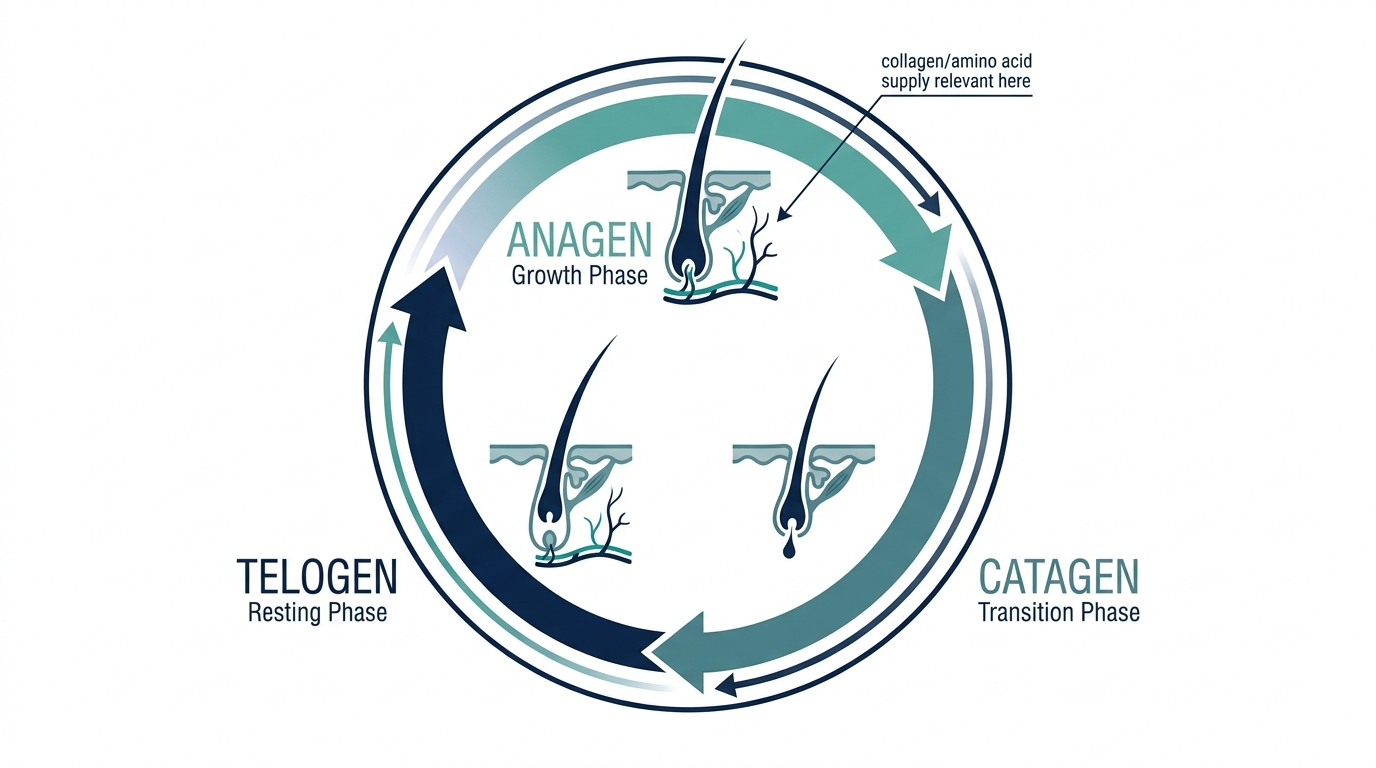
Short answer: Yes, with meaningful caveats. A 2026 randomized, double-blind, placebo-controlled trial published in the International Journal of Peptide Research and Therapeutics found that a low-molecular-weight collagen peptide group showed significant improvements in hair luster, shaft integrity, tensile strength, diameter, and density compared to placebo. But collagen does not directly become hair. It works indirectly, by supplying amino acids your follicles use to build keratin, by extending the anagen (growth) phase, and by reducing the oxidative stress that quietly degrades follicle stem cells over time.
Collagen research on hair growth is promising, but what’s actually driving your hair loss right now? One at-home Superpower draw checks 100+ biomarkers, physician-reviewed.
Why are so many people asking about collagen and hair right now?
Hair loss searches have spiked in the past two years, partly because dermatologists are now seeing a documented post-viral telogen effluvium wave, and partly because the supplement market pivoted hard toward collagen after biotin’s clinical track record turned out to be weaker than a decade of gummy-vitamin marketing implied.
Here is the tension that drives the question: hair is made of keratin, not collagen. They are structurally different proteins. So a reasonable person reads “collagen for hair” and immediately wonders whether this is just a label swap, a way to repackage the same “eat protein and something might happen” advice with fancier branding.
The answer is more interesting than that, and the mechanism matters if you want to know whether to spend money on it.
Full-body lab membership: 100+ biomarkers, doctor-reviewed, tracked over time.
How exactly does collagen get from your gut to your hair follicle?
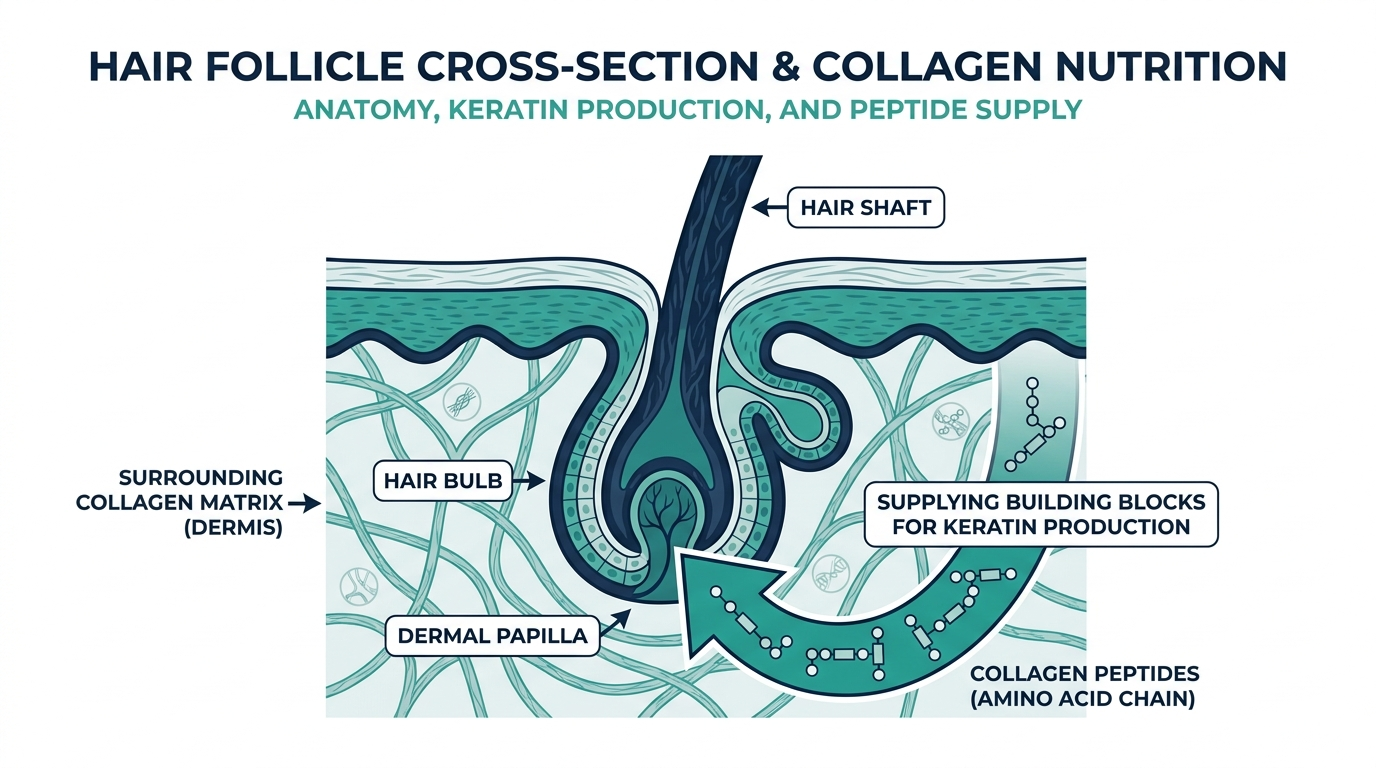
When you swallow a collagen peptide supplement, your digestive enzymes break the hydrolyzed collagen chains into their component amino acids, primarily glycine, proline, and hydroxyproline. These do not arrive at your hair follicle labeled “for hair use only.” They enter the general amino acid pool and get deployed wherever your body has the most urgent demand.
The reason this still matters for hair specifically comes down to three overlapping mechanisms.
First, the amino acid supply line. Keratin, the fibrous protein that makes up roughly 85% of each hair shaft, has a high proline content. Proline is classified as a conditionally essential amino acid, meaning your body makes some but not always enough under metabolic stress, illness, or chronic caloric restriction. Collagen is one of the richest dietary sources of proline on the planet. When the follicle has adequate proline circulating, keratin synthesis runs without a bottleneck. When it does not, hair diameter and tensile strength are the first things to suffer.
This bottleneck is more common than it sounds. Intermittent fasting protocols that restrict protein, combined with even moderate caloric deficits, can create transient proline shortfalls that show up as increased shedding about three months later, right at the lag that makes cause and effect nearly impossible to trace.
Second, the dermal papilla pathway. Dermal papilla cells are the small cluster of specialized cells at the base of each follicle that acts as the “command center” for the entire hair growth cycle. A 2024 study in Experimental Dermatology found that a specific fraction of collagen peptides, called AP collagen peptides (APCPs), promoted hair growth by activating the GSK-3 beta/beta-catenin signaling pathway in dermal papilla cells, the same Wnt/beta-catenin axis that minoxidil and several investigational hair loss drugs target (PubMed, Lee et al. 2024). The collagen fraction directly stimulated cell proliferation and extended the anagen phase in a mouse model, accelerating the telogen-to-anagen transition.
Third, the type XVII collagen connection. This is the mechanism almost nobody discusses in supplement marketing. A landmark Science paper identified that aging of hair follicle stem cells (HFSCs) is driven by the breakdown of type XVII collagen (COL17A1), a structural protein anchoring HFSCs to their niche (Science, Matsumura et al. 2016). When DNA damage accumulates in the follicle, COL17A1 undergoes proteolysis, stem cells lose their “stemness,” migrate upward, and differentiate into epidermal cells instead of hair-producing cells. The result is slow but irreversible follicle miniaturization, meaning shorter, thinner hair with each successive cycle. A 2025 study in Cosmetics showed that recombinant type XVII collagen promoted hair growth by activating both Wnt/beta-catenin and SHH/GLI signaling pathways (MDPI, 2025). Oral collagen peptides are not the same as recombinant type XVII collagen, but they contribute to the same collagen-rich extracellular matrix environment the follicle stem cell niche depends on.
What does the human clinical evidence actually show?
The evidence is real but not massive. Here is what exists as of mid-2026, without inflating it.
A randomized, double-blind, placebo-controlled trial published in 2026 in the International Journal of Peptide Research and Therapeutics tested low-molecular-weight collagen peptides in adults with damaged hair (Springer, 2026). Compared with placebo, the collagen group showed significant improvements in hair luster, shaft surface integrity, tensile strength, diameter, and hair density, alongside higher participant satisfaction scores.
A separate 2025 clinical study, cited by MDhair, followed participants for 24 weeks on a marine collagen peptide protocol and found normalization of cuticle structure and one-to-two grade improvements on the standard scanning electron microscopy (SEM) hair health grading scale (MDhair).
Gibson et al. (2024) tested a hydrolyzed collagen and vitamin C combination over 12 weeks and found a 27.6% increase in hair density in the collagen group compared to placebo, alongside an 11% improvement in scalp scaling (MDhair source).
A 2024 ScienceDirect study using human hair follicle organ culture showed that oral collagen peptides promoted elongation of hair follicles and induction of new hair shafts, preventing follicle regression (ScienceDirect, 2024).
Personally, what strikes me most is that the magnitude of effect across these studies is real but modest. No trial is showing 50% density recovery in people with established androgenetic alopecia. What they are consistently finding is meaningful improvements in hair quality metrics (tensile strength, diameter, cuticle integrity) and growth cycle dynamics, which is exactly what you would expect from an intervention that works at the supply-and-environment level rather than the hormonal or genetic level.
Marine vs. bovine collagen for hair: does the source matter?
It does, though not as dramatically as marketing implies.
| Feature | Marine Collagen | Bovine Collagen |
|---|---|---|
| Primary collagen type | Type I (dominant) | Type I and III |
| Molecular weight | Lower (better absorption, ~1,500 Da) | Higher (still well absorbed hydrolyzed) |
| Hydroxyproline content | Higher | Moderate |
| Anagen phase extension | More pronounced in studies | Beneficial via stem cell niche support |
| Bioavailability | Superior (absorbs 1.5x faster) | Slightly lower |
| Price | Higher ($40-70 per month typical) | Lower ($20-50 per month typical) |
| Dietary restrictions | Not suitable for vegans or pescatarians with fish allergy | Not suitable for vegans, halal, or kosher diets |
| Best for | Hair, skin, nails focus | All-purpose collagen support, joint + gut |
A 2025 comparative review in MDhair found that marine collagen was notably superior at prolonging the anagen phase, attributed to its higher hydroxyproline and hydroxylated proline content, which carry antioxidant properties particularly protective of the scalp environment (MDhair). If hair is the primary goal, marine collagen has the edge in the literature as it stands. If you want one supplement for joints, gut, and hair together, bovine is more economical and still effective.
Do not believe the “collagen equals keratin” shortcut
This is the myth that runs through most supplement marketing, even from otherwise reputable brands: the idea that taking collagen will directly replenish your hair’s keratin stores as if you are topping off a tank.
It does not work that way. Collagen and keratin are structurally distinct proteins. Keratin is a fibrous structural protein held together by disulfide bonds between cysteine residues. Collagen is a triple-helix structural protein rich in glycine-proline-hydroxyproline repeats. When you digest either of them, you get a pool of amino acids, not a ready-made replacement part.
The accurate framing is: collagen peptides supply specific amino acids (especially proline) that are limiting nutrients for keratin synthesis, support the extracellular matrix environment the follicle depends on, modulate growth factor signaling in dermal papilla cells, and reduce oxidative damage to follicle stem cells. That is four legitimate mechanisms, none of which require the collagen-to-keratin conversion story.
Knowing this distinction also helps you understand what collagen cannot do: it cannot block DHT, it cannot address iron deficiency anemia, and it will not override genetic androgenetic alopecia. For those, you need different interventions.
How does collagen compare to biotin for hair growth?
Biotin is the better-known supplement, partly because of decades of deficiency case reports showing dramatic reversals, and partly because it was easier to put in a gummy.
The honest comparison in 2026 looks like this: biotin supplementation produces meaningful hair improvements only when the person has a biotin deficiency, which is actually uncommon in people eating any variety of protein. A placebo-controlled study found that roughly 39% of participants in a biotin group reported a “remarkable decline” in hair loss, but this was not restricted to people with confirmed deficiency, so the number is hard to interpret. In people with normal biotin levels, the evidence for benefit is thin.
Collagen, by contrast, works through mechanisms that are relevant regardless of deficiency status. You do not need to be “collagen deficient” to benefit from amino acid availability or Wnt/beta-catenin pathway activation. The evidence base for collagen on hair structure outcomes is, as of 2026, stronger than the evidence base for biotin in non-deficient people.
The savvy move is not to choose between them. Vitamin C is required for collagen synthesis and was included in the Gibson et al. study that found the 27.6% density gain. If you are going to spend money on hair supplements, a hydrolyzed collagen plus vitamin C combination has better clinical grounding than biotin alone for anyone without a confirmed deficiency.
Hydrolyzed type I & III collagen peptides, third-party tested, unflavored.
How much collagen do you actually need, and for how long?
Dosing in the studies with positive hair outcomes ranged from 2,000 mg (2 g) daily for a 24-week skin and hair study to 10-20 g daily in broader collagen supplementation protocols. Most commercial collagen powders (Vital Proteins, Ancient Nutrition, Live Conscious) are dosed at 10-20 g per serving, which places them at or above the range used in clinical studies.
The timeline question is where most people underestimate the commitment. Hair grows roughly 1.25 cm (half an inch) per month during the anagen phase. Meaningful changes in density, tensile strength, and diameter will lag behind the biochemical changes by weeks because you are waiting for newly initiated follicle cycles to complete enough of their growth phase to be measurable. The consensus from the literature is:
- 4 to 8 weeks: reduced shedding during the telogen phase, possibly less breakage
- 3 months: visible improvement in shaft diameter and shine for some users
- 6 months: statistically detectable changes in density in the clinical trials
Anyone expecting results in two weeks has the wrong mental model for how hair biology works.
When will collagen not help your hair?
This matters more than the positive case, and very few supplement brands will say it directly.
Collagen supplementation is unlikely to produce meaningful hair recovery when:
- Iron stores are depleted. Ferritin below 40 ng/mL is associated with telogen effluvium in multiple studies. No amount of collagen compensates for the iron your follicle cells need to generate energy for protein synthesis.
- Thyroid function is off. Hypothyroidism is one of the most common and most missed causes of diffuse hair thinning in women over 30. TSH above 3.0 mIU/L is a common threshold where thyroid-related hair loss begins. Collagen does nothing for this.
- Androgenetic alopecia is advanced. If DHT has miniaturized the follicle past a critical threshold, the follicle may not have the cellular machinery to respond to improved amino acid availability. Earlier-stage patterned hair loss has more potential to respond.
- Caloric restriction is severe. Hair is biologically lower priority than organ function. If total protein intake is inadequate (below about 0.8 g per pound of body weight), collagen peptides on top of that still leave the follicle protein-starved.
This is why a biomarker panel before starting supplements is not a luxury recommendation. Ferritin, TSH, free T4, SHBG, and free testosterone together explain the majority of non-genetic hair loss causes, and most people have never had them measured at the same time. Treating a thyroid problem costs $15 a month in medication. Treating an iron deficiency costs even less. Both will outperform any supplement protocol if they are the underlying cause.
Don’t just read about your health, track it.
A single result is a snapshot. Superpower re-tests 100+ markers over time so you can watch them move as you change sleep, food, and training.
Frequently asked questions
Does collagen actually make hair grow faster?
Not exactly “faster,” but it can extend the anagen (growth) phase and increase the proportion of follicles in active growth at any given time. The 2024 Lee et al. study in Experimental Dermatology found that AP collagen peptides accelerated the onset of anagen in a mouse model and upregulated VEGF and beta-catenin expression, both of which support active follicle function. In humans, the more consistent findings are improved hair diameter and reduced shedding rather than measurably accelerated growth rate.
How long does it take collagen to work for hair?
Most clinical studies observe statistically meaningful changes at 12 to 24 weeks (3 to 6 months) of consistent daily supplementation. Reduced shedding can appear earlier, around 4 to 8 weeks, because the telogen phase is more sensitive to nutritional inputs than the active growth phase.
Is marine collagen or bovine collagen better for hair?
Marine collagen has an edge in the specific literature on hair, due to higher hydroxyproline content and superior molecular bioavailability. It absorbs roughly 1.5 times faster. However, the difference is not so large that bovine collagen is a poor choice. For someone prioritizing hair specifically, marine collagen is worth the slightly higher price.
Can collagen stop hair loss entirely?
No. Collagen addresses nutritional and microenvironmental factors around the follicle. It does not block DHT (the hormone that drives male and female pattern baldness), it does not correct thyroid dysfunction, and it does not reverse iron deficiency. If one of those is your underlying cause, collagen will not produce noticeable improvement.
Is there a risk collagen peptides could cause hair loss?
There is no scientific evidence that collagen peptides cause hair loss. The biological mechanisms all point in the opposite direction. The confusion sometimes arises because people start a collagen supplement around the same time they notice increased shedding, which may already be underway for an unrelated reason. Correlation is not causation here.
What dose of collagen should I take for hair?
Studies showing hair benefits have used 2 g to 10 g of hydrolyzed collagen daily. Most commercial powders like Vital Proteins provide 10 to 20 g per serving, which exceeds clinical study doses. Starting at one serving daily (as directed on the product) puts you well within the range associated with positive outcomes. There is no evidence that higher doses produce proportionally greater hair benefits.
Should I take collagen with vitamin C for hair?
Yes, and the evidence supports it. Vitamin C is a required cofactor for the enzymes that hydroxylate proline and lysine during collagen synthesis. Without adequate vitamin C, newly synthesized collagen chains are structurally weaker. The 2024 Gibson et al. study testing collagen plus vitamin C found a 27.6% increase in hair density versus placebo, and the combination specifically is what was tested, not collagen alone.
Hydrolyzed type I & III collagen peptides, third-party tested, unflavored.
Author: Vital Signs Today Editorial Team, [credential]”]. Educational content, not medical advice. Sources linked inline.
Primary sources
- Springer Nature: Low-Molecular-Weight Collagen Peptides Improve Hair Health (2026)
- ScienceDirect: Oral Collagen Peptides and Human Hair Follicle Organ Culture (2024)
- PubMed: AP Collagen Peptides Promote Hair Growth via GSK-3B/B-Catenin Pathway, Lee et al. 2024
- PMC: Low Molecular Weight Collagen Peptide Promotes Hair Growth via Wnt/GSK-3B/B-Catenin Signaling
- PMC: Fish Collagen Peptide in Human Dermal Papilla Cells and C57BL/6 Mice
- Science: Hair Follicle Aging Driven by COL17A1 Proteolysis, Matsumura et al. 2016
- MDPI Cosmetics: Recombinant Type XVII Collagen Promotes Hair Growth (2025)
- MDhair: Marine vs. Bovine Collagen for Hair
- MDhair: Collagen and Vitamin C Clinical Results
- Wimpole Clinic: Does Collagen Help Hair Growth?
- PMC: Oxidative Stress in Ageing of Hair
- Superpower: Biomarkers for Hair Health
Related reading
Vital Signs Today may earn a commission if you buy through links on this page. It does not affect our editorial assessments.