
Last updated 18 June 2026. Educational content, not medical advice. BPC-157 is not FDA-approved for human use. Speak to a licensed clinician before considering any peptide therapy.
Short answer: BPC-157 is definitively a peptide, a 15-amino-acid chain with the molecular formula C62H98N16O22 and a molecular weight of 1,419.55 daltons. It shares zero structural features with steroids, which are cholesterol-derived four-ring lipid compounds. The confusion exists because both BPC-157 and anabolic steroids circulate in the same athletic and bodybuilding communities, but at the chemistry level they are as different as a protein bar and a hormone injection.
BPC-157 shares zero structure with steroids, it’s a 15-amino-acid peptide. Curious what your own inflammation and recovery markers show? One at-home Superpower draw checks 100+ biomarkers, physician-reviewed.
Why do so many people mix up BPC-157 and steroids?
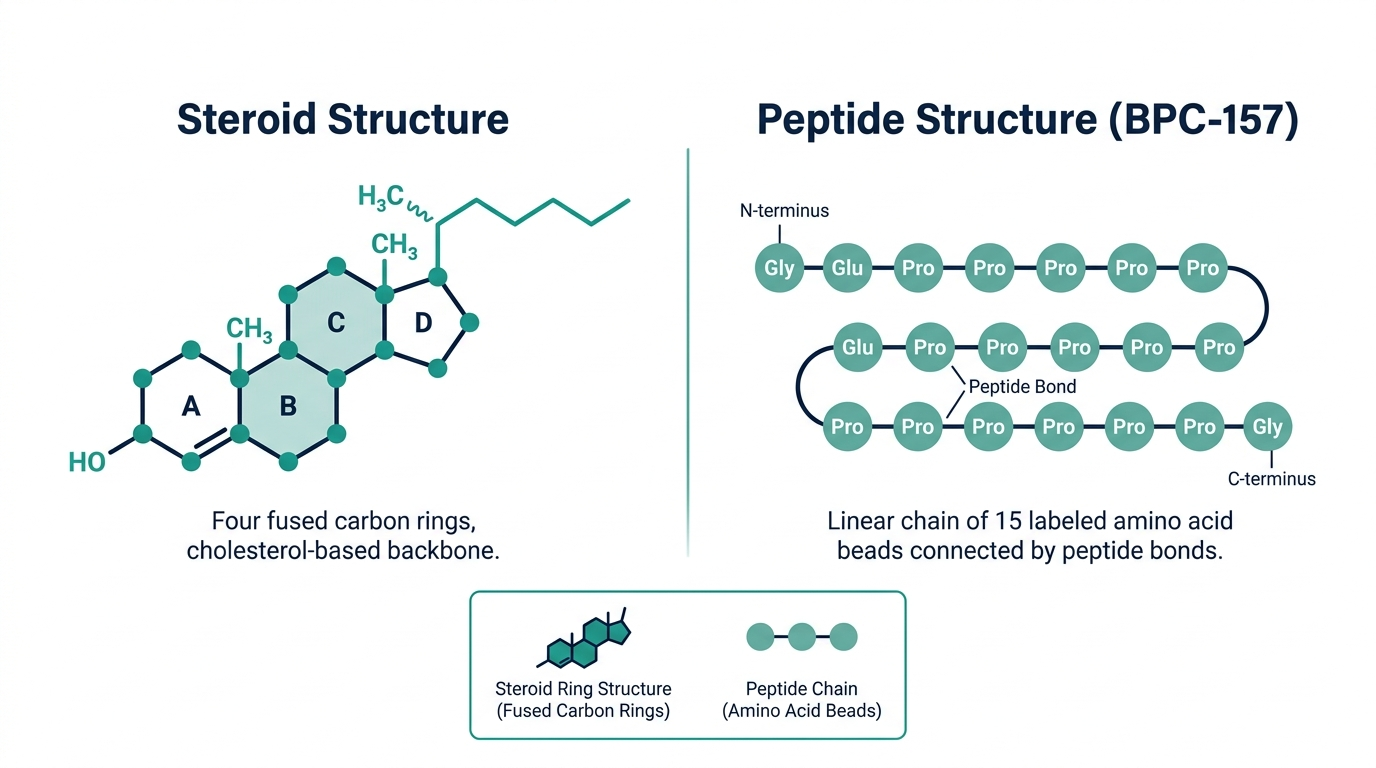
The question lands in search engines tens of thousands of times a month, and the confusion is not random. BPC-157 travels in the same circles as anabolic steroids: underground forums, bodybuilding subreddits, and peptide vendor catalogs all stack BPC-157 next to compounds that do carry steroid-level risk. The molecule itself gets guilt-by-association.
There is also a second driver. “Peptide” is an umbrella word that covers everything from the collagen powder in a protein bar to synthetic growth hormone analogues. When someone reads “injectable peptide” and “accelerated tissue repair,” they reach for the nearest reference class they know, which for most people is steroids. The word peptide is genuinely unfamiliar at a molecular level for most people who encounter it.
The third source of confusion is WADA. BPC-157 is banned by the World Anti-Doping Agency under two categories simultaneously: S0 (Non-Approved Substances) and S2 (Peptide Hormones, Growth Factors, Related Substances and Mimetics). When an athlete hears “banned substance,” the word steroid often follows automatically. But the WADA ban is based on BPC-157’s potential to enhance healing and angiogenesis, not on testosterone-like anabolic activity.
What actually makes something a steroid?
Before we go further on BPC-157, the definition of steroid deserves a precise answer rather than a vague one.
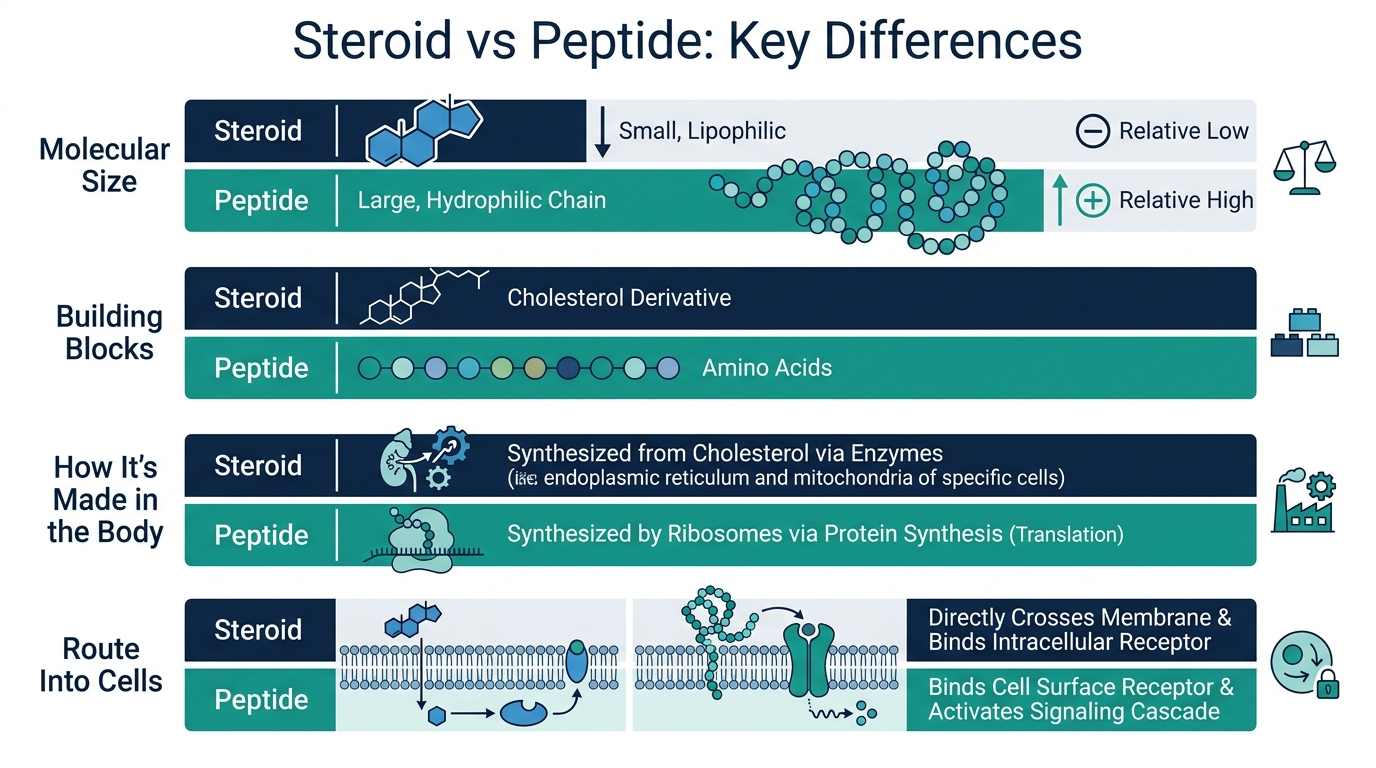
A steroid is a lipid-based compound built on a specific four-ring carbon skeleton called the gonane structure: three six-membered rings and one five-membered ring fused together, derived from cholesterol. Every steroid, from cortisol to testosterone to estrogen to vitamin D, shares that same ring framework. Because steroids are fat-soluble (lipophilic), they pass directly through cell membranes and bind to receptors inside the cell nucleus, triggering gene expression changes. That nuclear-entry mechanism is what gives anabolic steroids their dramatic, fast-onset effects on muscle protein synthesis.
Anabolic-androgenic steroids (AAS), the category people usually mean when they say “steroids,” bind directly to androgen receptors and produce a measurable surge in muscle protein synthesis. They also suppress the hypothalamic-pituitary-gonadal (HPG) axis, which is why a cycle typically requires a post-cycle therapy protocol to restart natural testosterone production.
BPC-157 does none of this. It has no four-ring carbon skeleton, no cholesterol origin, no androgen-receptor binding, and no documented HPG suppression.
What actually makes BPC-157 a peptide?
A peptide is a chain of amino acids linked by peptide bonds. Peptides are water-soluble, not fat-soluble, which means they cannot cross cell membranes on their own. Instead they bind to receptors on the cell surface and trigger signaling cascades from the outside.
BPC-157 (Body Protection Compound-157) is a synthetic pentadecapeptide, meaning it contains exactly 15 amino acids in a specific sequence: Gly-Glu-Pro-Pro-Pro-Gly-Lys-Pro-Ala-Asp-Asp-Ala-Gly-Leu-Val. It was isolated in the early 1990s at the University of Zagreb by Professor Predrag Sikiric’s research group, who were studying the cytoprotective proteins found in human gastric juice. The peptide is a stabilized synthetic fragment of a larger protein called gastric juice basic secretory protein (GBSP), and the “157” in its name refers to its position in that parent protein sequence.
The parentage matters: BPC-157 was born from stomach lining research, not from hormone engineering, which partly explains why its primary documented effect is tissue repair rather than direct anabolic output.
Here is the head-to-head comparison that settles the classification question:
| Feature | Steroids (AAS) | BPC-157 (Peptide) |
|---|---|---|
| Molecular backbone | Four-ring carbon (gonane) from cholesterol | Chain of 15 amino acids |
| Molecular formula | e.g., Testosterone: C19H28O2 | C62H98N16O22 |
| Solubility | Fat-soluble (lipophilic) | Water-soluble (hydrophilic) |
| Cell entry mechanism | Crosses cell membrane, binds nuclear receptor | Binds surface receptor, signals from outside |
| Androgen receptor activity | Direct binding, potent | None documented |
| HPG axis suppression | Yes, significant | Not documented |
| Primary effect | Direct muscle protein synthesis increase | Tissue repair, angiogenesis, inflammation modulation |
| FDA schedule | Schedule III controlled substance (testosterone) | Unscheduled under Controlled Substances Act |
| WADA status | Prohibited | Prohibited (different categories) |
What does BPC-157 actually do in the body?
This is where BPC-157 earns its genuine research interest and also where overclaiming starts. The honest answer is: the preclinical data is compelling, the human data is thin, and anyone who bridges that gap too confidently is selling something.
In animal models, BPC-157 works through several distinct pathways. It stimulates angiogenesis, the formation of new blood vessels, primarily through VEGFR2 activation and nitric oxide signaling. More blood flow to injured tissue is mechanically useful for healing. It also enhances fibroblast migration to injury sites and boosts type I collagen production, which is structurally load-bearing in tendons and ligaments. A 2026 PMC review in the International Journal of Molecular Sciences documented BPC-157’s role in both tissue repair and pain management, including modulation of the JAK2 signaling pathway and suppression of pro-inflammatory cytokines TNF-alpha and IL-6 (PMC12446177).
A separate 2026 review published in PMC by Sikiric and colleagues specifically addresses BPC-157’s interaction with nitric oxide pathways, describing the peptide as targeting angiogenesis and cytotoxic NO actions while preserving their protective functions (PMC12567428). Professor Sikiric’s group has published over 147 studies on BPC-157, almost all in rodent or in-vitro models.
The human data is sparse in a way that should be said plainly. As of mid-2026, fewer than 30 people across all published human studies have received BPC-157 in a controlled research setting. There are no randomized controlled trials. A Phase I clinical trial (NCT02637284) sponsored by PharmaCotherapia was designed to enroll 42 healthy volunteers, but results were never submitted. One Phase 2 trial currently recruiting (NCT07437547) is evaluating BPC-157 for acute hamstring muscle strain, with return-to-sport time as a primary endpoint.
Full-body lab membership: 100+ biomarkers, doctor-reviewed, tracked over time.
Does BPC-157 build muscle like steroids do?
No, and this distinction is worth being specific about. Anabolic steroids work by directly binding androgen receptors, which triggers a measurable surge in muscle protein synthesis (MPS). That is the mechanism behind the 5 to 20 lb muscle gains documented in controlled testosterone trials.
BPC-157 does not bind androgen receptors. It does not directly increase MPS. What it may do, based on animal research, is create conditions that support faster recovery from training damage: better blood supply to healing tissue, faster tendon and ligament repair, and reduced local inflammation. The bodybuilding community calls this an “indirect” anabolic effect, and that framing is fair, but it is not the same mechanism as AAS and should not be evaluated by the same yardstick.
Personally, the marketing language around BPC-157 in bodybuilding contexts bothers me. Phrases like “steroid-like healing” and “anabolic peptide” in vendor copy are not technically wrong enough to fight, but they manufacture exactly the confusion behind this article’s primary question. A compound that accelerates healing is valuable on its own terms without being dressed up in steroid vocabulary.
The one category where BPC-157 overlaps meaningfully with the bodybuilding use case is the HPG axis. Unlike testosterone, nandrolone, or any AAS, BPC-157 has no documented suppression of endogenous hormone production. That is a genuine pharmacological distinction, not a marketing point: someone using BPC-157 for tendon recovery is not accumulating the downstream cost of a hormonal recovery protocol.
What is the 2026 legal and regulatory status?
This is the most practically important section and the one that changes fastest.
The FDA placed BPC-157 on its 503A Category 2 list in November 2023, effectively banning it from use in compounding pharmacies. Then, in April 2026, the FDA removed both BPC-157 free base and BPC-157 acetate from Category 2. That removal did not move them to Category 1 (the affirmatively permitted list). It left them in a regulatory grey zone: neither explicitly prohibited from compounding nor explicitly authorized.
The next decisive step is a Pharmacy Compounding Advisory Committee (PCAC) meeting scheduled for July 23 to 24, 2026, where the committee will consider whether BPC-157 belongs on the 503A Bulks List. A Category 1 placement would open the door for licensed compounding pharmacies to include it in prescribed therapies. HHS signaled in early 2026 that roughly 14 peptides, including BPC-157, TB-500, CJC-1295, and Ipamorelin, are on the shortlist for that review.
For athletes: BPC-157 is banned year-round under WADA’s Prohibited List 2026, under both S0 and S2 categories, as confirmed by USADA. The UFC, NFL, NBA, MLB, and NCAA all enforce this ban. Detection uses advanced mass spectrometry. Violations trigger sanctions of two to four years. The WADA ban is about performance enhancement through accelerated healing, not anabolic or androgenic risk, but the competitive consequence is identical.
For everyone else: BPC-157 is not a controlled substance under the Controlled Substances Act. Research-use-only (RUO) sale is legal. Personal possession is not federally prosecuted. But the RUO label is a legal fiction that transfers risk entirely to the purchaser. The moment you draw it into a syringe for human use, you leave the legal protection of that label.
Do not believe vendors who frame the April 2026 Category 2 removal as “BPC-157 is now legal.” It is not approved. It is not yet on the Category 1 permitted list. It is in a waiting room, and the July 2026 PCAC meeting will determine whether it advances.
What are the known risks and safety concerns?
In rodent studies across tendon, gut, liver, and CNS models, BPC-157 has not produced a consistent toxicity signal even at doses 100 times the typical research equivalent. A 2025 pilot study in two healthy adults showed IV infusion was well tolerated with no adverse effects (Alternative Therapies in Health and Medicine).
The side effects reported by human users skew mild: injection-site redness, transient lightheadedness, occasional GI upset, and mild fatigue in the first week. These are consistent with subcutaneous peptide injection generally, not specific pharmacological effects of BPC-157.
The more theoretically serious concern is angiogenesis. BPC-157 promotes the formation of new blood vessels, which is exactly what makes it interesting for tissue repair. That same process can, in principle, supply blood to tumor tissue. A 2025 study suggested BPC-157 modulates rather than indiscriminately activates angiogenesis and demonstrated anti-tumor properties in preclinical settings, but the question has not been answered in human clinical trials. Anyone with a personal or family history of cancer should discuss this specific mechanism with an oncologist before considering BPC-157.
This is the honest gap in the evidence: the short-term safety profile in healthy adults looks benign, and the long-term profile is simply unknown because the trials have not been run.
How does BPC-157 get into the body, and does the route matter?
It does, in a way the vendor pages typically do not explain. BPC-157 has two primary administration routes in research contexts: subcutaneous injection and oral.
The injectable form bypasses gut metabolism and delivers the peptide systemically. This is the route associated with the systemic effects (tendon healing, CNS models, cardiovascular benefits) documented in most animal research. The injectable form requires reconstituting a lyophilized (freeze-dried) powder in bacteriostatic water, which requires its own precision: the wrong water-to-peptide ratio produces a dose that is off by a factor of ten.
The oral route is less well-documented for systemic uptake, but BPC-157 shows unusual stability in the digestive environment, which is consistent with its gastric origin. Research has shown oral BPC-157 produces meaningful gut-protective effects (PMC8275860). For gut-specific applications (leaky gut, ulcers, IBS), oral administration has a logic that the injectable route does not offer.
The takeaway: the same molecule produces different effects depending on the route. This is not a distinction you will find on most vendor product pages.
Telehealth GLP-1 program with provider visits and pharmacy coordination.
What does it actually cost to access BPC-157 in 2026?
Pricing breaks cleanly along the route:
| Route | Cost estimate | Oversight included |
|---|---|---|
| Research-use-only grey vendor | $30 to $120 per vial | None |
| Compounding pharmacy (if PCAC approves, post-July 2026) | $180 to $280 per month | Licensed pharmacist, prescription |
| Telehealth peptide clinic (full program) | $199 to $445+ per month | Clinician, monitoring, shipping |
| Complete “Wolverine Stack” (BPC-157 + TB-500) via clinic | $445 to $795 per cycle | Clinician oversight |
None of these are covered by insurance. BPC-157 has no FDA-approved indication, so carriers do not reimburse it regardless of clinical rationale. Budget for out-of-pocket costs before you start.
The grey vendor number looks cheaper on a spreadsheet. But the vendor price does not include bacteriostatic water, insulin syringes, needles, swabs, the cognitive load of doing the dose math yourself, or the cost of a contaminated batch from an unverified supplier. A 2026 independent testing review found that purity failures and identity mismatches are not edge cases in the RUO market. They are regular events. That is a real cost the price tag hides.
Curious what your own levels look like?
Baseline 100+ biomarkers today and retest as life changes, all in one membership with physician review.
Frequently asked questions
Is BPC-157 a steroid?
No. BPC-157 is a peptide, a 15-amino-acid synthetic chain with molecular formula C62H98N16O22. Steroids are cholesterol-derived four-ring lipid compounds. The two categories share no structural, mechanistic, or pharmacological overlap. BPC-157 does not bind androgen receptors and does not suppress the HPG axis.
Is BPC-157 a controlled substance?
No. BPC-157 is not scheduled under the Controlled Substances Act. Possession is not federally prosecuted. However, it is not FDA-approved for human use, and selling it for human use is not legal. The RUO designation exists precisely to separate commercial sale from human-use authorization.
Is BPC-157 banned in sports?
Yes. WADA’s 2026 Prohibited List bans BPC-157 year-round under S0 (Non-Approved Substances) and S2 (Peptide Hormones, Growth Factors, Related Substances). The ban applies to all sports under WADA jurisdiction including the UFC, NFL, MLB, NBA, and NCAA. Violations trigger two to four year sanctions.
Does BPC-157 work like testosterone?
No. Testosterone and anabolic steroids work by binding androgen receptors inside cells and dramatically increasing muscle protein synthesis. BPC-157 binds surface receptors, does not directly increase MPS, and produces its effects through angiogenesis, collagen stimulation, and inflammation modulation. The mechanisms are fundamentally different.
What is BPC-157 actually legal for right now?
As of June 2026, BPC-157 sits in a regulatory grey zone. The FDA removed it from Category 2 (banned from compounding) in April 2026 but has not yet placed it on the Category 1 permitted list. A PCAC meeting on July 23 to 24, 2026 will determine whether licensed compounding pharmacies can include it. Research-use-only sale remains legal; administration for human use is not authorized.
Can I get BPC-157 from a doctor?
Not through standard prescription channels yet. A small number of telehealth clinics include BPC-157 in peptide protocols and source it from compounding pharmacies that are navigating the current grey zone. If PCAC votes favorably in July 2026, compliant licensed compounding will become the clearly correct route. Defy Medical, Marek Health, and Hone Health are among the named platforms that offer peptide programs with clinical oversight.
How is BPC-157 different from growth hormone or GLP-1 drugs?
GLP-1 drugs like semaglutide (Ozempic/Wegovy) are FDA-approved peptide hormones for weight management, dispensed by prescription through standard pharmacy channels. Growth hormone secretagogues like sermorelin stimulate GH release and are also prescription-only. BPC-157 operates through a completely different mechanism (tissue repair, angiogenesis), has no FDA-approved indication, and is not hormone therapy in any conventional sense.
Author: Vital Signs Today Editorial Team, [credential]”]. Educational content, not medical advice. Sources linked inline.
Telehealth GLP-1 program with provider visits and pharmacy coordination.
Primary sources:
- BPC-157, Wikipedia
- PMC12446177: Regeneration or Risk? Narrative Review of BPC-157 for Musculoskeletal Healing (2026)
- PMC12567428: BPC 157 Therapy, Targeting Angiogenesis and Nitric Oxide (2026)
- PMC8275860: Stable Gastric Pentadecapeptide BPC 157 and Wound Healing
- PMC6271067: BPC 157 Enhances Growth Hormone Receptor Expression in Tendon Fibroblasts
- FDA PCAC Meeting July 23-24, 2026
- USADA: BPC-157, Experimental Peptide Creates Risk for Athletes
- Loti Labs: BPC-157 Legal Status 2026, FDA Category 2 Removal, PCAC Review
- AgeMD: BPC-157 FDA Status 2026, RFK Reclassification Explained
- PeakedLabs: BPC-157 Cost Guide 2026
- ClinicalTrials.gov NCT07437547: BPC 157 for Acute Hamstring Muscle Strain
- Alternative Therapies: Safety of Intravenous Infusion of BPC157 in Humans
- STAT News: BPC-157, the peptide with big claims and scant evidence (Feb 2026)
Related reading
Vital Signs Today may earn a commission if you buy through links on this page. It does not affect our editorial assessments.