Quick answer: Does urgent care do blood work? Yes, but only a limited menu of fast, common tests. Most clinics can run a rapid blood glucose, a basic metabolic panel, a complete blood count, a pregnancy test, mono and strep, and finger-stick screens on-site within a single visit. Anything specialized (hormones, vitamin D, a full lipid panel, tumor markers, most thyroid work) gets drawn at the clinic and shipped to an outside reference lab like Quest or Labcorp, with results in one to three days. Expect $100 to $250 cash for the visit plus the labs if you have no insurance.
Does urgent care do blood work, and what can they run on-site?
Yes, urgent care does blood work for the tests that change what they do for you in the next 30 minutes. That is the entire logic of an urgent care lab: it stocks point-of-care analyzers and rapid kits, not a full reference lab. If a result will not change your treatment during that single visit, they usually draw it and send it out rather than run it themselves.
Urgent care only runs a limited blood menu, so what would a full panel catch that they can’t? One at-home Superpower draw checks 100+ biomarkers, physician-reviewed.
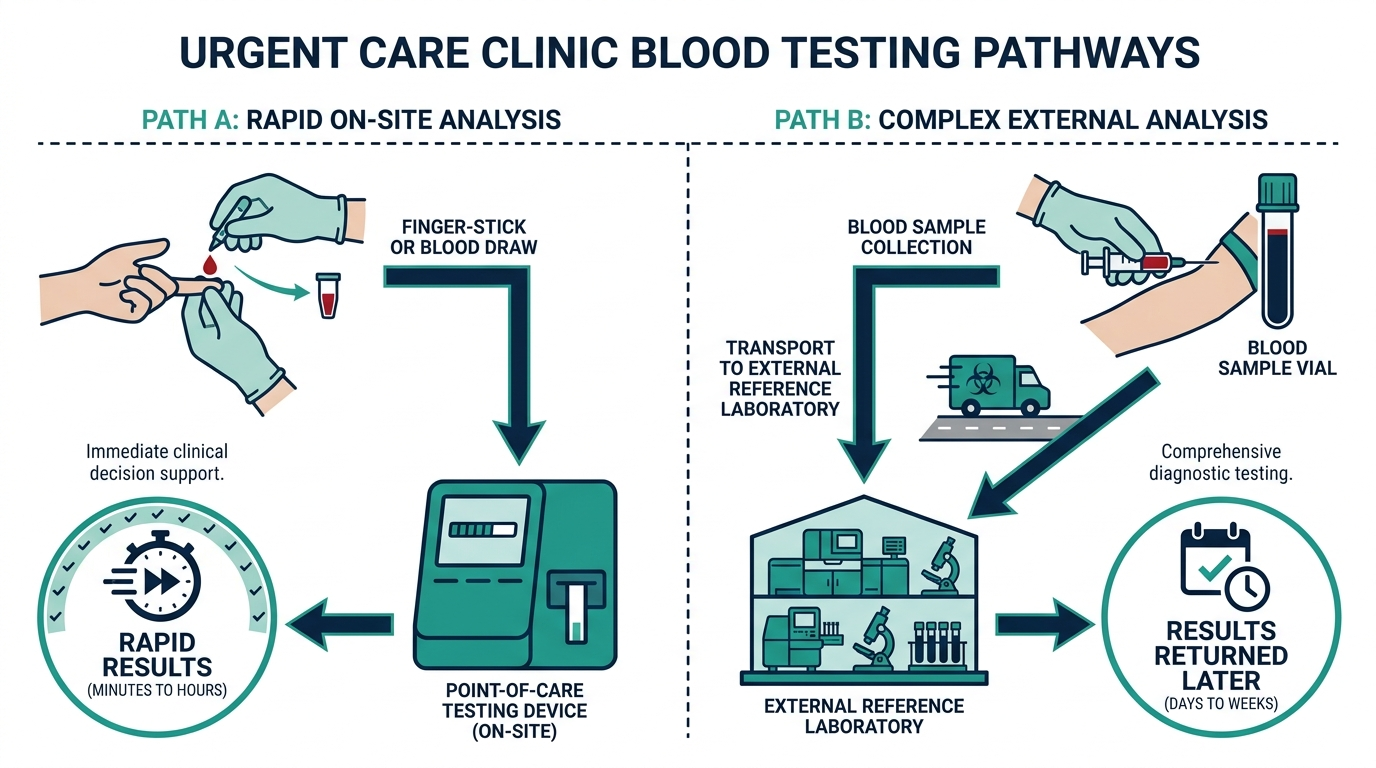
Here is the insider part most patients never hear. Urgent care centers are built around throughput. They invest in tests that turn around in minutes because the whole business model depends on getting you diagnosed, treated, and out the door fast. The blood draw itself is identical to a hospital draw, same needle, same tubes, same phlebotomy technique. What splits “on-site” from “send-out” is the analysis location, not the draw. The same tube of blood might give you a glucose reading on the spot and a vitamin D level four days later from a lab two states away.
A point-of-care analyzer is a countertop machine, often about the size of a desktop printer, that reads a small blood sample and prints results in 2 to 15 minutes. The most common ones run a CBC, a basic metabolic panel, and cardiac or inflammation markers. They cost the clinic real money per cartridge, which is part of why on-site labs carry a price even when the visit feels quick.
The standard on-site menu
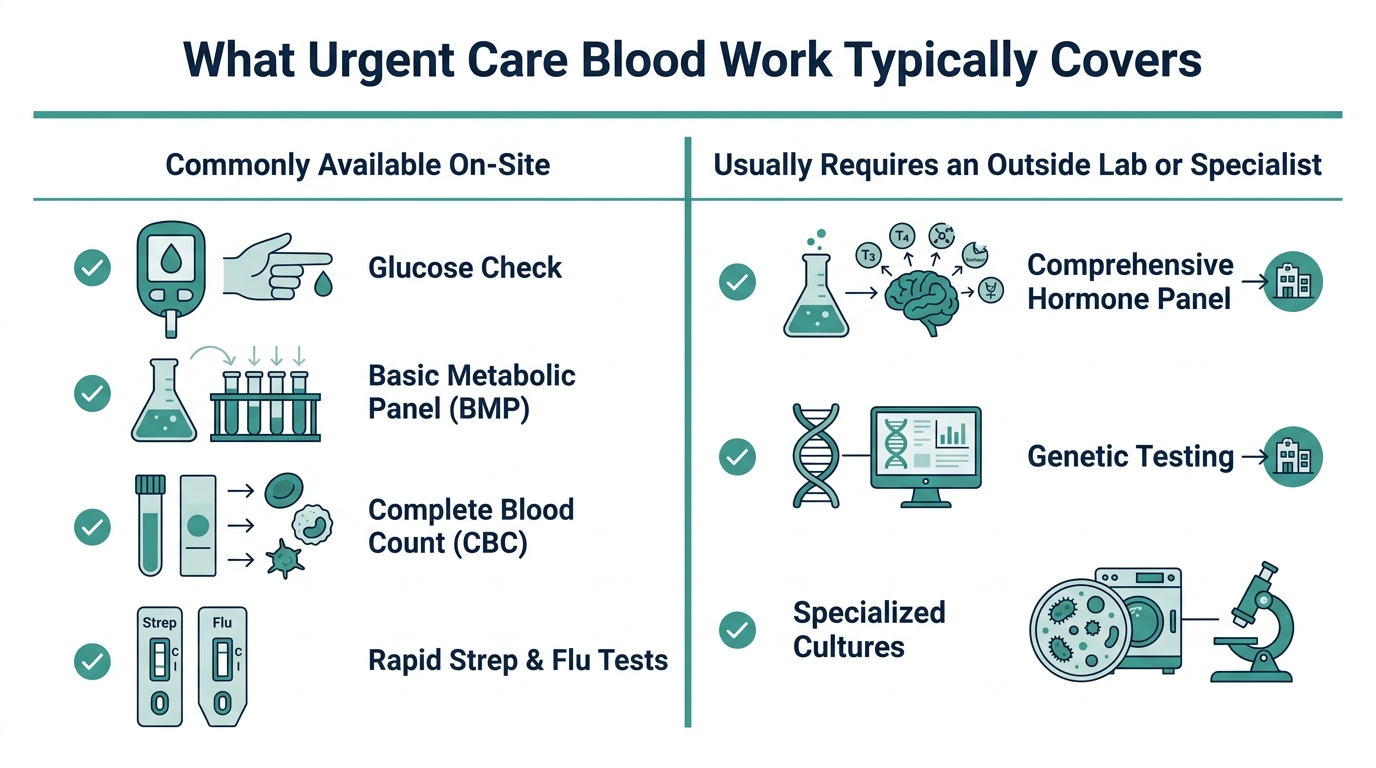
Typical blood tests an urgent care can run during your visit include:
- Rapid blood glucose, by finger-stick or from a venous tube, to flag high or low blood sugar in an acute episode
- Complete blood count (CBC), which reveals signs of infection, anemia, or a low platelet count
- Basic metabolic panel (BMP), covering electrolytes, kidney function, and blood sugar
- Rapid mononucleosis (mono) test, a finger-stick antibody screen
- Rapid strep and rapid flu, throat or nasal swabs paired with bloodwork when the picture is unclear
- Pregnancy test, blood (quantitative hCG) or urine, often before imaging or certain medications
- INR for patients on warfarin, at clinics that stock the analyzer, to check blood thinner levels
- C-reactive protein (CRP) or a rapid troponin at better-equipped centers, to help separate a minor complaint from something that belongs in an ER
So when people ask “do urgent cares do blood work,” the honest answer is this: they do the urgent half well, and they act as a collection point for everything else. The on-site list is short on purpose. It is engineered to answer one question, “do I need to treat this right now or send you somewhere else,” not to give you a complete health picture.
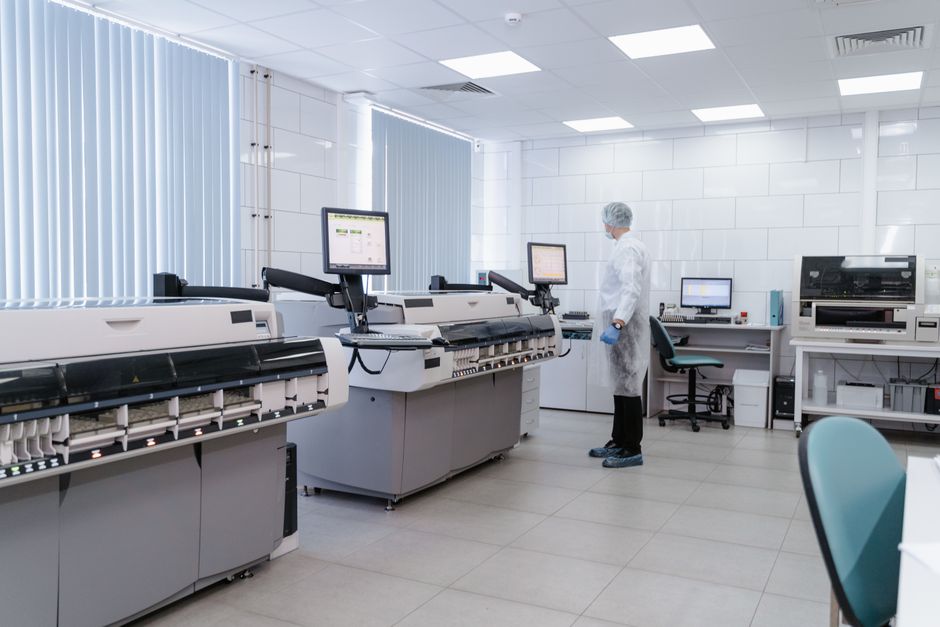
What blood work does urgent care send out to a lab?
Anything that is not time-critical gets routed to a partner reference lab. Urgent care can draw the blood, label it, and hand off the tubes, but the result lands one to three business days later through a patient portal or a callback. The clinic is acting as a draw site, exactly like a standalone lab, just attached to a doctor visit.
Common send-out tests include:
- Comprehensive metabolic panel (CMP) and a full lipid panel (total cholesterol, LDL, HDL, triglycerides)
- Thyroid panel (TSH, free T4, free T3) for fatigue, weight changes, or thyroid follow-up
- Hemoglobin A1c, which tracks average blood sugar over roughly three months for diabetes screening
- Vitamin D, vitamin B12, iron studies, and ferritin
- Hormone testing (testosterone, estrogen, cortisol)
- STI blood testing (HIV, syphilis, hepatitis B and C)
- Detailed liver and kidney function beyond the basics, plus specialty markers like a PSA
- Blood cultures and other tests that require incubation time the clinic does not have
The fasting detail almost no one explains
One thing worth knowing before you let an urgent care order a send-out: fasting matters for triglycerides but not for A1C. If a clinician orders a lipid panel and you ate breakfast, your triglyceride number can read artificially high, sometimes by 30 percent or more, while your A1C stays accurate because it reflects three months of blood sugar, not this morning’s bagel. A good clinic will tell you to come back fasting for a lipid panel; a rushed one will draw it anyway and you get a number you cannot trust. If you want a fuller picture of what a standard draw covers, see a complete blood panel and the biomarkers worth tracking.
Why “send-out” creates a results gap
The send-out model has a quiet downside that bites people later. The urgent care clinician who ordered your thyroid panel is often not the one who reads it three days later. Results land in a portal, sometimes get a one-line “normal” or “abnormal, follow up with your PCP” note, and that is the end of the relationship. There is no one tracking whether your TSH is drifting year over year. For an acute problem that is fine. For anything you want monitored over time, that fragmentation is the real cost, and it is invisible at the moment of the draw.
How much is urgent care blood work without insurance?
Without insurance, the visit and the labs are billed separately, which catches a lot of people off guard. The visit fee covers the clinician’s time and the room. The blood work is its own line item. And send-out labs add a third bill from Quest or Labcorp that can arrive weeks later, long after you thought the visit was paid for.
| Item | Typical 2026 cash price | Billed by |
|---|---|---|
| Urgent care visit (no insurance) | $100 to $250 | The clinic |
| On-site CBC or basic metabolic panel | $29 to $80 each | The clinic |
| Rapid glucose or pregnancy test | $15 to $50 | The clinic |
| Send-out lipid or thyroid panel | $40 to $150 | Quest or Labcorp |
| Hormone or vitamin send-out | $50 to $200 | Quest or Labcorp |
| STI blood panel (send-out) | $80 to $250 | Quest or Labcorp |
So a single visit with a couple of panels can land anywhere from $150 to $400 cash, and a visit that triggers several send-outs can climb past $500. Here is a worked example. Say you walk in with fatigue. The clinician runs an on-site CBC ($45) and BMP ($45), then sends out a thyroid panel ($90) and vitamin D ($120) on top of the $150 visit fee. Your real total is about $450, but you only saw the $150 quote at the desk. The same thyroid and vitamin D pair ordered directly through a discount online lab might run $60 combined, no visit fee at all.
The surprise lab bill, and how to avoid it
The trap is the surprise lab bill. The urgent care quotes you the visit fee, the blood goes to Quest, and three weeks later a separate invoice shows up for tests you did not realize were billed independently. To avoid it, ask one sentence at the desk before you agree to any draw: “Is this run here or sent out, and who bills me for the labs?” If the answer is “sent out,” ask for the estimated lab cost and whether you can request the same tests cash-pay directly from the lab instead. For a deeper breakdown of real prices across settings, read How Much Does Blood Work Cost? Real 2026 Prices With and Without Insurance.
What insurance changes
With insurance, the math flips. You typically pay an urgent care copay (often $25 to $75) and your plan negotiates the lab cost down, so a send-out panel that lists at $150 cash might cost you $20 to $40 after the plan applies. The catch is coding. If the visit is coded as diagnostic, which urgent care visits almost always are because you came in with a complaint, the labs go toward your deductible rather than being covered as free preventive screening. We will come back to this, because it is the single most expensive misunderstanding patients have about urgent care blood work.
The simplest way to actually get this done
Superpower is a full-body lab membership that runs 100+ biomarkers, has each result reviewed by a doctor, and tracks your numbers year over year (about $199/year). It is what we point readers to when they would rather get one clean, complete draw than chase single tests one at a time. Here is superpower reviewed in full.
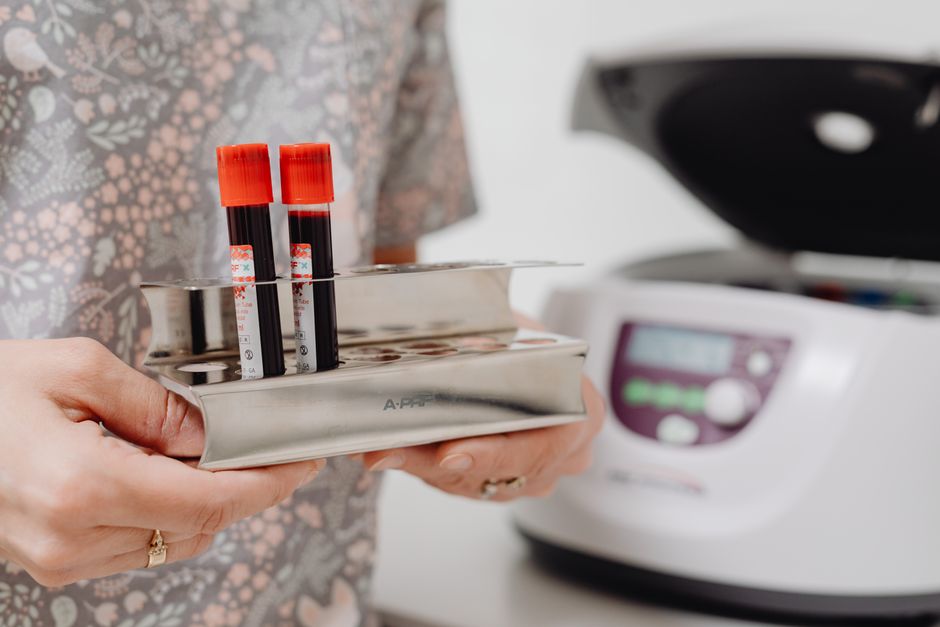
How does urgent care blood work actually work, step by step?
Knowing the sequence helps you ask the right question at the right moment and avoid the surprise bill. A typical visit that involves blood work moves like this:
- Check-in and triage. You describe your symptoms. A medical assistant takes vitals. This is where the clinic decides whether blood work is even needed.
- Clinician exam. The provider examines you and decides which tests to order. This is your moment to ask “on-site or send-out, and what will the labs cost me?”
- The draw. A phlebotomist or nurse draws blood, often two to four tubes. The draw is identical regardless of where the analysis happens.
- On-site analysis. Point-of-care tubes go into the countertop analyzer. Results print in 2 to 15 minutes and the clinician reviews them before you leave.
- Send-out handoff. The remaining tubes are labeled, logged, and picked up by a courier (often once or twice a day) and driven to the reference lab.
- Results and follow-up. On-site results shape your treatment that visit. Send-out results post to a portal in one to three business days, sometimes with a callback if something is abnormal.
The decision points that cost or save you money all live in steps 2 and 3, before the needle goes in. Once the blood is drawn and sent, the bills are already in motion.
Does urgent care do physicals and other routine checks?
Yes, urgent care does physicals, but mostly the form-driven kind: school sports physicals, pre-employment exams, DOT (commercial driver) physicals, immigration physicals, and basic wellness checks. These typically run $20 to $100 and take about 20 minutes. What urgent care does not replace is an annual preventive physical with your primary care doctor, where the visit, the labs, and the long-term tracking are tied together and your history follows you year to year.
Here is a billing detail almost nobody knows. A “free” preventive physical under your insurance is only free if it is coded as preventive. Walk into urgent care with a specific complaint, get blood work to chase it, and the visit gets coded as diagnostic, which means a copay and lab charges that count toward your deductible. The same draw, coded two different ways, costs you nothing or costs you a few hundred dollars. This is not a scam, it is how billing codes work, but the clinic has no incentive to explain it and the front desk often cannot. So when people ask “do urgent cares do physicals,” yes, but know which kind you are buying and how it will be coded.
Urgent care is the right tool for a sports form due Friday or a sudden fever you want checked tonight. It is the wrong tool for a yearly baseline you plan to compare over a decade. So when a friend asks does urgent care do blood work for a routine annual, the answer is technically yes but practically no, because you will pay diagnostic prices for a job a preventive visit does better and often free.
What is CVS MinuteClinic, and how much does it cost?
CVS MinuteClinic is a retail walk-in clinic inside CVS Pharmacy stores, staffed by nurse practitioners and physician assistants rather than physicians. It sits one notch below urgent care: great for minor illness, vaccines, screenings, and some chronic-condition checks, but it does fewer procedures and handles less complex bloodwork.
On the common cost questions, here is what to expect in 2026:
- A MinuteClinic visit runs roughly $35 to $145 cash before insurance, depending on the service.
- A basic illness or screening visit sits at the low end; a physical or more involved evaluation lands higher.
- With most insurance, you pay a standard copay instead of the full cash price.
Does CVS MinuteClinic do blood work? Some locations offer finger-stick screenings (cholesterol, glucose, A1C) and limited draws, but it is not a full lab. For anything beyond a quick screen, MinuteClinic refers out, the same send-out model as urgent care. If your goal is a complete, doctor-reviewed panel rather than a single screen, a retail clinic is the wrong starting point. Compare what you actually get against what Superpower tests for and how much Superpower costs.
Urgent care vs lab vs ER vs primary care: which is right for your blood work?
The single most useful thing you can do is match the setting to the job. Each option is good at something specific and wasteful or dangerous at the others. Here is the honest comparison.
| Setting | Best for | Blood work scope | Speed | Typical cash cost |
|---|---|---|---|---|
| Urgent care | Acute illness or injury where a result changes today’s treatment | On-site rapid tests, plus send-out for the rest | Minutes on-site, 1 to 3 days for send-outs | $100 to $400+ (visit plus labs) |
| Standalone lab (Quest, Labcorp) | Doctor-ordered or self-ordered routine panels, no illness | Almost any test, no on-site analysis needed | 1 to 3 days | $29 to $200 per panel, no visit fee |
| CVS MinuteClinic | Minor illness, vaccines, basic screens | Finger-stick screens, limited draws, refers out | Minutes for screens, days for send-outs | $35 to $145 visit |
| Emergency room | Chest pain, severe symptoms, possible emergency | Full stat lab, fastest comprehensive results | Often within an hour, on-site | $1,000 to $3,000+ |
| Primary care | Annual physicals, chronic disease tracking, anything you want monitored over years | Orders any test, interprets in context | 1 to 3 days | Often free preventive, or copay plus labs |
| Lab membership (full-body panel) | A complete baseline you want to repeat and compare | 100+ biomarkers in one draw, doctor-reviewed | Days, with tracking over time | ~$199/year flat |
Read the table as a decision tool. If a blood result needs to change your treatment in the next hour and you might be having an emergency, the ER is the only correct answer, even at its cost, because it has a full stat lab on-site. If you simply need routine numbers and you are not sick, a standalone lab or your primary care doctor is cheaper and cleaner than urgent care. Urgent care wins a narrow but real band: you feel sick now, it is not a clear emergency, and a fast on-site result will steer your treatment tonight.
When should you use urgent care for blood work, and when not?
Use urgent care for blood work when timing beats completeness. A possible infection, dehydration, a suspected mono case, or a glucose check during an acute episode all make sense there, because the on-site result steers your treatment right away. Can urgent care draw blood for these? Yes, and quickly. The same logic applies to a CBC when a doctor suspects an infection severe enough to need antibiotics tonight, or an INR check for someone on warfarin who feels off.
Skip urgent care when you want a complete, fasting, doctor-interpreted panel for long-term tracking. The visit fee plus stacked lab bills makes it an expensive way to get routine numbers, and the results come back fragmented across portals with no one connecting them over time. A clinician should read your results in context, so talk to your doctor about anything abnormal rather than self-diagnosing from a portal number.
Decision guidance by situation
- You feel sick tonight and want answers now: urgent care is a reasonable choice, especially after hours when your PCP is closed.
- You want an annual physical and routine labs: use primary care, where preventive coding often makes the labs free.
- You want a broad baseline to compare year over year: a full-body lab membership or a self-ordered panel beats urgent care on both cost and continuity.
- You have chest pain, trouble breathing, confusion, or severe symptoms: go to the ER, not urgent care. Urgent care will send you there anyway and you will pay twice.
- You need a form signed by Friday: urgent care or MinuteClinic handles sports, work, and DOT physicals fast.
The pattern is simple. Urgent care is built for the urgent slice of blood work and for fast referrals on everything else. For a planned baseline you want to repeat and compare, a dedicated lab membership or your primary care doctor is the cleaner, cheaper path.
Common mistakes people make with urgent care blood work
These are the errors we see again and again, each of which costs money, time, or accuracy.
- Assuming all results are same-day. Only on-site tests come back during the visit. People leave thinking they are cleared, then a send-out flags something three days later that they never check because they were not told to.
- Not asking who bills for the labs. The single most expensive omission. The visit fee is not the lab fee, and the lab bill arrives separately, often weeks later.
- Eating before a lipid panel. A non-fasting triglyceride reading can be misleadingly high. If you know you want cholesterol numbers, fast first or have them done elsewhere on purpose.
- Using urgent care as a primary care substitute. Fragmented, diagnostic-coded visits are a poor and pricey way to manage a chronic condition that needs continuity.
- Going to urgent care for emergency symptoms. Chest pain or stroke signs belong in an ER. Urgent care lacks the stat lab and imaging to handle them and will transfer you, doubling your bill and losing precious time.
- Expecting a “free” physical when you arrive with a complaint. The moment you mention a symptom and labs are ordered to chase it, the visit is diagnostic, and the preventive freebie is gone.
Edge cases: uninsured, minors, employer-required, and Medicare
The standard advice shifts in a few specific situations worth calling out.
If you are uninsured
Cash prices are negotiable more often than people think. Ask for the self-pay or cash rate up front, which is frequently lower than the billed rate, and ask whether you can take a lab order to a discount lab instead of using the clinic’s send-out. For routine, non-urgent panels, a self-ordered online lab test almost always beats an urgent care visit on price because you skip the visit fee entirely.
If the patient is a minor
Most urgent cares treat children and draw pediatric blood work, but policies vary on whether a parent or guardian must be present and on consent for certain tests. Call ahead. Sports physicals for students are a core urgent care service and usually quick and cheap.
If your employer requires the test
Pre-employment drug screens, DOT physicals, and certain occupational blood tests are routine urgent care work. In these cases the employer often pays directly or has a contracted rate, so confirm who is covering the cost before you pay out of pocket and try to get reimbursed later.
If you are on Medicare
Medicare generally covers medically necessary urgent care visits and the associated lab work, but coverage hinges on medical necessity and correct coding. Routine screening you request without a clinical reason may not be covered the way you expect. As with private insurance, the diagnostic-versus-preventive distinction drives what you owe.
Curious what your own levels look like?
Baseline 100+ biomarkers today and retest as life changes, all in one membership with physician review.
FAQ
How much is a MinuteClinic visit at CVS?
A MinuteClinic visit costs roughly $35 to $145 cash in 2026, depending on the service. Basic screenings and minor illness visits sit at the low end, while physicals and more involved evaluations cost more. With insurance, you usually pay a copay instead of the full cash price.
What is a MinuteClinic?
A MinuteClinic is CVS’s walk-in retail health clinic, staffed by nurse practitioners and physician assistants. It handles minor illnesses, vaccines, screenings, physicals, and some chronic-condition checks without an appointment, and refers out anything more complex to urgent care or a lab.
Do urgent cares do blood work for STIs?
Yes, urgent care can draw STI blood tests like HIV, syphilis, and hepatitis, but these are almost always sent out to a partner lab, so results take one to three days rather than coming back the same visit. Expect a separate lab bill in addition to the visit fee.
Can urgent care draw blood and give same-day results?
Urgent care can draw blood and give same-day results only for on-site tests like CBC, basic metabolic panels, rapid glucose, mono, and pregnancy. Specialized tests are drawn there but processed at an outside reference lab, so those results arrive one to three days later.
Does CVS MinuteClinic do blood work?
Some MinuteClinic locations offer finger-stick screenings for cholesterol, glucose, and A1C, plus limited draws. It is not a full lab, so anything beyond a quick screen gets referred out to Quest or Labcorp, with results in a few days.
How long does urgent care blood work take to come back?
Does urgent care do blood work fast? On-site point-of-care tests come back in 2 to 15 minutes during your visit. Send-out tests processed at Quest or Labcorp typically post to a portal in one to three business days, and a clinician may call if a result is abnormal.
Is urgent care cheaper than the ER for blood work?
Yes, dramatically. An urgent care visit with labs usually runs $100 to $400 cash, while an ER visit with blood work often starts around $1,000 and can exceed $3,000. The ER is only the right choice when you have emergency symptoms that need a full stat lab and imaging immediately.
Can I just get blood work without seeing a doctor?
Not at urgent care, where a clinician visit is part of the model and the bill. If you want labs without a visit fee, a standalone lab like Quest or Labcorp with a self-pay order, or a self-ordered online lab membership, lets you get a draw without a separate exam, usually for less money.
Will urgent care do blood work without symptoms?
Sometimes, for things like a pre-employment screen, a sports physical, or a patient-requested screening, but it is not what urgent care is built for and you will pay diagnostic-style prices. For routine, symptom-free testing, a lab or your primary care doctor is cheaper and better suited.
Does urgent care take insurance for blood work?
Yes. When people ask does urgent care do blood work through insurance, most urgent care centers accept major insurance for both the visit and the labs, leaving you a copay plus any costs that apply to your deductible. Because urgent care visits are usually coded as diagnostic, the labs often count toward your deductible rather than being covered as free preventive screening.
Vital Signs Today may earn a commission if you buy through links on this page. It does not affect our editorial assessments.