
Last updated June 2026. Educational content, not medical advice. Talk to a registered dietitian or clinician before making changes to your protein intake based on specific health goals.
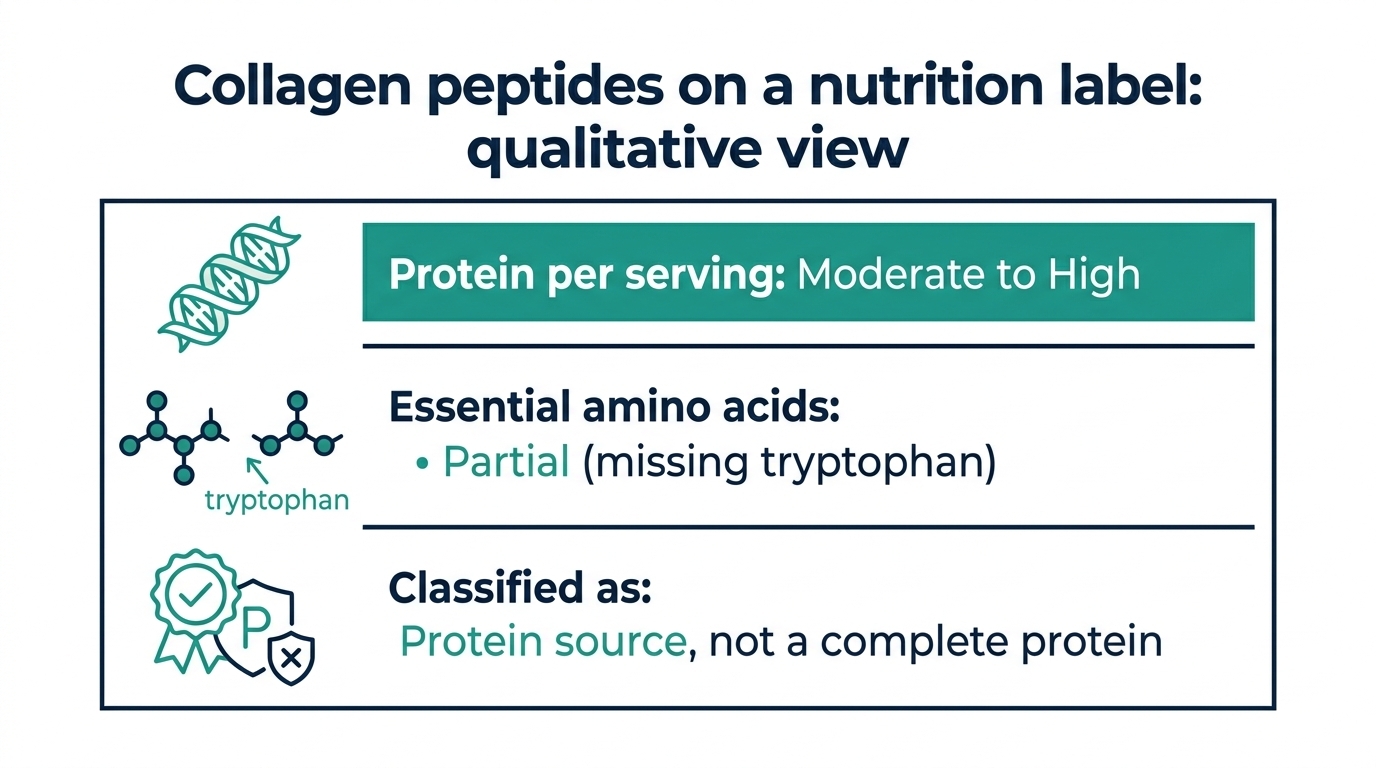
Short answer: Yes, collagen peptides are protein by molecular definition, providing roughly 18 grams of protein per 20-gram serving. However, they score a PDCAAS (Protein Digestibility Corrected Amino Acid Score) of 0.0, the lowest possible rating, because they contain zero tryptophan. That single missing amino acid is why the FDA requires collagen labels to read “Not a significant source of protein” in the % Daily Value column, and why collagen cannot replace complete protein for muscle building, no matter how many grams the label shows.
Collagen protein quality is limited on paper. See how your own amino acid and protein markers actually measure up. One at-home Superpower draw checks 100+ biomarkers, physician-reviewed.
What exactly are collagen peptides made of?
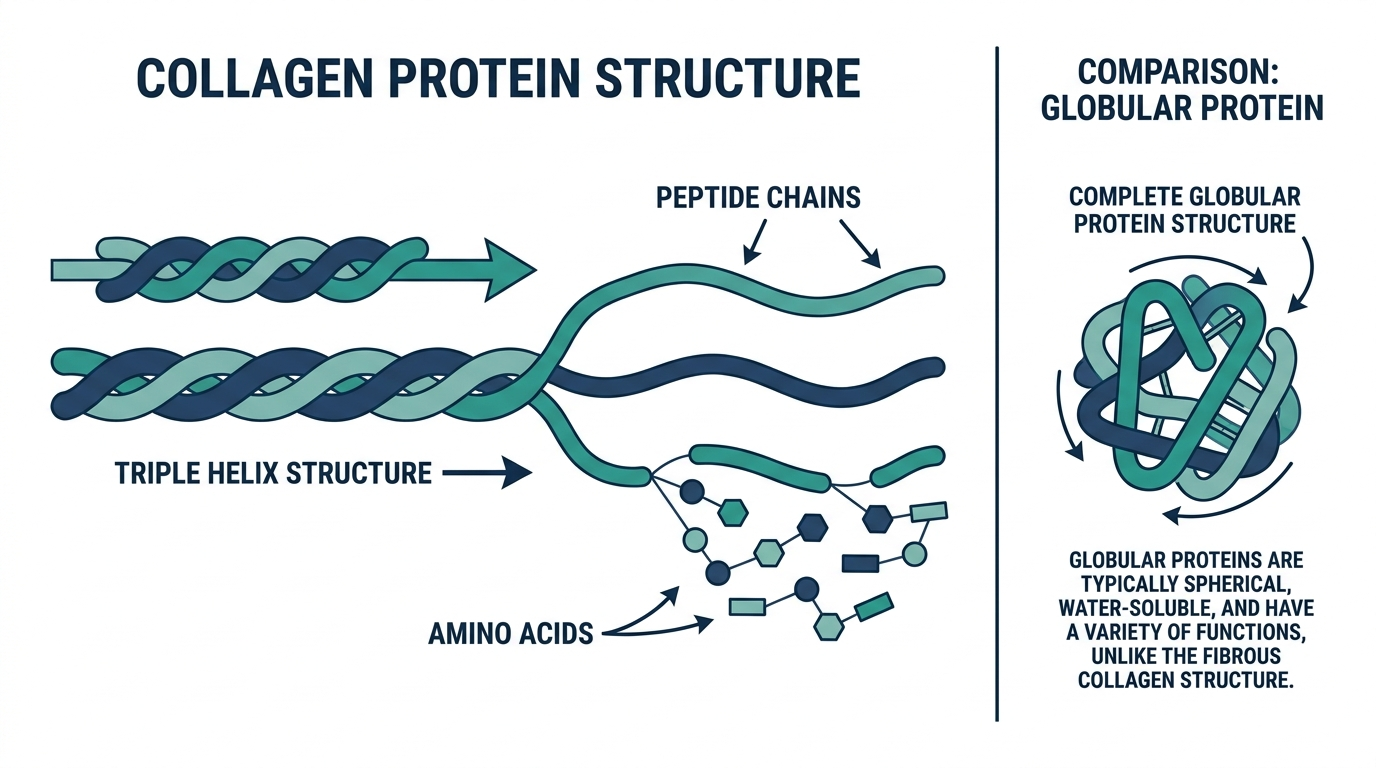
Collagen is the most abundant protein in the human body, forming the structural backbone of skin, tendons, ligaments, cartilage, and bone. The word “peptides” in the name describes what happens to it during manufacturing: whole collagen molecules, which can weigh 300,000 daltons or larger, are broken down by enzymes in a process called hydrolysis. The result is short peptide chains typically ranging from 2,000 to 5,000 daltons.
That size reduction matters more than most buyers realize. Research shows hydrolyzed collagen peptides have an absorption rate of approximately 90%, while whole collagen may absorb as poorly as 10 to 15%. Peptides small enough to pass through the intestinal wall reach the bloodstream intact, and studies detect them circulating within 30 minutes of consumption. The hydrolysis step is not marketing language. It is the mechanism.
Why does collagen have a PDCAAS score of zero?
This is the insider detail that changes how you read every collagen marketing claim. The PDCAAS is the standard the FDA uses to evaluate protein quality. It asks one question: does this food supply all nine essential amino acids in sufficient amounts? If even one is zero, the whole score is zero.
Collagen contains 19 different amino acids, including eight of the nine essential ones. The missing one is tryptophan. Completely absent. Not low, not trace, absent. Because the PDCAAS is calculated as the score of the most limiting amino acid, and tryptophan is 0, the entire score is 0.
The practical consequence: the FDA does not allow collagen to contribute to the % Daily Value for protein on nutrition labels. A collagen product can list 18 grams of protein in the nutrition facts panel, but the % Daily Value next to it will either be blank or carry a disclaimer. The grams are real. The protein quality those grams represent for essential amino acid needs is not.
Do not believe the marketing copy that treats collagen’s protein count as equivalent to whey or casein. A scoop of Vital Proteins Collagen Peptides and a scoop of whey isolate both show roughly 18 grams of protein. They are nutritionally very different things.
How does the amino acid profile actually compare to whey?
The gap is wider than most people expect, and it sits in a specific place.
| Nutrient factor | Collagen peptides | Whey protein isolate |
|---|---|---|
| Protein per 20g serving | ~18g | ~18-19g |
| PDCAAS score | 0.0 | 1.0 |
| Tryptophan | 0 mg | ~300-400 mg |
| Leucine per serving | ~1.2g | ~2.5g |
| Essential amino acids per serving | ~7.7g | ~13.9g |
| BCAA content | Low | Nearly 2x collagen |
| Glycine per serving | ~3-4g | <1g |
| Proline + hydroxyproline | ~25% of total AAs | Trace |
| Solubility in cold liquid | Excellent | Varies |
| Taste profile | Neutral | Often sweet/flavored |
Leucine is the rate-limiting trigger for muscle protein synthesis. It acts like a key in a lock, telling muscle cells to start building. A single study found plasma leucine concentration was 5.5 times higher after whey protein than after an equivalent amount of collagen. Another study directly measured 30 grams of collagen against 30 grams of whey and found that collagen did not stimulate muscle protein synthesis, while whey did.
That is not a small gap. It is a categorical difference in function.
Where collagen wins on paper is glycine. You get roughly 3 to 4 grams per serving, compared to less than 1 gram in whey. Glycine is unusually rich in collagen because it occupies every third position in the collagen triple helix structure (the repeating Gly-X-Y sequence that gives collagen its structural integrity). Glycine supports sleep quality, stress response, and is essential for synthesizing new collagen in your own connective tissue. It is the amino acid other proteins quietly ignore.
Does collagen count toward your daily protein goal?
This is the question fitness trackers and dietitians argue about, and the answer has two honest parts.
From a sheer nitrogen standpoint, yes, collagen provides amino acids your body can metabolize for energy, use for general protein synthesis, and contribute to total nitrogen balance. Research published in Nutrients found that up to 36% of daily protein could come from collagen peptides while still meeting all indispensable amino acid requirements, provided the rest of the diet contained complete protein sources.
From a muscle protein synthesis standpoint, no, collagen should not count. If your goal is hitting a protein target specifically to maintain or build muscle, collagen grams do not function equivalently to whey, egg, or meat grams. Tracking them the same way will leave your leucine and total essential amino acid intake short.
Personally, I think the cleanest approach is this: count collagen separately from your “functional protein” total for muscle. Think of it as a connective tissue supplement that happens to contain protein, not as a protein supplement that happens to contain collagen.
The practical floor is that most people hitting 0.8 to 1.2 grams of protein per pound of body weight from whole food sources are not going to be harmed by adding 10 to 20 grams of collagen on top. The problem arises when collagen displaces complete protein.
What is collagen protein actually good for?
This is where the honest answer flips. Collagen peptides are not a great protein source for muscle building. They are an excellent targeted supplement for connective tissue, skin, and joint support, and the research is increasingly solid.
Skin hydration and elasticity: A 2025 randomized, double-blind, placebo-controlled trial of 77 women taking 5,000 mg daily for 12 weeks showed significantly improved dermal density, decreased transepidermal water loss, and increased moisture content. Notably, benefits persisted during a 4-week post-intervention period after supplementation stopped.
Joint pain reduction: Zdzieblik et al. (2017) using 5 grams per day for 12 weeks reported a 38.4% reduction in pain scores in the collagen group versus 27.9% in placebo. An earlier Clark et al. 2008 study using 10 grams daily for 24 weeks found significant reductions in joint pain at rest.
Collagen synthesis support: A Shaw et al. study found that 15 grams of vitamin C-enriched gelatin taken 60 minutes before exercise increased collagen synthesis markers by 153% from baseline. The 5-gram dose increased synthesis only 59.2%, which is why “just 5 grams is enough” gets complicated once you’re optimizing for a specific outcome.
Body composition in older adults: A 2015 study of sarcopenic elderly men taking 15 grams per day alongside resistance training saw fat-free mass increase 4.2 kg versus 2.9 kg in the placebo group. Important caveat: that increase likely reflects connective tissue mass gains, not muscle fiber hypertrophy. The mechanism matters when you are interpreting the scale.
Full-body lab membership: 100+ biomarkers, doctor-reviewed, tracked over time.
What is the difference between collagen peptides and collagen protein?
You will see both terms on labels, and the distinction is mostly processing and molecular weight rather than a fundamentally different product.
“Collagen protein” typically refers to the broader category of protein derived from collagen, including both hydrolyzed and non-hydrolyzed forms. Hydrolyzed collagen, which is what most supplements contain, is also called collagen peptides or collagen hydrolysate. The hydrolysis step is what reduces molecular weight to the 2,000 to 5,000 dalton range that improves absorption.
Gelatin is the cooked form of collagen, used in food. It gels at room temperature, which peptides do not, because gelatin still has some of the larger structural elements intact. Gelatin and hydrolyzed collagen peptides have similar amino acid profiles; the difference is how they behave physically in water and likely in absorption rate.
Type I and III collagen are the forms found in skin, tendon, and bone, and these are the types in most bovine and marine supplements. Type II collagen is found in cartilage and is the focus of separate joint-specific supplements, often sold as “undenatured type II collagen” with UC-II branding. A systematic review of 17 studies found that undenatured collagen Type II significantly reduced WOMAC scores for pain and physical function in knee osteoarthritis, using much smaller doses than hydrolyzed peptide studies, typically around 40 mg per day.
Should you take collagen with vitamin C?
This is one of the better-grounded collagen supplement recommendations, but the mechanism is often misexplained. The claim you usually hear is that vitamin C “helps absorb collagen.” That is not precisely right.
Vitamin C is required by two enzymes, prolyl hydroxylase and lysyl hydroxylase, which convert proline and lysine residues into hydroxyproline and hydroxylysine during new collagen synthesis in your fibroblasts. Without adequate ascorbic acid, these iron-dependent enzymes cannot function, and your body cannot build stable, correctly folded collagen triple helices. Vitamin C deficiency literally causes scurvy, which is structural collagen breakdown.
Here is the part supplement labels gloss over: vitamin C does not act on the collagen powder you just drank. The hydroxyproline in your collagen supplement is already there. What vitamin C does is ensure that when those amino acid precursors circulate and your fibroblasts start building new collagen from scratch, they have the cofactor they need to do it correctly. In vitro studies show simultaneous exposure of fibroblasts to collagen peptides and ascorbic acid increases type I collagen expression by up to 200% compared to separate effects.
Practically: take 50 to 100 mg vitamin C alongside your collagen serving. It does not need to be a megadose. Regular dietary vitamin C from food works too.
How much collagen should you take, and when?
The dose range in research varies more than the supplement industry’s “one scoop” messaging implies, and it depends heavily on your target outcome.
- Skin hydration and elasticity: 2.5 to 5 grams per day. Most of the positive skin studies use 5 grams. The 2025 Collagen Stewardship Alliance study used 5 grams and found sustained effects.
- Joint pain and osteoarthritis: 10 grams per day. Clark et al. used 10 grams daily for 24 weeks and found significant joint pain reduction.
- Collagen synthesis for athletes and recovery: 15 grams taken 60 minutes before exercise, with vitamin C, based on the Shaw et al. protocol. This is one of the few collagen timing recommendations with direct mechanistic support.
- General connective tissue support: 10 to 15 grams per day, the most common clinical dose range.
Timing for non-athletic use is flexible. Collagen peptides dissolve completely in hot or cold liquid, mix well into coffee or smoothies with no grittiness, and do not require cycling. The practical floor is staying consistent, because connective tissue remodeling is slow. Most studies run 8 to 12 weeks before seeing measurable changes.
Which collagen supplement is worth buying?
With protein quality sorted out, the buying decision comes down to source, dose, and testing standards.
Bovine (beef hide) collagen delivers primarily Type I and Type III collagen, which are the dominant types in skin, tendons, and bones. Grass-fed, pasture-raised sourcing is worth the premium because bovine hides from conventionally raised animals can concentrate environmental residues more readily than muscle meat. Marine collagen from wild-caught fish is also Type I and often marketed for skin specifically. Both work. The amino acid profile is nearly identical.
Vital Proteins Collagen Peptides remains the category benchmark: grass-fed bovine, third-party tested by Swift independent lab, 18 grams of protein per 20-gram serving, single ingredient. Available on Amazon for around $25 to $35 for a standard canister. Transparent Labs Grass-Fed Collagen provides 22 grams of hydrolyzed collagen per serving with a publicly posted certificate of analysis.
What to ignore: proprietary blends that list “collagen complex” without specifying the gram amount of each type. You cannot verify the dose, and most of the positive research used specific doses, not a sprinkle of multiple types.
Hydrolyzed type I & III collagen peptides, third-party tested, unflavored.
The myth worth busting: “collagen replaces your protein shake”
This framing appears constantly in wellness content, and it needs a direct correction.
A 2026 meta-analysis published in Translational Sports Medicine reviewed 78 studies and initially ranked collagen highest using SUCRA analysis for muscle outcomes. Sounds impressive. The problem identified by nutritionist Igor Eckert: collagen’s top ranking relied on only four small studies with fewer than 30 participants each, and removing a single study eliminated the statistical significance entirely. An earlier 19-trial meta-analysis concluded collagen supplementation “may increase strength and size compared to not consuming additional protein” but “is not as effective as whey protein.”
The story is internally consistent once you accept the mechanism. The mass gained in collagen-plus-resistance-training studies likely reflects increased connective tissue mass rather than muscle fiber hypertrophy. That is a real and valuable outcome for athletes, older adults, and anyone recovering from tendon or ligament injuries. It just is not the same story as muscle protein synthesis.
Collagen is genuinely useful for what it does. It does not do what whey does. Conflating the two because both show up as “protein” on the label is the mistake.
Turn what you just learned into action.
Superpower lets you test 100+ biomarkers from home, then re-check them over time so you can actually see progress, physician-reviewed at every step.
Frequently asked questions
Are collagen peptides a complete protein?
No. Collagen peptides are an incomplete protein because they contain zero tryptophan, the one essential amino acid needed to score above zero on the PDCAAS scale. They supply 18 of the 20 standard amino acids and eight of the nine essential amino acids, but the missing tryptophan drops their protein quality score to 0.0. For muscle building, they should be paired with complete protein sources, not substituted for them.
How many grams of protein are in collagen peptides?
A standard 20-gram serving of hydrolyzed collagen peptides provides approximately 18 grams of protein by weight. Vital Proteins Collagen Peptides, one of the most widely sold brands, reports 18 grams per 20-gram serving. However, the FDA does not allow this protein to count toward the % Daily Value for protein on labels because of the PDCAAS of 0.
Why does the nutrition label say “Not a significant source of protein”?
Because PDCAAS equals zero due to the absence of tryptophan. The FDA’s labeling rules require that % Daily Value for protein reflect protein quality, not just grams. Since collagen cannot meet the essential amino acid criteria, the % DV column stays blank or carries a disclaimer regardless of how many grams of protein the product contains.
Can I replace whey protein with collagen peptides?
For muscle protein synthesis and post-workout recovery, no. Whey produces plasma leucine concentrations 5.5 times higher than collagen, and direct head-to-head studies show 30 grams of whey stimulates muscle protein synthesis while 30 grams of collagen does not. For connective tissue support, skin, and joints, collagen does things whey does not. They serve different functions and work well together.
Is marine collagen better than bovine collagen?
Both are primarily Type I collagen with nearly identical amino acid profiles. Marine collagen peptides tend to have slightly smaller molecular weights, which may give a marginal bioavailability advantage, but no head-to-head clinical trial has demonstrated a meaningful difference in outcomes for skin or joint health. Source quality and third-party testing matter more than the species.
Do collagen peptides work for skin?
The clinical evidence is reasonably strong at doses of 5 grams per day for 8 to 12 weeks. A 2025 double-blind trial of 77 women found significant improvements in dermal density, skin moisture, and transepidermal water loss at 5,000 mg daily, with benefits persisting four weeks after stopping. A separate analysis of 119 women found 10 grams daily significantly reduced wrinkle number and length, with 2.5 grams showing benefits for hydration and elasticity.
How long does collagen take to work?
Most clinical studies measure outcomes at 8 to 12 weeks. Skin changes, being more superficial, tend to appear sooner than joint or structural changes. Joint pain studies typically run 12 to 24 weeks. Connective tissue remodeling is inherently slow because collagen turnover in tendons and ligaments is measured in months, not weeks.
Author: Vital Signs Today Editorial Team, [credential]”]. Educational content, not medical advice. Sources linked inline.
Hydrolyzed type I & III collagen peptides, third-party tested, unflavored.
Primary sources
- Barbell Medicine: Collagen Protein, What It Is and Does It Work
- PMC: The effects of collagen peptide supplementation on body composition, collagen synthesis, and recovery from joint injury and exercise (2021)
- PMC: Significant Amounts of Functional Collagen Peptides Can Be Incorporated in the Diet While Maintaining Indispensable Amino Acid Balance
- PMC: Absorption of bioactive peptides following collagen hydrolysate intake (2024)
- Collagen Stewardship Alliance: Collagen Science Update February 2026
- ACSH: Collagen vs. Whey: Marketing Hype or Scientific Reality? March 2026
- Transparent Labs: Collagen Protein vs Whey Protein
- Vital Proteins: Collagen Peptides product page
- SUPERSONIC: Collagen and vitamin C synergistic action (2026)
- Superpower: Blood Test 100+ Biomarkers
Related reading
Vital Signs Today may earn a commission if you buy through links on this page. It does not affect our editorial assessments.