
Last updated 24 June 2026. Educational content, not medical advice. Reviewed by the Vital Signs Today Editorial Board. NAD+ is available as a compounded prescription through licensed telehealth providers. Talk to a licensed clinician before starting any injectable therapy.
First, a correction worth making up front: there is no such thing as an “NAD peptide.” NAD+ (nicotinamide adenine dinucleotide) is a coenzyme, built from two nucleotides, with no amino acids and no peptide bonds anywhere in its structure. “NAD peptide” is a wellness-marketing label, not a scientific category. It stuck because clinics often give NAD+ alongside true peptides like BPC-157 or CJC-1295, so it got lumped into the same menu. When people search “how to take NAD peptide,” what they actually mean is NAD+ itself, or its oral precursors NMN and NR. We will use the correct terms throughout, and explain where the confusion comes from.
NAD+ therapy claims to boost cellular energy, but do you know your actual nutrient and metabolic markers? One at-home Superpower draw checks 100+ biomarkers, physician-reviewed.
Short answer: What clinics commonly use as a starting point for injectable NAD+ is around 100 mg subcutaneously two to three times a week, reconstituted from a 500 mg lyophilized vial at 100 mg/mL using 5 mL bacteriostatic water. IV sessions at 250 to 500 mg run roughly $400 to $800 per infusion and require clinic supervision. Nasal spray (about 30 mg daily) and oral NMN or NR precursors (500 to 1,000 mg daily) are the self-administered tier below that. The route changes everything: speed of effect, side effect profile, cost, and whether you need a prescription at all. None of these numbers are a prescription from us. They describe what is commonly reported in studies and clinic protocols. Your dose is a conversation to have with a licensed clinician.
And the honest caveat that frames this whole article: the human evidence for NAD+ therapy is still weak. Most of the dramatic claims trace back to animal studies or small, short, often industry-linked human trials. Supplementation reliably raises NAD+ levels in the blood, but whether that translates into the energy, longevity, or recovery benefits people are paying for is still largely unproven in rigorous human trials. Read the dosing below as “what people are doing,” not “what works.”
Why does everybody suddenly want to take NAD+?
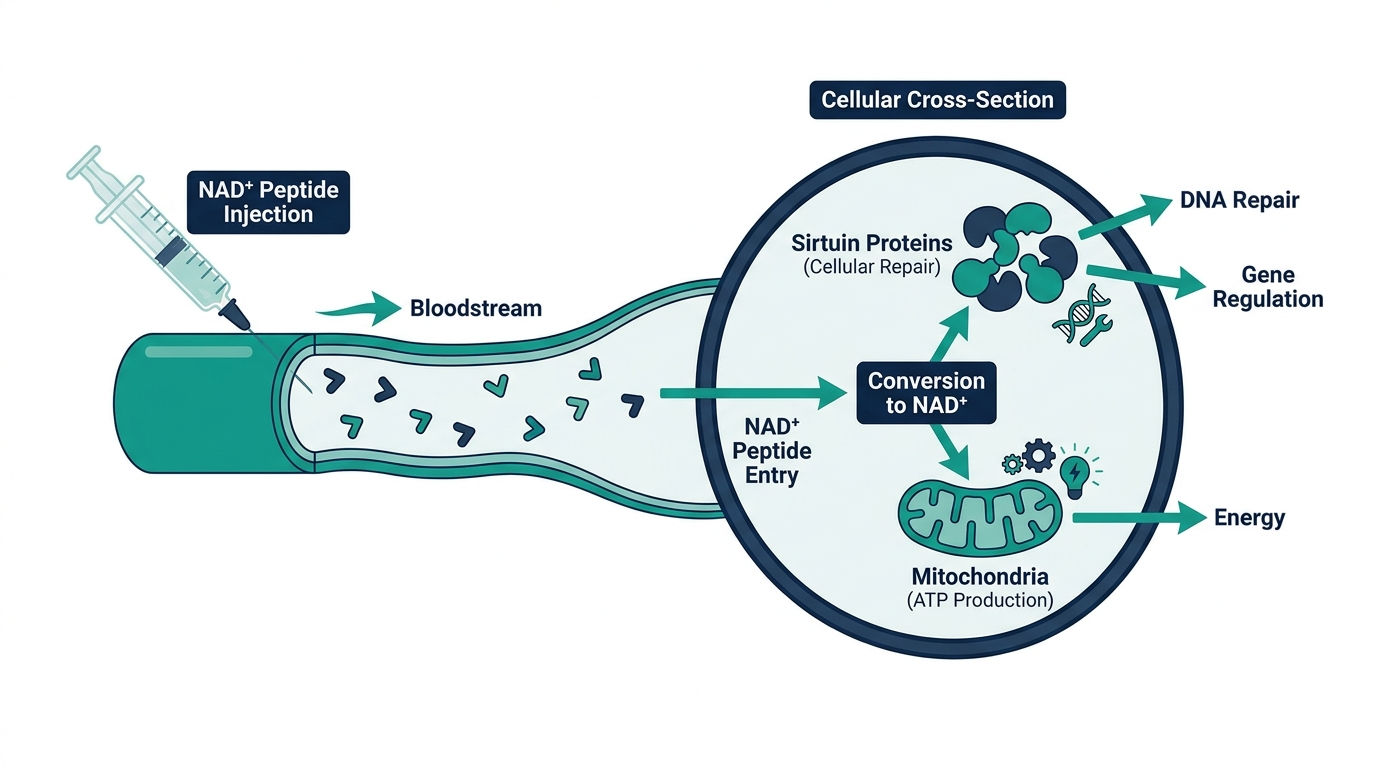
The short version: your body runs low on it as you age, and the symptoms of that depletion look a lot like “just getting older.”
NAD+ is the coenzyme your cells use to convert food into ATP, repair DNA through PARP enzymes, and activate the sirtuin proteins that regulate stress response and metabolic flexibility. When it drops, several cellular maintenance processes slow down. Note the word coenzyme again: this is a helper molecule for enzymes, not a peptide, not a hormone, and not a drug in its native form.
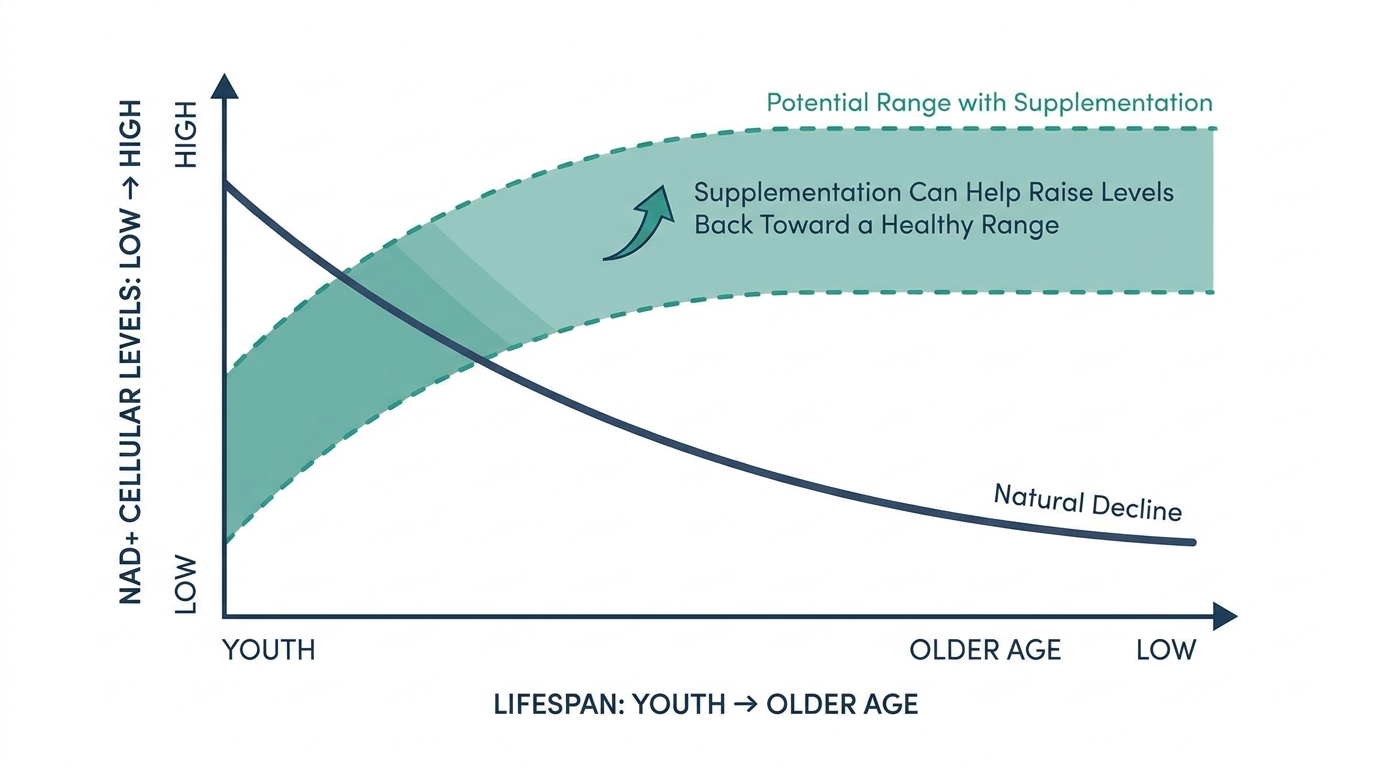
The decline is measurable. Tissue NAD+ levels fall by roughly 50% between your 20s and your 50s, based on human skin and liver biopsies and brain MRI studies summarized in a 2020 review by McReynolds, Chellappa, and Baur. A leading proposed driver is an enzyme called CD38, whose expression rises with age and consumes NAD+ faster than the salvage pathway can rebuild it. A secondary driver is declining expression of NAMPT, the rate-limiting enzyme in NAD+ synthesis. Keep one thing in perspective: showing that NAD+ declines with age is not the same as showing that restoring it reverses aging in humans. The first is well documented. The second is the open question.
Important nuance: whole-blood NAD+ does not reliably decline with age in cross-sectional studies. The decline shows up in tissues, which is why a whole-blood panel is not the right test here, and why intracellular NAD tests measure levels inside red blood cells rather than serum.
If you want to know your own starting point before spending anything on therapy, the smarter first move is to measure. See our guide to the best at-home biomarker tests for how to get a baseline, then retest after a protocol so you are working from data instead of how you think you feel.
Full-body lab membership: 100+ biomarkers, doctor-reviewed, tracked over time.
What are the actual delivery routes, and how do they differ?
“Taking NAD+” covers four genuinely different interventions. They share a molecule but diverge sharply on bioavailability, onset, side effects, cost, and whether you can self-administer. Here is the honest map:
| Route | Starting dose | Bioavailability | Onset | Cost per dose | Prescription needed? |
|---|---|---|---|---|---|
| IV infusion | 250-500 mg over 2-4 hrs | ~100% (direct bloodstream) | Minutes (during drip) | $300-$800/session | Yes (clinic) |
| Subcutaneous injection | 50-100 mg, 2-3x/week | High, bypasses GI | 30-90 min | $105-$350/month | Yes (telehealth) |
| Nasal spray | 30 mg once daily | Moderate (mucosal) | 10-20 min peak | $60-$150/month | Varies (some OTC, some Rx) |
| Oral NMN or NR precursors | 500-1,000 mg daily | Variable, GI-dependent | Hours (indirect) | $40-$100/month | No (supplement) |
IV infusion delivers the highest peak but requires clinic supervision and a long chair time, as described in one published NYC clinic protocol that lists 250 mg at $400 and 500 mg at $500. Subcutaneous injection sits below IV in peak levels but offers a better balance of bioavailability and self-management convenience. Nasal spray reaches peak plasma levels within 10 to 20 minutes and is often described as having somewhat better bioavailability than oral routes, due to vascular mucosa and bypassing first-pass liver metabolism, but it carries the lowest dose ceiling. Oral NMN and NR require conversion through the salvage pathway and show meaningful but highly variable NAD+ elevation depending on gut health, age, and genetics. Be careful with bioavailability figures from vendor pages: most are based on small or animal studies, not large head-to-head human comparisons, which do not yet exist.
Do not compare route cost without counting what each route does and does not include. An IV session at $500 includes clinical monitoring, nursing time, a physician on-site, and infusion supplies. A 500 mg subcutaneous vial for $80 requires you to reconstitute, calculate, inject, and troubleshoot any reaction yourself.
How does subcutaneous NAD+ injection actually work? (what the product pages skip)
A subcutaneous NAD+ vial arrives lyophilized, meaning freeze-dried to a white powder. The molecule does not ship stable in solution, so it is mixed before each session. A commonly cited protocol, summarized in one telehealth reconstitution guide and various compounding pharmacy SOPs, is:
- Add 5 mL bacteriostatic water (BAC water, 0.9% benzyl alcohol) to a 500 mg vial. This yields a concentration of 100 mg/mL.
- Inject the water slowly down the inside glass wall of the vial, not directly onto the powder, to avoid degrading the molecule. Do not shake; swirl gently.
- The reconstituted solution is generally considered stable for about 14 days refrigerated at 2 to 8 degrees Celsius, shorter than many other compounds. NAD+ in BAC water degrades faster than most peptides do.
- Withdraw your dose with a U-100 insulin syringe. At 100 mg/mL: 10 units (0.10 mL) = 10 mg, 50 units (0.50 mL) = 50 mg, 100 units (1.0 mL) = 100 mg.
- Inject subcutaneously into the abdomen or thigh, rotating sites each session.
The single most important thing nobody says upfront: NAD+ stings more than most compounds people inject at home. The proposed mechanism is well described. NAD+ is acidic, and that acidity irritates subcutaneous nerve endings and surrounding tissue on contact. It is also thought to activate the GPR109A receptor (the same niacin flush receptor), triggering prostaglandin release that causes warmth, local flushing, and sometimes a brief hot sensation radiating outward from the site. None of this is dangerous at typical subcutaneous doses, but it is genuinely unpleasant for about 60 to 90 seconds.
Practical mitigation that people report helps: inject slowly over 10 to 15 seconds rather than in one push. Ice the site for 10 minutes beforehand. Do not inject into the same spot two sessions in a row. The discomfort typically peaks around 30 seconds and resolves within two to three minutes at subcutaneous doses, per clinical reports from one lab provider’s side-effects overview and a clinic injection guide.
In our reading of the self-reported literature, the stinging is the most underreported aspect of NAD+ self-injection. You will find plenty of social posts showing someone effortlessly injecting BPC-157 or CJC-1295 with no reaction. NAD+ is a different experience, and it tends to catch first-timers off guard. That difference is also a clue to the chemistry: those are real peptides, and NAD+ is not.
What is the real dosing range, and how does a loading phase work?
The doses in circulation range from 50 mg to 1,000 mg per session depending on route. To repeat the framing: these are doses commonly used in studies and clinic protocols, not a recommendation. Decide your actual dose with a clinician. Here is how clinical practice tends to structure it, based on compounding-pharmacy and telehealth protocols such as those summarized at one compounding guide:
Subcutaneous, a commonly used structure:
– Week 1 to 2: 50 mg every other day (to assess tolerance, the stinging reaction, and any systemic flush response)
– Week 3 to 4: increase to 100 mg per session if well-tolerated
– Maintenance: 100 mg two to three times weekly
IV, a commonly used structure:
– Phase 1 (weeks 1 to 4): 4 to 6 sessions of 250 to 500 mg, each over 2 to 4 hours
– Phase 2 (maintenance): one session every 4 to 8 weeks, adjusted to symptom response and any repeat intracellular testing
Nasal spray:
– One to two sprays per nostril once daily, yielding approximately 30 mg total
– Often used between injectable sessions as a bridging dose rather than a standalone protocol
The IV side effect profile differs from subcutaneous. Nausea, chest tightness, rapid heartbeat, and flushing during IV infusion are widely described as rate-dependent: when infusion is slowed, they tend to recede. The proposed mechanism is the same prostaglandin release, accelerated by direct IV delivery. Clinics routinely slow or pause infusions in response to patient feedback. These symptoms are not rare; they are expected with faster rates and generally resolve once the drip is adjusted. This is exactly why IV NAD+ belongs in a supervised setting, not at your kitchen table.
Myth to break: “higher dose always means better results.” The research does not support dose escalation for wellness endpoints. A 2025 randomized controlled trial published in eClinicalMedicine (The Lancet) used 2,000 mg/day of oral NR in long-COVID patients for 20 weeks and found within-group improvements in fatigue severity, depressive symptoms, and sleep quality but no statistically significant difference versus placebo. Larger doses did not produce cleaner data. The honest state of the science: NAD+ supplementation appears reasonably safe across tested protocols and shows early promise for specific populations, but dose-response relationships and clinical benefit in humans are not yet clearly established.
IV vs subcutaneous vs nasal spray: which one fits your situation?
The answer depends on what you are trying to accomplish and what your life allows for. We are describing trade-offs, not prescribing a route.
IV infusion tends to suit: an initial loading phase, a specific condition managed under supervision (addiction recovery, post-viral fatigue, perioperative support), or working with a clinic that monitors labs during therapy. The cost is real: $250 to $800 per session at most US clinics, with NYC and LA running $600 to $1,000+ for 500 mg, per one IV therapy overview, and none of it covered by insurance. HSA/FSA funds can sometimes apply.
Subcutaneous injection tends to suit: people who want the bioavailability edge over oral precursors, are already comfortable with at-home injection, and have a telehealth prescription. Cost runs $105 to $350 per month through licensed providers, well below IV, often with labs and monitoring factored into the program fee.
Nasal spray tends to suit: a daily maintenance route between injection sessions, or anyone who wants to avoid needles. Eden, ProHealth Longevity, and others offer NAD+ nasal sprays at various prescription and OTC tiers. The ceiling is low: at about 30 mg per day you are not replicating what a 500 mg IV session does, and the higher absorption claims for the nasal route rest on limited data.
Oral NMN or NR tends to suit: a low-cost, no-needle starting point to see whether NAD+ supplementation changes anything for you. NMN at 500 mg/day raised blood NAD+ in a 2021 trial that also reported improved muscle insulin sensitivity in women with prediabetes (referenced in one published review), though that is a single small study. NMN and NR are sold openly as dietary supplements, cost $40 to $100 per month from brands like Tru Niagen (NR) or DoNotAge (NMN), and require no prescription. The trade-off is inconsistent absorption and a 2 to 4-hour indirect conversion time.
Do not believe the claim that “injections are 10x more effective than oral.” No published human trial has established that ratio for clinical outcomes. The pharmacokinetic advantage of injections (higher blood levels) is real; whether that translates to proportionally better outcomes in healthy adults is unknown.
Licensed clinical telehealth: provider intake, labs, and compounded protocols handled under supervision.
Why NAD+ is not like the peptides it gets sold next to (the compliance problem)
Most injectable peptides in the longevity space are straightforward once you learn the reconstitution math. NAD+, which again is a coenzyme and not a peptide, has a compliance problem that rarely gets mentioned in forum guides, and it explains a lot of the inconsistent self-reported results.
First, the stinging. As covered above, it is real, it scales with dose, and it gets old fast. The people who report consistent 2x to 3x weekly subcutaneous protocols for months are outliers in pain tolerance or technique, not the median experience.
Second, the roughly 14-day stability window is shorter than most people expect. If you reconstitute a 500 mg vial on Monday and use 100 mg sessions Monday-Wednesday-Friday, you use 300 mg in week one and have 200 mg left. By day 14 you discard whatever remains. Over 12 months that is roughly 26 vials, not the 20-sessions-per-vial math that looks obvious at first. Factor that into your cost projection.
Third, food-grade NAD+ is not appropriate for sterile injection. The FDA has flagged this: compounders have sourced material labeled as food-grade from repackagers, and that classification means it has not been processed to eliminate microbes and endotoxins to injectable standards. The FDA has received adverse event reports including severe chills, vomiting, and hospitalization tied to improperly sourced compounded NAD+ injectables, consistent with the FDA’s human drug compounding guidance. This is exactly why sourcing from a named, licensed 503A compounding pharmacy, not a research-chemical vendor selling lyophilized powder, matters more for NAD+ than for most other compounds.
If a telehealth provider cannot name their compounding pharmacy and confirm it is 503A licensed, treat that as a reason to walk away.
A note on NMN’s legal status (it changed twice)
If you choose the oral precursor route, the legal backdrop is worth knowing because it whipsawed. In late 2022 the FDA told two ingredient suppliers that NMN was excluded from the definition of a dietary supplement, on the grounds that it had been authorized for investigation as a new drug before it was lawfully marketed as a supplement. That cast a shadow over NMN sales for roughly three years.
Then, in letters dated late September 2025, the FDA reversed itself and confirmed that NMN is not excluded from the dietary supplement definition, so as of 2026 NMN is again lawful to sell as a supplement in the US (industry coverage of the reversal). One caveat remains: NMN is still a New Dietary Ingredient, so companies marketing it must satisfy premarket notification requirements. NR (sold as Tru Niagen and others) never went through this saga and has been a settled supplement ingredient throughout.
Who actually has evidence behind them? (the honest short list)
The research is least thin, and clinicians most willing to use NAD+, in three populations. “Least thin” is the right phrase; even here the evidence is early.
Adults over 40 with documented fatigue, metabolic dysfunction, or post-viral symptoms. The mechanism is plausible (tissue NAD+ decline is well documented in this age group) and the short-term safety profile looks acceptable. But the energy and clarity benefits are mostly subjective and self-reported, and large randomized trials confirming them have not landed. Treat it as a reasonable experiment, not a proven therapy.
People in addiction recovery. IV NAD+ has the longest clinical history of any use, going back decades in addiction medicine, where it has been used off-label to reduce withdrawal intensity and cravings. It is treated as a standard adjunct in some clinics. Note that “longest history” still does not mean “high-quality randomized evidence”; the literature here is largely observational.
Long COVID patients with persistent fatigue and brain fog. The 2025 eClinicalMedicine trial of 2,000 mg/day oral NR over 20 weeks (about 58 participants) found within-group improvements in fatigue, sleep, and executive function but did not reach between-group statistical significance versus placebo at that sample size. That is a hopeful signal, not a proven effect. Larger trials are underway.
For healthy adults under 40 with no specific complaint, the honest answer is: the evidence does not support routine injectable NAD+ as a wellness intervention. Oral NMN or NR is a low-risk experiment; IV therapy at $500 a session for someone with no identified deficiency is hard to justify on current data.
How much does NAD+ therapy cost in 2026?
Pricing splits cleanly by route and access model.
IV therapy in a clinic: $250 to $800 per single session. Mid-size cities average $300 to $500 for a 500 mg infusion. NYC and LA run $600 to $1,000+. Loading phases of 4 to 6 sessions mean an initial outlay of $1,500 to $4,800.
Subcutaneous via telehealth: $105 to $350 per month, monitoring usually included, per one published cost overview. This typically covers the compounded vials, supplies, and care coordination.
Nasal spray (Rx or OTC): $60 to $150 per month from providers like Eden or ProHealth, depending on concentration and whether a prescription is involved.
Oral NMN/NR supplements: $40 to $100 per month. Tru Niagen NR (ChromaDex) at 300 to 600 mg daily runs roughly $40 to $60. DoNotAge NMN at 500 mg daily runs about $50. Look for third-party testing (NSF or Informed Sport) at this tier.
Intracellular NAD+ test: commonly around $198 for a single test, with multi-pack pricing lower per test. The point of testing is simple: a baseline plus a retest at 4 weeks turns a guessing game into data. Our at-home biomarker test guide walks through the options if you want to measure before and after rather than spend on therapy blind.
None of these are covered by insurance. NAD+ therapy is classified as elective and wellness-based regardless of clinical rationale. Budget for the full program, and do not let a low first-dose price mislead you about total cost.
When should you NOT start NAD+ therapy? (and common mistakes to avoid)
There are genuine cautions and misuses worth flagging. These are general educational points, not personal medical advice.
Known active malignancy. NAD+ supports cell repair and sirtuin activity, and there is a theoretical concern (not proven in humans at supplementation doses) that it could support energy availability in rapidly dividing cancer cells. Many oncology-informed clinicians pause NAD+ supplementation during active cancer treatment pending clearer data. Discuss this with your oncologist.
Starting without a baseline test. If your intracellular NAD+ is already in a healthy range, paying for IV loading sessions has no clear mechanistic rationale. Test first.
Injecting food-grade or research-chemical powder. As noted above, this is the single biggest safety risk in the self-administration tier. The FDA’s adverse event reports on compounded NAD+ (severe chills, vomiting, hospitalization) trace back to improper sourcing, not the molecule itself.
Ignoring the stability window and injecting degraded solution. Discolored NAD+ solution (yellowing, clouding) is degraded. Discard it; do not inject it.
Using self-injection to replace a licensed clinical protocol. The telehealth route is accessible and not dramatically more expensive than grey-market self-sourcing once you count supplies, testing, and waste. The difference is a clinician adjusting your protocol when something is not working, which matters more than most people anticipate.
Curious what your own levels look like?
Baseline 100+ biomarkers today and retest as life changes, all in one membership with physician review.
Frequently asked questions
Is NAD a peptide?
No. NAD+ (nicotinamide adenine dinucleotide) is a coenzyme built from two nucleotides. It contains no amino acids and no peptide bonds, which is what defines a peptide. “NAD peptide” is a marketing label that spread because clinics often administer NAD+ alongside true peptides like BPC-157 and CJC-1295. When people search “how to take NAD peptide,” they mean NAD+ or its precursors NMN and NR.
How much NAD+ should I inject per day?
There is no “per day” answer to copy from an article, and you should set this with a clinician. The dose commonly used for subcutaneous maintenance is around 100 mg per session, two to three times weekly, not daily. Daily injection appears mainly in short loading phases of 7 to 14 days. An IV session is typically 250 to 500 mg and is not given daily.
Why does NAD+ injection sting so much?
NAD+ is acidic and irritates subcutaneous nerve endings at the injection site, and it is thought to activate the GPR109A receptor, triggering prostaglandin release that causes localized warmth and flushing. The sting usually peaks around 30 seconds and resolves within 2 to 3 minutes. Slowing the injection and icing the site beforehand reportedly reduce the reaction.
Can I take oral NMN instead of injecting NAD+ directly?
Yes, and for many people it is the right starting point. NMN and NR are precursor molecules the body converts to NAD+ after absorption, and they require no prescription or injection. The trade-off is slower and more variable absorption. A 2021 NMN trial reported improved insulin sensitivity in prediabetic women, but it was small and individual response varies widely. If a test shows you are low and oral supplementation does not move your numbers after 8 to 12 weeks, injectable is a logical next conversation with a clinician.
How long before NAD+ injections start working?
Acute effects like energy or mental clarity are often reported within 24 to 72 hours, though much of that may be expectation effect given the weak controlled evidence. More objective changes are typically assessed at 4 to 6 weeks, and a repeat intracellular NAD+ test at 4 weeks is the best way to confirm your levels are actually rising.
Is NAD+ available through telehealth in 2026?
Yes, through licensed providers. NAD+ is not a controlled substance, so telehealth prescribing here is governed by state pharmacy board rules rather than DEA controlled-substance flexibilities, per Telehealth.HHS.gov. Most providers require an intake evaluation and baseline labs before issuing a compounding pharmacy prescription.
What is the difference between NAD+ and NMN?
NAD+ is the active coenzyme itself. NMN (nicotinamide mononucleotide) is a precursor the body converts to NAD+ via the salvage pathway. Injected NAD+ bypasses that conversion and raises plasma levels faster. NMN’s advantage is oral dosing and no needle. Neither has been proven superior for clinical outcomes in head-to-head human trials, because those trials largely do not exist yet.
What should I do if I experience chest tightness during NAD+ IV therapy?
Tell the nurse or clinician immediately. Chest tightness during IV NAD+ is widely described as rate-dependent and tends to resolve when the infusion is slowed or paused. The clinic will adjust the drip. This is precisely why IV NAD+ requires clinical supervision and should not be self-administered.
Licensed clinical telehealth: provider intake, labs, and compounded protocols handled under supervision.
Reviewed by the Vital Signs Today Editorial Board. Educational content, not medical advice. Always consult a licensed clinician before starting NAD+ or any injectable therapy. Sources linked inline.
Primary sources:
– McReynolds MR, Chellappa K, Baur JA. Age-related NAD+ decline. Free Radic Biol Med. 2020. https://pmc.ncbi.nlm.nih.gov/articles/PMC7442590/
– Effects of nicotinamide riboside on NAD+ levels, cognition, and symptom recovery in long-COVID: a randomized controlled trial. eClinicalMedicine (The Lancet). 2025. https://www.thelancet.com/journals/eclinm/article/PIIS2589-5370(25)00567-X/fulltext
– FDA. Human Drug Compounding Policies and Rules. https://www.fda.gov/drugs/human-drug-compounding/human-drug-compounding-policies-and-rules
– NutraIngredients. FDA reinstates NDI status of NMN (Dec 2025). https://www.nutraingredients.com/Article/2025/12/09/fda-reinstates-ndi-status-of-nmn-with-new-letters-to-ingredient-players/
– GetHealthspan. NAD+ Injections vs. Oral Supplements: What the Evidence Actually Shows. https://www.gethealthspan.com/research/article/nad-injections-benefits
– Modal Pain Management. NAD+ IV Therapy: Benefits, Cost & What to Expect. https://modalpain.com/blog/nad-iv-therapy-benefits-cost-what-to-expect/
– Telehealth.HHS.gov. Prescribing via telehealth. https://telehealth.hhs.gov/providers/telehealth-policy/prescribing-controlled-substances-via-telehealth
Related reading
Vital Signs Today may earn a commission if you buy through links on this page. It does not affect our editorial assessments.