
Last updated June 2026. Educational content, not medical advice. Epitalon is not approved by the FDA for human therapeutic use. Speak with a licensed clinician before starting any peptide protocol.
Short answer: The most-studied protocol in published research runs 5 to 10 mg of epitalon per day, subcutaneously, for 10 to 20 consecutive days, two to three times per year, with evening dosing preferred because of the peptide’s direct effect on pineal gland melatonin output. That protocol comes from four decades of Russian laboratory work, and the safest way to access it in 2026 is through a licensed telehealth clinic, where a clinician sets the dose and a compounding pharmacy supplies the vial.
Epitalon protocols run a few times a year, so wouldn’t it help to track your biomarkers between cycles? One at-home Superpower draw checks 100+ biomarkers, physician-reviewed.
What is epitalon, and why does the how matter so much?
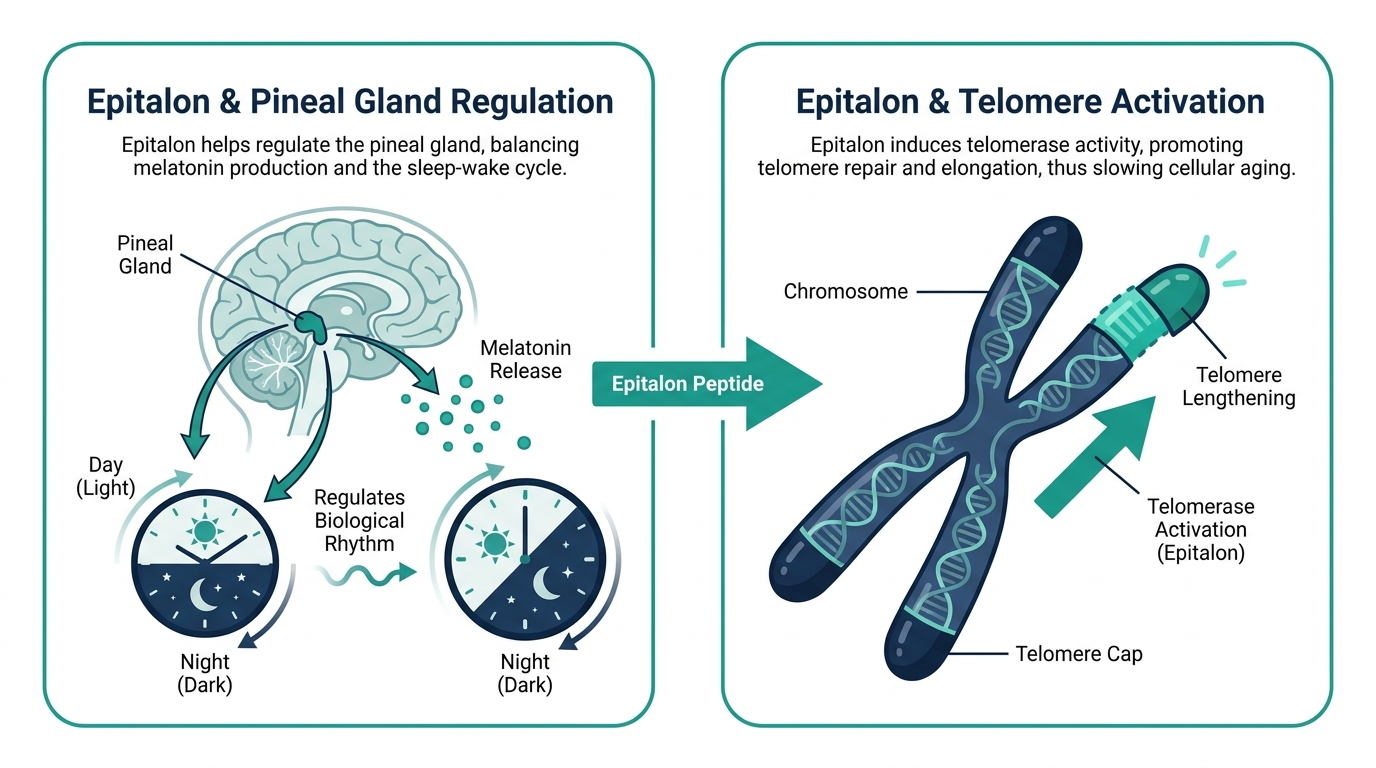
Epitalon is a synthetic tetrapeptide with the amino-acid sequence Ala-Glu-Asp-Gly (alanine, glutamic acid, aspartic acid, glycine). It is four amino acids long, which makes it one of the shortest peptides in active research. That brevity is structurally important: very short peptides can cross cell membranes more readily than longer chains, and the Khavinson research group has argued that this is part of what makes epitalon unusually active at low doses.
The original compound is not epitalon. It is epithalamin, a longer polypeptide extract isolated from bovine pineal glands in the 1970s at what is now the Saint Petersburg Institute of Bioregulation and Gerontology. Dr. Vladimir Khavinson and his team spent roughly a decade characterizing which portion of epithalamin drove the biological effects, then synthesized a stripped-down four-amino-acid analog, named it Epitalon, and spent the next forty years publishing results on it. Khavinson holds more than 700 published papers and dozens of patents on short peptide bioregulators, and essentially the entire evidentiary base for epitalon flows from his institute.
That origin matters for understanding the how. The dosing protocols you encounter online, the cycle lengths, the timing guidance, and the claimed side-effect profile all trace back to that single research tradition. Independent Western replication is genuinely sparse, which shapes how confidently you should hold any specific number in the protocols below.
Full-body lab membership: 100+ biomarkers, doctor-reviewed, tracked over time.
What does the research actually show?
This section is worth reading before the dosing section, because the dosing numbers only mean something if you understand what they were designed to do.
Telomere biology. The most-cited finding is telomere extension. In a 2025 study published in Biogerontology (Springer), epitalon increased telomere length in human cell lines through telomerase upregulation or alternative lengthening of telomeres (ALT) activity. Earlier work by Khavinson’s group showed that human fetal lung fibroblasts treated with epitalon continued dividing past the 44th passage, compared to controls that stopped at 34 passages, a roughly 30% extension of the replicative limit. In PHA-stimulated human lymphocytes from donors aged 25 to 88, one study recorded an average telomere lengthening of 33.3%, though the result varied considerably by individual.
The telomere data is the most replicated thread in epitalon research, and the 2025 Biogerontology paper represents a meaningful step toward independent confirmation outside Russia.
Melatonin restoration. A human trial involving 75 women found that sublingual epitalon at 0.5 mg per day for 20 days produced a 1.6-fold increase in urinary 6-sulfatoxymelatonin (the primary melatonin metabolite) compared to placebo. Clock gene expression in lymphocytes shifted measurably: Clock expression decreased 1.8-fold, Cry2 expression doubled, and Csnk1e expression decreased 2.1-fold. In aged macaques, epitalon normalized nighttime melatonin and stabilized cortisol rhythms. This is where the timing guidance, specifically the preference for evening dosing, originates.
Longevity in animal models. In Anisimov et al. (2006), epitalon treatment extended the mean lifespan of female rats by 25% and of male rats by 18%, a dramatic effect that has not been reproduced in a large, preregistered Western trial. In HER-2/neu transgenic mice, epitalon reduced breast adenocarcinoma incidence; tumors that did develop appeared later and were smaller than in untreated controls.
The honest caveats. The evidentiary base is real but narrow. Nearly every study comes from one institution. Human trial data remains limited to case reports, the 75-woman circadian study, and small open-label work. A 2025 systematic review noted that “information regarding critical issues about this peptide’s safety is missing.” There are no large-scale randomized controlled trials in Western populations. Treating the existing data as proof of effect in humans is a leap the evidence does not fully support.
How to take epitalon: delivery methods compared
Three routes are in active community and clinical use: subcutaneous injection, intranasal spray, and sublingual drops. They are not equivalent.
| Delivery method | Relative bioavailability | Research support | Typical dose | Needle required |
|---|---|---|---|---|
| Subcutaneous injection | Highest (reference standard) | Strongest, most studies | 5-10 mg/day | Yes |
| Intranasal spray | Moderate (roughly 40-60% of injectable) | Limited, some immune data | 5-15 mg/day | No |
| Sublingual / oral drops | Low (significant enzymatic breakdown) | One human circadian trial at 0.5 mg | 0.5-2 mg/day | No |
| Oral capsule | Very low | Essentially none | Not established | No |
Subcutaneous injection is the method used in the overwhelming majority of published research and remains the approach preferred in clinical settings. The peptide is injected into subcutaneous fat, typically the abdomen, thigh, or upper arm, using an insulin-gauge syringe (usually 29 to 31 gauge). Because epitalon is a very small molecule with good subcutaneous absorption, intramuscular injection offers no documented advantage and is rarely used.
Intranasal spray has shown some biological activity. After intranasal administration, epitalon enhanced IL-2 mRNA synthesis rates in human immune cells, with a faster onset (peak at approximately 1.5 hours versus 24 hours for intramuscular). The trade-off is bioavailability: to achieve comparable systemic exposure, nasal dosing typically requires two to three times the injectable dose. A 5 mg injectable dose may require 10 to 15 mg intranasally. For people who have a strong aversion to needles, nasal spray is the practical middle ground, with the caveat that clinical protocols have not been validated for this route.
Sublingual dosing at 0.5 mg per day was the method used in the melatonin/circadian human trial, which produced measurable hormonal effects. Whether those effects translate to the broader anti-aging endpoints studied at higher injectable doses is unknown. The liver does not fully metabolize sublingual peptides before they reach circulation, but enzymatic breakdown in saliva and the gut wall limits how much of a sublingual dose survives.
Oral capsules have almost no research support for epitalon. The digestive tract readily cleaves small peptides into their individual amino acids before systemic absorption. Capsule formulations that claim bioequivalence to injection have not published supporting data.
Dosing protocols: what the research used vs. what clinics use
The protocol numbers vary depending on whether you are reading Russian clinical literature, community forums, or a telehealth intake form. Here is what each source actually says.
The Khavinson research protocol runs 5 to 10 mg per day subcutaneously or intranasally for 10 to 20 consecutive days. This is the format that produced the telomere, melatonin, and lifespan findings. Total cycle dose on a 10-day, 10 mg/day protocol is 100 mg; on a 20-day, 5 mg/day protocol, also 100 mg total.
The community / longevity forum protocol condenses this into what is often called the “10-day blast”: 10 mg per day subcutaneously for 10 consecutive days, two times per year. Some practitioners extend to three cycles annually. The intervals of 4 to 6 months between cycles are not defined in published trials; they appear to be practical compromises based on cost and logistics.
Telehealth clinic protocols tend to be more conservative. Protocole, one of the named US telehealth providers offering pharmaceutical-grade epitalon in 2026, runs a structure of 1 mg per injection, 5 days per week, for approximately one month, pricing a 4-week supply at $225 standalone and up to $600 as part of a stacked longevity program. The one-month-on, three-months-off cycle aligns with a three-times-per-year frequency.
The low-dose human sublingual data from the circadian trial used 0.5 mg per day for 20 days, a much smaller amount than the injectable protocols, but still produced a 1.6-fold melatonin increase. This is useful context: epitalon appears to be biologically active at doses lower than the injectable protocols suggest.
Personally, I find the dose range in the community literature wider than the underlying data justifies. The honest answer is that nobody has run a dose-finding study in humans that tells us whether 5 mg or 10 mg per cycle produces meaningfully better telomere outcomes. The numbers circulating are extrapolated from animal studies and a small clinical dataset, not from a titration trial.
Timing: when to take epitalon within the day
Evening dosing, one to two hours before sleep, is the most consistent recommendation across clinical and research sources, and the reason is mechanistic rather than arbitrary.
Epitalon’s primary upstream target is the pineal gland, the small midline brain structure responsible for converting serotonin to melatonin in response to darkness. Melatonin output from the pineal gland declines substantially with age, a process that correlates with the circadian disruption, sleep fragmentation, and increased oxidative stress seen in older adults. Epitalon appears to support the enzymatic pathway by which the pineal gland produces melatonin, specifically enhancing hydroxyindole-O-methyltransferase (HIOMT) activity.
Evening dosing aligns the peptide’s biological peak with the natural window of pineal activation after lights-out. Morning dosing is not wrong, and some practitioners divide the daily dose, but if you are seeking the sleep-quality and circadian restoration effects, evening administration makes more biological sense.
Epitalon is not a sedative in the pharmaceutical sense; do not expect it to function like melatonin supplement. The melatonin-supporting effect is indirect and unfolds over the cycle, not in the first night.
Reconstitution: what the process actually looks like
Epitalon arrives as a lyophilized (freeze-dried) white powder in a sealed vial, usually in 10 mg increments. Before injection, it must be reconstituted with bacteriostatic water.
Bacteriostatic water (BAC water) contains 0.9% benzyl alcohol as a preservative, which allows you to draw from the same vial repeatedly over several weeks without contamination. Sterile water is for single-use; do not substitute it for a multi-dose vial.
The reconstitution steps, in plain terms (educational, not a clinical protocol):
- Allow the powder vial and bacteriostatic water vial to reach room temperature.
- Wipe both rubber stoppers with a fresh alcohol swab and let them dry for 10 seconds each.
- Draw your chosen volume of bacteriostatic water into an insulin syringe.
- Insert the needle into the peptide vial at an angle and inject the water slowly down the glass wall, not directly onto the powder. This matters because forcing liquid directly onto lyophilized peptide can denature the structure at the impact point.
- Do not shake the vial. Swirl gently until the powder fully dissolves. The solution should be clear and colorless.
- Store the reconstituted vial in the refrigerator at 2 to 8 degrees Celsius. Use within 28 to 30 days.
The concentration math. If you add 1 mL of BAC water to a 10 mg vial, you get a 10 mg/mL concentration. On a U-100 insulin syringe (100 units per mL), each 10 units drawn equals 0.1 mL, which equals 1 mg of epitalon. A 5 mg dose is 50 units on that syringe. If you add 2 mL of water to the same 10 mg vial, the concentration drops to 5 mg/mL and a 5 mg dose is now 100 units. Track your water volume and calculate before you draw, every single time.
This is the step where self-administration errors cluster. A decimal error at reconstitution changes your dose by a factor of ten, and epitalon vials are not labeled with per-unit dosing instructions. One of the genuine advantages of the licensed clinic route is that the pharmacy does this calculation for you and ships a pre-labeled, pre-diluted solution.
Cycling: how long, how often, and when to stop
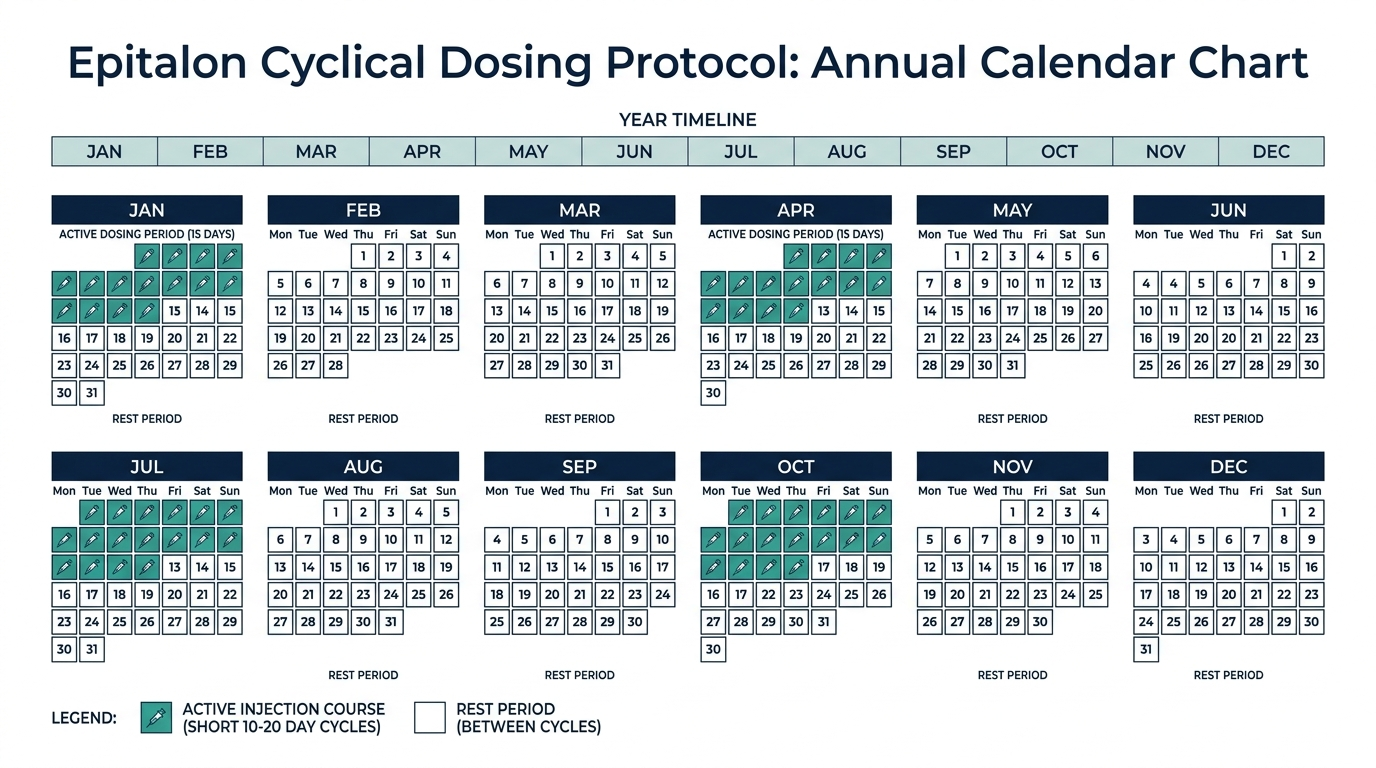
Standard cycle: 10 to 20 consecutive daily doses, followed by a rest period of at least 4 to 6 months before the next cycle. Two to three cycles per year covers the range reported in both the Khavinson literature and current telehealth protocols.
Do not run epitalon continuously. This is not a daily supplement like magnesium or vitamin D. The research basis is short-course, intermittent use, and the handful of in-vitro findings on telomerase activation raise a theoretical question about what continuous telomerase upregulation would mean in the long term. Epitalon’s animal data consistently shows reduced tumor incidence, not increased, but that finding comes from cycled protocols, not continuous use, and it has not been replicated in Western trials.
Seasonal timing. Some longevity practitioners align epitalon cycles with seasonal light transitions, particularly autumn into winter, when natural melatonin output shifts and circadian disruption becomes more prevalent. This is not evidence-based in the sense of RCT data, but it follows the biological logic of the compound’s mechanism.
Stack considerations. In the Khavinson tradition, epitalon is frequently paired with thymalin, a thymic bioregulator targeting immune function, during the same 10 to 20 day cycle. The combination in female rats produced stronger longevity effects than either peptide alone. In 2026, some telehealth longevity programs bundle epitalon with DSIP (delta sleep-inducing peptide), which is also scheduled for the July 24 PCAC meeting, reinforcing the circadian angle of the stack.
Do not believe anyone who tells you epitalon stacks well with telomerase-activating compounds from completely unrelated pathways without a mechanistic rationale. The stacking culture in the longevity community moves faster than the data, and combining multiple experimental compounds multiplies your unknown-unknown surface area, not just the potential upside.
The regulatory picture in 2026
Epitalon’s legal status in the United States is actively changing, and this is one of the most practically important things to understand before you decide how to source it.
As of April 15, 2026, the FDA removed epitalon (both the acetate and free-base forms) from its Category 2 list under the 503A bulk drug substances rules. Category 2 designation had flagged substances as presenting “significant safety concerns” and blocked compounding pharmacies from using them. Removal from Category 2 is not the same as approval, but it reopens the path for licensed 503A compounding pharmacies to prepare epitalon with a valid prescription.
On July 24, 2026, the Pharmacy Compounding Advisory Committee (PCAC) is scheduled to evaluate epitalon alongside emideltide (DSIP) and Semax. A positive recommendation from PCAC would move epitalon toward Category 1, the permitted-for-compounding designation, formally institutionalizing the legal pharmacy route for the first time in the US.
This is the same regulatory arc that BPC-157 is traveling, and the direction matters: the grey-market research-vial route for epitalon is becoming less necessary at exactly the moment the licensed clinical route is becoming more accessible. Sourcing from a named telehealth clinic and compounding pharmacy today means you are positioned correctly for the environment that exists now, not the one that existed two years ago.
Telehealth GLP-1 program with provider visits and pharmacy coordination.
Who should not take epitalon
The contraindication list is short but important.
Active cancer or high personal cancer-risk history. Telomerase is overactivated in the vast majority of cancer cells; it is part of how malignant cells evade normal replicative limits. The published data shows that epitalon-treated groups had lower, not higher, cancer rates, but that finding comes from a single research tradition and has not been independently replicated in clinical populations. The theoretical concern is real. Anyone with active cancer, a recent cancer history, or a known high-risk genetic profile (BRCA, Lynch syndrome, etc.) should not use epitalon without explicit discussion with an oncologist.
Pregnancy and breastfeeding. No safety data exists for epitalon during pregnancy. Avoid.
Autoimmune conditions. Epitalon modulates immune parameters, including IL-2 expression. In people with active autoimmune disease on immunosuppressive therapy, the immune-stimulating effects carry unknown risks. Discuss with your rheumatologist or treating physician before considering any peptide protocol.
People with untested biomarkers. This is less a hard contraindication and more a strong practical caution: starting epitalon without knowing your baseline melatonin, inflammatory markers, and immune function means you have no way to interpret what the cycle is doing. Testing before and after is how the existing human data was gathered; replicating that structure is the minimum epistemically responsible approach.
What about buying epitalon without a clinic?
The research-vial grey market for epitalon follows the same dynamics as the broader peptide market, with additional complications.
The FDA’s April 2026 Category 2 removal and the pending July 2026 PCAC review create an unusual market moment: some vendors are still operating under the old research-use-only framing, while the regulatory environment is actively shifting toward licensed compounding. Vendors who have not updated their posture to reflect the new FDA document are not paying close attention.
For anyone who chooses the research-vial route anyway, the same COA framework applies as with any grey-market peptide. The vial needs a batch-matched Certificate of Analysis with both HPLC purity at 96% or above and a Mass Spectrometry identity confirmation from a named independent lab (Janoshik, MZ Biolabs, Colmaric Analyticals), with a verification key you can confirm directly on the lab’s site. Epitalon’s small molecular weight (432.4 Da) makes it relatively straightforward to verify by mass spec, so a vendor who cannot produce this data has no excuse.
The self-reconstitution requirement, the dose calculation, the storage protocols, and the complete absence of a clinician in the loop are the same risks they are for every research peptide. The difference with epitalon, versus something like BPC-157, is that the research protocol involves very small total doses per cycle. A dosing error at reconstitution on a 10 mg vial is potentially more consequential than on a 5 mg vial of a compound with a wider safety margin.
Turn what you just learned into action.
Superpower lets you test 100+ biomarkers from home, then re-check them over time so you can actually see progress, physician-reviewed at every step.
Frequently asked questions
What is the standard epitalon dose?
The most-studied protocol from Khavinson’s group runs 5 to 10 mg per day subcutaneously for 10 to 20 consecutive days, two to three times per year. Telehealth clinics in the US typically run 1 mg per injection, 5 times per week, over 4 weeks, which produces a similar total cycle dose. No human dose-finding trial has established which approach is superior.
Should I take epitalon in the morning or at night?
Evening dosing, one to two hours before sleep, is the consensus recommendation because epitalon works partly by supporting the pineal gland’s melatonin production, which is a nighttime process. Morning dosing is not contraindicated, but it does not align with the mechanism. The 75-woman melatonin human trial used a daytime sublingual protocol, but the timing in that study was not optimized for the circadian endpoint.
How do I reconstitute epitalon?
Add bacteriostatic water to the lyophilized powder vial slowly, running the liquid down the glass wall rather than onto the powder. Swirl gently to dissolve; do not shake. Add 1 mL to a 10 mg vial for a 10 mg/mL concentration. Store reconstituted vials at 2 to 8 degrees Celsius and use within 28 to 30 days.
Is epitalon legal in the US in 2026?
Epitalon is not FDA-approved for any therapeutic use. The FDA removed it from the 503A Category 2 list on April 15, 2026, reopening the compounding pharmacy route. A PCAC meeting on July 24, 2026 will evaluate whether to move it to Category 1 (permitted for compounding). Obtaining it through a licensed telehealth clinic and 503A compounding pharmacy with a valid prescription is currently the most legally defensible route.
Can epitalon be taken orally?
Oral capsules have essentially no research support for the therapeutic endpoints studied in injection-based trials. Digestive enzymes break down the tetrapeptide before significant systemic absorption occurs. Sublingual administration at 0.5 mg per day for 20 days did produce measurable melatonin effects in a human trial, making it a better option than capsules, but it has not been validated for the telomere or anti-aging endpoints.
Does epitalon increase cancer risk?
The published animal data consistently shows lower, not higher, cancer incidence in epitalon-treated groups. However, that finding comes from a single research group and has not been independently confirmed in Western clinical populations. The theoretical concern, that systemic telomerase activation could accelerate latent or early-stage cancer, is real and unresolved. Anyone with a cancer history or high-risk genetic profile should not use epitalon without explicit oncology clearance.
How long before I notice anything from epitalon?
The human circadian trial found measurable melatonin changes within the 20-day protocol. Sleep quality improvement is the most commonly self-reported early change. Telomere extension, the most-publicized benefit, is not something you will feel or notice during a cycle; it requires laboratory measurement before and after. Do not start a cycle without a biomarker baseline if you want any ability to evaluate the result.
Author: Vital Signs Today Editorial Team, [credential]”]. Educational content, not medical advice. Sources linked inline.
Telehealth GLP-1 program with provider visits and pharmacy coordination.
Primary sources:
- PMC11943447: Overview of Epitalon, Highly Bioactive Pineal Tetrapeptide (2025 review)
- Springer Biogerontology 2025: Epitalon increases telomere length in human cell lines
- Healthspan Research: Epitalon, telomere protection and longevity evidence review
- Newtropin: Epitalon FDA Status 2026, Category 2 removal and PCAC meeting
- Innerbody: Epitalon Peptide, Benefits, Safety and Buying Advice 2026
- PeakedLabs: Epithalon Peptide, Evidence, Benefits, Dosage 2026
- Medsbase: Epitalon Peptide, Telomerase and the Honest Science
- Swolverine: Epitalon Dosage Guide, Safe Protocols, Cycling and Delivery Methods
- SeekPeptides: Epitalon Peptide Dosage, Complete Guide to Protocols and Cycling
- Wikipedia: Epitalon
- FDA 503A bulk drug substances list
Related reading
Vital Signs Today may earn a commission if you buy through links on this page. It does not affect our editorial assessments.