- A high PSA blood test usually means your prostate-specific antigen is above the common cutoff of 4.0 ng/mL, which signals further evaluation is needed but does not by itself diagnose cancer (Cleveland Clinic).
- Most elevated PSA results are caused by benign conditions such as an enlarged prostate (BPH) or prostatitis, not cancer, and roughly 80 percent of men with a raised PSA fall in the 4.0 to 10.0 ng/mL range where BPH is the most likely cause (American Cancer Society).
- A PSA above 10 ng/mL carries more than a 50 percent chance of prostate cancer, so the higher the number climbs the more urgent the workup becomes (National Cancer Institute).
What a high PSA result means and the cutoff
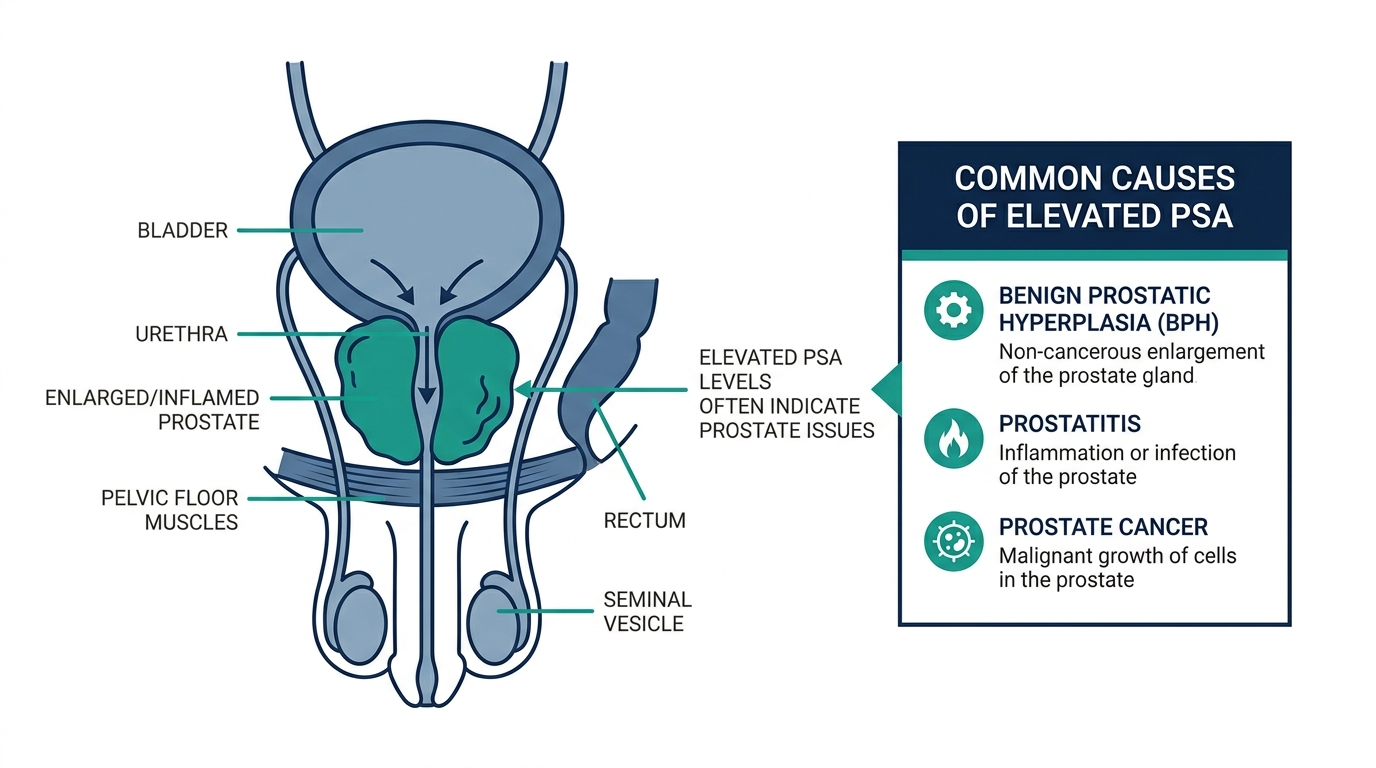
A high PSA blood test means the level of prostate-specific antigen in your blood is above the value labs treat as the upper limit of normal. Most men without prostate cancer have a PSA under 4.0 ng/mL, and many clinicians use 4.0 ng/mL or higher as the threshold for further testing (Cleveland Clinic). Some doctors act at a lower point, such as 2.5 or 3.0 ng/mL, especially in younger men.
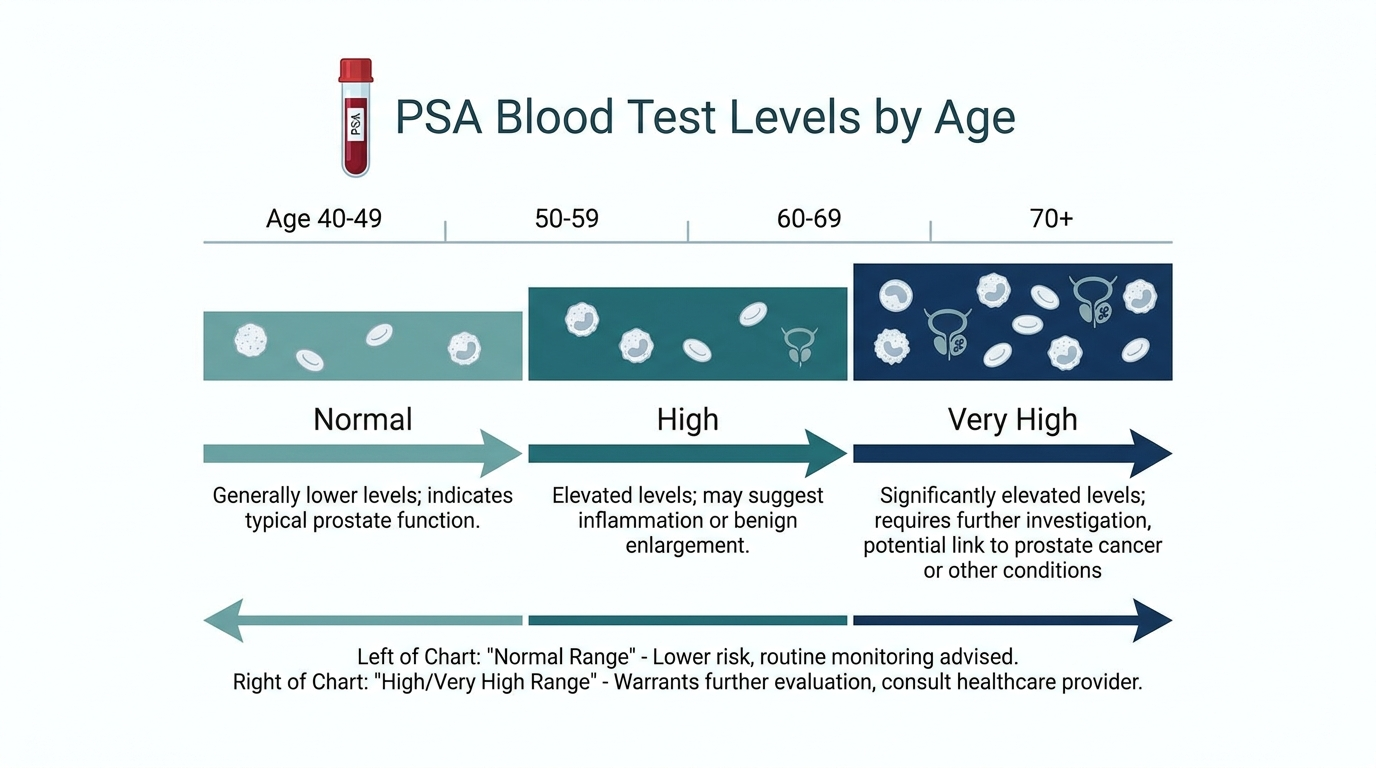
PSA is a protein made by the prostate gland. A single high number is a flag, not a diagnosis. Because PSA naturally rises with age, many labs and urologists also use age-specific reference ranges to interpret the result more fairly.
A high PSA signals further evaluation, not a diagnosis. See it alongside 100+ other markers. One at-home Superpower draw checks 100+ biomarkers, physician-reviewed.
- Age 40 to 50: 0 to 2.5 ng/mL (Cleveland Clinic urology).
- Age 50 to 60: 0 to 3.5 ng/mL.
- Age 60 to 70: 0 to 4.5 ng/mL.
- Age 70 to 80: 0 to 6.5 ng/mL.
So a 4.2 ng/mL reading may be borderline for a 50-year-old but well within range for a man in his 70s.
What an optimal PSA looks like, not just a normal one
Normal and optimal are not the same thing. A result can sit inside the lab reference range and still be higher than you would want for your age. Many healthy men in their 40s carry a PSA well under 1.0 ng/mL, and a baseline below 1.0 at age 40 to 50 is one of the stronger signals of a low lifetime prostate risk. A reading of 1.5 ng/mL is not abnormal, but it is a number worth recording so you have something to compare against a decade later.
The unit on every report is nanograms per milliliter, written ng/mL, and it means the same thing worldwide. What is not identical is the assay. Different labs calibrate their PSA machines to slightly different standards, so the same blood can read 3.8 ng/mL at one lab and 4.2 ng/mL at another. That gap is small, but it can push you across a cutoff, which is why urologists ask you to track PSA at the same lab whenever you can.
What causes a high PSA
The simplest way to actually get this done
Superpower is a full-body lab membership that runs 100+ biomarkers, has each result reviewed by a doctor, and tracks your numbers year over year (about $199/year). It is what we point readers to when they would rather get one clean, complete draw than chase single tests one at a time. Here is superpower reviewed in full.
Most high PSA results come from benign, non-cancer causes. Benign prostatic hyperplasia (BPH), prostatitis, and urinary retention all raise PSA, and BPH is the single most likely explanation when PSA sits between 4.0 and 10.0 ng/mL (American Cancer Society). Cancer is only one possibility on a longer list.
Common reasons your PSA may be elevated:
- Enlarged prostate (BPH): more prostate tissue makes more PSA. The increase is modest, near 0.3 ng/mL per gram of tissue, far less than the roughly 3.5 ng/mL per gram seen with cancer.
- Prostatitis: inflammation or infection can spike PSA sharply, sometimes to 20 ng/mL or higher, and tends to affect men under 50.
- Recent activity: ejaculation, vigorous cycling, a recent catheter, or a digital rectal exam can temporarily lift the number.
- Medical procedures: a prostate biopsy or urinary instrumentation raises PSA for days to weeks.
- Age and prostate size: PSA drifts up naturally over the decades.
Medications and habits that quietly move your PSA
Two common prostate drugs, finasteride and dutasteride (the 5-alpha-reductase inhibitors used for an enlarged prostate and for hair loss), lower PSA by roughly half after six to twelve months of use. If you take one, a good doctor mentally doubles your reading, so a 2.5 ng/mL on finasteride behaves more like a 5.0 ng/mL and still deserves attention. Always tell whoever orders the test that you are on these drugs.
Body size plays a part too. Men carrying more weight tend to run a slightly lower PSA because the same protein is diluted in a larger blood volume, which can mask a real rise. In the other direction, an active urinary infection, a recent catheter, or a flare of prostatitis can send PSA into the double digits for a few weeks before it settles. None of those are cancer, but each one can turn a clean result into a frightening one if the timing is wrong.
PSA also clears the blood slowly. Its half-life is about two to three days, so after anything that spikes it, whether a biopsy, an infection, or a long bike ride, the level needs a couple of weeks to drift back to baseline. That single fact explains most of the retesting advice further down this page.
Symptoms, or why it is often silent
A high PSA itself causes no symptoms. PSA is measured in blood, and early prostate cancer in particular is usually silent, which is exactly why the test exists as a screening tool (National Cancer Institute). Many men learn their PSA is high only because of a routine blood draw, feeling completely normal.
When symptoms do appear, they usually come from the underlying prostate condition rather than the PSA number. Watch for:
- Urinary changes: weak stream, trouble starting, frequent urination, or getting up at night.
- Pain or burning: often points to prostatitis or infection.
- Blood in urine or semen: always worth reporting promptly.
- Pelvic, hip, or back pain: uncommon, and a reason to seek care sooner.
Because most prostate disease can be silent for years, do not wait for symptoms to act on a high result.
When a high PSA is dangerous
The danger rises with the number. A PSA above 10 ng/mL carries more than a 50 percent chance of prostate cancer, while the 4 to 10 ng/mL “borderline” band carries roughly a 1 in 4 chance (National Cancer Institute; American Cancer Society). The trend over time matters as much as any single value.
Signs that push a result toward more urgent concern:
- Level above 10 ng/mL: cancer probability exceeds 50 percent and biopsy is commonly advised.
- Rapidly rising PSA: a fast year-over-year climb (PSA velocity) is more worrying than a stable elevated number.
- Low percent-free PSA: a free-PSA fraction of 10 percent or less leans toward cancer.
- Abnormal exam or family history: a suspicious digital rectal exam or strong family history raises the stakes at any PSA level.
A borderline number with reassuring features may simply be watched. None of this confirms cancer, but it shapes how fast your clinician moves.
At the very top of the scale the meaning gets simpler. A PSA in the hundreds is rarely a benign puzzle. Levels above 50 ng/mL are strongly associated with cancer that has already spread beyond the prostate, and a value over 100 ng/mL almost always points to metastatic disease. Those extremes are uncommon and are not the situation most men reading this are in, but they explain why a clinician treats a PSA of 8 very differently from a PSA of 80.
A realistic example of a borderline result
Picture a 58-year-old man whose routine physical returns a PSA of 5.2 ng/mL, up from 2.1 ng/mL three years earlier. On paper 5.2 is above the 4.0 cutoff, so it looks alarming. His doctor does not order a biopsy that day. She asks about recent cycling and any burning on urination, rechecks the level six weeks later with no ejaculation or hard exercise beforehand, and adds a percent-free PSA. The repeat comes back at 4.6 ng/mL with a free fraction of 22 percent. That combination, a slightly lower repeat and a reassuring free-PSA, points away from cancer, and the plan becomes an MRI and a recheck in a few months rather than an immediate biopsy. The takeaway is that a single number almost never decides anything on its own.
What to do next and when to see a doctor
The first step after a high PSA is usually to repeat the test, not to panic. Because infection, recent ejaculation, and exams can temporarily raise PSA, clinicians often recheck the level after a few weeks before recommending anything invasive (Cleveland Clinic). See a doctor promptly if your PSA is above 10, rising quickly, or paired with urinary symptoms or blood in the urine.
A sensible path forward:
- Repeat the PSA: confirm the elevation and rule out a temporary spike.
- Avoid PSA-raising activity before retesting: no ejaculation, hard cycling, or vigorous exercise for 48 hours.
- Consider refined tests: percent-free PSA, PSA density, or an MRI can clarify risk before any biopsy.
- Discuss biopsy if indicated: typically when the picture stays suspicious.
Bring your previous PSA values to the visit so your clinician can judge the trend.
How the newer tests narrow things down before a biopsy
A biopsy used to be the automatic next step above 4.0 ng/mL. It no longer is. Two calculations and one scan now sit between a high PSA and a needle. PSA density divides your PSA by the size of your prostate measured on ultrasound or MRI, and a density above roughly 0.15 raises concern because it means a lot of PSA is coming from a relatively small gland. PSA velocity looks at how fast the number climbs year over year, since a steady rise carries more weight than one high snapshot.
The bigger change is the prostate MRI. A multiparametric MRI can show whether a suspicious lesion exists at all, and it is scored on a five-point PI-RADS scale. A low score can safely spare many men a biopsy, while a high score lets the urologist aim the needle at the exact spot rather than sampling blindly. If your doctor jumps straight to biopsy without offering an MRI first, it is fair to ask why.
The insider nuance most patients miss
A single PSA number tells far less than the story behind it. Experienced urologists weigh percent-free PSA, PSA density, and velocity together, because these refine a borderline 4 to 10 ng/mL result that a raw number cannot resolve (American Cancer Society; National Cancer Institute). A higher free-PSA fraction points toward benign causes.
Two practical points clinicians lean on:
- Free PSA helps in the gray zone: a percent-free PSA of 25 percent or more usually points to a benign cause, while 10 percent or less leans toward cancer. Biopsy is often discussed in the 10 to 25 percent range.
- Trend beats a snapshot: a stable 5.5 ng/mL over three years is reassuring, whereas a jump from 2 to 5 in one year warrants attention even at a lower absolute number.
This is why guidelines have moved away from a single hard cutoff and toward judging the whole picture.
How a high PSA fits with your other blood work
PSA does not live in a vacuum. When a result comes back high, it helps to look at the numbers around it, because a few of them change how you read the prostate picture. Testosterone is the obvious one. Very low testosterone can suppress PSA, so a low-normal PSA in a man on testosterone therapy is not as reassuring as the same number in someone with normal hormones. If you are on testosterone replacement, your PSA deserves closer tracking, not less.
Infection and inflammation markers matter for context too. A urinary tract infection that shows up on a basic panel can be the entire reason a PSA spiked, and treating it often drops the number back to baseline on the retest. This is exactly the kind of situation where seeing many markers from a single draw pays off, because you can tell at a glance whether an infection or another process is driving the result rather than guessing from PSA alone.
None of those other markers replace the prostate-specific workup. What they do is stop you from acting on PSA in isolation, which is how borderline numbers turn into needless worry or, once in a while, into a missed clue.
Turn what you just learned into action.
Superpower lets you test 100+ biomarkers from home, then re-check them over time so you can actually see progress, physician-reviewed at every step.
Frequently asked questions
Is a PSA of 4 considered high?
A PSA of 4.0 ng/mL sits at the traditional cutoff, so it is borderline rather than clearly high. Many clinicians repeat the test and consider your age, since up to 4.5 ng/mL can be normal for men in their 60s (Cleveland Clinic).
Does a high PSA always mean cancer?
No. Most elevated PSA results come from benign causes such as BPH or prostatitis. In the 4 to 10 ng/mL range, only about 1 in 4 men turn out to have prostate cancer (American Cancer Society).
What PSA level requires a biopsy?
There is no single fixed number. Biopsy is often considered above 4 ng/mL and strongly considered above 10 ng/mL, but doctors also weigh free PSA, PSA density, MRI findings, and the trend over time (National Cancer Institute).
Can I lower my PSA before a retest?
You cannot meaningfully lower a true elevation, but you can avoid temporary spikes. Skip ejaculation, hard cycling, and vigorous exercise for about 48 hours before the blood draw, and tell your doctor about any recent infection.
How fast should I act on a high PSA?
For a borderline result, repeating the test in a few weeks is usually fine. Seek care sooner if your PSA is above 10, climbing quickly, or accompanied by urinary symptoms or blood in the urine or semen.
Can exercise or cycling really raise my PSA?
Yes, but usually only for a day or two. Long or vigorous bike rides press on the perineum and prostate and can nudge PSA up temporarily. It is one of the standard things to avoid for about 48 hours before a blood draw, along with ejaculation and any prostate exam.
What is a normal PSA for my age?
Age-adjusted upper limits run roughly 2.5 ng/mL in your 40s, 3.5 in your 50s, 4.5 in your 60s, and 6.5 in your 70s (Cleveland Clinic urology). These are ceilings, not targets. A number well below the ceiling for your decade is the reassuring position, and a rising trend within the range can still be worth watching.
How long should I wait before repeating a high PSA?
Because PSA takes about two to three days to clear and longer to settle after an infection or procedure, most clinicians recheck a borderline elevation after a few weeks rather than days. If the first value was drawn soon after a catheter, biopsy, or infection, waiting four to six weeks gives a cleaner reading.
Should I get a PSA test at all?
That is a genuine decision to make with your doctor, not an automatic yes. Screening is most often discussed for men from about age 50, or earlier around 40 to 45 for those with a family history or of higher-risk background. The value of a first PSA is that it gives you a personal baseline, which makes every future reading easier to interpret.
Sources
- Cleveland Clinic, Elevated PSA (Prostate-Specific Antigen) Level
- Cleveland Clinic, PSA Test: Purpose and Results
- American Cancer Society, Prostate Cancer Screening Tests
- National Cancer Institute, Prostate-Specific Antigen (PSA) Test
- WebMD, Low Free PSA Levels and Prostate Cancer
This article is for general educational purposes and is not medical advice. It cannot diagnose or treat you and does not replace your clinician. Always discuss your lab results and any health decisions with a qualified healthcare professional.
Related: compare the best at-home biomarker and blood tests.
Vital Signs Today may earn a commission if you buy through links on this page. It does not affect our editorial assessments.