- A low PSA blood test result, generally under 2.0 ng/mL, signals a very low chance of prostate cancer and is considered reassuring for most men.
- A low PSA does not guarantee you are cancer-free, because some aggressive prostate cancers and several common medications can keep PSA artificially low.
- If you take finasteride or dutasteride, your true PSA is roughly double the number on your report, so a “low” reading may be masking a real rise.
A prostate-specific antigen (PSA) test measures a protein made by the prostate gland that circulates in your blood. Most men want to know their number is high. A low number is usually good news, but it carries a few caveats worth understanding before you file the result away.
What does a low PSA result mean and what is the cutoff?
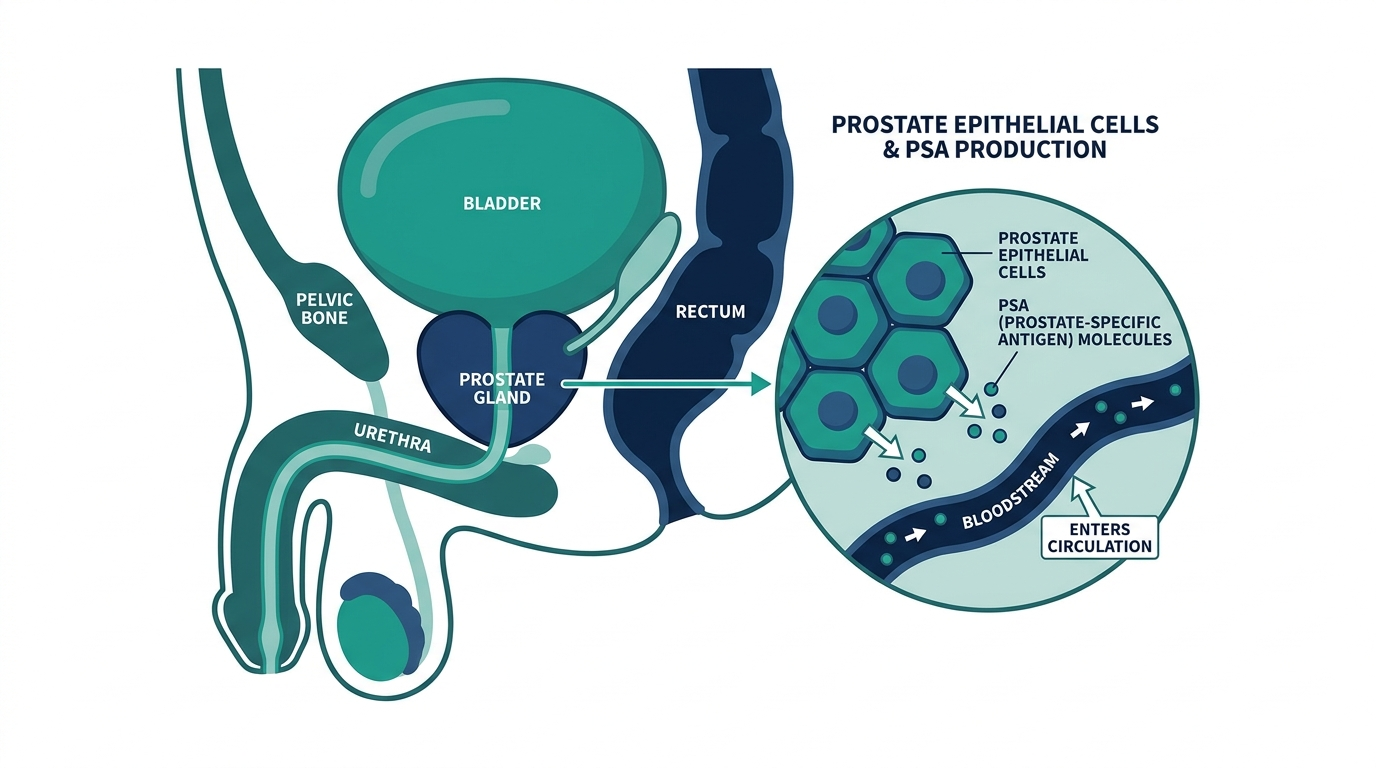
A low PSA result means the level of prostate-specific antigen in your blood is below the range that prompts concern, and your statistical risk of prostate cancer is very low. A PSA from 0 to 2.0 ng/mL is generally considered low, and at this level the chance of prostate cancer is small (Cleveland Clinic). For context, the average PSA for men aged 40 to 49 is only about 0.5 to 0.7 ng/mL.
A low PSA is reassuring, but it’s one marker out of hundreds. See the rest of your health picture. One at-home Superpower draw checks 100+ biomarkers, physician-reviewed.
There is no single number that defines “normal,” because PSA rises naturally with age and prostate size. Historically a value of 4.0 ng/mL was the line that triggered a biopsy referral, but clinicians now weigh PSA alongside age, family history, and how the number changes over time rather than reading it in isolation (MedlinePlus). A low result is best understood as one data point in a trend, not a one-time verdict.
Why there is no single “normal” PSA number
PSA does not have one clean cutoff the way a strep test has a yes or no. The old 4.0 ng/mL threshold was a convenience, not a biological wall, and plenty of men with prostate cancer sit below it while plenty above it have no cancer at all (MedlinePlus). What counts as reassuring shifts with age, because the prostate grows over a lifetime and produces more PSA as it does. A 45-year-old with a PSA of 2.5 and a 75-year-old with the same 2.5 are not in the same situation, which is why age-specific reference ranges exist.
As a rough guide, PSA tends to rise from well under 1.0 ng/mL in a man’s forties toward higher single digits by his seventies. A truly low PSA, in the 0 to 2.0 range, is the expected and reassuring baseline for most younger and middle-aged men (Cleveland Clinic). The practical point is to read your number against your own age band and your own prior results, not a generic line.
Total PSA versus free PSA
When people say “PSA,” they usually mean total PSA, which captures all the antigen in your blood. A second measure, free PSA, is the fraction not bound to proteins, and the ratio of free to total helps refine risk when total PSA is borderline (WebMD). A low total PSA rarely needs free PSA added, but understanding that the two exist explains why a doctor might order more than one PSA-based number when a result is ambiguous rather than clearly low.
What causes a low PSA level?
The simplest way to actually get this done
Superpower is a full-body lab membership that runs 100+ biomarkers, has each result reviewed by a doctor, and tracks your numbers year over year (about $199/year). It is what we point readers to when they would rather get one clean, complete draw than chase single tests one at a time. Here is superpower reviewed in full.
The most common cause of a low PSA is simply a healthy prostate that is small and not inflamed, which is the expected baseline for younger men. The average PSA in men under 50 sits below 2.5 ng/mL (Healthline). Several factors can push the number down, some natural and some artificial.
- Younger age and smaller prostate: less prostate tissue means less PSA produced, so younger men trend lower.
- 5-alpha-reductase inhibitors: finasteride and dutasteride, used for an enlarged prostate or hair loss, cut measured PSA by about 50 percent (StatPearls, NCBI).
- Other medications: certain drugs can falsely lower PSA, which is why your clinician needs a full medication list (MedlinePlus).
- Obesity: a larger blood volume can dilute PSA, producing a lower reading that does not reflect prostate biology.
How does a PSA result fit with the rest of prostate screening?
PSA is a screening tool, not a diagnosis, and it is only one station in a longer pathway. A low PSA usually means the pathway stops early, but it helps to know what the other stations are so you understand why one number is not the whole answer.
- Digital rectal exam: a physical check of the prostate can catch abnormalities a low PSA misses, which is why the two are often done together.
- Repeat and trend: a single PSA becomes far more useful once there is a second reading to compare it against, since the direction of change matters as much as the value.
- Free PSA and PSA density: when total PSA is borderline, the free-to-total ratio and PSA relative to prostate size help sort out who needs more.
- Imaging and biopsy: a prostate MRI and, if warranted, a targeted biopsy sit at the far end of the pathway, reserved for higher or rising numbers or worrying symptoms.
A low PSA generally means you stay at the first two stations with routine follow-up. It earns that reassurance precisely because it is read alongside your exam, your history, and your trend, not as a lone verdict (National Cancer Institute).
It also helps to know why screening is a shared decision rather than an automatic yearly ritual. PSA testing can find cancers that would never have caused harm, leading to biopsies and treatments some men did not need, which is why guidelines emphasize discussing the tradeoffs with your clinician based on your age and risk. A low result simplifies that conversation, because it keeps you in the low-risk lane where watchful, periodic checking is usually enough.
Symptoms: is a low PSA silent?
A low PSA itself causes no symptoms, because PSA is a lab measurement, not a disease. You will not feel a low number, and on its own it usually points to a healthy prostate. Symptoms matter more than the number when something is wrong.
Watch for urinary changes that can accompany prostate problems regardless of PSA: a weak or interrupted stream, needing to urinate often or urgently, trouble starting, getting up at night to urinate, or blood in the urine or semen. These signs warrant evaluation even with a low PSA, because early prostate cancer can be present without raising PSA much, and some men have a normal PSA alongside real disease (National Cancer Institute). The absence of a high number is not the same as the absence of a problem, so describe any symptoms to your clinician.
When is a low PSA actually dangerous?
A low PSA is rarely dangerous in itself, but it becomes a concern when it is artificially suppressed and hides a true rise. The clearest example is medication: a man on finasteride or dutasteride for six months or longer should have his measured PSA doubled to estimate the real value (StatPearls, NCBI).
Consider the math. A man on dutasteride sees a reported PSA of 2.0 ng/mL and feels reassured. Doubled, his true PSA is closer to 4.0 ng/mL, which would normally prompt further evaluation. The danger is not the low number but the false comfort it creates. The second concern is a small subset of aggressive cancers that produce little PSA, so a normal value cannot fully rule out disease (National Cancer Institute). This is why trend and context beat any single reading.
What can make a PSA read higher or lower than your true level?
PSA is easily nudged by things that have nothing to do with cancer, and knowing them helps you trust or question a given result. Several everyday factors temporarily raise PSA, so if any applied on test day, a “normal” or borderline reading might actually be lower than it looks once they settle.
- Recent ejaculation: sexual activity within about 48 hours before the draw can raise PSA, so many clinicians advise abstaining for two days beforehand.
- Vigorous cycling or a recent prostate exam: long bike rides, a digital rectal exam done just before the blood draw, a urinary catheter, or a recent biopsy can all push PSA up briefly.
- Urinary infection or prostatitis: inflammation or infection of the prostate can raise PSA substantially, and it should be treated and rechecked rather than acted on immediately.
On the other side, the things that lower PSA are mostly the 5-alpha-reductase inhibitors and the hemodilution from a larger body size covered above. The takeaway is simple: a low PSA drawn when you were well, had abstained, and were off PSA-lowering drugs is the most trustworthy kind. If any confounder was in play, the number is best confirmed under cleaner conditions.
What to do next and when to see a doctor
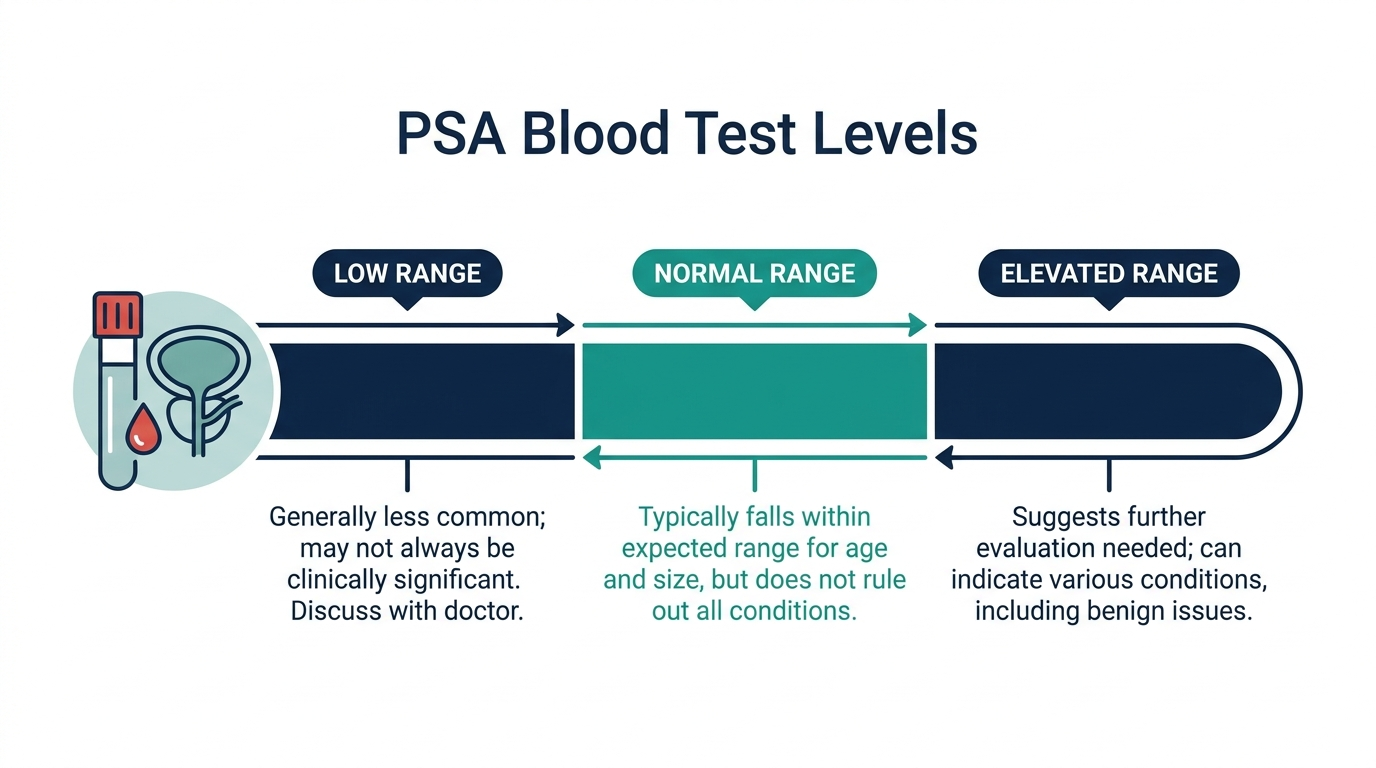
For most men, a low PSA means routine follow-up at the interval your clinician recommends, with no urgent action needed. The key next step is to give your doctor a complete medication list so a drug-suppressed reading is interpreted correctly (MedlinePlus).
See a doctor sooner if you have urinary symptoms, blood in urine or semen, bone pain, or a family history of prostate cancer, regardless of how low your number is. Ask three practical questions at your visit:
- Is my PSA affected by any medication I take? If you are on a 5-alpha-reductase inhibitor, ask for the doubled, adjusted value.
- How does this compare to my previous results? A rising trend, even within the low range, matters more than one snapshot.
- When should I test again? Screening intervals depend on age, risk, and prior results, so get a personalized schedule.
What do low PSA results look like in real life?
Scenario one: the reassuring baseline. A healthy 46-year-old with no symptoms gets a PSA of 0.7 ng/mL at a routine physical. He takes no prostate medications and had no recent cycling or exam. This is exactly the low, reassuring result most men in their forties should expect, and the plan is simply to keep the number as a baseline and recheck at the interval his doctor recommends.
Scenario two: the masked rise. A 60-year-old on dutasteride for an enlarged prostate sees a PSA of 2.1 ng/mL and feels relieved it is under the old 4.0 line. But because the drug roughly halves measured PSA, his true value is closer to 4.2 ng/mL, and it has crept up from 1.4 over two years. Doubling the reading and looking at the trend changes the story entirely, and his clinician arranges further evaluation. Two low-looking numbers, two completely different meanings, separated only by context.
The insider nuance: a “low” PSA can be a moving target
Clinicians pay close attention to PSA velocity, the rate at which your number changes over time, because a low absolute value can still be quietly climbing. A man whose PSA moves from 0.8 to 1.6 ng/mL over two years is technically still “low” at every reading, yet the doubling is a flag worth investigating.
This is also why a single low result, especially the first one you have ever had, gives you a baseline rather than a final answer. The number is most useful when tracked. Free PSA, the fraction of PSA not bound to proteins, is another layer clinicians may add to refine risk when results are ambiguous (WebMD). The takeaway: treat a low PSA as a starting line, keep your prior results, and let the trend tell the story.
Turn what you just learned into action.
Superpower lets you test 100+ biomarkers from home, then re-check them over time so you can actually see progress, physician-reviewed at every step.
Frequently asked questions
Is a low PSA level a good thing?
Generally yes. A PSA from 0 to 2.0 ng/mL means a very low statistical chance of prostate cancer (Cleveland Clinic). It is reassuring but not a guarantee, since some cancers produce little PSA and certain medications can lower the reading.
Can you have prostate cancer with a low PSA?
Yes, though it is uncommon. A small subset of aggressive prostate cancers produce little PSA, so a normal or low value cannot fully rule out disease (National Cancer Institute). Urinary symptoms should be evaluated regardless of your number.
What medications lower PSA levels?
The 5-alpha-reductase inhibitors finasteride and dutasteride, used for an enlarged prostate or hair loss, reduce measured PSA by about 50 percent (StatPearls, NCBI). Always tell your clinician about any medications you take.
If I take finasteride, how do I read my PSA?
After six months or more on finasteride or dutasteride, double the reported value to estimate your true PSA (StatPearls, NCBI). A reported 2.0 ng/mL is closer to 4.0 ng/mL, which may warrant follow-up.
What is a normal PSA level by age?
There is no single threshold, but PSA rises with age. Men under 50 typically sit below 2.5 ng/mL, and men aged 40 to 49 average about 0.5 to 0.7 ng/mL (Healthline). Older men trend slightly higher.
Does ejaculation or cycling affect a PSA test?
Yes. Recent ejaculation within about 48 hours, long bike rides, a urinary catheter, or a prostate exam just before the draw can all temporarily raise PSA (MedlinePlus). If you want the cleanest reading, abstain for a couple of days and avoid vigorous cycling beforehand, then compare the result to your prior numbers.
What is free PSA and when is it used?
Free PSA is the portion of PSA not bound to blood proteins, and the ratio of free to total PSA can refine cancer risk when the total is borderline (WebMD). It is not usually needed for a clearly low result, but a clinician may add it when a value sits in a gray zone.
How often should I get a PSA test if mine is low?
There is no one-size answer. Screening intervals depend on your age, family history, prior PSA values, and how the number is trending, so a personalized schedule from your clinician beats a fixed rule. A low, stable PSA generally means less frequent testing, while a rising trend, even within the low range, may prompt closer follow-up.
Can a low PSA rule out prostate problems entirely?
No. A low PSA makes prostate cancer statistically unlikely, but it cannot rule out every problem. Some aggressive cancers make little PSA, benign conditions can exist alongside a low number, and medications can suppress the reading (National Cancer Institute). This is why symptoms and your exam still matter even when the number looks great.
Sources
- Cleveland Clinic, Prostate-Specific Antigen (PSA) Test
- MedlinePlus, Prostate-Specific Antigen (PSA) Test
- National Cancer Institute, Prostate-Specific Antigen (PSA) Test Fact Sheet
- StatPearls, NCBI, 5-Alpha-Reductase Inhibitors
- Healthline, PSA Normal Ranges by Age
- WebMD, Low Free PSA Levels and Prostate Cancer
This article is for general educational purposes and is not medical advice. It cannot diagnose or treat you and does not replace your clinician. Always discuss your lab results and any health decisions with a qualified healthcare professional.
Related: compare the best at-home biomarker and blood tests.
Vital Signs Today may earn a commission if you buy through links on this page. It does not affect our editorial assessments.