Estrogen is the family of hormones that drives sexual development, the menstrual cycle, bone strength, and much more. When people say “estrogen level,” they almost always mean estradiol (E2), the most active form measured on routine blood tests. Because estradiol shifts dramatically across the menstrual cycle, between the sexes, and across the lifespan, there is no single “normal number.” This guide gives you the real reference ranges by age and sex, drawn from clinical laboratory sources.
Wondering where your estrogen falls for your age? See it alongside your complete hormone panel. One at-home Superpower draw checks 100+ biomarkers, physician-reviewed.
- A normal estradiol level for an adult man is roughly 10 to 42 pg/mL, while an adult woman of reproductive age can range from about 30 to 400 pg/mL depending on the menstrual cycle phase (Cleveland Clinic).
- Estradiol normally drops to under 30 pg/mL after menopause, with Mayo Clinic Laboratories listing a postmenopausal reference range of about 7 to 40 pg/mL.
- In children before puberty, estradiol is very low or undetectable (Tanner stage I is undetectable to about 13 pg/mL per Mayo Clinic Laboratories), then climbs as puberty progresses.
What is a normal estrogen level?
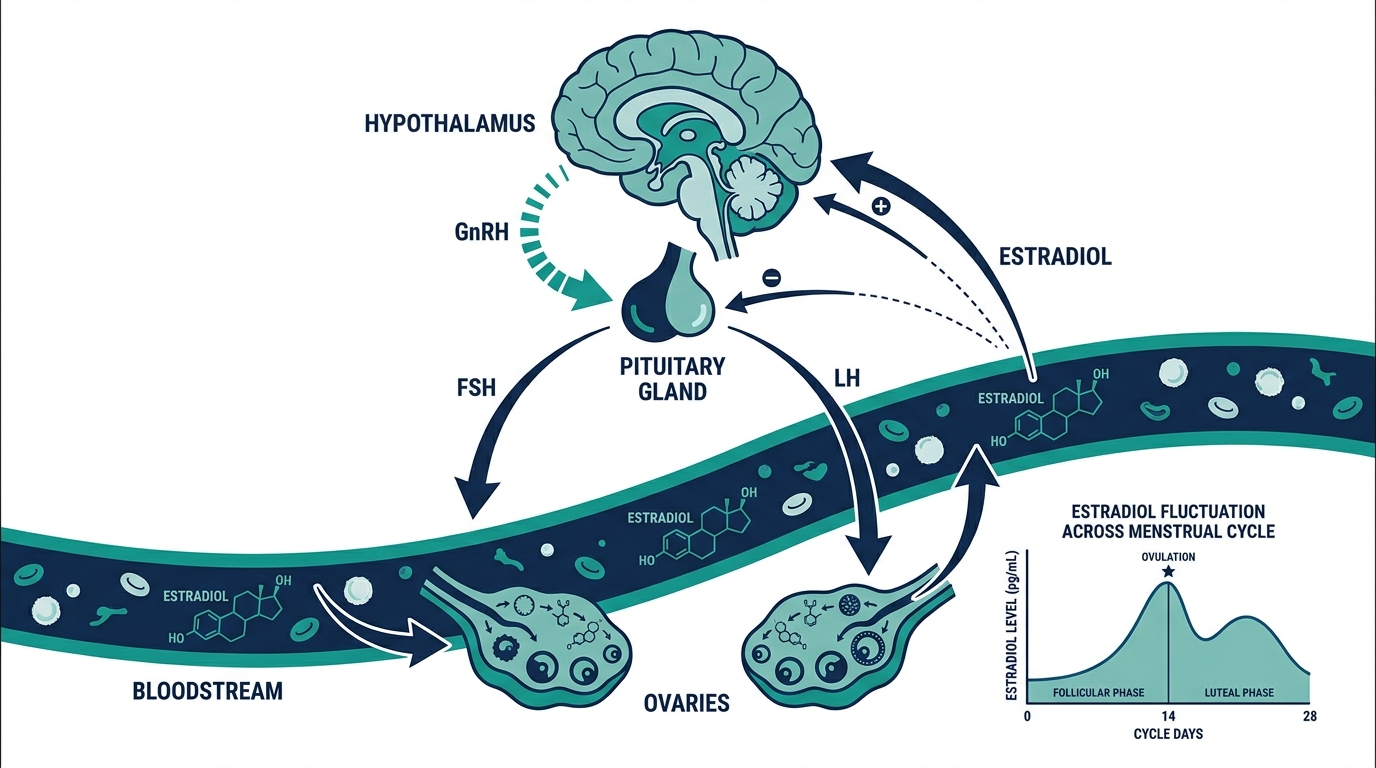
For most adults, a normal estradiol level falls between about 10 and 400 pg/mL, but the meaningful number depends entirely on your sex and, for women, where you are in the menstrual cycle (Cleveland Clinic). An adult man’s estradiol typically sits at 10 to 42 pg/mL, while a premenopausal woman swings from roughly 30 pg/mL in the early cycle up to 400 pg/mL near ovulation (Cleveland Clinic).
“Estrogen” is actually three hormones: estradiol (E2), the dominant and most potent form during the reproductive years; estrone (E1), the main estrogen after menopause; and estriol (E3), which rises mainly in pregnancy. Most lab panels report estradiol, so that is the number this article focuses on. Reference ranges also vary by laboratory and assay method, so always compare your result to the range printed on your own report rather than a generic chart.
Units, timing, and why the draw day matters most
Estradiol is reported in picograms per milliliter, written pg/mL, in the United States. Some labs use picomoles per liter (pmol/L) instead, where 1 pg/mL is about 3.67 pmol/L, so a result of 40 pg/mL is roughly 147 pmol/L. Check which unit your report uses before you compare it to any chart, because the two look wildly different for the same blood.
For a woman who is still cycling, the day of the draw is not a detail, it is the whole answer. A normal estradiol has no meaning unless the lab knows your cycle day. When a clinician wants a clean baseline, they usually draw on day 3, counting the first day of full flow as day 1, because early follicular levels are low and stable and easy to compare month to month. A number pulled at random mid-cycle can read four or five times higher and look alarming when nothing is wrong. If you track your own results, write down the cycle day next to each one.
Estrogen normal range by age (and sex)
The simplest way to actually get this done
Superpower is a full-body lab membership that runs 100+ biomarkers, has each result reviewed by a doctor, and tracks your numbers year over year (about $199/year). It is what we point readers to when they would rather get one clean, complete draw than chase single tests one at a time. Here is superpower reviewed in full.
Estradiol reference ranges climb from near zero in early childhood, peak during the reproductive years in women, and settle to low levels after menopause and in adult men. The table below combines published reference values from Cleveland Clinic and Mayo Clinic Laboratories. All values are estradiol (E2) in pg/mL.
| Life stage or group | Estradiol (E2) reference range, pg/mL | Source |
|---|---|---|
| Children, prepubertal (Tanner stage I) | Undetectable to about 13 | Mayo Clinic Laboratories |
| Puberty, Tanner stage II | Undetectable to about 16 | Mayo Clinic Laboratories |
| Puberty, Tanner stage III | Undetectable to about 26 | Mayo Clinic Laboratories |
| Puberty, Tanner stage IV | Undetectable to about 38 | Mayo Clinic Laboratories |
| Puberty, Tanner stage V (adolescent) | About 10 to 40 | Mayo Clinic Laboratories |
| Adult woman, early follicular phase | 30 to 100 | Cleveland Clinic |
| Adult woman, late follicular phase | 100 to 400 | Cleveland Clinic |
| Adult woman, luteal phase | 50 to 150 | Cleveland Clinic |
| Postmenopausal woman | About 7 to 40 (often under 30) | Mayo Clinic Laboratories |
| Adult man (18+) | 10 to 42 | Cleveland Clinic |
Two patterns stand out. First, the female reproductive years produce by far the widest swing, from about 30 pg/mL up to 400 pg/mL within a single month (Cleveland Clinic). Second, adult men and postmenopausal women land in a similar low band, roughly 10 to 42 pg/mL, because neither group has ovaries cycling at full output.
Normal on paper versus the number that fits you
Estradiol is a marker where the printed range can be technically normal and still not tell the full story. In a postmenopausal woman with hot flashes and bone loss, a value of 15 pg/mL sits inside the reference range yet may be exactly why she feels the way she does. In a young woman who has lost her period, a low-normal estradiol paired with a high FSH points toward ovarian failure even though each number alone can look acceptable. The range is a starting point, not a verdict.
There is also a technical trap at the low end. The cheap, common immunoassays that measure estradiol are least accurate exactly where accuracy matters most, at the very low levels seen in men, children, and postmenopausal women. For those groups, many endocrinologists prefer a mass spectrometry method (often labeled LC-MS/MS or sensitive estradiol), which reads low numbers far more reliably. If a man or a postmenopausal woman gets a surprising estradiol result, asking whether a sensitive assay was used is a fair and often clarifying question.
How does sex change the range?
Sex changes the range enormously: an adult woman of reproductive age can reach about 400 pg/mL at peak, roughly ten times the upper limit of 42 pg/mL for an adult man (Cleveland Clinic). The driver is the ovary, which produces large, cyclical amounts of estradiol that men’s bodies never make.
In men, estradiol is still essential. It is made mostly when the enzyme aromatase converts testosterone into estradiol in fat, brain, and bone tissue, and it supports bone density, libido, and sperm production. Because men lack ovaries, their estradiol stays in a narrow 10 to 42 pg/mL band with no monthly cycle (Cleveland Clinic). In women, estradiol is the headline reproductive hormone: it thickens the uterine lining, triggers the luteinizing hormone surge that releases an egg, and falls sharply if pregnancy does not occur, prompting menstruation. This is why a woman’s “normal” value is meaningless without knowing her cycle day.
What makes estrogen rise or fall with age?
Age changes estrogen mainly through the ovary in women: levels rise at puberty, stay high and cyclical through the reproductive years, then fall to under about 30 pg/mL after menopause, which occurs at an average age of 51 (Cleveland Clinic). In children, estradiol is very low until puberty begins, climbing in step with Tanner stages (Mayo Clinic Laboratories).
Several forces push estradiol up or down at any age:
- Puberty: Rising brain signals (FSH and LH) wake up the ovaries or testes, lifting estradiol from undetectable toward adult levels (Mayo Clinic Laboratories).
- Menstrual cycle: Estradiol peaks just before ovulation, then dips and rises again in the luteal phase, the source of the wide female range (Cleveland Clinic).
- Pregnancy: The placenta produces large amounts of estrogen, far above non-pregnant levels.
- Perimenopause and menopause: Ovarian output declines and becomes erratic, then drops permanently low (Cleveland Clinic).
- Body fat, medications, and illness: Fat tissue makes estrogen through aromatase, so higher body fat can raise it, while certain drugs, hormone therapy, and ovarian or pituitary disorders can move it either way.
When is an out-of-range result a concern?
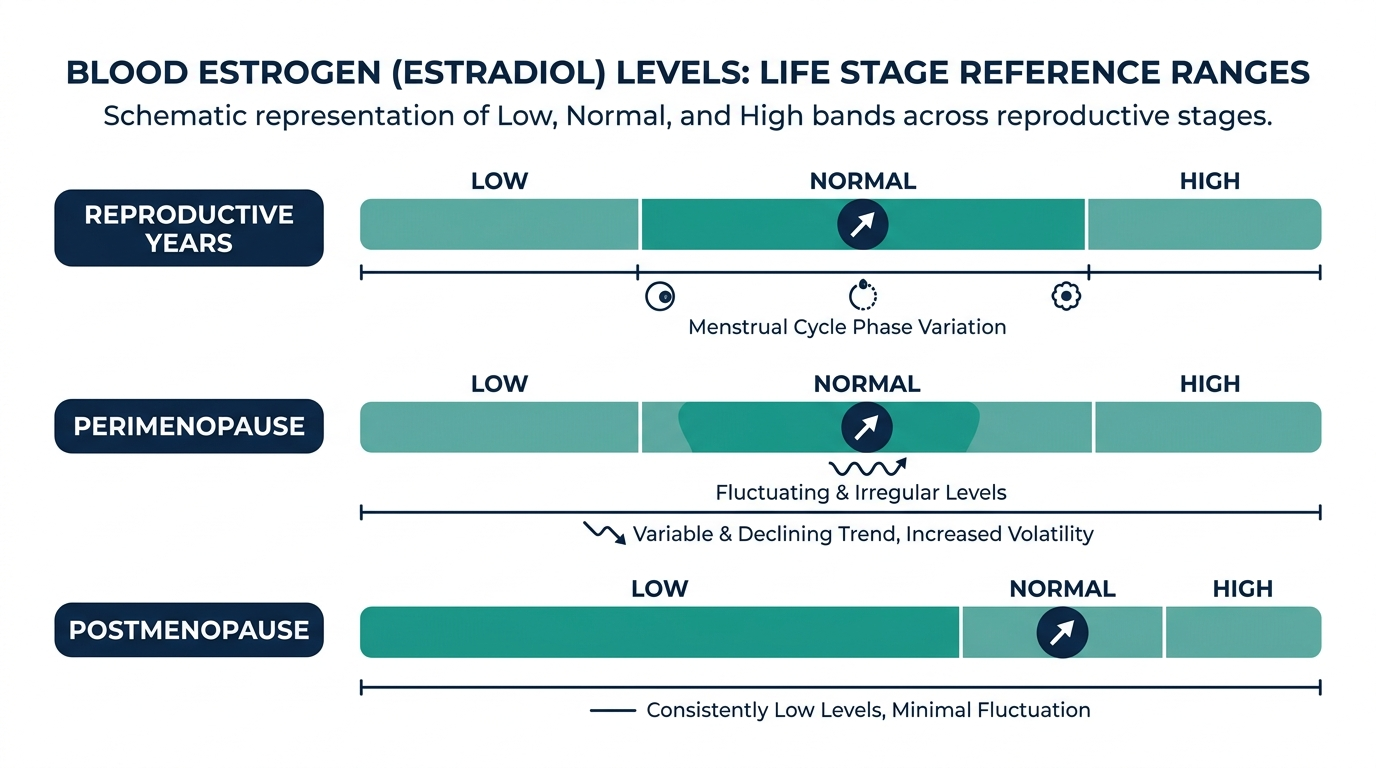
An out-of-range estradiol result matters most when it does not fit your age, sex, and symptoms; for example, very low levels in a younger woman or unexpectedly high levels in a man or child warrant evaluation (Cleveland Clinic). A single number rarely diagnoses anything on its own and is usually interpreted alongside FSH, LH, and your clinical picture.
Why perimenopause makes the numbers jump around
The years before menopause, called perimenopause, are the most confusing time to test estrogen, and it helps to know why. As the ovaries wind down they do not fade smoothly. They sputter, so estradiol can swing from higher than normal to very low within the same few weeks, which is exactly why a single result during this window is so hard to read. A woman can get a reassuringly high estradiol one month and a menopausal-looking low one the next, with hot flashes throughout. This is the biological reason clinicians lean on the pattern of symptoms and repeated FSH testing during perimenopause rather than betting on one estradiol draw.
Low estradiol in women can show up as missed periods, hot flashes, vaginal dryness, low libido, or bone loss, and may reflect menopause, primary ovarian insufficiency, very low body weight, or pituitary problems. High estradiol may relate to certain ovarian cysts or tumors, hormone therapy, or, in men, increased aromatase activity that can cause breast tissue growth (gynecomastia) and reduced fertility. In children, estradiol that rises too early can signal precocious puberty, while levels that stay flat past the expected age can point to delayed puberty (Mayo Clinic Laboratories). Any persistent symptom or surprising lab value deserves a conversation with your clinician, who can order repeat or timed testing.
A realistic example of a result read in context
Take a 27-year-old woman whose periods have become irregular and who gets an estradiol of 22 pg/mL. On its own that number is low but not shocking. The context changes everything. If it was drawn on cycle day 3, it is a reasonable early-follicular baseline and probably fine. If she has not had a period in four months and her FSH is high, the same 22 pg/mL supports a diagnosis of premature ovarian insufficiency and leads to more testing, not reassurance. If instead her FSH is low and she trains hard on very few calories, the picture shifts toward the hormonal shutdown seen with low energy availability. One estradiol value, three different meanings, decided entirely by the numbers and history around it.
Don’t just read about your health, track it.
A single result is a snapshot. Superpower re-tests 100+ markers over time so you can watch them move as you change sleep, food, and training.
How estrogen connects to your other hormones
Estradiol almost never gets interpreted by itself, and the markers drawn alongside it usually decide what it means. FSH and LH, the two signals the brain sends to the ovaries, are the most important companions. A low estradiol with a high FSH says the ovary is the problem, as in menopause or ovarian insufficiency, because the brain is shouting and getting no answer. A low estradiol with a low FSH points the finger upstream at the pituitary or hypothalamus instead. Reading estradiol without FSH is like hearing one side of a phone call.
In men, the number that matters next to estradiol is testosterone, because estradiol is made directly from it by the aromatase enzyme. A man with high estradiol and high body fat is often simply aromatizing more of his testosterone, which is why weight loss can bring the estradiol down without any drug. The testosterone-to-estradiol balance, not estradiol alone, is what drives symptoms like breast tenderness or gynecomastia.
Two more markers round things out. SHBG, the protein that carries sex hormones in the blood, changes how much of your estradiol is actually free and active, so a high SHBG can make total estradiol look higher than the effective level. And thyroid hormones sit in the background of any menstrual complaint, since a struggling thyroid can disturb cycles all on its own. This is the practical case for seeing hormones as a panel rather than chasing one value at a time.
Frequently asked questions
What is a normal estrogen level for a woman?
It depends on her cycle. An adult woman of reproductive age ranges from about 30 pg/mL in the early follicular phase to 100 to 400 pg/mL in the late follicular phase, then 50 to 150 pg/mL in the luteal phase (Cleveland Clinic). After menopause it falls to roughly 7 to 40 pg/mL.
What is a normal estrogen level for a man?
For an adult man aged 18 and over, a normal estradiol level is about 10 to 42 pg/mL (Cleveland Clinic). Men make estradiol by converting testosterone, and it supports bone, libido, and sperm production, so it should be present but low.
What is a normal estradiol level after menopause?
Postmenopausal estradiol is low, with Mayo Clinic Laboratories listing a reference range of about 7 to 40 pg/mL, and many women fall under 30 pg/mL. This drop reflects the ovaries no longer producing cyclical estrogen.
What estradiol level confirms menopause?
No single estradiol value confirms menopause on its own. Menopause is defined clinically as 12 months without a period, and clinicians usually look at a persistently low estradiol together with a high FSH rather than one number (Cleveland Clinic).
Why do estrogen ranges differ between labs?
Labs use different assays, equipment, and validated populations, so each sets its own reference interval. That is why your report prints its own range. Always compare your result to the range on your own report, not a generic chart, and review it with your clinician.
Do I need to fast for an estrogen test?
Estradiol testing does not usually require fasting. What matters far more is timing: for a cycling woman, the cycle day of the draw, and for anyone, telling the lab about hormone therapy, birth control, or fertility medication, since all of these move the number.
Can birth control or hormone therapy change my estradiol result?
Yes. Combined birth control pills suppress your own ovarian estradiol while supplying a synthetic estrogen that many assays do not measure well, so a low result on the pill is expected rather than worrying. Estrogen replacement therapy raises measured estradiol, and the level is often used to check that a dose is in the right zone. Always tell whoever interprets the test what hormones you take.
What are the symptoms of low estrogen?
In women, low estrogen commonly shows up as missed or irregular periods, hot flashes, night sweats, vaginal dryness, low libido, mood changes, and over time bone loss. In men, low estradiol is less talked about but can contribute to low libido and weaker bones, since men need a small amount of estradiol for bone health too.
Is high estrogen dangerous?
High estradiol is usually a clue rather than a disease in itself. In a man it can signal excess aromatase from high body fat, certain medications, or, rarely, a hormone-producing tumor. In a woman it may reflect a normal ovulatory peak, an ovarian cyst, or hormone therapy. The concern depends on who has it and why, which is why a high result is investigated in context rather than treated as an emergency.
How often should estrogen be retested?
It depends on why you are testing. A one-off check to explain a symptom is often enough, while someone on hormone therapy or fertility treatment may retest every few weeks to fine-tune a dose. For a cycling woman chasing an irregular pattern, repeating the draw on the same cycle day across two or three months tells a far clearer story than a single result ever could.
Sources
- Cleveland Clinic, Estrogen: Hormone, Function, Levels and Imbalances
- Mayo Clinic Laboratories, Estradiol, Serum (EEST) Test Catalog
- Mayo Clinic Laboratories, Estrogens, Estrone (E1) and Estradiol (E2), Fractionated, Serum (ESTF)
- MedlinePlus, Estrogen Levels Test
This article is for general educational purposes and is not medical advice. It cannot diagnose or treat you and does not replace your clinician. Always discuss your lab results and any health decisions with a qualified healthcare professional.
Related reading
Related: test your thyroid and hormones from home.
Vital Signs Today may earn a commission if you buy through links on this page. It does not affect our editorial assessments.