Curious where your cortisol falls for your age and time of day? See it alongside your full hormone panel. One at-home Superpower draw checks 100+ biomarkers, physician-reviewed.
- A normal morning (6 to 8 a.m.) blood cortisol level for most healthy adults is about 10 to 20 micrograms per deciliter (mcg/dL), falling to roughly 3 to 10 mcg/dL by around 4 p.m., according to Cleveland Clinic.
- Cortisol reference ranges change far more with the time of day than with age, and after about age 6 most children share the adult-style ranges, so labs rarely publish separate adult age brackets.
- Healthy men and women use essentially the same blood cortisol reference range, because standard lab values are not split by sex, though pregnancy and oral estrogen can raise measured total cortisol.
Cortisol is the body’s main stress hormone, and it is one of the few lab values that is supposed to swing wildly across a single day. That is what makes “is my cortisol normal” a harder question than it looks. The same number that is perfectly healthy at 7 a.m. could be a red flag at 11 p.m. Below is what the reference ranges actually are, how age and sex move them, and when an out-of-range result is worth a second look.
What is a normal cortisol level?
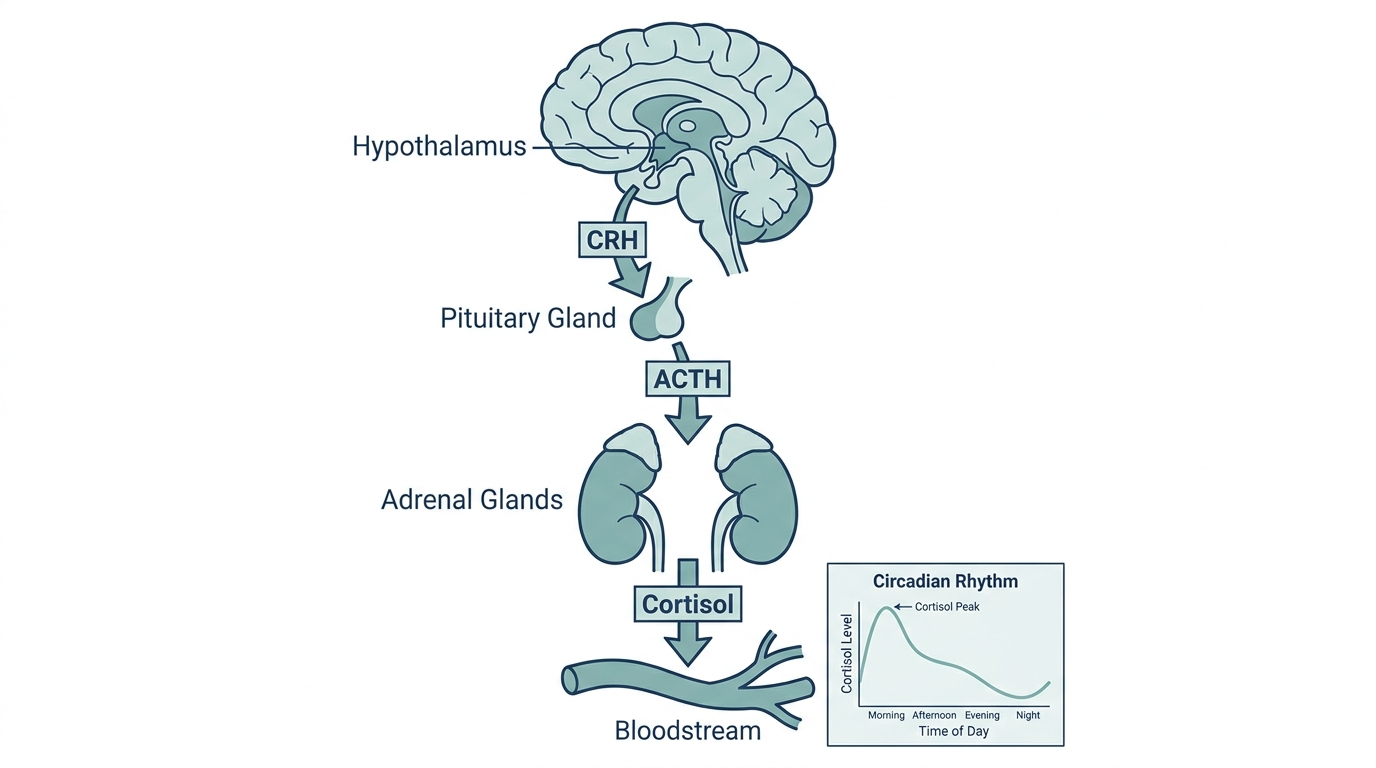
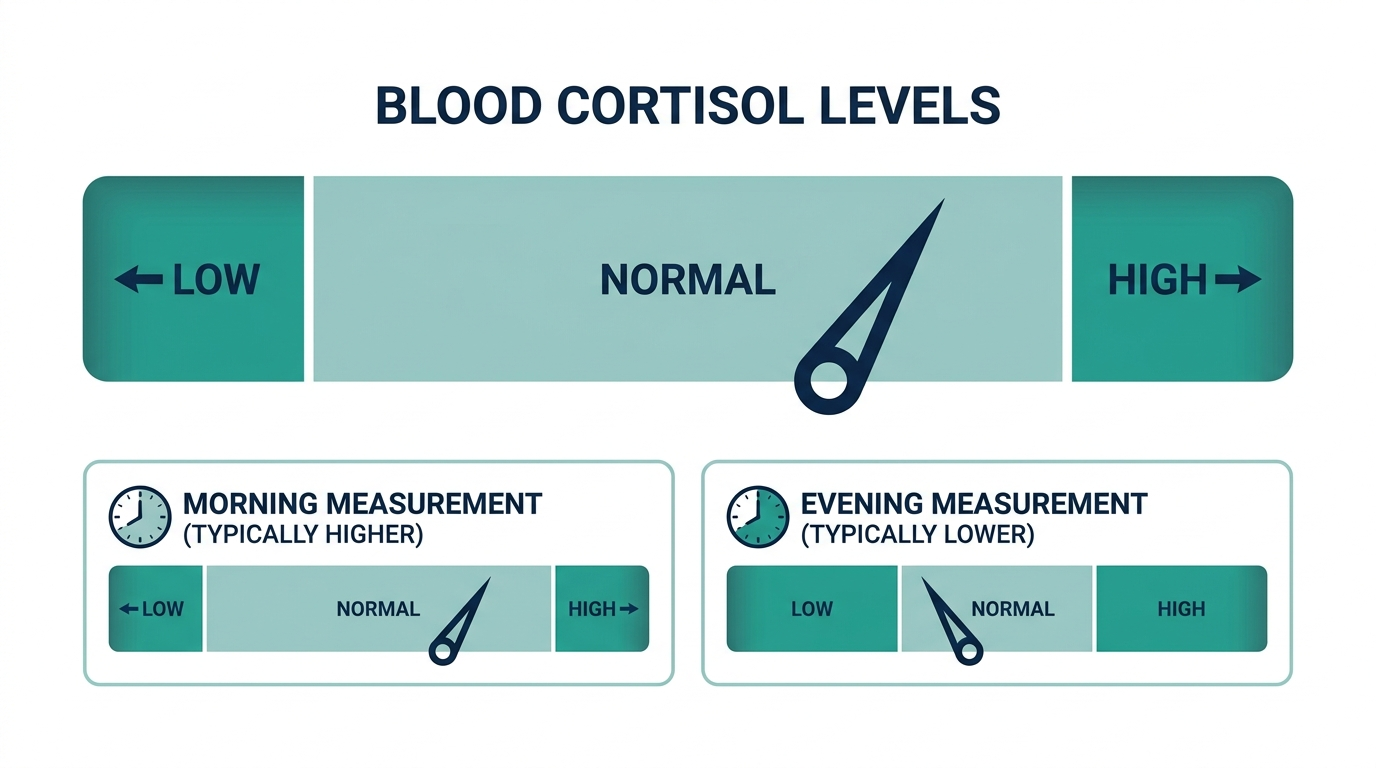
For most healthy adults, a normal blood cortisol level is about 10 to 20 mcg/dL when drawn in the early morning (6 to 8 a.m.) and about 3 to 10 mcg/dL when drawn around 4 p.m. (Cleveland Clinic). The single most important fact about cortisol is timing: levels are normally highest shortly after you wake and drop to their lowest around midnight.
This daily rhythm is why your doctor cares so much about when the blood was drawn. A cortisol of 18 mcg/dL is reassuring at 7 a.m. but unusual at 10 p.m. MedlinePlus notes that samples are often taken twice in a day, once in the morning at the peak and again near 4 p.m. when levels should be much lower, precisely to confirm the rhythm is intact (MedlinePlus).
A few practical points:
- Units matter: US labs usually report mcg/dL; some international labs use nmol/L, where 1 mcg/dL is about 27.6 nmol/L.
- Test type matters: blood, saliva, and 24-hour urine each have their own reference ranges and cannot be compared head to head.
- Your lab’s range wins: reported normals vary by laboratory and assay, so read your result against the range printed on your own report.
Cortisol normal range by age
The simplest way to actually get this done
Superpower is a full-body lab membership that runs 100+ biomarkers, has each result reviewed by a doctor, and tracks your numbers year over year (about $199/year). It is what we point readers to when they would rather get one clean, complete draw than chase single tests one at a time. Here is superpower reviewed in full.
Cortisol reference ranges shift much more with time of day than with age, and most laboratories publish a single adult range rather than separate brackets for, say, 30-year-olds versus 60-year-olds (Cleveland Clinic). The clearest age difference is in early life: newborns have a wide, still-developing range, and the adult-style morning-high, night-low rhythm generally stabilizes by about age 6 (NCBI PMC).
How to get a cortisol result you can trust
Cortisol is one of the easiest lab values to draw badly, and a mistimed or stressful draw is the single most common reason for a confusing number. Because the peak is in the first hour after waking, a morning cortisol means blood taken between 6 and 8 a.m., not whenever you happen to reach the lab at 11. If your slip says 8 a.m. cortisol, treat the time as part of the test, not a suggestion.
A few things sway the result before the needle even goes in. A stressful commute, a fasted low blood sugar, hard exercise that morning, or even anxiety about the draw itself can nudge cortisol up, which is why a calm ten minutes in the waiting room helps. Night-shift workers are a special case, since their clock is shifted, so a morning range read against a sample drawn after a night awake can look abnormal when the underlying rhythm is fine. Tell the lab if you work nights so the timing can be matched to your own wake time.
The three test types are not interchangeable. Blood measures total cortisol at one instant. Saliva measures free, active cortisol and is popular for late-night sampling, because a healthy person should be near their floor at bedtime. A 24-hour urine free cortisol averages the whole day and is a workhorse for spotting genuine overproduction. Comparing a saliva number to a blood range, or a urine result to either, is how people scare themselves for no reason.
The table below shows typical morning (about 8 a.m.) and afternoon (about 4 p.m.) blood cortisol reference values. Treat these as orientation, not diagnosis, because exact cutoffs differ by lab.
| Age group | Morning (about 8 a.m.) | Afternoon (about 4 p.m.) |
|---|---|---|
| Newborns (0 to 1 month) | about 1 to 24 mcg/dL | Rhythm not yet established |
| Children (1 to 16 years) | about 3 to 21 mcg/dL | about 3 to 10 mcg/dL |
| Adults (morning peak) | about 10 to 20 mcg/dL | about 3 to 10 mcg/dL |
| Older adults (65+) | Same adult range applies | Same adult range applies |
Newborn and pediatric figures reflect published infant and pediatric reference work, while the adult morning and afternoon values follow Cleveland Clinic’s reported ranges of 10 to 20 mcg/dL and 3 to 10 mcg/dL (Cleveland Clinic, NCBI PMC). The takeaway: outside of infancy, “by age” matters less than “by time of day.”
Why the shape of your curve beats any single number
The most useful thing about cortisol is not the height of the morning peak but the size of the drop from morning to evening. A healthy pattern falls steeply through the day and lands near the floor at bedtime. When people describe feeling tired but wired, they often mean a curve that stays too flat, where the evening number never comes down the way it should. That flattening is what tends to creep in with older age, chronic stress, and poor sleep, even while each individual reading still lands inside the printed range.
This is why a single mid-range value can be reassuring and misleading at the same time. A cortisol of 12 mcg/dL is unremarkable at 8 a.m. and quite abnormal at 10 p.m. If your main complaint is fatigue or trouble sleeping, a doctor is often more interested in a late-night salivary cortisol or a paired morning-and-evening draw than in one daytime number, because those capture the rhythm rather than a snapshot.
How does sex change the range?
For everyday lab interpretation, sex does not change the cortisol reference range: men and women are read against the same morning and afternoon values of roughly 10 to 20 mcg/dL and 3 to 10 mcg/dL (Cleveland Clinic). Standard blood cortisol tests are not split by sex the way hormones like testosterone or estradiol are.
There is one important wrinkle that is about chemistry, not biology. Most blood cortisol travels bound to a carrier called cortisol-binding globulin (CBG). Anything that raises CBG raises the total cortisol the test sees, even when the active, free cortisol is normal. Pregnancy and oral estrogen (including some birth control pills) can raise CBG and push total cortisol above the usual range without indicating disease (NCBI StatPearls). Because of this, clinicians may switch to a free cortisol or salivary test, or simply interpret a total result in light of these medications, rather than reading a high number as a problem.
What makes cortisol rise or fall with age?
The biggest driver of cortisol across the lifespan is not aging itself but the daily rhythm and acute stress: cortisol peaks within an hour of waking and bottoms out near midnight, a pattern controlled by the hypothalamic-pituitary-adrenal (HPA) axis (NCBI StatPearls). On top of that rhythm, day-to-day surges come from physical or emotional stress, illness, intense exercise, and low blood sugar.
Age does play a supporting role. In newborns the circadian rhythm is immature and stabilizes over the first months of life (NCBI PMC). Research in older adults suggests average cortisol can drift modestly upward and the curve can flatten somewhat with advancing age, though the standard reference range stays the same. Other things that move a single result include:
- Medications: corticosteroid drugs (even creams or inhalers), and estrogen, as noted above.
- Shift work and poor sleep: these can blunt or shift the normal daily curve.
- Acute stress or illness: a stressful blood draw alone can nudge the number up.
When is an out-of-range result a concern?
A single out-of-range cortisol is rarely a diagnosis on its own; a cortisol test cannot identify the cause of an abnormal level by itself, which is why doctors confirm with repeat or dynamic testing (MedlinePlus). What matters is the pattern, the timing, and your symptoms. As a guide, an 8 a.m. plasma cortisol under 10 mcg/dL in someone with symptoms of deficiency usually prompts further study (NCBI StatPearls).
Two broad directions raise concern:
- Persistently high cortisol can point to Cushing syndrome, an adrenal or pituitary tumor, or corticosteroid medication use (Cleveland Clinic). Classic clues include weight gain around the trunk and face, easy bruising, purple stretch marks, and high blood pressure.
- Persistently low cortisol can reflect Addison disease (damaged adrenal glands) or pituitary problems (MedlinePlus). Warning signs include fatigue, weight loss, low blood pressure, salt cravings, and darkening of the skin.
To sort this out, clinicians use confirmatory tests such as the ACTH (cosyntropin) stimulation test for suspected low cortisol and the dexamethasone suppression test or a 24-hour urine free cortisol for suspected high cortisol (Cleveland Clinic). Bring any abnormal result to your clinician, and mention every medication and supplement you take, since several can move the number.
A realistic example of a confusing result
Consider a 34-year-old woman on a combined birth control pill whose routine panel shows an 8 a.m. cortisol of 26 mcg/dL, above the usual ceiling. On its own that looks like a flag for overproduction. Her clinician asks one question first: are you on estrogen. Oral estrogen raises cortisol-binding globulin, the carrier protein, so the total cortisol the blood test sees climbs even though the active free cortisol is normal. Rather than launch a Cushing workup, the doctor either repeats the test with a free or salivary cortisol or simply reads the number in light of the pill. No disease, just chemistry. The same logic protects pregnant patients, whose total cortisol rises for the same reason.
Turn what you just learned into action.
Superpower lets you test 100+ biomarkers from home, then re-check them over time so you can actually see progress, physician-reviewed at every step.
How cortisol connects to your other numbers
Cortisol rarely drifts in isolation, and a few neighboring markers make an abnormal result much easier to read. Blood sugar is the closest partner. Cortisol raises glucose on purpose, so chronically high cortisol often shows up alongside a creeping fasting glucose or hemoglobin A1c, and a stubbornly high morning sugar can be an early hint that stress hormones are running hot. If your cortisol is high, it is worth seeing where your glucose sits.
Thyroid and other pituitary hormones matter too. The same pituitary gland that drives cortisol through ACTH also governs thyroid and sex hormones, so a genuinely low cortisol from a pituitary problem frequently travels with low thyroid or low testosterone. That is one reason a single low cortisol prompts a doctor to look at the wider hormone panel rather than treat the number alone. Potassium and sodium round out the picture in suspected adrenal failure, where low sodium and high potassium can accompany the fatigue and salt cravings.
The practical point is the one that runs through every good workup. One hormone read in isolation invites both false alarms and missed problems, whereas seeing cortisol next to glucose, thyroid, and the sex hormones from a single draw turns a puzzling value into a story you can actually follow.
Frequently asked questions
What is a normal cortisol level in the morning?
For most healthy adults, a normal early-morning (6 to 8 a.m.) blood cortisol is about 10 to 20 mcg/dL, the daily high point, according to Cleveland Clinic. Levels then fall through the day, reaching roughly 3 to 10 mcg/dL by around 4 p.m. Your lab’s printed reference range is the one to compare against.
Do cortisol levels increase with age?
The standard reference range does not change with adult age, so labs use one adult range. Research suggests average cortisol may drift slightly higher and the daily curve can flatten a bit in older adults, but a single value is still read against the usual morning and afternoon ranges.
Is cortisol different for men and women?
No, routine blood cortisol tests use the same range for both sexes. The exception is chemistry, not biology: pregnancy and oral estrogen can raise total measured cortisol by increasing its carrier protein, so clinicians may use a free or salivary cortisol test instead.
What cortisol level is dangerously high?
There is no single universal danger number, because timing and symptoms matter more than one value. Persistently high cortisol, especially with weight gain around the trunk, easy bruising, or high blood pressure, can signal Cushing syndrome and warrants confirmatory testing such as a dexamethasone suppression test.
Can a blood test alone diagnose a cortisol problem?
No. MedlinePlus states a cortisol test alone cannot identify the cause of an abnormal level. Doctors confirm with repeat timed draws or dynamic tests, such as the ACTH stimulation test for low cortisol or the dexamethasone suppression test for high cortisol, plus your full symptom picture.
What is a normal cortisol level at night?
Cortisol should be at its lowest late in the evening, near your bedtime and around midnight, which is exactly why a late-night salivary cortisol is used to screen for overproduction. A number that is still high at that hour is more telling than a high morning value, because the morning peak is supposed to be high in the first place.
Can stress alone push my cortisol out of range?
Short bursts of stress raise cortisol briefly, and even the anxiety of a blood draw can lift a single reading. What a one-off stress spike does not do is create the sustained, rhythm-flattening pattern seen in true disease. If a result looks high and you were stressed or rushed, a calm repeat draw at the right time often settles it.
Do I need to fast for a cortisol test?
A cortisol blood test does not usually require fasting, but timing matters far more than food. Aim for the window your doctor specified, most often early morning, and mention any steroid medication, estrogen, or overnight shift work, since each can shift the result.
Is a cortisol of 20 high?
At 8 a.m. a cortisol near 20 mcg/dL sits at the top of the usual morning range, so it is generally normal rather than high, especially if you were up early or a little stressed. The same 20 mcg/dL drawn in the late afternoon or evening, when the level should have fallen well into the single digits, is the reading that would prompt a closer look.
Sources
- Cleveland Clinic, Cortisol Test
- MedlinePlus, Cortisol Test
- NCBI StatPearls, Physiology, Cortisol
- NCBI PMC, Salivary Cortisol Circadian Rhythm and Reference Intervals in Full-Term Infants
- Cleveland Clinic, ACTH (Cosyntropin) Stimulation Test
This article is for general educational purposes and is not medical advice. It cannot diagnose or treat you and does not replace your clinician. Always discuss your lab results and any health decisions with a qualified healthcare professional.
Related reading
Related: test your thyroid and hormones from home.
Vital Signs Today may earn a commission if you buy through links on this page. It does not affect our editorial assessments.