
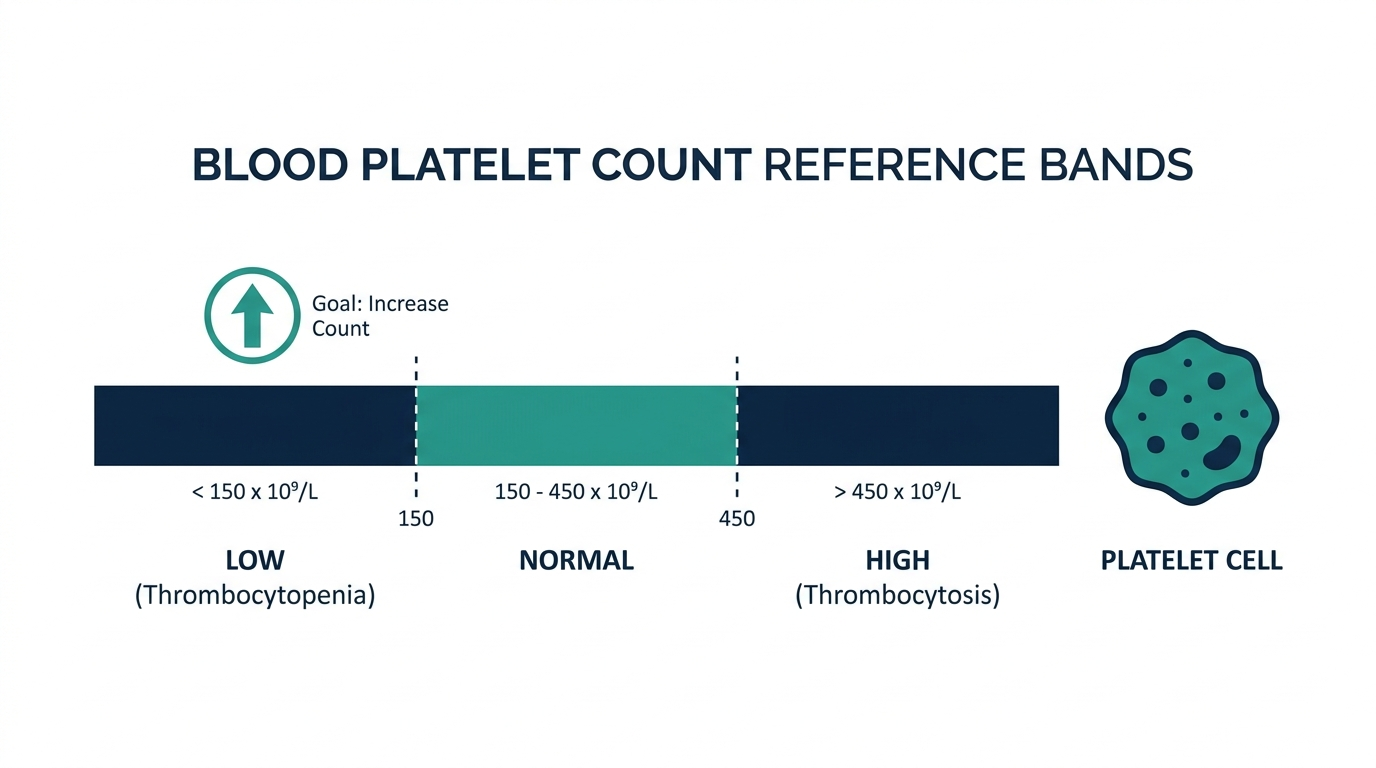
- A normal platelet count is 150,000 to 450,000 platelets per microliter of blood, and “low platelets” (thrombocytopenia) begins below 150,000, according to the Cleveland Clinic.
- The most reliable way to raise a low platelet count is to correct the underlying cause, such as a folate, vitamin B12, or iron deficiency, an infection, a medication side effect, or heavy alcohol use, because no single food rapidly rebuilds platelets on its own.
- Because circulating platelets live only 8 to 10 days and the marrow makes about 100 billion per day, a count that is trending up usually takes one to several weeks to recover once the cause is fixed.
Part of our Complete Blood Count guide.
What counts as low platelets?
Low platelets, called thrombocytopenia, means a platelet count under 150,000 platelets per microliter of blood. A normal adult range is 150,000 to 450,000 per microliter (Cleveland Clinic). Cleveland Clinic grades the drop in tiers: mild is roughly 101,000 to 140,000, moderate is 51,000 to 100,000, and severe is below 50,000, where the risk of bleeding during everyday activities rises sharply.
If you’re trying to raise a low platelet count, wouldn’t it help to see the full blood picture first? One at-home Superpower draw checks 100+ biomarkers, physician-reviewed.
Most people with mildly low platelets feel nothing. Symptoms usually appear only when counts fall well below 50,000 and can include easy bruising, tiny red or purple skin dots called petechiae, frequent nosebleeds, bleeding gums, and heavier than usual periods. A count under about 10,000 to 20,000 is the zone where spontaneous, serious bleeding becomes a real concern and prompt medical care is needed.
How the count is measured, and when it is falsely low
Your platelet count comes from an automated analyzer that runs alongside the rest of your complete blood count. Before you accept a low number and start changing your diet, it is worth knowing that a surprising share of “low” results are not real. The most common false alarm is pseudothrombocytopenia, where platelets clump together in the purple-top EDTA tube used for a standard blood draw. The machine counts a clump as a single cell, so a normal count can read as low. Clinicians confirm this by looking at a blood smear under the microscope: if they see clumps, the true count is fine, and a redraw into a citrate tube usually gives a normal reading. If your low platelet count came out of the blue with no bleeding and no symptoms, ask whether the lab reviewed the smear before you worry.
The report often carries a second clue next to the count: mean platelet volume, or MPV, which measures the average size of your platelets. Young platelets are larger, so a high MPV alongside a low count suggests the marrow is pumping out fresh platelets to replace ones being destroyed, which points toward a destruction problem like immune thrombocytopenia. A low or normal MPV with a low count leans more toward a production problem. It is not a stand-alone diagnosis, but it is a free piece of information already on your printout.
What affects your platelet number on test day
Platelets are less sensitive to test-day variables than glucose or lipids, and you do not need to fast for a CBC. Even so, a few things move the number. Hard exercise in the hours before a draw can transiently lift the count, because the spleen releases stored platelets into circulation, so a reading taken right after a workout can look higher than your baseline. A recent viral illness can push the count down for a week or two and then recover on its own. Pregnancy lowers platelets modestly in many people, a normal pattern called gestational thrombocytopenia. And the count naturally drifts a little from one draw to the next, so a single value near the bottom of the range is best confirmed with a repeat test rather than treated as a crisis.
Why raise it?
The simplest way to actually get this done
Superpower is a full-body lab membership that runs 100+ biomarkers, has each result reviewed by a doctor, and tracks your numbers year over year (about $199/year). It is what we point readers to when they would rather get one clean, complete draw than chase single tests one at a time. Here is superpower reviewed in full.
You raise a low platelet count to restore normal clotting and lower bleeding risk, since platelets are the cell fragments that plug damaged blood vessels. Below 50,000 per microliter, the risk of bleeding from minor cuts and daily activities climbs, and below roughly 10,000 to 20,000, dangerous spontaneous bleeding can occur (Cleveland Clinic, NHLBI).
The right reason to act is not chasing a number for its own sake. A mildly low count found on routine bloodwork, with no bleeding and no symptoms, may simply need monitoring and a search for the cause. The goal is a count high enough to protect you, not a “perfect” lab value. That is why your clinician weighs your count alongside symptoms, medications, and any planned procedures or surgery before deciding whether and how aggressively to intervene.
What causes a low platelet count?
Every cause of thrombocytopenia falls into one of three buckets, and knowing which one you are in tells you what will actually raise the count. This is the framework a hematologist uses on the first visit, and it is worth carrying into the exam room yourself.
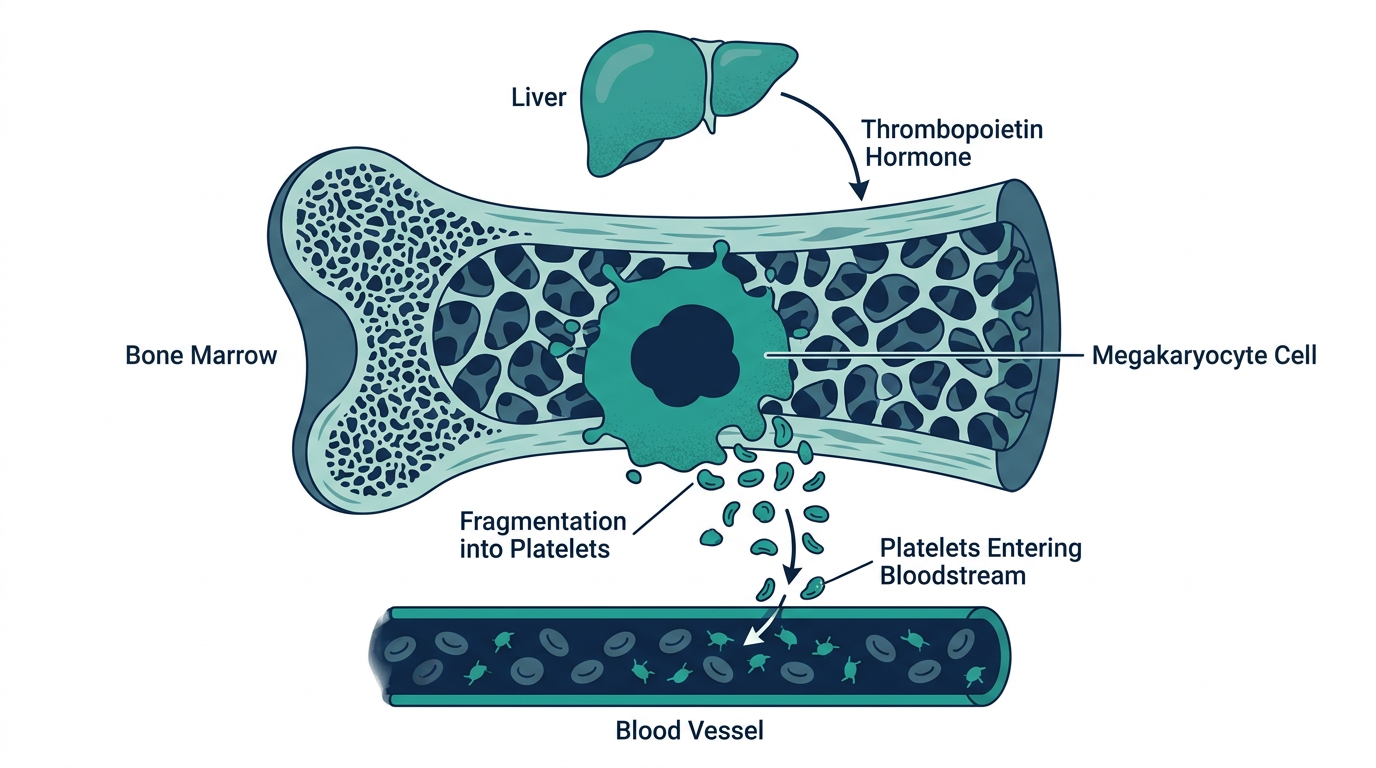
- The marrow makes too few. Platelets are built by giant marrow cells called megakaryocytes. When production slows, the count falls. Common reversible triggers are heavy alcohol use, a vitamin B12 or folate deficiency, and viral infections. Less common but more serious causes include chemotherapy, marrow disorders, and rare inherited conditions. Fixing a production problem is often the most durable win, because you are turning the tap back on.
- The body destroys them too fast. Here the marrow works fine, but platelets are cleared from the blood early. Immune thrombocytopenia (ITP) is the classic example, where the immune system tags platelets for removal. Certain drugs trigger the same reaction, including some antibiotics, quinine, heparin, and a handful of seizure medicines. Destruction problems tend to show a high MPV, because the marrow is racing to keep up.
- The spleen holds too many. Normally about a third of your platelets sit in the spleen at any moment. When the spleen enlarges, often from liver disease and portal hypertension, it can pool a much larger share, so the circulating count reads low even though the total platelet mass is closer to normal. This is called sequestration, and it is why chronic liver disease so often shows up first as a quietly low platelet count.
These buckets are not mutually exclusive. Advanced liver disease, for example, lowers platelets through both reduced production of the hormone thrombopoietin and increased splenic sequestration. The practical point is simple: a food or supplement only helps the first bucket, and only when a specific deficiency is present. That is why the sections below start with finding the cause.
Evidence-based ways to raise platelets
The most effective way to raise platelets is to identify and treat the underlying cause, because thrombocytopenia is a symptom, not a disease. Correcting a nutrient deficiency, stopping a triggering drug, or treating an infection does more than any “platelet-boosting” food. Below are the levers your care team actually uses, from gentlest to most direct.
Diet
Diet helps most when a specific deficiency is driving the low count, because folate (vitamin B9) and vitamin B12 are required for the bone marrow to produce platelets, and deficiencies in either can lower the count (Healthline, MedlinePlus). Food alone will not fix thrombocytopenia caused by an autoimmune problem or a drug.
- Folate: leafy greens, beans, lentils, asparagus, oranges, and fortified grains.
- Vitamin B12: eggs, fish, shellfish, lean meat, and dairy, plus fortified foods for those eating plant based.
- Iron: lean red meat, beans, lentils, tofu, and pumpkin seeds, which support healthy marrow output.
- Vitamin C: citrus, bell peppers, strawberries, and kiwi, which improve iron absorption.
Supplements
Supplements help only when bloodwork shows a true deficiency, so the smart first step is testing folate, vitamin B12, and iron rather than guessing. Replacing a documented B12 or folate deficiency can restore platelet production, but taking these when your levels are already normal does not push platelets higher and can cause harm. Some over the counter products and herbs interfere with platelet function or interact with blood thinners, so clear any supplement with your clinician first. Treat “natural platelet boosters” marketed online with caution, because most lack strong human evidence.
Lifestyle
The highest impact lifestyle change is cutting alcohol, because alcohol directly suppresses platelet production in the bone marrow and heavy drinking is a common, reversible cause of low counts (NHLBI). Reducing or stopping alcohol can let counts recover within days to weeks. Other practical steps: review every medication and supplement with your clinician, since drugs from certain antibiotics to quinine and some seizure medicines can lower platelets. Protect yourself while counts are low by avoiding contact sports, using a soft toothbrush, and being careful with sharp tools and razors.
Medical treatment
When the count is dangerously low or food and lifestyle are not enough, medical treatment targets the cause directly. For immune thrombocytopenia (ITP), first line options include corticosteroids and intravenous immunoglobulin (IVIG) to slow platelet destruction (NHLBI). Other tools your hematologist may use include thrombopoietin receptor agonists such as romiplostim or eltrombopag that tell the marrow to make more platelets, and platelet transfusions for active bleeding or counts in the critical range. The choice always depends on the cause, the count, and whether you are bleeding.
A realistic example of how this plays out
Consider a common scenario. A routine physical turns up a platelet count of 118,000, flagged low, in someone who feels fine and has no bruising. Because the value is only mildly low and there are no symptoms, the sensible first move is not a supplement aisle. It is a blood smear to rule out clumping, a short medication and alcohol review, and a check of B12, folate, and liver enzymes. Say the smear is clean, the person drinks most evenings, and B12 comes back on the low side. Cutting alcohol and correcting the B12 over the next few weeks lets the count drift back into the 150,000 range on a repeat draw. No dramatic intervention, no papaya leaf, just finding the two levers that were actually holding the number down. That sequence, test then treat the cause then recheck, is the pattern behind almost every real recovery.
How platelets connect to the rest of your blood work
Platelets rarely tell the whole story alone, and the smartest reading looks at them next to the other lines on the CBC. If your platelets are low but your white cells and red cells are normal, an isolated problem like ITP or a drug reaction becomes more likely. If platelets, white cells, and hemoglobin are all low at once, a pattern called pancytopenia, the concern shifts to the marrow itself and needs prompt specialist attention. A low platelet count paired with signs of liver strain, such as elevated liver enzymes or a large spleen on imaging, points toward sequestration rather than a marrow or immune cause. This is why clinicians resist treating the platelet number in isolation. The count is one instrument in an ensemble, and the diagnosis usually lives in the pattern across markers rather than in any single value.
How long does it take?
Recovery usually takes one to several weeks once the cause is addressed, because platelets circulate for only 8 to 10 days and a healthy adult marrow produces roughly 100 billion new platelets daily (ASH/Blood, Wikipedia). When you fix a reversible trigger, the count climbs over one or more of these turnover cycles rather than overnight.
The timeline varies by cause. Stopping alcohol or a culprit drug can show improvement within days to a couple of weeks. Replacing a B12 or folate deficiency typically lifts counts over a few weeks. Immune-driven low counts treated with IVIG can rise within a day or two but may need ongoing therapy, while steroids work over days to weeks. There is no credible way to “raise platelets in two days” with food, so be skeptical of any source promising it.
When to see a doctor
See a doctor promptly for any unexplained bleeding or bruising, and seek emergency care for signs of serious bleeding, because severe thrombocytopenia (below 50,000 per microliter) raises bleeding risk and very low counts can bleed spontaneously (Cleveland Clinic). Do not wait to self-treat with diet if you have symptoms.
Warning signs that need same-day or emergency attention include bleeding that will not stop, blood in urine or stool, black tarry stools, vomiting blood, a sudden severe headache, confusion, or many tiny red dots spreading on the skin. Even without symptoms, a low platelet count found on a blood test deserves a follow-up to find the cause. Bring a full list of your medications and supplements, since these are among the most common and fixable culprits.
Turn what you just learned into action.
Superpower lets you test 100+ biomarkers from home, then re-check them over time so you can actually see progress, physician-reviewed at every step.
Frequently asked questions
What is the fastest way to increase platelet count?
The fastest route is treating the cause, not diet. Stopping alcohol or a culprit drug can help within days, and for immune thrombocytopenia, IVIG can raise counts within 1 to 2 days. No food raises platelets in 48 hours.
Which foods increase platelets the most?
Foods help mainly by fixing deficiencies. Folate-rich greens and legumes, vitamin B12 from eggs, fish, and dairy, and iron from lean meat and beans support marrow production. They work only when a deficiency is present, not as a standalone cure.
Can vitamin D or papaya leaf raise platelets?
Evidence is limited. Papaya leaf extract has small studies mostly in dengue, and results are not conclusive for general use. Vitamin D is not an established platelet treatment. Talk to your clinician before trying either, especially with blood thinners.
At what platelet level is it dangerous?
Bleeding risk during daily activities rises below 50,000 per microliter, and spontaneous serious bleeding becomes a real concern below roughly 10,000 to 20,000, per Cleveland Clinic and NHLBI. Counts in this range usually need urgent medical evaluation.
Does drinking water increase platelets?
No. Water does not increase platelet production. Staying hydrated keeps blood volume normal so a sample is not falsely concentrated, but it does not treat thrombocytopenia. Raising a truly low count requires addressing the underlying cause.
Can stress or poor sleep lower my platelets?
Not directly in any meaningful way. Chronic stress and poor sleep are not established causes of thrombocytopenia, so you cannot expect the count to climb from meditation alone. What they can do is worsen habits that matter, such as heavier drinking or skipped meals that deepen a nutrient gap. Address the real drivers, and treat sleep and stress as support rather than the main lever.
My platelets are low but I feel completely fine. Do I still need to act?
A mildly low count with no bleeding often needs monitoring and a hunt for the cause rather than urgent treatment. Feeling fine is reassuring, but it does not tell you why the number is low, and some causes are silent until they are not. The right move is a follow-up test to confirm the value is real and stable, plus a review of medications, alcohol, and simple deficiencies. If the count keeps falling or drops below 50,000, the calculus changes.
Do platelets come back on their own after chemotherapy or an infection?
Often yes. Platelet counts suppressed by a viral illness or a round of chemotherapy usually recover over one to several weeks as the marrow rebounds, because the underlying hit was temporary. Your care team tracks the count with repeat draws and, in the setting of cancer treatment, may adjust timing or use supportive medications if the drop is steep. The recovery still follows the same 8 to 10 day turnover rhythm, so patience across a couple of cycles is normal.
Sources
- Cleveland Clinic, Thrombocytopenia
- Cleveland Clinic, Platelet Count (PLT)
- NHLBI, Thrombocytopenia
- Healthline, How to Increase Platelet Count Naturally
- MedlinePlus, Platelet count
- Wikipedia, Platelet (lifespan and daily production)
This article is for general educational purposes and is not medical advice. It cannot diagnose or treat you and does not replace your clinician. Always discuss your lab results and any health decisions with a qualified healthcare professional.
Related: which GLP-1 telehealth service fits you.
Vital Signs Today may earn a commission if you buy through links on this page. It does not affect our editorial assessments.