
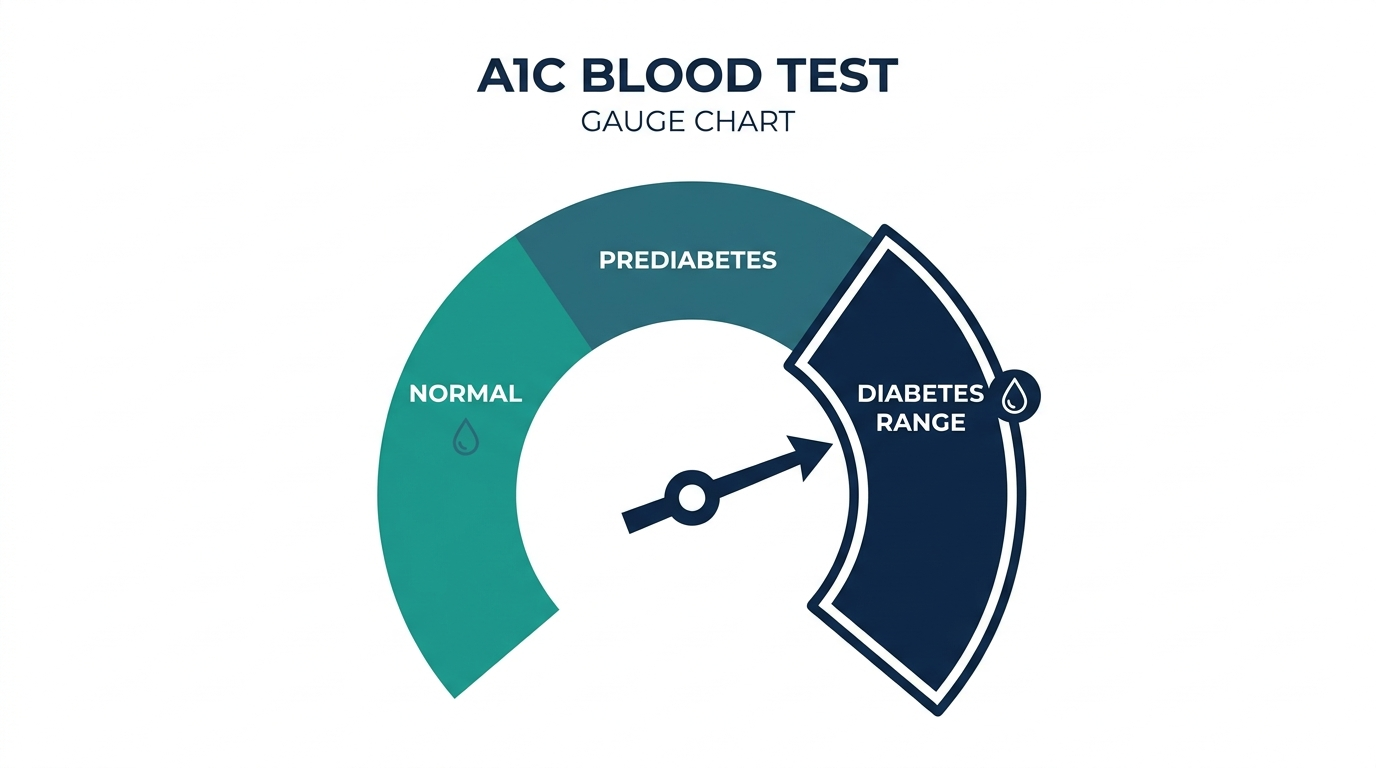
- A high A1C means your blood sugar has been elevated for the past two to three months, with 5.7 to 6.4 percent signaling prediabetes and 6.5 percent or higher meeting the threshold for diabetes (American Diabetes Association).
- A1C reflects the percentage of your hemoglobin coated with sugar, so an A1C of 7 percent corresponds to an estimated average glucose of about 154 mg/dL (NIDDK).
- A single high A1C is usually confirmed with a repeat test before a diabetes diagnosis, and the result can often be lowered through diet, weight loss, activity, and medication (Cleveland Clinic).
What does a high A1C mean and what is the cutoff?
A high A1C means too much sugar has been attached to your red blood cells over the last two to three months, which signals chronically elevated blood glucose. The American Diabetes Association sets clear cutoffs: below 5.7 percent is normal, 5.7 to 6.4 percent is prediabetes, and 6.5 percent or higher indicates diabetes (American Diabetes Association).
The A1C test, also called hemoglobin A1C or HbA1c, measures the percentage of your hemoglobin that is glycated, meaning coated with glucose. Because red blood cells live about three months, the test captures a longer view than a single fingerstick reading (NIDDK).
It helps to translate the percentage into a number you recognize from a home glucose meter. This is the estimated average glucose, or eAG:
- 6 percent: about 126 mg/dL
- 7 percent: about 154 mg/dL
- 8 percent: about 183 mg/dL
- 9 percent: about 212 mg/dL
Each one point rise in A1C is roughly a 29 mg/dL rise in average glucose (Nathan et al., Diabetes Care, PMC).

What causes a high A1C?
A high A1C is caused by blood sugar that stays elevated, most often from type 2 diabetes, prediabetes, or undertreated type 1 diabetes. The single biggest driver is insulin resistance, where the body still makes insulin but cannot use it well, which affects the large majority of people with type 2 diabetes (Cleveland Clinic).
Common contributors include the following:
- Diet and weight: Frequent high-carbohydrate meals and excess body weight raise average glucose.
- Inactivity: Muscles pull glucose out of the blood during movement, so low activity keeps levels higher.
- Medications: Steroids such as prednisone and some other drugs can push glucose up.
- Stress and illness: Hormones released during infection, surgery, or major stress raise blood sugar temporarily.
A few factors can falsely raise or lower A1C without reflecting true glucose. Conditions that shorten red blood cell life, such as certain anemias, recent blood loss, kidney disease, or pregnancy, can skew the result, which is why your clinician interprets A1C alongside your full picture (NIDDK).
What are the symptoms, or is high A1C silent?
A high A1C is often completely silent, especially in the prediabetes range of 5.7 to 6.4 percent, which is why many people are diagnosed only through routine blood work. The CDC notes that more than 1 in 3 US adults has prediabetes, and the large majority do not know it (CDC).
When blood sugar climbs higher, classic symptoms can appear. Watch for these:
- Increased thirst and urination: The kidneys flush excess glucose and pull water with it.
- Fatigue: Cells struggle to use glucose for energy.
- Blurred vision: High sugar shifts fluid in the lens of the eye.
- Slow-healing cuts or frequent infections: Elevated glucose impairs healing and immune response.
- Unexplained weight loss or increased hunger: More common as glucose rises into the diabetes range.
Because symptoms lag behind the numbers, a high A1C on a lab report deserves attention even if you feel fine. The damage to blood vessels and nerves can begin quietly before you notice anything.
When is a high A1C dangerous?
A high A1C becomes more dangerous the longer it stays elevated and the higher it climbs, because sustained high glucose damages blood vessels, nerves, kidneys, eyes, and the heart. The American Diabetes Association links higher A1C to greater risk of these complications, which is why many adults with diabetes aim for an A1C below 7 percent (American Diabetes Association).
Risk rises across a spectrum rather than at one sharp line. An A1C of 6.5 to 7 percent that is newly diagnosed and managed early carries far less immediate danger than an A1C of 9 to 10 percent, where average glucose sits above 212 mg/dL and complications accelerate.
Seek prompt medical care if a high A1C comes with warning signs of very high blood sugar, such as severe thirst, confusion, rapid breathing, fruity-smelling breath, nausea, or vomiting. These can point to a dangerous acute condition that needs urgent treatment, not a routine follow-up.

What should you do next and when should you see a doctor?
If your A1C is high, the first step is to talk with your clinician, who will usually confirm the result with a repeat test before making a diabetes diagnosis. The American Diabetes Association recommends confirming an abnormal A1C, since one result can be affected by lab variation or red blood cell conditions (American Diabetes Association).
Practical next steps include the following:
- Schedule a visit: Bring your result and ask whether it is prediabetes or diabetes.
- Adjust diet: Cut sugary drinks and refined carbohydrates, and build meals around vegetables, protein, and fiber.
- Move more: Aim for regular activity, which lowers glucose both during and after exercise.
- Lose modest weight if needed: Even a 5 to 7 percent drop meaningfully cuts diabetes risk.
- Follow medication guidance: Some people need metformin or other drugs in addition to lifestyle change.
See a doctor promptly rather than waiting if your A1C is 6.5 percent or higher, if you have symptoms like excessive thirst and urination, or if you have other risk factors such as a family history of diabetes (Cleveland Clinic).
Insider nuance: why your A1C and home glucose readings can disagree
One detail that surprises many patients is that A1C and daily glucose meter readings do not always tell the same story, because A1C is an average and your meter is a snapshot. A person with frequent highs and lows can land at a 7 percent A1C, the same as someone whose glucose stays steady near 154 mg/dL (Nathan et al., Diabetes Care, PMC).
This matters in two ways. First, a normal looking A1C can hide dangerous swings, so continuous glucose monitoring or frequent fingersticks add information the average cannot. Second, individual biology varies. Some people are consistent high glycators or low glycators, meaning their A1C runs slightly higher or lower than their true average glucose would predict.
If your A1C and your meter readings seem to contradict each other, do not assume one is wrong. Bring both sets of numbers to your clinician, who can decide whether a different measure, such as a fructosamine test or a CGM, gives a clearer picture of your control.
A1C to average glucose conversion chart
One of the most useful things you can do with an A1C is translate it into the average glucose your meter would show. The relationship is well established, and each 1 percent rise in A1C corresponds to roughly a 29 mg/dL rise in estimated average glucose (Nathan et al., Diabetes Care). The chart below expands that translation across the range.
| A1C (%) | Estimated average glucose (mg/dL) | Category |
|---|---|---|
| 5.0 | About 97 | Normal |
| 5.7 | About 117 | Prediabetes begins |
| 6.0 | About 126 | Prediabetes |
| 6.5 | About 140 | Diabetes threshold |
| 7.0 | About 154 | Common treatment target |
| 8.0 | About 183 | Above target |
| 9.0 | About 212 | High, complications accelerate |
| 10.0 | About 240 | Very high |
Reading the chart, you can see why a jump from 7 to 9 percent is not trivial: it represents an average glucose climbing from about 154 to 212 mg/dL, a difference the body feels over months. Keep in mind these are population averages, and an individual’s true average can run slightly higher or lower than the A1C predicts.

The biology: how sugar sticks to hemoglobin
Understanding what A1C measures makes the number far less abstract. Hemoglobin is the protein inside red blood cells that carries oxygen. When glucose circulates in the blood, some of it attaches to hemoglobin in a slow, nonreversible process called glycation. The more glucose in the blood over time, the greater the fraction of hemoglobin that becomes glycated. A1C reports that fraction as a percentage.
Because red blood cells live about three months before being replaced, the glycated fraction reflects the average glucose exposure over that window, weighted a little more heavily toward the most recent weeks. This is the fundamental reason A1C is a longer-term measure than a fingerstick: a single meter reading captures one moment, while A1C captures a rolling season of blood sugar. It also explains why A1C changes slowly. You cannot move it overnight, because the glycated cells already in circulation persist until they are naturally replaced. That biology is why clinicians retest A1C about every three months rather than every week.
The same biology explains why anything that changes the lifespan of red blood cells can distort A1C. If cells are destroyed or replaced faster than usual, as in some anemias or after recent blood loss, they spend less time exposed to glucose and A1C can read falsely low. If cells live longer than usual, A1C can read falsely high. This is not a flaw in the test so much as a consequence of what it actually measures, and it is why your clinician weighs A1C against your fuller clinical picture rather than reading it in isolation.
A1C targets vary by person
Although 7 percent is a common target for many adults with diabetes, it is not a universal goal. The right target depends on age, how long someone has had diabetes, other health conditions, and the risk of low blood sugar from treatment. Clinicians individualize the number rather than applying one line to everyone.
- Many nonpregnant adults with diabetes: a target below 7 percent is common, balancing complication prevention against the risk of hypoglycemia (American Diabetes Association).
- Some older adults or those with multiple conditions: a looser target may be safer, because aggressive lowering can cause dangerous low blood sugar.
- Prediabetes: the goal is to return below 5.7 percent and prevent progression to diabetes.
- Pregnancy: targets are handled separately and set by the care team, and A1C is less reliable during pregnancy.
The point is not to fixate on a single number but to agree on a personalized target with your clinician, then track your trend toward it.
Why a sustained high A1C matters: the complications
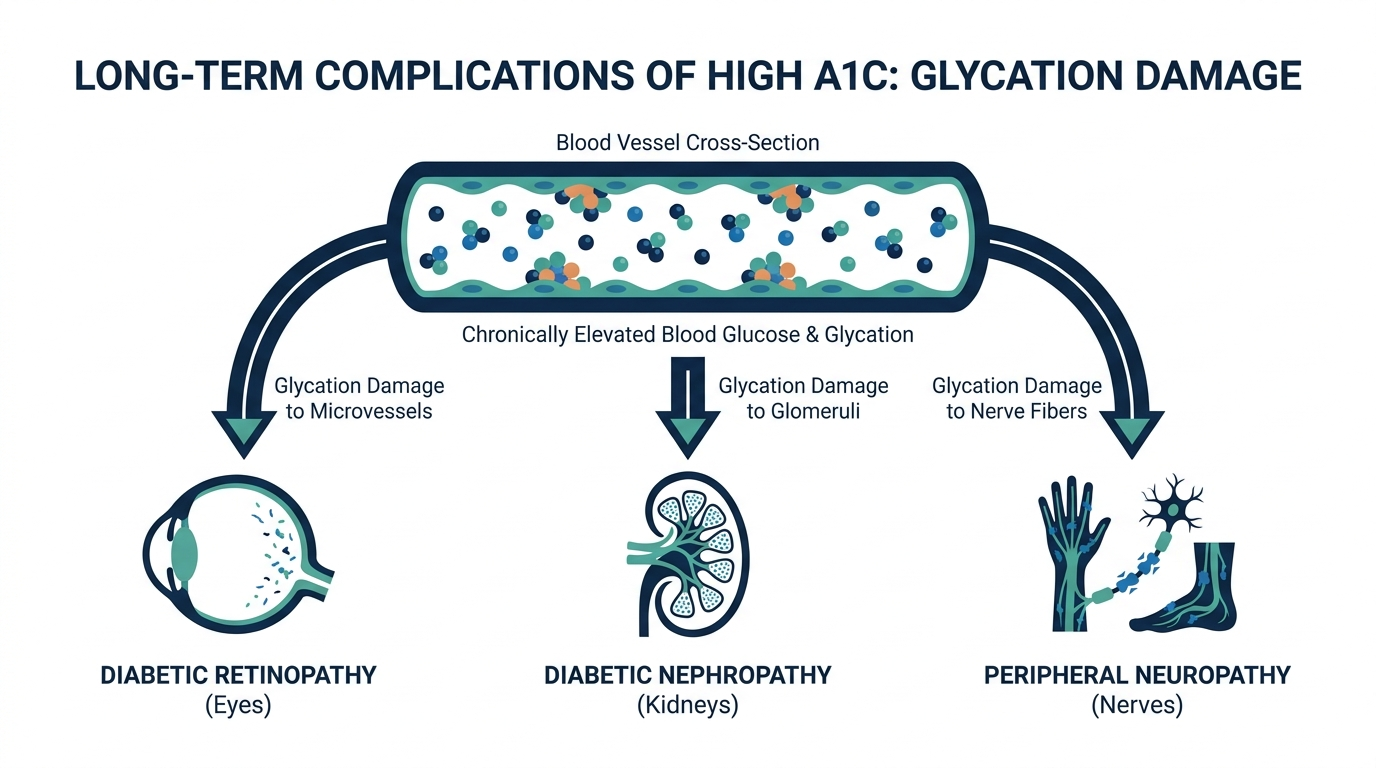
The reason clinicians treat a high A1C seriously is that chronically elevated glucose damages the body silently, often before symptoms appear. The complications fall into two broad groups.
- Small-vessel (microvascular) damage: the eyes (retinopathy, a leading cause of vision loss), the kidneys (nephropathy, which can progress to kidney failure), and the nerves (neuropathy, causing numbness, pain, and foot problems).
- Large-vessel (macrovascular) damage: the heart and blood vessels, raising the risk of heart attack, stroke, and peripheral artery disease.
The risk rises across a spectrum rather than switching on at a single threshold, and it compounds the longer glucose stays high. This is why bringing a high A1C down, even partway toward target, is worthwhile: reducing average glucose lowers the cumulative stress on these vessels and nerves over time. It also explains the urgency behind catching prediabetes early, while the numbers are still modest and the damage minimal.

Companion tests read alongside A1C
A1C is powerful, but it is not the only window into blood sugar and metabolic health. Clinicians often read it alongside other tests that fill in what an average cannot show.
- Fasting plasma glucose: a single morning glucose after fasting, used to diagnose and monitor alongside A1C.
- Oral glucose tolerance test: measures how glucose responds to a sugar load, sometimes revealing problems A1C misses.
- Fructosamine: reflects glucose over the past two to three weeks, useful when A1C is unreliable, such as in some anemias or pregnancy.
- Continuous glucose monitoring (CGM): shows the pattern of highs and lows that an average hides, including time in range.
- Lipids and blood pressure: not glucose tests, but central to the overall cardiovascular risk that a high A1C amplifies.
Reading these together is what turns a single percentage into a full metabolic picture. A high A1C with wide glucose swings on a CGM, for example, calls for a different approach than a high A1C with steady but consistently elevated readings.
Sample interpretation scenarios
Concrete examples show how the same A1C can prompt different responses. These illustrate clinical reasoning and are not personalized advice.
- A1C of 5.9 percent, no symptoms: prediabetes. This is an early warning and an opportunity, since diet, activity, and modest weight loss can often return it toward normal.
- A1C of 6.6 percent, first time: meets the diabetes threshold but is usually confirmed with a repeat test before diagnosis, then managed with lifestyle change and possibly metformin.
- A1C of 7.0 percent but frequent lows on a meter: the average looks fine, but wide swings mean the treatment plan may need adjusting, and a CGM can reveal the pattern.
- A1C of 9.5 percent with thirst and fatigue: a clearly high value with symptoms that warrants prompt medical attention and a structured treatment plan.
In each case the number is the starting point, and the context of symptoms, trends, and companion tests shapes what happens next. The common thread across all four scenarios is that no single reading tells the whole story on its own, and the smartest response is always to look at the surrounding evidence before deciding what to do.
Common misconceptions about a high A1C
A high A1C is one of the most misunderstood results, partly because it averages an invisible process. A few corrections help.
- “I can crash my A1C in a week.” Because A1C reflects months of glucose, meaningful change shows up over roughly three months, not days.
- “A high A1C always means insulin.” Many people with prediabetes or early type 2 diabetes manage with lifestyle change and oral medication. Insulin is more common in type 1 diabetes or when other treatments fall short.
- “A single high reading is a diagnosis.” An abnormal A1C is usually confirmed with a repeat test, because lab variation and red blood cell conditions can skew one result.
- “A normal A1C means my blood sugar is always fine.” An average can hide dangerous highs and lows, which is why some people benefit from CGM or fingerstick data on top of A1C.
The most useful habit is to treat A1C as a trend to move, not a verdict to fear. Track it over quarters, pair it with your daily readings, and work the plan with your clinician over time.
Practical steps that actually lower A1C
Since A1C reflects roughly three months of average glucose, the aim is to lower your typical blood sugar day after day, and then let the number follow at the next quarterly draw. A handful of changes carry most of the weight, and stacking them beats chasing any single one.
Food is the largest lever for most people. The biggest wins usually come from cutting sugary drinks and reducing large portions of refined carbohydrates like white bread, pastries, and sweetened snacks, since these produce the sharpest glucose spikes. Shifting the plate toward vegetables, protein, and higher-fiber foods flattens those spikes and tends to move the average down over weeks. Movement compounds the effect. Regular activity, including a short walk after meals, helps muscles pull glucose out of the blood, and even modest weight loss in someone carrying excess can meaningfully improve A1C.
Two quieter factors deserve mention because they are easy to ignore. Sleep and stress both raise glucose through hormonal pathways, so poor sleep or chronic stress can keep an A1C stubbornly high even when diet looks reasonable. And for anyone on medication, taking it consistently as prescribed is part of the plan, not separate from it. The reason to re-test after about three months rather than sooner is built into the biology: A1C simply cannot reflect this week’s effort, so a follow-up at the right interval is what honestly tells you whether the changes are working before you decide what to adjust next with your clinician.
When A1C is the wrong test for you
A1C is convenient because it needs no fasting and captures months of glucose in one number, but it rests on an assumption that does not hold for everyone: that your red blood cells live a normal lifespan. A1C measures the fraction of hemoglobin coated in sugar, and hemoglobin sits inside red cells that survive around three months. Anything that shortens or lengthens that lifespan, or changes the hemoglobin itself, can make the A1C misleading even when your actual glucose control is different from what the number suggests.
Several common situations fall into this trap. Some forms of anemia, recent blood loss, pregnancy, kidney disease, and certain inherited hemoglobin variants can all pull A1C artificially high or low relative to your true average glucose (CDC). This is one reason a surprising A1C that does not match your home glucose readings should prompt a conversation rather than an immediate conclusion. It may be a red-cell issue, not a glucose issue.
When A1C is unreliable, clinicians have alternatives, including a fasting glucose test, an oral glucose tolerance test, or direct glucose monitoring over time. The practical message is not to distrust A1C in general, since for most people it is an excellent tool, but to know that it has blind spots. If you have a condition affecting your red blood cells, or your A1C consistently disagrees with your day-to-day readings, mention it, because the right test for you may be a different one entirely.
Frequently asked questions
Is an A1C of 6.5 always diabetes?
An A1C of 6.5 percent meets the diagnostic threshold for diabetes, but it is usually confirmed with a repeat test or a second glucose test before the diagnosis is final, because lab variation and certain blood conditions can affect a single result (American Diabetes Association).
How fast can I lower a high A1C?
Because A1C reflects two to three months of glucose, meaningful change typically shows up over about three months. Diet, activity, weight loss, and medication can lower it steadily, but expect to track progress over a quarter rather than days.
What is a dangerous A1C level?
There is no single danger line, but the risk of complications rises as A1C climbs. Many adults with diabetes aim for below 7 percent, and levels of 9 percent or higher, with average glucose above 212 mg/dL, raise complication risk sharply (American Diabetes Association).
Can stress or illness raise my A1C?
Short-term stress or illness can raise blood glucose temporarily, but because A1C averages months of readings, a brief spike usually has a small effect. Chronic stress, poor sleep, and steroid medications can have a larger and longer impact on A1C.
Does a high A1C mean I will need insulin?
Not necessarily. Many people with prediabetes or early type 2 diabetes manage a high A1C with diet, activity, weight loss, and oral medication such as metformin. Insulin is more likely with type 1 diabetes or when other treatments do not bring glucose under control.
Sources
- American Diabetes Association, Diabetes Diagnosis and Tests
- American Diabetes Association, Understanding A1C
- NIDDK (NIH), The A1C Test and Diabetes
- Cleveland Clinic, A1C Test, Levels and Chart
- CDC, A1C Test for Diabetes and Prediabetes
- Nathan DM et al., Translating the A1C Assay Into Estimated Average Glucose Values, Diabetes Care (PMC)
This article is for general educational purposes and is not medical advice. It cannot diagnose or treat you and does not replace your clinician. Always discuss your lab results and any health decisions with a qualified healthcare professional.
Vital Signs Today may earn a commission if you buy through links on this page. It does not affect our editorial assessments.