
Disclosure: Vital Signs Today may earn a commission if you buy through links on this page, at no extra cost to you. This does not influence our evidence-based assessments. We are not a medical provider; talk to a clinician before acting on test results.
Related: magnesium blood test: the full guide · What a low magnesium result means
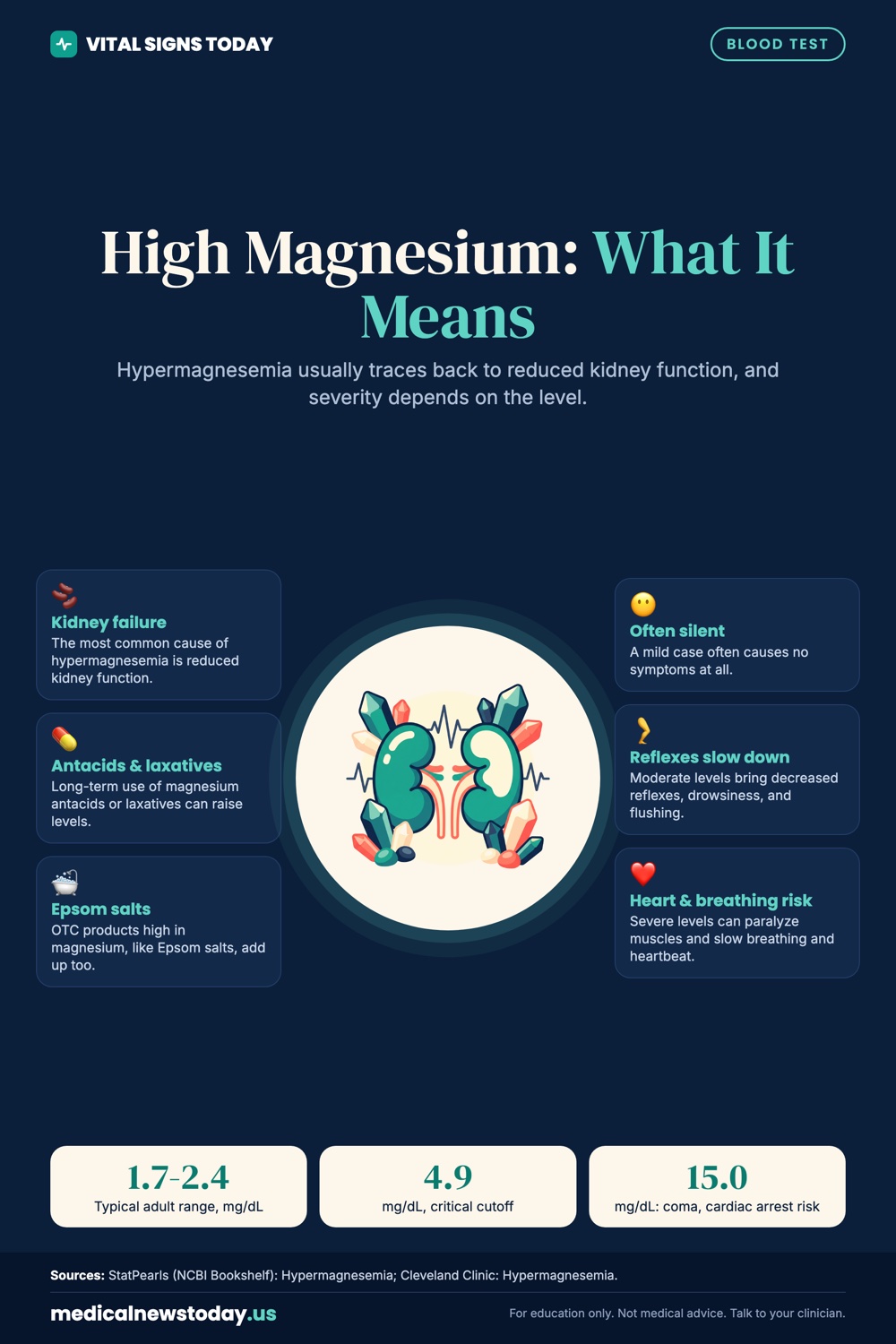
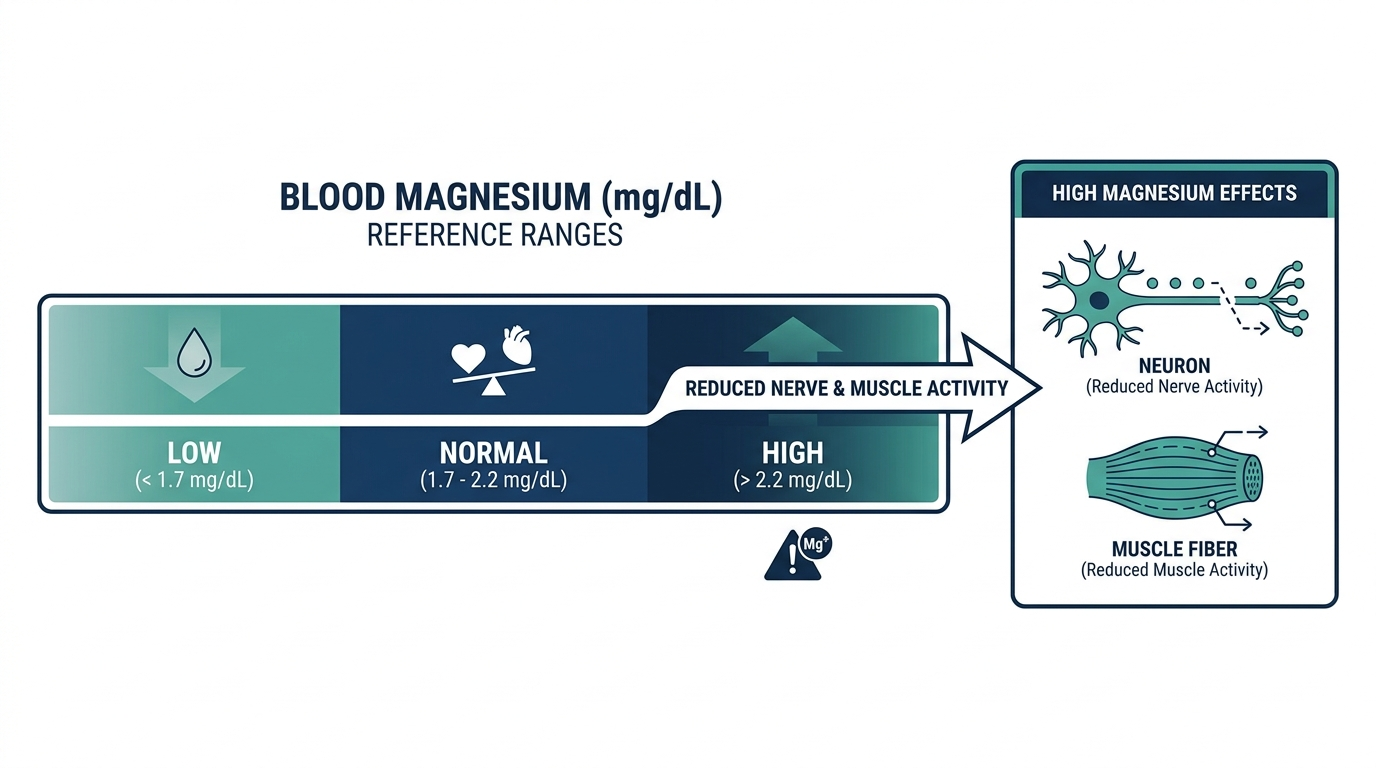
- A high magnesium blood test, called hypermagnesemia, usually means your serum magnesium is above 2.6 mg/dL, since the normal adult range is about 1.7 to 2.3 mg/dL (Cleveland Clinic).
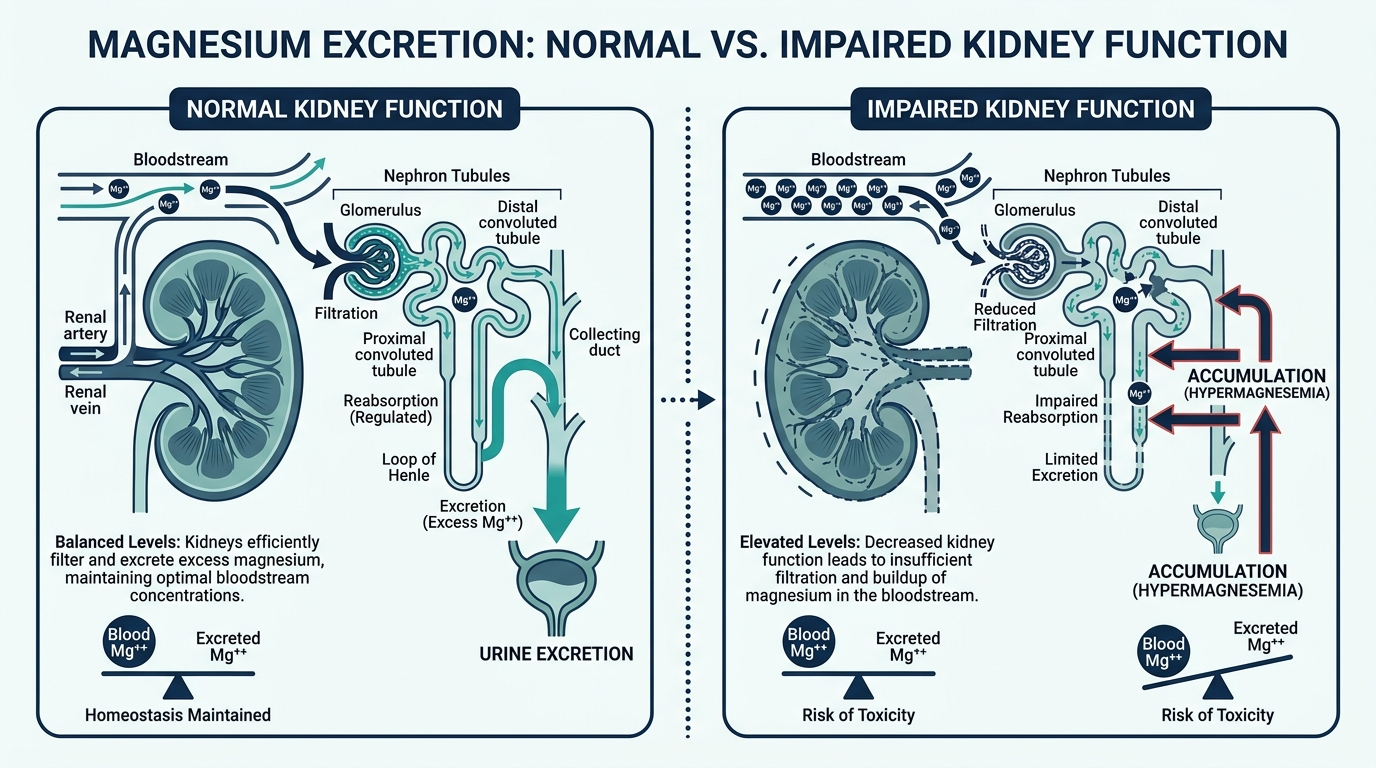
- The single most common cause of high magnesium is reduced kidney function, because healthy kidneys normally excrete excess magnesium, so it builds up when they fail (StatPearls, NIH).
- Mild high magnesium often causes no symptoms, but levels above 7 mg/dL can trigger loss of reflexes, low blood pressure, and slow heartbeat, and levels above 12 mg/dL can be life threatening (StatPearls, NIH).
Seeing your magnesium flagged high on a lab report can be unsettling, especially when you may not feel anything at all. The good news is that mild elevations are common and often easy to explain. This guide walks through exactly what the number means, what pushes it up, when it becomes dangerous, and the practical next steps to take with your clinician.
What does a high magnesium result mean, and what is the cutoff?
A high magnesium result, known as hypermagnesemia, generally means your serum magnesium is above 2.6 mg/dL, since the normal adult reference range runs roughly 1.7 to 2.3 mg/dL (Cleveland Clinic). StatPearls places the upper normal limit slightly higher at 2.4 mg/dL and treats values above 4.9 mg/dL as a critical reference value (StatPearls, NIH).
Most blood panels report magnesium in mg/dL, but some use mmol/L or mEq/L. As a quick conversion, the normal range of 1.7 to 2.3 mg/dL is about 0.7 to 0.95 mmol/L, or 1.4 to 1.9 mEq/L. Lab cutoffs differ slightly between facilities, so always read your result against the reference range printed on your own report rather than a generic number. A value that sits just over the top of the range carries very different weight than one that is several points high.

What causes high magnesium?
By far the leading cause of high magnesium is impaired kidney function, because the kidneys normally filter out excess magnesium, so it accumulates when they cannot keep up (StatPearls, NIH). Cleveland Clinic notes that hypermagnesemia is uncommon in people with healthy kidneys and that acute or chronic kidney disease is the main risk factor (Cleveland Clinic).
Beyond the kidneys, common contributors include:
- Magnesium-containing products: Overuse of magnesium supplements, antacids, or laxatives such as milk of magnesia, especially when kidney function is reduced.
- IV magnesium in hospitals: Treatment for preeclampsia or eclampsia in pregnancy uses magnesium sulfate, which can push levels high.
- Other conditions: Adrenal insufficiency, hypothyroidism, severe dehydration, tumor lysis syndrome, and certain bowel conditions that increase absorption.
In healthy adults eating a normal diet, food alone almost never causes hypermagnesemia, because the kidneys clear the surplus efficiently.
What are the symptoms, or is it silent?
Mild high magnesium is frequently silent and discovered only on a routine blood test, with clear symptoms typically appearing once levels rise above roughly 7 mg/dL (StatPearls, NIH). At that stage, symptoms tend to track the severity of the elevation.
How symptoms usually progress:
- Mild (below 7 mg/dL): Often none, or vague weakness, nausea, flushing, and headache.
- Moderate (7 to 12 mg/dL): Loss of deep tendon reflexes, drowsiness, blurred vision, a drop in blood pressure, and slow heart rate.
- Severe (above 12 mg/dL): Pronounced low blood pressure, muscle paralysis, slowed breathing, and dangerous heart rhythm changes.
Because the early stages are so quiet, the number on your lab report is often more informative than how you feel. That is exactly why magnesium is checked alongside kidney markers in people at risk.
When is high magnesium dangerous?
High magnesium becomes dangerous when levels climb past about 7 mg/dL, and it can be life threatening above 12 mg/dL, where coma and cardiac arrest become likely once values exceed roughly 15 mg/dL (StatPearls, NIH). The Merck Manual similarly notes that serious electrocardiogram changes and cardiac risk appear at the higher concentrations rather than with mild elevations.
The greatest danger lies in the heart and breathing. As magnesium rises, it can slow the heart, lower blood pressure, prolong electrical intervals on an ECG, and eventually depress the muscles that drive respiration. The speed of the rise matters too. A rapid spike, such as from IV magnesium, is generally tolerated worse than a gradual increase at the same final value. Anyone with reduced kidney function who develops confusion, very slow heartbeat, or trouble breathing should be treated as a medical emergency.

What should you do next, and when should you see a doctor?
The first step is to review the result with your clinician alongside your kidney function, since high magnesium almost always points back to how well your kidneys are clearing it (Cleveland Clinic). For a mild elevation, this often means a simple recheck and a look at your medications.
Practical next steps include:
- List your supplements and antacids: Bring every magnesium-containing product, including laxatives, so your clinician can spot a reversible cause.
- Ask about kidney testing: A creatinine and eGFR check tells you whether your kidneys are the driver.
- Stop the source if advised: In many mild cases, pausing magnesium products plus normal kidney function lets levels self correct.
Seek urgent care if you have known kidney disease plus new weakness, confusion, a very slow pulse, or breathing difficulty. Severe hypermagnesemia is treated in hospital with IV calcium, fluids, and sometimes dialysis.
The insider nuance: a falsely high reading is more common than you think
One detail clinicians watch for is that a high magnesium value is sometimes an artifact rather than true hypermagnesemia, which is why an isolated high reading in a healthy person is usually rechecked before any action is taken. A published case in PMC describes iatrogenic confusion caused simply by misreading the magnesium reporting unit after magnesium sulfate was given (PMC, NIH).
Two practical points follow from this. First, hemolysis, where red blood cells break during a difficult draw, can release magnesium and inflate the result, so a redraw can resolve a surprising value. Second, always confirm the unit. The same patient can look alarmingly high in mg/dL or perfectly normal in mmol/L if the units are mixed up. If your number looks high but you feel well and your kidneys are healthy, a careful recheck is the standard and sensible next move.
What magnesium does in the body and why balance matters
To understand why a high magnesium reading deserves attention, it helps to know how much work this mineral quietly does. Magnesium is a cofactor for more than 300 enzyme reactions, including the ones that release energy from food and build proteins and DNA. It also acts as a natural calcium blocker at nerve and muscle cells, which is precisely why an excess makes nerves and muscles less responsive.
Key roles include:
- Nerve and muscle signaling: magnesium dampens the electrical excitability of nerves and the muscles they control, including the heart. Too much magnesium quiets these signals, which is how high levels blunt reflexes and slow the heartbeat.
- Heart rhythm: it stabilizes the electrical activity of cardiac cells, so both very low and very high levels can disturb rhythm.
- Blood pressure and blood vessels: magnesium relaxes vascular smooth muscle, which is why a surplus can lower blood pressure.
- Bone and energy metabolism: most of the body’s magnesium sits in bone, with the rest inside cells; only about 1 percent circulates in blood, which is the fraction the test measures.
That last point is important. Because so little magnesium lives in the bloodstream, a serum level is a limited window into your total body stores. It is excellent at catching dangerous highs and lows, but a normal blood value does not guarantee normal magnesium inside your cells and bones.

Understanding the units and reference ranges
Magnesium is one of the most unit-confused values on a lab report, and that confusion is a genuine source of error, so it is worth getting straight. The same true concentration can be printed three different ways.
| Unit | Approximate normal adult range |
|---|---|
| mg/dL (US standard) | 1.7 to 2.3 |
| mmol/L (SI unit) | 0.7 to 0.95 |
| mEq/L | 1.4 to 1.9 |
Want to check your magnesium?
Three ways to get it measured. Pick whichever fits you.
Affiliate links: we may earn a commission at no extra cost to you. A lab test does not replace a visit with your clinician.
A value of 2.0 in one unit is not comparable to 2.0 in another, so a result that looks alarmingly high may simply be a normal value reported in a different unit. Reference ranges also drift slightly by laboratory and can differ in newborns and pregnancy, so the single most reliable comparison is always the reference interval printed next to your own result. If you ever move a number between apps, trackers, or clinicians, carry the unit with it every time.
The markers read alongside magnesium
Because high magnesium usually reflects how well the kidneys are clearing it, and because magnesium interacts closely with other electrolytes, it is almost never interpreted alone. The surrounding markers tell your clinician whether the elevation is a kidney problem, an intake problem, or an artifact.
- Creatinine and eGFR: the most important companions. Reduced kidney function is the leading cause of true hypermagnesemia, so these values often reveal the driver at a glance.
- Calcium: high magnesium can suppress parathyroid hormone and lower calcium, and the two minerals share regulatory pathways, so calcium is frequently checked in tandem.
- Potassium: magnesium influences how the kidneys and cells handle potassium, and the two are commonly disturbed together.
- Phosphorus: often abnormal alongside magnesium in kidney disease and in conditions with rapid cell turnover.
- PTH (parathyroid hormone): may be checked when calcium is also off, since magnesium levels affect PTH secretion.
Read together, these markers turn a lone high magnesium into a pattern. High magnesium with a high creatinine points firmly at the kidneys, while high magnesium with perfect kidney numbers in a healthy person points toward supplements or a lab artifact and usually earns a simple recheck.
Who is most at risk, and how to prevent it
Hypermagnesemia is uncommon in healthy adults because the kidneys are so efficient at dumping the surplus. The risk rises sharply in specific groups, and knowing whether you are one of them changes how carefully magnesium products should be used.
- People with chronic or acute kidney disease: the central risk group. When filtration is reduced, magnesium accumulates, so any magnesium-containing product must be used with caution and clinician guidance.
- Older adults: kidney function declines with age, and the frequent use of magnesium-based laxatives and antacids for constipation or reflux adds intake at the same time.
- Pregnant patients on magnesium sulfate: treated in hospital for preeclampsia or preterm labor, they are monitored closely because IV magnesium can climb quickly.
- People taking large supplement doses: especially combined with antacids and laxatives, the total magnesium load can add up faster than expected.
Prevention is mostly practical. If you have reduced kidney function, review every over-the-counter product with your clinician or pharmacist, since many antacids and laxatives are magnesium based and are easy to overlook. Do not exceed labeled doses of magnesium supplements without guidance, and keep a current list of everything you take so a preventable cause can be spotted early.

Dietary magnesium and supplement forms explained
For the vast majority of people with healthy kidneys, food is not a route to dangerous magnesium levels, because the body clears dietary surplus with ease. Still, it helps to understand where magnesium comes from and how supplement forms differ, since supplements are the input most likely to push a susceptible person high.
Magnesium-rich foods include leafy greens like spinach, nuts and seeds (pumpkin seeds, almonds), legumes, whole grains, and dark chocolate. Eating these supports healthy magnesium status without any realistic risk of overload in normal kidneys.
Supplement forms vary in how much elemental magnesium they deliver and how they affect the gut:
- Magnesium oxide: high in elemental magnesium but poorly absorbed, which is why it doubles as a laxative and antacid; the unabsorbed portion draws water into the bowel.
- Magnesium citrate: better absorbed, also used as a laxative at higher doses.
- Magnesium glycinate: well tolerated and gentler on the gut, often chosen when the goal is repletion rather than a laxative effect.
The practical point for a high reading is that laxative and antacid forms are magnesium in disguise. Someone managing constipation with milk of magnesia may not think of it as a magnesium supplement at all, yet in reduced kidney function it is one of the most common reversible causes of a high result.
How a mild high magnesium is usually followed up
For most people, a slightly high magnesium is not treated so much as investigated and rechecked. Understanding the usual sequence takes the anxiety out of the result and helps you know what to expect at your follow-up.
A typical pathway for a mild elevation looks like this. First, your clinician confirms the value is real by checking the unit and, if the reading is surprising in an otherwise well person, arranging a repeat draw to rule out hemolysis. Second, they review kidney function through creatinine and eGFR, since the kidneys are the usual gatekeeper for magnesium. Third, they audit your medications and over-the-counter products for magnesium sources, laxatives and antacids being the usual culprits. If kidney function is normal and a magnesium product is identified, pausing it and rechecking often returns the level to normal without any specific treatment. Only when levels are high enough to cause symptoms, or when kidney function is impaired, does active treatment such as IV fluids, IV calcium, or dialysis enter the picture. The reassuring reality is that the large majority of mildly high magnesium results are explained, reversible, and resolved with a simple change and a follow-up test.
Common misconceptions about high magnesium
A few persistent myths make a high magnesium result more confusing than it needs to be.
- “A high blood magnesium means my whole body is overloaded.” Not necessarily. Only about 1 percent of body magnesium circulates in blood, so the serum value is a narrow window, best at catching acute problems rather than total stores.
- “Eating magnesium-rich food can push my level dangerously high.” In healthy kidneys, this essentially never happens; the surplus is excreted efficiently.
- “Any value over the range is an emergency.” Mild elevations are often symptomless and frequently resolve by stopping a magnesium product, while emergencies typically involve much higher levels and reduced kidney function.
- “A high reading always means true hypermagnesemia.” A difficult blood draw (hemolysis) or a mixed-up reporting unit can inflate the number, which is why an isolated high value in a well person is usually rechecked.
- “Magnesium supplements are harmless for everyone.” For most people they are fine, but in reduced kidney function they are a leading avoidable cause of dangerous highs.
Reading a high magnesium in context: three scenarios
The same magnesium number can mean very different things depending on who it belongs to and why the test was ordered. Walking through a few realistic patterns shows why clinicians never treat the figure in isolation.
- A healthy adult with a mild elevation and normal kidneys: a value just above the reference range in someone who feels well, has normal creatinine and eGFR, and takes no magnesium products is most often a laboratory artifact or a minor blip. The usual next move is a simple recheck, sometimes after confirming the reporting unit, rather than any treatment.
- Someone with chronic kidney disease taking a magnesium-containing laxative or antacid: here a high value is far more likely to be real and to keep climbing, because the kidneys cannot clear the extra load. This is the classic setup for genuine hypermagnesemia, and the fix usually starts with stopping the magnesium source and reassessing.
- A hospitalized patient after intravenous magnesium: in obstetric care or arrhythmia treatment, magnesium is given deliberately, so a high level is expected and monitored on purpose. What matters here is watching reflexes, heart rhythm, and breathing rather than the number alone, because a fast rise is tolerated less well than a gradual one.
The thread running through all three is that kidney function, medications, and how the sample was drawn shape the meaning of the result. When you get a high magnesium back, the most useful information you can offer is your kidney status, every magnesium-containing product you take, and whether you actually feel unwell.
Frequently asked questions
Is a magnesium level of 2.5 mg/dL high?
A level of 2.5 mg/dL is at or just above the typical upper limit of about 2.3 mg/dL (Cleveland Clinic). It is usually a mild elevation that rarely causes symptoms, but it is worth discussing with your clinician, who may recheck it and review your kidney function.
Can taking magnesium supplements cause a high blood test?
Yes, especially if you take high doses or have reduced kidney function. In people with healthy kidneys, the excess is usually cleared efficiently, so supplements rarely push levels into a dangerous range. Always tell your clinician about every magnesium product, including antacids and laxatives.
What level of magnesium is dangerous?
Symptoms generally start above 7 mg/dL, and levels above 12 mg/dL can be life threatening, with coma and cardiac arrest likely above roughly 15 mg/dL (StatPearls, NIH). The heart and breathing are most at risk, particularly in people with kidney disease.
How is high magnesium treated?
Mild cases often resolve by stopping magnesium products if kidney function is normal. Severe hypermagnesemia is treated in hospital with intravenous calcium to protect the heart, IV fluids to boost excretion, and dialysis when the kidneys cannot clear the magnesium themselves (Cleveland Clinic).
Does high magnesium mean I have kidney disease?
Not always, but reduced kidney function is the most common cause, so your clinician will usually check creatinine and eGFR (StatPearls, NIH). A mild elevation can also come from supplements or a lab artifact, which is why an isolated high result is often rechecked.
Sources
- Cleveland Clinic, Hypermagnesemia: Causes, Symptoms and Treatment
- StatPearls, NIH, Hypermagnesemia
- Merck Manual Professional Edition, Hypermagnesemia
- PMC, NIH, Iatrogenic Hypermagnesemia From Misinterpretation of Reporting Unit
This article is for general educational purposes and is not medical advice. It cannot diagnose or treat you and does not replace your clinician. Always discuss your lab results and any health decisions with a qualified healthcare professional.
Vital Signs Today may earn a commission if you buy through links on this page. It does not affect our editorial assessments.