
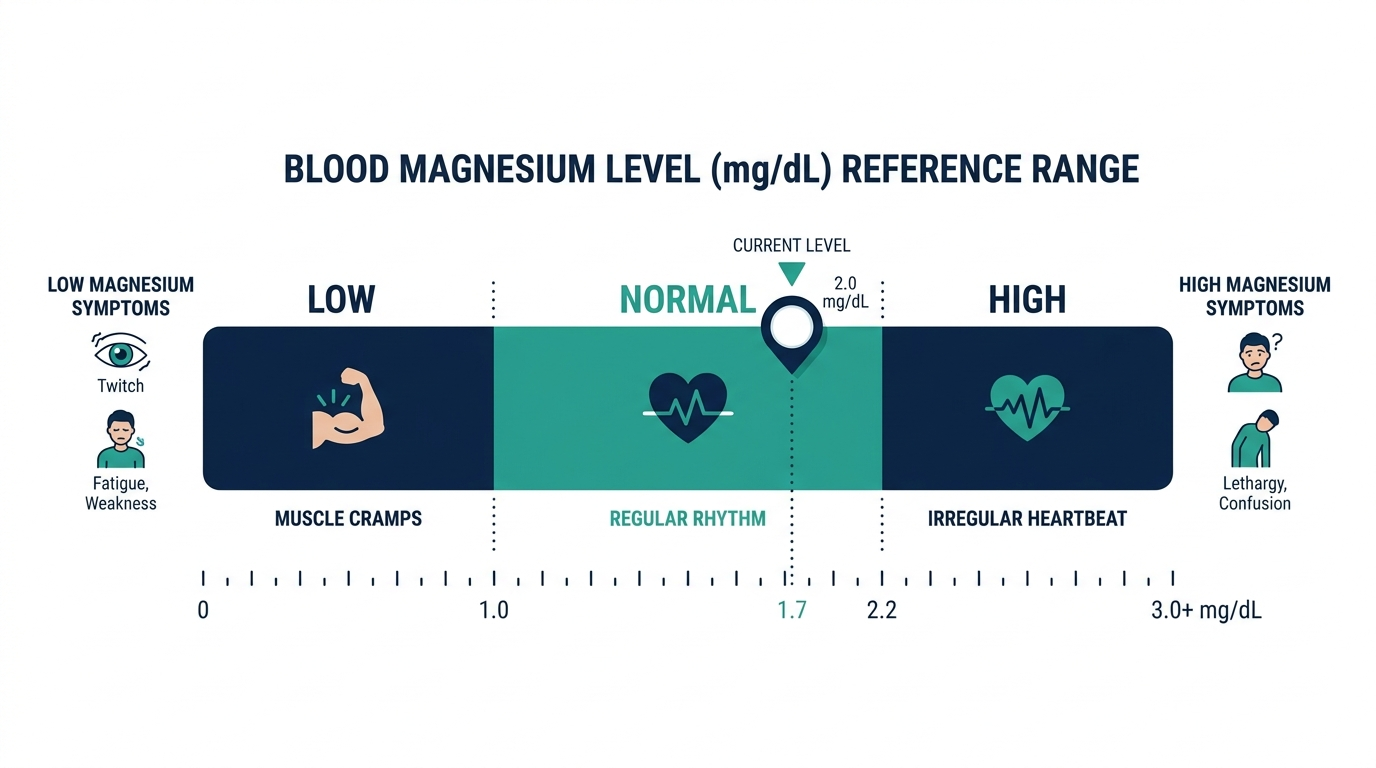
- Magnesium in a blood test, usually reported as serum magnesium, measures the mineral floating in your blood, and the normal range is roughly 1.7 to 2.2 mg/dL (Cleveland Clinic lists 1.46 to 2.68 mg/dL).
- A high blood magnesium above 2.6 mg/dL is called hypermagnesemia and almost always points to kidney problems or magnesium-containing medications (StatPearls, NCBI).
- A low blood magnesium below about 1.46 mg/dL is called hypomagnesemia, and it usually comes from gut losses, kidney losses, alcohol use, or certain drugs rather than from too little in your diet alone (Cleveland Clinic).
What is magnesium in a blood test?

Magnesium in a blood test is the amount of the mineral magnesium circulating in the liquid part of your blood, reported as “serum magnesium” or simply “magnesium” on your panel. The normal range is roughly 1.7 to 2.2 mg/dL, and Cleveland Clinic gives a slightly wider lab range of 1.46 to 2.68 mg/dL because reference values differ by laboratory and method (Cleveland Clinic).
Magnesium is one of the most abundant minerals in the body and a partner in more than 300 enzyme reactions, including those that power muscles, nerves, blood sugar control, and heart rhythm. The catch worth knowing: only about 1 percent of your body’s magnesium lives in the blood. Most of it is stored in bone and inside cells. So a serum magnesium result is a useful snapshot, but it can look normal even when total body stores are running low.

Why is magnesium measured?
Magnesium is measured to find the cause of unexplained muscle, nerve, or heart symptoms and to monitor people at risk of losing the mineral. Clinicians order it when someone has cramps, tremors, irregular heartbeat, seizures, or persistently low calcium or potassium that will not correct (StatPearls, NCBI).
It is also a routine check in higher-risk groups. Up to 50 to 60 percent of intensive care unit patients develop low magnesium, compared with about 2 percent of the general US population (Cleveland Clinic). Common reasons to test include:
- Heavy alcohol use: a frequent and often missed cause of magnesium depletion.
- Long-term medications: diuretics, proton pump inhibitors, and some antibiotics drain magnesium.
- Gut disease: chronic diarrhea, celiac disease, or gastric bypass reduce absorption.
- Kidney disease: failing kidneys can let magnesium climb too high.
What does a high magnesium mean?
A high blood magnesium, called hypermagnesemia, is a level above 2.6 mg/dL, and the dominant cause is the kidneys not clearing magnesium properly (StatPearls, NCBI). It is fairly rare in people with healthy kidneys because the body excretes the excess efficiently.
The usual setup is reduced kidney function plus an extra magnesium load, often from magnesium-containing antacids, laxatives, or supplements. Symptoms track with severity. Mild elevations may cause nausea, flushing, weakness, and low blood pressure. As levels rise, reflexes fade and breathing slows. Severe hypermagnesemia, generally above 12 mg/dL, can trigger dangerous heart rhythm changes, and values above roughly 15 mg/dL can cause cardiac and respiratory arrest (StatPearls, NCBI). If you have kidney disease, this is why clinicians caution against over-the-counter magnesium products without guidance.
What does a low magnesium mean?
A low blood magnesium, called hypomagnesemia, is a level below about 1.46 mg/dL, and it most often reflects losses through the gut or kidneys rather than simply eating too little (Cleveland Clinic). Many people stay symptom-free until magnesium drops below roughly 1.2 mg/dL (StatPearls, NCBI).
When symptoms do appear, they center on the nerves, muscles, and heart. Cleveland Clinic groups them by severity:
- Mild: tremors, muscle spasms and cramps, abnormal eye movements, fatigue, and weakness.
- Severe: generalized seizures, delirium, and irregular heartbeats.
Causes fall into three buckets: too little intake (malnutrition, alcohol use disorder, malabsorption), excess loss through the kidneys or gut (diuretics, certain antibiotics, diabetes, diarrhea), and redistribution inside the body (acute pancreatitis or after parathyroid surgery) (Cleveland Clinic).

How is magnesium interpreted with other markers?
Magnesium is rarely read alone. It is interpreted alongside potassium and calcium because low magnesium often drags both of them down, and those companion lows will not correct until the magnesium is replaced first (StatPearls, NCBI).
This is one of the most clinically useful patterns in electrolyte work. A patient with stubborn hypokalemia (low potassium) or hypocalcemia (low calcium) that resists supplements very often has an unrecognized magnesium deficiency driving it. Kidney function tests matter too: a high creatinine alongside high magnesium points toward impaired clearance. Because serum magnesium reflects only the small fraction in blood, clinicians weigh the number against your symptoms, medications, and the rest of the metabolic panel rather than treating the figure in isolation.
The insider nuance most reports skip
Here is what years of looking at these panels teaches you: a normal serum magnesium does not rule out a magnesium problem. Because roughly 99 percent of body magnesium sits in bone and cells, the blood can read normal while tissue stores are quietly depleted, a state sometimes called chronic latent deficiency.
That is why a clinician may treat a borderline-normal result as low when the clinical picture fits, for example in a patient with refractory low potassium, long-term proton pump inhibitor use, or unexplained arrhythmia. The number is a clue, not a verdict. Two timing details also help: blood drawn after a magnesium dose can read falsely reassuring, and hemolyzed (broken-cell) samples can artificially raise the result. If your magnesium looks borderline and your symptoms do not, that conversation with your clinician is worth having.
What magnesium actually does in the body
To understand why a magnesium result matters, it helps to see how many jobs the mineral holds. Magnesium is a cofactor in more than 300 enzyme reactions, which is why a shortage shows up in so many different systems at once (StatPearls, NCBI). Its main roles include:
- Muscle and nerve signaling: magnesium helps control the flow of calcium and potassium across cell membranes, which is why low levels cause cramps, tremors, and twitching.
- Heart rhythm: it stabilizes the electrical activity of heart cells, so a deficiency can trigger arrhythmias and is sometimes corrected before other rhythm treatments.
- Energy production: the body’s energy currency, ATP, is biologically active only when bound to magnesium, so nearly every energy-using process depends on it.
- Blood sugar control: magnesium supports the action of insulin, part of why low magnesium is common in poorly controlled diabetes.
- Bone structure: most body magnesium is stored in bone, where it contributes to bone strength alongside calcium.
Because it touches muscles, nerves, heart, metabolism, and bone, a single magnesium value is really a readout on a mineral woven through the whole body. That breadth is exactly why symptoms of deficiency are so varied and easy to misattribute.

Where magnesium comes from and why absorption matters
A common assumption is that a low magnesium result means poor diet, but the picture is more nuanced. For most people the body balances magnesium through a combination of intake, gut absorption, and kidney handling, and a problem in any of the last two matters more than diet alone (Cleveland Clinic).
Magnesium-rich foods include leafy green vegetables, nuts and seeds, legumes, whole grains, and dark chocolate. The mineral in green plants sits at the center of chlorophyll, which is why greens are a reliable source. Even so, a healthy person eating a mixed diet rarely becomes deficient from food choices alone, because the kidneys are efficient at conserving magnesium when intake drops. When true deficiency appears, it usually reflects one of three things: the gut is not absorbing it, the kidneys are wasting it, or a medication or illness is driving losses. This is why chasing a low magnesium with diet alone often fails when the real problem is absorption or loss.
Medications and conditions that quietly drain magnesium
One of the most useful things to know about magnesium is which everyday medicines and conditions pull it down, because these are frequently the hidden cause of a low result.
| Cause | How it lowers magnesium |
|---|---|
| Proton pump inhibitors (long-term) | Reduce intestinal magnesium absorption over months to years of use. |
| Loop and thiazide diuretics | Increase magnesium loss through the urine. |
| Certain antibiotics and chemotherapy agents | Damage the kidney tubule handling of magnesium, causing wasting. |
| Chronic alcohol use | Combines poor intake, gut losses, and kidney wasting, a very common and missed cause. |
| Chronic diarrhea, celiac disease, bypass surgery | Cut absorption in the gut. |
| Poorly controlled diabetes | Drives magnesium out through the urine along with glucose. |
If your magnesium is low and you take a proton pump inhibitor or a diuretic long term, that medication is often the first suspect. The fix is rarely just more magnesium in the diet. It usually involves addressing the underlying loss, which is why identifying the driver matters more than the number itself.
Why magnesium must be fixed before potassium and calcium
This is one of the most clinically important and least known facts about magnesium, and it deserves its own explanation. When magnesium is low, potassium and calcium often fall with it, and here is the catch: those companion lows frequently refuse to correct until the magnesium is replaced first (StatPearls, NCBI).
The reason is mechanistic. Low magnesium causes the kidney to waste potassium, so no matter how much potassium is given, the body keeps dumping it until magnesium is restored. Low magnesium also blunts the release and action of parathyroid hormone, which keeps calcium low. Practically, this means a patient with stubborn low potassium or low calcium that will not respond to supplements very often has an unrecognized magnesium deficiency underneath. Experienced clinicians check and replace magnesium early in that situation, rather than pouring in potassium or calcium that the body cannot hold. It is a small insight that changes how a whole electrolyte problem is solved.

When a serum test is not enough
Because serum magnesium reflects only the roughly 1 percent of body magnesium that circulates in blood, there are times when the standard test can miss a real deficiency. In those cases a few alternatives and cautions come into play.
- Red blood cell (RBC) magnesium is sometimes used to estimate stores inside cells, since intracellular magnesium is where much of the action is. It is not a routine test but may be considered when serum looks normal and symptoms persist.
- A trial of repletion is a practical approach some clinicians use when the clinical picture strongly suggests deficiency despite a borderline-normal serum value.
- Timing and sample quality matter. Blood drawn soon after a magnesium dose can read falsely reassuring, and a hemolyzed sample, where cells have broken open, can falsely raise the result because magnesium leaks out of the ruptured cells.
The single number on your report is a clue, not a verdict. If your magnesium looks fine but your symptoms and risk factors point elsewhere, that mismatch is worth raising with your clinician.
How magnesium problems are corrected
Treatment always follows the cause and the severity, and it is layered rather than one-size-fits-all.
- For low magnesium: mild deficiency is often addressed with oral magnesium and by removing the driver, such as adjusting a diuretic or reviewing long-term proton pump inhibitor use. More severe or symptomatic deficiency, especially with heart rhythm changes or seizures, is treated with intravenous magnesium under medical supervision (Cleveland Clinic).
- For high magnesium: the first step is stopping the magnesium source, such as antacids, laxatives, or supplements, and supporting kidney clearance. In severe hypermagnesemia, intravenous calcium can be given to counter the effects on the heart while the excess is cleared, sometimes with dialysis in kidney failure (StatPearls, NCBI).
In both directions, the theme is the same. The number is corrected by treating the underlying reason, not by chasing the value alone. That is why finding the cause is the real work.
Reading your own magnesium result step by step
When your report lands, a simple sequence keeps you from over-reacting or missing something real.
- Find the lab’s own range. Compare your value to the reference range printed on your report, not a generic figure, since methods differ between labs.
- Check where you fall. Clearly inside the range with no symptoms is usually reassuring. Clearly outside it, or borderline with symptoms, deserves a closer look.
- Look at the neighbors. Scan potassium, calcium, and kidney function on the same panel, since those numbers change what a magnesium value means.
- Factor in your medicines and habits. A borderline-low magnesium in someone on a diuretic or a long-term proton pump inhibitor is more meaningful than the same value in someone taking nothing.
- Match it to how you feel. A normal number with real symptoms, or a borderline number with cramps and palpitations, is exactly the mismatch worth raising with your clinician.
This is how an experienced reader turns a single figure into a decision. The number starts the conversation, and the context around it finishes the thought.
Magnesium and the conditions people ask about
Magnesium comes up often in conversations about migraines, blood pressure, sleep, and muscle cramps. It is worth separating what the mineral genuinely influences from the marketing around supplements.
- Blood pressure: magnesium plays a role in blood vessel tone, and low levels are associated with higher blood pressure in some people. It is one input among many, not a standalone treatment.
- Migraine: magnesium is one of the nutrients studied in migraine prevention, and some people with frequent migraines are found to run low. Any use for this reason should be guided by a clinician, not self-directed high dosing.
- Sleep and muscle cramps: these are the most common reasons people reach for over-the-counter magnesium. A genuine deficiency can cause cramps and poor sleep, but taking large doses without a measured deficiency is not risk-free, especially for anyone with reduced kidney function.
- Bone health: since most body magnesium sits in bone, adequate magnesium supports bone strength alongside calcium and vitamin D.
The honest summary is that correcting a real magnesium deficiency can help these areas, but magnesium is not a cure-all, and supplementing without knowing your level carries its own risks. That is the value of actually measuring it rather than guessing.
Who should have magnesium checked
Magnesium is not part of every routine panel, so it helps to know who genuinely benefits from having it measured.
- Anyone with unexplained muscle cramps, tremors, or an irregular heartbeat.
- People with low potassium or low calcium that will not correct with supplements.
- Long-term users of diuretics or proton pump inhibitors.
- People with heavy alcohol use or chronic gut disease that reduces absorption.
- Those with kidney disease, who can swing toward high magnesium instead of low.
- People with poorly controlled diabetes, who lose magnesium through the urine.
For a healthy adult with no symptoms or risk factors, a one-off magnesium check is of limited value. The test earns its place when there is a reason to suspect the mineral is being lost, is not being absorbed, or is not being cleared.
Raising magnesium with food first, then supplements
If your magnesium runs low and the cause is dietary rather than a medical drain, food is the sensible first move. Magnesium is concentrated in foods that many modern diets skimp on: pumpkin seeds, almonds, cashews, and other nuts and seeds, dark leafy greens such as spinach and Swiss chard, legumes including black beans and edamame, whole grains, and dark chocolate. A useful mental shortcut is that magnesium travels with the green and the unrefined. The more a food is processed and stripped of its bran and germ, the less magnesium survives, which is one reason a diet heavy in refined grains and light on plants tends to fall short.
When food alone is not enough, supplement form matters more than most labels admit. Magnesium oxide is cheap and common but poorly absorbed, and its main practical effect is often a laxative one. Better absorbed forms include magnesium citrate, glycinate, and malate. Glycinate in particular is gentler on the gut and less likely to cause loose stools, which makes it a frequent choice for people who need to raise levels without digestive upset. The loose stool effect is actually the built in signal that you have taken more than your gut can absorb, and it is the body’s own dose limiter.
Two cautions are worth stating plainly. First, if you have reduced kidney function, do not start magnesium supplements on your own, because the kidneys clear excess magnesium and impaired kidneys can let it build to dangerous levels. Check with a clinician first. Second, correcting a true deficiency usually takes weeks of consistent intake, not days, because the body has to refill tissue stores, not just the blood. A single serum test taken soon after starting can still look low even as the deficit is filling in, so patience and a repeat test give a fairer read than an early recheck.
Frequently asked questions
What is a normal magnesium level in a blood test?
The normal serum magnesium range is roughly 1.7 to 2.2 mg/dL, and Cleveland Clinic lists a wider lab range of 1.46 to 2.68 mg/dL. Reference ranges vary by laboratory, so always read your result against the range printed on your own report.
Should I fast before a magnesium blood test?
A standalone magnesium test usually does not require fasting. However, it is often drawn as part of a larger metabolic panel that may need fasting, and recent magnesium supplements can skew the result. Ask the lab or your clinician about prep before your draw.
Can low magnesium be serious?
Yes. Mild low magnesium causes cramps, tremors, and fatigue, but severe hypomagnesemia, generally below 1.2 mg/dL, can cause seizures, delirium, and irregular heartbeats (StatPearls, NCBI). It can also keep potassium and calcium low until the magnesium is replaced.
What causes high magnesium in the blood?
High magnesium, above 2.6 mg/dL, is usually caused by reduced kidney function combined with magnesium-containing antacids, laxatives, or supplements (StatPearls, NCBI). Healthy kidneys normally clear excess magnesium, so it is uncommon without kidney impairment or a large magnesium load.
Does a normal magnesium test mean I am not deficient?
Not necessarily. Only about 1 percent of body magnesium is in the blood, so serum levels can read normal while stores in bone and cells are low. If you have symptoms or risk factors, your clinician may investigate further despite a normal number.
Sources
- Cleveland Clinic, Hypomagnesemia: What It Is, Causes, Symptoms and Treatment
- StatPearls (NCBI Bookshelf), Hypomagnesemia
- StatPearls (NCBI Bookshelf), Hypermagnesemia
- Cleveland Clinic, Hypermagnesemia: Causes, Symptoms and Treatment
This article is for general educational purposes and is not medical advice. It cannot diagnose or treat you and does not replace your clinician. Always discuss your lab results and any health decisions with a qualified healthcare professional.
Vital Signs Today may earn a commission if you buy through links on this page. It does not affect our editorial assessments.