
Disclosure: Vital Signs Today may earn a commission if you buy through links on this page, at no extra cost to you. This does not influence our evidence-based assessments. We are not a medical provider; talk to a clinician before acting on test results.
Related: calcium blood test: the full guide · How to bring calcium back into range
You scanned your lab report, found the calcium line, and saw a number sitting just under the reference range, maybe with a small “L” flag next to it. Your stomach drops a little. Calcium feels important, the stuff of bones and heartbeats, so a low reading sounds like something is breaking down. Here is the part almost nobody explains up front. A single low calcium number on a standard panel is one of the most commonly misread results on the whole report, and a large share of the time it is not what it looks like.
Before you assume the worst, you need to know what calcium on a blood test actually measures, why one extra value on the same report can flip the meaning, and which low results are genuinely worth acting on.
Part of our Comprehensive Metabolic Panel guide.
What does low calcium mean in a blood test?
A low calcium on a blood test, called hypocalcemia, means the level of calcium circulating in your blood is below the normal range. It does not mean your bones are losing calcium, and it is not the same thing as osteoporosis. It is purely a snapshot of the calcium floating in your bloodstream at the moment of the draw.
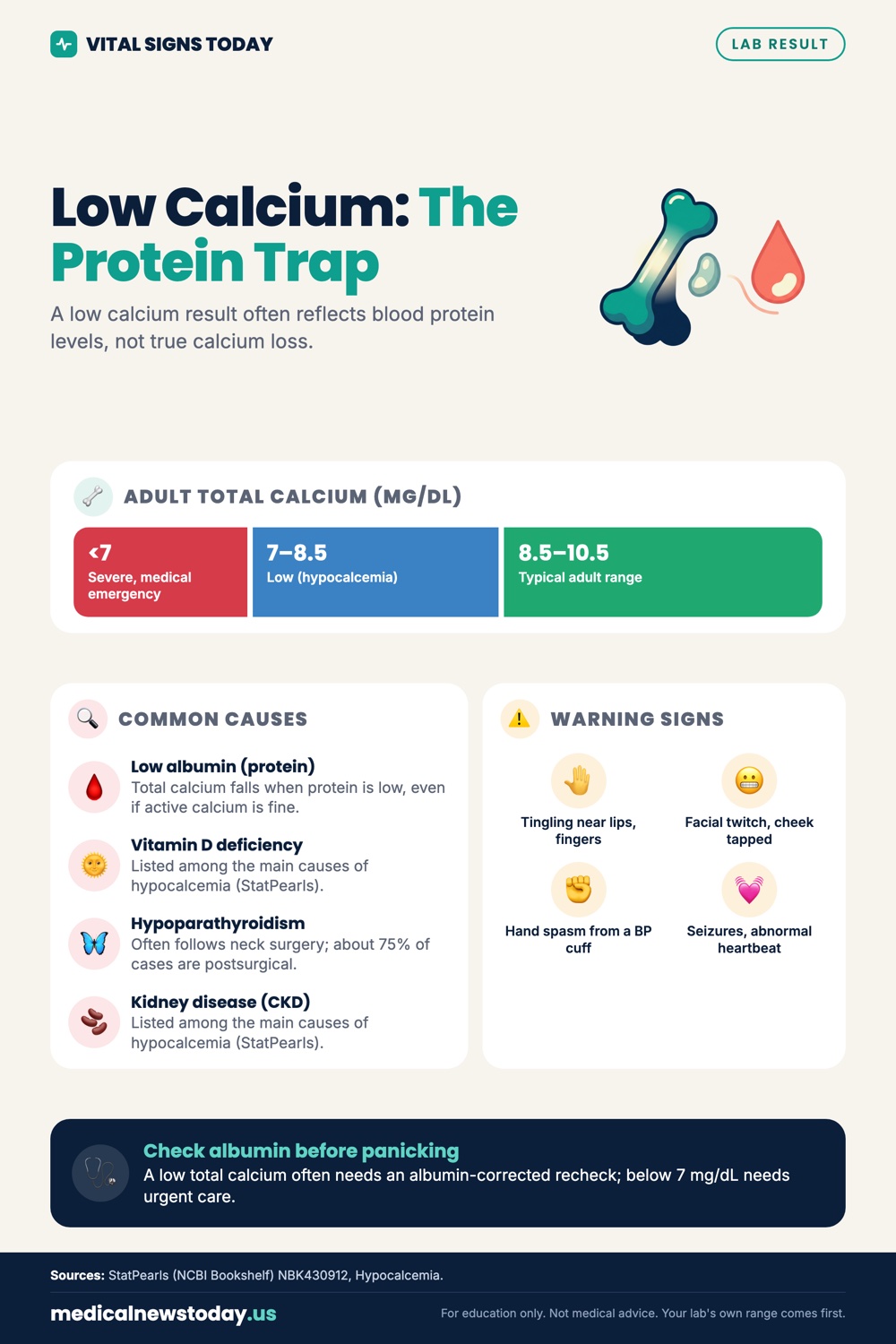
For adults, a typical normal range for total calcium is about 8.5 to 10.2 mg/dL, though the exact cutoffs vary slightly by laboratory (Cleveland Clinic). Clinically, you are generally considered to have hypocalcemia when your total serum calcium falls below roughly 8.8 mg/dL (Cleveland Clinic). So a result of 8.3 or 8.6 is mildly low, while something in the 7s starts to get a clinician’s attention quickly.
The single most important thing to know: most standard panels report total calcium, which includes the calcium bound to proteins (mainly albumin) plus the “free” calcium that is biologically active (MedlinePlus). About 45 percent of your calcium rides around attached to albumin (StatPearls, NCBI). That detail is the key to everything below, because it means a “low” total calcium can be an illusion created by low protein, not a true calcium problem at all.

Why is my calcium low on a blood test? The real causes
Here is the differential a clinician actually runs through, roughly in order of how often each one shows up.
- Low albumin (the most common false alarm). If your blood protein is low, often from liver disease, malnutrition, or simply being acutely ill, your total calcium reads low even when the active calcium is perfectly fine (MedlinePlus). This is not true hypocalcemia. More on how to unmask it below.
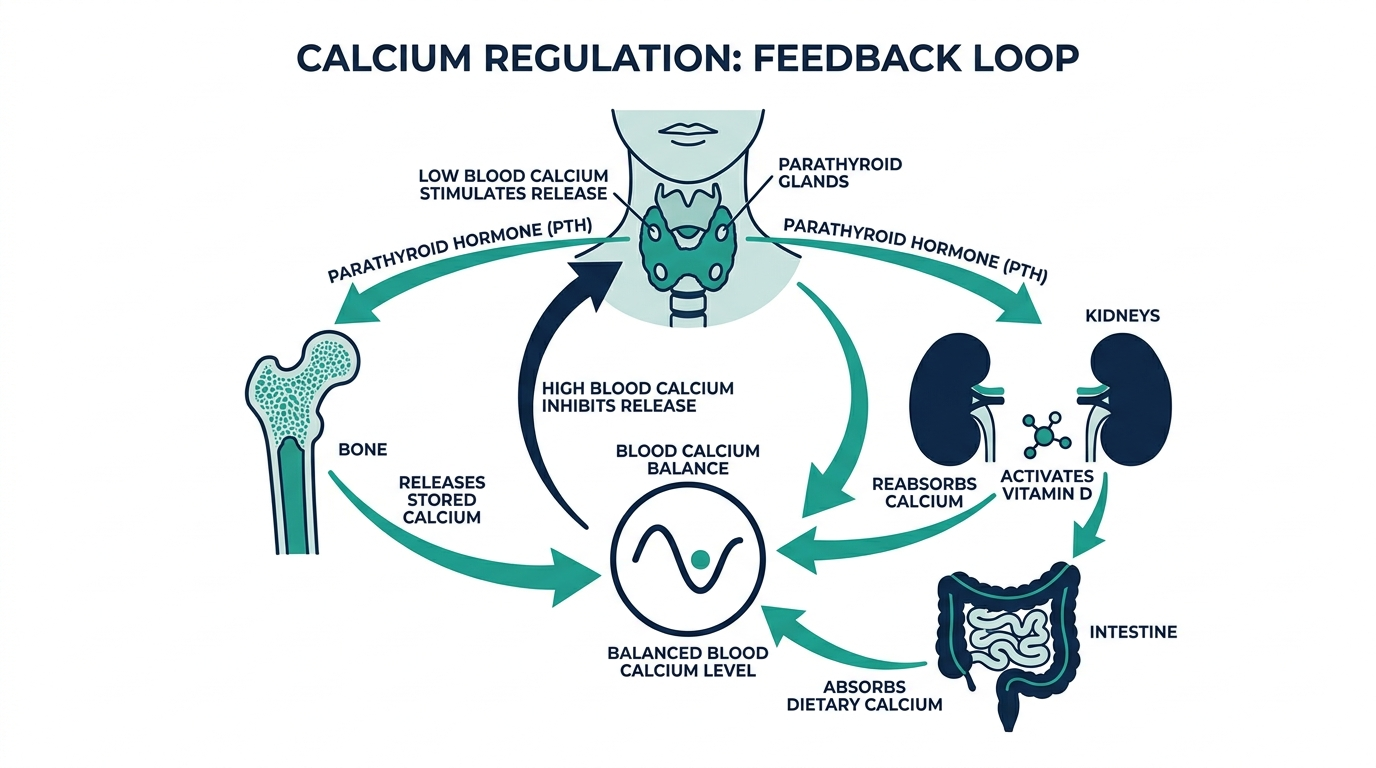
- Vitamin D deficiency. Without enough vitamin D, your gut cannot absorb calcium efficiently, so blood levels drift down. This is one of the most common genuine causes (Cleveland Clinic).
- Hypoparathyroidism. The parathyroid glands are the body’s calcium thermostat. When they make too little parathyroid hormone, often after thyroid or neck surgery, calcium falls (Cleveland Clinic).
- Kidney disease. Failing kidneys retain phosphorus and make less active vitamin D, both of which pull calcium down (Cleveland Clinic).
- Low magnesium. Magnesium is needed for parathyroid hormone to work. If magnesium is low, calcium often follows and will not correct until the magnesium is fixed (StatPearls, NCBI).
- Other causes. Pancreatitis, inadequate dietary calcium, malabsorption such as celiac disease, and certain medications can all lower the number (Cleveland Clinic).
Notice the pattern. The number one item on this list is not a disease at all. It is a measurement artifact. That is why a low calcium should almost never be interpreted in isolation.
What are the symptoms of low calcium?
Mild hypocalcemia is frequently silent. Many people feel nothing at all and only learn about it because a routine panel flagged the number (Cleveland Clinic). That is worth sitting with, because it means a slightly low calcium with no symptoms is rarely the crisis it can feel like on paper.
When symptoms do appear, they tend to be neuromuscular, because calcium controls how nerves and muscles fire. Mild signs can include muscle cramps, dry skin, brittle nails, and coarse hair (Cleveland Clinic). As levels drop further, the classic symptom is tingling, often in the lips, tongue, fingers, and feet, along with more intense muscle cramping.
Clinicians have two bedside tricks to detect irritable nerves before full symptoms hit. Chvostek’s sign is a twitch of the facial muscles when the cheek is tapped over the facial nerve. Trousseau’s sign is a telltale spasm of the hand when a blood pressure cuff is inflated on the arm (StatPearls, NCBI). If your doctor does these, now you know what they are checking for.

When is low calcium dangerous or a medical emergency?
Most low calcium results are mild and not urgent. The danger lives at the bottom of the scale. Severe hypocalcemia, generally a level below about 7 mg/dL, is a genuine medical emergency because of what it does to the brain and heart (StatPearls, NCBI).
The red-flag complications are:
- Seizures. Very low calcium makes the brain hyperexcitable (Cleveland Clinic).
- Laryngospasm and tetany. The muscles of the throat and body can clamp into sustained spasm, which can interfere with breathing (Cleveland Clinic).
- Dangerous heart rhythms. Severe hypocalcemia can prolong the QT interval on an ECG, which can trigger a life-threatening ventricular arrhythmia called torsades de pointes (StatPearls, NCBI).
If you have a known low calcium and develop spreading numbness and tingling, full-body muscle spasms, difficulty breathing, confusion, fainting, or a seizure, treat it as an emergency and seek care immediately. Severe cases are treated with intravenous calcium under monitoring, not a pill you take at home (Cleveland Clinic).
What should you do about a low calcium?
Answer first: for a mildly low result on a routine panel, the right move is almost never to start chugging calcium supplements. It is to find out whether the low number is real and why.
The logical next steps a clinician takes:
- Check your albumin and correct the calcium. This is the single most valuable follow-up, and it is usually already sitting on the same panel. See the insider section below.
- Repeat or confirm with ionized calcium. Ionized calcium measures only the biologically active free calcium and bypasses the protein problem entirely (MedlinePlus). It is the tiebreaker when the total looks low.
- Look at the supporting cast. Vitamin D, parathyroid hormone, magnesium, phosphorus, and kidney function tell the story of why calcium is low (StatPearls, NCBI).
- Treat the cause, not just the number. If vitamin D is low, you replace vitamin D. If magnesium is low, you fix that first or the calcium will not budge. The most common treatment for true, ongoing hypocalcemia is oral calcium and vitamin D, but only when it is actually warranted (Cleveland Clinic).
Taking high-dose calcium on your own to chase a borderline number can cause its own problems and can mask the real underlying issue. Let the workup lead.

When should you see a doctor?
Any low calcium result deserves a conversation with the clinician who ordered the test, even if you feel fine, because the interpretation depends on your albumin, your other labs, and your history. Book a prompt appointment if your result is more than mildly low, if it is low on a repeat test, or if you have symptoms like persistent muscle cramps, tingling around the mouth or in the hands, or unexplained fatigue. Seek emergency care without waiting if you have a seizure, severe widespread spasms, trouble breathing, or fainting, since those point to severe hypocalcemia that needs treatment now (Cleveland Clinic).
The insider catch: most “low calcium” is a protein illusion
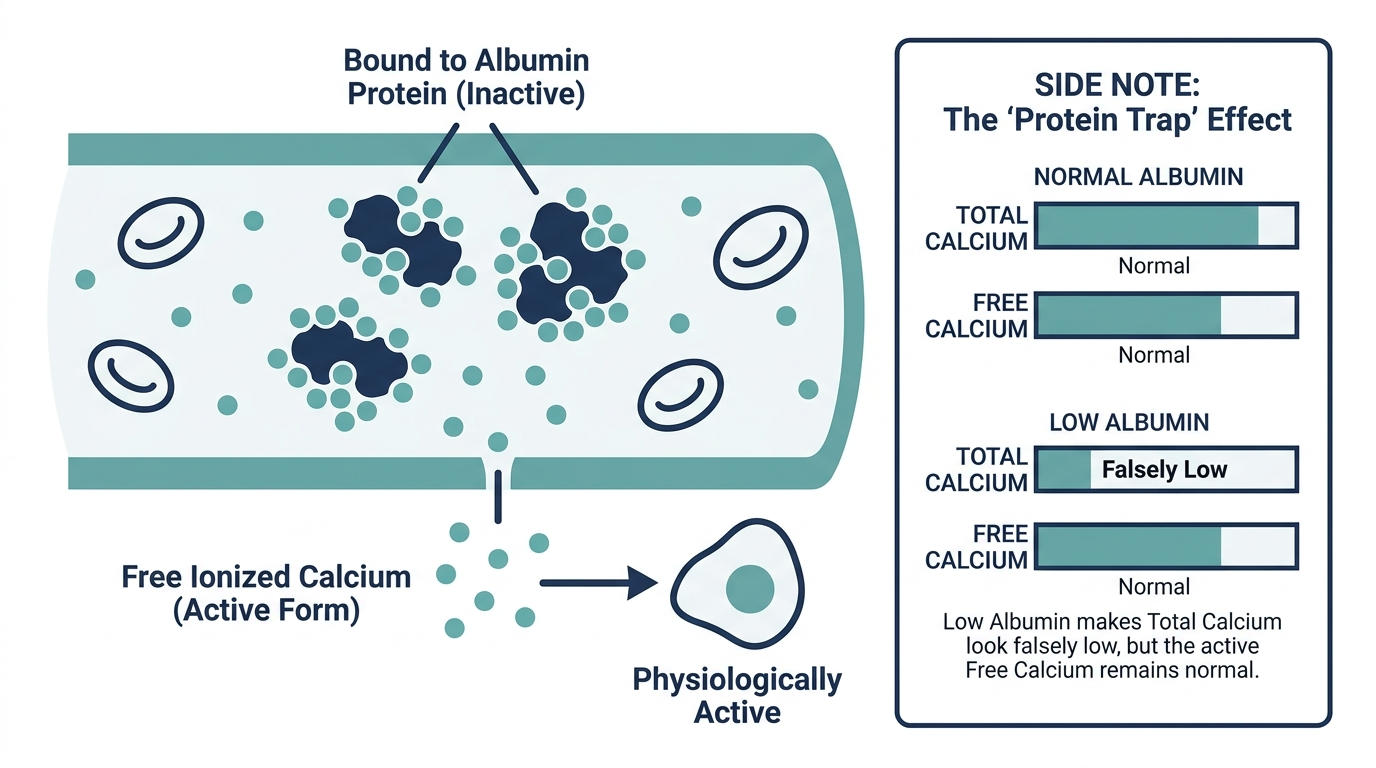
This is the detail that gets lost in nearly every patient summary, and it changes how you should read your own report. Because roughly 45 percent of blood calcium is bound to albumin, a low albumin drags the total calcium number down even when the active, free calcium is completely normal (StatPearls, NCBI). Hospitalized and chronically ill patients very often have low albumin, which is exactly why so many of them show a flagged low total calcium that means nothing on its own.
Clinicians correct for this with a simple rule. For every 1 g/dL that your albumin sits below 4 g/dL, you add about 0.8 mg/dL back to your measured total calcium to estimate the “corrected” value (StatPearls, NCBI). Run the math and a result that looked alarmingly low often lands right back inside the normal range.
A quick example. Suppose your total calcium is 8.0 mg/dL, flagged low, but your albumin is 2.5 g/dL, also low. Albumin is 1.5 below 4.0, so you add 1.5 times 0.8, which is 1.2. Corrected calcium becomes 8.0 plus 1.2, or 9.2 mg/dL, squarely normal. The “low calcium” was a low-protein mirage.
So before you panic over a flagged calcium, glance at the albumin on the same report. If albumin is low too, your calcium may be fine. And when there is any real doubt, an ionized calcium settles it directly, because it ignores protein binding entirely (MedlinePlus). This one habit, reading calcium and albumin together, is what separates a confident read from a needless scare.

How the calcium test is done, and what can throw the number off
Calcium is measured from a routine venous blood draw, and for a plain total calcium you generally do not need to fast. That said, the way blood is collected and handled has a real effect on the result, and knowing this helps you make sense of a value that does not match how you feel.
The biggest technical culprit is the tourniquet. If the band is left on your arm too long while the phlebotomist hunts for a vein, and especially if you pump your fist repeatedly, the prolonged squeeze can falsely raise calcium and other protein-bound values. A related artifact is hemolysis, where red cells rupture in the tube during a difficult draw or rough transport, which can skew several chemistry results. If a result looks strange and nothing else fits, a simple repeat draw with a clean stick sometimes resolves the mystery entirely.
Blood pH also matters, which is why an ionized calcium sample is handled so carefully. When blood becomes more alkaline, more calcium binds to albumin and the free, active fraction drops, even though total calcium has not changed. This is the physiology behind the tingling and hand cramps some people feel when they hyperventilate during a panic attack. They are briefly lowering their ionized calcium by blowing off carbon dioxide, not developing a calcium deficiency.
Common things that can genuinely nudge a total calcium reading include:
- Dehydration, which concentrates the blood and can push calcium and albumin up together.
- Thiazide diuretics, a widely used blood pressure medication class that reduces how much calcium the kidneys excrete and can raise the level.
- Lithium, which over time can nudge the parathyroid glands to run higher.
- High-dose vitamin D or calcium supplements, which raise calcium and are a frequent reason a level drifts up rather than down.
- Prolonged bed rest or immobilization, which releases calcium from bone into the blood.
Because a low total calcium is so often an artifact of low protein or collection technique, most clinicians will not act on a single mildly low value in a person who feels well. They confirm it, look at albumin, and only then decide whether a workup is warranted.
The panel that surrounds calcium: reading the whole neighborhood
Calcium almost never travels alone on a report. On a comprehensive metabolic panel it sits beside albumin, and a good clinician orders a small cluster of related tests to figure out why calcium is low. Learning to read these together turns a scary isolated number into a coherent story.
| Companion test | What it adds to a low calcium |
|---|---|
| Albumin | The first thing to check. Low albumin explains most falsely low total calcium. Correct for it before doing anything else. |
| Parathyroid hormone (PTH) | The master switch. A low calcium with low or inappropriately normal PTH points toward hypoparathyroidism. A low calcium with high PTH means the glands are fighting to compensate, often because of vitamin D deficiency or kidney disease. |
| Vitamin D (25-hydroxyvitamin D) | Deficiency is one of the most common true causes of a genuinely low calcium, because vitamin D drives calcium absorption in the gut. |
| Magnesium | Low magnesium blocks PTH from working and from being released. Calcium will not correct until magnesium is replaced. |
| Phosphorus | High phosphorus with low calcium suggests kidney disease or hypoparathyroidism. Low phosphorus with low calcium points more toward vitamin D deficiency. |
| Creatinine and eGFR | Kidney function shapes calcium handling and active vitamin D production, so a low calcium is often read alongside kidney markers. |
Want to check your calcium?
Three ways to get it measured. Pick whichever fits you.
Affiliate links: we may earn a commission at no extra cost to you. A lab test does not replace a visit with your clinician.
Worked interpretation scenarios
Numbers make more sense in patterns than in isolation. Here are the pattern reads a clinician runs almost automatically. None of these replace your own doctor, but they show how the same low calcium can mean very different things.
- Low total calcium, low albumin, everything else normal. This is the classic protein illusion. Correct the calcium for albumin and it usually lands back in range. Often no further action beyond confirming the pattern.
- Low calcium, high PTH, low vitamin D. A very common real picture. The parathyroid glands are working overtime to defend calcium in the setting of vitamin D deficiency. The fix is usually vitamin D repletion, which lets calcium recover.
- Low calcium, low PTH, recent neck or thyroid surgery. This raises concern for hypoparathyroidism from surgical injury to the parathyroid glands, and it needs prompt medical management, sometimes with calcium and active vitamin D.
- Low calcium, high phosphorus, high creatinine. This trio points toward chronic kidney disease, where the kidneys retain phosphorus and produce less active vitamin D. Treatment focuses on the kidney disease and its mineral balance.
- Low calcium that will not correct despite treatment. Always prompts a magnesium check, because unrecognized low magnesium is a frequent reason calcium refuses to normalize.
Common misconceptions about low calcium
A handful of beliefs cause needless worry or the wrong action. Clearing them up is often more useful than any single number.
- “Low blood calcium means my bones are weak.” Not directly. Blood calcium is tightly defended by hormones and reflects the moment of the draw, not your bone density. Bone strength is assessed with a DEXA scan, not a calcium level.
- “I should just take more calcium.” For a mildly low value this can backfire, mask the real cause, and in some cases push calcium too high. The right move is to find out why it is low first.
- “A low result always means something is wrong.” Frequently it is a low-protein artifact or a collection issue, especially in someone who feels well.
- “Dietary calcium controls my blood level.” Diet matters for long-term bone health, but your blood calcium is governed minute to minute by parathyroid hormone, vitamin D, and the kidneys, not by yesterday’s dairy intake.
- “One low reading needs immediate treatment.” Unless it is severe or symptomatic, the standard first step is to confirm and investigate, not to treat the number blindly.
Who should get calcium checked, and how often
Total calcium is included by default on the basic and comprehensive metabolic panels that most adults get at routine visits, so many people have it measured without ever asking. Beyond routine screening, there are situations where calcium deserves closer attention or repeat testing.
- After thyroid, parathyroid, or neck surgery, where the parathyroid glands can be bruised or removed, calcium is often monitored closely in the days afterward.
- In chronic kidney disease, calcium is tracked alongside phosphorus and PTH as part of managing mineral and bone health.
- With vitamin D deficiency or malabsorption conditions such as celiac disease or after bariatric surgery, periodic checks make sense.
- When symptoms suggest a problem, such as recurrent muscle cramps, tingling around the mouth and fingers, or unexplained fatigue and confusion.
- On medications that affect calcium, including certain diuretics, lithium, or long-term supplements.
For a mildly low result in a well person, a repeat test in a few weeks, drawn cleanly and read alongside albumin, is often all that is needed to sort a true problem from a passing artifact. The goal is never to chase a single number, but to see the trend and the surrounding panel clearly.
Frequently asked questions
What is considered a low calcium level on a blood test?
For adults, total calcium is typically normal between about 8.5 and 10.2 mg/dL, and you are generally considered to have hypocalcemia when total serum calcium falls below roughly 8.8 mg/dL (Cleveland Clinic). Always compare your value to the reference range printed on your own report, since labs differ slightly.
Why is my calcium low on my blood test if I feel fine?
Mild hypocalcemia is often symptomless, and a very common reason for a low total calcium is low albumin rather than a true calcium problem (MedlinePlus). Other genuine causes include vitamin D deficiency, low magnesium, hypoparathyroidism, and kidney disease (Cleveland Clinic).
Can low albumin make my calcium look low?
Yes, and this is one of the most common reasons for a falsely low result. About 45 percent of blood calcium is bound to albumin, so low protein lowers total calcium even when the active free calcium is normal. Clinicians add about 0.8 mg/dL for every 1 g/dL the albumin is below 4 g/dL to get a corrected value (StatPearls, NCBI).
When is low calcium a medical emergency?
Severe hypocalcemia, generally below about 7 mg/dL, can cause seizures, throat and muscle spasms that affect breathing, and dangerous heart rhythms, and it needs urgent intravenous treatment (StatPearls, NCBI). Get emergency care for a seizure, severe spasms, trouble breathing, confusion, or fainting.
Should I take calcium supplements if my blood calcium is low?
Not on your own for a mildly low result. The first step is finding out whether the low value is real, often by checking albumin and ionized calcium, and identifying the cause. Treatment such as oral calcium and vitamin D is used only when true hypocalcemia is confirmed, and low magnesium usually has to be corrected first (Cleveland Clinic).
This article is for general educational purposes and is not medical advice. It cannot diagnose or treat you and does not replace your clinician. Always discuss your lab results and any health decisions with a qualified healthcare professional.
Vital Signs Today may earn a commission if you buy through links on this page. It does not affect our editorial assessments.