
Disclosure: Vital Signs Today may earn a commission if you buy through links on this page, at no extra cost to you. This does not influence our evidence-based assessments. We are not a medical provider; talk to a clinician before acting on test results.
You scanned your blood panel, your albumin looked fine, your liver enzymes looked fine, and then one line stopped you: globulin, flagged high. Maybe the albumin/globulin ratio next to it was flagged too. Globulin is a number most people never think about until a lab puts an arrow next to it, and the first instinct is to assume the worst.
Here is the calmer truth. A high globulin is almost never a diagnosis by itself. It is a signpost, and where it points depends on what else is going on in your body. The trick is knowing which fork in the road you are on, because the gap between the harmless explanation and the serious one is huge.
Part of our Comprehensive Metabolic Panel guide.
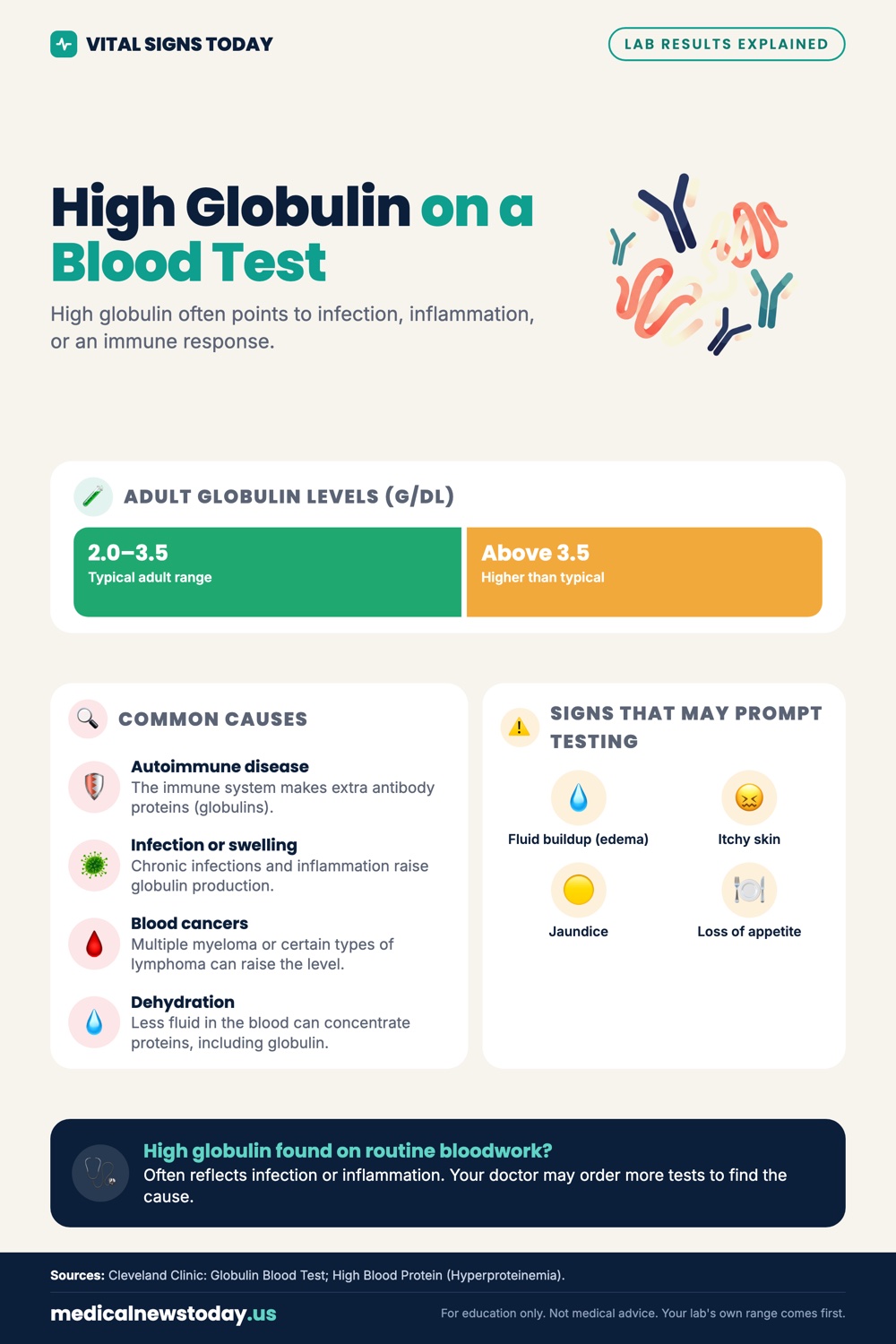
What does high globulin mean in a blood test?
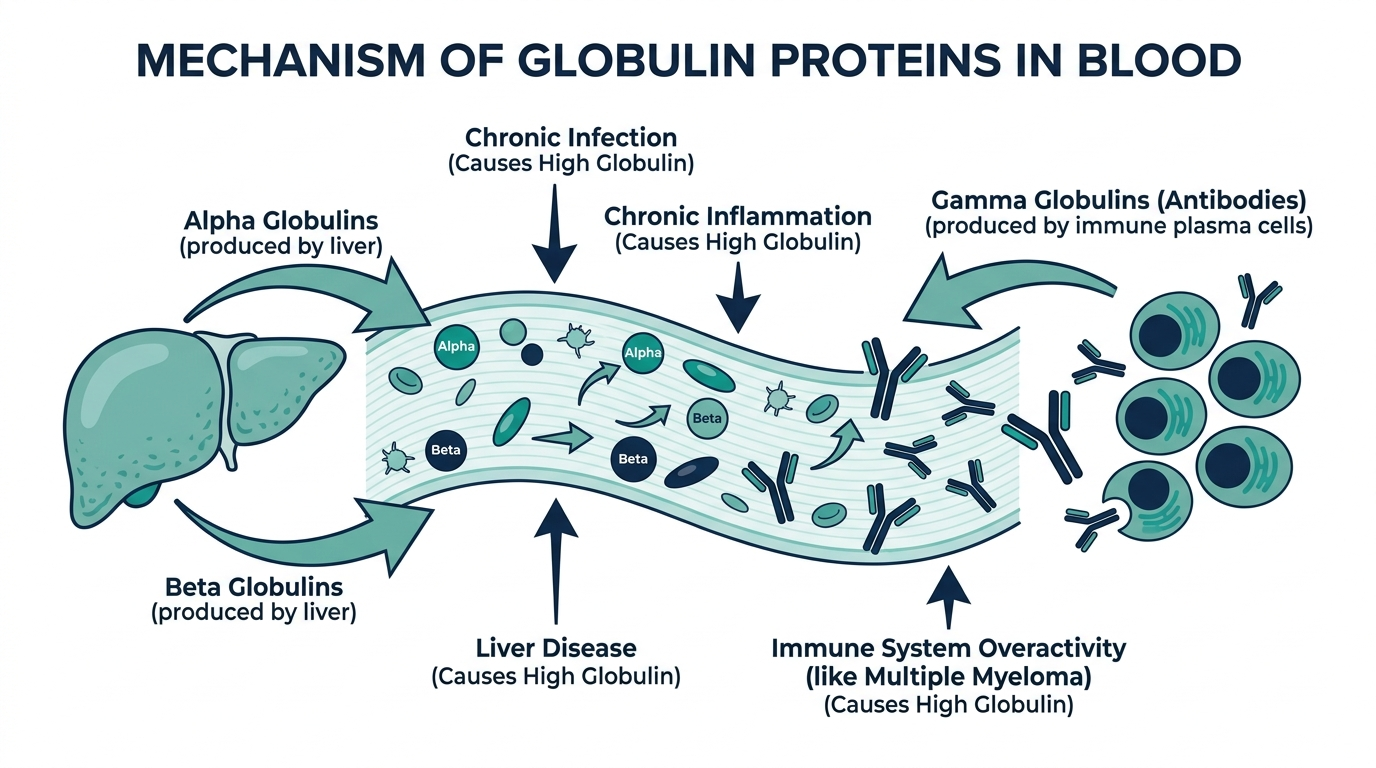
A high globulin means the non-albumin proteins in your blood are elevated, and that usually reflects your immune system working overtime, your liver behaving abnormally, or in a smaller number of cases an abnormal plasma cell producing one protein in bulk. Globulins are a family of proteins made by your liver and your immune system that help fight infection and move substances through your blood (Cleveland Clinic).
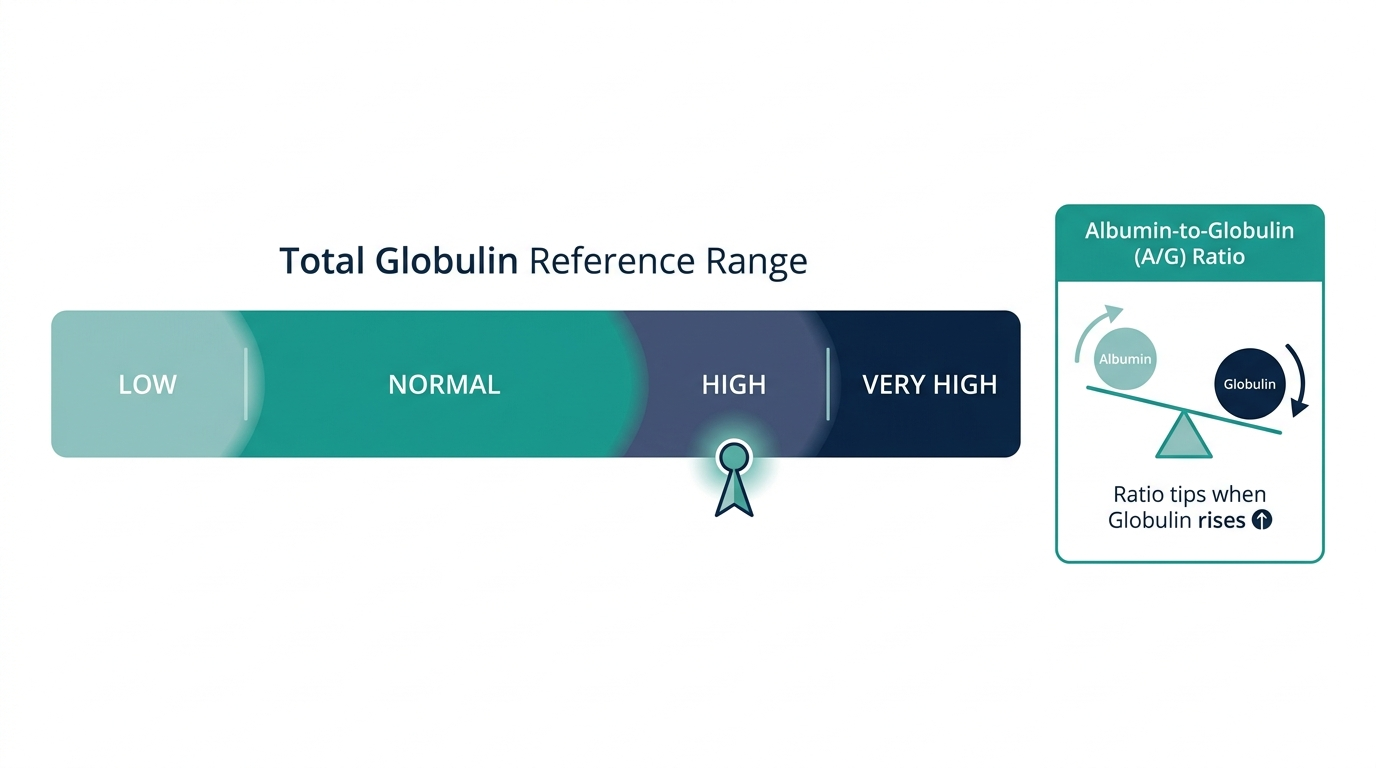
So what counts as high? Most labs put the normal total globulin range at roughly 2.0 to 3.5 g/dL (Cleveland Clinic). A value above about 3.5 g/dL is generally where the lab starts flagging it as elevated. The medical term for it is hyperglobulinemia. Globulin is rarely measured directly. It is usually calculated by subtracting your albumin from your total protein, which is why a high globulin and a low albumin/globulin (A/G) ratio so often appear together. A normal A/G ratio sits slightly above 1, because your blood normally holds a little more albumin than globulin (Cleveland Clinic). When globulin climbs, that ratio tips below 1, and that is frequently the first clue your clinician notices.
The single most important idea to take from this article: a high globulin asks a question, it does not answer one. The whole job from here is figuring out which kind of high globulin you have.

What causes a high globulin?
The causes split into two buckets that could not be more different. The first is a broad, reactive rise in many antibodies at once. The second is a single abnormal protein produced in bulk. Telling them apart is the entire game.
Common causes, roughly most common first:
- Chronic inflammation and infection. Ongoing infections such as hepatitis B, hepatitis C, HIV, or tuberculosis drive your immune system to pump out more antibodies, and globulin rises as a group (MedlinePlus). This is the everyday explanation and usually the least alarming pattern.
- Autoimmune disease. Conditions like lupus and rheumatoid arthritis keep the immune system chronically activated, raising globulin and lowering the A/G ratio (MedlinePlus).
- Chronic liver disease. A struggling liver makes less albumin while inflammation pushes globulin up, so the A/G ratio falls from both directions at once (Cleveland Clinic).
- Dehydration. This is the one people forget. If your blood volume drops, every protein becomes more concentrated, and globulin can read high simply because there is less water diluting it (Cleveland Clinic). Rehydrate, retest, and the number can normalize.
- Blood cancers and plasma cell disorders. This is the bucket that matters most to rule out. Multiple myeloma, Waldenstrom macroglobulinemia, certain lymphomas, and leukemia can drive globulin up by overproducing a single abnormal antibody (Cleveland Clinic, MedlinePlus).
The reassuring context: most of the time, a mildly high globulin traces back to something reactive and benign, not cancer. High blood protein is a sign of an underlying issue rather than a disease in its own right, and treating that underlying issue is what resolves the number (Cleveland Clinic). But the small slice of cases that are serious is exactly why no good clinician shrugs off an unexplained, persistent elevation.
What are the symptoms of a high globulin?
Here is the honest answer most people are not expecting: a high globulin usually causes no symptoms at all. High blood protein on its own does not produce noticeable physical signs, which is why it is almost always discovered by accident on a routine panel rather than because someone felt unwell (Cleveland Clinic).
What you may notice instead are symptoms of whatever is driving the globulin up. Depending on the cause, those can include fatigue, fluid retention or swelling (edema), itchy skin, jaundice, or loss of appetite (Cleveland Clinic). None of these are caused by the globulin itself. They are footprints of the underlying condition. That is why the symptom history you give your clinician matters more than the globulin number alone. A high globulin in someone who feels completely well is a very different conversation from one in someone with bone pain, night sweats, or unexplained weight loss.
When is a high globulin dangerous or a medical emergency?
A high globulin is not an emergency in the moment. No globulin number, by itself, requires a same-day trip to the ER. What makes the situation potentially serious is the company it keeps.
The pattern that should be taken seriously is a persistently elevated globulin or low A/G ratio alongside red-flag symptoms. The classic warning cluster for multiple myeloma is sometimes remembered as CRAB: elevated Calcium, Renal (kidney) impairment, Anemia, and Bone pain or fractures. Multiple myeloma, certain lymphomas, and leukemia are recognized causes of a high globulin and low A/G ratio (Cleveland Clinic, MedlinePlus). So what moves a high globulin from routine to urgent is not the value but signals like new bone pain, unexplained fractures, rising calcium, worsening kidney function, profound fatigue from anemia, recurrent infections, or unintentional weight loss. If a high globulin shows up next to any of those, it deserves prompt workup rather than a wait-and-see approach.
What should you do about a high globulin?
The most useful next step is almost always one specific test: serum protein electrophoresis, or SPEP. When globulin or total protein is abnormal, it separates your blood proteins into bands and shows the concentration of each fraction, including the gamma globulins where antibodies live (Cleveland Clinic). It is the test that turns a vague high globulin into an actual answer.
Why it matters comes down to one distinction. On electrophoresis, a broad, rolling hill in the gamma region (a polyclonal rise) points toward infection, inflammation, liver disease, or autoimmune disease, the reactive and usually non-cancerous causes. A narrow, sharp spike (a monoclonal band, often called an M-spike) points instead toward a plasma cell disorder such as multiple myeloma and triggers further testing like immunofixation (PMC, role of SPEP in detecting multiple myeloma). One cheap test sorts the harmless wide hill from the worrying tall spike.
Practical steps, in order:
- Confirm hydration and repeat. If the elevation is mild and you may have been dehydrated, a properly hydrated repeat draw can settle it without further workup.
- Review the whole panel together. Your clinician will read globulin alongside albumin, total protein, the A/G ratio, blood counts, and kidney function, not in isolation.
- Get the SPEP if it stays high. A persistent, unexplained elevation warrants electrophoresis to separate polyclonal from monoclonal patterns (Cleveland Clinic).
- Treat the cause, not the number. There is no treatment for high globulin itself. Resolving the underlying infection, inflammation, liver issue, or plasma cell disorder brings the number back into range (Cleveland Clinic).

The part most people never hear: the A/G ratio direction is the tell
Here is the clinical nuance that gets lost in most patient explanations. The number on your report that says globulin matters far less than which direction the A/G ratio moved and why. Two people can have the same high globulin for completely opposite reasons.
Consider this. In chronic liver disease, globulin rises while albumin falls, so the A/G ratio drops from both ends. In a plasma cell disorder, globulin rises because a single clone is mass-producing one antibody, and albumin may stay near normal. Both show a high globulin and a low A/G ratio on the basic panel, yet they are different diseases with different stakes. The basic chemistry panel cannot tell them apart, which is the most common reason a high globulin gets either over-worried or under-investigated.
There is a second, easy-to-miss trap. Because globulin is calculated as total protein minus albumin, a flagged high globulin can sometimes really be a low albumin problem in disguise, for example in malnutrition or kidney protein loss. Genuinely high gamma globulins only get confirmed and separated into reactive versus clonal patterns on electrophoresis (PMC, role of SPEP in detecting multiple myeloma). The takeaway: do not let a flagged globulin alone push you toward panic or complacency. The direction of the A/G ratio, the rest of your panel, and ultimately the electrophoresis pattern carry the real meaning.
When should you see a doctor?
If your only abnormal finding is a slightly high globulin and you feel well, this is a normal-priority conversation at your next appointment, not an emergency. Bring the actual report and ask whether the elevation needs a repeat draw or a serum protein electrophoresis. Many mild elevations are reactive and resolve once an infection clears or hydration improves (Cleveland Clinic).
See a doctor sooner, and be specific about symptoms, if a high globulin comes with bone pain, unexplained fractures, persistent fatigue, recurrent infections, unintentional weight loss, foamy urine, or known liver or kidney disease. Those features raise the priority of finding the cause (MedlinePlus). And if the elevation persists across more than one test without an obvious explanation, that alone is reason enough to push for electrophoresis.
The four globulin fractions, and why the subtype changes the meaning
The word globulin on your basic panel hides four distinct protein groups, and knowing which one is elevated is what turns a vague flag into a real direction. Serum protein electrophoresis separates them into bands, and each band tells a different story.
- Alpha-1 globulins. This band is dominated by alpha-1 antitrypsin, an acute-phase protein. It rises with inflammation and infection, and a strikingly low alpha-1 band can hint at alpha-1 antitrypsin deficiency, a genetic condition affecting the lungs and liver.
- Alpha-2 globulins. Includes haptoglobin and ceruloplasmin. This band climbs during acute inflammation and can also rise in nephrotic syndrome, where the kidneys leak smaller proteins while retaining these larger ones.
- Beta globulins. Includes transferrin and some complement proteins. Changes here can reflect iron status and certain lipid or inflammatory states.
- Gamma globulins. This is where antibodies (immunoglobulins) live, and it is the band that matters most in a high globulin workup. A broad gamma rise points to reactive causes, while a sharp gamma spike points to a plasma cell clone (PMC, role of SPEP in detecting multiple myeloma).
The basic chemistry panel lumps all four together into a single globulin number. That is exactly why an unexplained elevation so often needs electrophoresis: only by splitting the total into these bands can a clinician see whether an acute-phase inflammatory pattern, a gamma spike, or a kidney-related shift is driving the number.
Reading a high globulin alongside the rest of your panel
A globulin value read in isolation is nearly meaningless. Its interpretation depends heavily on the markers around it, which is why clinicians never act on the globulin line alone.
| Marker | What it adds to a high globulin |
|---|---|
| Albumin | The other half of total protein. If albumin is low, a flagged high globulin may partly be a low-albumin problem in disguise, as in malnutrition or kidney protein loss. |
| Total protein | Confirms whether the overall protein load is genuinely elevated or whether the shift is only in the ratio. |
| A/G ratio | A ratio below 1 flags a relative excess of globulin and is often the first clue a clinician notices. |
| Calcium, creatinine, hemoglobin | The CRAB markers. High calcium, rising creatinine, or anemia alongside a high globulin raise concern for a plasma cell disorder and shift the workup toward urgency. |
| Liver enzymes (ALT, AST) | Abnormal liver enzymes with a high globulin point toward chronic liver disease as a contributor. |
Want to check your globulin?
Three ways to get it measured. Pick whichever fits you.
Affiliate links: we may earn a commission at no extra cost to you. A lab test does not replace a visit with your clinician.
The pattern is everything. A mildly high globulin with normal calcium, kidney function, blood count, and liver enzymes in someone who feels well is a very different situation from a high globulin sitting beside anemia, high calcium, and a rising creatinine.
Sample interpretations: same high globulin, different stories
Because a high globulin can mean opposite things, working through realistic patterns clarifies how clinicians think. These are illustrative, not diagnoses, and none replaces the clinician who ordered your test.
- Mildly high globulin during a recent infection. A value of 3.7 g/dL in someone recovering from a viral illness, with everything else normal. This is a reactive, polyclonal rise. It often settles once the infection clears, and a repeat draw confirms it (MedlinePlus).
- High globulin with a known autoimmune condition. An elevated gamma globulin in someone with lupus or rheumatoid arthritis reflects chronic immune activation. The number tracks the disease rather than signaling something new (MedlinePlus).
- High globulin with low albumin and abnormal liver enzymes. This combination points toward chronic liver disease, where reduced albumin production and inflammation push the ratio down from both ends (Cleveland Clinic).
- Persistent high globulin with anemia and bone pain. A stubbornly elevated globulin alongside CRAB features earns a prompt electrophoresis to look for a monoclonal spike, because this is the pattern that can signal multiple myeloma (PMC, role of SPEP in detecting multiple myeloma).
How the test is done, and what can skew the result
Globulin is not usually measured directly. It is calculated from a total protein and albumin measurement, both part of a comprehensive metabolic panel, a standard blood draw. Because of how it is derived, a few factors can nudge the number in ways worth knowing.
- Hydration status. The most common source of a spurious high globulin. Dehydration concentrates all blood proteins, so a value can read high simply because there is less water in the sample (Cleveland Clinic). A rehydrated repeat often clarifies it.
- The calculation trap. Since globulin equals total protein minus albumin, a genuinely low albumin can make globulin look artificially elevated even when antibody production is normal.
- Recent infection or inflammation. An acute illness raises acute-phase proteins and antibodies, so a value drawn during or just after being sick may not reflect your baseline.
- Prolonged tourniquet time during the draw. Leaving the tourniquet on too long can slightly concentrate proteins in the sample, another reason a borderline value is worth confirming.
The practical rule is the same one clinicians use: a mild, isolated elevation, especially one that could be explained by dehydration or a recent illness, is a reason to repeat the test rather than to worry.
Common misconceptions about a high globulin
A few persistent myths cause people to either panic or dismiss a high globulin when neither reaction fits. Clearing them up is most of the work.
- “High globulin means I have cancer.” No. The large majority of high globulin results are reactive, from infection, inflammation, autoimmune disease, or liver disease. Plasma cell cancers are a smaller slice, which is why the follow-up test exists to sort them out (Cleveland Clinic).
- “The globulin number tells the whole story.” It does not. The direction of the A/G ratio, the rest of your panel, and ultimately the electrophoresis pattern carry the meaning, not the single value.
- “A high globulin needs treatment.” There is no treatment for the number itself. Managing the underlying infection, inflammation, liver issue, or plasma cell disorder is what brings it back into range.
- “One reading settles it.” A single mildly high value, especially one influenced by hydration or a recent illness, is a starting point. A repeat test and, if it persists, electrophoresis are what provide the real answer.
Frequently asked questions
What is a high globulin level on a blood test?
Total globulin is normally about 2.0 to 3.5 g/dL, so values above roughly 3.5 g/dL are generally flagged as high (Cleveland Clinic). Globulin is usually calculated from total protein minus albumin, so a high globulin and a low albumin/globulin ratio often appear together. Always compare your result to the reference range printed on your own report.
What does a high globulin in a blood test mean?
It usually means your immune system is producing more antibodies, often from chronic infection, inflammation, or autoimmune disease, or in fewer cases that your liver is abnormal or a plasma cell disorder is present (MedlinePlus). It is a signpost for further testing, not a diagnosis on its own.
Can dehydration cause a high globulin?
Yes. Dehydration concentrates the proteins in your blood, so globulin and total protein can read high simply because there is less water diluting them (Cleveland Clinic). A repeat test taken when you are properly hydrated can clarify whether the elevation is real.
Does a high globulin always mean cancer?
No. Most high globulin results trace back to reactive causes like infection, inflammation, autoimmune disease, or liver disease (Cleveland Clinic). Blood cancers such as multiple myeloma are a less common cause, which is why a persistent or unexplained elevation is checked with serum protein electrophoresis to separate harmless from serious patterns.
What test is done after a high globulin?
The usual next step is serum protein electrophoresis (SPEP), which separates blood proteins and shows whether the rise is a broad polyclonal increase (reactive) or a narrow monoclonal spike that suggests a plasma cell disorder (PMC, role of SPEP in detecting multiple myeloma).
This article is for general educational purposes and is not medical advice. It cannot diagnose or treat you and does not replace your clinician. Always discuss your lab results and any health decisions with a qualified healthcare professional.
Vital Signs Today may earn a commission if you buy through links on this page. It does not affect our editorial assessments.