Disclosure: Vital Signs Today may earn a commission if you buy through links on this page, at no extra cost to you. This does not influence our evidence-based assessments. We are not a medical provider; talk to a clinician before acting on test results.
Related: bilirubin blood test: the full guide · How to bring bilirubin back into range
You opened your liver panel expecting the usual drama around high numbers, and instead one line caught your eye for the opposite reason. Your bilirubin came back low, with a little flag next to it. Most articles will tell you to relax and move on. That advice is mostly right, but it skips the part that has quietly become interesting over the last decade.
For years a low bilirubin was treated as a non-event. Newer research has started to question that, and it changes how a thoughtful clinician reads the number. Here is the honest picture.
Part of our Liver Function Tests guide.
What does low bilirubin mean in a blood test?
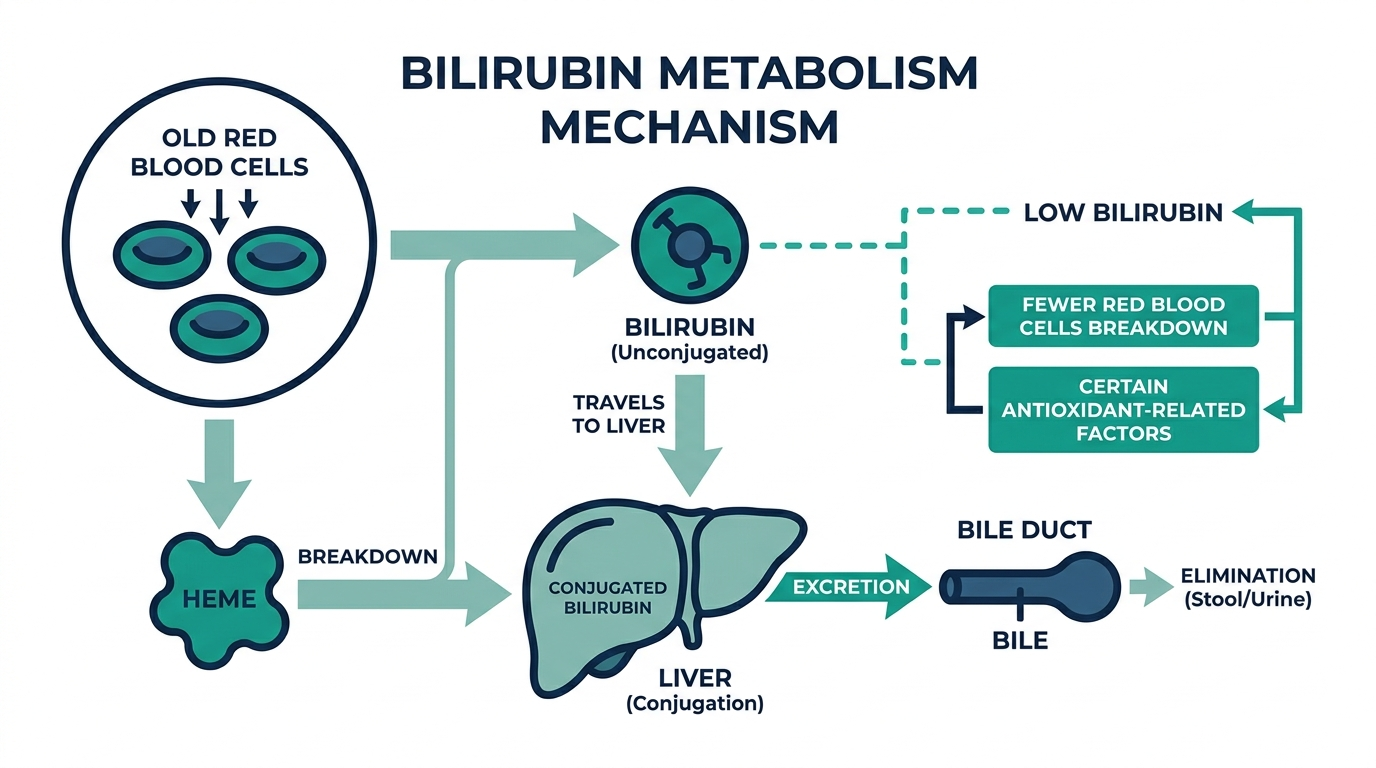
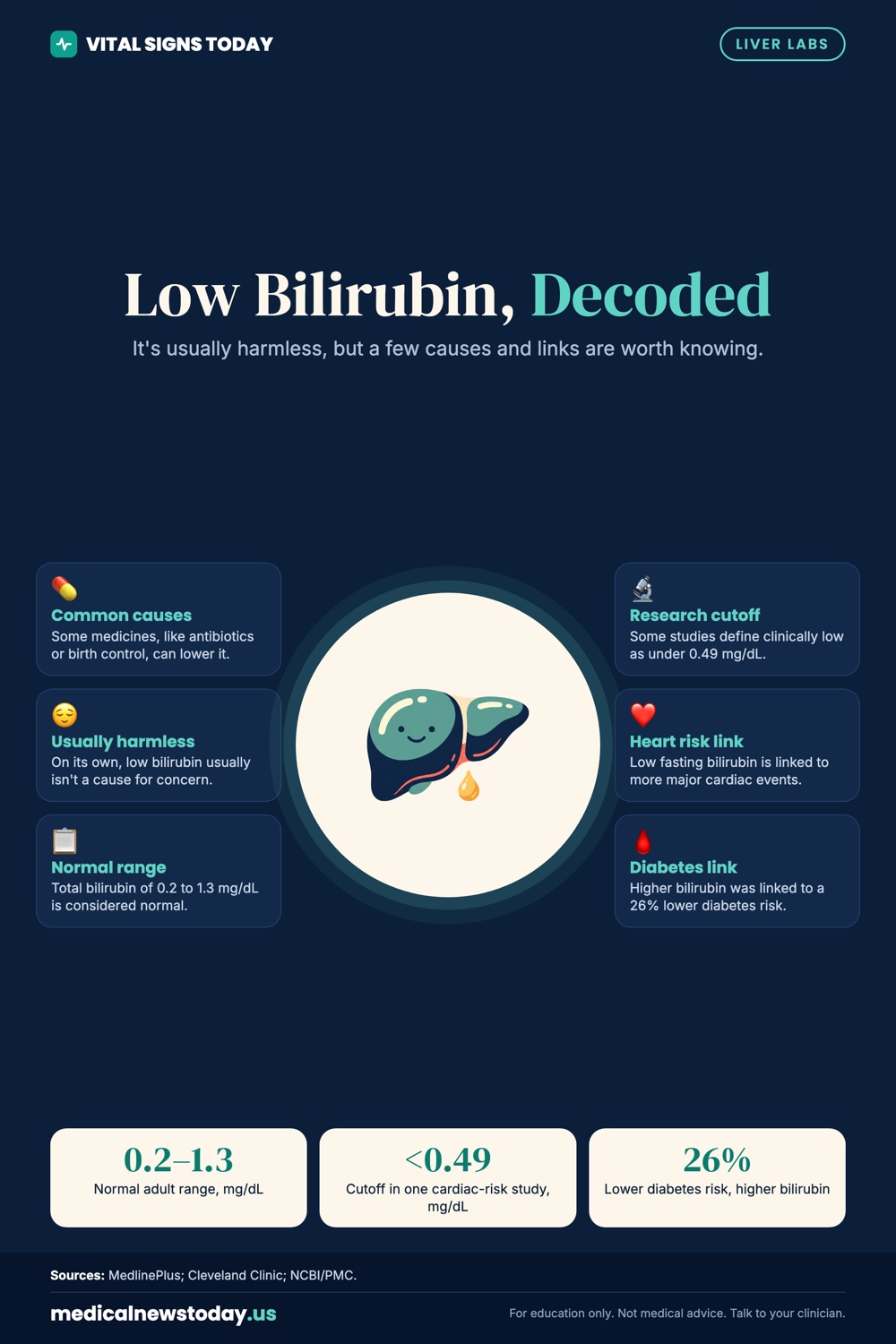
A low bilirubin in a blood test means your body has a smaller than usual amount of the yellow pigment that forms when old red blood cells are broken down and processed by your liver (MedlinePlus). On its own, a low result is usually harmless and far less worrying than a high one, which is the version doctors actually screen for when they check this test.
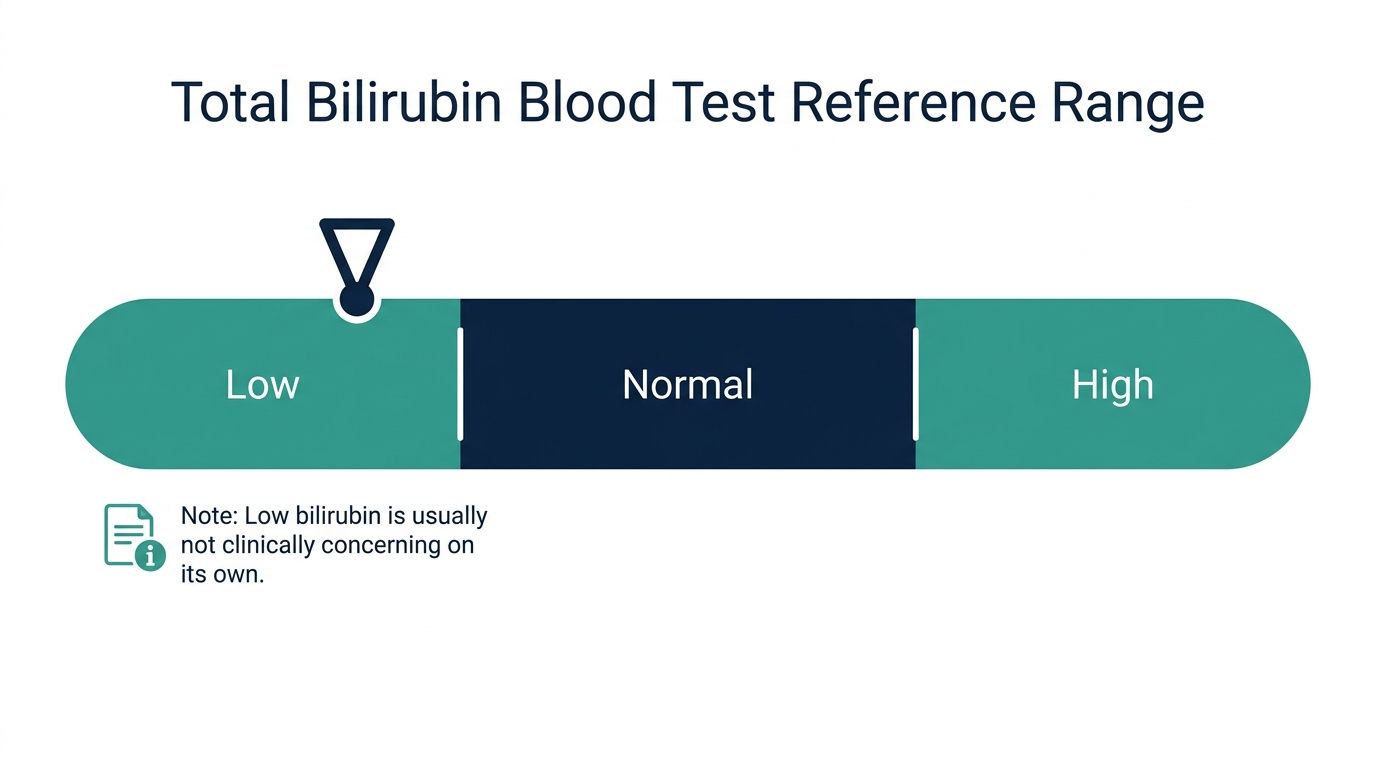
For children and adults, a total bilirubin between roughly 0.2 and 1.3 mg/dL is considered normal, though the exact cutoff shifts slightly from lab to lab (Cleveland Clinic). A “low” result generally means a value at or under the bottom of your lab’s range, often around 0.2 to 0.3 mg/dL. Researchers studying the topic tend to draw the line for clinically low, or hypobilirubinemia, even tighter, frequently below about 0.5 mg/dL (PMC, white matter lesions study).
The practical takeaway: a single low bilirubin with an otherwise clean panel is rarely a problem you need to fix. But it is not always pure noise either, and the next sections explain why.

What causes a low bilirubin?
Most of the time, a low bilirubin is the fingerprint of something ordinary rather than a disease. The common explanations, roughly in order of how often they turn up, are these.
- Medications. This is the most frequent culprit. Several common drugs lower bilirubin, including some antibiotics, birth control pills, sleeping pills, and seizure medications (Cleveland Clinic). If your result dropped after starting a new prescription, the prescription is the first suspect.
- Caffeine before the draw. A large dose of coffee or other caffeine in the hours before your blood test can pull the number down, which is one reason a borderline low value should not be over-interpreted from a single sample.
- Lower red blood cell turnover. Bilirubin is a waste product of red cell breakdown. When fewer red cells are being recycled than usual, less bilirubin is produced, so the level drifts down (MedlinePlus).
- Normal individual variation. Plenty of perfectly healthy people simply run on the low end. Genetics, sex, and the timing of your draw all nudge the number, and not every value at the floor of the range has a “cause” worth chasing.
Notice what is missing from this list. Unlike a high bilirubin, which points toward liver disease, bile duct blockage, or excessive red cell destruction, a low bilirubin does not have a tidy list of dangerous diseases sitting behind it. That asymmetry is the single most important thing to understand about this result.
What are the symptoms of a low bilirubin?
There are none. A low bilirubin produces no symptoms you can feel, which is why people only ever discover it by reading a lab report (Cleveland Clinic). You will not turn pale, lose energy, or notice any change in how you feel because your bilirubin sits at 0.2 instead of 0.7.
Contrast that with a high bilirubin, which announces itself with yellowing of the skin and eyes, the condition called jaundice. There is no low-bilirubin equivalent. Any symptoms a person with a low value happens to have are coming from something else entirely, such as the underlying reason their red cell turnover changed, not from the bilirubin number itself. So if your bilirubin is low and you feel fine, that is exactly what the data would predict.
When is a low bilirubin dangerous or a medical emergency?
Let me be direct: a low bilirubin is essentially never a medical emergency. There is no acute crisis caused by too little bilirubin, no number so low it sends you to the emergency room. Nobody is admitted to a hospital because their bilirubin is at the floor of the range. This is the opposite of a high bilirubin, where very elevated levels, especially in newborns, genuinely can be dangerous.
The nuance worth knowing is about long-term risk, not emergencies. A growing body of research treats persistently low bilirubin, hypobilirubinemia, as a possible marker of higher cardiovascular and metabolic risk rather than a benign quirk (PMC, bilirubin as a metabolic hormone). In one study of apparently healthy adults, people in the lowest bilirubin group, under 0.5 mg/dL, had a 2.36-fold higher prevalence of severe deep white matter lesions in the brain compared with the highest bilirubin group (PMC, white matter lesions study). Low bilirubin has also been examined alongside cerebral small vessel disease and atherosclerosis (PMC, bilirubin and cerebral small vessel disease).
Read those findings carefully. They describe statistical associations across populations, not a verdict on you as an individual. A low bilirubin does not mean you are having a stroke or developing dementia. It means a low value is better thought of as a faint background signal than as the all-clear it used to be assumed to be.
What should you do about a low bilirubin?
For most people the honest answer is: very little, and certainly nothing urgent. There is no treatment that raises bilirubin and no reason to take one, because a low value is not a deficiency disease the way low iron or low vitamin D is. Here is the sensible sequence.
- Look at the whole panel first. Bilirubin is interpreted alongside the other liver markers, ALT, AST, ALP, and albumin. If those are all normal and bilirubin is the only low outlier, the picture is reassuring (Cleveland Clinic).
- Check your medication list. If you started an antibiotic, birth control pill, sleeping aid, or seizure medication recently, that is very likely the explanation, and it is not a reason to stop the drug without talking to your clinician (MedlinePlus).
- Avoid heavy caffeine before a repeat draw. If the value is borderline and you want a cleaner reading, skip the large coffee beforehand.
- Treat it as a prompt for general heart health, not a diagnosis. Given the cardiovascular research, a persistently low bilirubin is a reasonable nudge to keep blood pressure, lipids, blood sugar, and lifestyle in good shape, the same things that protect everyone (PMC, bilirubin as a metabolic hormone).
What you should not do is panic, demand aggressive testing, or try supplements marketed to raise bilirubin. There is no established benefit to artificially pushing the number up.

When should you see a doctor?
You do not need to book an urgent visit for a low bilirubin alone. It is worth bringing up at your next routine appointment, especially if it shows up repeatedly across several tests or alongside other abnormal results. Mention it to a clinician if any of the following apply: your other liver enzymes are also abnormal, you have symptoms like unexplained fatigue or changes in your blood counts, you have known cardiovascular or metabolic risk factors and want context for the finding, or you simply want to confirm a medication is the cause.
The reason to raise it is not because low bilirubin is dangerous in the moment. It is because a good clinician can put the number in the context of your full panel and your history in about thirty seconds, which is exactly what turns a confusing flag into a closed question.
The part most people never hear: low bilirubin may be a missed protective signal, not a problem
Here is the counterintuitive insight that rarely makes it into patient explainers. Bilirubin is not just waste. At normal blood levels it works as a powerful antioxidant, scavenging free radicals and helping protect blood vessels (Cleveland Clinic). That reframes the entire conversation. The concern with a low value is not that bilirubin itself is harmful when scarce, but that you may have less of a built-in defense than someone with a higher level.
The cleanest illustration is Gilbert syndrome, a common and harmless inherited condition in which people run a mildly elevated bilirubin. Far from being sick, these individuals tend to have a lower risk of coronary artery disease, and researchers increasingly see their higher bilirubin as protective rather than pathological (PMC, bilirubin as a metabolic hormone). The same body of work flags the other end of the spectrum: minor decreases in serum bilirubin correlate with increased cardiovascular and metabolic risk, and very low levels, below roughly 0.49 mg/dL, have been linked to worse outcomes after cardiac procedures (PMC, bilirubin as a metabolic hormone).
What gets missed in everyday practice is that a low bilirubin is almost universally dismissed as “fine” without a second glance, precisely because the test exists to catch high values. That habit is usually correct and occasionally too quick. The number does not call for alarm, but it deserves to be read as one small data point in your cardiovascular and metabolic story, not crossed off as meaningless.

Direct versus indirect bilirubin, and why the split matters
Bilirubin does not exist as a single number. Your report usually breaks it into fractions, and understanding the split explains why the low end behaves so differently from the high end.
When old red blood cells are broken down, the pigment released is unconjugated bilirubin, also called indirect bilirubin. It is fat-soluble and travels to the liver bound to a protein. Inside the liver, an enzyme attaches sugar molecules to it in a process called conjugation, turning it into conjugated or direct bilirubin, which is water-soluble and can be excreted into bile and out through the gut. Total bilirubin is simply the sum of the two.
- Indirect (unconjugated) bilirubin reflects how much is being produced from red cell breakdown before the liver processes it. In Gilbert syndrome, a mild rise here is common and harmless.
- Direct (conjugated) bilirubin reflects the liver and bile ducts doing their job of processing and clearing it. A rise in this fraction is what points toward bile flow problems.
Here is why this matters for a low result. Because the whole test is designed to catch elevations, the fractions are most useful when bilirubin is high, where the ratio tells a clinician whether the problem is upstream red cell breakdown or downstream bile flow. When bilirubin is low, both fractions are simply small, and there is no dangerous pattern hidden in the split. That is a big part of why a low total bilirubin is read so much more calmly than a high one.
Want to check your bilirubin?
Three ways to get it measured. Pick whichever fits you.
Affiliate links: we may earn a commission at no extra cost to you. A lab test does not replace a visit with your clinician.
Which liver and blood markers to read alongside a low bilirubin
A low bilirubin gains almost all of its meaning from the company it keeps. On a liver panel and a complete blood count, these are the neighbors that turn an isolated low value into a clear picture.
- ALT and AST. These liver enzymes rise when liver cells are stressed or damaged. When they are normal alongside a low bilirubin, the liver is almost certainly fine, and the low value is background noise rather than a signal.
- Alkaline phosphatase (ALP). This marker rises with bile duct problems. A normal ALP with a low bilirubin further reassures that bile flow is not the issue.
- Albumin. A protein the liver makes, albumin reflects the liver’s synthetic function. Normal albumin means the liver is producing what it should, which rounds out a reassuring panel.
- Complete blood count, especially hemoglobin and reticulocytes. Because bilirubin is a byproduct of red cell breakdown, the CBC gives context on red cell turnover. This is more relevant when interpreting a high bilirubin, but it also explains why some healthy people with lower red cell turnover run a lower bilirubin.
- Cardiovascular and metabolic markers. Given the research linking persistently low bilirubin to cardiovascular and metabolic risk, lipids, blood pressure, and fasting glucose are the numbers actually worth attention when a low value keeps showing up.
The pattern that matters is simple. A low bilirubin surrounded by normal liver enzymes, normal ALP, and normal albumin is a closed question. The number only becomes worth a second thought as a faint nudge toward general heart and metabolic health.
What can skew a bilirubin result
Several everyday factors move bilirubin up or down, and knowing them keeps you from over-reading a single low value.
- Recent caffeine. A large coffee or other caffeine in the hours before the draw can lower bilirubin, so a borderline low result taken after a busy caffeinated morning may not reflect your true baseline.
- Medications. Some antibiotics, birth control pills, sleeping aids, and seizure medications lower bilirubin. A recent new prescription is often the whole explanation for a drop.
- Fasting versus fed state. Bilirubin actually tends to rise with fasting and fall after eating, which is one reason a non-fasting sample can read lower. This is the opposite direction from many other markers and is worth keeping in mind.
- Light exposure of the sample. Bilirubin is broken down by light, so a sample left exposed rather than protected can read artificially low. This is a lab-handling factor, but it is a real source of a spuriously low result.
- Individual and genetic variation. Sex, genetics, and normal day-to-day fluctuation all shift the number, so plenty of healthy people simply sit at the low end without any cause to find.
Because so many ordinary factors nudge the number down, a lone low bilirubin is best confirmed on a clean, unhurried repeat before it is read as anything at all.
Reading your own low bilirubin: worked scenarios
The same low value means different things depending on what surrounds it. These illustrative patterns show how a clinician moves from a flagged number to a conclusion. They are not a diagnosis, and your provider always reads your full panel.
- Bilirubin 0.2 mg/dL, all other liver markers normal, no symptoms. This is the textbook harmless low. With normal ALT, AST, ALP, and albumin, it is essentially a closed question and needs no action.
- Bilirubin low, started a new antibiotic or birth control pill two weeks ago. The timing of the medication is the loudest clue, and the drug is the most likely explanation. It is not a reason to stop the prescription without talking to your clinician.
- Bilirubin low, drawn right after a large coffee. Caffeine can pull the number down, so a cleaner repeat without the pre-draw coffee is the sensible next step if the value looks borderline.
- Bilirubin persistently low across several tests, plus high blood pressure and elevated lipids. Here the low value is best read as a faint background signal that reinforces attention to cardiovascular and metabolic health, not as a problem to treat directly.
The recurring lesson is that a low bilirubin almost never stands on its own as a concern. It is a small data point that gains meaning only from the rest of your panel and your risk profile.
Common misconceptions about a low bilirubin
A few myths cause needless worry or misguided action around this result. Clearing them up settles most of the confusion.
- “Low bilirubin means my liver is failing.” This is backwards. Liver disease characteristically raises bilirubin, not lowers it. A low value with normal liver enzymes is one of the more reassuring findings on a panel.
- “I need a supplement to raise it.” There is no established treatment to raise bilirubin and no proven benefit to doing so. Products marketed to boost it are not supported by evidence.
- “A low result is completely meaningless.” This is the older assumption, and it is slightly too quick. The number rarely needs action, but research increasingly reads a persistently low bilirubin as a faint marker of cardiovascular and metabolic risk rather than pure noise.
- “One low reading tells me something.” Because caffeine, medications, fed state, and even sample handling can lower the number, a single low value is a weak data point. A clean repeat is what separates a true low baseline from an artifact.
Held in the right frame, a low bilirubin is neither an alarm nor entirely nothing. It is usually harmless, occasionally a gentle prompt to protect your heart and metabolism, and almost never a reason for urgent concern.
Frequently asked questions
What does a low bilirubin blood test mean?
It means your body has less than the usual amount of the pigment made when old red blood cells break down. A low result is generally harmless and far less concerning than a high one, and is most often explained by medications, recent caffeine, or normal individual variation (Cleveland Clinic).
What is a normal bilirubin level, and what counts as low?
For children and adults, a total bilirubin of about 0.2 to 1.3 mg/dL is normal, with slight variation by lab (Cleveland Clinic). A low result is usually a value at or below the bottom of your lab’s range, and research studies often define clinically low as under about 0.5 mg/dL.
Can medications cause a low bilirubin?
Yes, and they are the most common cause. Some antibiotics, birth control pills, sleeping pills, and seizure medications can lower bilirubin, and this is generally not a cause for concern (MedlinePlus). Do not stop a prescribed drug because of it without talking to your clinician.
Is low bilirubin dangerous?
It is not an emergency and causes no symptoms on its own. However, persistently low bilirubin has been associated in research with higher cardiovascular and metabolic risk and with brain white matter changes, so it is best read as a faint long-term signal rather than an immediate threat (PMC, bilirubin as a metabolic hormone).
Do I need treatment to raise my bilirubin?
No. There is no established treatment to raise bilirubin and no proven benefit to doing so. The sensible response is to confirm the cause, look at your full panel, and keep your general heart and metabolic health in good shape (Cleveland Clinic).
This article is for general educational purposes and is not medical advice. It cannot diagnose or treat you and does not replace your clinician. Always discuss your lab results and any health decisions with a qualified healthcare professional.
Vital Signs Today may earn a commission if you buy through links on this page. It does not affect our editorial assessments.