Disclosure: Vital Signs Today may earn a commission if you buy through links on this page, at no extra cost to you. This does not influence our evidence-based assessments. We are not a medical provider; talk to a clinician before acting on test results.
Related: EGFR normal range by age (full chart)
You scanned your blood work, hit a line that said eGFR, and the number sat below the reference range. Maybe 55. Maybe 42. Your stomach dropped a little, because eGFR is one of the few labs where the words “kidney function” sit right there in plain sight. Here is what to know before you spiral: a single low eGFR is a signal, not a sentence, and the most important thing about it is almost never the one number you are staring at.
eGFR is one of the most useful numbers on a routine panel, and also one of the most misread. Let me walk you through what a low result means and what to actually do about it.
Part of our Comprehensive Metabolic Panel guide.
What is eGFR in a blood test, low result and all?
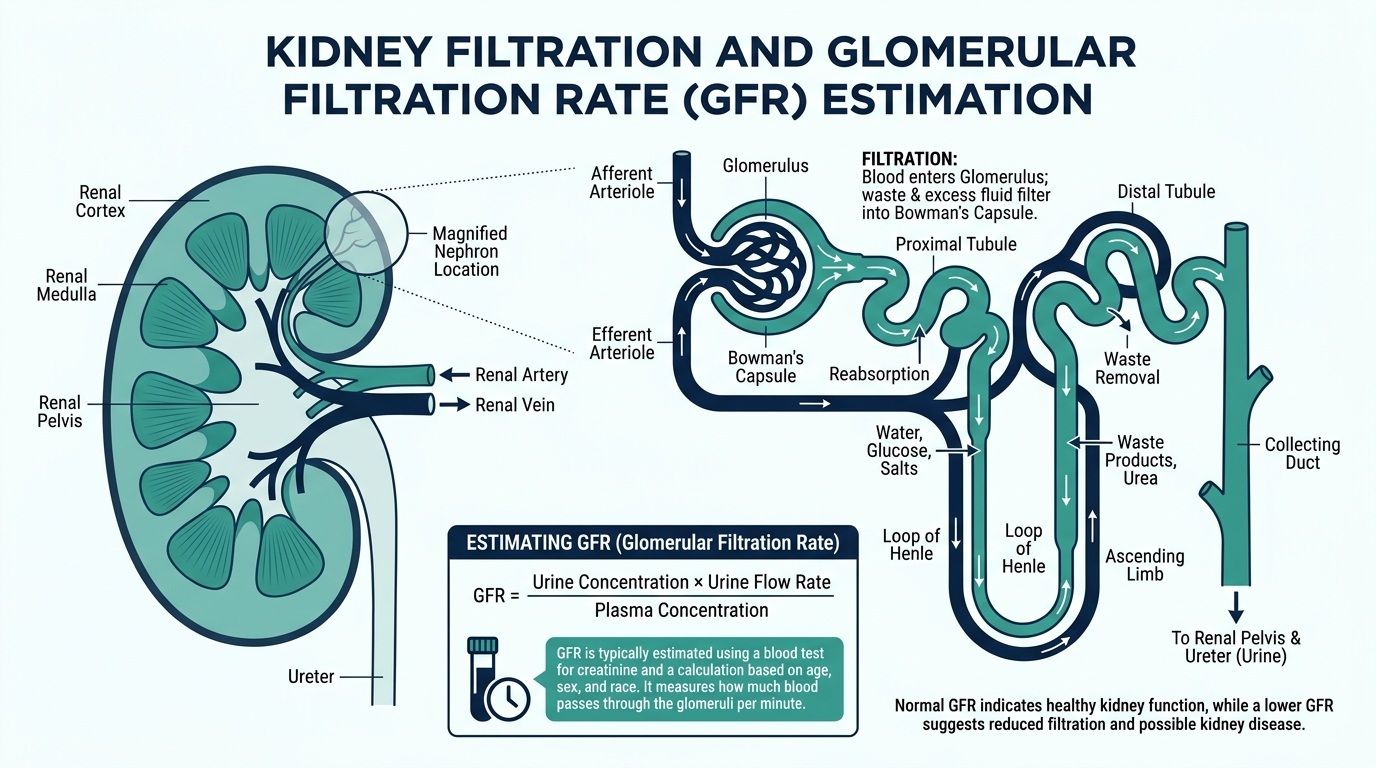
eGFR stands for estimated glomerular filtration rate. It is a calculation of how well your kidneys filter waste out of your blood, estimated from your blood creatinine level plus your age and sex (Cleveland Clinic). It is reported in mL/min/1.73m2, and you can read it loosely as a percentage of normal filtering capacity. An eGFR of 100 means your kidneys are working about as well as expected for a healthy adult. An eGFR of 40 means roughly 40 percent of that.
So a low eGFR tells you your kidneys are filtering more slowly than the calculator expects for someone your age and sex. That is the whole concept. Everything below is about how low is actually low, why, and what deserves your attention.

What does a low eGFR mean on a blood test?
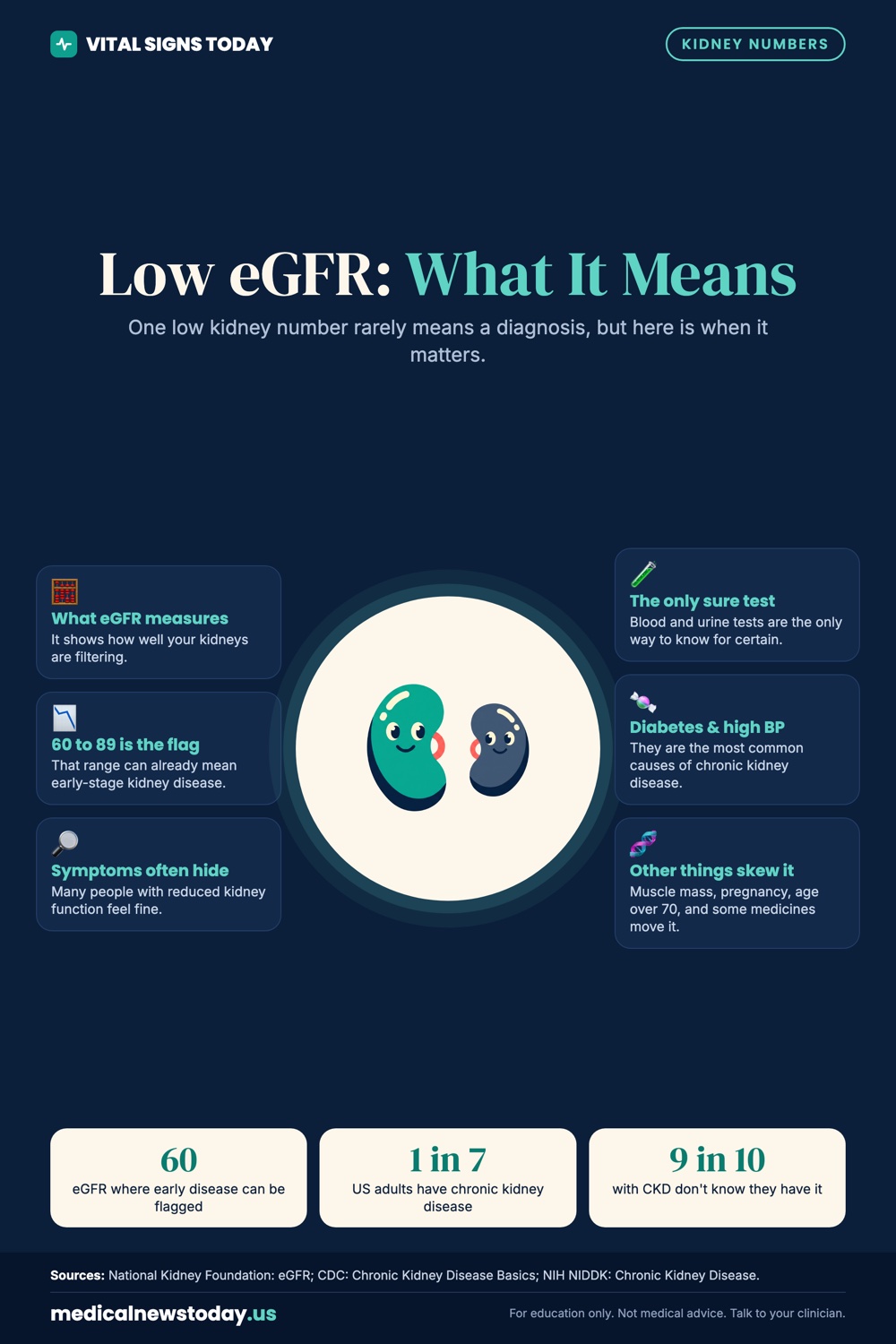
The short answer: a low eGFR means your kidneys are clearing waste from your blood more slowly than normal, and the threshold clinicians watch is 60. An eGFR below 60 is the line where kidney disease becomes a real consideration (MedlinePlus).
But the number alone is not a diagnosis, and this is the part people miss. Chronic kidney disease is defined as an eGFR that stays below 60 for three months or more, or an eGFR above 60 paired with other signs of kidney damage such as protein in the urine (Cleveland Clinic). The word that matters is “stays.” One reading below 60 is a reason to recheck, not a reason to conclude anything.
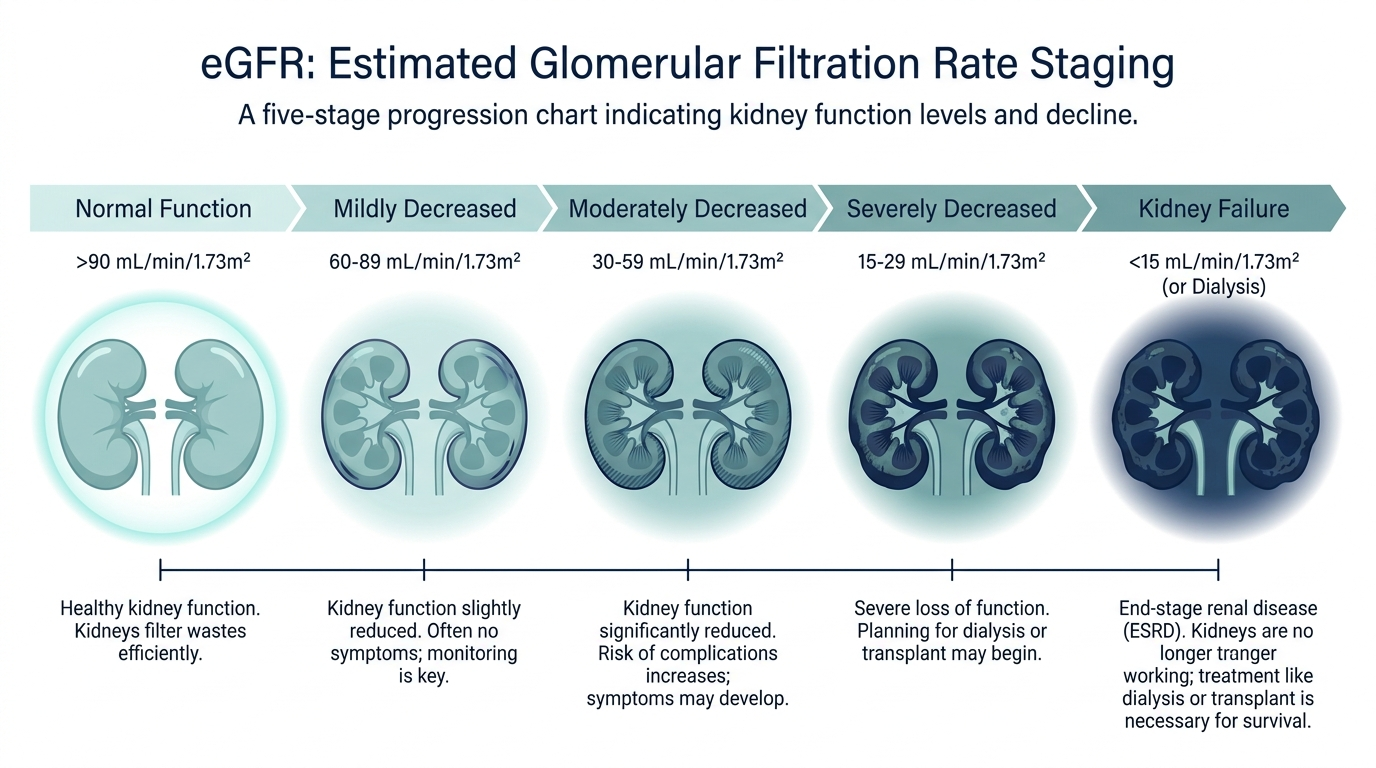
Here is the staging clinicians use, with the eGFR range for each (National Kidney Foundation):
- Stage 1: eGFR 90 or above. Filtering is normal, but there may be early kidney damage detected another way.
- Stage 2: eGFR 60 to 89. Mildly reduced, often still working well.
- Stage 3: eGFR 30 to 59. Mild to moderate loss of function. This is where most newly flagged low results land.
- Stage 4: eGFR 15 to 29. Severe loss of function.
- Stage 5: eGFR below 15. Kidney failure, the point where dialysis or a transplant enters the conversation.
One more thing worth internalizing: eGFR naturally drifts down with age. A healthy 25 year old averages around 116, while a healthy 70 year old averages closer to 75 (Cleveland Clinic). So a number that looks alarming on its own may be entirely normal for the decade you are in.
What causes a low eGFR?
A low eGFR is the result, not the cause. The job is to find what is slowing your kidneys down. By far the two most common drivers, accounting for the majority of chronic kidney disease, are diabetes and high blood pressure (Mayo Clinic). High blood sugar and high pressure both quietly damage the tiny filtering units in the kidney over years.
The fuller differential, roughly in order of how often it shows up:
- Diabetes. The single leading cause of kidney disease and kidney failure in the United States (Mayo Clinic).
- High blood pressure. The second major driver, and one that both causes and is worsened by kidney decline.
- Glomerulonephritis, inflammation of the kidney’s filtering units, often from autoimmune disease.
- Polycystic kidney disease and other inherited conditions.
- Recurrent kidney infections and prolonged urinary blockage, for example from an enlarged prostate (Mayo Clinic).
- Risk-stacking factors that make all of the above more likely: family history of kidney disease, heart disease, age over 50, smoking, and obesity (MedlinePlus).
And do not overlook the temporary causes. Dehydration, a recent dose of certain medications such as NSAIDs, or even a heavy protein meal or intense workout before the blood draw can nudge creatinine up and push eGFR down for that one test. This is precisely why a single low value gets rechecked rather than acted on.
What are the symptoms of a low eGFR?
Here is the hard truth that makes kidney disease so dangerous: in the early stages, a low eGFR usually has no symptoms at all. Many people feel completely fine through stages 1, 2, and even into stage 3 (Mayo Clinic). The kidneys have enormous reserve, so they can lose a large chunk of function before you notice anything. That is exactly why eGFR is run on routine panels. It catches the problem while you still feel well.
When symptoms do appear, it usually means function has dropped further. Signs of more advanced kidney decline include (MedlinePlus):
- Swelling in your legs, feet, ankles, hands, or face
- Fatigue and difficulty concentrating
- Changes in how often you urinate
- Dry, itchy skin and muscle cramps
- Nausea, vomiting, and loss of appetite
- Shortness of breath
If you have a low eGFR and none of these, that is normal and even reassuring. If you have a low eGFR and several of these, that moves the conversation up in urgency.

When is a low eGFR dangerous or a medical emergency?
Most low eGFR results are not emergencies. They are findings to investigate over weeks, not minutes. But there are clear red-flag thresholds where the pace changes.
An eGFR below 15 signals kidney failure, also called end-stage kidney disease, and is the level at which dialysis or a transplant becomes necessary (Cleveland Clinic). An eGFR in the 15 to 29 range, stage 4, is severe and warrants prompt specialist care even if you feel okay.
The other danger pattern is not a single number but a trajectory. An eGFR that drops fast, for example falling 20 or 30 points over a few weeks, can signal acute kidney injury, which is a medical emergency. Combine a rapidly falling or very low eGFR with warning signs such as little or no urine output, severe swelling, confusion, chest pain, or shortness of breath, and that is a same-day medical evaluation, not a wait-and-see. The number that has been quietly low for years is a different animal from the number that just fell off a cliff.
What should you do about a low eGFR?
The most useful response to a first low eGFR is calm and methodical, not panic. Here is the sensible sequence.
Confirm it is real and persistent. Because dehydration, medications, and timing can skew a single result, your clinician will typically recheck eGFR and creatinine, often well hydrated and at a different time. Chronic kidney disease requires that low reading to persist for three months (Cleveland Clinic).
Get the urine test that eGFR alone cannot give you. A urine albumin-to-creatinine ratio (uACR) checks for protein leaking into your urine. A uACR over 30, alongside or even instead of a low eGFR, is a core sign of kidney damage (National Kidney Foundation). Blood and urine together tell the story that neither tells alone.
Treat the cause. If diabetes or high blood pressure is behind it, controlling blood sugar and blood pressure is the single most powerful lever you have to slow further decline (Mayo Clinic). Lifestyle steps that genuinely help include staying well hydrated, not smoking, keeping a healthy weight, limiting excess salt, and being cautious with kidney-stressing painkillers like regular high-dose NSAIDs.
Encouragingly, kidney function is not always a one-way street. When a low eGFR is driven by something reversible, such as dehydration, a medication, or a flare of an underlying condition that gets treated, the number can recover (National Kidney Foundation).
When should you see a doctor?
Any low eGFR result deserves a conversation with the clinician who ordered it. You do not need to wait for symptoms. Specifically, follow up promptly if your eGFR is below 60, if it has dropped noticeably from a previous result, or if your report also shows protein in the urine.
Move faster, ideally same-day, if a low eGFR comes with red-flag symptoms: marked swelling, sharply reduced urination, confusion, chest pain, or breathlessness. And if you live with diabetes or high blood pressure, treat eGFR as a number to track on a schedule rather than to check once and forget, because catching decline early is the entire point of the test.
The insider part: why your eGFR number may be misleading you
Here is what gets lost in the patient version. eGFR is an estimate, and it leans heavily on creatinine, which comes from muscle. That single fact creates a trap that fools people in both directions.
If you are very muscular, or you took a creatine supplement or ate a big steak before the draw, your creatinine can run higher, dragging your eGFR down and making healthy kidneys look impaired. The reverse is the more dangerous miss. In someone with low muscle mass, an older frail adult, or a person who has lost significant weight, creatinine can be deceptively low, which inflates eGFR and can hide real kidney disease behind a falsely reassuring number. This is why eGFR is acknowledged to be an imperfect test that does not always reflect true kidney damage (MedlinePlus).
The professional workaround, when the creatinine-based estimate is in doubt, is a cystatin C based eGFR, which does not depend on muscle mass and can confirm or overturn a borderline result (Cleveland Clinic). If your eGFR sits in that gray 45 to 70 zone and the picture does not add up with how you feel or your body type, that cystatin C test is the question worth asking. It is exactly the kind of nuance that turns a confusing lab line into an answer.
Why the eGFR equation changed, and why your old number may not match your new one
If you compared an eGFR from a few years ago with a recent one and the numbers seemed to jump without any change in your health, the equation itself may be the reason. For decades, the standard formulas used to estimate GFR included a coefficient based on race, which nudged results upward for Black patients. In 2021 a national task force convened by the National Kidney Foundation and the American Society of Nephrology recommended moving to a new race-free version of the CKD-EPI creatinine equation, and laboratories across the country adopted it.
The practical effect is that some people, particularly Black patients, will see a different eGFR from the same creatinine value than they would have under the old formula, because the race adjustment was removed. This matters because eGFR thresholds drive real decisions: referral to a kidney specialist, eligibility for a transplant waitlist, and the dosing of certain medications. If you are tracking your kidney number over years, it is worth knowing that a shift in the reported value could reflect a change in the calculation rather than a change in your kidneys. Ask your clinician whether your lab has moved to the 2021 equation so you are comparing like with like.
The creatinine link: why a small creatinine change swings eGFR so much
eGFR is not measured directly. It is calculated, and the main ingredient is your blood creatinine, a waste product your muscles produce at a fairly steady rate and your kidneys clear. The relationship between the two is not a straight line, and that non-linearity explains some confusing results.
When kidney function is good and creatinine is low, a small rise in creatinine produces a large drop in eGFR. When kidney function is already reduced and creatinine is high, the same size rise in creatinine moves eGFR much less. In plain terms, the eGFR scale is compressed at the healthy end and stretched at the impaired end. This is why an eGFR falling from 100 to 70 can be caused by a creatinine change that looks trivial on paper, while a drop from 25 to 20 requires a much bigger creatinine move.
Two takeaways follow. First, do not panic over a modest eGFR fall in the high range if creatinine barely budged, especially if you were dehydrated or had eaten a protein-heavy meal or taken creatine before the draw. Second, at the lower end of function, watch creatinine trends directly, because small absolute changes there represent meaningful shifts. Reading eGFR and creatinine side by side, rather than eGFR alone, gives you the truer picture.
The number eGFR cannot see: albuminuria and the two-axis view of kidney health
eGFR answers one question, how fast the kidneys filter, but kidney health has a second axis that eGFR is blind to: whether the filters are leaking. That second axis is measured in the urine, most commonly with a urine albumin-to-creatinine ratio (uACR). Modern kidney assessment reads these two together, not in isolation (National Kidney Foundation).
The reason this matters is that damage can show up on either axis first. A person can have an eGFR comfortably above 60 yet be spilling significant albumin into the urine, which by itself signals kidney damage and raises cardiovascular risk. Another person can have a mildly low eGFR with a clean urine test, a picture that often reflects normal aging more than disease. The combination of the two tells you where someone sits on the risk map:
- Normal eGFR, normal uACR: reassuring, low risk.
- Normal eGFR, elevated uACR: early damage that filtration rate alone would miss, worth investigating.
- Low eGFR, normal uACR: reduced filtering without active leak, often stable, frequently age-related.
- Low eGFR, elevated uACR: the highest-risk quadrant, where both filtering and barrier function are impaired.
This is why the single most useful test to pair with a low eGFR is a urine uACR. If your report shows a low eGFR but no one has checked your urine for protein, that is the obvious next question to raise.
How medications interact with a low eGFR
A low eGFR is not just a health signal, it is also a dosing instruction. Many drugs are cleared by the kidneys, and when filtering slows, they can accumulate to higher levels than intended. Clinicians use eGFR to adjust doses or avoid certain medications entirely, which is one practical reason the number sits on so many routine panels.
A few interactions worth understanding:
- Pain relievers. Regular high-dose NSAIDs such as ibuprofen and naproxen can reduce blood flow to the kidneys and worsen function over time, which is why they are used cautiously in people with reduced eGFR (Mayo Clinic).
- Contrast dye. The contrast used in some imaging scans passes through the kidneys, so a low eGFR prompts extra caution, hydration, and sometimes an alternative approach.
- Common chronic medications. Doses of many drugs, from certain antibiotics to some diabetes medications, are adjusted based on eGFR. This is why keeping an up-to-date medication list and knowing your kidney number protects you across your whole care.
The point is that a low eGFR quietly reshapes what is safe to take and at what dose. Any new prescription, over-the-counter medication, or supplement is worth running past a clinician who knows your kidney number.
What actually protects kidney function when eGFR is low
There is no pill or food that “boosts” eGFR directly, and any product marketed that way deserves suspicion. What genuinely slows kidney decline is controlling the forces that damage the filters in the first place. The evidence-backed levers are unglamorous but powerful:
- Blood pressure control. Keeping blood pressure in a healthy range is one of the most effective ways to protect kidneys, since high pressure damages the filtering units and accelerates decline (Mayo Clinic).
- Blood sugar control. Because diabetes is the leading cause of kidney disease, managing blood glucose is central for anyone with diabetes and a low eGFR.
- Sensible sodium and a balanced diet. Limiting excess salt supports blood pressure control. Some people with more advanced kidney disease are advised on protein and potassium intake, but those adjustments should come from a clinician or dietitian, not from guesswork, since the right target depends on your stage.
- Not smoking. Smoking accelerates kidney damage and raises cardiovascular risk, which is tightly linked to kidney outcomes.
- Adequate hydration and caution with kidney stressors. Staying reasonably hydrated and being careful with NSAIDs and unproven supplements avoids adding insult to filters that are already working harder.
The encouraging reality is that these levers work. Many people with a mild to moderate low eGFR keep stable kidney function for decades by controlling blood pressure and blood sugar and avoiding the things that make it worse (National Kidney Foundation).
Common misunderstandings about a low eGFR
- “Low eGFR means I am headed for dialysis.” For the large majority of people with a mild to moderate reduction, it does not. Most people with stage 3 kidney function never progress to failure, especially when the underlying causes are managed. Dialysis enters the picture only at the far end of the scale.
- “A single low number is a diagnosis.” It is not. Chronic kidney disease requires the reduction to persist over three months, and a lone low value can come from dehydration, a medication, or a protein-heavy meal before the draw (Cleveland Clinic).
- “My eGFR is normal, so my kidneys are definitely fine.” Not necessarily. Because eGFR is blind to leakage, a normal filtering rate can coexist with significant albumin in the urine, which is why the urine test matters.
- “I can eat my way to a higher eGFR.” No food raises eGFR directly. Diet supports kidney health indirectly by helping control blood pressure, blood sugar, and weight, but the number responds to those upstream factors, not to a specific superfood.
Want to check your eGFR?
Three ways to get it measured. Pick whichever fits you.
Affiliate links: we may earn a commission at no extra cost to you. A lab test does not replace a visit with your clinician.
Frequently asked questions
What does a low eGFR mean in a blood test?
A low eGFR means your kidneys are filtering waste from your blood more slowly than expected for your age and sex. The threshold clinicians watch is 60, and an eGFR that stays below 60 for three months or more is a sign of chronic kidney disease (Cleveland Clinic). A single low reading is a reason to recheck, not a diagnosis.
What eGFR number is considered low or dangerous?
An eGFR below 60 is considered low and prompts evaluation for kidney disease (MedlinePlus). An eGFR below 15 marks kidney failure and is the level where dialysis or a transplant is considered (National Kidney Foundation).
What is the most common cause of a low eGFR?
Diabetes and high blood pressure are by far the two most common causes of low eGFR and chronic kidney disease (Mayo Clinic). Temporary factors such as dehydration or certain medications can also lower a single result.
Can a low eGFR go back to normal?
Sometimes, yes. When a low eGFR is caused by something reversible such as dehydration, a medication, or a treatable flare of an underlying condition, kidney function and the eGFR number can recover (National Kidney Foundation). Damage from long-standing disease is harder to reverse but can often be slowed.
Do I have symptoms if my eGFR is low?
Often not. Early kidney disease usually causes no symptoms, which is why eGFR is run routinely to catch problems before you feel them (Mayo Clinic). Symptoms like swelling, fatigue, and nausea tend to appear only at more advanced stages.
This article is for general educational purposes and is not medical advice. It cannot diagnose or treat you and does not replace your clinician. Always discuss your lab results and any health decisions with a qualified healthcare professional.
Vital Signs Today may earn a commission if you buy through links on this page. It does not affect our editorial assessments.