Disclosure: Vital Signs Today may earn a commission if you buy through links on this page, at no extra cost to you. This does not influence our evidence-based assessments. We are not a medical provider; talk to a clinician before acting on test results.
Related: potassium blood test: the full guide · How to bring potassium back into range
You scanned your blood test, hit the line marked potassium, and saw a number sitting just above the top of the reference range, maybe with a little “H” stamped next to it. Your stomach dropped. Potassium is one of those electrolytes that sounds harmless until you learn that the heart runs on it, and that is exactly why a high reading deserves a calm, clear-eyed look rather than a panic scroll.
Here is the part that almost no patient explainer says out loud. A surprising share of “high potassium” results are not real. The potassium in the tube went up after the blood left your arm, not inside your body. Before you assume the worst, it is worth understanding both the genuine causes and the very common false ones.
Part of our Comprehensive Metabolic Panel guide.
What does high potassium mean in a blood test?
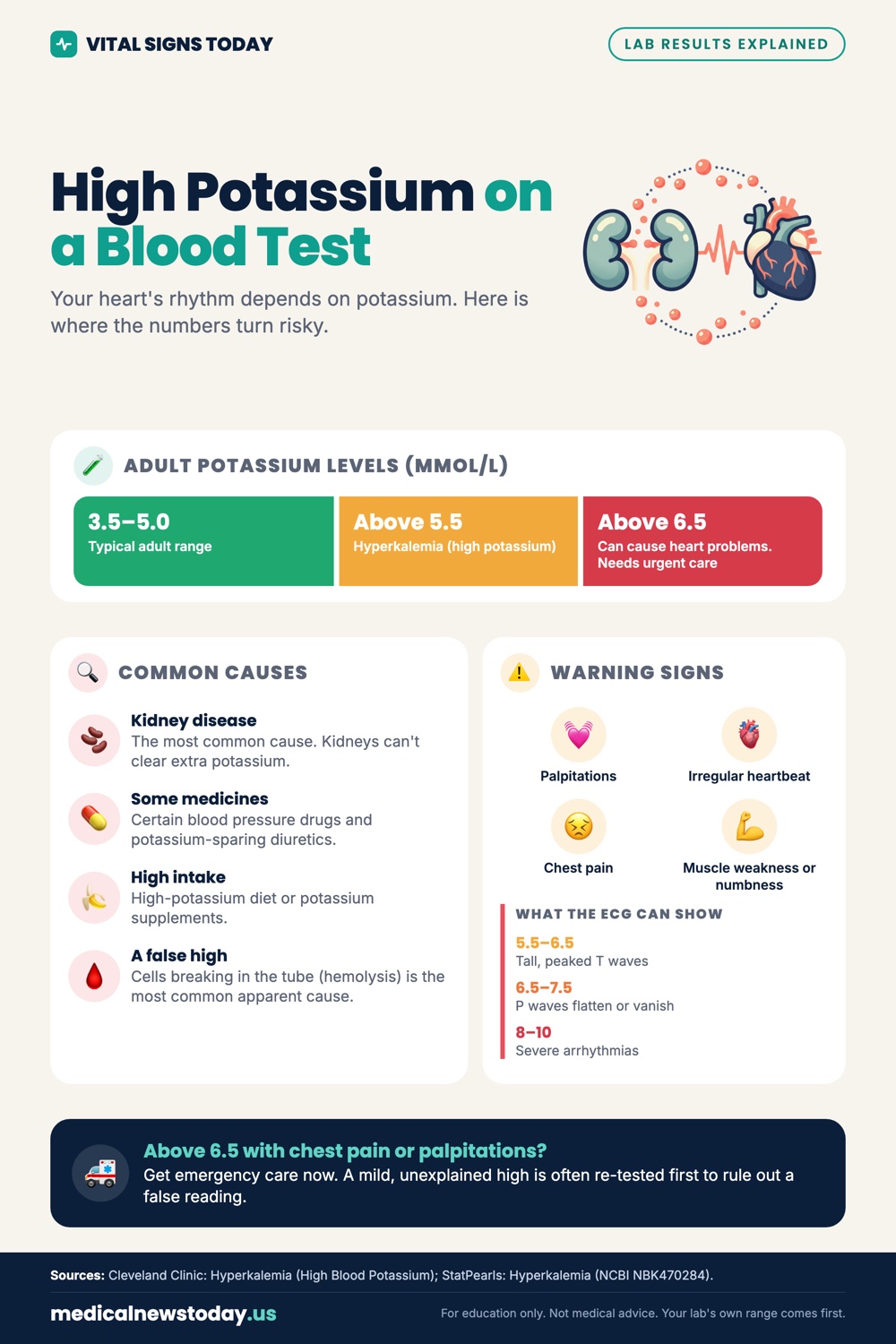
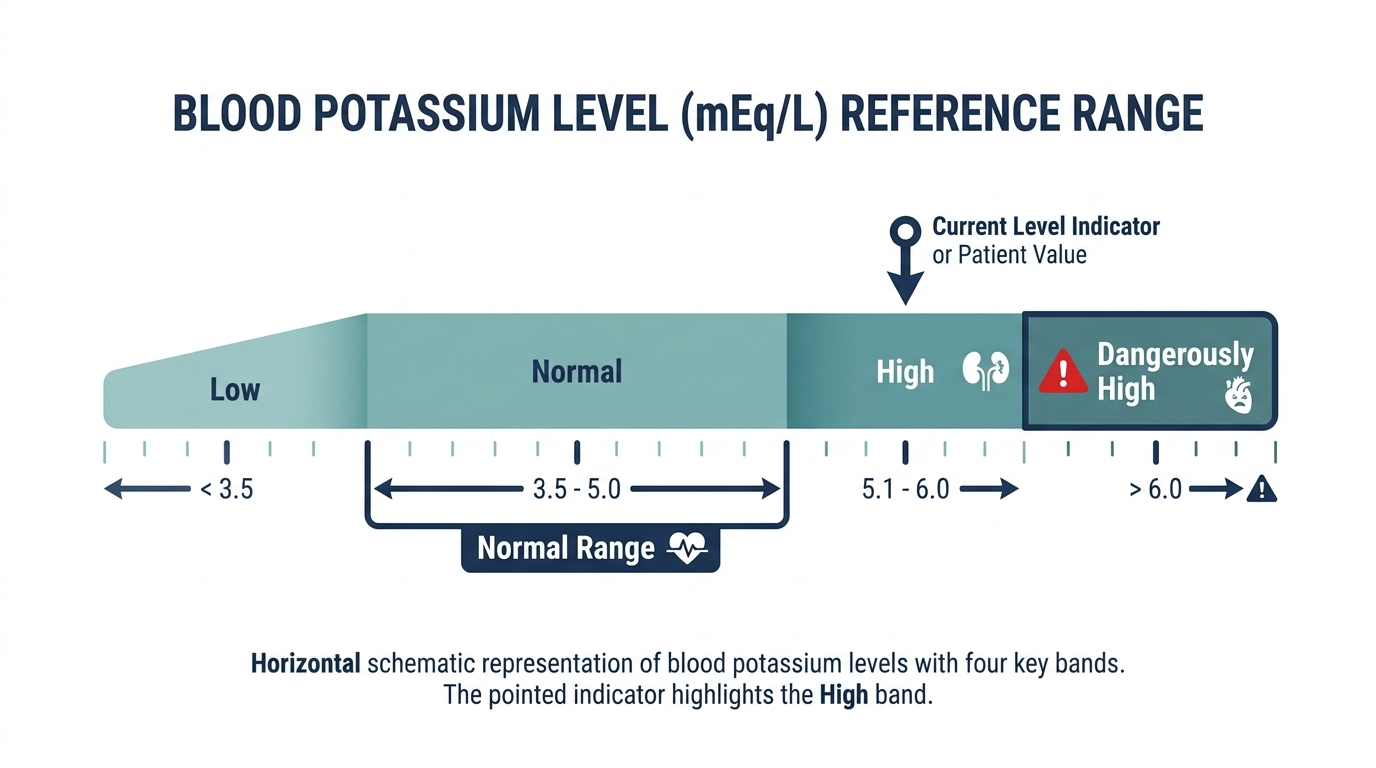
A high potassium on a blood test means the level of potassium in your blood has risen above the normal range, a condition doctors call hyperkalemia. A typical adult potassium level sits between 3.5 and 5.0 millimoles per liter, and hyperkalemia is generally defined as a level above 5.5 mmol/L (Cleveland Clinic). Potassium is an electrolyte, an electrically charged mineral your cells use to fire nerves, contract muscles, and keep your heartbeat steady (MedlinePlus).
The numbers matter, so here is the practical map clinicians use. A reading of 5.5 to 5.9 mmol/L is mild, 6.0 to 6.5 mmol/L is moderate, and anything above 6.5 mmol/L is severe and treated as urgent (StatPearls, NIH). A value just barely over the top of your lab’s range, say 5.2 or 5.3, is far less alarming than a 6.8. Always read your result against the reference range printed on your own report, because labs calibrate slightly differently.

What causes a high potassium?
True hyperkalemia comes down to three mechanisms: your body is not getting rid of potassium, potassium is leaking out of cells into the blood, or you are taking in more than your kidneys can clear. Most cases involve the first one (StatPearls, NIH).
- Kidney disease. This is the single most common cause. Your kidneys are the main exit route for potassium, so when kidney function drops, potassium builds up (Cleveland Clinic).
- Medications. A long list of common drugs raises potassium, including ACE inhibitors and angiotensin receptor blockers for blood pressure, potassium-sparing diuretics like spironolactone and amiloride, and NSAIDs (StatPearls, NIH). This is one of the most overlooked causes in otherwise healthy people.
- Hormone problems. Conditions that lower aldosterone, such as Addison disease or hypoaldosteronism, blunt the kidney’s ability to dump potassium (MedlinePlus).
- Cell breakdown and shifts. Crushed or damaged tissue spills potassium into the blood. Think rhabdomyolysis, burns, large injuries, tumor lysis syndrome, and uncontrolled diabetes with diabetic ketoacidosis, where lack of insulin pushes potassium out of cells (StatPearls, NIH).
- Too much intake. On its own, diet rarely causes hyperkalemia in someone with healthy kidneys. But heavy use of potassium supplements, salt substitutes, or IV potassium, especially layered on top of kidney trouble, can tip the balance (Cleveland Clinic).
Notice the pattern. Real hyperkalemia usually has a setup behind it: weak kidneys, a relevant medication, or a major physical insult to the body. A high reading in a perfectly healthy person with normal kidneys and no medications should make you suspicious of a false result, which we cover below.
What are the symptoms of a high potassium?
Here is the uncomfortable truth: high potassium often causes no symptoms at all, which is exactly what makes it dangerous (StatPearls, NIH). Many people learn they have it only because a routine blood test caught it. The first sign can be a serious heart rhythm problem rather than a gentle warning.
When symptoms do show up, they tend to be vague and easy to dismiss (Cleveland Clinic):
- Muscle weakness, fatigue, or a heavy, tired feeling in the limbs
- Numbness or tingling
- Nausea, vomiting, abdominal pain, or diarrhea
- Heart palpitations or an irregular, fast, or fluttering heartbeat
- Chest pain or shortness of breath
Symptoms generally appear once levels climb above 6.0 mmol/L, but there is no reliable symptom threshold, and you cannot feel your way to safety here (StatPearls, NIH). The number on the page tells you more than how you feel.

When is a high potassium dangerous or a medical emergency?
The danger of high potassium is almost entirely about the heart. Potassium controls the electrical signals that make your heart beat, and when it climbs too high, those signals distort and can stall the heart entirely. A potassium level above 6.5 mmol/L can cause heart problems that need immediate medical attention (Cleveland Clinic).
Doctors actually watch the damage unfold on an ECG, and the changes track with severity. Peaked T waves appear first, often around 5.5 to 6.5 mmol/L, followed by flattened or absent P waves, then a widening QRS complex, and at the extreme a sine wave pattern that precedes cardiac arrest (StatPearls, NIH). That is why severe hyperkalemia is an emergency even when you feel fine.
Call for emergency care or get to an ER right away if you have a high potassium result along with chest pain, a weak or irregular pulse, severe muscle weakness, difficulty breathing, or severe abdominal pain (Cleveland Clinic). One more nuance worth knowing: how fast potassium rises matters as much as the absolute number. A person with long-standing kidney disease may quietly tolerate a level that would put someone with a sudden spike into a dangerous rhythm (StatPearls, NIH).
What should you do about a high potassium?
The first move is almost always to confirm the result. Because false high readings are so common, a single borderline value in a healthy person usually gets rechecked with a fresh, carefully drawn sample before anyone treats anything (StatPearls, NIH). If the repeat is normal, the story often ends there.
If the elevation is real, the response depends on how high it is and why:
- Find and fix the cause. Your clinician will look at your kidney function, your medication list, and your hormones. Often the fix is adjusting or stopping a drug that is driving the level up (StatPearls, NIH).
- Diet, when relevant. If your kidneys are not clearing potassium well, you may be asked to ease off high-potassium foods like bananas, dried fruit, nuts, and salt substitutes, and to be cautious with supplements (MedlinePlus).
- Medication to lower potassium. Options include diuretics that flush potassium out and potassium binders taken by mouth (Cleveland Clinic).
- Emergency treatment for severe cases. In the hospital, dangerously high levels are treated with IV calcium to protect the heart, insulin with glucose and inhaled albuterol to drive potassium back into cells, and dialysis when needed (Cleveland Clinic).
What you should not do is try to self-treat a high potassium by guessing, or ignore a confirmed high result because you feel fine. This is a number to act on with your doctor, not on your own.

When should you see a doctor?
Any high potassium result on a lab report deserves a conversation with the clinician who ordered it, even a mild one. They can decide whether to recheck it, look at your kidneys and medications, and tell you how concerned to be in your specific situation (MedlinePlus).
Move faster, and seek urgent or emergency care, if a high reading comes with chest pain, palpitations or an irregular pulse, marked muscle weakness, numbness, trouble breathing, or severe nausea and abdominal pain (Cleveland Clinic). When potassium and heart symptoms appear together, that combination is the one you never wait on.
The insider point: that high reading might be fake
This is the part that gets missed constantly, and it can save you a scare. A large fraction of “high potassium” results are pseudohyperkalemia, meaning the potassium rose in the test tube after the blood was drawn, not in your bloodstream (StatPearls, NIH). Your real level is normal. The lab just measured an artifact.
How does this happen? The most common culprit is hemolysis, where red blood cells rupture during or after the draw and dump their potassium into the surrounding plasma. It happens more often with a syringe than a vacuum tube, and it also follows a tourniquet left on too long or a fist pumped repeatedly during the stick (StatPearls, NIH). That last one is so well known that MedlinePlus specifically warns that clenching and relaxing your fist right before or during the draw can falsely raise your potassium (MedlinePlus).
There is an even sneakier version. People with very high platelet or white blood cell counts can show falsely elevated potassium because those cells release potassium as the sample clots (StatPearls, NIH). Delayed processing of the sample can do it too.
The practical lesson: if you are healthy, take no relevant medications, have normal kidneys, and feel completely fine, a lone high potassium is more likely a sample problem than a body problem. A good clinician will not start treatment off one suspicious value. They will redraw it cleanly, often noting whether the lab flagged the sample as hemolyzed, before deciding anything. Asking “was that sample hemolyzed?” is one of the smartest questions you can bring to that appointment.

How your body normally keeps potassium in a narrow band
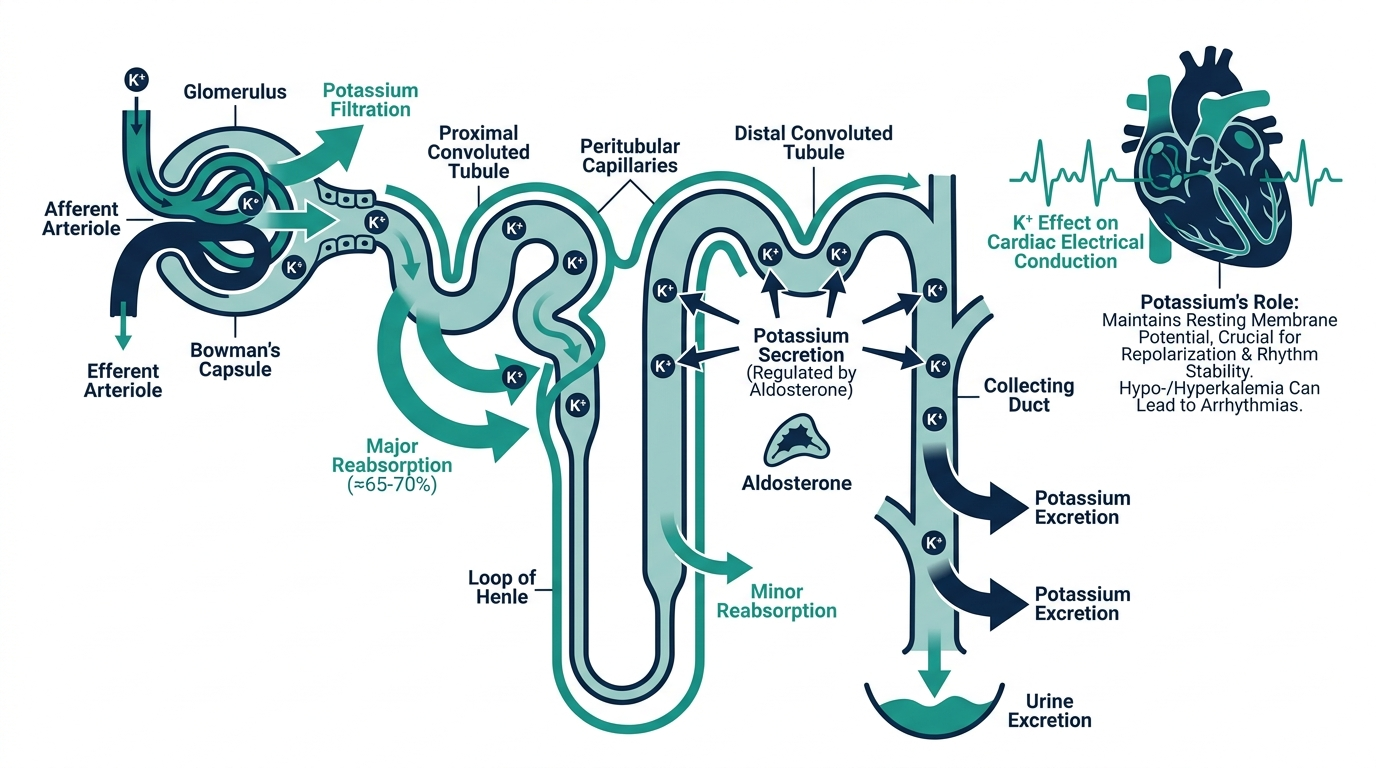
Potassium sits in one of the tightest reference ranges on the whole panel, and understanding why makes a high reading less mysterious. The vast majority of your body’s potassium lives inside cells, not in the bloodstream, and the small amount in your blood is guarded by several overlapping systems working at once.
- The kidneys are the main exit. They excrete most of the potassium you take in each day, fine-tuning output to match intake. This is why kidney disease is the leading cause of a genuinely high potassium.
- Aldosterone is the hormonal dial. This adrenal hormone tells the kidneys to dump potassium. When aldosterone is low, as in Addison disease, or when medications block its effect, potassium backs up.
- Insulin and adrenaline shift potassium into cells. After a meal, insulin helps move potassium out of the blood and into cells for storage. This is exactly why insulin (with glucose) is used in the hospital to treat dangerously high levels, and why uncontrolled diabetes with low insulin can let potassium climb.
- Blood pH pushes potassium in and out. When blood turns acidic (acidosis), potassium tends to shift out of cells into the blood, raising the measured level. Correcting the acid-base problem often moves potassium too.
Because so many systems share the job, a high potassium is really a signal that one of these controls, kidney clearance, hormones, cellular shifts, or acid-base balance, has been disturbed. That framing is what turns a scary number into a solvable question.
Want to check your potassium?
Three ways to get it measured. Pick whichever fits you.
Affiliate links: we may earn a commission at no extra cost to you. A lab test does not replace a visit with your clinician.
Reading potassium alongside the rest of the panel
Potassium is rarely interpreted alone. The surrounding markers on a metabolic panel usually reveal why it is high:
- Creatinine and eGFR. These are the first numbers a clinician checks, because impaired kidney function is the most common real driver of hyperkalemia. A high potassium with a high creatinine and low eGFR tells a coherent story.
- Bicarbonate (CO2). A low bicarbonate signals metabolic acidosis, which can shift potassium out of cells and raise the blood level. High potassium with low bicarbonate points toward an acid-base contribution.
- Glucose. Very high glucose with low insulin, as in diabetic ketoacidosis, can push potassium out of cells, so a high potassium alongside markedly high glucose is a recognizable and urgent pattern.
- Sodium. A low sodium paired with a high potassium can hint at low aldosterone states such as adrenal insufficiency, prompting hormone testing.
Read together, these markers separate a kidney problem from a hormone problem from a cellular-shift problem, even when the potassium value itself looks the same.
How to get a clean draw and avoid a false high
Because pseudohyperkalemia is so common, a few simple steps before and during the blood draw genuinely lower the odds of a falsely high result:
- Do not pump your fist. Repeatedly clenching and relaxing your hand during the draw releases potassium from forearm muscles and can falsely raise the reading. Keep your hand relaxed.
- Ask for a short tourniquet time. A tourniquet left on too long promotes hemolysis and potassium leakage. A brief application is better.
- Prompt processing helps. A sample that sits too long before the lab spins it down can drift, so timely handling matters. This is a lab-side factor, but a delayed courier or a sample drawn far from the lab is a legitimate reason to be skeptical of a lone high value.
- Flag a hemolyzed sample. Labs often note when a sample is hemolyzed. If your result was high and the sample was flagged, that is a strong reason to redraw rather than treat.
If you are healthy, take no relevant medications, and feel well, asking whether the sample was hemolyzed and requesting a clean redraw is often the single most useful next step.
Medications worth reviewing when potassium is high
Drug-related hyperkalemia is one of the most common and most fixable causes in otherwise healthy people, and it is worth reviewing your full list with your clinician. Common contributors include:
- ACE inhibitors and angiotensin receptor blockers (ARBs), widely used for blood pressure and the heart
- Potassium-sparing diuretics such as spironolactone, eplerenone, and amiloride
- NSAIDs like ibuprofen and naproxen, especially with regular use
- Potassium supplements and salt substitutes, which often use potassium chloride in place of sodium
The risk climbs when several of these are combined, or when any of them is layered on top of reduced kidney function. Often the fix for a mild, real elevation is simply adjusting or spacing out one of these agents under medical guidance, not a dramatic intervention. Never stop a prescribed blood pressure or heart medication on your own, though, because the underlying condition it treats also carries risk. This is a conversation to have with the prescriber.
Worked examples and follow-up cadence
Consider two panels that both flag potassium high. In the first, a healthy person with no medications, normal creatinine, and no symptoms has a potassium of 5.4 mmol/L, and the lab noted the sample was hemolyzed. This is the archetype of pseudohyperkalemia, and the right move is a clean redraw, which usually comes back normal.
In the second, someone with known kidney disease who takes an ACE inhibitor and an NSAID has a potassium of 6.0 mmol/L, a high creatinine, and a low bicarbonate. This is genuine hyperkalemia with a clear setup, and it warrants prompt evaluation, a look at the medications, and an ECG given the level. Same test, very different urgency, because the surrounding context points in opposite directions.
For people with ongoing risk factors, chronic kidney disease, heart failure, or long-term use of the medications above, potassium is typically monitored on a schedule set by their clinician, and rechecked after any medication change that affects it. For a healthy person with a single suspicious value that redraws normal, no ongoing monitoring is usually needed beyond routine care.
The dietary potassium most people overlook
When someone is told to lower their potassium, they usually think of bananas first, and then stop there. In practice the bigger surprises are the sources people never suspect. The most important trap is the salt substitute. Products marketed as low sodium or no salt alternatives typically replace sodium chloride with potassium chloride, so a shaker meant to protect your heart can deliver a large potassium load in a single meal. Anyone with reduced kidney function or on a potassium raising medication should read those labels carefully, because a salt substitute can quietly undo a careful diet.
Beyond that, potassium is concentrated in a wide range of everyday foods: potatoes and sweet potatoes, tomatoes and tomato sauce or paste, oranges and orange juice, avocados, dried fruits like raisins and apricots, beans and lentils, spinach, and dairy. Cooking method matters too. Boiling high potassium vegetables and discarding the water, sometimes called leaching, can lower their potassium content meaningfully, which is a practical trick for people who need to cut intake without giving up the food entirely.
Two cautions keep this sensible. First, potassium is essential, and a low potassium diet is only appropriate for people who actually need it, usually those with kidney disease or a proven tendency to run high. Healthy people with normal kidneys should not fear potassium rich foods, which are linked with benefits for blood pressure and heart health. Second, diet is rarely the whole story when potassium is high. Kidney function and medications almost always play the larger role, so cutting bananas while ignoring a drug that traps potassium misses the point. If your level is elevated, use food as one lever, but review the full picture with your clinician rather than trying to fix a high reading with the grocery list alone.
Frequently asked questions
What potassium level is considered high on a blood test?
A normal adult potassium level is about 3.5 to 5.0 mmol/L, and hyperkalemia is generally defined as a level above 5.5 mmol/L (Cleveland Clinic). Levels of 5.5 to 5.9 are mild, 6.0 to 6.5 moderate, and above 6.5 severe (StatPearls, NIH).
What is the most common cause of high potassium?
Kidney disease is the most common cause, because the kidneys are the main route for clearing potassium. Medications such as ACE inhibitors, ARBs, potassium-sparing diuretics, and NSAIDs are another frequent and often overlooked cause (StatPearls, NIH).
Can a high potassium result be a mistake?
Yes, and it is common. Pseudohyperkalemia happens when potassium rises in the tube after the draw, often from hemolyzed red cells, a tourniquet left on too long, fist clenching during the draw, or very high platelet or white cell counts (StatPearls, NIH). A high result in a healthy person is often rechecked before any treatment.
What are the symptoms of high potassium?
High potassium often causes no symptoms. When present, they can include muscle weakness, fatigue, numbness or tingling, nausea, and heart palpitations or an irregular heartbeat (MedlinePlus). Because the first sign can be a serious arrhythmia, a high result is taken seriously even without symptoms.
When is high potassium a medical emergency?
A potassium level above 6.5 mmol/L can cause heart problems that need immediate attention (Cleveland Clinic). Seek emergency care for a high result with chest pain, a weak or irregular pulse, severe muscle weakness, or difficulty breathing.
This article is for general educational purposes and is not medical advice. It cannot diagnose or treat you and does not replace your clinician. Always discuss your lab results and any health decisions with a qualified healthcare professional.
Vital Signs Today may earn a commission if you buy through links on this page. It does not affect our editorial assessments.