Disclosure: Vital Signs Today may earn a commission if you buy through links on this page, at no extra cost to you. This does not influence our evidence-based assessments. We are not a medical provider; talk to a clinician before acting on test results.
You scanned your complete blood count, expecting the usual suspects to be flagged, and instead your eye snagged on three letters sitting below the reference range: RDW, low. Maybe there was a little “L” next to it. Your first instinct was the same one most people have when a lab value falls below normal. Something is wrong. Something is missing. I am running low on something.
Here is the reassuring twist, and it is worth sitting with before you spend a weekend reading worst-case scenarios. A low RDW is one of the very few “abnormal” lab flags that is almost always good news, or at the very least, nothing to chase. It is the rare number where lower really is calmer. Let me walk you through exactly what it means, why your lab flagged it at all, and the one situation where it actually matters.
Part of our Complete Blood Count guide.
What is low RDW blood test result and what does it mean?
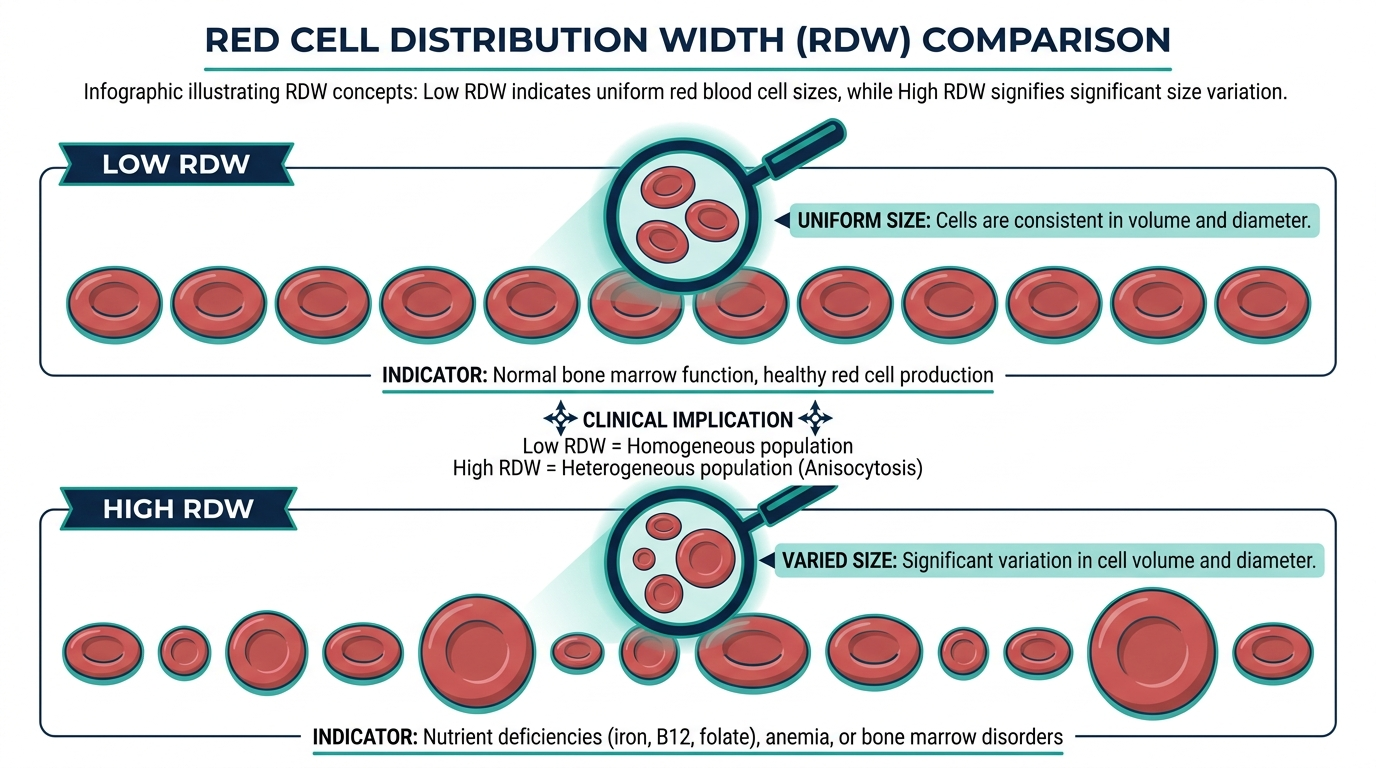
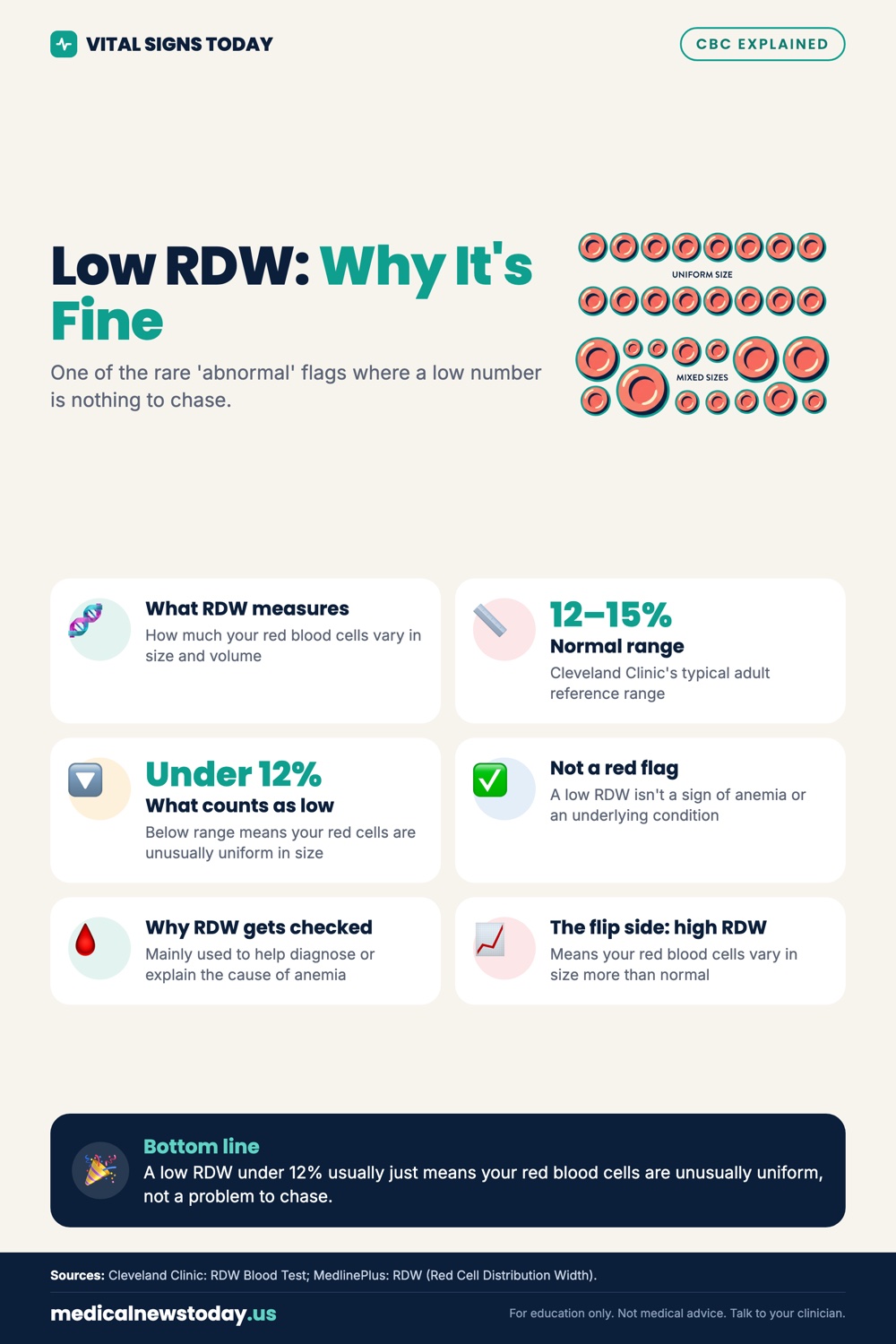
The phrase what is low rdw blood test really comes down to one idea: RDW stands for red cell distribution width, and it measures how much your red blood cells vary in size. A low RDW means your red cells are remarkably uniform, all stamped out at close to the same size, with very little spread between the smallest and the largest (MedlinePlus).
Think of RDW as a consistency score for your red blood cells. A high RDW means your cells are a mixed bag of sizes. A low RDW means they came off the production line looking like identical coins. MedlinePlus is blunt about it: a low RDW “is not a sign of anemia and isn’t usually something to worry about” (MedlinePlus).
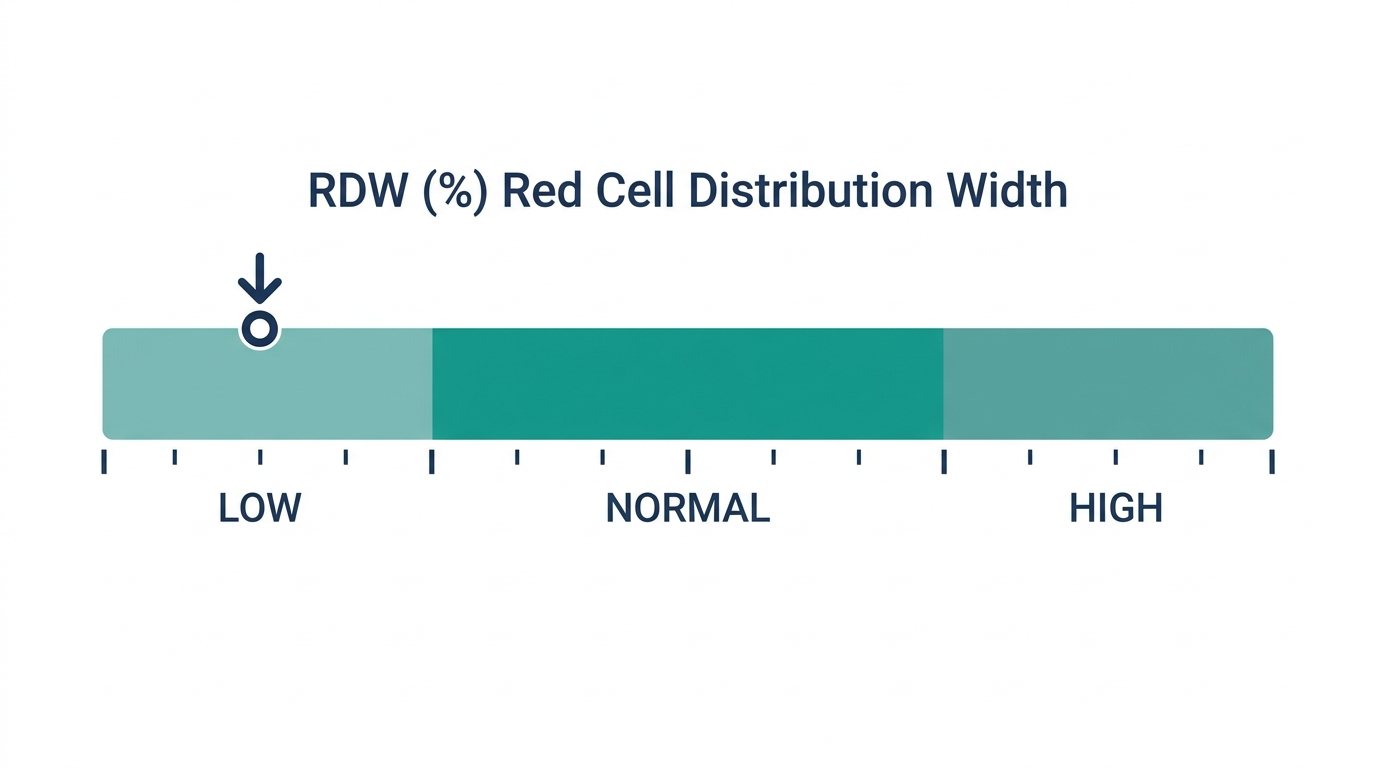
As for the actual cutoff, most labs put the normal RDW range at roughly 12 to 15 percent, so a “low” flag generally means your result came in under about 12 percent (Cleveland Clinic). The exact threshold drifts a little between labs and analyzers, so the number that matters most is the reference range printed on your own report, because that is the range your lab actually calibrated its machine to.
What causes a low RDW?
The honest answer surprises people: most of the time, nothing is causing it in a meaningful sense. A low RDW usually just reflects a healthy, orderly red cell population. Your bone marrow is producing cells of consistent size, and the analyzer is reporting that consistency back to you as a low spread.
Unlike a high RDW, which has a tidy differential of iron, B12, and folate deficiency, a low RDW has no recognized disease that it points to on its own. Both Cleveland Clinic and MedlinePlus state that a low result is not considered a marker of any underlying condition (Cleveland Clinic). Working from most to least common, here is what is actually going on when you see a low number:
- Normal, uniform red cells. This is the overwhelming majority of low RDW results. Your cells are simply consistent in size, which is exactly what healthy marrow produces.
- A number sitting just under the cutoff. Reference ranges are statistical lines, not biological cliffs. A value a fraction below the bottom of the range is extremely common and rarely means anything (MedlinePlus).
- Lab and analyzer variation. Different machines and different reference populations shift the floor slightly, so a result that flags as low on one report might sit comfortably inside normal on another.
Notice what is not on that list: there is no “low RDW disease.” If you were searching for the deficiency or illness behind the flag, the most useful thing I can tell you is that you are unlikely to find one, and that is by design.
What are the symptoms of a low RDW?
There are none. A low RDW produces no symptoms whatsoever, because uniform red blood cells are not a problem your body needs to signal.
This is the part that trips people up. We are trained to associate “below normal” with feeling unwell, but RDW is a descriptive measurement of cell variation, not a substance you can be deficient in. You cannot feel your red cells being consistent in size any more than you can feel your blood being a particular shade of red. If you do feel tired, foggy, breathless, or off, those symptoms are coming from something else on your panel or off it entirely, and the low RDW is just an innocent bystander that happened to get flagged on the same page.
When is a low RDW dangerous or a medical emergency?
Let me be direct, because this is the question that brought most readers here. A low RDW, by itself, is never a medical emergency. There is no red-flag threshold for a low RDW the way there is for, say, a critically low hemoglobin or a sky-high white count. A value of 10 percent is not “more dangerous” than 11.5 percent. Below the floor, the number simply stops carrying alarm.
If anything, the research points the other direction. In a UK Biobank study of 240,477 healthy volunteers, the lowest RDW group, under 12.5 percent, was the reference group with the lowest risk, while higher RDW was strongly associated with mortality, heart disease, and cancer over years of follow-up (PMC, RDW and disease onset in 240,477 volunteers). In a separate analysis of patients with diabetes, it was the highest RDW group, not the lowest, that carried more than double the risk of death (PMC, RDW and mortality in diabetes). In study after study, low and stable RDW is the company you want to keep.
The only thing worth a closer look is not the low RDW itself but the rest of your CBC sitting next to it. The danger, if there is one, lives in those other numbers. So the real question is never “is my low RDW dangerous,” it is “is anything else on this panel off.” Almost always, the answer is no.
What should you do about a low RDW?
In most cases, the correct action is genuinely nothing. You do not need a supplement, a special diet, or a follow-up test ordered because of an isolated low RDW. There is no treatment for it, because there is nothing to treat (MedlinePlus).
That said, here is the sensible way to close the loop so you can actually stop thinking about it:
- Read it in context, not in isolation. RDW is meant to be interpreted alongside MCV (your average red cell size) and hemoglobin (MedlinePlus, MCV). If your MCV and hemoglobin are normal and your RDW is just a touch low, that is a clean, unremarkable picture.
- Glance at MCV specifically. The combination of a low or normal RDW with a low MCV is the one pairing that occasionally points somewhere, which I explain in the expert section below.
- Compare to your old results. If your RDW has always run a little low and you feel fine, that is your normal. Stability over time is reassuring on its own.
- Bring questions to your appointment, not to a search bar at midnight. If anything on your panel is unclear, your clinician can read the whole report in seconds and tell you whether the low RDW is part of a story or just a footnote.

The part most people miss: low RDW with a low MCV
This is the one nuance that separates a careful read from a casual one, and it is exactly where a low RDW can quietly point at something rather than at nothing.
On its own, a low RDW is reassuring. But pair it with a low MCV, meaning small red cells that are also uniform in size, and you have a classic fingerprint of thalassemia trait, an inherited condition where the body makes smaller red cells that happen to be remarkably consistent (MedlinePlus, MCV). This is the mirror image of iron deficiency, which tends to produce small cells that vary widely in size and therefore a high RDW. One cheap pair of numbers helps tell two look-alike conditions apart: small and uniform leans toward thalassemia trait, small and scattered leans toward iron deficiency.
Here is the trap I see people fall into. They see the low RDW, breathe a sigh of relief, and never look at the MCV sitting one line away. If both are low and you have a family history of mild anemia that never responded to iron, that is worth raising with your clinician, not because the low RDW is dangerous, but because it is a clue in a larger pattern. Thalassemia trait is usually mild and often needs no treatment at all, but knowing you carry it matters for family planning and saves you from years of pointless iron supplements that were never going to work. The low RDW was not the problem. It was a tiny piece of evidence that the right person can read in context.
When should you see a doctor?
A low RDW in isolation, with a normal hemoglobin and MCV, is not a reason to book an appointment. It will keep. But you should bring your results to a clinician if any of these are also true:
- Your hemoglobin is low, or your MCV is low, alongside the low RDW.
- You have symptoms like persistent fatigue, breathlessness, dizziness, or pale skin, since these come from other markers, not the RDW.
- You have a family history of thalassemia, mild lifelong anemia, or unexplained small red cells.
- You were iron-supplementing for “anemia” that never improved, which can hint at a misdiagnosed thalassemia trait.
- Several numbers on your CBC are flagged at once, which is always worth a professional read.
The guiding principle: see a doctor about the company your low RDW keeps, not about the low RDW itself.

How RDW is actually calculated, and RDW-CV versus RDW-SD
Understanding where the number comes from removes a lot of the mystery. Your analyzer measures the size (volume) of thousands of individual red blood cells and plots them on a curve. RDW describes how wide that curve is. A narrow curve, meaning cells clustered tightly around one size, gives a low RDW. A wide curve, meaning a mix of sizes, gives a high RDW.
There are two ways labs report it, and knowing which one you have prevents confusion:
- RDW-CV (coefficient of variation) is the version reported as a percentage, with a normal range of roughly 12 to 15 percent. This is the number most people see and the one that gets flagged low under about 12 percent. It is mathematically tied to the average cell size, which is why RDW is always read next to MCV.
- RDW-SD (standard deviation) is reported in femtoliters (fL) and measures the actual width of the size distribution directly, independent of the average size. Some labs print both.
If your report shows a low RDW-CV, it simply means your red cells are unusually consistent in size. That is the same reassuring picture described throughout this article. The distinction matters mainly when a clinician is untangling a complex anemia, not for an isolated low value in an otherwise normal panel.
The RDW and MCV grid: how the two numbers read together
RDW earns its keep when paired with MCV, your average red cell size. Together they sort anemias and red cell patterns into recognizable boxes, an approach sometimes credited to a classification by Bessman. Here is how the combinations line up.
| MCV (average size) | Low or normal RDW (uniform) | High RDW (varied) |
|---|---|---|
| Low (small cells) | Thalassemia trait, chronic disease | Iron deficiency |
| Normal | Healthy, normal blood | Early nutritional deficiency, mixed picture |
| High (large cells) | Aplastic anemia, some liver disease | B12 or folate deficiency |
Want to check your RDW?
Three ways to get it measured. Pick whichever fits you.
Affiliate links: we may earn a commission at no extra cost to you. A lab test does not replace a visit with your clinician.
The box that matters most for a low RDW is the top-left one. Small cells that are also uniform (low MCV, low or normal RDW) is the classic thalassemia trait fingerprint, while small cells that are scattered in size (low MCV, high RDW) points toward iron deficiency (MedlinePlus, MCV). This single grid is why no experienced reader looks at RDW without glancing at MCV in the same breath.
Telling thalassemia trait from iron deficiency: the Mentzer index
Because thalassemia trait and iron deficiency both produce small red cells but call for completely different management, clinicians use a quick screening calculation to lean one way before ordering more tests. The best known is the Mentzer index: your MCV divided by your red blood cell count.
- A Mentzer index above 13 leans toward iron deficiency, where the body makes fewer, smaller, more variable cells.
- A Mentzer index below 13 leans toward thalassemia trait, where the body makes many small, uniform cells, which is exactly why RDW tends to stay low in that setting.
The index is a screening rule of thumb, not a diagnosis. Confirming thalassemia trait requires hemoglobin electrophoresis, and confirming iron deficiency requires iron studies such as ferritin. But it explains why a low RDW alongside a low MCV and a normal-to-high red cell count nudges a clinician toward an inherited trait rather than a treatable deficiency, and why iron pills prescribed for a misread thalassemia trait never work.
What can skew an RDW result
RDW is measured as part of a complete blood count, a routine draw with no fasting required. It is a fairly stable number, but a few things can influence it, and knowing them keeps an isolated low value in perspective.
- Recent blood transfusion. Transfused cells add a second population of a different size, which typically raises RDW temporarily. A genuinely low RDW is more meaningful in someone who has not been recently transfused.
- Analyzer and lab differences. Different machines and reference populations set the low cutoff slightly differently, so a value flagged low on one report can sit inside range on another.
- Sample age and handling. Very delayed processing can affect red cell measurements, another reason a borderline flag is best read against the rest of a fresh panel.
- Where the value sits. A result just a hair under the cutoff is statistical noise far more often than a signal, since reference ranges are drawn from population data, not biological cliffs.
Why a low, stable RDW is quietly good company
One of the more interesting shifts in recent laboratory medicine is the recognition that RDW behaves as a general health and prognosis marker, not just an anemia clue. Across large population studies, a higher RDW has tracked with worse outcomes, while a lower, stable RDW has consistently landed in the lowest-risk group.
In a UK Biobank analysis of 240,477 healthy volunteers, the group with RDW under 12.5 percent served as the low-risk reference, and rising RDW was associated with higher mortality, cardiovascular disease, and cancer over years of follow-up (PMC, RDW and disease onset in 240,477 volunteers). In a separate cohort of people with diabetes, it was the highest RDW group that carried more than double the mortality risk, not the lowest (PMC, RDW and mortality in diabetes).
The practical meaning is simple and worth internalizing. RDW is one of the few markers where the direction of concern points up, not down. A low, stable RDW next to a normal MCV and hemoglobin is not a deficiency to fix. It is a sign your red cells are being produced in an orderly, consistent way, which is exactly what a healthy marrow does.
Frequently asked questions
What does low RDW mean in a blood test?
A low RDW means your red blood cells are similar in size, with very little variation between them. It is not a sign of anemia and is usually nothing to worry about (MedlinePlus). It is one of the few below-range lab flags that is generally reassuring rather than concerning.
What is considered a low RDW level?
Most labs set the normal RDW range at about 12 to 15 percent, so a result under roughly 12 percent is typically flagged as low (Cleveland Clinic). The exact cutoff varies by lab and analyzer, so compare your result to the reference range printed on your own report.
Is a low RDW dangerous?
No. A low RDW is not a sign of disease on its own and is never a medical emergency (Cleveland Clinic). In large studies, the lowest RDW group actually carried the lowest risk of death and cardiovascular events, while higher RDW was the worrying direction (PMC, RDW and disease onset).
What does a low RDW with a low MCV mean?
That combination, small red cells that are also uniform in size, is a classic clue for thalassemia trait, an inherited condition that produces small consistent cells (MedlinePlus, MCV). It is the mirror image of iron deficiency, which usually scatters cell sizes and raises RDW. If both are low and you have a family history of mild anemia, mention it to your clinician.
Do I need treatment for a low RDW?
Generally no. There is no treatment for a low RDW because there is nothing to treat. If your hemoglobin and MCV are normal, an isolated low RDW needs no supplements, diet changes, or follow-up testing (MedlinePlus).
This article is for general educational purposes and is not medical advice. It cannot diagnose or treat you and does not replace your clinician. Always discuss your lab results and any health decisions with a qualified healthcare professional.
Vital Signs Today may earn a commission if you buy through links on this page. It does not affect our editorial assessments.