Disclosure: Vital Signs Today may earn a commission if you buy through links on this page, at no extra cost to you. This does not influence our evidence-based assessments. We are not a medical provider; talk to a clinician before acting on test results.
You scanned your complete blood count, everything looked routine, and then you spotted it tucked near the platelet line: MPV, with a number that came in under the reference range. Maybe the lab flagged it, maybe it did not, and now you are wondering whether a small number next to three letters you have never heard of is a problem. Here is the honest answer up front. A low MPV is rarely the headline of your blood work. It is a footnote that occasionally points to something worth chasing, and the trick is knowing which.
Most write-ups bury MPV or treat it like trivia. That is a mistake, because read in the right context it tells you something real about how your bone marrow is making platelets.
Part of our Complete Blood Count guide.

What is low MPV in a blood test?
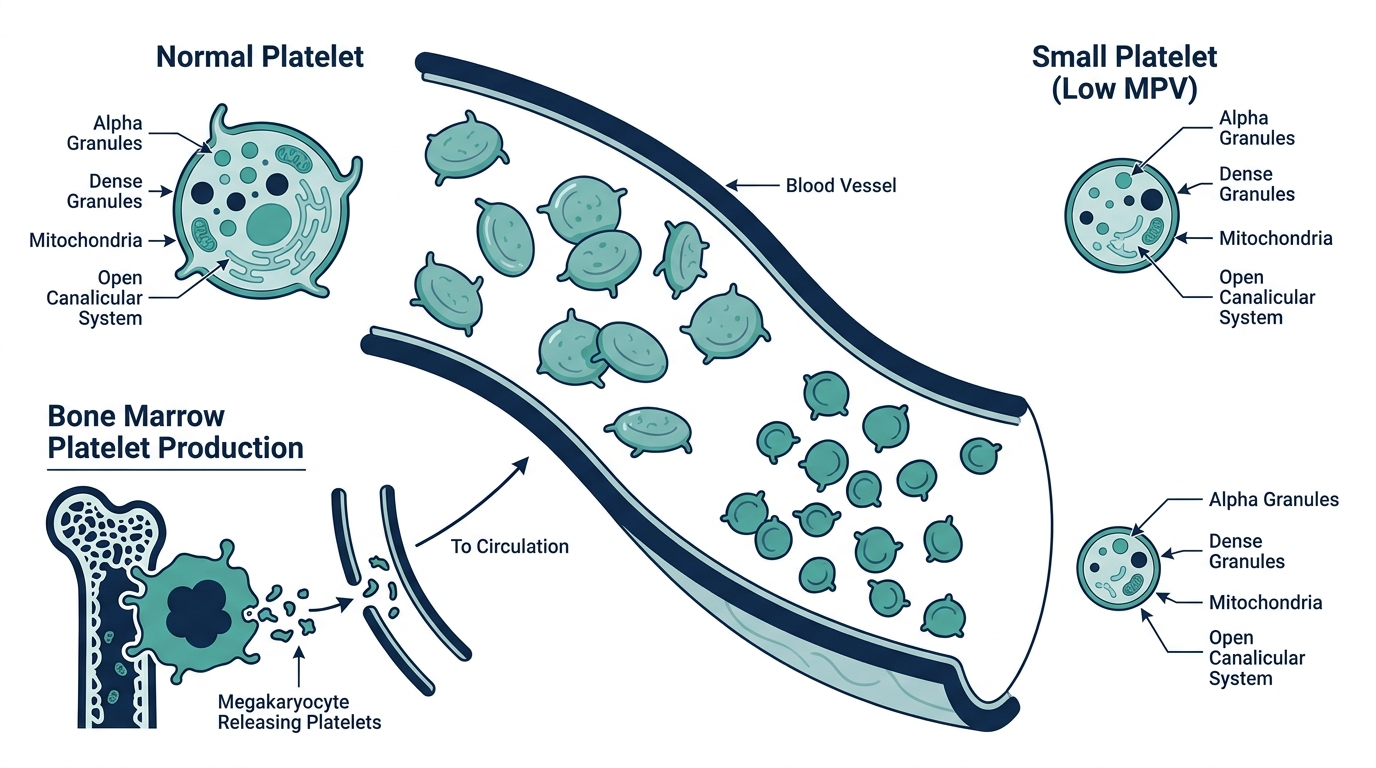
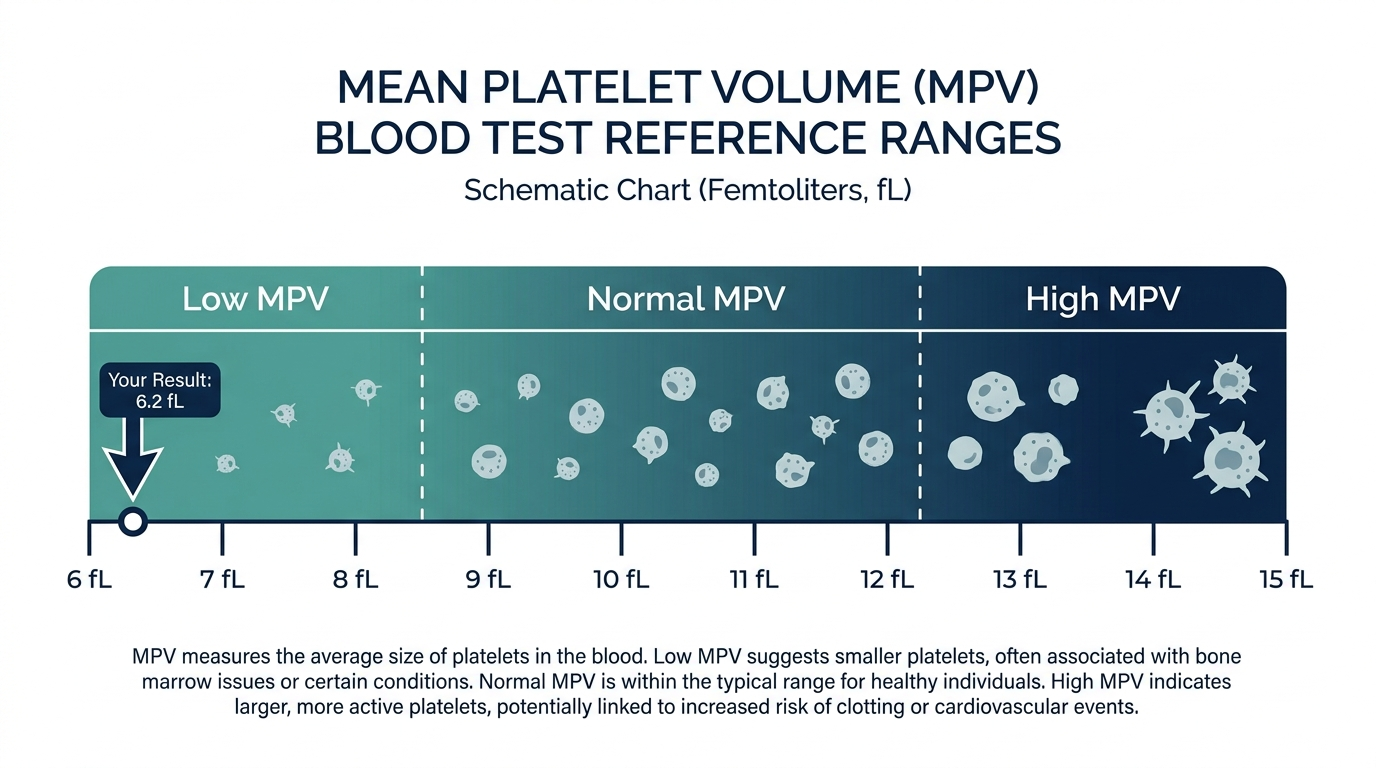
MPV stands for mean platelet volume, and it measures the average size of the platelets in your blood. It is calculated automatically by the analyzer as part of a standard complete blood count, the same panel that reports your red cells and white cells (MedlinePlus). A normal MPV runs roughly 7 to 9 femtoliters for non-pregnant adults, though some labs and instruments use a wider band of about 8 to 12 fL (Cleveland Clinic). When your result falls below your lab’s range, you have a low MPV, which simply means your platelets are smaller than average.
That single fact, average platelet size, is the key to everything below. Young, freshly released platelets tend to be large. Older platelets that have been circulating for days are smaller. So the size of your platelets is a quiet readout of how fast your bone marrow is pushing out new ones.
What does a low MPV mean on a blood test?
A low MPV means your platelets are running small, and the most common interpretation is that your bone marrow is not producing many fresh, large platelets (Cleveland Clinic). Think of it like a bakery. When the ovens are running hot, you see big, fresh loaves coming out. When production slows, what is left on the shelf is mostly the small, older stock. A low MPV is the lab telling you the shelf is stocked with older, smaller platelets.
The threshold that counts as low is whatever sits below the reference range printed on your own report, usually under about 7 fL on the narrower scale (Cleveland Clinic). There is no single universal cutoff, because the number shifts with the analyzer and even with how long the sample sat before testing. The far more important question is not the MPV by itself but what your platelet count is doing right next to it. A low MPV with a normal platelet count usually means very little. A low MPV alongside a low platelet count is the combination that actually earns a second look.
What causes a low MPV?
A low MPV almost always traces back to a bone marrow that is underproducing platelets, rather than a body that is destroying them. The clinical logic is clean: when platelets are being destroyed in the bloodstream, a healthy marrow compensates by pumping out large young platelets, which pushes MPV up. When the marrow itself is the problem, it cannot make those large replacements, so MPV stays low (Cleveland Clinic Journal of Medicine). Here are the real causes, most common first:
- Bone marrow suppression from medication. Chemotherapy and other drugs that blunt the marrow’s ability to make new platelets are among the most frequent reasons for a low MPV (Cleveland Clinic).
- Aplastic anemia and marrow hypoplasia. When the bone marrow is failing or underpopulated, megakaryocytes (the cells that make platelets) cannot keep up, and both platelet count and MPV tend to fall (Cleveland Clinic).
- Autoimmune disease such as lupus. Systemic conditions like lupus can suppress platelet production and show up as a low MPV (Cleveland Clinic).
- Inherited platelet disorders. Wiskott-Aldrich syndrome is the classic genetic cause of small platelets, producing a characteristically low MPV alongside a low platelet count, a combination called microthrombocytopenia that is typically present from birth (MedlinePlus Genetics).
- Thrombocytosis. Counterintuitively, some conditions with very high platelet counts run with a low MPV, because the marrow is churning out large volumes of smaller platelets (Cleveland Clinic).
The pattern worth memorizing: low MPV points toward a production problem, high MPV points toward a destruction problem. That single distinction is what makes MPV genuinely useful when a clinician is trying to figure out why a platelet count is off (Cleveland Clinic Journal of Medicine).
What are the symptoms of a low MPV?
A low MPV by itself produces no symptoms at all. You cannot feel platelet size, and small platelets are not inherently harmful. This is the part people miss when they panic over a flagged number. The MPV is not a disease, it is a clue (Cleveland Clinic).
What you can feel are the symptoms of a genuinely low platelet count, which is the situation a low MPV sometimes accompanies. A low platelet count, called thrombocytopenia, can cause prolonged bleeding from minor cuts, frequent nosebleeds, unexplained bruising, pinpoint red spots on the skin called petechiae, larger purple or brown patches called purpura, heavy or long menstrual periods, and blood in the urine or stool (MedlinePlus; Cleveland Clinic). If your MPV is low but your platelet count is normal and you have none of these signs, there is usually nothing to feel and nothing to chase. The symptoms belong to the platelet count, not to the platelet size.

When is a low MPV dangerous or a medical emergency?
A low MPV on its own is never a medical emergency. The danger, when there is any, comes from the platelet count it may be sitting beside. A normal platelet count runs about 150,000 to 450,000 per microliter (Cleveland Clinic). Bleeding risk climbs as the count falls, with serious spontaneous bleeding becoming a real concern at the lower end of severe thrombocytopenia, and the lower it goes, the higher the risk (Cleveland Clinic).
The red flags are about bleeding, not about MPV. Get emergency care or call 911 if you have severe or uncontrolled bleeding, bleeding that will not stop, blood in your vomit or stool, a sudden severe headache, or any new neurological symptoms, because the most serious complication of a very low platelet count is bleeding into the brain or gastrointestinal tract (MedlinePlus). A small MPV number with a healthy platelet count and no bleeding is not an emergency. A low MPV with a crashing platelet count and active bleeding is.
What should you do about a low MPV?
Start by reading it in context, because a lone low MPV with everything else normal is the most common scenario and the least concerning. Pull up your full CBC and look at the platelet count sitting right next to the MPV. If the platelet count is normal, a low MPV is usually a benign quirk that needs no action (Cleveland Clinic).
If the platelet count is also low, that is the signal to dig deeper. The single most useful next step a clinician can order is a peripheral blood smear, where a technician looks at your actual platelets under a microscope. Because MPV is prone to laboratory variation, any abnormal value should be confirmed by a smear before anyone reads too much into it (Cleveland Clinic Journal of Medicine). From there, the workup follows the platelet count: a review of your medications, screening for autoimmune disease, and in persistent or severe cases, sometimes a bone marrow evaluation.
There is no lifestyle fix and no supplement that raises MPV, because MPV is not a target you treat. You treat the underlying cause when there is one. If your low MPV is an isolated finding, the right move is usually to note it, recheck it on your next routine blood work, and not lose sleep over it.
When should you see a doctor?
See your clinician, without rushing, if your low MPV comes with a low platelet count, if it is a new change from previous blood work, or if you have started a new medication that could affect your marrow. Any of these makes the number worth a conversation rather than a shrug (Cleveland Clinic).
Seek care promptly if you notice unexplained bruising, petechiae, frequent nosebleeds, bleeding gums, or heavier than usual periods, since those point to the platelet count rather than the size (MedlinePlus). And go to the emergency room for severe or uncontrolled bleeding. If your low MPV is sitting alone on an otherwise clean report, simply mention it at your next visit and ask whether it should be rechecked.

The part most people never hear: low MPV is not always reassuring
Here is the nuance that gets lost in the patient-friendly explainers, which almost uniformly file low MPV under harmless. That is mostly true, but not always. A growing body of research has found that a low MPV can flag vascular trouble in specific populations. In one study of more than 2,000 patients with peripheral arterial disease, a lower MPV was an independent predictor of critical limb ischemia, the most severe form of the disease, with an MPV at or below 10.2 fL marking higher risk (PMC, low MPV and critical limb ischemia). The proposed mechanism is that small platelets may behave like tiny pro-clotting particles in already diseased arteries.
The second thing people miss is how easily MPV can be wrong. It is one of the most lab-dependent numbers on the entire CBC, drifting with the anticoagulant in the tube, the analyzer model, and how long the blood sat before it was run. That is exactly why hematologists insist that any abnormal MPV be confirmed with a peripheral blood smear rather than acted on from the printout alone (Cleveland Clinic Journal of Medicine). The common misread is treating a low MPV as a stand-alone result. It was never meant to be read that way. Its whole value lives in the company it keeps, especially the platelet count beside it.
Why platelet size reveals production speed
The reason a low MPV points toward the bone marrow, rather than the bloodstream, comes down to how platelets are made and how they age. In your marrow, huge cells called megakaryocytes shed thousands of platelet fragments into circulation. Freshly released platelets are relatively large and granule-rich. Over their roughly 7 to 10 day lifespan they gradually shrink. So at any given moment, MPV is essentially a measure of how young your platelet population is on average.
Now the logic falls into place. When the body is destroying platelets faster than normal, a healthy marrow responds by flooding the bloodstream with large, young replacements, and MPV climbs. When the marrow itself is underperforming, it cannot generate that wave of big new platelets, so the circulating population skews old and small, and MPV drops. That is why a low MPV so often signals a production issue rather than a destruction issue. It is the marrow quietly telling you it is not in overdrive.
The production-versus-destruction rule, and its exceptions
The single most useful concept for reading any MPV, high or low, is the production-versus-destruction rule:
- Low MPV usually means underproduction. The marrow is not releasing many large young platelets, as in marrow suppression or failure.
- High MPV usually means active turnover. The marrow is racing to replace platelets being destroyed or consumed.
This rule is genuinely useful, but honest interpretation means knowing where it bends. There are real exceptions that keep a low MPV from being a perfect map of the marrow:
- Thrombocytosis with small platelets. Some conditions produce very high platelet counts made of small platelets, which drags MPV down even though the marrow is busy.
- Inherited small-platelet disorders. In conditions like Wiskott-Aldrich syndrome, platelets are congenitally small, so a low MPV reflects genetics rather than a slow marrow (MedlinePlus Genetics).
- Lab artifact. The anticoagulant in the collection tube and the delay before testing can shift MPV, sometimes enough to cross the reference line.
The rule is a starting point, not a verdict. It tells your clinician which direction to look first, and the rest of the picture confirms or overturns it.

The four combinations of MPV and platelet count
Because MPV only means something next to the platelet count, it helps to see all four combinations laid out. Low MPV lives in the bottom row here.
| Low platelet count | Normal or high platelet count | |
|---|---|---|
| Low MPV | The combination that earns a workup. Suggests the marrow is failing to make enough platelets, as in suppression, aplastic anemia, or an inherited micro-platelet disorder. | Often benign, or a reactive thrombocytosis producing many small platelets. A low MPV with a normal count and no symptoms is usually a quiet non-event. |
| High MPV | Destruction pattern, such as immune thrombocytopenia, where a healthy marrow makes large young replacements. | Marrow overproduction, or simply an incidental finding. |
Want to check your MPV?
Three ways to get it measured. Pick whichever fits you.
Affiliate links: we may earn a commission at no extra cost to you. A lab test does not replace a visit with your clinician.
Reading your own report through this grid answers the only question that matters: is the low MPV sitting next to a normal platelet count, in which case it is almost always nothing, or next to a low count, in which case it is the pairing worth a closer look.
Distinguishing an inherited cause from an acquired one
One useful fork for a persistent low MPV, especially with a low platelet count, is whether the finding is lifelong or new. This is a question your clinician will often ask directly, and your old lab records can answer it.
- Lifelong small platelets that show up on blood work going back years, sometimes with a family history of easy bruising or bleeding, point toward an inherited condition. Wiskott-Aldrich syndrome is the classic example, producing small platelets and a low count together, a pattern called microthrombocytopenia that is present from birth (MedlinePlus Genetics).
- A new drop in MPV and platelet count that was normal on earlier tests points toward something acquired: a recently started medication, marrow suppression from chemotherapy, a new autoimmune process, or marrow failure. These are the situations that call for a peripheral blood smear and a broader workup.
This is why bringing your previous blood counts to the appointment is so valuable. A single low MPV is a snapshot. The trend across years is what separates a stable, harmless quirk from a genuine change worth investigating.
A worked example of reading a low MPV
Imagine three people who each get back an MPV of 6.5 fL, just under the reference range.
- A healthy 30-year-old, platelet count 250,000, no symptoms. Low MPV, normal count, feels fine. This is the overwhelmingly common scenario and almost always a benign, isolated finding. The reasonable plan is to note it and recheck at the next routine blood work.
- A 55-year-old on chemotherapy, platelet count 90,000. Here the same MPV fits marrow suppression from treatment. It is expected given the context, monitored closely, and managed as part of the cancer care rather than treated on its own.
- A young adult with lifelong easy bruising, low platelet count, small platelets on every test since childhood. This pattern raises the possibility of an inherited micro-platelet disorder and warrants specialist evaluation rather than reassurance.
The femtoliter value never changed. What changed was the platelet count beside it, the symptoms, and the history behind it. That is the entire lesson of MPV: it is a number that only becomes meaningful when you place it next to a person.
Frequently asked questions
What does a low MPV blood test mean?
A low MPV means your platelets are smaller than average, which usually suggests your bone marrow is not producing many fresh, large platelets (Cleveland Clinic). On its own it is rarely concerning. It matters most when read alongside your platelet count.
What is a normal MPV level?
A normal MPV is generally about 7 to 9 femtoliters for non-pregnant adults, though some labs use a range of roughly 8 to 12 fL depending on the analyzer (Cleveland Clinic). Always compare your result to the reference range printed on your own report.
Should I worry about a low MPV if my platelet count is normal?
Usually no. A low MPV with a normal platelet count and no bleeding symptoms is most often a benign finding that needs no treatment (Cleveland Clinic). Mention it at your next visit and ask whether it should be rechecked.
Can a low MPV be a lab error?
Yes. MPV is one of the most laboratory-dependent values on a CBC, shifting with the collection tube, the analyzer, and how long the sample sat. Hematologists recommend confirming any abnormal MPV with a peripheral blood smear before acting on it (Cleveland Clinic Journal of Medicine).
What causes a low MPV with a low platelet count?
That combination points toward reduced platelet production in the bone marrow, seen with chemotherapy and other marrow-suppressing drugs, aplastic anemia, autoimmune disease such as lupus, and inherited disorders like Wiskott-Aldrich syndrome (Cleveland Clinic). It warrants a closer workup with your clinician.
This article is for general educational purposes and is not medical advice. It cannot diagnose or treat you and does not replace your clinician. Always discuss your lab results and any health decisions with a qualified healthcare professional.
Vital Signs Today may earn a commission if you buy through links on this page. It does not affect our editorial assessments.