
You scanned your complete blood count, your platelet count looked fine, and then your eye snagged on a flagged line near the bottom: MPV, with a little H next to it. High. No explanation, no asterisk telling you what to do, just three letters and a number slightly above the printed range. If your stomach dropped a little, that is normal. Here is the reassuring part and the useful part in one sentence: a high MPV is almost never a diagnosis on its own, but it is a real clue, and knowing what it points to tells you whether to shrug or to look closer.
Most explainers stop at “your platelets are bigger than average” and leave you exactly where you started. Let us go further than that, because the why behind a big platelet is where the actual information lives.
Part of our Complete Blood Count guide.
What is high MPV blood test result telling you?
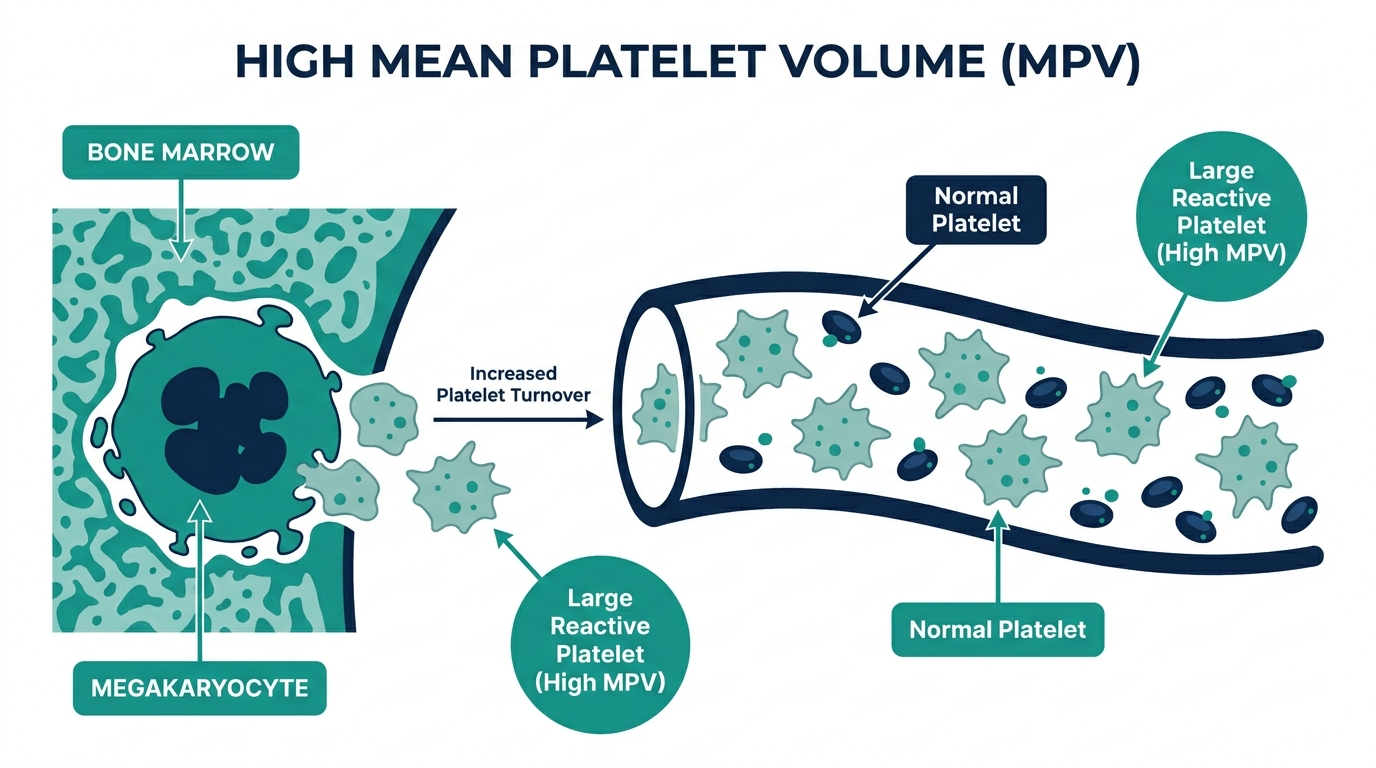
MPV stands for mean platelet volume, the average size of the platelets in your blood, reported in femtoliters (fL) as part of a standard complete blood count (Cleveland Clinic). A high MPV means your platelets are running larger than usual. That matters because of one simple biological fact: newly made platelets are bigger, and they shrink as they age. So when the average platelet size climbs, it usually means your bone marrow is pumping out fresh, young, oversized platelets faster than normal (Cleveland Clinic).
Think of MPV as the average age of your platelet workforce. A low MPV is a settled, veteran crew of small older cells. A high MPV is a fleet of rookies just off the assembly line, which tells you the marrow is in overdrive, often because platelets are being used up or destroyed somewhere and the body is replacing them in a hurry.
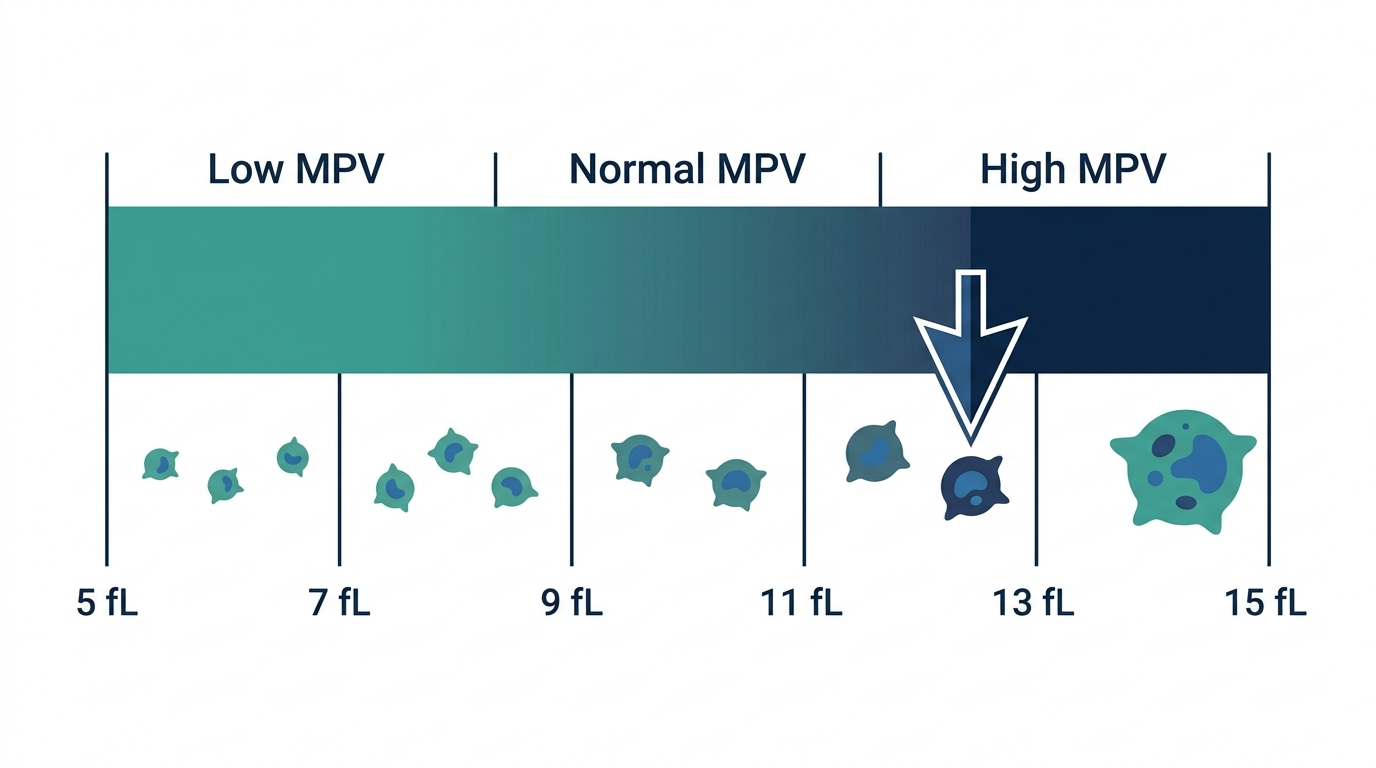
What counts as high? Cleveland Clinic gives a typical adult MPV of 7 to 9 fL, while many labs use a broader range of roughly 8 to 12 fL depending on the analyzer (Cleveland Clinic). The Cleveland Clinic Journal of Medicine notes labs commonly run about 8 to 12 fL (Cleveland Clinic Journal of Medicine). Because the cutoff drifts by instrument, the only number that matters for you is the reference range printed on your own report. A result a hair above that line is a very different thing from one well into the teens.

What causes a high MPV?
A high MPV is a symptom of something else, not a condition itself, so the job is to figure out what is driving the marrow to make big young platelets. The differential, roughly from most to least common, looks like this (Cleveland Clinic):
- Platelet destruction or consumption. The classic case is immune thrombocytopenia (ITP), where the immune system destroys platelets, so the marrow releases large young replacements and MPV rises while the platelet count falls (Cleveland Clinic Journal of Medicine).
- Cardiovascular disease. Larger platelets are more reactive and more prone to clotting, and a higher MPV shows up repeatedly in heart attack and acute coronary syndrome (PMC review on MPV).
- Type 2 diabetes. Poor blood sugar control nudges platelets larger, and MPV tracks with fasting glucose and HbA1c (PMC review on MPV).
- Inflammatory and autoimmune disease. Active inflammatory bowel disease, including Crohn’s, and other inflammatory states are associated with elevated MPV (Cleveland Clinic).
- Thyroid and other endocrine conditions. Hyperthyroidism is on the list (Cleveland Clinic).
- Pregnancy complications. Preeclampsia can push MPV up (Cleveland Clinic).
- Bone marrow overproduction. Myeloproliferative disorders, where the marrow overproduces blood cells, can raise MPV (Cleveland Clinic).
- Inherited giant platelet disorders. Rare conditions such as Bernard-Soulier syndrome and other macrothrombocytopenias produce genuinely huge platelets from birth (Cleveland Clinic Journal of Medicine).
- Vitamin deficiencies. B12, folate, or vitamin D deficiency can also factor in (Cleveland Clinic).
The single most important read is what the MPV is doing relative to your platelet count, because that pairing separates the worrying causes from the harmless ones. High MPV with a low platelet count suggests platelets are being destroyed or used up while a busy marrow scrambles to replace them, the ITP pattern. High MPV with a high platelet count points more toward the marrow overproducing on its own. High MPV with a perfectly normal platelet count is often the least alarming scenario of all, and frequently it is just a quiet, isolated finding.
What are the symptoms of a high MPV?
Here is the part that surprises people: a high MPV by itself produces no symptoms at all. You cannot feel large platelets. MPV is a calculated lab number, not a disease, so there is nothing to notice in the mirror or in how you feel. In the overwhelming majority of cases, a mildly high MPV is found by accident on a routine CBC ordered for something unrelated.
Any symptoms you do have come from the underlying cause, not the MPV. If platelets are being destroyed and your count has dropped, you might see the warning signs of low platelets: easy bruising, tiny red or purple dots on the skin, bleeding gums, frequent nosebleeds, or cuts that ooze longer than they should (MedlinePlus). If an inflammatory or metabolic condition is driving it, you will have that condition’s symptoms instead. The MPV is the smoke; you have to find the fire.
When is a high MPV dangerous or a medical emergency?
A high MPV number on its own is never an emergency. There is no MPV value that sends someone to the ER. What can be urgent is the condition underneath it, and the red flags to act on are about platelet count and bleeding, not the MPV figure.
Seek prompt medical attention if a high MPV comes packaged with any of these: a platelet count that is significantly low, bleeding that will not stop, a sudden crop of petechiae (pinpoint red dots), large unexplained bruises, blood in urine or stool, or a severe headache with confusion. On the clotting side, because large platelets are more reactive, watch for signs of an actual clot such as one-sided leg swelling and pain, chest pain, shortness of breath, or sudden weakness on one side of the body (PMC review on MPV). Those symptoms are emergencies regardless of what your MPV says. The MPV is context, not the alarm.
What should you do about a high MPV?
The honest first step is to not panic over an isolated, mildly elevated MPV with an otherwise clean CBC. That combination very often needs nothing more than a repeat test down the line. Your real to-do list depends on the rest of the picture:
- Read it next to your platelet count first. This single comparison does most of the interpretive work and tells your clinician which branch of the differential to chase (Cleveland Clinic Journal of Medicine).
- Expect a peripheral blood smear if the value is clearly abnormal. Because MPV is prone to lab-to-lab variation, an experienced reviewer looking at your actual platelets under a microscope is the confirmation step, and it can catch giant-platelet disorders a machine number alone will miss (Cleveland Clinic Journal of Medicine).
- Treat the cause, not the number. There is no medication for “high MPV.” If the driver is iron, B12, or folate, you correct the deficiency. If it is diabetes or inflammation, controlling that condition is what matters, and improving blood sugar control has been associated with MPV moving back toward normal (PMC review on MPV).
- Use the lifestyle levers that lower the underlying risk. Since high MPV travels with cardiovascular and metabolic stress, the same boring, proven moves apply: not smoking, managing blood pressure and glucose, staying active, and eating in a way that keeps inflammation down.

When should you see a doctor?
You do not need to book an urgent visit for a single MPV that is a touch over the line with everything else normal. Bring it up at your next routine appointment and ask whether it is worth rechecking. Do reach out sooner if the MPV is flagged alongside an abnormal platelet count, if you have any of the bleeding or clotting red flags above, if you are noticing easy bruising or unusual fatigue, or if the value keeps climbing across repeat tests. The pattern over time and the company it keeps are far more informative than one snapshot, and your clinician is the right person to put those pieces together with your history.
The insider angle: your “high” MPV may be partly an artifact of the tube
Here is the nuance that almost never reaches the patient and that even rushed clinicians can forget. The standard purple-top tube used for a CBC contains EDTA, an anticoagulant that keeps your blood from clotting in transit. EDTA has a quiet side effect: it makes platelets slowly swell and round up over time. The longer your sample sits between the blood draw and the moment the analyzer reads it, the larger your platelets measure. Studies of post-collection handling have documented MPV creeping upward in the first hour after the draw before drifting back down, which is why MPV is considered one of the least standardized numbers on the entire CBC (Acta Haematologica, EDTA effects on MPV).
The practical consequences are real. A sample run quickly can give a different MPV than the same blood run two hours later. That is exactly why the Cleveland Clinic Journal of Medicine stresses that an abnormal MPV should always be confirmed with a look at the peripheral blood smear rather than trusted as a hard number (Cleveland Clinic Journal of Medicine). So before you spiral over a value that is only slightly high, remember it may reflect how long your tube waited in a courier bag as much as anything happening in your body. The fix is simple and free: if a borderline MPV is the only oddity on your report, the most reasonable move is often to repeat the test rather than launch a workup off one shaky figure.

The four-quadrant framework: MPV read against platelet count
The most powerful move in interpreting a high MPV is refusing to read it alone. Pair it with your platelet count and four distinct pictures appear, each pointing your clinician in a different direction. This grid is closer to how hematologists actually think than any single cutoff.
| Low platelet count | High platelet count | |
|---|---|---|
| High MPV | Destruction pattern. Marrow is healthy and racing to replace platelets being destroyed, as in immune thrombocytopenia (ITP). Often the most clinically important quadrant. | Overproduction pattern. Marrow is making platelets, and big ones, on its own. Raises the question of a myeloproliferative process. |
| Low MPV | Production failure. Marrow is struggling and releasing few, small platelets, as in marrow suppression or some chemotherapy effects. | Often reactive. Small platelets with a high count can follow infection, iron deficiency, or inflammation. |
Notice that high MPV lives in the top row of that grid, and the same big platelets mean very different things depending on which way the platelet count moves. A high MPV with a low count says destruction with a compensating marrow, which is reassuring about marrow health even while the low count itself may need attention. A high MPV with a normal count, the most common real-world scenario, usually sits outside the grid entirely as a quiet incidental finding.
Where big platelets come from: a quick tour of thrombopoiesis
To understand why a high MPV means what it means, it helps to see how platelets are born. In your bone marrow, giant cells called megakaryocytes shed thousands of platelet fragments into the bloodstream. These fresh platelets start out relatively large and granule-rich. As they circulate over their roughly 7 to 10 day lifespan, they shrink. So at any moment, your MPV is essentially a snapshot of how young your platelet population is on average.
When something is chewing through platelets, whether the immune system, a clot forming somewhere, or an inflamed vessel wall, the marrow senses the drop and ramps up production. It pushes out a wave of new, oversized platelets, and your MPV rises. This is why a high MPV is often described as a marker of platelet turnover. It is less about size for its own sake and more about the pace at which your platelet workforce is being replaced. A high MPV, in that sense, is the marrow showing you it is working hard.
Why cardiologists pay attention to a high MPV
MPV has drawn steady research interest in heart disease for a reason that follows directly from the biology above. Larger platelets are not just younger, they are more active. They carry more of the granules and signaling molecules that drive clotting, and they aggregate more readily than small ones. That makes a high MPV a plausible marker of a more clot-prone state (PMC review on MPV).
In practice this shows up as an association, not a diagnosis. A higher MPV appears more often in people with heart attack and acute coronary syndrome, and it tends to travel with the metabolic company you would expect: type 2 diabetes, poor glucose control, and cardiovascular risk factors (PMC review on MPV). No one is treated for their MPV number in cardiology. But if your MPV is high and you also carry metabolic risk, it is one more nudge toward the unglamorous fundamentals: blood pressure control, glucose control, not smoking, and staying active. Notably, better blood sugar control has been associated with MPV drifting back toward normal, which fits the idea that the number partly reflects overall metabolic stress.
The rest of the platelet panel MPV lives inside
MPV is one of several platelet indices your analyzer reports, and reading its neighbors adds depth:
- Platelet count is the headline number and the first thing to read MPV against, as covered above.
- PDW (platelet distribution width) measures how varied your platelet sizes are. A high MPV with a high PDW suggests a genuinely mixed population of new and old platelets, consistent with active turnover, whereas uniformly large platelets can hint at an inherited giant-platelet trait.
- Plateletcrit (PCT) is the total volume platelets take up in blood, combining count and size. It rounds out the picture of overall platelet mass.
None of these replaces the human step. Because analyzers vary and the EDTA tube can distort platelet measurements, an abnormal MPV is typically confirmed by a technologist examining a peripheral blood smear under the microscope, which can catch clumping, giant platelets, and other findings a machine number alone will miss (Cleveland Clinic Journal of Medicine).
A worked example of a high MPV in context
Picture three reports that all show an MPV of 12.5 fL, flagged high.
- Otherwise normal CBC, no symptoms. Platelet count normal, no bleeding, feels well. The overwhelmingly likely plan is a simple recheck, especially given how easily the EDTA tube inflates MPV as a sample sits.
- Platelet count of 40,000 with new bruising. Now the same MPV is meaningful. A high MPV with a genuinely low count and bleeding signs fits the ITP destruction pattern and warrants a prompt conversation with a clinician.
- Longstanding diabetes with rising HbA1c. Here the high MPV lines up with metabolic stress. It is not an emergency, but it reinforces the case for tighter glucose control, which itself may bring the MPV down.
Same femtoliter value, three different responses. The MPV never changed. What changed was the company it kept.
Frequently asked questions
Should I worry about a high MPV?
Usually not on its own. A high MPV is a clue, not a diagnosis, and it is interpreted alongside your platelet count and the rest of your CBC (Cleveland Clinic). A mildly elevated MPV with an otherwise normal blood count is frequently an incidental finding that simply warrants a recheck.
What is a normal MPV level?
Cleveland Clinic gives a typical adult MPV of 7 to 9 fL, while many labs use a broader range of about 8 to 12 fL depending on the analyzer (Cleveland Clinic). Always compare your result to the reference range printed on your own report.
What does high MPV with a low platelet count mean?
That pairing suggests platelets are being destroyed or used up while the bone marrow releases large young replacements, the classic pattern of immune thrombocytopenia (Cleveland Clinic Journal of Medicine). It is the combination most worth discussing with your clinician.
Can a high MPV mean cancer?
By itself, no. An elevated MPV is far more often linked to deficiencies, inflammation, diabetes, or cardiovascular disease than to cancer, though myeloproliferative disorders and some malignancies can raise it (PMC review on MPV). It is a signal to investigate, not a diagnosis.
Can a high MPV be a lab error?
Partly, yes. The EDTA in standard collection tubes makes platelets swell over time, so a sample that sits before analysis can read higher in the first hour, which is one reason MPV is considered poorly standardized and why an abnormal value should be confirmed on a blood smear (Acta Haematologica, EDTA effects on MPV).
This article is for general educational purposes and is not medical advice. It cannot diagnose or treat you and does not replace your clinician. Always discuss your lab results and any health decisions with a qualified healthcare professional.
Vital Signs Today may earn a commission if you buy through links on this page. It does not affect our editorial assessments.