You ordered a hormone panel, maybe to chase down irregular periods, low libido, or a fertility question, and the results came back with a two-letter line item: LH. Next to it a number, next to that a reference range that swings wildly depending on whether you are a woman mid-cycle, a woman past menopause, or a man. If the range itself seems to move around, you are not imagining it. LH is one of the few blood markers whose normal value depends on what your body is doing the day you got stuck.
Most explainers stop at “it controls ovulation.” That is true, and it badly undersells what this number can tell you about your pituitary, your ovaries or testes, and conditions like PCOS that hide in plain sight.
LH is only one piece of the hormone puzzle behind irregular cycles or PCOS. Want your full hormone picture? One at-home Superpower draw checks 100+ biomarkers, physician-reviewed.
Part of our Hormone Panel guide.
What is LH in a blood test?
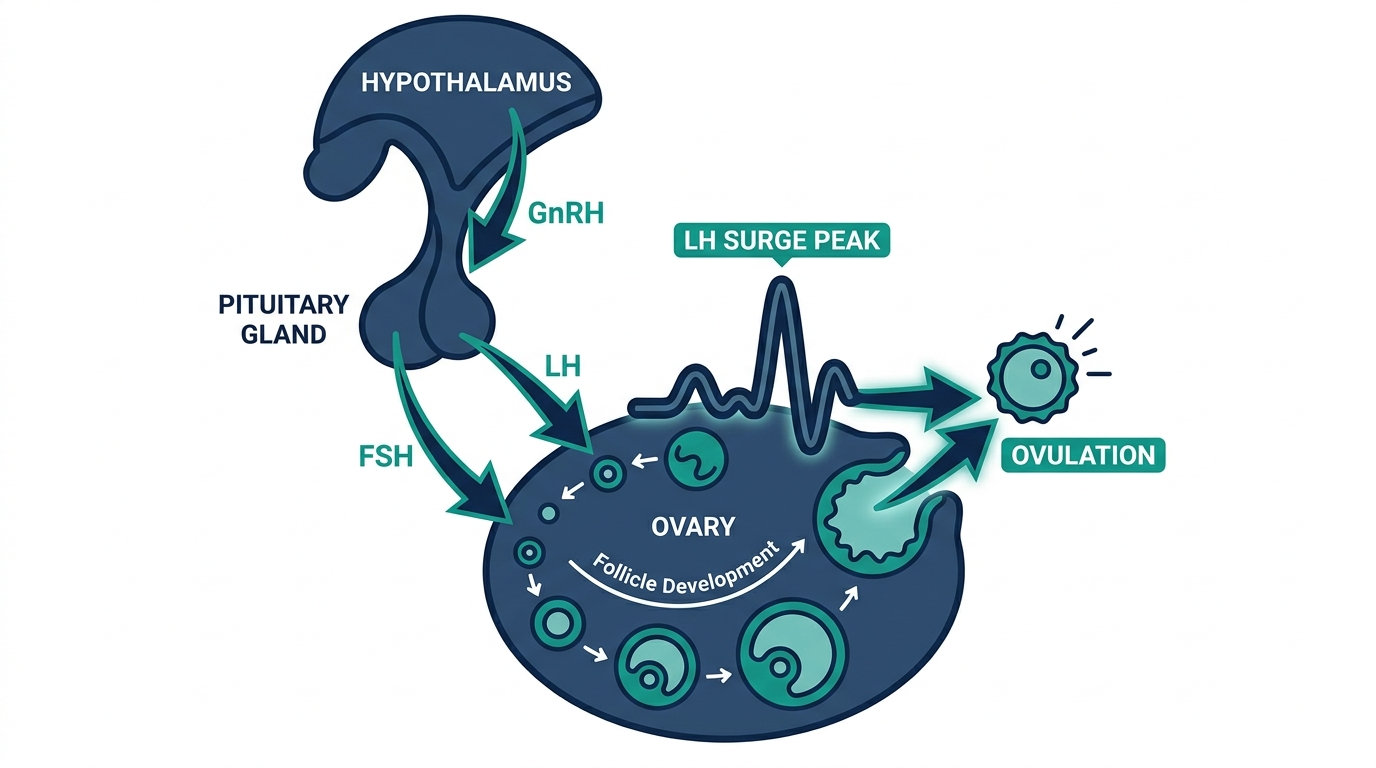
LH stands for luteinizing hormone, and a blood test measures how much of it is circulating in your body. LH is made by your pituitary gland, the pea-sized gland at the base of your brain, and it drives puberty, sexual function, reproduction, and sex drive (Cleveland Clinic). In women, LH governs the menstrual cycle and triggers ovulation. In men, it tells the testes to make testosterone.
So when you ask what is LH in a blood test, the short answer is this: it is a readout of the signal your brain is sending to your ovaries or testes. A normal LH means the signal and the response are roughly in sync. An abnormal LH means the conversation between brain and gonads has broken down somewhere, and the level itself often tells your clinician on which end the problem sits.
What does an LH blood test actually measure?
The simplest way to actually get this done
Superpower is a full-body lab membership that runs 100+ biomarkers, has each result reviewed by a doctor, and tracks your numbers year over year (about $199/year). It is what we point readers to when they would rather get one clean, complete draw than chase single tests one at a time. Here is superpower reviewed in full.
An LH blood test measures the concentration of luteinizing hormone in your serum, usually reported in international units per liter (IU/L). The hormone is released in pulses by the pituitary in response to a signal from the hypothalamus, so a single draw is a snapshot of a moving target (MedlinePlus).
That pulsing matters. In a menstruating woman, LH stays relatively low for most of the month, then spikes sharply in the middle of the cycle. This is the LH surge, and it is the event that ruptures the mature follicle and releases the egg. Most women ovulate within 24 to 36 hours after that surge, which is exactly why at-home ovulation kits detect LH in urine (Mayo Clinic Laboratories). The same hormone that confuses people on a lab report is the one quietly powering the ovulation stick in the bathroom drawer.
A provider typically orders an LH test to investigate fertility problems, irregular or absent periods, low sex drive, early or delayed puberty in children, or to work out whether low testosterone in a man comes from the testes or from the pituitary (Cleveland Clinic).
What is a normal LH level?
There is no single normal LH level, because the healthy range depends on your sex and, for women, where you are in your cycle. Cleveland Clinic lists these general adult ranges in IU/L (Cleveland Clinic):
- Women, follicular phase (cycle weeks 1 to 2): about 1.37 to 9.0
- Women, mid-cycle surge (around ovulation): about 6.17 to 17.2
- Women, luteal phase (cycle weeks 3 to 4): about 1.09 to 9.2
- Women, post-menopause: about 19.3 to 100.6
- Men: about 1.42 to 15.4
The single most important thing to notice here is the post-menopausal range. After menopause the ovaries stop responding, so the pituitary shouts louder and LH climbs into the double and triple digits. A value of 40 IU/L would be alarming in a 25-year-old woman and completely expected in a 60-year-old. Context is everything, so always read your result against the reference range printed on your own report, against your age, and against your cycle day.
Why the day of your cycle can change everything
For a menstruating woman, the single biggest reason two LH results look nothing alike is timing. LH stays low and fairly flat through the follicular phase, spikes hard for the mid-cycle surge, then settles again in the luteal phase. A draw taken on cycle day 3 and a draw taken on day 13 can differ several-fold in the same perfectly healthy woman, and neither is wrong. This is why clinicians usually order a baseline LH early in the cycle, often around days 2 to 4, when the number sits at its quiet resting level and is easiest to compare against a reference range. If your result came back without a cycle day attached, that one missing detail can make an LH number nearly impossible to read.
What an optimal reading looks like in context
There is no universal optimal LH the way there is for something like fasting glucose, because the right value is entirely situational. A resting LH near the middle of the follicular range in a woman trying to conceive is reassuring. The same number in a post-menopausal woman would be surprisingly low and might prompt a second look. For men, a mid-range LH paired with a healthy testosterone is the picture of a system in balance. The useful mental model is not a single target number but a matched pair: does the LH fit the sex, the age, the cycle day, and the hormone it is supposed to be driving? When it does, the axis is working. When it does not, that mismatch is the finding.
What does a high LH level mean?
A high LH usually means your ovaries or testes are not producing enough sex hormones, so the pituitary is working overtime trying to push them. This is called primary gonadal failure, and the brain end of the system is doing its job (Cleveland Clinic). Common causes of a genuinely elevated LH include:
- Menopause or perimenopause, the most common reason for a high LH in women, where rising LH simply reflects ovaries winding down (Cleveland Clinic).
- Primary ovarian insufficiency or testicular failure, where the gonads underperform and LH rises to compensate.
- Genetic conditions such as Turner syndrome in women and Klinefelter syndrome in men (Cleveland Clinic).
- Polycystic ovary syndrome (PCOS), where LH is often elevated relative to FSH, which is a clue we will come back to.
- Damage to the ovaries or testes from autoimmune disease, surgery, radiation, or chemotherapy (MedlinePlus).
Here is the insider point. A high LH is not automatically bad news. In a woman in her early fifties with hot flashes, it is the expected biochemical signature of menopause, not a disease to fix. The number only becomes a red flag when it does not fit the person. High LH in a 30-year-old woman who is not pregnant or menopausal is the result that should prompt real follow-up, because it suggests the ovaries are failing decades early.
The symptoms that accompany a high LH are really the symptoms of the low sex hormones underneath it. In a woman whose ovaries are winding down, that can mean irregular or missed periods, hot flashes, night sweats, vaginal dryness, and broken sleep. In a man with failing testes, a high LH often travels with the signs of low testosterone: flagging libido, fatigue, low mood, loss of muscle, and sometimes reduced fertility. The LH number itself does not cause any of these feelings. It is the alarm bell ringing because the gland it keeps shouting at has gone quiet.
What does a low LH level mean?
A low LH means your pituitary gland is not putting out enough hormone to drive your ovaries or testes, which points to a problem higher up the chain in the pituitary or hypothalamus rather than in the gonads themselves (MedlinePlus). This is called secondary or central hypogonadism. Causes include:
- Pituitary disorders, such as a tumor or damage that blunts hormone output.
- Hypothalamic amenorrhea, often driven by very low body weight, heavy training, or chronic stress, which suppresses the signal to the pituitary.
- Kallmann syndrome, a genetic condition that impairs the hormone signal and is often paired with a reduced sense of smell (Cleveland Clinic).
- Malnutrition or eating disorders, which shut down the reproductive axis to conserve energy.
In a man with low testosterone, a low LH is the finding that flips the diagnosis. If testosterone is low and LH is also low, the testes may be fine and the pituitary is the issue. If testosterone is low but LH is high, the testes are the problem. That single pairing changes the entire workup.
Because a low LH means the whole reproductive signal is turned down, the symptoms tend to be those of an underactive axis. Women may stop menstruating altogether, a state called amenorrhea, and may notice low libido or trouble conceiving. Men may feel the classic low-testosterone cluster of low drive, fatigue, and reduced muscle even though, in their case, the testes could work fine if only the pituitary would ask. When a low LH shows up in someone training hard or eating too little, restoring energy availability, meaning enough fuel and enough rest, is often the first thing that brings the signal back online.
Why is LH almost always tested with FSH?
LH is rarely interpreted alone. It is read alongside follicle-stimulating hormone (FSH) because the two are released by the same gland and work as a coordinated pair (MedlinePlus). FSH matures the ovarian follicle while LH triggers it to rupture and release the egg, and in men both work together to support testosterone and sperm production (Cleveland Clinic).
Reading them together lets a clinician locate the problem. If both LH and FSH are high, the signal is fine and the gonads are failing, as in menopause or primary ovarian insufficiency. If both are low, the pituitary or hypothalamus is the weak link. One number tells you a level, but the pair tells you a direction.
The detail most people miss: the LH to FSH ratio in PCOS
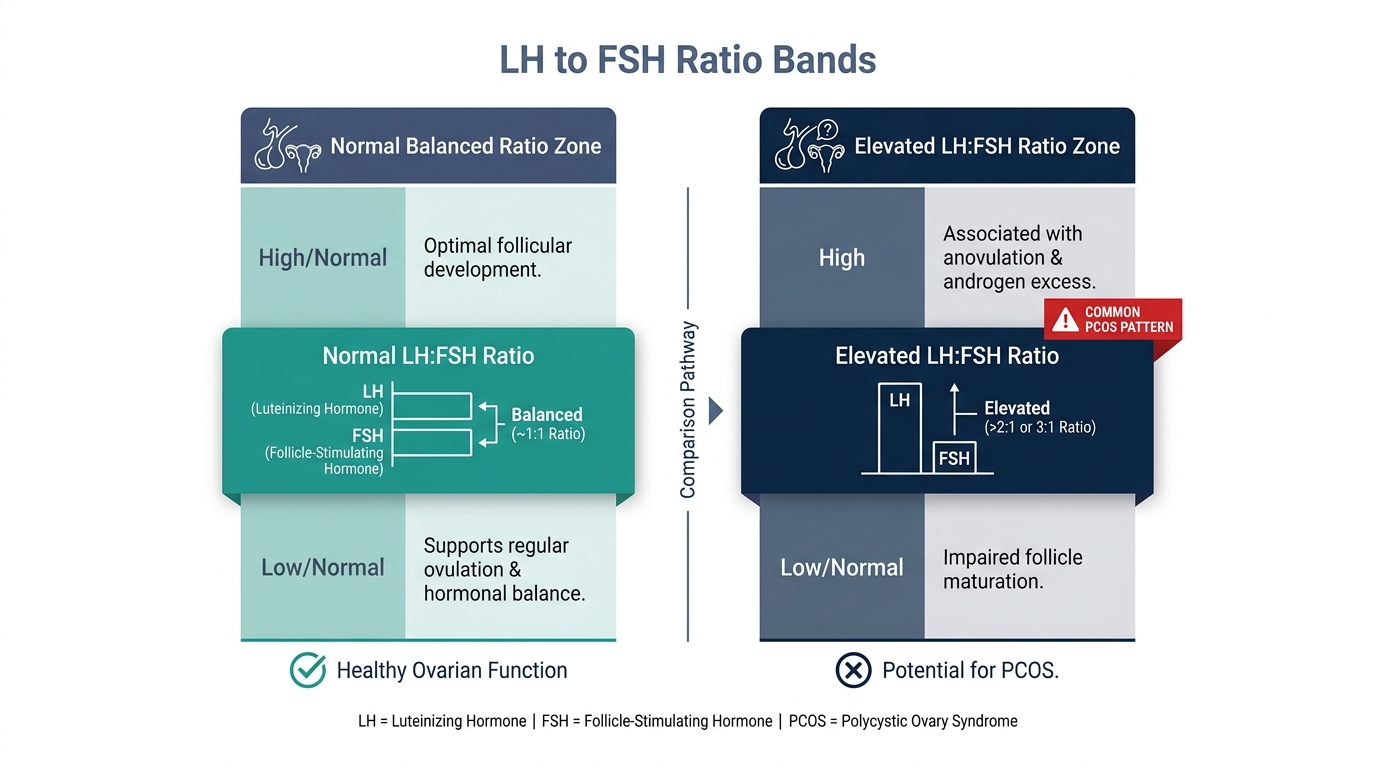
This is where LH stops being a simple fertility number and becomes a quiet diagnostic clue. In polycystic ovary syndrome, the absolute LH level can sit inside the normal range, yet the LH to FSH ratio is often skewed. Many women with PCOS show LH running higher than FSH, sometimes 2 to 3 times higher, while a typical cycle keeps the two closer to balanced.
Researchers have studied this ratio closely. One study of women with PCOS reported an LH to FSH ratio averaging around 2.76 to 2.79, and notably found that this elevation persisted in lean women just as much as in obese women (PubMed, LH:FSH ratio in PCOS, obese vs non-obese). That last finding matters more than it sounds. It means the skewed ratio is not just a side effect of weight, and a slim woman with regular-looking individual hormone values can still carry the hormonal fingerprint of PCOS.
The honest caveat is that the LH to FSH ratio is not a standalone diagnosis. PCOS is diagnosed using broader criteria, and not every woman with the condition shows a high ratio. But it is exactly the kind of pattern that gets missed when someone glances at an LH number, sees it inside the reference range, and moves on. The relationship between the two hormones can be telling even when each one looks unremarkable alone. If you have irregular cycles and a normal LH, the ratio is worth a second look with your clinician.
How do you prepare for an LH test, and what can skew the result?
An LH test does not usually require fasting, but a handful of things can move the number enough to matter, and most of them are avoidable. The biggest is timing in the cycle, covered above: a baseline draw is typically done early, around cycle days 2 to 4, unless your clinician is deliberately trying to catch the ovulatory surge. Beyond that, watch for:
- Hormonal birth control. The pill, patch, ring, hormonal IUD, and similar methods suppress LH by design, so a level drawn while you are on them reflects the medication, not your natural axis (MedlinePlus). A clinician hunting for your true baseline may ask you to be off hormonal contraception first.
- Recent pregnancy or a positive pregnancy test, which changes the hormonal backdrop and the way LH should be interpreted.
- High-dose biotin supplements, common in hair, skin, and nail products, which can interfere with some hormone immunoassays. The FDA has cautioned that biotin can skew certain lab results, so mention any supplement you take.
- Recent fertility medications or GnRH-based drugs, which act directly on this axis and can raise or suppress LH depending on the drug.
The practical checklist is short. Tell the lab your cycle day, or your last period date if you are unsure. List every medication and supplement, including over-the-counter hair and nail products. And if you are on hormonal birth control and want a true baseline, ask your clinician whether and how long to pause it before testing. A well-timed, well-documented draw is worth far more than a random one.
What should you do about a high or low LH?
A lone LH value rarely settles anything. The first move is always to read it next to the hormones it partners with, because the pattern, not the single number, points to the answer. In practice that means pairing LH with FSH, and usually with estradiol in women or testosterone in men, plus prolactin when the pituitary is in question. Those companions are what separate a failing gonad from a quiet pituitary.
A few sensible next steps depending on the pattern:
- High LH and high FSH with low sex hormones: the gonads are the weak link. In an older woman this is simply menopause; in a young woman or man it is a prompt to look into premature ovarian insufficiency or testicular failure and their causes.
- Low LH and low FSH with low sex hormones: the signal from above is weak, which turns attention to the pituitary and hypothalamus, energy availability, body weight, stress, and, less often, a pituitary lesion.
- Normal LH with irregular cycles, especially with LH running higher than FSH: worth reviewing for PCOS using the full criteria rather than the ratio alone.
On retesting, remember that LH is pulsatile and cycle-dependent, so one odd value is not a verdict. If a result does not fit the story, repeating it on the correct cycle day and off any interfering medication often clears things up. Hormones are best read as a trend against a consistent time point, not as a single dramatic snapshot.
Three quick real-world reads
Picture a 29-year-old with irregular, unpredictable periods whose individual hormone values all print inside their reference ranges. Her LH is normal, her FSH is normal, but her LH sits more than twice as high as her FSH. That ratio is the kind of quiet signal that sends a careful clinician toward a full PCOS evaluation instead of a shrug. Now picture a competitive distance runner who has not had a period in months; her LH and FSH are both low, pointing not to her ovaries but to an axis switched down by heavy training and too little fuel. Finally, picture a 40-year-old man with low libido and low testosterone. If his LH is low, the trail leads to his pituitary; if his LH is high, it leads to his testes. Same complaint, three different roads, and LH is the fork in each one.
Don’t just read about LH, track it.
A single result is a snapshot. Superpower re-tests LH and 100+ markers over time so you can watch them move as you change sleep, food, and training.
Frequently asked questions
What is LH on a blood test in simple terms?
LH is luteinizing hormone, a chemical messenger made by your pituitary gland that controls ovulation in women and testosterone production in men (Cleveland Clinic). On a blood test it shows how strongly your brain is signaling your ovaries or testes.
What is a normal LH level?
It depends on sex and cycle phase. For women in the follicular phase it is roughly 1.37 to 9.0 IU/L, the mid-cycle surge runs about 6.17 to 17.2, and after menopause it rises to about 19.3 to 100.6. For men it is about 1.42 to 15.4 (Cleveland Clinic). Always check your own report’s range.
What does a high LH level mean?
A high LH usually means the ovaries or testes are not producing enough sex hormones, so the pituitary pushes harder. Common causes include menopause, primary ovarian or testicular failure, genetic conditions, and PCOS (Cleveland Clinic). It is expected after menopause but warrants follow-up in younger people.
What does a low LH level mean?
A low LH points to a problem in the pituitary or hypothalamus rather than the ovaries or testes, such as a pituitary disorder, very low body weight, heavy exercise, or chronic stress (MedlinePlus). In a man with low testosterone, a low LH suggests the pituitary, not the testes, is the cause.
Why is LH tested together with FSH?
Because the two hormones are released by the same gland and work as a pair, and reading them together shows whether a reproductive problem sits in the gonads or in the pituitary (MedlinePlus). The LH to FSH ratio can also be a clue to PCOS (PubMed).
Do I need to fast for an LH test?
Fasting is not usually required for an LH test. What matters far more is timing in your cycle and any hormonal medication you take, so tell your clinician your cycle day and list your medications and supplements (MedlinePlus).
When in my cycle should LH be tested?
For a baseline reading, LH is usually drawn early in the cycle, often around days 2 to 4, when it sits at its low resting level. If the goal is to catch ovulation instead, testing is timed for the expected mid-cycle surge, which is also what at-home ovulation kits detect (Mayo Clinic Laboratories).
Can birth control affect LH results?
Yes. Hormonal birth control suppresses LH by design, so a level measured while you are using it reflects the medication rather than your natural axis (MedlinePlus). If your clinician wants your true baseline, they may ask you to pause hormonal contraception first.
Can an LH test confirm menopause?
LH is one piece of the menopause picture rather than a single confirming test. After menopause, LH and FSH both rise as the ovaries stop responding, and a persistently high FSH alongside high LH and low estradiol fits the pattern, but the diagnosis also rests on your age and symptoms (Cleveland Clinic).
This article is for general educational purposes and is not medical advice. It cannot diagnose or treat you and does not replace your clinician. Always discuss your lab results and any health decisions with a qualified healthcare professional.
Vital Signs Today may earn a commission if you buy through links on this page. It does not affect our editorial assessments.