You got a lab report back, ran down the column of acronyms, and landed on two letters with a number that looked oddly high: CK. Maybe your clinician ordered it because your muscles ached, maybe it was thrown in with a panel, maybe a statin prompted it. Either way, CK is one of those results that can look alarming and mean almost nothing, or look modest and matter a great deal. The trick is knowing which situation you are in.
Here is what most quick explainers miss. A single CK number out of context is one of the most over-interpreted values in all of lab medicine, and the reasons why are genuinely useful to understand before you panic about a result.
CK spikes for a lot of reasons, from workouts to something more. Want to rule it out with a full panel? One at-home Superpower draw checks 100+ biomarkers, physician-reviewed.
What is CK in a blood test?
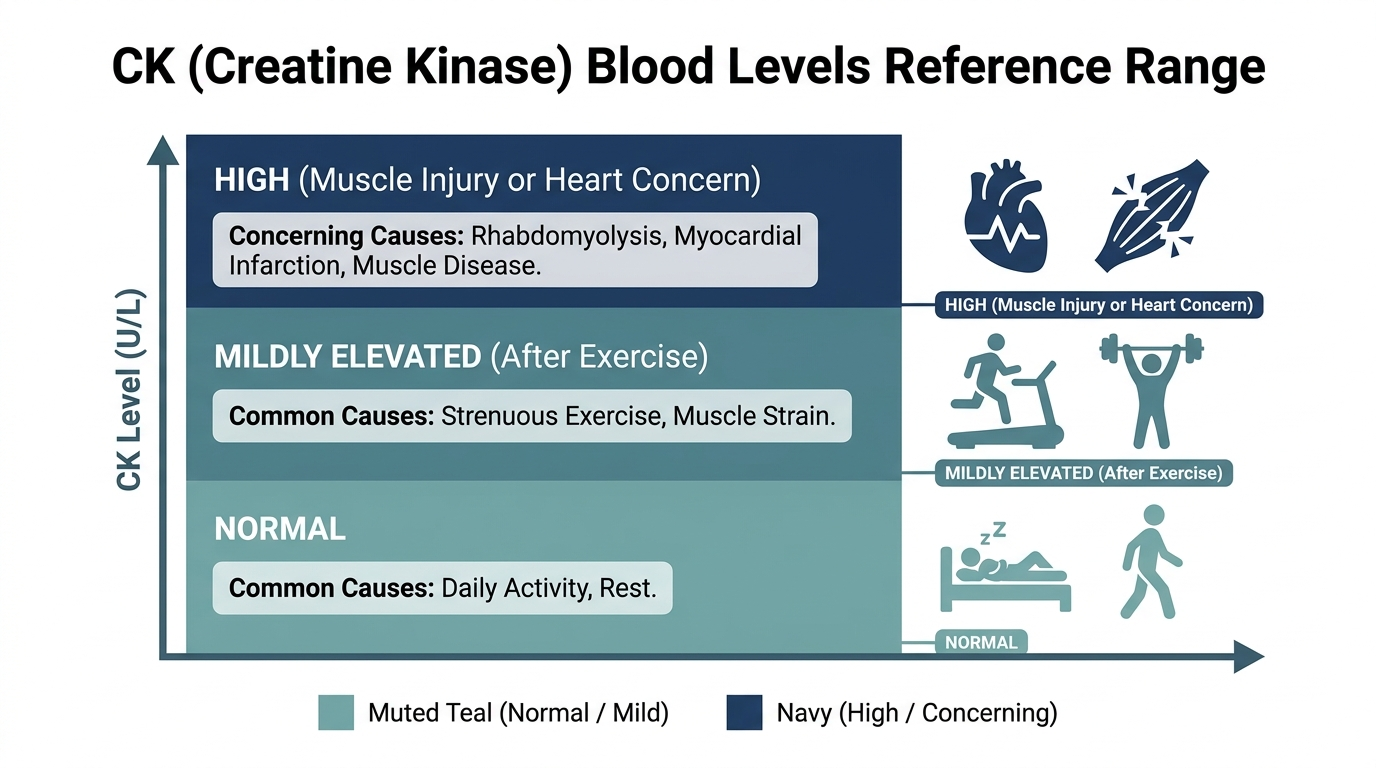
CK stands for creatine kinase, an enzyme found mainly in your skeletal muscles, with smaller amounts in your heart muscle and brain (Cleveland Clinic). Its job is to help your muscle cells make and store energy. When any of those tissues are damaged, CK leaks out of the cells and into your bloodstream, so the blood level rises. In plain terms: CK is a muscle-damage signal, and a typical normal range runs roughly 20 to 200 U/L (StatPearls, NCBI).
That single idea, leakage from damaged muscle, explains everything below. A small amount of CK is always in your blood from normal wear and tear. The question your clinician is really asking is whether the level reflects ordinary background turnover or something that broke open more cells than it should have.

What does CK actually measure?
CK measures the amount of the creatine kinase enzyme circulating in your blood, which is a proxy for how much muscle tissue has been damaged recently (MedlinePlus). It does not tell you which muscle, and on a standard test it does not tell you whether the source is skeletal muscle, heart, or brain. It just tells you that cells somewhere are leaking.
CK actually comes in three forms, called isoenzymes, and this is where the test gets more precise when needed (MedlinePlus):
- CK-MM comes mostly from skeletal muscle, the muscles you use to move. The vast majority of your CK is this type.
- CK-MB comes mostly from heart muscle. A high CK-MB can point to heart damage such as a heart attack or myocarditis.
- CK-BB comes mostly from brain tissue and can rise after a stroke or brain injury.
Most of the time a lab reports a single total CK. Only when the source is in question, classically chest pain, does a clinician split it into isoenzymes to ask “is this the heart or just sore muscles?”
What is a normal CK level?
A normal total CK is generally in the range of about 20 to 200 U/L, although the exact cutoff varies by laboratory, instrument, and the person being tested (StatPearls, NCBI). Normal CK ranges tend to run higher in males than in females (Cleveland Clinic). Always read your result against the reference range printed on your own report, because that is the range your lab calibrated.
Here is a detail that trips up patients and clinicians alike. The standard reference ranges most labs print are arguably set too low for some people, which leads to overdiagnosis of “abnormal” CK. One published analysis using a 97.5 percent threshold put the upper limit far higher in certain groups, for example around 325 IU/L for white women and 504 IU/L for white men, with even higher values in Black adults (Cleveland Clinic Journal of Medicine). The practical message: a CK that sits a little above the printed range, with no symptoms, is often not the emergency it looks like.
What does a high CK mean?
A high CK means muscle tissue has been damaged and is leaking enzyme into your blood. It is a signal, not a diagnosis, and the size of the number combined with your symptoms is what gives it meaning (MedlinePlus). The common causes range from completely benign to genuinely serious:
- Recent intense exercise. This is the single most common reason for a surprising CK. Strenuous activity can push CK up to as much as 30 times the upper limit of normal within 24 hours, then it slowly falls over about a week (Cleveland Clinic Journal of Medicine).
- Muscle injury or trauma, including crush injuries, falls, surgery, or even an intramuscular injection.
- Statins and certain other medicines. About 5 percent of statin users develop a CK elevation, typically 2 to 10 times the upper limit of normal (Cleveland Clinic Journal of Medicine).
- Muscle disease, such as muscular dystrophy or an inflammatory condition like myositis (MedlinePlus).
- Rhabdomyolysis, a dangerous large-scale breakdown of muscle. It is usually defined by a CK above roughly 1,000 U/L or more than 5 times the upper limit of normal (StatPearls, NCBI).
- Heart muscle damage, reflected more specifically by the CK-MB isoenzyme (MedlinePlus).
The level that genuinely worries clinicians is the rhabdomyolysis range, because released muscle contents can injure the kidneys. The risk of acute kidney injury climbs once CK passes about 1,000 U/L and becomes substantial above 5,000 U/L (StatPearls, NCBI). That is why a CK in the thousands, especially with dark urine, severe muscle pain, or weakness, is treated as an emergency rather than a number to recheck next month.

Why is CK measured with CK-MB and troponin?
CK rarely answers the most important question on its own: where is the damage coming from? That is why clinicians pair total CK with CK-MB and, for the heart, with troponin (MedlinePlus). Total CK tells you how much muscle is leaking. CK-MB and troponin tell you whether the heart is involved.
A simplified version of how the pieces fit together:
- High total CK, low CK-MB fraction: points toward skeletal muscle as the source, such as exercise or a statin effect.
- High CK with a high CK-MB fraction: raises concern for heart muscle damage and prompts further cardiac testing.
- Chest pain workup: troponin has largely replaced CK-MB as the front-line marker for heart attack because it is more specific to heart muscle, but CK-MB is still used in some settings, especially to detect a second heart attack soon after the first.
The logic is the same as reading any single number in context. CK alone is a smoke detector. The companion tests tell you which room the smoke is coming from.
What does a low CK mean?
A low CK is generally not a cause for concern. Because CK reflects muscle mass and muscle damage, a low level usually just means there is little muscle breakdown happening, and there is no widely recognized disease defined by an abnormally low CK on its own (Cleveland Clinic). It can simply reflect lower muscle mass, and it sometimes appears in conditions associated with reduced muscle, such as certain thyroid states or in people who are bedridden. If your CK is on the low side and you feel well, it is rarely something to chase.
The part most people never hear: why your CK can be high and totally fine
This is where CK stops being a scary number and starts making sense. An isolated high CK in someone who feels well is common, and the right next step is often patience rather than alarm. The reasons are specific and worth knowing.
First, timing and exercise. Because hard activity can spike CK as much as 30-fold and it takes about a week to settle, a single elevated result tells you little until it is repeated after rest. In one analysis, when people with an initially high CK were retested after three days of rest, about 70 percent had returned to normal (Cleveland Clinic Journal of Medicine). The fix for many “abnormal” CK results is simply to stop exercising for a few days and recheck.
Second, who you are. CK is meaningfully affected by sex, muscle mass, and ancestry, with higher baseline values in men and in Black adults, which is exactly why a fixed one-size reference range overcalls abnormality (Cleveland Clinic Journal of Medicine).
Third, a quiet curveball called macro-CK. In roughly 4 percent of people with an unexplained, persistent CK elevation and no symptoms, the cause is not muscle damage at all but an abnormal enzyme complex in the blood that the analyzer misreads as high CK (Cleveland Clinic Journal of Medicine). It is a lab artifact, not a disease, and a specialized test can identify it. So before chasing a muscle biopsy over a stubbornly high CK, a good clinician asks whether the number is even real. That is the kind of nuance that never fits on a results portal.
CK and statins: what the number actually triggers
Statins are the most common reason a stable, symptom-free person suddenly has a CK checked, so it is worth knowing how clinicians act on the result. The key principle is that the number is read together with symptoms, not in isolation.
- Routine monitoring is not standard. For most people on a statin, guidelines do not call for checking CK on a schedule. A baseline value is sometimes drawn before starting, and CK is checked mainly when someone develops muscle symptoms or is at higher risk because of a personal or family history of statin intolerance or muscle disease.
- Mild elevations often do not mean stopping. A modest CK rise without symptoms usually leads to closer monitoring rather than abandoning a medication that lowers cardiovascular risk.
- The clear stop signals. Clinicians generally stop the statin when CK rises above roughly 10 times the upper limit of normal, or when muscle symptoms are severe regardless of the exact number. Severe pain or weakness always outranks a reassuring value.
If you take a statin and notice new, unexplained muscle aches or weakness, that symptom, not a routine number, is the reason to call your clinician. The CK is there to help interpret the symptom, not to replace it.
Rhabdomyolysis: the CK scenario that is a true emergency
Most high CK results are benign. The one that is not is rhabdomyolysis, a large-scale breakdown of muscle that spills so much cellular content into the blood that it can injure the kidneys. This is the situation where a CK number genuinely calls for the emergency room, not a recheck next week.
The classic triad to recognize is muscle pain, muscle weakness, and dark, tea-colored or cola-colored urine. That dark urine comes from myoglobin, a muscle protein released in bulk when muscle breaks down, and it is the single most important warning sign. Other clues include severe muscle swelling and feeling generally unwell after an inciting event such as a crush injury, extreme exertion, a long period of immobility, heat illness, or certain drug reactions.
The reason the kidneys are the concern is that myoglobin can clog and damage them. Risk of acute kidney injury climbs as CK rises well into the thousands. So the rule of thumb is simple: severe muscle pain or weakness together with dark urine is an urgent, same-day problem, whatever else the report says. Prompt treatment, often with intravenous fluids, is what protects the kidneys.
How to prepare, and what can push CK up on its own
CK is one of the most exercise-sensitive numbers in the lab, so preparation matters more than for most tests. If your CK is being checked to answer a real question, a few habits keep the result interpretable:
- Avoid strenuous exercise for a few days beforehand. A hard workout can raise CK many times over and keep it elevated for about a week. Testing right after leg day can produce an alarming number that means nothing.
- Mention recent injections or procedures. An intramuscular injection, recent surgery, a fall, or even vigorous physical work can leak CK from muscle.
- List your medications. Statins are the obvious one, but tell your clinician about everything, since several drugs can affect muscle.
- Expect a recheck. Because CK moves so much with activity, a single high value with no symptoms is frequently repeated after several days of rest before anyone acts. In practice a large share of these initially high results return to normal on that repeat.
Baseline differences also matter. Because men, people with more muscle mass, and Black adults tend to run higher normal CK values, a one-size reference range overcalls abnormality in exactly these groups. Reading your number against your own report, and your own baseline, beats reading it against a generic cutoff.

Using CK to follow a known muscle condition over time
Beyond the one-off surprise result, CK has a second life as a tracking tool. In people with a diagnosed muscle disorder, such as an inflammatory myopathy, the trend in CK over weeks and months can help gauge how active the disease is and how well treatment is working. A falling CK during treatment for myositis, for instance, is a reassuring sign that inflammation is settling, while a rising CK can flag a flare before symptoms fully return.
This is where the single number gives way to the curve. For someone under specialist care for a muscle disease, the direction and pace of change often matter more than any one value, which is why these patients are tested repeatedly rather than once. The same enzyme that causes needless worry as an isolated result becomes a genuinely useful gauge when watched over time.
A worked example: reading a high CK sensibly
Imagine your CK comes back at 900 U/L, well above the printed range, and you feel fine. A calm, stepwise read looks like this:
- Ask about recent exertion. Any intense workout, heavy lifting, or unusual physical activity in the past week? This alone explains a large share of surprising results.
- Check for symptoms. Severe muscle pain, weakness, or dark urine changes everything and points toward urgent evaluation. Their absence is reassuring.
- Review medications. A statin or other muscle-affecting drug in the mix is worth noting.
- Repeat after rest. With no symptoms and a likely exercise explanation, the usual move is to avoid strenuous activity for a few days and recheck. A value that drifts back toward normal needs no further chase.
- Escalate only if it persists. A CK that stays high across repeats, with no exercise explanation, is when a clinician considers muscle disease, isoenzyme testing, or the possibility of a lab artifact like macro-CK.
The same 900 U/L is trivial after a marathon and worth investigating in a sedentary person with muscle weakness. Context, not the number alone, sets the response.
Common misunderstandings about CK
- “A high CK means my heart is damaged.” Most CK comes from skeletal muscle, not the heart. Only the CK-MB fraction, and more specifically troponin, speaks to heart muscle. A high total CK after exercise says nothing about your heart.
- “Any result above the range is abnormal.” The printed range is arguably too low for some people, so a value modestly above it, with no symptoms, is often normal for that individual.
- “A high CK needs immediate aggressive testing.” For an isolated elevation without symptoms, resting and rechecking usually comes first, precisely because exercise moves the number so much.
- “A persistently high CK must mean muscle disease.” In a small share of cases the culprit is macro-CK, a harmless enzyme complex the analyzer misreads, not muscle damage at all.
Why your normal CK depends on who you are
One of the most overlooked facts about creatine kinase is that a single reference range does not fit everyone equally. CK reflects muscle, so the more muscle you carry and the more you use it, the higher your baseline sits. Men on average run higher CK values than women because they tend to have more muscle mass. A muscular, physically active man can have a resting CK that would look mildly high against a generic range, yet is entirely normal for him. This is why lifting weights, doing manual labor, or training hard in the days before a draw can push the number up without anything being wrong.
Ancestry matters too, and it is well documented. People of African descent, on average, have higher CK levels than people of European or Asian descent, again largely because of differences in muscle mass and composition. This is not a marker of disease, it is normal population variation, but it means a CK that a lab flags as high may be unremarkable for that individual. Good clinicians read the number against the person in front of them, not only against the printed cutoff.
Age and recent activity round out the picture. Newborns have high CK from the stress of birth, and levels settle over the first days of life. In adults, a hard workout, a long run, an intramuscular injection, or even a recent fall can all raise CK for a day or more. The practical lesson is simple: before treating a high CK as a problem, account for your sex, your build, your ancestry, and what your muscles have been doing lately. A repeat test taken after several days of rest, avoiding strenuous exercise, gives a far truer baseline than a single reading taken the morning after leg day.
Don’t just read about CK, track it.
A single result is a snapshot. Superpower re-tests CK and 100+ markers over time so you can watch them move as you change sleep, food, and training.
Frequently asked questions
Is a high CK something to worry about?
It depends on the size and the context. A modest elevation after exercise or with a statin is common and often harmless, while a CK above roughly 1,000 U/L, or more than 5 times the upper limit of normal, can signal rhabdomyolysis and needs prompt attention (StatPearls, NCBI). Severe muscle pain, weakness, or dark urine with a high CK should be evaluated urgently.
What is a normal CK level?
A normal total CK is generally about 20 to 200 U/L, though it runs higher in males and varies by lab and method (StatPearls, NCBI). Compare your result to the reference range printed on your own report.
Can exercise raise my CK?
Yes, and dramatically. Strenuous activity can raise CK up to about 30 times the upper limit of normal within 24 hours, then it slowly declines over roughly a week (Cleveland Clinic Journal of Medicine). A single high CK is often rechecked after a few days of rest before any further workup.
What is the difference between CK and CK-MB?
Total CK measures all the creatine kinase in your blood, most of it from skeletal muscle, while CK-MB is the fraction that comes mainly from heart muscle (MedlinePlus). CK-MB and troponin are used to ask whether the heart is the source of a CK elevation.
Should I be concerned about a low CK?
Generally no. A low CK usually just reflects little muscle breakdown or lower muscle mass and is not considered a sign of disease on its own (Cleveland Clinic).
This article is for general educational purposes and is not medical advice. It cannot diagnose or treat you and does not replace your clinician. Always discuss your lab results and any health decisions with a qualified healthcare professional.
Vital Signs Today may earn a commission if you buy through links on this page. It does not affect our editorial assessments.