Your blood work comes back, and one line is flagged in red: CK, well above the reference range. Maybe a number like 400, maybe 4,000. Your first instinct is to assume the worst, that something is wrong with your heart or your muscles are failing. Here is the calmer truth most people never get told. A high CK is one of the most commonly misread numbers on a lab report, and the single most frequent reason it is up has nothing to do with disease at all.
That does not mean you should ignore it. It means you need to know what actually moves this number, which thresholds matter, and when a high CK is a footnote versus a red flag. Let us walk through it.
A high CK number can range from a tough workout to something worth watching. See the full picture with 100+ biomarkers. One at-home Superpower draw checks 100+ biomarkers, physician-reviewed.
What does a high CK blood test mean?
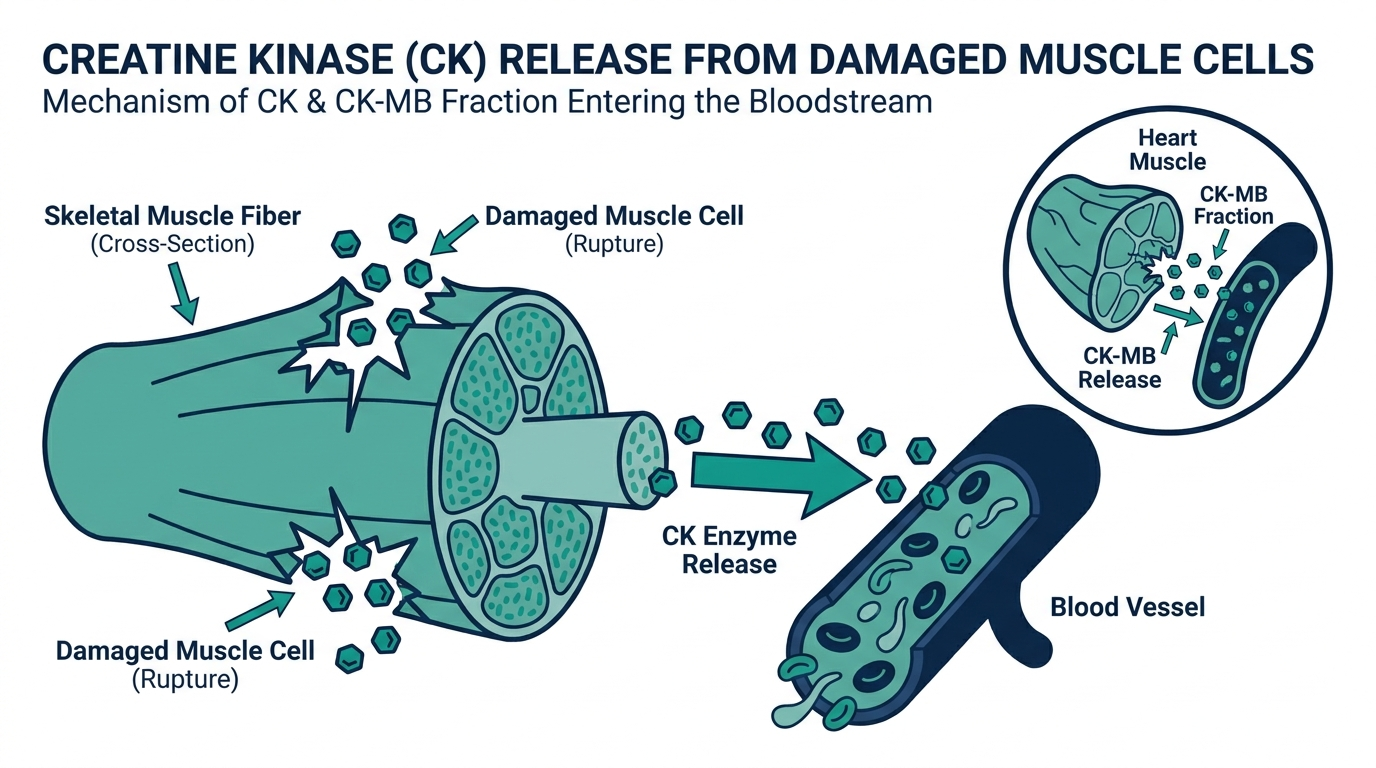
A high CK blood test means creatine kinase, an enzyme packed inside your muscle cells, has leaked into your bloodstream, which usually signals that muscle tissue has been recently damaged or stressed (MedlinePlus). CK lives mainly in your skeletal muscle, with smaller amounts in your heart muscle and brain. When those cells are injured, torn, inflamed, or simply worked very hard, they spill CK out, and the level in your blood climbs (Cleveland Clinic).
The honest catch: a high CK tells you muscle was damaged, but it does not tell you which muscle or why. It is a smoke alarm, not a diagnosis.
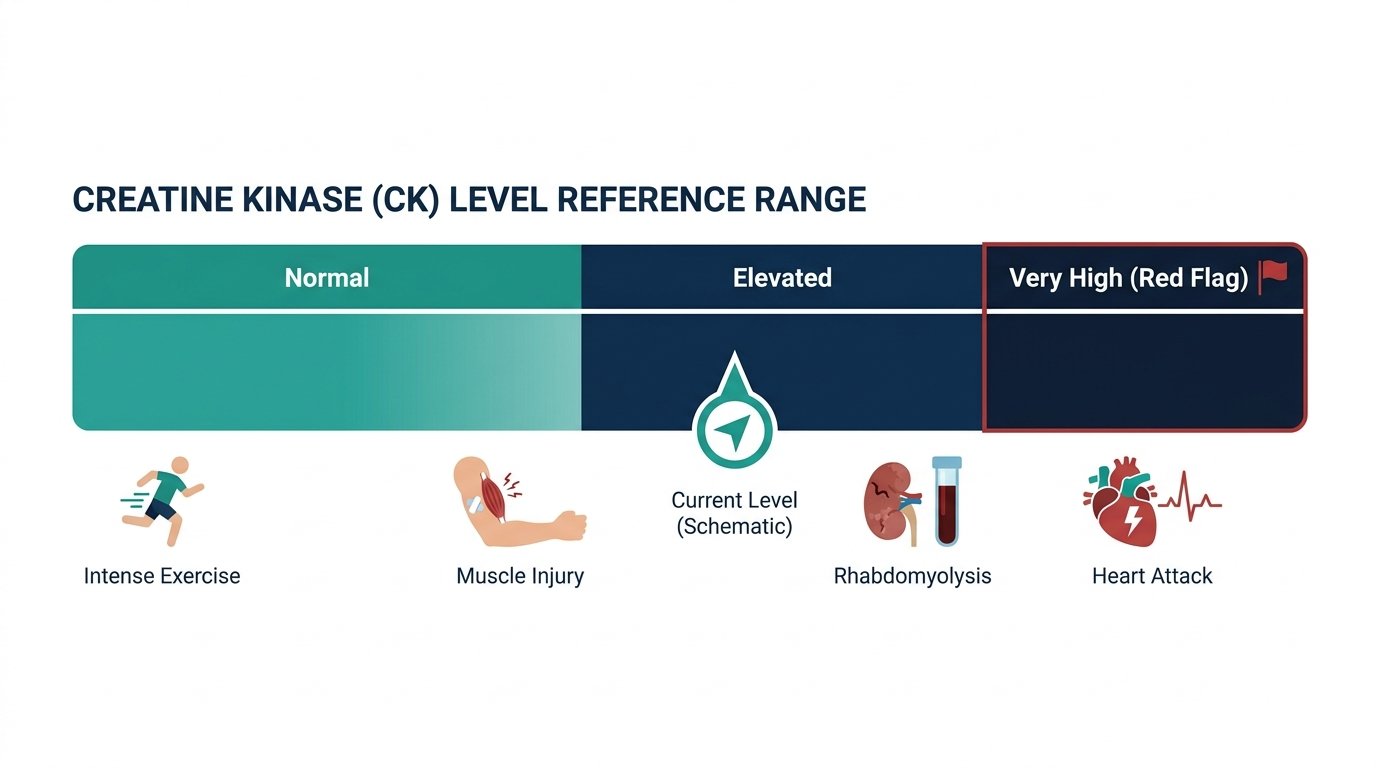
What counts as high is trickier than the lab printout suggests. A common reference range is roughly 22 to 198 units per liter, but the standard ranges used by most labs are arguably set too low, which leads to overdiagnosis of “abnormal” results (Cleveland Clinic Journal of Medicine). CK is strongly shaped by your sex, your ancestry, and how physically active you are. The same review notes that a more realistic threshold for actually investigating an elevation is about 1.5 times the upper limit of normal, which works out to roughly 325 units per liter for white women, 504 for white men, 621 for Black women, and 1,200 for Black men. In other words, a number that gets flagged red on your report may be entirely normal for your body.
What causes a high CK?
The differential runs from completely benign to genuinely urgent. Ordered roughly from most to least common in everyday practice:
- Exercise. This is the elephant in the room. After strenuous exercise, CK can rise to as much as 30 times the upper limit of normal within 24 hours, then drift back down over about a week (Cleveland Clinic Journal of Medicine). A hard leg day, a first marathon, or a new gym program can throw a four-figure CK that means nothing more than sore muscles.
- Intramuscular injections and minor trauma. A shot in the arm, a fall, surgery, or a bad bruise all release CK from the damaged muscle (MedlinePlus).
- Statins and other medications. Up to 5 percent of statin users develop a CK elevation, usually in the range of 2 to 10 times the upper limit of normal, which typically settles after stopping the drug (Cleveland Clinic Journal of Medicine).
- Muscle disease and inflammation. Muscular dystrophy, polymyositis, and dermatomyositis raise CK because the muscle is being actively broken down or inflamed (Cleveland Clinic).
- Hormone and thyroid disorders. An underactive thyroid is a classic quiet cause, along with Addison’s disease and Cushing’s syndrome (MedlinePlus).
- Heart and brain injury. A heart attack releases the CK-MB form from heart muscle, and a stroke or brain injury can raise the CK-BB form (MedlinePlus).
- Rhabdomyolysis. The dangerous end of the spectrum, where muscle breaks down rapidly and floods the blood with CK and other proteins (Cleveland Clinic).
This is why your clinician will ask what you have been doing. A CK of 1,500 in someone who just ran a half marathon is a different story from the same number in someone with dark urine and no recent activity.
What are the symptoms of a high CK?
Here is the part that surprises people. A high CK itself causes no symptoms. CK is just an enzyme floating in your blood, and the number on your report does not hurt. What matters are the symptoms of whatever is releasing it. The classic muscle-related warning signs that often accompany a meaningful CK elevation include (MedlinePlus):
- Muscle pain, aching, or cramps
- Muscle weakness, especially weakness that is getting worse
- Balance problems, numbness, or tingling
- Swollen extremities
- Dark, tea-colored, or cola-colored urine
Many people with a mildly high CK feel completely fine, and that is common, especially after exercise or with a long-standing benign elevation. The combination that should grab your attention is a high CK plus symptoms, particularly muscle pain with dark urine. That pairing points away from “you just worked out hard” and toward something that needs same-day attention.
When is a high CK dangerous or a medical emergency?
The level where a high CK stops being a curiosity and becomes a warning is rhabdomyolysis, the rapid destruction of muscle tissue. Diagnosis is generally confirmed when CK climbs above roughly 5 times the upper limit of normal, which in practice usually means above about 1,000 units per liter, and a level at least 10 times the upper limit is often considered diagnostic (PMC, extremely high CK in rhabdomyolysis).
The reason rhabdomyolysis is dangerous is not the CK itself, it is what comes with the muscle breakdown. The released proteins, especially myoglobin, can overwhelm and injure the kidneys. The risk of acute kidney injury climbs with the CK level, becoming more likely above roughly 15,000 units per liter and reaching a high rate, over 80 percent in some series, when CK exceeds about 75,000 (PMC, rhabdomyolysis and acute kidney injury). CK levels in severe rhabdomyolysis can run from 10,000 into the hundreds of thousands.
Treat it as an emergency and seek care now if a high CK comes with any of these:
- Dark, reddish-brown urine
- Severe or rapidly worsening muscle pain and weakness
- Greatly reduced urine output, confusion, or feeling very unwell after intense exertion, a crush injury, a long fall with time on the ground, or a new high-dose statin
- Chest pain or pressure, which raises concern for the heart rather than skeletal muscle

What should you do about a high CK?
For most people, a mildly to moderately high CK with no symptoms does not need treatment. It needs context and a recheck. A practical sequence looks like this:
- Rest and repeat the test. Because exercise is such a powerful driver, the single most useful next step is to stop hard physical activity and retest after about a week. In one study, CK had normalized after just 3 days of rest in 70 percent of cases (Cleveland Clinic Journal of Medicine). A normal repeat result often closes the case.
- Review your medications. Tell your clinician about statins, fibrates, and any new drugs, since these are a common and reversible cause (Cleveland Clinic Journal of Medicine).
- Check the obvious metabolic causes. A thyroid panel is worth doing, because an underactive thyroid quietly elevates CK and is easy to miss (MedlinePlus).
- Look at the company it keeps. Kidney function, electrolytes, and the CK isoenzyme breakdown, including CK-MB if the heart is a concern, help point to the source (MedlinePlus).
- Escalate only if it persists. A CK that stays high after rest, or that comes with muscle weakness, may warrant referral for further muscle evaluation (Cleveland Clinic Journal of Medicine).
Treatment, when it is needed, targets the cause, not the number. Rhabdomyolysis is treated with aggressive intravenous fluids to protect the kidneys. A statin may be paused. A thyroid problem gets corrected. The CK falls as the underlying issue resolves.
When should you see a doctor?
See a doctor promptly, the same day or via urgent care, if a high CK comes with dark urine, severe muscle pain, marked weakness, or reduced urination, since that combination raises concern for rhabdomyolysis and possible kidney injury (PMC, rhabdomyolysis and acute kidney injury). Go to the emergency department for chest pain or pressure.
For a high CK with no symptoms, book a routine appointment to discuss it. Bring three things: what your physical activity looked like in the days before the test, a list of your medications, and any history of muscle problems in your family. Those details often explain the result faster than another round of bloodwork.
The insider point: most “high CK” results are not what they look like
Here is the nuance clinicians know that rarely reaches the patient. The reference range printed on your report is a statistical average, and for CK it is genuinely problematic, because the standard ranges most labs use are too low and produce a lot of false alarms (Cleveland Clinic Journal of Medicine). CK baseline varies dramatically with sex, ancestry, and muscle mass. A muscular Black man can have a perfectly healthy resting CK that would be flagged as sharply abnormal against a generic range, which is exactly why expert thresholds for investigation run as high as 1,200 units per liter for that group rather than the 198 on the printout.
The second trap is timing. CK does not spike instantly and then vanish. It can take up to two days to peak after muscle injury and then declines over the following days (MedlinePlus). So a single high reading taken the morning after an intense workout, a long hike, or even an enthusiastic gym session is one of the most common reasons for a scary-looking number that means nothing. The expert move is almost always the same and almost always overlooked by worried patients: do not chase a single CK value. Rest, repeat, and interpret the trend, not the snapshot.
The three CK isoenzymes and why they matter
Total CK is one number, but the enzyme actually comes in three forms, called isoenzymes, each tied to a different tissue. When a total CK is high and the source is unclear, a lab can fractionate it to help point to where the leak is coming from.
| Isoenzyme | Main source | What a rise suggests |
|---|---|---|
| CK-MM | Skeletal muscle | By far the largest fraction of normal total CK. A high total that is almost all MM points to skeletal muscle, exercise, injury, or muscle disease. |
| CK-MB | Heart muscle | Historically used to help detect heart muscle damage. A rise in the MB fraction shifts attention toward the heart, though troponin has largely replaced it for diagnosing heart attacks. |
| CK-BB | Brain and smooth muscle | Rarely measured, occasionally elevated after brain injury or stroke. |
This is why a clinician worried about the heart will usually order a troponin rather than lean on CK-MB, and why a very high total CK in someone with sore legs after a workout is almost always CK-MM. The isoenzyme pattern turns a vague total into a directed clue.
How the test is done and what can skew it
CK is measured from a routine venous blood draw, and no fasting is required. The bigger issue is not preparation but the activities in the days before the test, because they move CK far more than food does. To get a baseline that reflects your muscles at rest rather than your last workout, the practical advice is:
- Avoid strenuous exercise for a few days before the draw if the goal is a true resting baseline. A single hard session can inflate the result several fold.
- Note recent injections, falls, or procedures, since even an intramuscular shot or minor trauma can raise CK.
- Tell the lab about recent surgery, which releases CK from cut muscle.
- Mention new or high-dose statins and fibrates, which can push the number up.
A vigorous draw itself does not meaningfully raise CK the way it can raise potassium, but the timing relative to physical activity is everything. This is the core reason a single elevated CK is so often a false alarm.
The markers doctors read alongside a high CK
CK rarely tells the whole story on its own. A few companion tests turn a high number into a diagnosis.
| Companion test | What it adds |
|---|---|
| Creatinine and eGFR | Kidney function is the reason rhabdomyolysis is dangerous. A rising creatinine with a very high CK signals the kidneys are being affected. |
| Potassium and phosphorus | Muscle breakdown dumps these into the blood. High potassium in rhabdomyolysis can threaten the heart rhythm. |
| Urinalysis | A dipstick that reads positive for blood but shows no red cells under the microscope suggests myoglobin, the pigment from muscle breakdown that darkens urine. |
| TSH (thyroid) | An underactive thyroid quietly raises CK and is an easy, reversible cause to catch. |
| Troponin | The preferred marker if heart muscle injury is a concern, more specific than CK-MB. |
| Liver enzymes (AST, ALT) | AST also leaks from muscle, so muscle injury can raise liver-looking numbers and cause confusion without CK for context. |
Reading the pattern: worked scenarios
- CK of 2,000, sore legs, big workout two days ago, normal kidney function and urine. Classic exercise effect. Rest and repeat, and it usually falls fast.
- CK of 12,000, severe muscle pain, dark urine, rising creatinine. This is rhabdomyolysis with kidney involvement and needs emergency care and intravenous fluids.
- CK of 600, no symptoms, on a statin. A common, mild, reversible elevation. The clinician reviews the statin and rechecks.
- Mildly high CK, fatigue, weight gain, cold intolerance. Prompts a thyroid check, because hypothyroidism is a quiet cause.
- Persistent high CK after rest, with progressive muscle weakness. Points away from a benign cause and toward a muscle disease that warrants specialist evaluation.
Common misconceptions about a high CK
- “A high CK means a heart problem.” Usually not. The overwhelming majority of high total CK comes from skeletal muscle, not the heart. Troponin, not CK, is used to assess the heart.
- “The number itself is hurting me.” CK is just an enzyme in the blood and causes no symptoms. What matters is the condition releasing it.
- “A red flag on my report means something is wrong.” Standard reference ranges are set low and do not account for sex, ancestry, or muscle mass, so many flagged results are normal for that person.
- “I need more tests right away.” For a symptom-free elevation, the smartest first step is usually rest and a repeat, not an immediate cascade of tests.
- “High CK means I should stop exercising forever.” Exercise is the most common benign cause. It means time the test away from hard training, not that training is dangerous.
Who should have CK checked, and how often
CK is not part of a standard metabolic panel, so it is usually ordered for a reason rather than as routine screening. It makes sense to check or monitor CK in these situations.
- New muscle pain or weakness on a statin, to see whether the drug is affecting muscle.
- Suspected rhabdomyolysis after crush injury, prolonged immobilization, extreme exertion, or heat illness, where CK is tracked serially until it falls.
- Evaluation of a possible muscle disease, where a persistently high CK guides further testing.
- Unexplained dark urine with muscle symptoms, as part of the workup for muscle breakdown.
- Follow-up of a previously high result, where the trend over a week of rest matters far more than any single value.
The unifying principle is that CK is a trend marker, not a one-shot verdict. Interpreted next to your recent activity, medications, kidney function, and symptoms, it becomes a genuinely useful early warning. Read alone, off a generic reference range, it is one of the most over-worried numbers on the whole report.
Curious what your own levels look like?
Baseline 100+ biomarkers today and retest as life changes, all in one membership with physician review.
Frequently asked questions
What does a high CK blood test mean?
It means creatine kinase, an enzyme inside muscle cells, has leaked into your blood, which usually points to recent muscle damage or stress (MedlinePlus). It is a signal, not a diagnosis, and the most common harmless cause is recent strenuous exercise.
What is considered a high CK level?
A common reference range is about 22 to 198 units per liter, but experts argue these ranges are set too low. A more realistic threshold for investigation is roughly 1.5 times the upper limit of normal, which ranges from about 325 to 1,200 units per liter depending on sex and ancestry (Cleveland Clinic Journal of Medicine). Always compare against your own lab’s reference range.
Can exercise cause a high CK?
Yes, and it is the most common benign cause. After strenuous exercise, CK can rise to as much as 30 times the upper limit of normal within 24 hours, then fall back over about a week (Cleveland Clinic Journal of Medicine). Resting and retesting often returns the level to normal.
When is a high CK an emergency?
When it reflects rhabdomyolysis, typically a CK above roughly 1,000 units per liter combined with severe muscle pain, weakness, and dark urine, because the kidneys can be injured (PMC, extremely high CK in rhabdomyolysis). Seek urgent care if those symptoms appear.
Can statins raise CK levels?
Yes. Up to 5 percent of statin users develop a CK elevation, usually 2 to 10 times the upper limit of normal, and it generally normalizes after the medication is stopped (Cleveland Clinic Journal of Medicine). Tell your clinician about any statin before chasing other causes.
This article is for general educational purposes and is not medical advice. It cannot diagnose or treat you and does not replace your clinician. Always discuss your lab results and any health decisions with a qualified healthcare professional.
Vital Signs Today may earn a commission if you buy through links on this page. It does not affect our editorial assessments.