You opened your lab report, scanned the long column of abbreviations, and near the top of the complete blood count you saw three letters: HGB. Maybe there was a number next to it, maybe a little H or L flag, maybe nothing. Of all the cryptic codes on a CBC, this is the one worth understanding first, because HGB is arguably the single most important line on the whole page.
Most people glance at it, see a number in the teens, and move on. That is a mistake. HGB is the number that tells you whether your blood can actually do its main job, which is carrying oxygen. Here is how to read it like someone who knows what it means.
Part of our Complete Blood Count guide.
What is HGB in a blood test?
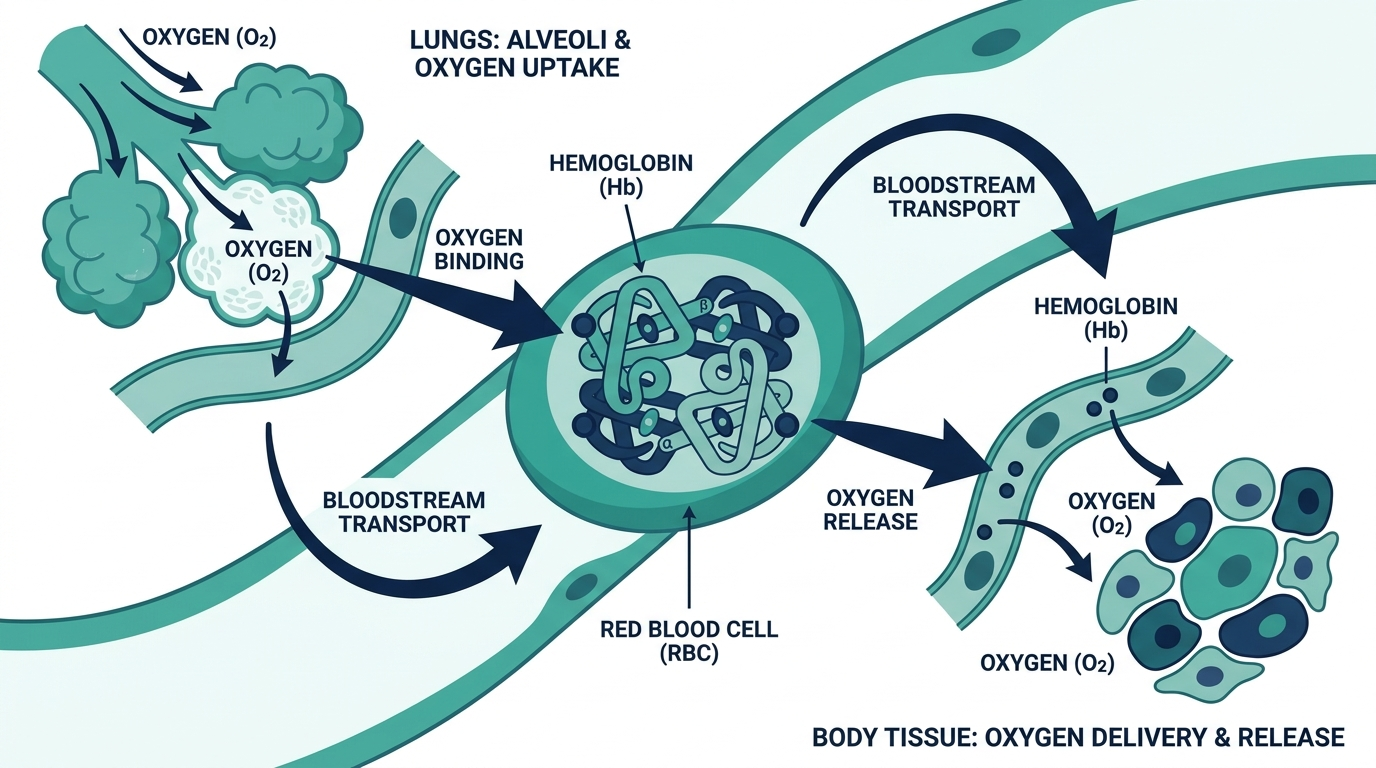
HGB stands for hemoglobin, the iron-rich protein inside your red blood cells that carries oxygen from your lungs to the rest of your body and ferries carbon dioxide back out. The HGB value on your report measures how much of that protein is in your blood, reported in grams per deciliter (g/dL) (Cleveland Clinic). It is almost always run as part of a standard complete blood count (CBC) (MedlinePlus).
In plain terms, HGB is your blood’s oxygen-carrying capacity expressed as a single number. Hemoglobin is also what gives red blood cells, and your blood, their red color. When that number drops, less oxygen reaches your tissues, which is why a low HGB so often shows up as fatigue, breathlessness, and pale skin.
What does HGB mean in a blood test, and how is it different from a red blood cell count?
What does HGB in a blood test mean in practice? It measures the concentration of hemoglobin protein, not the number of red cells. That distinction matters more than most people realize. Your CBC reports both your red blood cell count (how many cells you have) and your HGB (how much oxygen-carrying protein those cells contain). They usually move together, but not always.
You can have a normal red cell count and still be anemic if each cell is underfilled with hemoglobin, which is exactly what happens in iron deficiency. That is why clinicians lean on HGB as the headline number for diagnosing anemia rather than the cell count alone (MedlinePlus). Hemoglobin tells you about cargo capacity; the red cell count just tells you how many trucks are on the road.
What is a normal HGB level?
A normal hemoglobin level is roughly 14.0 to 17.5 g/dL for adult men and about 12.3 to 15.3 g/dL for adult women, though the exact cutoffs vary by laboratory, age, and other factors (Cleveland Clinic). MedlinePlus describes a broad adult reference range of about 12 to 17.4 g/dL, which spans both sexes (MedlinePlus).
The sex difference is real and expected, so do not be alarmed if your number looks lower than a friend’s of the opposite sex. Children have their own age-specific ranges that shift as they grow. The single most important habit: read your HGB against the reference range printed on your own report, because that is the range your lab actually calibrated its instrument to.

What does a low HGB mean?
A low HGB means you have less hemoglobin than normal, which is the definition of anemia and signals reduced oxygen delivery to your tissues (Cleveland Clinic). It is the most common abnormal CBC finding, and the test tells you how low you are but not why. The usual suspects include:
- Iron deficiency, the most common cause worldwide, where there is not enough iron to build hemoglobin (MedlinePlus).
- Blood loss, whether obvious like heavy periods or trauma, or hidden like a slow gastrointestinal bleed. Chronic blood loss is one of the most common causes of anemia (MedlinePlus Encyclopedia).
- Vitamin B12 or folate deficiency, which starves the bone marrow of materials it needs.
- Chronic kidney disease, because the kidneys make the hormone that tells marrow to produce red cells.
- Inherited disorders such as sickle cell disease and thalassemia, plus some cancers and chronic illnesses (Cleveland Clinic).
How low matters. A mildly low HGB might cause no symptoms at all, while a sharply low one can cause real fatigue, dizziness, and shortness of breath. Your provider uses the actual number to gauge how severe the anemia is and how urgently to act.
What does a high HGB mean?
A high HGB means your blood holds more hemoglobin than normal, a state often called polycythemia or erythrocytosis, and it can make blood thicker and slower to flow (Cleveland Clinic). Polycythemia is clinically identified by an elevated hemoglobin concentration and hematocrit (NCBI StatPearls). The common causes split into two groups.
The first is simply not enough fluid. Dehydration concentrates your blood, so the hemoglobin reading rises even though your actual red cell mass has not changed. This is a frequent and benign reason for a borderline-high HGB, and it can resolve with hydration.
The second group reflects a true increase in red cells, driven by the body responding to low oxygen or by a bone marrow problem. Living at high altitude, chronic lung disease, smoking, sleep apnea, and certain heart or kidney conditions all push the marrow to make more red cells (Cleveland Clinic). A genetic bone marrow disorder called polycythemia vera causes the marrow to overproduce red cells on its own and needs specific treatment.

Why is HGB read together with hematocrit and red cell indices?
HGB rarely gets interpreted in isolation. Clinicians read it alongside hematocrit, the percentage of your blood made up of red cells, and the red cell indices like MCV that describe cell size. Together these turn a single number into a real diagnosis.
Hematocrit usually tracks HGB closely, and a quick rule of thumb is that hematocrit runs roughly three times the hemoglobin value. The bigger payoff comes from pairing HGB with MCV. A low HGB with small cells (low MCV) points toward iron deficiency or thalassemia. A low HGB with large cells (high MCV) points toward B12 or folate deficiency. The HGB tells you that something is wrong; the indices help tell you what.
The part most people miss: a normal HGB does not always mean your blood is fine
Here is the insider detail that almost never makes the patient handout. A hemoglobin value sitting comfortably in the normal range can still be hiding a problem, and clinicians who only watch for flagged results will skate right past it.
Two things make HGB sneaky. First, dehydration can mask anemia. If you are low on fluid, your blood is concentrated, which can lift a truly low hemoglobin up into the normal band and make borderline anemia disappear on paper until you rehydrate. Second, your own trend matters more than the population range. A man whose HGB drifts from 16 down to 14 over two years is still inside the normal range, yet he has lost a meaningful amount of hemoglobin and something is quietly pulling it down. In fact, polycythemia vera has been reported in rare cases even when hemoglobin and hematocrit look normal, which is why context and trend beat a single snapshot (PMC case report). The lesson: compare your HGB to your own past results, not just to the reference range, and look at the whole CBC rather than one tidy number.
The symptoms that go with a low or high HGB
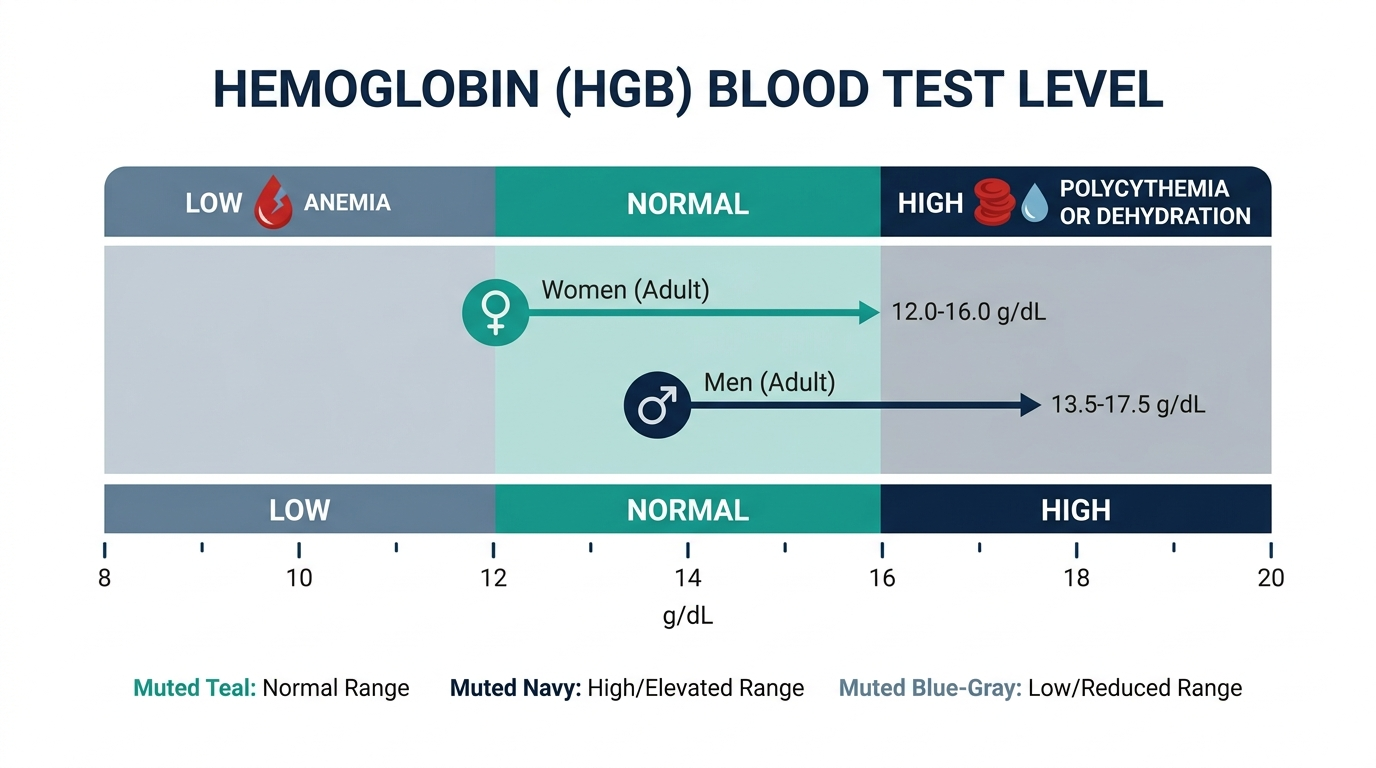
Numbers are easier to act on when you connect them to how you feel. Because hemoglobin is about oxygen delivery, both directions produce fairly recognizable symptom patterns, though mild cases can be silent.
A low HGB, when it causes symptoms, tends to show up as:
- Fatigue and weakness that rest does not fully fix, the most common complaint by far.
- Shortness of breath, especially on exertion like climbing stairs, as tissues struggle for oxygen.
- Pale skin, gums, or inner eyelids, since hemoglobin is what gives blood its red color.
- A fast or pounding heartbeat, as the heart works harder to move oxygen with fewer carriers.
- Dizziness, headaches, cold hands and feet, and in iron deficiency specifically, unusual cravings for ice or non-food items.
A high HGB, by contrast, can cause symptoms tied to thicker, slower blood:
- Headaches, dizziness, or blurred vision.
- Flushed or reddened skin.
- Itching, sometimes notably after a warm shower, which is a classic clue in polycythemia vera.
- Fatigue and, in more serious cases, an increased tendency to form blood clots.
Certain features are red flags that deserve prompt medical attention regardless of the exact number: chest pain, severe breathlessness, fainting, signs of significant bleeding such as black or bloody stools, or a rapidly dropping hemoglobin. When symptoms and the number disagree, the symptoms guide urgency.
What comes after an abnormal HGB: the anemia workup
A low HGB tells you anemia is present but not why, so it kicks off a focused set of follow-up tests. Understanding this sequence helps you know what to expect and what to ask.
- Mean corpuscular volume (MCV). Already on your CBC, MCV sorts anemia into three families by red cell size, which is the fork in the road that directs everything else.
- Ferritin and iron studies. Ferritin reflects your iron stores, and a low ferritin is the most reliable confirmation of iron deficiency, the world’s most common cause of anemia.
- Reticulocyte count. This measures young red cells and shows whether your bone marrow is responding appropriately. A high count means the marrow is trying to compensate, often for blood loss or destruction; a low count means the marrow itself is underproducing.
- Vitamin B12 and folate. Checked when cells are large, since deficiency of either starves the marrow of building materials.
- Kidney function and other tests as the picture directs, since chronic kidney disease and chronic inflammation are common causes of anemia that does not fit a simple deficiency.
This is why a single low HGB rarely ends with a prescription on the same day. It points the way, and the follow-up panel names the actual problem so treatment targets the real cause rather than guessing.
How red cell size classifies anemia
The pairing of HGB with MCV is the single most useful move in reading a CBC for anemia, because cell size narrows a long list of causes into a short one. Here is the map clinicians carry in their heads.
| MCV pattern | Cell size | Typical causes |
|---|---|---|
| Low MCV (under about 80 fL) | Microcytic, small cells | Iron deficiency and thalassemia most often, since both impair hemoglobin building. |
| Normal MCV (about 80 to 100 fL) | Normocytic, normal-size cells | Acute blood loss, chronic disease and inflammation, kidney disease, and some marrow problems. |
| High MCV (over about 100 fL) | Macrocytic, large cells | Vitamin B12 or folate deficiency, significant alcohol use, some thyroid and marrow disorders. |
So a low HGB with small cells and a low HGB with large cells send your clinician down entirely different diagnostic paths, even though the headline anemia number might look similar. This is exactly why HGB is never interpreted alone, and why the humble MCV sitting a few lines down on your report is one of the most powerful clues on the whole page.
Everyday factors that shift your hemoglobin
Several ordinary, non-disease factors move HGB, and knowing them prevents both false alarm and false reassurance.
- Hydration. Dehydration concentrates the blood and can lift HGB, sometimes enough to mask a true anemia. Overhydration or a large IV fluid load can dilute it and make HGB look lower than your real status.
- Altitude. Living at high altitude prompts the body to make more red cells to compensate for thinner air, so long-term high-altitude residents run higher hemoglobin, and reference expectations are adjusted accordingly.
- Smoking. Carbon monoxide from smoking binds hemoglobin far more tightly than oxygen, and the body responds by producing more hemoglobin, nudging the baseline up in regular smokers.
- Pregnancy. Plasma volume expands more than red cell mass during pregnancy, which dilutes hemoglobin. This physiologic or dilutional anemia is expected, and pregnancy uses its own lower cutoffs, generally under 11 g/dL in the first trimester and under about 10.5 g/dL in the second and third.
- Sex and age. Adult men typically run higher than women, and children have their own age-specific ranges, which is why comparing your number to a friend of a different sex or age can mislead.
None of these mean the test is unreliable. They mean a borderline value should be read in light of your hydration, altitude, smoking status, and life stage before anyone concludes anything.
Common misconceptions about hemoglobin
A handful of beliefs lead people astray when they read this number.
- “HGB counts my red blood cells.” It does not. HGB measures the oxygen-carrying protein concentration, while a separate line counts the cells. You can have a normal cell count and still be anemic if each cell is underfilled with hemoglobin.
- “A normal HGB means my blood is definitely fine.” Not always. Dehydration can lift a truly low value into the normal band, and a hemoglobin that has drifted down within the normal range can still signal a quiet problem. Your own trend often matters more than the population range.
- “A high HGB always means a serious disease.” Frequently it is just dehydration, which resolves with fluids. True red cell excess from altitude, smoking, lung disease, or a marrow disorder is a separate and less common story.
- “Low hemoglobin always means I need iron.” Iron deficiency is the most common cause but far from the only one. Taking iron for a B12-related or blood-loss anemia can delay finding the real problem. The cause should be identified first.
- “One number tells the whole story.” HGB is the headline, but the diagnosis lives in the combination of HGB, hematocrit, MCV, and the follow-up panel. One line is a starting point, not a conclusion.
The recurring lesson is the one experienced clinicians lean on: read HGB as the most important single number on your CBC, but always in the company of the indices beside it, your symptoms, your history, and your own past results. If you build one habit, make it this: when you see your hemoglobin, glance immediately at the MCV a few lines down, check whether you were well hydrated at the draw, and compare the value against your own earlier reports rather than against a single population range. That small routine turns a confusing abbreviation into a genuinely useful reading of how well your blood is doing its most fundamental job.
Tracking your hemoglobin over time, not just at one draw
One of the most practical shifts you can make is to stop reading each hemoglobin as a pass or fail against a wide population range and start reading it against your own history. Two people can both sit inside the normal band while one is perfectly steady and the other has quietly dropped a point or more from their usual baseline, and only the trend reveals the difference.
- Keep your old results. A hemoglobin of 14 g/dL is reassuring if you always run near 14, but potentially worth a look if your baseline was closer to 16. Your prior reports are the reference range that matters most.
- Compare like with like. Hydration, time of day, and posture all nudge the value a little. When you want to know whether a change is real, look at draws taken under similar conditions rather than a well-hydrated morning against a dehydrated afternoon.
- Watch the direction, not a single dip. A one-off value slightly off your normal is common and often means nothing. A steady drift downward across several tests is the pattern that deserves attention, because it can signal slow blood loss or a developing deficiency before you feel any symptom.
- Glance at the indices each time. Pairing every hemoglobin with the MCV a few lines down lets you spot early whether cells are becoming smaller or larger, which often changes before the hemoglobin itself falls out of range.
The habit that ties this together is simple. When a new CBC arrives, do not just check whether hemoglobin is in range, line it up against your last few results and note the direction of travel. That single practice turns a static number into a moving picture of how well your blood is doing its most fundamental job, and it catches quiet problems far earlier than a single snapshot ever could.
Frequently asked questions
What is a HGB blood test and what does it check?
A HGB blood test measures the amount of hemoglobin, the oxygen-carrying protein in your red blood cells, usually as part of a complete blood count (MedlinePlus). It is mainly used to screen for and gauge the severity of anemia, and it can also flag an unusually high hemoglobin level.
What is a normal HGB level?
A normal hemoglobin level is roughly 14.0 to 17.5 g/dL for adult men and about 12.3 to 15.3 g/dL for adult women, though ranges vary by lab, age, and sex (Cleveland Clinic). Always compare your result to the reference range printed on your own report.
What does it mean if my HGB is low?
A low HGB means anemia, or fewer red cells carrying oxygen, most often from iron deficiency, blood loss, or vitamin B12 or folate deficiency (Cleveland Clinic). The number shows how low you are but not the cause, so your clinician will usually order follow-up tests.
Is a high HGB dangerous?
A high HGB can make blood thicker and is worth investigating, but it is often caused by something benign like dehydration (Cleveland Clinic). Other causes include high altitude, lung disease, smoking, and a bone marrow disorder called polycythemia vera (NCBI StatPearls).
Is HGB the same as a complete blood count?
No. HGB is one measurement within a complete blood count, which also reports your red and white cell counts, hematocrit, platelets, and red cell indices (MedlinePlus). HGB is usually the headline number for diagnosing anemia, but it is read alongside the rest.
This article is for general educational purposes and is not medical advice. It cannot diagnose or treat you and does not replace your clinician. Always discuss your lab results and any health decisions with a qualified healthcare professional.
Vital Signs Today may earn a commission if you buy through links on this page. It does not affect our editorial assessments.