Related: Creatinine levels by age: chart
You got your lab report back, scanned the comprehensive metabolic panel, and there it was sitting between BUN and glucose: creatinine, with a small decimal number next to it. No flag, no asterisk, so you moved on. But creatinine is quietly one of the most important numbers on the whole page. It is the single value most doctors glance at first when they want to know one thing: how well are your kidneys actually working?
Here is what most explainers get wrong. They treat creatinine like a standalone score, when in reality it is only half of a two-part story. Understand both halves and you will read your own kidney health far better than the report itself lets on.
Part of our Comprehensive Metabolic Panel guide.
What is creatinine in blood test results?
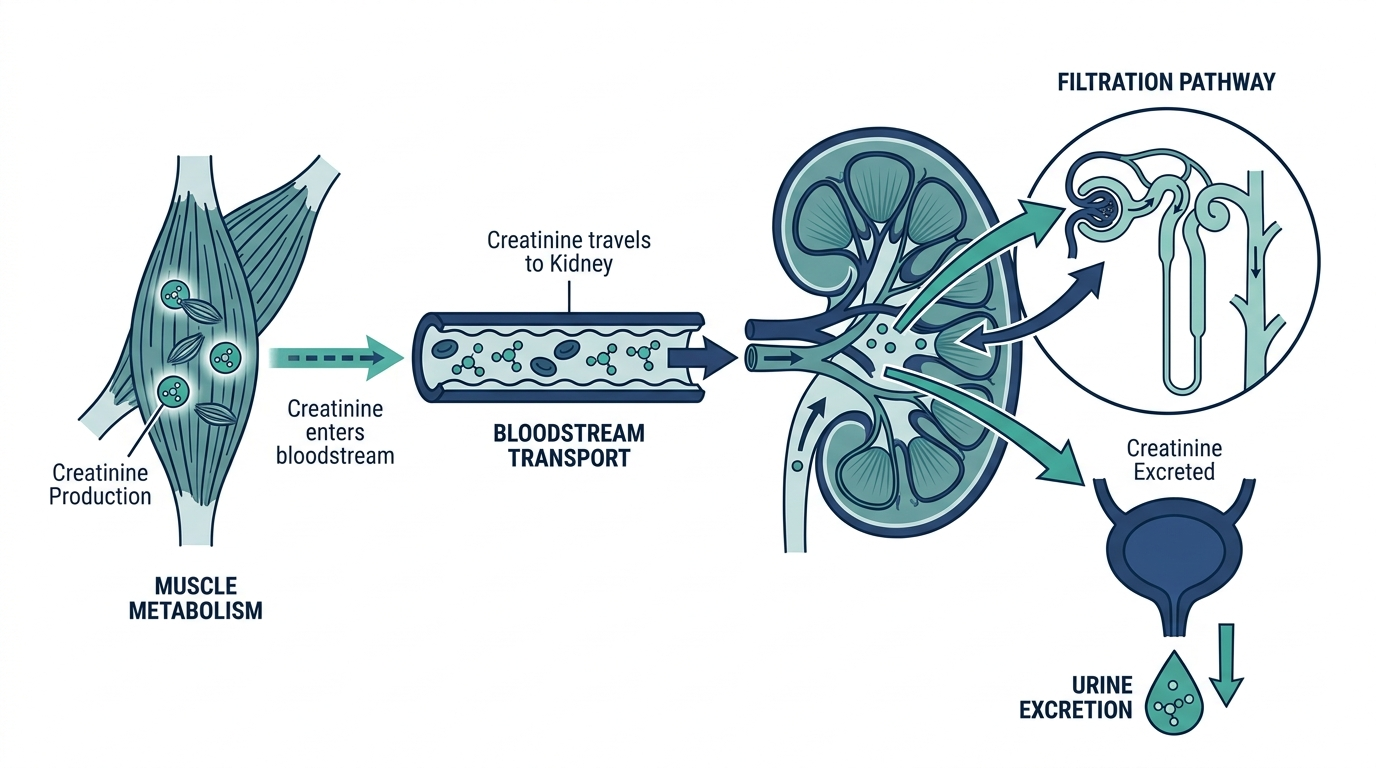
Creatinine is a waste product your body makes when you use your muscles, and the creatinine in blood test results tells you how well your kidneys are clearing that waste out (MedlinePlus). Every day your muscles break down a compound called creatine for energy, and creatinine is the leftover. Healthy kidneys filter it from your blood and flush it out in urine, so the level in your blood stays low and steady. When kidneys slow down, creatinine has nowhere to go and starts building up in the bloodstream.
That single mechanism is the key to everything below. Creatinine production is fairly constant from day to day, so a rise in your blood level usually points back to the kidneys, not to a sudden surge in waste. In plain terms: creatinine is a backed-up-drain signal. The more it pools in your blood, the more it suggests the filter is clogged.

What does creatinine mean in a blood test, and why is it measured?
When you ask what does creatinine mean in a blood test, the short answer is that it is the most widely used everyday marker of kidney function. It is measured because creatinine has two properties that make it an almost perfect natural tracer. Your body produces it at a steady rate, and your kidneys are responsible for removing nearly all of it (MedlinePlus).
That is why a creatinine blood test shows up on routine panels and why your clinician orders it to screen for kidney disease, to monitor a known kidney condition, and to check whether a medication is straining your kidneys (MedlinePlus). It is cheap, it is fast, and it gives a real-time read on filtration. Doctors also use the same value to track trends over time, because a creatinine that is slowly creeping up across several years of bloodwork can matter more than any single result.
What is a creatinine blood test, and how does it differ from creatinine clearance?
A creatinine blood test, sometimes called serum creatinine, measures the amount of creatinine in a sample of your blood (MedlinePlus). It is a simple blood draw, usually bundled into a basic or comprehensive metabolic panel, so most people never order it on its own. They just get it automatically.
There is a close cousin worth knowing. Creatinine clearance and the 24-hour urine creatinine test measure how much creatinine your kidneys move out of your blood and into your urine over a set period, which gives a more direct picture of filtering capacity. The blood test answers how much is in the tank right now. The clearance test answers how fast the pump is working. For everyday screening, the blood version is the workhorse, and it feeds directly into the calculation that actually matters most, your eGFR.

What is a normal creatinine level in blood test ranges?
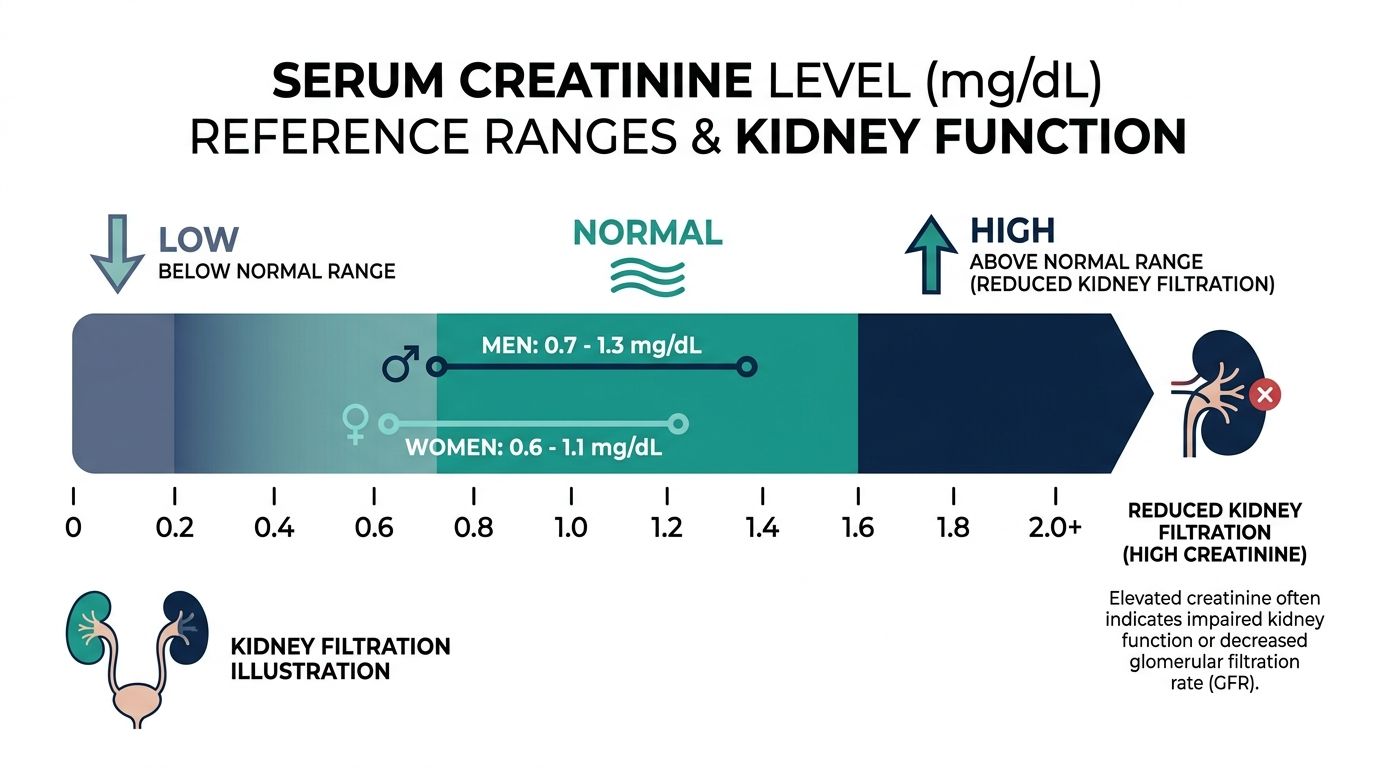
A normal creatinine level in blood test ranges is typically low, on the order of about 0.58 to 0.96 mg/dL, though the exact cutoffs vary by laboratory, by sex, and by how much muscle you carry (Cleveland Clinic). Men generally run higher than women because they tend to have more muscle mass, and a healthy, very muscular athlete can sit above the standard range without anything being wrong.
This is exactly why the National Kidney Foundation says a single normal creatinine number is hard to define cleanly, because it shifts with age, sex, and body size (National Kidney Foundation). The practical move is the same one good clinicians make: read your result against the reference range printed on your own report, and pay attention to the direction it is trending across past tests rather than fixating on one decimal.
What does a high creatinine level mean?
A high creatinine level usually means waste is building up because your kidneys are not filtering it out as well as they should (MedlinePlus). It is a signal, not a diagnosis by itself, and it points to a short list of common causes:
- Kidney disease or damage, the reason clinicians worry about high creatinine in the first place, where the filtering units simply cannot keep up (MedlinePlus).
- Reduced blood flow to the kidneys, for example from dehydration, heart failure, or a urinary blockage, which slows filtration even if the kidneys themselves are healthy.
- Medications that stress the kidneys, which is one reason your clinician rechecks creatinine after starting certain drugs (MedlinePlus).
- Non-kidney causes, such as dehydration, a very high-meat meal before the draw, intense exercise, or naturally high muscle mass, all of which can nudge creatinine up without any kidney problem at all.
Here is the insider point that rarely makes it into the patient version. Creatinine is a surprisingly insensitive early warning system. You can lose a meaningful chunk of kidney function before serum creatinine ever climbs out of the normal range, because the remaining nephrons compensate and keep the blood level looking fine. Research on otherwise healthy people has even found that upper-normal creatinine, still technically inside the reference range, predicts a higher future risk of chronic kidney disease (PMC, upper-normal creatinine and CKD risk). So a creatinine sitting at the high end of normal is not automatically a green light. It can be the first faint shadow of a problem that the report itself will not flag.

What does a low creatinine level mean?
A low creatinine level is usually nothing to worry about, and it often just reflects lower muscle mass rather than any disease (MedlinePlus). Because creatinine comes from muscle, people with less muscle, including many older adults, smaller-framed people, and those who have lost weight or muscle, tend to run lower. Pregnancy can also lower creatinine.
There is no recognized condition defined by a low creatinine on its own, and a low result generally does not point to a kidney problem. If your creatinine is on the low side and the rest of your panel looks unremarkable, it is usually not something to chase. The one caveat worth knowing is the flip side of the muscle issue: in a frail person with very little muscle, a creatinine that looks reassuringly normal can actually be masking reduced kidney function, which is exactly why doctors do not stop at creatinine alone.
Why is creatinine read together with eGFR?
Creatinine rarely tells the full story by itself, so clinicians plug it into a formula to calculate eGFR, the estimated glomerular filtration rate, which is the number that actually classifies kidney health (Cleveland Clinic). The eGFR equation takes your blood creatinine and adjusts it for your age, sex, and body factors, which is how it corrects for the muscle-mass problem that makes raw creatinine misleading.
This pairing is the real engine of kidney testing. Where creatinine is a single waste-level reading, eGFR translates it into a percentage-style estimate of how well your kidneys filter:
- eGFR of 90 or higher: generally normal kidney function (National Kidney Foundation).
- eGFR of 60 to 89: early or mild kidney damage, especially if other signs are present (Cleveland Clinic).
- eGFR of 15 to 59: moderate to severe loss of kidney function (Cleveland Clinic).
- eGFR below 15: kidney failure, which is life-threatening without dialysis or a transplant (Cleveland Clinic).
A diagnosis of chronic kidney disease generally requires an eGFR of 60 or lower that persists for more than three months, not a single low reading (Cleveland Clinic). Note the direction reverses between the two numbers: higher creatinine is worse, but higher eGFR is better. That flip trips up a lot of people reading their own results, so it is worth fixing in your mind. When creatinine goes up, eGFR goes down, and it is the eGFR your doctor uses to stage anything serious. For people with high muscle mass where creatinine can mislead, a cystatin C test is sometimes added to get a clearer picture (National Kidney Foundation).

Creatinine and BUN: the two-number kidney check
On a metabolic panel, creatinine almost always sits right next to BUN, or blood urea nitrogen, and the two are meant to be read as a pair. BUN measures a different nitrogen-containing waste that comes from protein breakdown, and comparing the two adds information that neither gives alone. Clinicians often look at the BUN-to-creatinine ratio, which in adults typically runs somewhere around 10 to 20 to 1.
- High ratio, high BUN relative to creatinine: often points to a cause outside the kidney itself, most commonly dehydration or reduced blood flow to the kidneys. Fix the fluid problem and the numbers often settle.
- Normal ratio with both rising together: is more suggestive of a problem within the kidney tissue itself.
- Low BUN with normal creatinine: is usually harmless and can reflect low protein intake, overhydration, or liver factors.
This is why your doctor does not react to creatinine in isolation. The pattern across creatinine, BUN, and eGFR, read together, is what separates a passing dehydration blip from genuine kidney strain.
Symptoms that can accompany a high creatinine
A mildly elevated creatinine usually causes no symptoms at all, which is why kidney disease is often called a silent condition and why routine bloodwork catches it before you feel anything. When creatinine is high because kidney function is genuinely reduced, the symptoms that appear are the downstream effects of waste and fluid building up, not of the creatinine itself. According to the National Kidney Foundation, these can include:
- Swelling in the legs, ankles, or around the eyes as fluid is retained
- Fatigue, trouble concentrating, or a general washed-out feeling
- Changes in urination, such as urinating more or less than usual, or foamy urine
- Poor appetite, nausea, or a metallic taste
- Persistent itching or muscle cramps in more advanced cases
None of these is specific to the kidney, which is exactly why the blood number matters. If you have a high creatinine alongside any of these symptoms, that combination deserves prompt medical review rather than watchful waiting.
How to prepare, and what can throw the result off
Creatinine is one of the more preparation-sensitive numbers on a routine panel, and a handful of everyday things can nudge it up or down enough to matter. If you want your result to reflect your true baseline, keep these in mind:
- Meat before the draw: a large serving of cooked red meat in the hours before your test can transiently raise creatinine, because cooking converts some creatine in the meat to creatinine that you then absorb. For a clean baseline, avoid a heavy meat meal right before testing.
- Hydration: being dehydrated concentrates your blood and can push creatinine up. Ordinary hydration before a draw is fine and, if anything, helpful.
- Intense exercise: a hard workout in the day or two before the test can raise creatinine because of muscle turnover. If your number looks high after a heavy training block, that context matters.
- Creatine supplements: the popular gym supplement can modestly raise measured creatinine. This is a lab effect, not kidney damage, but it is worth mentioning to your clinician so the number is read correctly.
- Fasting: creatinine itself does not strictly require fasting, but it usually rides along on a comprehensive metabolic panel that includes glucose, so you may be asked to fast 8 to 12 hours for the panel as a whole.
Because these factors are common and reversible, a single high creatinine is almost always confirmed with a repeat draw under cleaner conditions before anyone concludes there is a kidney problem.
What to do after a high creatinine result
A single high creatinine is a prompt to investigate, not a diagnosis. Here is the sensible sequence, and what you can do on your side.
- Confirm with a repeat test and your eGFR. One value can be a fluke from dehydration, a meaty dinner, or a hard workout. A repeat, read together with eGFR, tells you whether it is real and persistent.
- Review your medications with a clinician. Some common drugs, including certain anti-inflammatories and blood pressure medications, affect creatinine or kidney function. Do not stop anything on your own, but bring the full list to your appointment.
- Address the reversible drivers. Rehydrate, manage blood pressure and blood sugar, and follow your clinician’s guidance on protein and salt. Blood pressure and diabetes are the two biggest drivers of chronic kidney disease, so controlling them protects the kidneys directly.
- Track the trend. Because creatinine is a late warning sign, the direction it moves over months and years is more telling than any one number. A creatinine slowly climbing across annual panels deserves attention even while each value still reads normal.
Who should test creatinine, and how often
Creatinine is part of most routine metabolic panels, so many people get it checked at their annual physical without asking. Testing more deliberately makes sense if you carry higher risk for kidney problems. Consider more regular monitoring if you:
- Have diabetes or high blood pressure, the two leading causes of kidney disease
- Have a family history of kidney disease
- Take medications that can affect the kidneys long term
- Have heart disease or a history of kidney stones or urinary problems
- Are older, since kidney function naturally declines with age
For people with those risk factors, a periodic creatinine and eGFR, often paired with a urine test for protein called the urine albumin-to-creatinine ratio, is the standard way to catch a slow decline early, while it is still manageable. Protein leaking into the urine can appear before creatinine ever moves, which is why the urine test complements the blood test rather than duplicating it. For everyone else, seeing creatinine on a yearly panel and watching the trend across years is usually enough. The through-line is the same in every case: read creatinine with eGFR and BUN, watch the direction of travel, and confirm any surprise with a clean repeat draw before you worry. A single decimal on one report tells you far less than the same number tracked across several years, so the habit of keeping your past results and comparing them is one of the most useful things a non-specialist can do for their own kidney health.
Common misconceptions about creatinine
The most persistent misconception is that creatinine is a pure measure of kidney health, a number that rises only when the kidneys fail. It is not. Creatinine is a byproduct of muscle turnover, so how much you make each day is tied to how much muscle you carry. A heavily muscled athlete can run a creatinine at the high end of normal with flawless kidneys, while a frail older adult with little muscle can sit comfortably in range even as kidney function quietly declines. The number reflects both the tap that makes creatinine, meaning muscle, and the drain that clears it, meaning the kidneys, and reading only the drain misses half the picture.
That leads to a second misunderstanding, that everyone shares the same normal range. Reference values run lower for women, who on average carry less muscle and therefore produce less creatinine, and they tend to drift down with age as muscle mass falls. Muscle mass also varies across populations, which is one reason a single printed cutoff can mislead. The practical takeaway is that a creatinine value means the most when it is read against your own body and your own prior results, not against a one size number.
A third misconception is that a normal creatinine guarantees healthy kidneys. Because the number depends so heavily on muscle, it can stay normal until a fair amount of kidney function is already lost, which is exactly why clinicians pair it with eGFR and, in tricky cases, with cystatin C. Cystatin C is a marker that is far less swayed by muscle mass, so it is especially useful in bodybuilders, in people with muscle wasting, and in anyone whose creatinine seems out of step with how they feel. Finally, a single high reading is not a diagnosis. Dehydration, a big protein meal, intense exercise, and certain medications can all lift creatinine temporarily, so the honest next step after one high value is usually a repeat under calmer conditions rather than alarm.
Frequently asked questions
Is a high creatinine level something to worry about?
Not on its own. A high creatinine is a signal, not a diagnosis. It most often points to reduced kidney filtering, but it can also rise from dehydration, certain medications, intense exercise, a high-meat meal, or simply having a lot of muscle (MedlinePlus). Your clinician interprets it alongside your eGFR and the rest of your panel before drawing conclusions.
What is a normal creatinine level in a blood test?
Normal serum creatinine is generally low, around 0.58 to 0.96 mg/dL, though ranges vary by lab, sex, and muscle mass (Cleveland Clinic). Men typically run higher than women. Always compare your result to the reference range printed on your own report.
Can creatinine be high without kidney disease?
Yes. Dehydration, a recent high-protein or high-meat meal, strenuous exercise, some medications, and naturally high muscle mass can all raise creatinine without any kidney problem (MedlinePlus). That is why doctors confirm with eGFR and repeat testing rather than reacting to one number.
What is the difference between creatinine and eGFR?
Creatinine is the raw amount of waste in your blood, while eGFR uses that creatinine plus your age and sex to estimate how well your kidneys actually filter (Cleveland Clinic). Higher creatinine is worse, but higher eGFR is better, and eGFR is the number used to stage kidney disease.
Should I be concerned about a low creatinine level?
Usually no. A low creatinine most often reflects lower muscle mass and is not considered a sign of kidney disease on its own (MedlinePlus). It can also occur in pregnancy. If the rest of your panel is normal, it is generally not a cause for concern.
This article is for general educational purposes and is not medical advice. It cannot diagnose or treat you and does not replace your clinician. Always discuss your lab results and any health decisions with a qualified healthcare professional.
Vital Signs Today may earn a commission if you buy through links on this page. It does not affect our editorial assessments.