Related: See the eGFR reference chart by age and sex
You scanned your blood work, saw your cholesterol, your glucose, maybe a flagged number or two, and then near the bottom you hit a line labeled eGFR with a value like 92 next to it. No asterisk, no warning, so you moved on. Here is what almost nobody explains. That one number is the single best snapshot of how well your kidneys are filtering your blood right now, and it is doing it quietly in the background of nearly every routine panel you have ever had.
Most people never look at it until a doctor frowns. By then the number has usually been trying to tell a story for years. Let us read it properly.
Part of our Comprehensive Metabolic Panel guide.
What is eGFR in a blood test?
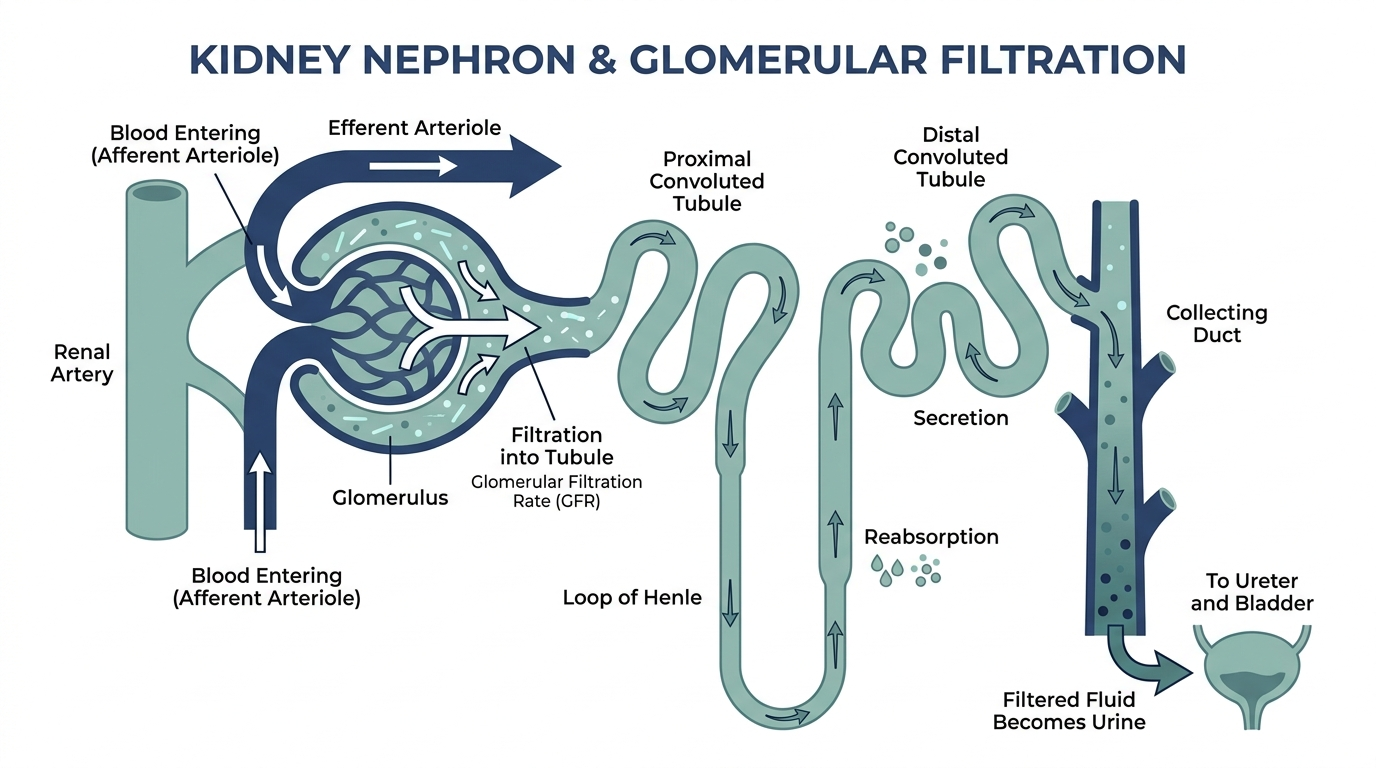
eGFR is a calculated estimate of how much blood your kidneys filter every minute, and it is the main number doctors use to grade kidney function and stage kidney disease (National Kidney Foundation). It is not measured directly. Instead, a lab takes the creatinine level from your blood and runs it through a formula that also factors in your age and sex (MedlinePlus). The output is a single number, and in adults a result above 90 is considered normal.
In plain terms, what is eGFR in a blood test really telling you? It is a filtration score for your kidneys. Higher is better. A high eGFR means your kidneys are clearing waste efficiently. A falling eGFR means the filters are losing capacity, and that is the early warning sign clinicians watch most closely.

What does eGFR stand for in a blood test?
eGFR stands for estimated glomerular filtration rate. Each word does real work, so it is worth unpacking. The glomeruli are roughly a million tiny filtering units inside each kidney. Glomerular filtration rate is the speed at which those units strain waste and excess fluid out of your blood, reported in milliliters per minute per 1.73 square meters of body surface area (Cleveland Clinic). The word estimated matters too. The true rate is hard to measure directly, so the eGFR you see on your report is a calculation, not a stopwatch reading.
So when people ask what does eGFR mean in a blood test, the honest answer is this. It is the lab’s best mathematical guess at your filtration speed, built from your blood creatinine and a few personal details.
How is a eGFR blood test actually done?
A eGFR blood test is just a standard blood draw. A healthcare professional takes blood from a vein in your arm, usually in under five minutes, and the lab measures the creatinine in that sample (MedlinePlus). Creatinine is a waste product from the normal wear and tear of your muscles. When your kidneys filter well, creatinine stays low. When filtering slows, creatinine builds up in the blood, which is exactly why it works as a proxy for kidney function.
The lab then feeds that creatinine value, plus your age and sex, into a validated formula and prints the eGFR (National Kidney Foundation). You do not need a separate appointment for it. eGFR is bundled into the basic and comprehensive metabolic panels that come with most routine checkups, which is why you likely already have several old eGFR values sitting in your records. Some labs also use cystatin C, a protein marker that is not affected by muscle size, age, or diet, when a more precise estimate is needed (MedlinePlus).
What is a normal eGFR level?
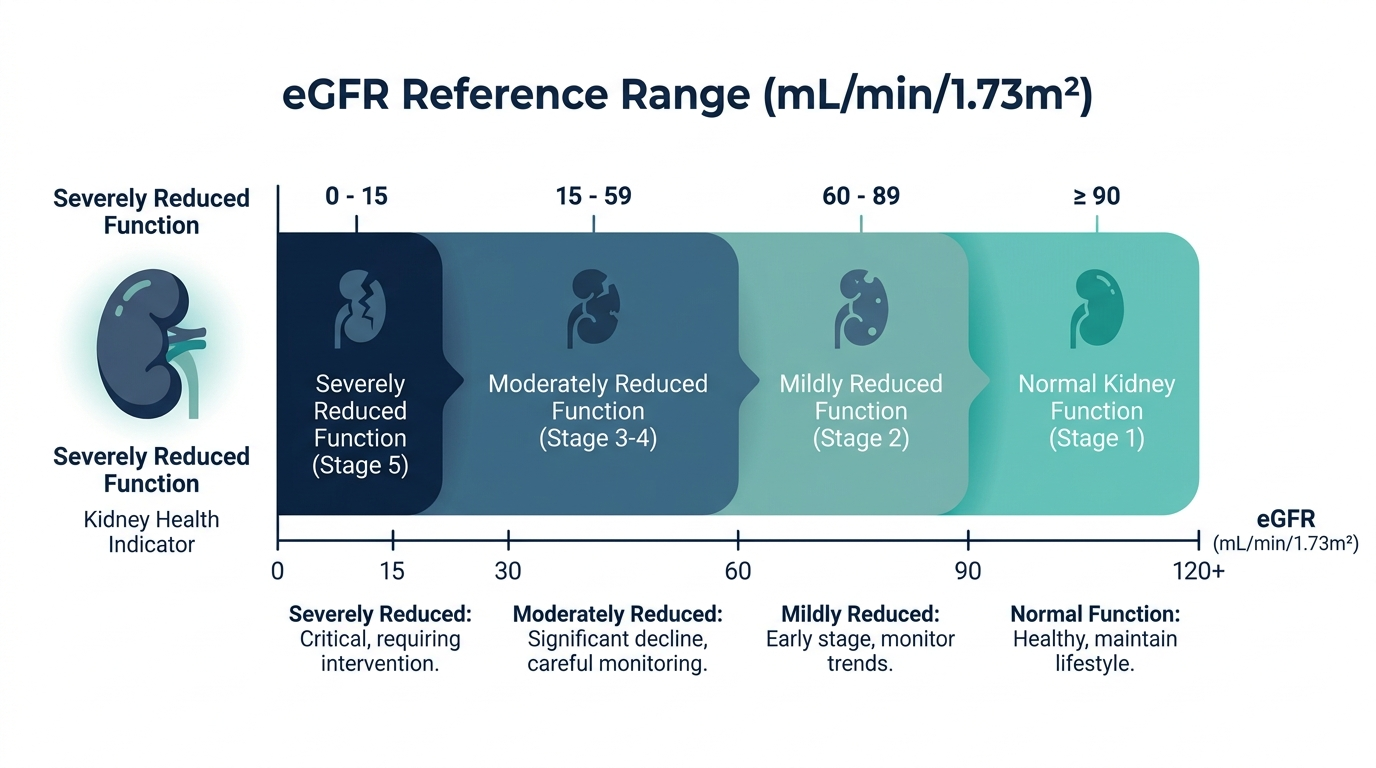
In adults, a normal eGFR is generally above 90 (National Kidney Foundation). A value of 90 or higher with no other signs of kidney damage points to kidneys that are working well. The number that triggers concern is 60. An eGFR that stays below 60 for three months or longer is a defining criterion for chronic kidney disease (Cleveland Clinic).
Here is a detail that trips people up. eGFR naturally declines with age, even in healthy kidneys. Cleveland Clinic lists typical values that drop across the decades: around 116 in your twenties, about 99 in your forties, roughly 85 in your sixties, and near 75 at age 70 and beyond (Cleveland Clinic). So a 70 year old with an eGFR of 78 and a 25 year old with an eGFR of 78 are not in the same situation. Always read your number against your age and the reference range on your own report.

What does a low eGFR mean?
A low eGFR means your kidneys are filtering less blood than they should, and the lower the number, the more filtering capacity has been lost (MedlinePlus). Doctors translate the number into stages of chronic kidney disease, and those stages are the practical roadmap (National Kidney Foundation):
- Stage 1, eGFR 90 or above: normal filtration, but possible early kidney damage detected another way, such as protein in the urine.
- Stage 2, eGFR 60 to 89: mild loss of function. Often no symptoms.
- Stage 3a, eGFR 45 to 59, and Stage 3b, eGFR 30 to 44: mild to moderate then moderate to severe loss. This is where many people first get a kidney disease diagnosis.
- Stage 4, eGFR 15 to 29: severe loss. Time to plan ahead with a nephrologist.
- Stage 5, eGFR below 15: kidney failure, the point where dialysis or transplant enters the conversation (National Kidney Foundation).
One important nuance. A single low reading is not a diagnosis. eGFR can dip temporarily from dehydration, certain medications, or even a very high protein meal before the draw. That three month rule exists precisely because the diagnosis hinges on a sustained drop, not a one off blip (Cleveland Clinic).
What does a high eGFR mean?
A high eGFR, above 90, is generally the result you want. It signals kidneys that are filtering efficiently and is the normal range for healthy adults (National Kidney Foundation). There is no recognized disease defined by an eGFR that is simply high. If your number sits comfortably above 90 and the rest of your kidney picture, including urine tests, looks clean, that is reassuring.
One caveat worth knowing. Because the calculation leans on creatinine, which comes from muscle, eGFR can occasionally read deceptively high in people with very low muscle mass, such as frail older adults. The reverse is also true. A heavily muscular person can have a slightly lower eGFR without any real kidney problem. This is one reason creatinine based eGFR is an estimate and not the final word.
Why is eGFR read together with urine and creatinine?
eGFR rarely tells the whole story by itself. Clinicians pair it with a urine test for protein, usually the albumin to creatinine ratio, because the two measure different kinds of kidney trouble (National Kidney Foundation). eGFR captures filtering speed. Urine albumin captures whether the filters are leaking. You can have early kidney damage with a still normal eGFR but rising albumin, which is exactly why doctors order both.
The serum creatinine on your panel is the raw ingredient behind the eGFR, so the two move in opposite directions. As creatinine climbs, eGFR falls. Reading them side by side, along with the trend over time, is far more telling than any single value. A stable eGFR of 75 for ten years is a very different signal than an eGFR that slid from 95 to 75 in eighteen months.

The part most people never hear: your eGFR number changed in 2021
Here is the insider detail that even many patients with kidney disease have never been told. For more than two decades, the standard eGFR formula included a race coefficient that automatically raised the estimated kidney function of Black patients. In 2021, after a major review, the National Kidney Foundation and the American Society of Nephrology recommended a new race free CKD-EPI equation, and labs across the country have been switching to it (National Kidney Foundation).
Why does this matter to you, practically? Because the old equation could make some Black patients look like they had healthier kidneys than they actually did, which delayed diagnoses, referrals, and transplant eligibility. The new race free equation was judged to be the most equitable approach and was recalibrated around age, sex, and creatinine alone (PMC, 2021 race-free eGFR equations). The catch is that during the changeover, the same creatinine value can produce a different eGFR depending on which formula your lab uses, and for some people the result can shift by more than 10 percent, especially at higher eGFR values and in younger adults (National Kidney Foundation).
The takeaway is concrete. If you are comparing an eGFR from a few years ago to a recent one, a small change might reflect the new formula rather than your kidneys. It is a fair and useful question to ask your clinician: which equation produced this number?
What can throw off your eGFR, and how to prep
Because eGFR is calculated from creatinine, anything that changes your creatinine, temporarily or artificially, moves your eGFR without your kidneys changing at all. Knowing these factors keeps you from misreading a one-off result.
- A big protein or cooked-meat meal before the draw. Cooking meat converts some creatine to creatinine, and eating a large portion shortly before a blood test can transiently raise creatinine and lower your eGFR. For a cleaner read, avoid a heavy meat meal right before testing.
- Intense exercise. A hard workout in the day before the draw can bump creatinine from muscle breakdown, nudging eGFR down temporarily.
- Dehydration. Being low on fluids concentrates the blood and can lower eGFR, which is one reason a single low value is often rechecked after rehydration.
- Creatine supplements. Popular in fitness, creatine can raise blood creatinine and lower the estimated GFR even when the kidneys are healthy. Tell your clinician if you take it.
- Muscle mass extremes. Very muscular people can read a lower eGFR and frail, low-muscle people a deceptively higher one, since creatinine tracks muscle. This is where a cystatin C based estimate, which does not depend on muscle, can give a truer picture.
The practical prep: stay normally hydrated, skip a large meat meal and hard exercise right before the test, and mention creatine or other supplements. Keep your conditions consistent from year to year so your eGFR trend reflects your kidneys, not your habits on test day.
What a declining eGFR feels like (often nothing)
The unsettling truth about early kidney trouble is that it is usually silent. Many people with a falling eGFR feel completely normal until function is substantially reduced, which is exactly why the number matters more than symptoms in the early stages.
When symptoms of reduced kidney function do appear, they tend to be nonspecific and easy to attribute to something else:
- Fatigue and lower energy as waste products accumulate.
- Swelling in the ankles, feet, or around the eyes from fluid the kidneys are not clearing.
- Changes in urination, such as foamy urine (a hint of protein) or needing to go more at night.
- Poor appetite, nausea, or difficulty concentrating in more advanced stages.
- Itchy skin or muscle cramps as mineral balance shifts.
The red-flag principle is that symptoms usually arrive late, so a dropping eGFR caught on routine labs while you feel fine is a gift, not a false alarm. It is the early window in which slowing the decline is most possible. Do not wait to feel sick before taking a downward trend seriously.
Who is at higher risk and how often to check
eGFR is worth watching more closely if you carry the major risk factors for chronic kidney disease. The two biggest drivers, by a wide margin, are diabetes and high blood pressure, which together account for a large share of kidney disease.
Higher-risk groups include people with:
- Diabetes, where high blood sugar damages the delicate filtering units over time.
- High blood pressure, which strains the same small vessels.
- Cardiovascular disease, which shares risk factors and blood-vessel damage with the kidneys.
- A family history of kidney disease.
- Older age, since filtration naturally declines over the decades.
- Long-term use of certain medications, including frequent high-dose NSAID pain relievers.
How often to check depends on your risk. Someone with diabetes or high blood pressure is typically monitored at least annually, and more often if the eGFR is already reduced or trending down, so the pace of change can be seen. For a healthy person with no risk factors, the eGFR bundled into routine metabolic panels at checkups is usually enough. The value of testing is not any single reading, it is the line those readings draw over years.
What to do after a low or falling eGFR
A low or declining eGFR is an invitation to act, and much of what protects kidneys is the same everyday management that protects the heart. The steps below are general and are decided with your clinician, not self-prescribed.
- Confirm it is real. Because a single value can dip from dehydration, a meal, or exercise, a low result is usually repeated and read alongside a urine albumin test before any conclusion.
- Control blood pressure and blood sugar. These are the two most important levers for slowing kidney decline, which is why they are the first thing a clinician addresses.
- Review your medications. Some drugs, including frequent high-dose NSAIDs, can burden the kidneys, and doses of certain medications need adjusting when eGFR falls. Bring your full list to the conversation.
- Stay hydrated and mind protein and salt. Your clinician or a dietitian can tailor guidance, since the right amount depends on your stage and other conditions.
- Track the trend. Watching eGFR and urine albumin over time tells you and your clinician whether the plan is working, which is far more useful than reacting to any single number.
- Know when a nephrologist enters. Persistently reduced or rapidly falling values are when specialist referral is considered, well before any talk of advanced treatment.
The encouraging reality is that catching a downward trend early gives you the most room to change it, and the everyday habits that help are within reach for most people.
Common misconceptions about eGFR
A few misunderstandings cause needless worry or false comfort about this number:
- “One low eGFR means I have kidney disease.” Not necessarily. The diagnosis requires a sustained reduction over three months, since a single value can be a temporary dip.
- “A normal eGFR means my kidneys are perfectly fine.” You can have early kidney damage with a normal eGFR but protein leaking into the urine, which is why the urine albumin test is done alongside it.
- “Higher eGFR is always better.” Above the normal range there is no bonus, and an unusually high value in a frail, low-muscle person can actually mask reduced function because creatinine is low for the wrong reason.
- “My eGFR dropped, so my kidneys got worse.” A change might reflect the 2021 formula switch, dehydration, or a pre-test meal rather than true decline, which is why the trend and the method matter.
Reading eGFR well means holding it as one estimate on a connected panel, interpreted against your age, your urine test, your other markers, and above all your own trend over time.
Creatinine, eGFR, and cystatin C: which kidney number to trust
Your report may carry more than one kidney number, and they are not saying the same thing in different words. Creatinine is the raw measurement, a waste product from muscle that builds up when filtering slows. eGFR is the interpretation, a formula that turns that creatinine into an estimated filtration score adjusted for your age and sex. Reading creatinine alone can mislead, because a muscular person naturally runs a higher creatinine without any kidney problem, while a frail or low-muscle person can have a falsely reassuring creatinine even as filtration declines. The eGFR exists precisely to translate the raw number into something comparable across different bodies.
That translation still leans on creatinine, so it inherits creatinine’s blind spots. This is where cystatin C comes in. Cystatin C is a protein filtered by the kidneys that is far less affected by muscle mass, diet, or age, which makes it a useful cross-check when a creatinine-based eGFR seems out of step with the person in front of the doctor (MedlinePlus). When creatinine-based and cystatin-based estimates disagree, that disagreement is itself informative, and clinicians sometimes combine both for a more reliable picture.
The takeaway is not that one number is right and the others wrong. It is that they answer slightly different questions and check each other. If your eGFR looks surprising given how you feel, a reasonable next step is to ask whether your muscle mass or a recent creatinine-raising factor could be skewing it, and whether a cystatin C estimate would clarify things. A single eGFR from a single creatinine is a good starting point, but the most trustworthy read comes from seeing these markers together and, ideally, tracking them over time rather than judging your kidneys on one line from one day.
Frequently asked questions
What does eGFR mean in a blood test?
eGFR means estimated glomerular filtration rate. It is a calculated estimate of how much blood your kidneys filter each minute, based on your blood creatinine level plus your age and sex (MedlinePlus). It is the main number used to grade kidney function.
What is a normal eGFR level?
In adults, a normal eGFR is generally above 90 (National Kidney Foundation). eGFR also drops naturally with age, so compare your value to your age and the reference range printed on your own report.
Is a low eGFR something to worry about?
A single low reading is a flag, not a diagnosis, since dehydration or medications can lower it temporarily. An eGFR that stays below 60 for three months or longer is a defining criterion for chronic kidney disease (Cleveland Clinic), so a sustained low value should be reviewed by your clinician.
What is the difference between GFR and eGFR?
GFR is the actual filtration rate of your kidneys, which is difficult to measure directly. eGFR is the estimated version calculated from a blood creatinine test and a formula (Cleveland Clinic). On a routine lab report you will almost always see eGFR.
Can eGFR improve?
It can. eGFR can rise again if a temporary cause such as dehydration or a medication is corrected. Lasting damage in established chronic kidney disease is harder to reverse, but managing blood pressure, blood sugar, and the underlying cause can slow or stabilize the decline (National Kidney Foundation).
This article is for general educational purposes and is not medical advice. It cannot diagnose or treat you and does not replace your clinician. Always discuss your lab results and any health decisions with a qualified healthcare professional.
Vital Signs Today may earn a commission if you buy through links on this page. It does not affect our editorial assessments.