
Part of our Complete Blood Count guide.
You got your blood work back, scanned the platelet section, and there it was, tucked under your platelet count: MPV, with a small number in femtoliters next to it. No red flag, no asterisk, so you moved on. Here is what most people never get told. MPV is not measuring how many platelets you have. It is measuring how big they are, and that size carries a story about what your bone marrow is doing right now.
Most explainers shrug MPV off as a throwaway number. Read it the right way, alongside your platelet count, and it becomes one of the more useful clues hiding on your report.
What is MPV in a blood test?
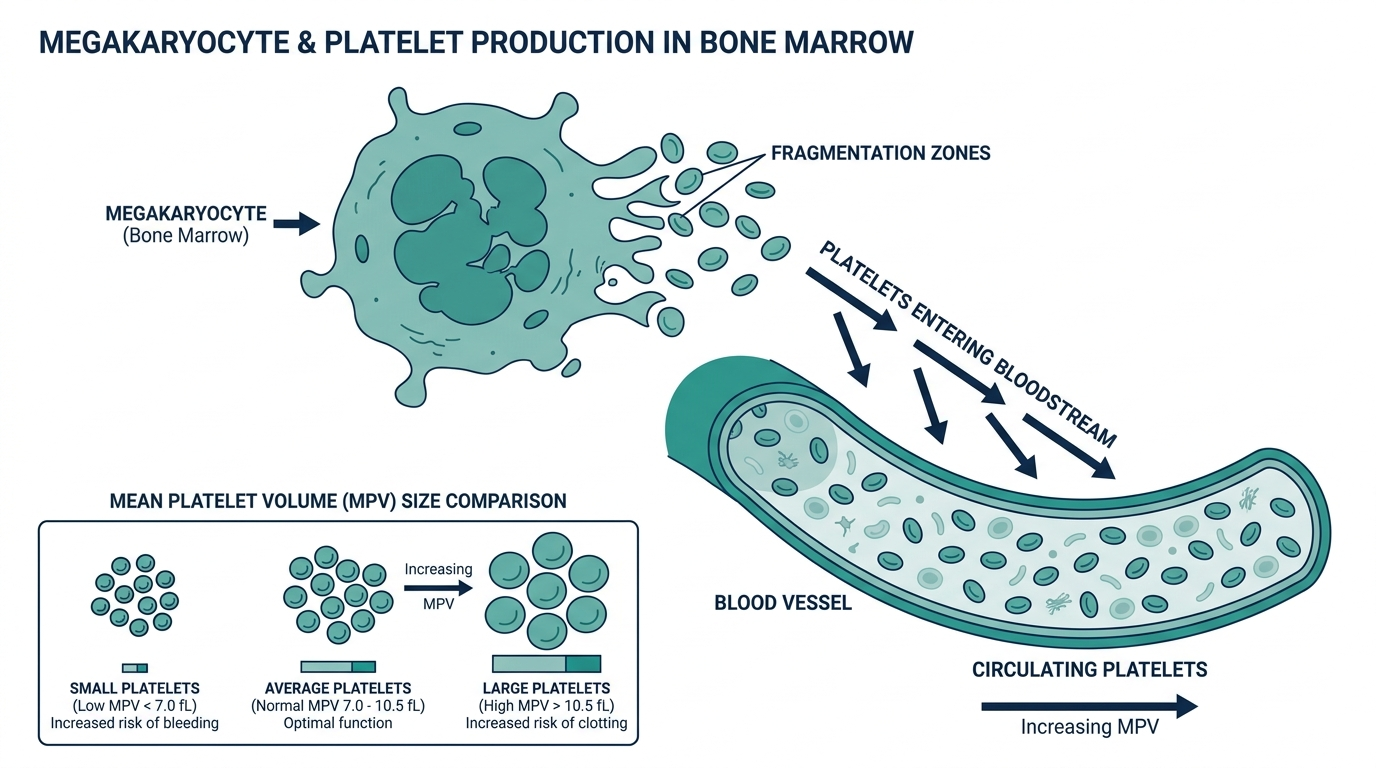
MPV stands for mean platelet volume, and it measures the average size of your platelets, the tiny blood cells that clump together to help your blood clot (Cleveland Clinic). It is reported in femtoliters (fL) and usually shows up right beside your platelet count on a complete blood count. A high MPV means your platelets are larger than average. A low MPV means they are smaller. In plain terms, MPV is a size gauge for your platelets, and a typical adult result sits in single digits.
The key idea to hold onto: MPV does not count your platelets, it sizes them (MedlinePlus). Those are two different questions. One asks how many soldiers you have. The other asks how fresh and how big each one is. The answer to the second question tells your clinician something about how fast your bone marrow is pumping out new platelets.

What does MPV mean in a blood test, and what does it actually measure?
MPV measures the average volume of a single platelet, which is a direct readout of platelet size. Newer platelets are bigger, and older platelets shrink as they age, so the average size becomes a rough clock for how recently your platelets were made (MedlinePlus). When your bone marrow is cranking out fresh platelets in a hurry, the average size climbs, because young platelets are large and reactive.
This is why the question “what is MPV on a blood test” has a more interesting answer than “the size of your platelets.” Size is a proxy for production speed. Larger platelets generally mean active, ramped-up production. Smaller platelets generally mean slower or impaired production. That single number lets a clinician make an educated guess about what is happening inside your marrow without a single needle going into the bone.
What is a normal MPV level?
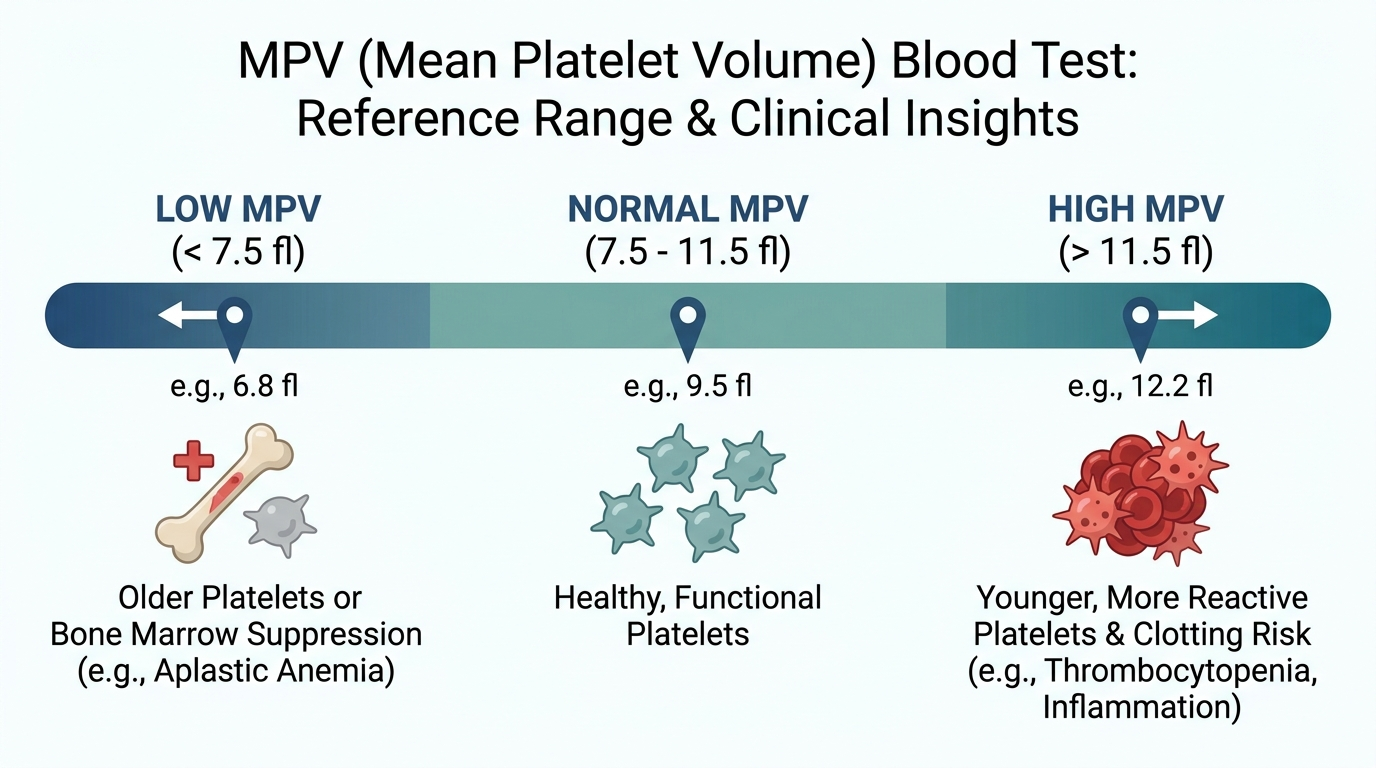
A normal MPV for non-pregnant adults is generally around 7 fL to 9 fL, though the exact cutoff varies by laboratory and the analyzer that ran your sample (Cleveland Clinic). Some labs report a slightly wider band, so the only range that truly matters is the reference range printed on your own report, because that is the one your lab calibrated its machine to.
Here is the practical takeaway. A result a touch above or below the line, with a normal platelet count and no symptoms, is rarely something to chase. MPV becomes meaningful when it is clearly out of range, or when it moves in the opposite direction from your platelet count. That second pattern is where the number earns its keep, and we will get to it below.

What does a high MPV mean?
A high MPV means your platelets are larger than average, which usually signals that your bone marrow is releasing fresh, young platelets faster than normal (Cleveland Clinic). It is a clue, not a diagnosis. Your body ramps up production like this when platelets are being destroyed or used up quickly, so the marrow compensates by shipping out big new ones. Common situations linked to a high MPV include:
- Immune thrombocytopenia (ITP). The immune system destroys platelets, the marrow responds with large young ones, and MPV rises while the count falls (MedlinePlus).
- Recovery after blood loss or platelet consumption, when fresh large platelets flood the bloodstream to rebuild numbers.
- Myeloproliferative conditions, bone marrow disorders that can overproduce platelets of abnormal size (Cleveland Clinic).
- Inflammatory and metabolic conditions such as diabetes, cardiovascular disease, and preeclampsia, where larger, more reactive platelets are commonly seen (MedlinePlus).
Now the insider point that rarely makes the patient version. Larger platelets are not just bigger, they are biologically hotter. Young, large platelets are more metabolically active and more reactive, meaning they clot more readily and release more inflammatory signals than the small old ones (PMC, MPV as a biomarker). That is why a high MPV is not just a marrow status update. It can reflect a more thrombosis-prone, more inflamed state. It is the kind of nuance that vanishes when a report simply says your platelets are normal.
What does a low MPV mean?
A low MPV means your platelets are smaller than average, which often suggests your bone marrow is not producing many new platelets (Cleveland Clinic). Because young platelets are large, a population of small platelets points toward older cells and a quieter marrow. On its own it is not a diagnosis, but it can accompany conditions where platelet production is suppressed or where the marrow itself is struggling.
Conditions linked to a low MPV include aplastic anemia and marrow hypoplasia, where the marrow underproduces; certain autoimmune diseases such as lupus; some inherited platelet disorders; and the effects of certain chemotherapy drugs (Cleveland Clinic, MedlinePlus). As always, a low MPV with an otherwise unremarkable CBC and no symptoms is usually nothing to lose sleep over. The pattern matters more than the single value.

Why is MPV read together with platelet count?
MPV is rarely interpreted alone. Clinicians read it next to your platelet count, because the two together reveal far more than either does by itself (MedlinePlus). Platelet count answers how many. MPV answers how big and how fresh. Combine them and you can often tell whether a low platelet count is a production problem or a destruction problem, which are treated very differently.
A simplified version of how the pair reads:
- Low platelet count with high MPV: often a destruction or consumption problem, such as ITP, where the marrow is working hard and pumping out large young platelets to replace the ones being lost.
- Low platelet count with low MPV: more suggestive of a production problem, where the marrow itself is underperforming and cannot make enough new platelets.
- High platelet count with high MPV: can appear in some myeloproliferative conditions where abnormal large platelets are overproduced.
That first contrast is the whole reason MPV is worth printing. Two people can have the exact same low platelet count, and MPV is one of the cheap signals that helps separate “your immune system is eating your platelets” from “your factory is offline.” One small number, no extra blood draw, real diagnostic value.
The part most people never hear: MPV as a quiet risk signal
This is where MPV graduates from a minor platelet footnote to something genuinely worth watching. A growing body of research treats MPV as a low-cost biomarker that reflects platelet reactivity, inflammation, and clotting risk, not just marrow turnover (PMC, MPV as a biomarker). The thread tying it together is that bigger platelets are younger, hotter, and more prone to forming clots.
The pattern shows up most clearly in heart disease. Elevated MPV has been linked to higher mortality in patients with acute coronary syndromes, and researchers describe it as an independent risk factor for poor prognosis in that setting (PMC, MPV as a biomarker). The proposed mechanism is intuitive once you know that large platelets clot more readily: a person running a higher average platelet size may be in a more thrombosis-prone state, which matters a great deal when the arteries feeding the heart are already narrowed.
MPV has also been studied as a marker of disease activity in chronic inflammatory conditions such as rheumatoid arthritis and inflammatory bowel disease, because reactive platelets release pro-inflammatory signals (PMC, MPV as a biomarker). None of this means a single elevated MPV diagnoses anything. It does not (Cleveland Clinic). But it is a reasonable nudge to look at the rest of the picture, your platelet count, your inflammatory markers, your cardiovascular risk, rather than scroll past three letters you assumed were noise.

The preanalytical catch that makes MPV tricky to trust
Here is a detail that even many patients who study their labs never learn, and it explains why MPV can look different from one draw to the next even when nothing has changed inside you. MPV is unusually sensitive to how the sample is handled after it leaves your arm.
Most blood counts are collected in a tube containing EDTA, the standard anticoagulant. The problem is that platelets slowly swell inside EDTA over time, so the longer the tube sits before the analyzer measures it, the larger the platelets appear. With the common impedance measurement method, MPV can rise noticeably within minutes of the blood hitting the EDTA, and continue creeping upward over the next couple of hours as the platelets swell (PubMed, MPV measurement, EDTA or citrate). This is why labs aim to run the sample promptly, ideally within about an hour, to keep the size artifact small.
The practical consequences for reading your own MPV are worth internalizing:
- Timing matters. An MPV run quickly after the draw and one run after the tube sat for two hours are not strictly comparable. A modest difference between two reports can be a handling artifact rather than a real biological change.
- Compare like with like. Trends are most meaningful when the samples were processed under similar conditions, ideally at the same lab on the same type of analyzer.
- Do not over-read a small shift. A one point wobble in MPV, with a stable platelet count and no symptoms, is often noise. The number becomes interesting when it is clearly out of range or moves opposite to your platelet count.
This preanalytical fragility is a big reason MPV is treated as a supporting clue rather than a standalone verdict. It is genuinely useful, but only when read in context and interpreted with a little humility about how the sample was handled.
Where MPV sits among the other platelet indices
MPV is one member of a small family of platelet measurements that modern analyzers report, and knowing its siblings helps you see what MPV does and does not tell you.
| Platelet index | What it describes |
|---|---|
| Platelet count | How many platelets you have per volume of blood. |
| MPV (mean platelet volume) | The average size of your platelets, a proxy for how fresh they are. |
| PDW (platelet distribution width) | How variable the platelet sizes are. A wide spread suggests a mix of old small and new large platelets. |
| IPF (immature platelet fraction) | The share of very young platelets, a more direct readout of marrow output where available. |
MPV and PDW often move together, because a marrow pumping out fresh large platelets tends to widen the size distribution as well. The immature platelet fraction, when a lab reports it, is the most direct answer to the question MPV only approximates: how hard is the bone marrow working right now. Reading MPV as part of this cluster, rather than in isolation, is how a hematologist extracts the real signal. The count tells you how many, MPV and PDW tell you about size and spread, and IPF tells you about freshness.
Worked examples: MPV only makes sense next to the count
MPV rarely means anything on its own. Its value comes from the direction it moves relative to your platelet count. These scenarios show why.
Scenario one: low platelet count with a high MPV. The marrow is working overtime, releasing large young platelets to replace ones being destroyed or consumed. This pattern leans toward a destruction problem such as immune thrombocytopenia, and it tells a clinician the factory is running, not broken.
Scenario two: low platelet count with a low MPV. Now the small platelets suggest the marrow itself is underproducing. This shifts suspicion toward a production problem, such as marrow suppression, and calls for a different line of investigation than scenario one.
Scenario three: normal platelet count with a mildly high MPV and no symptoms. Often unremarkable, and sometimes a handling artifact from a sample that sat too long. Usually watched rather than chased, especially if a careful repeat normalizes it.
Scenario four: high platelet count with a high MPV. This combination can appear in some marrow disorders that overproduce abnormally large platelets, and it deserves specialist review rather than reassurance.
Scenario five: a rising MPV over several draws in someone with cardiovascular risk factors. Because larger platelets are more reactive, a persistent upward trend is a reasonable prompt to look at the fuller cardiovascular and inflammatory picture, not a diagnosis by itself.
Who benefits from watching MPV, and how often
MPV is not a screening test that healthy people need to order deliberately. It arrives automatically on any complete blood count, and for most people that passive exposure is enough. A few situations make it worth paying closer attention.
- When the platelet count is abnormal. Here MPV earns its keep, helping separate a destruction problem from a production problem without an extra draw.
- When evaluating unexplained bruising or bleeding. The count plus MPV together shape the direction of the workup.
- In people with cardiovascular or chronic inflammatory conditions. A persistently high MPV can be one supporting signal among many, tracked over time rather than acted on in isolation.
- During treatment that affects the marrow. Some therapies suppress platelet production, and MPV can help interpret the resulting counts.
The right frequency always follows the reason. A one-off out-of-range MPV in a well person with a normal count usually needs only a careful repeat. A value tied to a diagnosed condition follows that condition’s monitoring schedule.
Common misconceptions about MPV
MPV attracts a specific set of misreadings, partly because it looks like a small number that must mean something small. Clearing these up makes it far more useful.
- “MPV tells me how many platelets I have.” No. It measures average platelet size, not quantity. The platelet count answers how many, and MPV answers how big and how fresh.
- “A high MPV by itself is a problem.” Usually not. It most often reflects a marrow releasing fresh large platelets, and it is meaningful mainly in relation to the platelet count and the wider clinical picture.
- “A small change in MPV between tests matters.” Often it does not. MPV is sensitive to how long the sample sat in the EDTA tube, so a modest shift can be a handling artifact rather than a real change.
- “MPV can diagnose heart disease or inflammation.” It cannot. It has been studied as a supporting risk marker, but it is a nudge to look further, not a standalone diagnostic test.
- “A normal MPV means my platelets are definitely fine.” A normal average size can still hide a wide spread of platelet sizes, which is why indices like PDW and, where available, the immature platelet fraction add information MPV alone misses.
How your MPV can shift with age, sex, and pregnancy
MPV is not a fixed personal constant. It drifts with normal life stages, which is one more reason a value a hair outside the reference band rarely means much on its own. Pregnancy is the clearest example. As pregnancy advances, platelet counts commonly fall a little while platelet size tends to rise, so a higher MPV in a pregnant person often reflects the body producing fresh, larger platelets rather than any disorder. Many labs even print a slightly different expected range for pregnancy, which is why your own report’s reference interval, not a generic figure, is the one to trust.
Age and sex nudge the number too, though usually within a narrow window. Newborns and young children can show platelet size patterns that differ from adults, and small average differences between men and women have been described. None of these shifts are large enough to diagnose anything by themselves. Their real value is as a reminder that MPV is a moving target read against a personal baseline, not a universal pass or fail line.
Everyday factors layer on top of biology. Smoking, high altitude, certain chronic conditions, and even the analyzer that ran your sample can move the average size a little. This is why a clinician who sees a slightly high or low MPV in an otherwise well person, with a normal platelet count and no symptoms, will often simply note it and move on. The number earns real attention when it sits clearly out of range, moves opposite to your platelet count, or changes sharply from your own previous results. Comparing today’s MPV to your past reports, when you have them, tells you far more than comparing it to a stranger’s textbook range.
Frequently asked questions
Is a high MPV something to worry about?
Not on its own. A high MPV is a clue, not a diagnosis, and it most often means your bone marrow is releasing fresh, larger platelets faster than usual (Cleveland Clinic). Your clinician will read it alongside your platelet count and the rest of your CBC, and may order follow-up tests if the pattern warrants it.
What is a normal MPV level?
A normal MPV for non-pregnant adults is generally around 7 fL to 9 fL, though ranges vary slightly by laboratory and analyzer (Cleveland Clinic). Always compare your result to the reference range printed on your own report.
What is the difference between MPV and platelet count?
Platelet count measures how many platelets you have, while MPV measures their average size (MedlinePlus). They answer different questions, and reading them together helps separate a platelet production problem from a destruction problem.
What does low platelet count with high MPV mean?
That combination often points to platelet destruction or consumption, such as immune thrombocytopenia, where the marrow is making large young platelets to replace the ones being lost (MedlinePlus). A low count with a low MPV points more toward a marrow production problem.
Should I be concerned about a low MPV?
Usually not by itself. A low MPV means your platelets are smaller than average and can reflect slower bone marrow production, but with a normal platelet count and no symptoms it is generally not a cause for alarm (Cleveland Clinic). Discuss any abnormal result with your clinician.
This article is for general educational purposes and is not medical advice. It cannot diagnose or treat you and does not replace your clinician. Always discuss your lab results and any health decisions with a qualified healthcare professional.
Vital Signs Today may earn a commission if you buy through links on this page. It does not affect our editorial assessments.