
Quick answer: Only one antidepressant reliably causes weight loss, and it is bupropion (brand names Wellbutrin and Zyban). In studies, people taking bupropion lose roughly 5 to 7 pounds over several months, and it is the only commonly prescribed antidepressant that does not tend to add weight. Fluoxetine (Prozac) can cause modest short-term weight loss in the first few months before that effect usually fades. Every other major antidepressant is weight-neutral at best, and several cause weight gain. If your goal is to lose weight, bupropion is the answer, but the loss is small and you should never pick an antidepressant for the scale instead of for your mental health.
The question of which antidepressants cause weight loss comes up constantly, and most articles answer it badly by listing a dozen drugs and calling them all options. The honest version is narrower. Antidepressants are designed to treat depression and anxiety, not body weight, and the weight effects are side effects, not features. Below is the real evidence, the numbers, the drugs to avoid if weight matters to you, and the more important point most people miss: a stalled scale is far more often a hormone or metabolic problem than a medication problem.
Before switching medications over weight side effects, wouldn’t you rather see what your own bloodwork says is happening? One at-home Superpower draw checks 100+ biomarkers, physician-reviewed.
Which antidepressants cause weight loss?
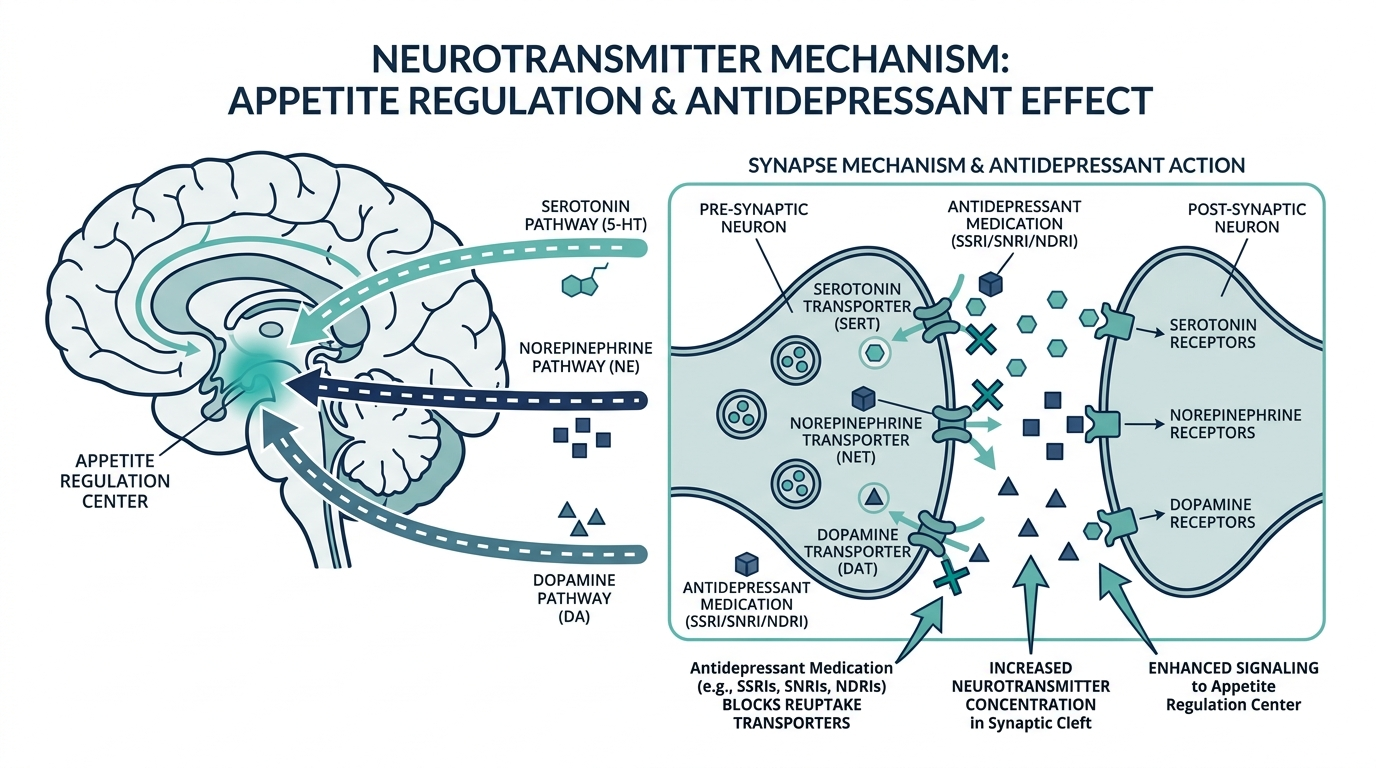
Bupropion is the one antidepressant that actually causes weight loss in a meaningful number of people. It works on dopamine and norepinephrine rather than serotonin, which is why it behaves so differently from the rest. In trials and real-world use, bupropion is associated with an average loss of about 5 to 7 pounds, and the effect tends to be larger in people who started at a higher weight. It is so consistent that bupropion is one half of the FDA-approved weight-loss drug Contrave, where it is combined with naltrexone.
Fluoxetine (Prozac) is the only other antidepressant with a credible weight-loss signal, and it is weaker and shorter. In the first few months, some people on fluoxetine lose a few pounds, likely from reduced appetite. By the one-year mark that effect usually disappears and weight often drifts back to baseline or slightly above. So fluoxetine can cause early weight loss, but it is not a long-term weight tool.
That is the whole real list. Drugs you will sometimes see called weight-loss antidepressants, like sertraline (Zoloft) or duloxetine (Cymbalta), are better described as weight-neutral. They do not reliably add weight the way some older drugs do, but they do not strip it off either.
How bupropion actually affects appetite
Bupropion raises dopamine and norepinephrine activity in the brain, which blunts appetite and reduces food-related reward signals for many people. That is the same pathway stimulants use, in a much milder form. It is also why bupropion can cause jitteriness, trouble sleeping, and a dry mouth, and why it is a poor choice for someone with a seizure history or an active eating disorder. The appetite effect is real, but it is gentle. Bupropion is not a weight-loss drug wearing an antidepressant costume.
A few practical points a prescriber will weigh. Bupropion comes in immediate-release, sustained-release (SR) and extended-release (XL) forms, and the once-daily XL version is the one most people are started on. It is combined with naltrexone in Contrave precisely because that pairing strengthens the appetite effect, which tells you the weight signal is genuine but modest on its own. It is avoided in people with a seizure disorder, a current or past eating disorder like bulimia or anorexia, and those stopping heavy alcohol or sedative use, because it lowers the seizure threshold. That is not a reason to fear it, it is a reason the decision belongs to a clinician who knows your history rather than to a number on the scale.
What is the best antidepressant for weight loss?
The best antidepressant for weight loss is bupropion, with no close second. If a clinician is choosing between antidepressants for a patient who also wants to avoid weight gain, bupropion is the default first choice, and it is frequently picked specifically for that reason. It treats depression, it has a useful effect on smoking cessation, and it is the only first-line option that nudges weight down instead of up.
There is an important nuance, though. The best antidepressant for any individual is the one that treats their depression or anxiety with side effects they can live with. Bupropion is energizing, which is great for low-energy, low-motivation depression but can worsen anxiety and insomnia. For someone whose depression comes with panic attacks, a serotonin drug they tolerate well may be a far better choice even if it is weight-neutral. Trading effective treatment for a few pounds is a bad deal, and any good prescriber will say so.
Best antidepressants for weight loss, ranked by evidence
| Antidepressant | Class | Typical weight effect | Best for |
|---|---|---|---|
| Bupropion (Wellbutrin) | NDRI | Loss, about 5 to 7 lb on average | Patients who want to avoid weight gain; low-energy depression |
| Fluoxetine (Prozac) | SSRI | Small early loss, usually fades by 1 year | Short-term, may regain later |
| Sertraline (Zoloft) | SSRI | Roughly weight-neutral | Anxiety with depression, less weight risk than paroxetine |
| Duloxetine (Cymbalta) | SNRI | Roughly weight-neutral, sometimes slight loss | Depression with chronic pain |
| Venlafaxine (Effexor) | SNRI | Roughly weight-neutral | Depression and anxiety |
Notice how short the loss column is. Two drugs cause loss, and one of those two only does it briefly. That is the realistic picture, and it is worth holding onto before you ask a doctor to switch your prescription over the scale.
Can antidepressants cause weight loss, and how much?
Yes, antidepressants can cause weight loss, but the amount is small and inconsistent. With bupropion, the average is around 5 to 7 pounds, and a minority of people lose more. With fluoxetine, early loss is usually a few pounds at most. Compare that to the GLP-1 weight-loss medications, where people on semaglutide (Wegovy) in the STEP trials lost about 15 percent of body weight and people on tirzepatide (Zepbound) in the SURMOUNT trials lost over 20 percent. An antidepressant is not in the same category, and it never will be.
There is also a confounder that trips people up. Depression itself changes weight. Severe depression often kills appetite, so people lose weight while ill and then regain it as they recover, which can look like the antidepressant caused weight gain when it was really recovery from the illness. The reverse happens too, where someone who was overeating from anxiety eats less once treated. Some of the weight change credited to or blamed on antidepressants is actually the depression lifting.
Does fluoxetine help with weight loss long term?
Fluoxetine helps with weight loss only in the short term, and the effect usually does not last. Studies that followed patients past six months to a year generally found that early weight loss reversed, with many people returning to their starting weight or gaining slightly. The appetite-suppressing effect appears to be something the body adjusts to. So if a clinician starts you on fluoxetine and you drop a few pounds in month two, do not build a weight plan around it. Treat it as a pleasant side effect that is likely temporary.
This is exactly why bupropion stands apart. Its weight effect tends to hold rather than fade, which is why it made it into an FDA-approved combination weight-loss drug and fluoxetine did not.
Which antidepressants cause weight gain instead?
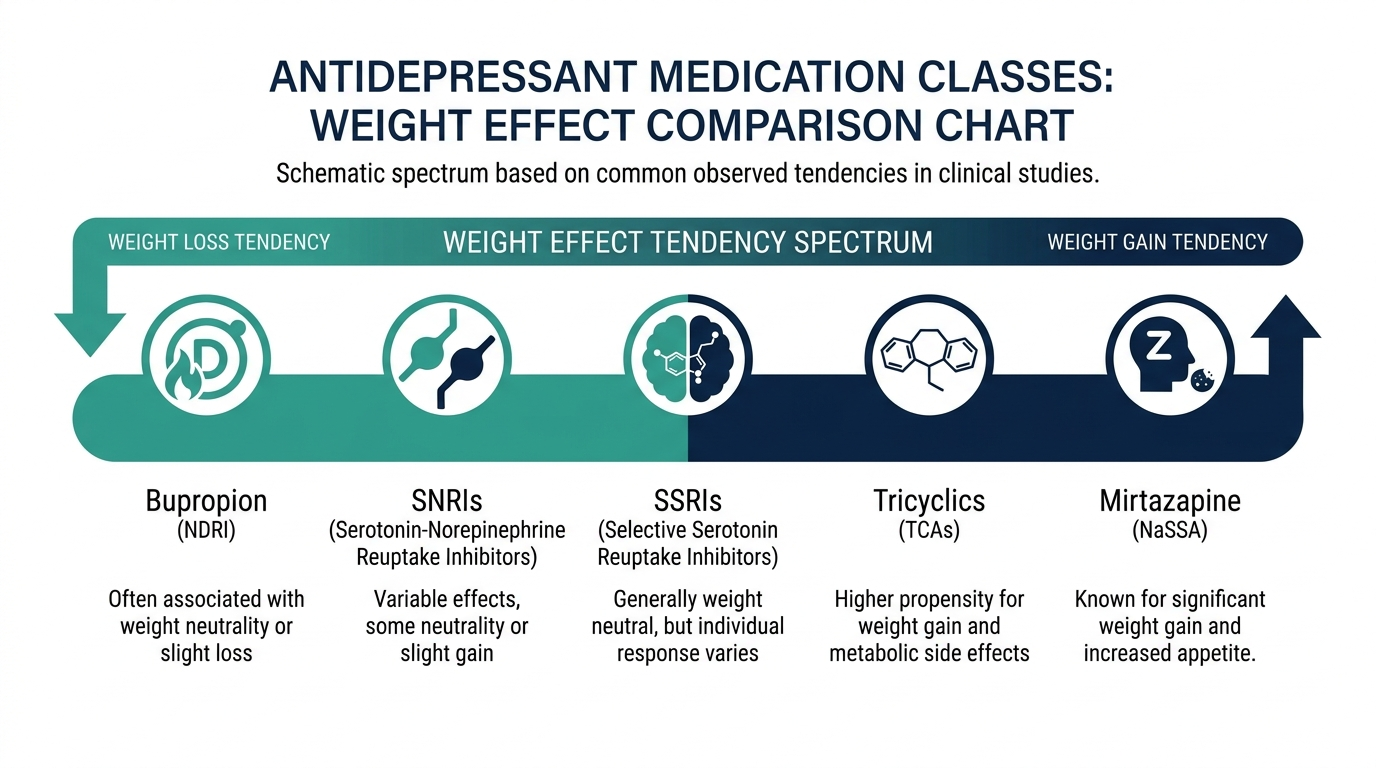
If avoiding weight gain is your real goal, knowing the offenders matters as much as knowing bupropion. The antidepressants most associated with weight gain are paroxetine (Paxil) among the SSRIs, mirtazapine (Remeron), and the older tricyclics like amitriptyline. Mirtazapine is notorious for increasing appetite and is sometimes prescribed on purpose to older or underweight patients who need to gain. Long-term use of several SSRIs can also lead to slow, gradual gain over a year or more, often a few to several pounds.
The mechanism behind the gain differs by drug, which is worth understanding. Mirtazapine and the older tricyclics block histamine (H1) receptors, and that antihistamine effect drives appetite and sedation, the same reason an allergy pill can leave you groggy and reaching for snacks. With the SSRIs the gain is slower and less well understood, but the leading explanations are a gradual return of appetite as depression lifts, an increase in carbohydrate craving in some people, and the simple fact that feeling well again often means eating more than you did while ill. None of these is a fast, dramatic effect. The gain that gets blamed on an SSRI usually accrues quietly over a year, which is exactly why it is so easy to misattribute to the pill when the real driver is elsewhere.
| Drug | Direction | Notes |
|---|---|---|
| Bupropion (Wellbutrin) | Loss | The weight-loss antidepressant |
| Fluoxetine (Prozac) | Small early loss | Fades, often regains by 1 year |
| Sertraline (Zoloft) | Neutral to slight gain | Lower gain risk than paroxetine |
| Paroxetine (Paxil) | Gain | Highest weight-gain risk among SSRIs |
| Mirtazapine (Remeron) | Gain | Strongly increases appetite |
| Amitriptyline (tricyclic) | Gain | Older drug, sedating, raises appetite |
So a fair summary of the whole class: one drug pushes weight down, two or three are roughly neutral, and the rest tend to push it up. Never stop or switch an antidepressant on your own to chase the scale, because stopping suddenly can cause withdrawal symptoms and a return of depression. Talk to the clinician who prescribed it before you change anything.
What stalls people: blaming the pill for the wrong problem
Here is the mistake we see over and over. Someone gains 15 pounds, decides their antidepressant did it, switches drugs, and the weight does not move. The antidepressant was a small contributor at most, and the real driver was somewhere else entirely. A 5-pound swing from a drug is easy to confuse with the 20-pound swing that comes from an undiagnosed thyroid problem, rising insulin resistance, or the metabolic shifts of perimenopause.
The common confounders that masquerade as a medication problem:
- Underactive thyroid. Hypothyroidism slows metabolism and causes steady, stubborn gain. It is common, easy to test with TSH and free T4, and very treatable. Plenty of people switch antidepressants three times before anyone checks their thyroid.
- Insulin resistance. Rising fasting insulin makes fat storage easier and weight loss harder, often years before blood sugar looks abnormal on a standard glucose test. A fasting insulin and A1C reading shows it.
- Perimenopause. Shifting estrogen redistributes fat to the midsection and reduces insulin sensitivity, which feels exactly like a drug side effect but is not.
- Low testosterone. In men, low testosterone lowers muscle mass and metabolic rate and is rarely checked when weight creeps up.
- Recovery appetite. As discussed, feeling better after depression often means eating normally again, which can read as drug-induced gain.
Consider a common case. A 44-year-old woman starts an SSRI for anxiety, and over the next year the scale climbs 18 pounds. She assumes the drug did it and asks to switch to bupropion. Her clinician agrees, but runs labs first, and they come back with a TSH of 6.5 and a fasting insulin in the high teens. Her thyroid was slowing and her insulin was rising across that same year, changes that had nothing to do with the antidepressant. Treating the thyroid and the insulin resistance moved her weight far more than any medication swap would have. The pill was a footnote. The hormones were the story.
The point is not that antidepressants never affect weight. It is that they are a minor lever, and people keep yanking on the minor lever while the major one sits untouched and unmeasured. Before you blame a pill, get the numbers that would prove or clear it.
Before you switch your antidepressant over the scale, see what your numbers say
Superpower is a full-body lab membership that runs 100+ biomarkers including fasting insulin, A1C, thyroid (TSH and free T4), testosterone and cortisol, has each result reviewed by a doctor, and tracks your numbers year over year so you can see what is actually stalling your weight (about $199/year). If your weight changed after starting an antidepressant, these are the exact labs that separate a drug side effect from a thyroid or insulin problem. Here is Superpower reviewed in full.
Want a real clinician to run the numbers, not a guess?
Joi + Blokes is a telehealth clinic that prescribes GLP-1 medication (Zepbound, compounded semaglutide and tirzepatide), hormone therapy (TRT, HRT), thyroid care, and peptides after a real lab panel and clinician review, with no membership or consult fee (prescriptions from about $59/month, lab panels from $149). If the scale will not budge, this is where you find out whether insulin, thyroid, or hormones are the real reason. Here is Joi + Blokes reviewed in full.
If you want real weight loss, where antidepressants fit
Antidepressants are not a weight-loss strategy, and treating them like one leads to disappointment and sometimes worse depression. If weight loss is the goal and you also have depression, the smart sequence is: treat the depression with the right drug for your symptoms (bupropion if it suits you and you want the weight benefit), and separately address weight with the levers that actually move it. Those levers are protein intake, resistance training, sleep, and, where appropriate and clinician-supervised, the GLP-1 medications that produce 15 to 20 percent loss rather than 5 pounds.
One more honest note for anyone tempted by the gray market. Compounded semaglutide and tirzepatide are sold cheaply online, often $150 to $300 a month cash, but compounded versions are not FDA-approved. They are legally prescribed only through licensed clinicians and pharmacies, and quality varies. The FDA-approved drugs (Wegovy, Zepbound, Saxenda) are the proven route, and coverage questions like whether Medicare covers weight-loss drugs or whether Medicaid covers weight-loss shots are worth checking before you assume the cash market is your only option. Telehealth services such as Ro can be a structured way to do this with supervision. Self-experimenting with peptides you bought online, with no labs and no doctor watching, is how people get hurt.
The simple, measurable next step
Whether your weight is stuck because of a medication, a hormone, or just guesswork, the fix starts the same way: stop guessing and measure. Get thyroid, fasting insulin, A1C, and sex hormones checked. If they are off, you found your real lever, and no antidepressant switch would have touched it. If they are clean, you can rule the medication question in or out with confidence instead of cycling through prescriptions. People also overrate small tricks at this stage, asking whether B12 helps with weight loss or exactly how much water to drink for weight loss, when the data on those is thin and the data on your own bloodwork is decisive.
Curious what your own levels look like?
Baseline 100+ biomarkers today and retest as life changes, all in one membership with physician review.
FAQ
Does bupropion always cause weight loss?
No. Bupropion causes weight loss on average, around 5 to 7 pounds, but individual results vary widely. Some people lose more, some lose nothing, and a few even gain depending on appetite, baseline weight, and lifestyle. It is the most weight-favorable antidepressant, not a guaranteed one.
Can an antidepressant cause weight loss without me trying?
Yes, bupropion and short-term fluoxetine can reduce appetite enough to cause passive weight loss in some people. The amount is usually modest, a handful of pounds, and with fluoxetine it often reverses within a year. Do not rely on it as a deliberate weight strategy.
What antidepressant is best for weight loss and depression together?
Bupropion (Wellbutrin) is the best choice when you want to treat depression and avoid weight gain or even lose a little, especially for low-energy depression. If you have significant anxiety, panic, or insomnia, bupropion can make those worse, and a serotonin drug you tolerate well may be the better overall pick even though it is weight-neutral.
Is there an antidepressant that helps with weight loss like Ozempic?
No. No antidepressant comes close to GLP-1 drugs like Ozempic, Wegovy, or Zepbound. Bupropion produces about 5 to 7 pounds of loss, while semaglutide averaged roughly 15 percent of body weight in the STEP trials and tirzepatide over 20 percent in SURMOUNT. They work on completely different biology.
Does sertraline (Zoloft) cause weight loss?
Sertraline is essentially weight-neutral. Some people see a small early loss and others a slow gain over a year, but on average it does not move weight much in either direction. It is a reasonable choice if you want to minimize weight gain risk and need a serotonin drug for anxiety.
Which antidepressants cause the most weight gain?
Paroxetine (Paxil) carries the highest weight-gain risk among SSRIs, mirtazapine (Remeron) strongly increases appetite, and older tricyclics like amitriptyline tend to add weight. If avoiding gain is a priority, these are the ones to discuss alternatives for with your prescriber.
Can I switch antidepressants just to lose weight?
You should not switch on your own. Stopping an antidepressant abruptly can cause withdrawal symptoms and bring back depression, and the weight payoff from switching is usually small. If weight is a concern, raise it with your clinician, who may consider bupropion, but the decision should weigh your mental health first.
How do I know if my antidepressant caused my weight gain or something else did?
You test for it. A few pounds is plausibly the drug, but larger or stubborn gain is more often thyroid disease, insulin resistance, perimenopause, or low testosterone. Checking TSH, free T4, fasting insulin, A1C, and sex hormones tells you which lever is actually moving your weight, so you stop blaming the wrong thing.
How long does antidepressant weight loss last?
With bupropion, the weight effect tends to persist as long as you take it and maintain your habits. With fluoxetine, early loss usually fades within six months to a year as the body adjusts. Neither produces the kind of sustained, large loss seen with GLP-1 medications.
Why do SSRIs cause weight gain over time?
The gain is usually slow and modest, and it comes from a mix of causes rather than one. As depression lifts, appetite returns to normal, some people notice more carbohydrate craving, and the change adds up quietly over a year. Paroxetine carries the highest risk in the class, while sertraline and fluoxetine are far more weight-friendly. If you notice steady gain, it is worth checking your thyroid and insulin before assuming the drug is the sole cause.
Does mirtazapine always cause weight gain?
Not always, but it carries one of the strongest appetite-boosting effects of any antidepressant because it blocks histamine receptors. That is why it is sometimes chosen on purpose for older or underweight patients who need to eat more. If weight gain is a concern for you, this is a drug to discuss alternatives for with your prescriber rather than one to start lightly.
Should I ask for bupropion specifically to lose weight?
Only in the context of treating a real mood or anxiety condition. Bupropion is not approved as a standalone weight-loss drug, and taking an antidepressant purely for the scale is the wrong tool for a weight problem that GLP-1 medication, nutrition and training address far better. If you have depression and also want to avoid weight gain, that is a fair thing to raise with your clinician, who will weigh your mental health first.
Vital Signs Today may earn a commission if you buy through links on this page. It does not affect our editorial assessments.