Quick answer: For weight loss, most adults do well drinking about 64 to 100 ounces of water a day (roughly half your body weight in pounds, converted to ounces), with one 16-ounce glass 20 to 30 minutes before each meal. Water itself does not burn fat, but it blunts appetite, replaces liquid calories, and supports the metabolism. In a randomized trial published in Obesity, dieters who drank 500 mL before meals lost about 44 percent more weight over 12 weeks than dieters who did not. The drink does not do the work. It just makes the calorie deficit easier to hold.
Here is the honest version of the “drink water to lose weight” advice, including how much water should drink for weight loss in real numbers, which drinks help, which are marketing, and why the scale often refuses to move no matter what is in your glass.
Water helps blunt appetite, but it won’t fix a metabolic issue. See what’s really driving your weight with a full panel. One at-home Superpower draw checks 100+ biomarkers, physician-reviewed.
How much water should you drink a day for weight loss?
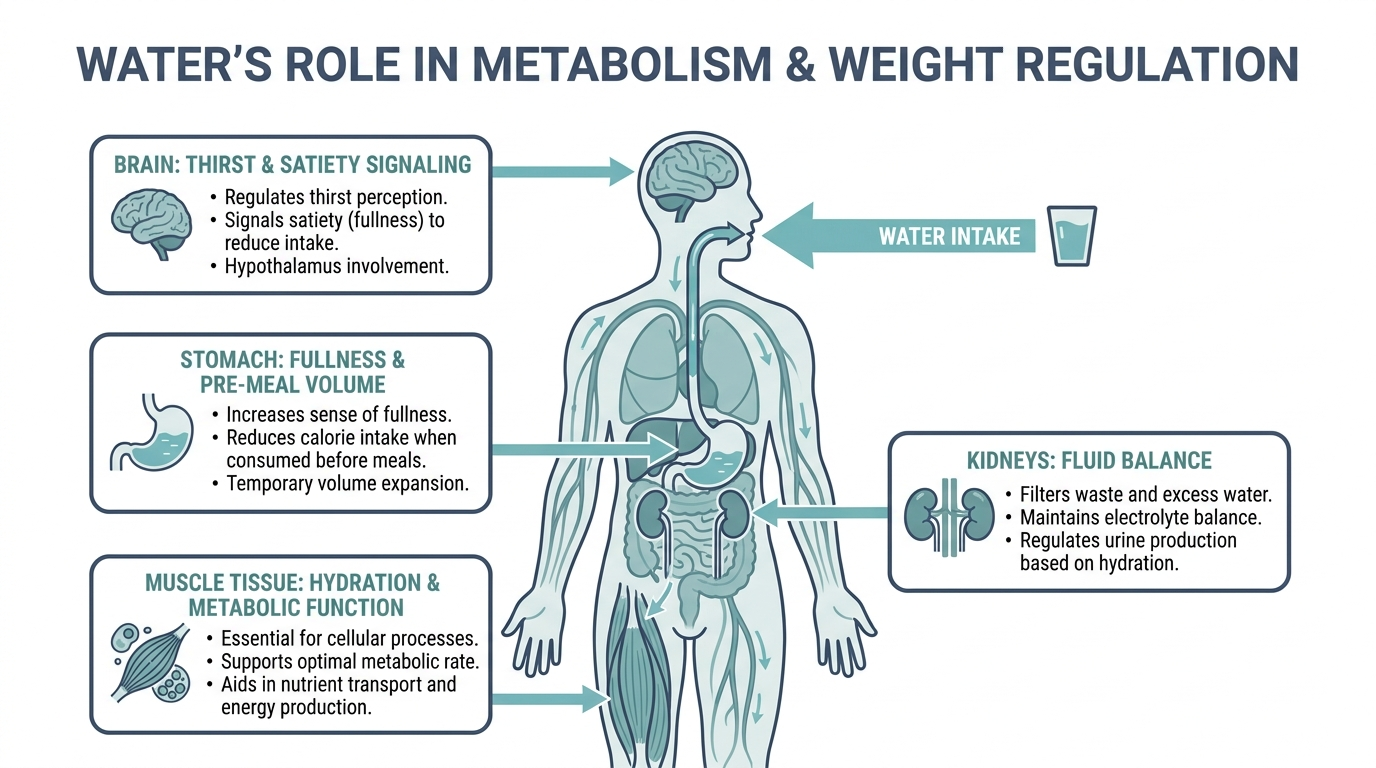
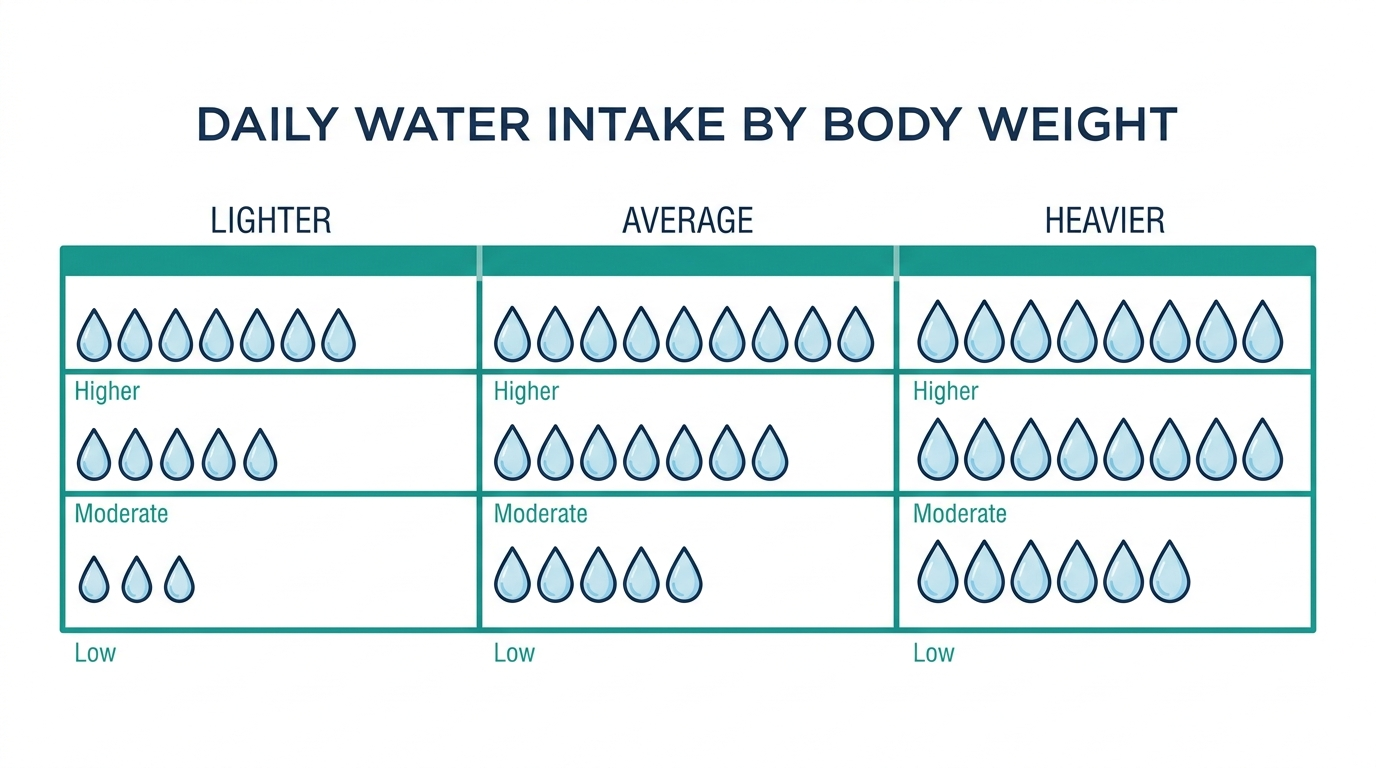
A practical target is half your body weight in pounds, expressed as ounces, capped around 100 ounces for most people. So a 160-pound adult aims for about 80 ounces (ten 8-ounce glasses) a day. The old “eight glasses” rule (64 ounces) is a reasonable floor, not a magic number.
The reason this helps weight loss is not metabolic magic. It is three concrete mechanisms. Water fills the stomach and triggers stretch receptors that signal fullness, so you eat less at the next meal. It often gets mistaken for hunger, because the thirst and hunger signals share brain real estate, so people snack when they are actually just dry. And every ounce of water you drink is an ounce of soda, juice, or sweet coffee you did not drink, which is where most accidental calories hide.
Adjust up for heat, exercise, high-protein diets (protein metabolism needs more water to clear nitrogen), and GLP-1 medications like Wegovy or Zepbound, which suppress thirst along with appetite and leave a lot of people quietly dehydrated and constipated. Adjust down if you have heart failure or kidney disease, where fluid is restricted on purpose. Plain water, sparkling water, and unsweetened tea or coffee all count toward the total.
How do you know if you are actually hydrated?
Do not trust thirst as your only gauge, because the thirst signal lags behind real fluid loss, and that lag widens as you get older. The fastest home check is urine color. Pale straw or light lemonade means you are in range, while dark amber or a strong smell means you are already behind. A second tell is frequency. Most well-hydrated adults empty the bladder every three to four hours during the day. If you sail through a whole morning without needing the bathroom, you are running dry. None of this needs an app or a marked bottle, just a glance in the bowl and honest attention.
One nuance people miss on higher intakes: at 80 to 100 ounces a day, plain water alone can dilute your electrolytes if you are also sweating hard or eating very little sodium. You do not need a sports drink for normal life, but if you feel lightheaded, get calf cramps, or notice a dull headache despite drinking plenty, add a pinch of salt to one glass or eat something salty rather than pouring in more water. More water is not always the fix, and past a point it makes the problem worse. This matters most on low-carb diets, which flush sodium fast, and on GLP-1 medications, where reduced eating means less salt coming in with food.
How much water to drink before meals, and does timing matter?
The simplest way to actually get this done
Superpower is a full-body lab membership that runs 100+ biomarkers, has each result reviewed by a doctor, and tracks your numbers year over year (about $199/year). It is what we point readers to when they would rather get one clean, complete draw than chase single tests one at a time. Here is superpower reviewed in full.
Yes, timing is the single most useful trick here, and it is the part most people skip. Drink 16 ounces (about 500 mL) of water 20 to 30 minutes before each main meal. That is the protocol from the Obesity trial, and it works because the water is still creating gastric stretch when you sit down to eat, so you reach fullness on fewer calories.
Drinking water with the meal helps a little less, because it empties faster and you are eating into the volume anyway. Chugging right at the table can also dilute the feeling of a satisfying meal without the pre-load effect. The window matters. Front-load it.
One real-world caution: do not white-knuckle 100 ounces in the evening, or you will be up at 2 a.m. and your sleep will tank, which raises the hunger hormone ghrelin the next day. Spread intake across the morning and early afternoon.
Here is what the pre-load looks like in practice. Say you eat lunch at noon. At 11:35 you drink a full 16-ounce glass, then get back to work. By the time you sit down, your stomach already has volume in it, so the sandwich that used to leave you reaching for a second one now lands as enough. Do the same before dinner and you have quietly removed a couple hundred calories from two meals without counting a thing. Repeat it daily and that is the entire mechanism the trial measured. It is unglamorous, it is free, and it is the one piece of water advice that reliably moves the scale.
What to drink for weight loss (and what to skip)
The best drink for weight loss is water, full stop, because it has zero calories and does the appetite job for free. After that, the useful list is short: black coffee, unsweetened tea, sparkling water, and protein shakes that replace a meal rather than adding to it. The drinks that quietly stall people are the ones that feel “healthy”: smoothies, fruit juice, sweetened lattes, kombucha, and most “detox” waters.
Here is how the common options actually stack up.
| Drink | Calories (typical serving) | Does it help weight loss? | Why |
|---|---|---|---|
| Plain or sparkling water | 0 | Yes | Fills the stomach, replaces calorie drinks, costs nothing |
| Black coffee | ~5 | Mild yes | Caffeine modestly raises metabolism and blunts appetite short term |
| Unsweetened green or black tea | 0 to 5 | Mild yes | Small thermogenic effect, helps hydration and habit replacement |
| Meal-replacement protein shake | 150 to 250 | Yes, if it replaces a meal | High satiety per calorie; backfires if added on top of food |
| Fruit juice / smoothie | 250 to 500 | Usually no | Liquid sugar, low satiety, easy to overdrink |
| Diet soda | 0 | Neutral, sometimes helps | Cuts sugar calories but may keep sweet cravings alive for some people |
| Apple cider vinegar drink | ~5 | Barely | Tiny appetite effect at best; mostly hype |
Notice the pattern: the drinks that help are the ones with no calories or the ones that stand in for a meal. Everything marketed as a “fat burner” or “detox” lives in the rounding error.
Are diet drinks good for weight loss?
Diet soda is calorie-neutral and, for many people, a genuinely useful bridge off regular soda, which can carry 140 calories and 39 grams of sugar per can. Swapping one regular soda a day for a diet version removes roughly 51,000 calories a year, all else equal. That is real.
The caveat is behavioral, not metabolic. Some people find that the sweet taste keeps the sweet-craving loop alive, so they compensate with sugar elsewhere. The cleanest evidence (a 2024 trial in JAMA Network Open) found that swapping sugary drinks for diet versions led to modestly better weight loss than swapping in water, likely because adherence was easier. If diet soda helps you quit the sugary stuff and you do not overeat to make up for it, it is a fine tool. If it leaves you hunting for dessert, drop it.
Are protein drinks good for weight loss?
Yes, protein drinks are one of the few “functional” beverages with real evidence behind them, because protein is the most filling macronutrient and the hardest to overeat. A shake with 25 to 30 grams of protein and under 250 calories can replace a meal you would otherwise eat carelessly, and it protects muscle while you lose fat, which keeps your resting metabolism from cratering.
The trap is simple: a protein shake only helps if it replaces calories, not if it adds them. Drinking a 220-calorie shake after a full lunch is just 220 extra calories. The people who succeed use shakes as a deliberate meal swap (often breakfast) when they are too busy to make a high-protein meal.
What is the best protein drink for weight loss?
The best protein drink for weight loss is the one with the highest protein and lowest sugar that you will actually drink. Look for 25 to 30 grams of protein, under 5 grams of sugar, and 150 to 250 calories. Whey isolate digests fast and is the gold standard for muscle support; a soy or pea blend works well for plant-based eaters. A scoop of plain whey isolate (about $1 a serving) blended with water and ice beats almost every pre-made bottle on cost and sugar. Among ready-to-drink options, the low-sugar high-protein shakes in the 150-calorie, 30-gram range are the reliable pick. Skip anything labeled “weight gainer” or carrying 30-plus grams of sugar; that is a milkshake wearing a gym shirt.
What is the best tea to drink for weight loss?
Green tea is the best-evidenced tea for weight loss, because its catechins (mainly EGCG) plus caffeine produce a small thermogenic effect, on the order of 75 to 100 extra calories burned a day in some studies. “Small” is the operative word. That is roughly a 10-minute walk, not a transformation. Plain unsweetened black, oolong, and herbal teas help mainly by replacing calorie drinks and giving you a warm, ritual-driven alternative to snacking.
So-called “slimming” or “detox” teas are a different category and worth a warning: many contain senna, a laxative. Any weight you lose is water and stool, it returns within a day, and chronic use can damage normal bowel function. A good tea to drink for weight loss is plain green tea, hot or iced, no sweetener. Anything promising to flush fat is selling you cramps.
Doing everything right and the scale still will not budge?
Superpower is a full-body lab membership that runs 100+ biomarkers including fasting insulin, A1C, thyroid, testosterone and cortisol, has each result reviewed by a doctor, and tracks your numbers year over year so you can see what is actually stalling your weight (about $199/year). When water, protein, and a real deficit are in place and the weight still holds, the answer is almost always in your hormones, not your cup. Here is Superpower reviewed in full.
What stalls people: the mistakes that make water useless
The number one reason “drink more water” fails is that people add water without subtracting calories. Water only helps inside a calorie deficit. If you drink your 80 ounces and still eat at maintenance, nothing happens, and you blame the water.
- Treating the drink as the lever. No beverage burns meaningful fat. Water, tea, and coffee make the deficit easier to hold. They do not create one.
- Drinking calories you think are “healthy.” A green smoothie, oat-milk latte, and kombucha can total 600 calories before noon. These are the silent stalls.
- Backloading water at night, wrecking sleep, raising next-day hunger.
- Chasing detox and slimming teas, which move water weight that returns within 24 hours and can disrupt the gut.
- Mistaking water weight for fat. The fast 5 to 8 pounds people lose in week one of low-carb is mostly glycogen-bound water, not fat. It comes back the moment carbs return, and that is normal, not failure.
And the biggest one of all: doing everything right and still not losing. That is rarely a willpower problem. It is usually a measurement problem.
When water is not the problem: the hormone and metabolism check
If you are hitting your water target, eating in a real deficit, moving daily, and the scale still will not move for four to six weeks, the issue is almost never the contents of your glass. It is your metabolic numbers. The usual hidden suspects are an underactive thyroid (which slows the whole metabolism and is easy to miss), insulin resistance (which makes fat storage sticky and hunger relentless), high cortisol from chronic stress or poor sleep, and the hormonal shifts of perimenopause or PCOS, which change where and how fast the body holds fat.
None of these show up on a bathroom scale. They show up on a blood panel: fasting insulin, A1C, TSH and free T4, testosterone, and cortisol. Most people guessing at diets have never seen these numbers. If you are over 40, were assigned female at birth and dealing with perimenopause, or have a family history of diabetes or thyroid disease, this is where to look before you buy another supplement or “fat-burning” drink.
If you do get labs, know the difference between “normal” and optimal, because standard reference ranges are wide enough to hide a slow metabolism. A TSH of 4.0 sits inside most lab ranges but is high enough to leave many people tired and stalled, and plenty of clinicians will treat symptoms once TSH climbs past roughly 2.5 with matching signs. Fasting insulin often reads as “normal” on a report because many labs only flag it when it is very high, yet a fasting insulin in the low single digits is what you actually want if fat loss is the goal. Ask for the number, not just the pass or fail, and remember that labs vary in how they draw these lines, so your own trend over time tells you more than a single flag. Retest three to six months after you change something, since one value on a stressful, poorly slept morning can mislead you.
Talk to a clinician before starting or stopping any medication, and before reading too much into a single lab value. The point is to measure first. A few cases worth knowing: B12 is often pitched as a weight aid, but it only helps if you were deficient, which is worth reading about in our breakdown of whether B12 helps with weight loss. And if you are weighing prescription options instead, understand the access and cost side first, including whether Medicare covers weight-loss drugs and whether Medicaid covers weight-loss shots, because coverage gaps are why so many people end up on the gray market.
What about drinks for “fast” weight loss?
There is no drink that produces fast fat loss, and anything sold that way is selling water weight or a laxative effect. The fast drop you see from cutting carbs, fasting, or a “cleanse” is glycogen water and gut contents, and it returns when you eat normally again. Real fat loss runs about 1 to 2 pounds a week on a sustained deficit, regardless of what is in your cup.
If you want the genuine fast-track, it is not a beverage. It is supervised medical weight loss with a real clinician and labs, where appropriate. FDA-approved GLP-1 medications produce serious results: in the STEP trials, Wegovy (semaglutide) drove about 15 percent average body-weight loss, and in the SURMOUNT trials, Zepbound (tirzepatide) reached roughly 20 percent or more. Those are real drugs, prescribed and monitored. Compounded semaglutide and tirzepatide are not FDA-approved; they are legally prescribed through licensed clinicians and pharmacies, and they belong under medical supervision, not bought blind online. If you are even considering this route, do it through a supervised telehealth clinic with bloodwork, and price it honestly first, like our look at how much Ro weight loss costs. If the appeal is more about the psychology of overeating than the metabolism, it is also worth knowing whether hypnosis works for weight loss before you spend on it.
Curious what your own levels look like?
Baseline 100+ biomarkers today and retest as life changes, all in one membership with physician review.
Want a real clinician to run the numbers, not a guess?
Joi + Blokes is a telehealth clinic that prescribes GLP-1 medication (Zepbound, compounded semaglutide and tirzepatide), hormone therapy (TRT, HRT), thyroid care, and peptides after a real lab panel and clinician review, with no membership or consult fee (prescriptions from about $59/month, lab panels from $149). If the scale will not budge, this is where you find out whether insulin, thyroid, or hormones are the real reason. Here is Joi + Blokes reviewed in full.
FAQ
How much water should I drink for weight loss if I exercise?
Add roughly 16 to 24 ounces for every hour of sweaty exercise on top of your baseline of half your body weight in ounces. If your urine is pale yellow and you are not cramping, you are in range. Dark urine and headaches mean you are behind.
Can drinking too much water be harmful?
Yes, though it is rare. Drinking several liters in a short window can dilute blood sodium (hyponatremia), causing nausea, confusion, and in extreme cases seizures. Spread intake through the day rather than chugging, and respect fluid limits if you have heart or kidney disease.
Does drinking cold water burn more calories?
Only a trivial amount. Your body spends a few calories warming cold water to body temperature, but the total is around 8 calories per glass, not enough to matter for weight loss. Drink it however you will actually drink it.
What drinks help with weight loss the most?
Water first, then black coffee and unsweetened green tea for a mild appetite and metabolism nudge, then a high-protein, low-sugar shake when it replaces a meal. The common thread is zero or near-zero calories, or high satiety per calorie. Anything sweet and liquid usually works against you.
What is best to drink for weight loss in the morning?
Plain water and black coffee. Water rehydrates you after the overnight fast and front-loads your daily intake; black coffee gives a mild appetite and metabolism bump for almost no calories. Skip the juice and the sweet latte, which are where breakfast calories quietly balloon.
Are protein shakes good for weight loss at night?
They can be, if a shake replaces a heavier late snack and keeps you under your calorie target. A casein or whey shake with 25 to 30 grams of protein curbs late-night grazing. Adding it on top of dinner just adds calories.
Does lemon water help you lose weight?
Only indirectly. Lemon water has no fat-burning property, but if a slice of lemon makes you drink more water and skip soda, it helps through that habit, not through the lemon. The acid and vitamin C do nothing measurable to your metabolism.
Why am I drinking water and still not losing weight?
Almost always because you are not in a calorie deficit, you are drinking hidden calories elsewhere, or a hormonal issue (thyroid, insulin resistance, cortisol, perimenopause) is slowing your metabolism. Water supports a deficit; it cannot create one or override a metabolic problem. If the basics are dialed in and nothing moves for a month or more, get fasting insulin, A1C, and thyroid checked before changing anything else.
Is sparkling water as good as still water for weight loss?
Yes, as long as it is unsweetened. Sparkling water counts fully toward your fluid total and can curb cravings with its fizz and ritual. Check the label for added sugar or juice, which turns it back into a calorie drink.
Does drinking water before bed help or hurt weight loss?
It mostly hurts, for a practical reason rather than a metabolic one. A large glass close to bedtime pulls you out of deep sleep to use the bathroom, and broken sleep raises next-day ghrelin and cortisol, both of which push appetite up. If you are thirsty at night, take a few sips, but do your real hydrating before mid-afternoon so the volume clears before you lie down.
Do coffee and tea count toward my water total, or are they dehydrating?
They count. The old idea that caffeine dehydrates you is overstated for regular coffee and tea drinkers, whose bodies adapt to the mild diuretic effect. A cup of black coffee or unsweetened tea delivers more fluid than it makes you lose, so it lands on the positive side of your daily total. The trouble is never the water in the coffee, it is the syrup, cream, and sugar people stir into it.
Vital Signs Today may earn a commission if you buy through links on this page. It does not affect our editorial assessments.