Quick answer: Here is how to calculate weight loss percentage: divide the pounds you lost by your starting weight, then multiply by 100. The formula is (starting weight minus current weight) divided by starting weight, times 100. If you started at 200 pounds and now weigh 186, you lost 14 pounds, and 14 divided by 200 is 0.07, so that is a 7 percent loss. Percentage matters more than raw pounds because losing 5 percent of your body weight is the clinically meaningful threshold where blood pressure, blood sugar, and triglycerides start to improve.
How do you calculate your weight loss percentage?
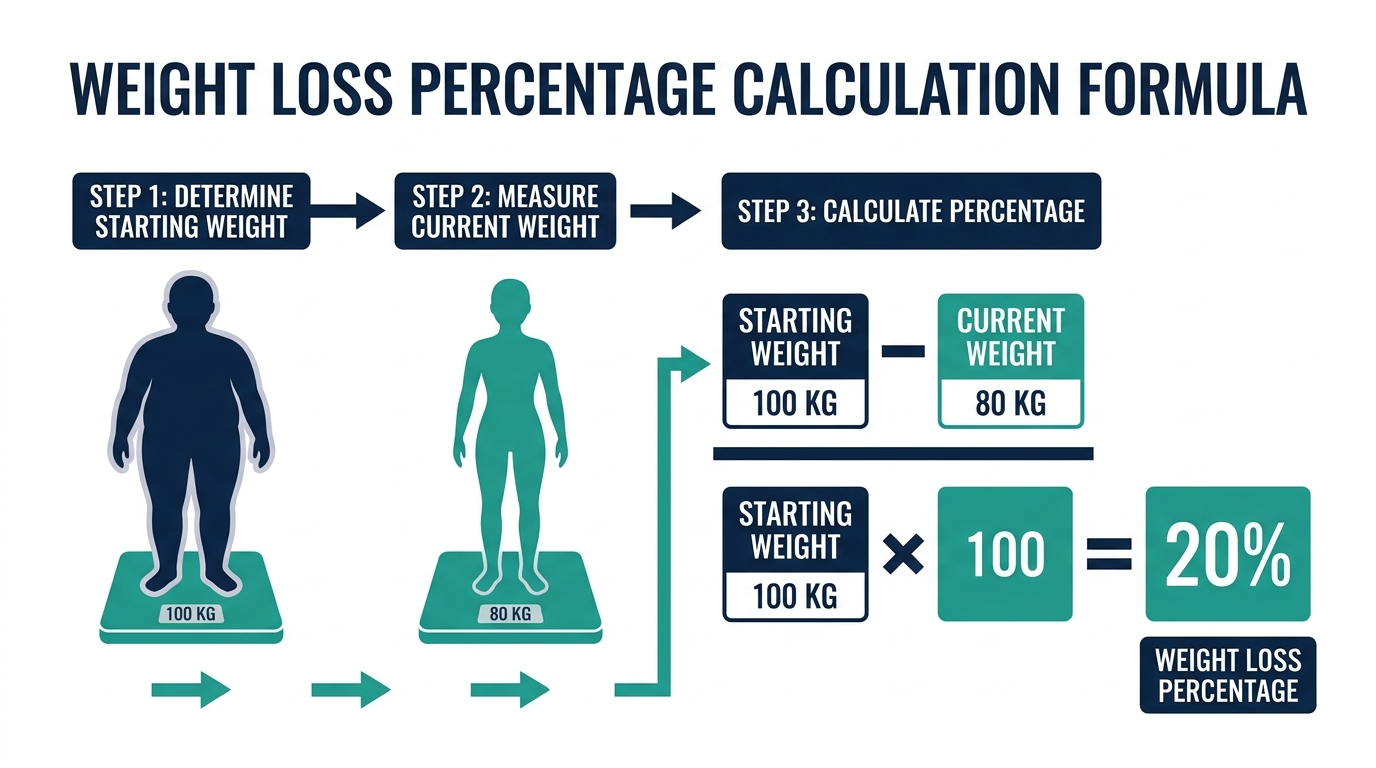
You calculate your weight loss percentage by dividing the weight you lost by your starting weight and multiplying by 100. Spelled out: take your starting weight, subtract your current weight, divide that difference by your starting weight, then multiply the result by 100 to turn it into a percentage.
You can calculate your weight loss percentage in seconds, but do you know what’s actually happening inside your body while it drops? One at-home Superpower draw checks 100+ biomarkers, physician-reviewed.
Here is the formula in plain text:
Weight loss percentage = ((Starting weight – Current weight) / Starting weight) x 100
The single most common mistake people make is dividing by the wrong number. You divide by your starting weight, not your current weight and not the pounds you lost. Dividing by current weight will inflate the percentage and make your progress look better than it is. Anchor everything to the weight you began at.
The units do not matter as long as you stay consistent. Pounds and kilograms give the exact same percentage because the units cancel out in the division. Just do not mix them. If your starting weight is in pounds, your current weight has to be in pounds too.
How to calculate weight loss percentage: a worked example
The simplest way to actually get this done
Superpower is a full-body lab membership that runs 100+ biomarkers, has each result reviewed by a doctor, and tracks your numbers year over year (about $199/year). It is what we point readers to when they would rather get one clean, complete draw than chase single tests one at a time. Here is superpower reviewed in full.
The fastest way to learn how to calculate weight loss percentage is to run a real number through the formula. Say you started a program at 220 pounds and three months later you step on the scale at 198 pounds.
- Find the pounds lost: 220 – 198 = 22 pounds.
- Divide by starting weight: 22 / 220 = 0.10.
- Multiply by 100: 0.10 x 100 = 10 percent.
So that person lost 10 percent of their body weight, a genuinely significant clinical milestone. To reverse the math and find your goal weight at a target percentage, multiply your starting weight by the percentage as a decimal, then subtract. To hit a 15 percent loss from 220 pounds: 220 x 0.15 = 33 pounds, so your goal weight is 187 pounds.
How to calculate weight loss by percentage at each milestone
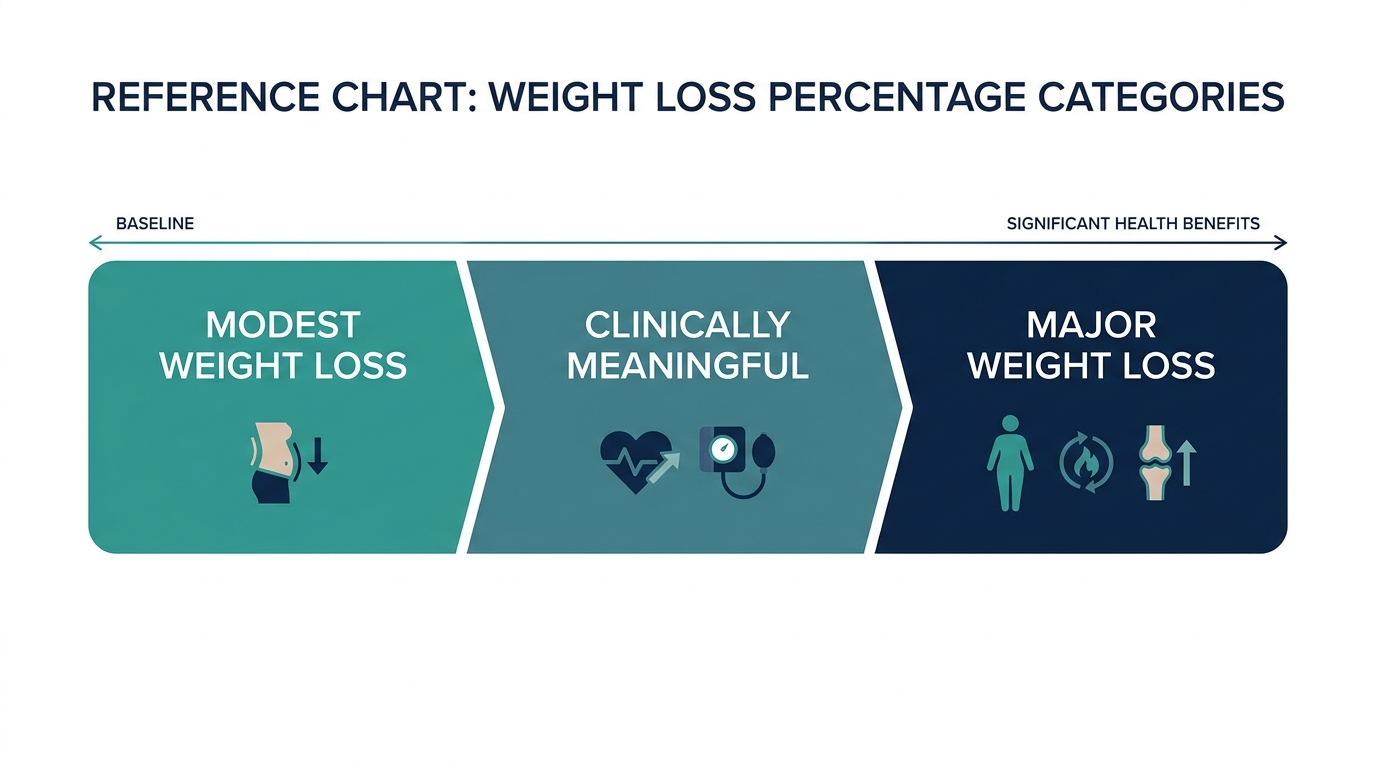
Percentages get useful when you map them to the milestones clinicians actually care about. Doctors do not chase a magic goal weight. They watch for the 5 percent mark first, because that is where the metabolic payoff begins, and then 10 percent, where the payoff compounds.
| Milestone | What it takes (200 lb start) | What it takes (250 lb start) | What changes in the body |
|---|---|---|---|
| 3 percent | 6 lb | 7.5 lb | Early triglyceride and blood sugar dip |
| 5 percent | 10 lb | 12.5 lb | Meaningful drops in blood pressure, A1C, and fatty liver markers |
| 10 percent | 20 lb | 25 lb | Stronger improvement in insulin resistance and sleep apnea |
| 15 percent | 30 lb | 37.5 lb | The average loss seen with semaglutide in the STEP trials |
| 20 percent | 40 lb | 50 lb | Around the average loss with tirzepatide in the SURMOUNT trials |
This is why the number is worth tracking. A 5 percent loss is the floor where research consistently shows health markers move, not just the mirror. The 15 and 20 percent rows are not arbitrary either. Those are the average results from the major GLP-1 medication trials, and we will come back to what that means for real people.
How to get percentage of weight loss without doing math by hand
You do not have to reach for a calculator every week. Most fitness apps and smart scales compute the percentage automatically once you enter a starting weight. The catch is that they often reset the baseline silently or use a rolling 30-day window, which makes your total progress look smaller.
If you track by hand, keep one fixed starting weight at the top of your log and calculate against it every single time. A simple spreadsheet does this in one cell. Put your start weight in cell A1, today’s weight in B1, and the formula is (A1 – B1) / A1, then format the cell as a percentage. The spreadsheet handles the times-100 step for you.
One honest warning about the scale itself: weigh yourself at the same time of day, ideally first thing in the morning before eating or drinking. Body weight swings 2 to 4 pounds across a single day from food, water, and sodium. Comparing a morning weight to an evening weight can show a fake gain or loss of more than 1 percent that has nothing to do with fat.
What percentage of weight loss is diet vs exercise?
For losing weight, diet drives the large majority of the result, and most clinicians put it somewhere around 75 to 80 percent diet and 20 to 25 percent exercise. The reason is simple arithmetic. It is far easier to not eat 500 calories than to burn 500 calories through close to an hour of hard running.
Exercise still earns its keep, just not where people expect. Its real job in weight loss is protecting muscle while you eat at a deficit. When you lose weight without resistance training, a meaningful share of what comes off is muscle, and muscle is the tissue that keeps your metabolism up. That is the quiet reason crash diets backfire: you torch muscle, your resting burn drops, and the lost pounds come back faster.
So the practical split looks like this:
- Diet creates the calorie deficit that moves the percentage on the scale.
- Strength training protects the muscle so the weight you lose is mostly fat, not lean tissue.
- Cardio and daily movement add to the deficit and help with appetite and insulin sensitivity, but they are the supporting act.
If your scale percentage is stalling despite tight eating, the problem is usually not that you need more cardio. It is more often a sign that something measurable is off, which is the next thing to check.
What percentage macros for weight loss should you aim for?
For weight loss, a common starting macro split is roughly 30 to 40 percent protein, 25 to 35 percent fat, and 25 to 40 percent carbohydrate, with the exact mix adjusted to how you feel and perform. The one number that should not flex much is protein. Protein is what keeps you full, protects muscle in a deficit, and costs the most energy to digest.
Here is a quick reference for where macro percentages tend to land by goal:
| Approach | Protein | Carbs | Fat | Best for |
|---|---|---|---|---|
| Balanced deficit | 30 to 35 percent | 35 to 40 percent | 25 to 30 percent | Most people losing fat sustainably |
| Higher protein | 35 to 40 percent | 25 to 30 percent | 30 to 35 percent | Preserving muscle, hunger control |
| Lower carb / keto | 25 to 30 percent | 5 to 10 percent | 60 to 70 percent | Strong appetite suppression, fast early water loss |
That last row explains a thing most people misread. The first week of low-carb feels like magic on the scale, often 4 to 8 pounds, but a large chunk of it is water. Carbs hold water in your body through stored glycogen, and when you cut carbs that water flushes out fast. That early percentage drop is real weight, but it is not all fat, so do not expect that pace to continue.
Rather than obsessing over decimals, anchor on protein first. Aim for roughly 0.7 to 1 gram of protein per pound of your goal body weight, fill the rest with carbs and fat in whatever ratio keeps you satisfied and energized, and let the macro percentages fall out of that. Percentages of total calories matter less than hitting your protein floor every day.
What stalls people: why the percentage stops moving
The scale percentage stalling for weeks despite honest effort is the most common and most demoralizing experience in weight loss, and it is rarely about willpower. Most plateaus have a measurable, physical cause that a diet tweak cannot fix because the lever is not in the kitchen.
Here are the usual suspects, roughly in order of how often they hide a stall:
- Underactive thyroid. A sluggish thyroid (hypothyroidism) slows your metabolism, drives fatigue, and can park the scale no matter how clean you eat. It is extremely common in women over 40 and frequently undiagnosed. A TSH and free T4 test settles it.
- Insulin resistance. When your cells stop responding to insulin, your body holds onto fat and fights weight loss. Fasting insulin and A1C reveal it, and a fasting insulin test often flags the problem years before standard glucose does.
- PCOS. Polycystic ovary syndrome ties insulin resistance and hormone imbalance together and is a leading reason weight will not budge in younger women. It needs hormone and metabolic labs to confirm.
- Perimenopause. Shifting estrogen in the 40s and 50s changes where fat is stored and how the body responds to food, and the old approach stops working.
- Muscle loss and a true plateau. As you lose weight, you need fewer calories, so the deficit you started with shrinks until it disappears. This one is real math, fixed by recalculating intake, not by eating less and less forever.
Notice the pattern: four of the five biggest stalls are things you cannot see, only measure. People burn months self-experimenting with new diets and supplements when a single round of bloodwork would have pointed at the actual problem. If you have been doing everything right and the percentage has not moved in six to eight weeks, you are most likely guessing when you should be measuring.
Stuck below 5 percent no matter what you eat? See your actual numbers.
Superpower is a full-body lab membership that runs 100+ biomarkers including fasting insulin, A1C, thyroid, testosterone and cortisol, has each result reviewed by a doctor, and tracks your numbers year over year so you can see what is actually stalling your weight (about $199/year). If your weight loss percentage has flatlined, this is how you find the thyroid or insulin problem behind it instead of guessing. Here is Superpower reviewed in full.
How GLP-1 medications change the percentage math
If you have read that people lose 15 to 20 percent on the new weight loss shots, those numbers come from real, named clinical trials, and understanding them keeps your expectations honest. In the STEP trials, adults on semaglutide (sold as Wegovy) lost about 15 percent of their body weight on average over roughly 68 weeks. In the SURMOUNT trials, tirzepatide (sold as Zepbound) pushed the average past 20 percent at the higher doses.
A few things matter here for the math:
- Those are averages over more than a year, not month-one results. Plenty of people lose less, some lose more, and the loss is slow and steady, usually 1 to 2 percent a month once dosed up.
- Wegovy, Zepbound, Saxenda, and the off-label use of Ozempic and Mounjaro are FDA-approved medications. Compounded semaglutide and tirzepatide are not FDA-approved. They are legally prescribed through licensed clinicians and pharmacies, but they are a different category, and the price gap reflects that.
- Cost varies widely. Brand-name GLP-1s often run several hundred to over a thousand dollars a month without insurance coverage, while compounded versions through telehealth have commonly run in the range of roughly $150 to $300 a month cash, though that market is shifting fast.
The part nobody mentions until later: when people stop a GLP-1, weight tends to come back, because the drug works partly by quieting appetite signals, and those signals return when the medication stops. That is not a personal failure, it is how the biology works, and it is why this should be done with a clinician who tracks your labs over time rather than through the gray market. If you are weighing coverage and cost, our explainers on whether Medicare covers weight loss drugs and whether Medicaid covers weight loss shots walk through the rules, and if you are pricing telehealth, see how much Ro weight loss costs.
Common mistakes when calculating and tracking your percentage
The math itself is simple, but the way people track it introduces errors that make progress look better or worse than reality. These are the ones to avoid.
- Dividing by current weight instead of starting weight. The most frequent error. It inflates the percentage every time.
- Resetting your baseline. If you keep updating your starting weight after a few pounds off, you erase your total progress and the number gets stuck near zero. Pick one start date and hold it.
- Weighing inconsistently. Morning versus evening, hydrated versus dehydrated, before versus after a salty meal. A single day’s swing can be over 1 percent. Same time, same conditions, every time.
- Chasing the daily number. Weight is noisy. A weekly average smooths out water and sodium swings and shows the true trend. Day-to-day blips mean almost nothing.
- Ignoring body composition. The scale percentage cannot tell fat from muscle. If you are strength training, you can lose fat and the scale barely moves because you gained muscle. That is a win the percentage hides.
Talk to a clinician before starting or stopping a medication, and before any aggressive calorie cut.
Don’t just read about your health, track it.
A single result is a snapshot. Superpower re-tests 100+ markers over time so you can watch them move as you change sleep, food, and training.
Want a real clinician to run the numbers, not a guess?
Joi + Blokes is a telehealth clinic that prescribes GLP-1 medication (Zepbound, compounded semaglutide and tirzepatide), hormone therapy (TRT, HRT), thyroid care, and peptides after a real lab panel and clinician review, with no membership or consult fee (prescriptions from about $59/month, lab panels from $149). If the scale will not budge, this is where you find out whether insulin, thyroid, or hormones are the real reason. Here is Joi + Blokes reviewed in full.
FAQ
How do I calculate percentage of weight loss quickly?
Subtract your current weight from your starting weight, divide by your starting weight, and multiply by 100. For example, losing 18 pounds from a 240-pound start is 18 / 240 = 0.075, or 7.5 percent. Always divide by the starting weight, not the current one.
How to calculate percentage loss in weight if I only lost a few pounds?
The formula is identical regardless of the amount. If you lost 4 pounds from 160, that is 4 / 160 = 0.025, which is 2.5 percent. Small percentages still count, and a 5 percent loss is the first clinically meaningful target to aim for.
How do you calculate your percentage of weight loss in kilograms?
Exactly the same way, just keep both numbers in kilograms. A loss from 90 kg to 81 kg is 9 kg lost, 9 / 90 = 0.10, or 10 percent. Percentage is unit-free, so pounds and kilograms produce the same result as long as you do not mix them.
What is a good weight loss percentage per week?
A safe and sustainable rate is about 0.5 to 1 percent of your body weight per week, which for most people is 1 to 2 pounds. Losing much faster than that usually means you are shedding water and muscle, and that weight tends to return.
What percentage of weight loss is diet?
For weight loss specifically, diet drives roughly 75 to 80 percent of the result. You can create a calorie deficit far more easily by eating less than by exercising more. Exercise, especially strength training, protects muscle and supports the loss but is the smaller lever on the scale.
What should macro percentages be for weight loss?
A common range is 30 to 40 percent protein, 25 to 35 percent fat, and 25 to 40 percent carbohydrate, adjusted to how you feel. Prioritize hitting a protein target of roughly 0.7 to 1 gram per pound of goal weight, and let the other percentages fill in around it.
Why is my weight loss percentage not changing even though I am eating well?
A stall that lasts six to eight weeks despite honest effort often has a measurable cause like an underactive thyroid, insulin resistance, PCOS, or perimenopause, not a willpower problem. Bloodwork that checks thyroid, fasting insulin, and A1C frequently finds the real reason the scale will not move.
Does losing 5 percent of body weight really matter?
Yes. A 5 percent loss is the threshold where research consistently shows improvements in blood pressure, blood sugar, triglycerides, and fatty liver markers. It is the point clinicians watch for first, well before any cosmetic goal weight.
Should I use body weight percentage or BMI to track progress?
Weight loss percentage is better for tracking change over time because it is personal to your starting point and updates with every weigh-in. BMI is a snapshot category, not a progress meter, and it cannot tell fat from muscle. For day-to-day tracking, percentage of weight lost is the more useful number.
How much of my early weight loss is water?
On a low-carb or keto start, the first 4 to 8 pounds are largely water, because cutting carbs depletes glycogen and the water bound to it. That early percentage drop is genuine weight but not all fat, so the pace naturally slows once the water is gone.
Vital Signs Today may earn a commission if you buy through links on this page. It does not affect our editorial assessments.