Last updated 18 June 2026. Educational content, not medical advice. Topical copper-peptide serums are sold legally as cosmetics. Injectable GHK-Cu is sold “for research use only” and is not approved for human use. Talk to a licensed clinician before injecting anything.
Short answer: If you want GHK-Cu for your skin or hair, buy a topical copper-peptide serum from a reputable beauty retailer or brand. That route is legal, sold openly, costs $20 to $60, and is the only form with actual human trial data behind it. The injectable “where to buy ghk cu peptide injection” route is a completely different risk class: a grey-market research chemical with zero human trials, sold under a “not for human consumption” label that exists to transfer all the liability onto you. The two are not the same product at two prices. They are two different decisions, and for almost everyone reading this, the answer is the serum.
Whether you choose topical or injectable GHK-Cu, do you actually know your skin and inflammation markers first? One at-home Superpower draw checks 100+ biomarkers, physician-reviewed.
What is GHK-Cu, and why is everyone suddenly buying it?
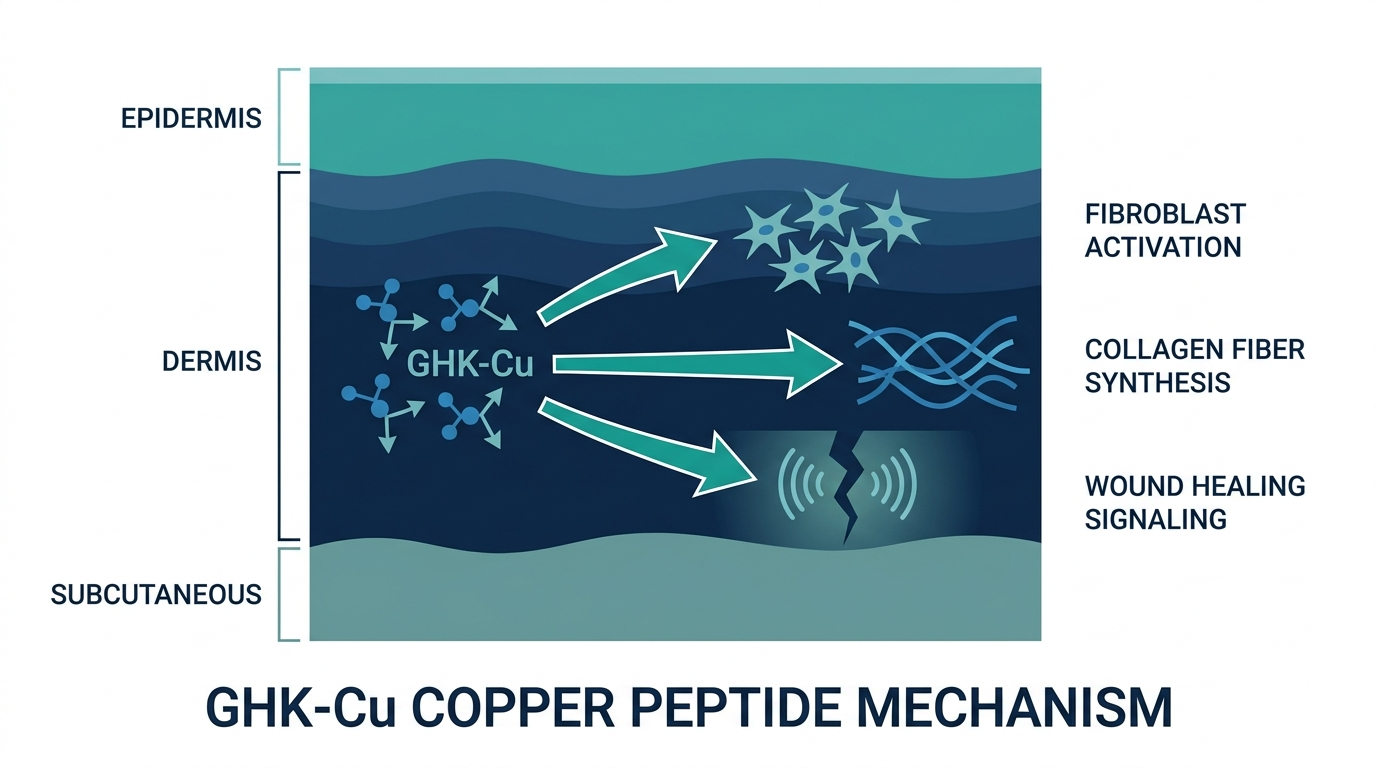
GHK-Cu is a copper-binding tripeptide: three amino acids (glycine, histidine, lysine) wrapped around a single copper ion. A biochemist named Loren Pickart discovered it in 1973 while trying to figure out why blood plasma from young donors helped aged liver tissue regenerate in the lab (PeptideDeck). He isolated the active fragment and then, somewhat improbably, spent the next five decades publishing on it. Most “miracle ingredients” do not come with fifty years of one obsessive researcher’s notes attached. This one does.
The reason it is trending again in 2026 has nothing to do with new science and everything to do with the peptide boom. Once forums full of people learned to reconstitute BPC-157 and CJC-1295 with insulin syringes, GHK-Cu got swept into the same shopping cart, and “where to buy ghk-cu peptide” started getting typed by two completely different people: a 38-year-old comparing copper-peptide serums on Sephora, and a biohacker pricing 50mg vials on a research-chem site. They are asking the same words and shopping in two different universes. The whole point of this page is to keep you from wandering into the wrong one by accident.
Here is the thing the supplement blogs bury: Pickart’s own data showed GHK levels in the body fall from roughly 200 ng/mL at age 20 to under 80 ng/mL by age 60, a drop of more than 60% (PeptideDeck). That decline is real and it is the entire pitch for “replacing” it. But “your body makes less of it as you age” is not the same claim as “smearing it on your face reverses aging,” and the gap between those two sentences is where most of the marketing lives.
Full-body lab membership: 100+ biomarkers, doctor-reviewed, tracked over time.

Topical or injectable: which GHK-Cu are you actually shopping for?
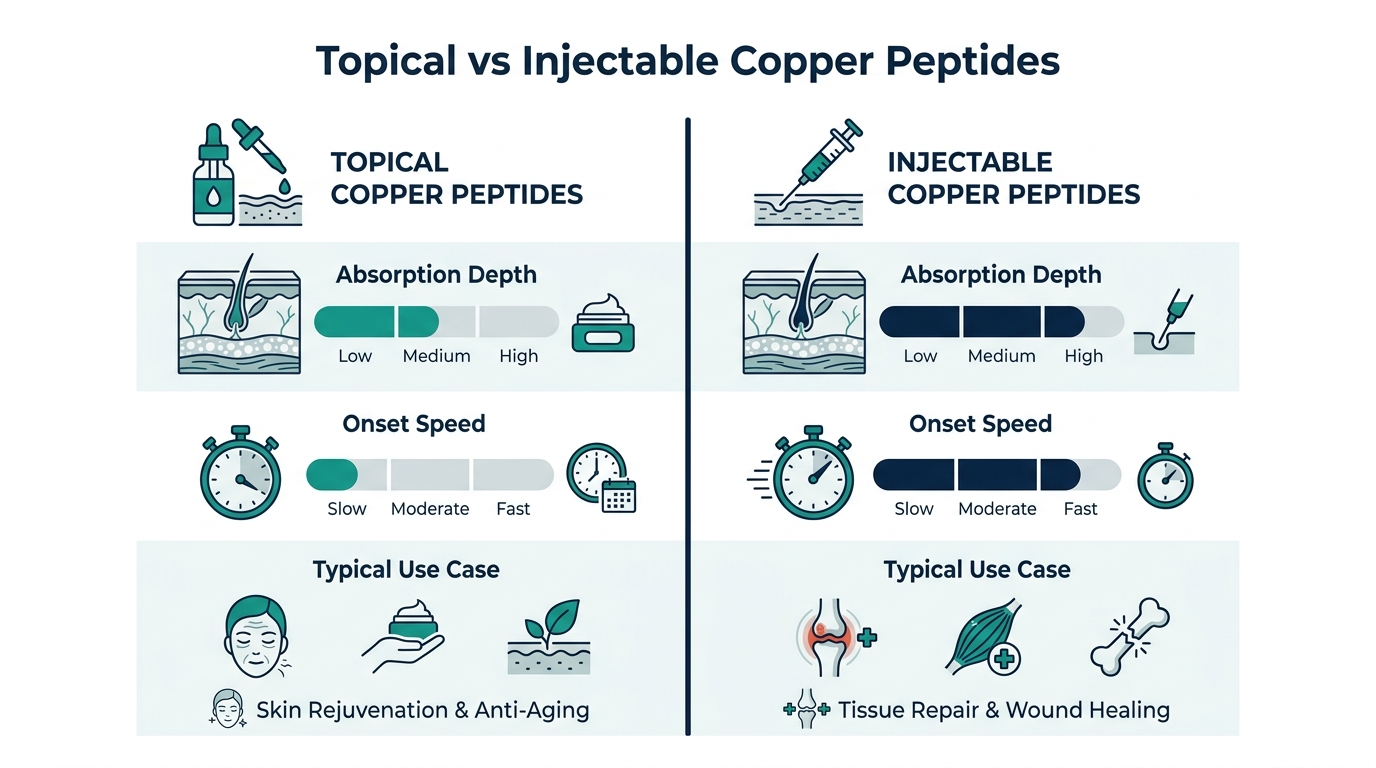
This is the fork in the road, and almost nobody draws it clearly, so here it is in one table.
| Topical serum (Copper Tripeptide-1) | Injectable research vial | |
|---|---|---|
| Legal status (US, 2026) | Sold legally as a cosmetic | “Research use only,” not legal to use on yourself |
| Human evidence | Yes: RCTs on wrinkles, firmness | None: zero published human trials |
| Where to buy | Beauty retailers, brand sites, Amazon, Sephora, Ulta | Grey-market “research peptide” vendors only |
| Typical price | $20 to $60 per bottle | ~$0.59/mg median; ~$60 to $100 per 50 to 100mg vial |
| What you handle | Pump and apply | Reconstitute powder, draw, inject, dose math |
| Who stands behind it | A cosmetics brand and the FDA’s cosmetic rules | Nobody. The label says so. |
| Risk class | Low (mild transient redness in a few %) | High and largely unstudied |
Read that top to bottom and the recommendation writes itself. The topical form is the one with trials, the one with retail accountability, the one you can buy with a credit card from a store with a return policy. The injectable form is the one where you become the manufacturer, the pharmacist, and the test subject simultaneously. People treat the price gap as the deciding factor. The price gap is the least important line in that table.
Where do you buy a copper-peptide serum (and what’s actually worth it)?
For the topical route, you are spoiled for choice, which is its own problem because most of the marketing is noise. The serum that anchors the entire category is The Ordinary Multi-Peptide + Copper Peptides 1%, sold at Sephora, Ulta, Target, Amazon, and the brand’s own site for around $30, often less on subscription (The Ordinary). The “1%” is the GHK-Cu concentration, and it is blended with a stack of other peptides (Matrixyl, SYN-AKE, Argirelox). At the budget end, brands like Asterwood sell a simpler 0.1% GHK-Cu plus hyaluronic acid serum for about $20 (Asterwood). At the premium end you have NIOD, Dr. Brenner, and a dozen department-store options charging three to ten times more for, frankly, similar core chemistry.
My honest take after reading the labels rather than the ad copy: this is a category where the $20 to $35 options are genuinely competitive with the $120 ones, because the active is cheap and the differentiation is mostly texture, fragrance, and packaging. You are not buying a rare molecule. You are buying a stable, well-formulated delivery of a molecule that costs pennies. Pay for formulation and feel, not for the word “copper” on the box.
Hydrolyzed type I & III collagen peptides, third-party tested, unflavored.

How do you read a copper-peptide serum label? (the part the box won’t explain)
Here is where a little chemistry saves you from both overpaying and sabotaging your own results.
Concentration: the effective range is roughly 0.05% to 2%, and more is genuinely worse. This is the counterintuitive part. The research-relevant band for topical GHK-Cu sits around 0.05% to 2%, with most credible formulas landing at 0.1% to 1% (Asterwood). Crank it higher and you do not get more collagen; some data suggests very high concentrations actually upregulate collagen-degrading enzymes, working against you. So when a serum brags about being “extra strength 5% copper peptide,” that is a marketing number, not a better product. Look for a stated GHK-Cu (or “Copper Tripeptide-1”) percentage in the 0.1% to 1% zone and stop being impressed by bigger numbers.
The myth to bust: copper peptides and vitamin C “cancel each other out.” You will read everywhere that you cannot use copper peptides with vitamin C, niacinamide, or anything acidic. The truth is more specific. The real, documented concern is that very low-pH direct vitamin C (think L-ascorbic acid serums) can destabilize the copper-peptide complex if applied at the same time, so you separate them by time of day, morning and evening (Asterwood). That is a real interaction. But the old internet claim that niacinamide neutralizes copper peptides is largely a myth at cosmetic concentrations; they are fine together. And retinol is not just compatible, it is arguably synergistic, since the two stimulate collagen by different pathways. So the practical rule is narrow: keep strong direct vitamin C and exfoliating acids on a different clock from your copper peptide (wait 15 to 20 minutes after acids), and ignore the rest of the “do not mix” folklore.
Formulation tells you more than concentration. Copper peptides are oxidation-sensitive. An opaque or airless pump bottle, a fragrance-free formula, and a short ingredient list are quiet signals of a brand that understands what it is selling. A clear jar that scoops air onto the product every time you open it is a quiet signal of one that does not.
What does the evidence actually say for skin and hair?
Let me separate what is shown from what is hoped, because the marketing fuses them.
Skin (topical): the strongest case. A 2022 randomized controlled trial (n=71, 12 weeks) reported that a 1% GHK-Cu cream was associated with a roughly 55.7% reduction in wrinkles, and a 2023 safety review across 12 studies (n=512) found the main adverse events were mild and transient: erythema in about 4.2% and itching in about 2.8% (search-aggregated clinical summary). Controlled studies also point to improvements in firmness, elasticity, and skin density over three to six months. This is not Retin-A-level evidence, but for a cosmetic ingredient it is a genuinely respectable file. The honest caveat: product purity varies, with some serums reportedly carrying only 10% to 50% active, so the bottle you buy may not match the cream they tested.
Hair: promising, less proven. GHK-Cu is theorized to enlarge follicles, reduce the miniaturization behind androgenetic alopecia, and improve scalp blood supply via angiogenesis, and some sources claim it performs comparably to minoxidil 5% in early work (Perfect B). Treat “comparable to minoxidil” as a hopeful headline, not a settled finding; the human hair data is thin next to the skin data.
Wound healing: the original story, mostly preclinical. GHK’s well-documented lab effects (reducing inflammation, remodeling the extracellular matrix, stimulating new blood vessels) are real and impressive in cell and animal models, which is exactly where Pickart’s work lives. That is the legitimate scientific core. It is also why the injectable crowd believes so hard in it, and why it is worth saying plainly: a striking petri-dish result is not a green light to inject something into your subcutaneous fat at home.
Where would you even buy injectable GHK-Cu, and why I’m not linking it
Now the search that worries me: “where to buy ghk cu peptide injection.” Here is the straight reality.
Injectable GHK-Cu only exists in the grey market. It is sold by “research peptide” vendors as a lyophilized (freeze-dried) powder, labeled “for laboratory research, not for human consumption,” at a 2026 median of around $0.59 per milligram, which works out to roughly $60 to $100 for a 50mg or 100mg vial ([market pricing data, Q1 2026]). The 50mg vial is the default size people buy for injection. There is no pharmacy, no prescription, no clinician, and crucially no published human clinical trial evaluating injectable GHK-Cu for skin, hair, or wound outcomes. The cycling protocols you see on forums exist precisely because nobody actually knows the long-term safety, so “cycle off” is a hedge dressed up as a method.
I am not going to give you a buy link for it, and that is a deliberate editorial line, not an oversight. Steering a reader from a $30 retail serum with trial data toward an unregulated injectable with none would be the opposite of helpful. If you are determined to go that route anyway, understand what the bar looks like, because it is the only thing standing between you and a counterfeit:
- A recent, batch-matched third-party Certificate of Analysis where the batch number on the COA matches the vial you receive.
- Both HPLC (purity, you want 98%+, the better vendors show 99%+) and Mass Spec (identity, confirming it is actually GHK-Cu).
- For an injectable specifically, also a bacterial endotoxin test and a sterility panel, because you are putting it under your skin. The good vendors publish all of these; the best-known testing lab in this world is Janoshik, whose reports carry a unique key you verify on Janoshik’s own site (clinical/COA practice summary).
And the insider tell: a vendor selling “for research only” on the label while their entire website is dosing charts in milligrams-per-day and before-and-after face photos is telling you, in writing, that the label is a fiction. They know exactly what you are doing with it. The legal language exists to protect them, not you.
Is GHK-Cu FDA approved? What changed in 2026?
No, GHK-Cu is not an FDA-approved drug for any human therapeutic use. But the regulatory picture moved this spring and it is worth getting right, because the headlines oversold it.
On 15 April 2026, the FDA removed injectable GHK-Cu from its 503A Category 2 list (the “substances that may present significant safety risks” list that effectively blocks compounding), because the original nominations were withdrawn (PeptIQ; Frier Levitt). The biohacker forums read that as “GHK-Cu is legal now.” It is not that simple. Removal from Category 2 is not the same as Category 1 approval. Formal rulemaking is still required before licensed 503A and 503B compounding pharmacies can routinely make injectable GHK-Cu, and the FDA has signaled it intends to consult its Pharmacy Compounding Advisory Committee before the end of February 2027 (PeptIQ). So the door is unlocked, not open. The practical read: the legitimate, prescribed, pharmacy-made route for injectable GHK-Cu is plausibly coming, which is one more reason to not gamble on a grey vial today when a regulated version may be a clinician’s prescription away within a year or two.
Meanwhile the topical form was never in this fight. Copper Tripeptide-1 in skincare is regulated as a cosmetic, has been sold openly the whole time, and is what you should be buying if your goal is skin or hair.
How much does GHK-Cu actually cost?
Pricing splits cleanly along the two routes, and the cheaper-per-milligram option is the one carrying all the hidden cost.
- Topical serum: $20 to $60 per bottle, lasting one to three months. Genuinely low risk; buy on formulation and reviews. The $30 The Ordinary tier is hard to beat on value.
- Injectable research vial: around $0.59/mg, so roughly $60 to $100 for a 50 to 100mg vial, which at a 1 to 2 mg/day community protocol works out to about $20 to $50 a month ([market pricing data]). But that number excludes bacteriostatic water, syringes, alcohol swabs, and the entirely uncosted risk of injecting something with no oversight.
The vial looks cheaper per milligram. It is not cheaper once you price in the COA you have to verify yourself, the reconstitution you can get wrong, and the fact that no one is accountable if the powder is not what the label claims. With the serum, the “everything else” is included in the $30.
What I would actually do
Personally, and I say this as someone who finds the biohacking rabbit hole genuinely fascinating: for skin and hair, I would buy a 0.1% to 1% copper-peptide serum from a retailer with a return policy, use it consistently for the twelve weeks the trials ran, and judge it on my own face. That is the version of GHK-Cu with human evidence, retail accountability, and a near-zero downside. It is also, conveniently, the cheap and easy one.
I would not inject grey-market GHK-Cu in 2026, and the timing argument is the clincher, not just the safety one. The regulatory door is swinging toward licensed compounding pharmacies after the April Category 2 removal. If injectable GHK-Cu turns out to be worth doing, there is a real chance you will soon be able to get a pharmacy-made, prescribed, sterility-tested version from a clinician who took your history first. Trading that near-future for a powder from a vendor who can post a goodbye note next month, with your money and zero recourse, is a bad trade on every axis except impatience.
If you take one line from this page: for GHK-Cu, the serum is the product and the injectable is the gamble. Same molecule, completely different decision.
Turn what you just learned into action.
Superpower lets you test 100+ biomarkers from home, then re-check them over time so you can actually see progress, physician-reviewed at every step.
Frequently asked questions
Where can I buy GHK-Cu copper peptides?
For skin and hair, buy a topical copper-peptide serum (look for “Copper Tripeptide-1” or “GHK-Cu” at 0.1% to 1%) from a reputable beauty retailer or brand: The Ordinary, Asterwood, NIOD, and others sell them at Sephora, Ulta, Target, Amazon, and brand sites for roughly $20 to $60. Injectable GHK-Cu is only available from grey-market research-peptide vendors, is labeled “not for human use,” and is the riskier route we do not recommend or link.
Is topical or injectable GHK-Cu better?
For almost everyone, topical. The topical serum has actual human trial data (a 1% cream linked to ~55.7% wrinkle reduction over 12 weeks), is legal, is sold by accountable retailers, and is low-risk. Injectable GHK-Cu has zero published human trials, no pharmacy or clinician behind it, and a “research use only” label that shifts all liability to you.
Is GHK-Cu FDA approved?
No. GHK-Cu is not an FDA-approved drug. Topical Copper Tripeptide-1 is regulated and sold as a cosmetic. Injectable GHK-Cu was removed from the FDA’s 503A Category 2 list on 15 April 2026, but that is not approval; formal rulemaking and a Pharmacy Compounding Advisory Committee review (expected by February 2027) are still needed before pharmacies can routinely compound it.
What concentration of copper peptide serum should I look for?
The research-relevant range is about 0.05% to 2%, with most credible serums at 0.1% to 1%. Higher is not better; very high concentrations may actually trigger collagen-degrading enzymes. A stated GHK-Cu percentage in the 0.1% to 1% band, in opaque or airless packaging, is the sweet spot.
Can I use copper peptides with vitamin C, niacinamide, or retinol?
Keep strong direct (low-pH) vitamin C and exfoliating acids on a different schedule, morning versus evening, since they can destabilize the copper-peptide complex. Niacinamide is fine alongside copper peptides at cosmetic concentrations (the “they cancel out” claim is largely a myth), and retinol is compatible and may even be synergistic.
How much does GHK-Cu cost?
Topical serums run $20 to $60 per bottle. Injectable research vials run around $0.59/mg, roughly $60 to $100 for a 50 to 100mg vial, but that excludes bacteriostatic water, syringes, and the cost of no oversight. The per-milligram price on the vial hides everything the serum’s price includes.
Does GHK-Cu work for hair loss?
There is early, hopeful evidence that GHK-Cu supports follicle size and scalp circulation, with some sources claiming it rivals minoxidil 5%, but the human hair data is much thinner than the skin data. Treat hair claims as promising rather than proven, and see a clinician for established options first.
Author: Vital Signs Today Editorial Team, [credential]”]. Educational content, not medical advice. Sources linked inline.
Primary sources (verify live before publish):
– The Ordinary, Multi-Peptide + Copper Peptides 1% product page: https://theordinary.com/en-us/multi-peptide-copper-peptides-1-serum-100625.html
– Asterwood, Copper Peptides Guide 2026 (concentration range, layering chemistry, pricing): https://www.asterwood.co/blogs/skincare/copper-peptides-guide-2026
– Sarbaziha et al., “Copper Peptides in Regenerative Aesthetic Dermatology,” Dermatological Reviews (Wiley, 2026): https://onlinelibrary.wiley.com/doi/abs/10.1002/der2.70067
– PeptideDeck, GHK-Cu benefits / Pickart history / age-decline data: https://www.peptidedeck.com/blog/ghk-cu-peptide-skin-hair-benefits
– Perfect B, Copper Peptide for Hair Loss (GHK-Cu vs minoxidil): https://www.perfectb.com/copper-peptide-for-hair-loss-ghk-cu/
– Peptide Dosing Protocols, GHK-Cu dosing & COA practice: https://www.peptidedosingprotocols.com/protocol/ghk-cu
– PeptIQ, FDA removes GHK-Cu from Category 2 (April 2026, PCAC by Feb 2027): https://peptiq.io/blog/ghk-cu-fda-category2-removal-2026
– Frier Levitt, FDA peptide “do not compound” list update 2026: https://www.frierlevitt.com/articles/fda-peptides-do-not-compound-list-update-2026/
Related reading
Vital Signs Today may earn a commission if you buy through links on this page. It does not affect our editorial assessments.