If your complete blood count (CBC) flags “abs eosinophils” as low, you are looking at the absolute eosinophil count, the raw number of one type of white blood cell per microliter of blood. A low value, called eosinopenia, is common, is usually not a stand alone disease, and most often reflects stress, infection, or steroid medication rather than a serious problem.
- A low absolute eosinophil count (eosinopenia) generally means fewer than about 30 cells per microliter, and a result of zero can still be normal on a single test, per Cleveland Clinic and MedlinePlus.
- The most common causes of low eosinophils are acute physical stress, bacterial infection or sepsis, and corticosteroid medications or excess cortisol from Cushing syndrome, which suppress eosinophils through the hormone cortisol.
- Eosinopenia by itself rarely causes symptoms and rarely needs treatment, but a low count during a serious illness can signal worse outcomes, so it is read alongside the rest of the CBC and your clinical picture.
Part of our Complete Blood Count guide.
Low eosinophils flagged on your CBC? See the complete white blood cell picture behind it. One at-home Superpower draw checks 100+ biomarkers, physician-reviewed.
What does a low abs eosinophils result mean, and what is the cutoff?

A low absolute eosinophil count means the number of eosinophils circulating in your blood has dropped below the reference range. Cleveland Clinic lists a normal absolute eosinophil count as 30 to 350 cells per microliter and considers a value low when it falls below 30 cells per microliter. MedlinePlus describes a normal count as less than 500 cells per microliter, which is why many lab reports show a lower limit at or near zero.
This matters because the bottom of the eosinophil range sits very close to zero. Eosinophils are a small fraction of your white blood cells, so a count of 0 on a single test is often not abnormal at all. The differential also reports a percentage, but the absolute number (percentage multiplied by your total white blood cell count) is the figure clinicians trust most, because the percentage alone can mislead when your overall white count is high or low.
What causes low eosinophils?
The leading causes of low eosinophils are acute stress, infection, and the hormone cortisol, whether from medication or your own body. Corticosteroid drugs and excess cortisol from Cushing syndrome both reduce eosinophil production in the bone marrow and pull existing eosinophils out of the bloodstream, which is documented by MedlinePlus and StatPearls.
- Acute physical stress: Surgery, trauma, burns, or intense exertion trigger a surge of cortisol and adrenaline that temporarily clears eosinophils from the blood.
- Acute infection and sepsis: During a bacterial infection, eosinophils migrate out of the blood into tissue, and a low count has been studied as a marker of acute bacterial infection in hospitalized adults (PMC).
- Corticosteroid medications: Prednisone, dexamethasone, and similar drugs are a classic cause of drug induced eosinopenia.
- Cushing syndrome: Chronic cortisol overproduction keeps eosinophils persistently low (Cleveland Clinic).
- Alcohol intoxication: MedlinePlus lists acute alcohol intoxication as a recognized cause.
What are the symptoms, or is it silent?
Low eosinophils almost always produce no symptoms of their own. Eosinopenia is typically a silent lab finding, and Cleveland Clinic notes it is rarely a concern on its own. Any symptoms you feel usually come from the underlying trigger, not from the missing eosinophils.
For example, if a serious bacterial infection drove your eosinophils down, the symptoms you notice are fever, chills, rapid heart rate, or feeling very unwell from the infection itself. If you take prednisone, you will not feel the drop in eosinophils at all. Because eosinophils mainly fight parasites and drive allergic inflammation, a short term dip does not leave you obviously more vulnerable, which is part of why a single low or zero result is usually left alone.
When is a low eosinophil count dangerous?
Eosinopenia is dangerous not as a disease but as a possible warning sign during serious illness. Research has linked a low absolute eosinophil count to worse outcomes in critically ill patients, including a study finding that a low count predicted in hospital mortality in cirrhosis with systemic inflammatory response syndrome (PMC).
The takeaway is about context, not the number alone. A low or zero eosinophil count in an otherwise healthy person at a routine checkup is reassuring and rarely meaningful. The same result in someone who is acutely sick, hospitalized, or in the intensive care unit can be a clue that the body is under heavy stress or fighting a severe infection. Clinicians read it together with white blood cell count, neutrophils, lactate, vital signs, and how you look and feel, never in isolation.
What should you do next, and when should you see a doctor?
For most people, a low abs eosinophils result needs no action, especially if it is your only abnormal value and you feel well. The single most useful step is to review the whole CBC with the clinician who ordered it, because eosinophils are interpreted as part of the full panel, not on their own.
- If you feel fine and everything else is normal: No specific treatment exists or is needed; eosinopenia usually resolves once the trigger (stress, illness, or a steroid course) passes.
- If you take corticosteroids: Mention it, since the medication likely explains the result. Do not stop a prescribed steroid on your own.
- See a doctor promptly if you also have fever, persistent fatigue, unexplained weight changes, signs of infection, or other abnormal CBC values.
- Ask about repeat testing if your clinician wants to confirm the finding, since a single result can be transient.
The insider nuance: why eosinophils are the body’s “cortisol meter”
Here is what experienced clinicians watch for that patients rarely hear. Eosinophils are exquisitely sensitive to cortisol, so a drop in eosinophils is one of the body’s fastest readouts of a stress or steroid response, sometimes called the cortisol effect. This is why a count near zero often says more about cortisol than about your immune system.
Two practical points follow. First, because cortisol drives the drop, eosinopenia and the morning of a steroid dose go hand in hand, so timing of your blood draw relative to medication can change the number. Second, in hospitalized patients, clinicians sometimes use a falling eosinophil count as a cheap, fast hint of new acute infection, since a low count has been associated with acute bacterial infection in older adults (PMC). A low eosinophil count is therefore best understood as a sensitive signal, not a diagnosis.
What eosinophils are and what they normally do
Understanding the cell explains why a low count usually matters so little. Eosinophils are a type of white blood cell made in your bone marrow. They make up only a small slice of your total white cells, and most of them do not even circulate in the blood; the majority live in tissues, especially the lining of your gut, lungs, and skin, where their real work happens.
Their two headline jobs are fighting certain parasites and driving allergic inflammation. When you have a parasitic infection or an allergic condition such as asthma or eczema, eosinophils are recruited in large numbers, which is why a high count often points toward allergy or parasites. In everyday health, though, you need only a modest number in the bloodstream, and the blood pool is small and quick to change. Because eosinophils spend so little time in the blood and are so easily pulled out of it by cortisol, the blood number swings readily, and a temporary dip to a very low or even zero value does not leave you meaningfully more vulnerable. That biology is the foundation for why an isolated low count is generally left alone.
Absolute count versus percentage: reading the differential correctly
One of the most common sources of confusion on a CBC is the difference between the absolute eosinophil count and the eosinophil percentage, and getting this straight prevents needless worry.
A complete blood count with differential reports each white cell type two ways. The percentage tells you what share of your total white cells are eosinophils. The absolute count, calculated by multiplying that percentage by your total white blood cell count, tells you the actual number of eosinophils per microliter of blood. Clinicians trust the absolute number, because the percentage alone can mislead.
Here is why. Imagine your eosinophil percentage reads a normal-looking 2 percent, but your total white count is very high because of an infection. Two percent of a large number can still be a lot of eosinophils. Conversely, a percentage that looks low can be normal in absolute terms if your total white count is low. This is exactly why lab reports label the value abs eosinophils: the word absolute signals that the figure has already been converted into a real cell count, which is the number worth acting on.
How eosinophils are read within the whole CBC
An eosinophil count is one line in a larger differential, and its meaning comes from the pattern around it. Clinicians almost never look at eosinophils in isolation; they scan the whole panel for a coherent story.
| Component | What it adds to a low eosinophil reading |
|---|---|
| Total white blood cell count | A high total with low eosinophils and high neutrophils fits an acute bacterial infection or stress response. |
| Neutrophils | Often rise as eosinophils fall during acute stress and infection, a classic paired shift driven by cortisol. |
| Lymphocytes | Also suppressed by cortisol, so a combined drop in eosinophils and lymphocytes strengthens the stress or steroid interpretation. |
| Neutrophils and bands | A rise in immature neutrophils (a left shift) alongside low eosinophils supports active infection. |
| Red cells and platelets | Help judge whether the marrow as a whole is affected or only the white cell response is shifting. |
Put together, a very common and benign pattern is high neutrophils, low eosinophils, and low lymphocytes, the fingerprint of a cortisol-driven stress response from illness, surgery, or steroids. Recognizing this pattern is often more informative than the eosinophil number by itself.
Low versus high eosinophils: keeping the directions straight
Because most clinical attention goes to high eosinophils, it helps to hold both directions in view so you can place your own result correctly.
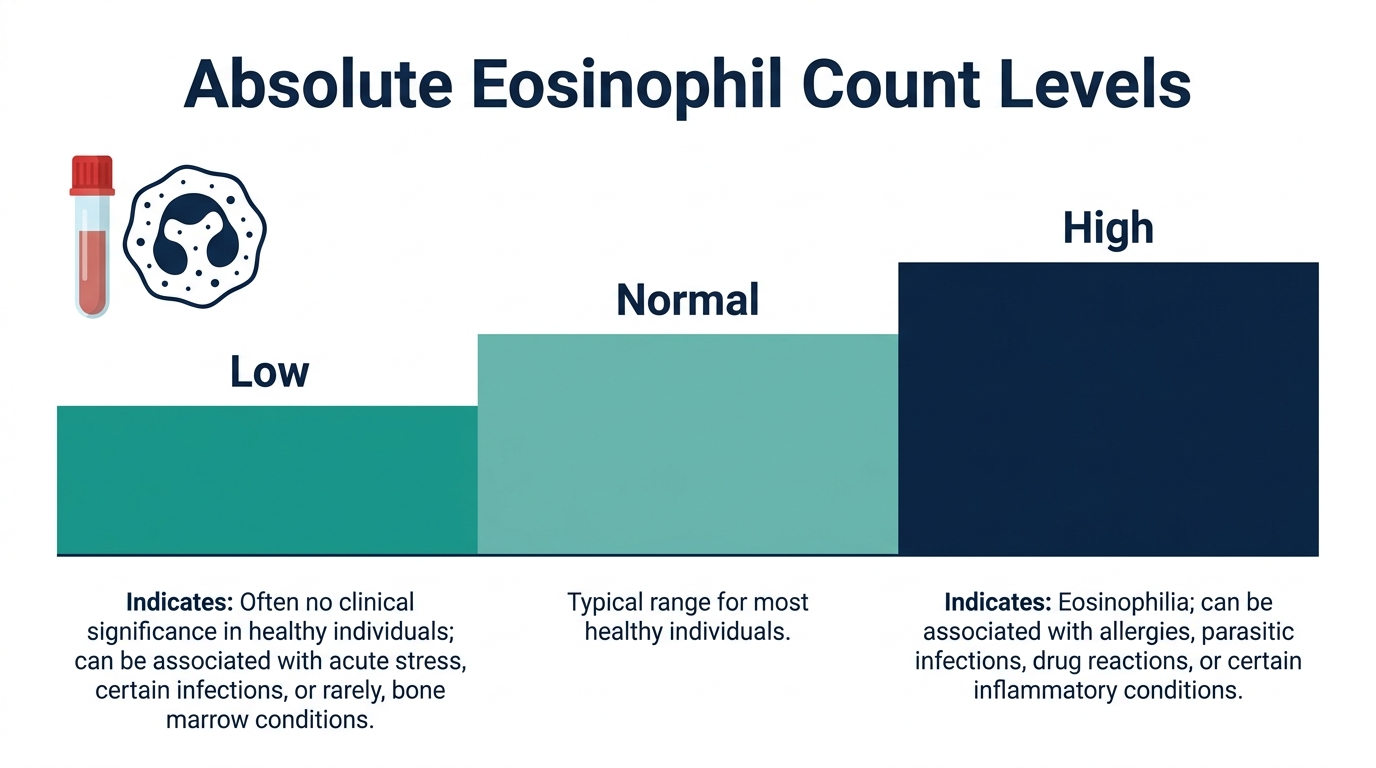
A high eosinophil count (eosinophilia) is the finding that more often prompts a workup, since it points toward allergic disease, asthma, drug reactions, parasitic infection, certain skin conditions, and, less commonly, specific blood disorders. A low count (eosinopenia), by contrast, is usually a marker of the body’s stress or steroid state rather than a disease of the eosinophils themselves. The asymmetry is deliberate: the immune system is built to ramp eosinophils up sharply when needed, so a surplus signals an active process, whereas a shortfall in the blood mostly reflects cortisol pulling them out of circulation. This is why a high value tends to trigger questions about what is stimulating the immune system, while a low value tends to prompt a simple question about stress, infection, or steroids, and often nothing more.

Timing, steroids, and getting a clean reading
Since cortisol is the main lever on eosinophils, a few practical factors influence the number and are worth keeping in mind when interpreting a low result.
- Time of day: cortisol follows a daily rhythm, peaking in the morning, and eosinophils tend to mirror it in reverse, often reading lower in the morning. A morning draw can therefore show a lower eosinophil count than an afternoon one.
- Steroid timing: if you take a corticosteroid, the count can drop after a dose, so the interval between your medication and the blood draw affects the value.
- Acute stress on the day: a recent injury, surgery, severe pain, or intense exertion raises cortisol and can transiently clear eosinophils from the blood.
- Illness: an active bacterial infection can pull eosinophils into tissue, lowering the blood count while you are unwell.
None of these require special fasting or preparation, but they do explain why a single low or zero reading is so often transient. If the result matters clinically, a repeat draw once any acute stress or steroid effect has passed usually gives a truer picture, which is why clinicians lean on the trend and the whole panel rather than one number.
Who should follow up on a low eosinophil count
For the large majority of people, a low abs eosinophils result needs no follow-up at all. It becomes worth a closer look mainly when it keeps company with other findings or a concerning clinical picture.
Consider discussing it further if any of these apply. You are acutely unwell, hospitalized, or have signs of a serious infection, since in that setting a low count can be one clue among many that the body is under heavy stress. Other parts of your CBC are also abnormal, such as an unexplained high or low white count, anemia, or low platelets, which shifts attention to the marrow or a systemic process. You have features that raise the possibility of cortisol excess (Cushing syndrome), such as weight gain around the trunk, easy bruising, high blood pressure, and muscle weakness, where a persistently low eosinophil count fits the hormonal picture. Or the finding persists across repeat tests when you are otherwise well and off steroids, which is unusual and merits a conversation. Outside these situations, an isolated low eosinophil count on an otherwise normal panel, in someone who feels fine, is one of the least worrisome results a CBC can produce.
Common misconceptions about low eosinophils
A few misunderstandings make this result more alarming than it should be.
- “A count of zero means my immune system is failing.” A zero eosinophil count on a single test is frequently normal, because the bottom of the range sits at or near zero and eosinophils are a small, tissue-dwelling population.
- “Low eosinophils will make me catch every infection.” Eosinophils mainly target parasites and drive allergy; a short-term dip does not leave you broadly defenseless, and other white cells carry the main load against everyday infections.
- “There must be a treatment to raise them.” There is no treatment for eosinopenia itself; the count recovers when the underlying stress, illness, or steroid effect resolves.
- “The percentage is what matters.” The absolute count is the trustworthy figure, since the percentage can mislead when the total white count is unusually high or low.
- “A low count always signals something serious.” In a well person at a routine visit it is typically meaningless; it gains weight only in the context of acute illness or other abnormal results.
When to recheck a low eosinophil count, and what to watch
Because a single low or even zero eosinophil reading is often meaningless on its own, the useful question is not “is this bad” but “does it need a second look.” A few practical guideposts help you decide.
- An isolated low value with no symptoms rarely needs urgent action. Eosinopenia by itself is seldom a concern, and a count of zero can appear on a routine test in a perfectly healthy person (Cleveland Clinic). In that setting, the count is usually just noted and revisited at your next routine panel.
- Recent stress or steroids explain many low readings. Acute infection, physical stress, or a course of corticosteroids can transiently suppress eosinophils. If any of those applied around your draw, a recheck once you have recovered often shows the count returning to its usual range.
- Read it as part of the whole CBC. A low eosinophil line matters far more when other counts are also disturbed than when it stands alone in an otherwise normal count. The pattern across the differential carries the signal, not the single cell type.
- Let symptoms set the timeline. If you feel well, a routine recheck at your next scheduled bloodwork is reasonable. New or worsening symptoms are the cue to speak with your clinician sooner rather than waiting.
The takeaway is proportion. A one-off low eosinophil count in someone who feels fine is one of the least alarming findings on a CBC, and the sensible response is a calm recheck under ordinary conditions rather than immediate worry. Bring the full count and any recent illness or medication to that follow-up, since those details usually explain the number without further testing.
Don’t just read about your health, track it.
A single result is a snapshot. Superpower re-tests 100+ markers over time so you can watch them move as you change sleep, food, and training.
Frequently asked questions
Is a low eosinophil count something to worry about?
Usually no. Cleveland Clinic notes eosinopenia is rarely a concern on its own, and a count of zero can be normal on a single test. It becomes meaningful mainly during serious illness, when it is read alongside the rest of your CBC and symptoms.
What number counts as low for absolute eosinophils?
Cleveland Clinic lists a normal absolute eosinophil count as 30 to 350 cells per microliter and considers below 30 cells per microliter low. MedlinePlus describes normal as less than 500 cells per microliter, so many lab reports place the low end at or near zero.
Can stress lower my eosinophils?
Yes. Acute physical stress such as surgery, trauma, or severe infection raises cortisol and adrenaline, which quickly clears eosinophils from the blood. This effect is temporary and the count typically recovers once the stressor resolves.
Do steroids cause low eosinophils?
Yes. Corticosteroid medications like prednisone and dexamethasone are a classic cause, and excess natural cortisol from Cushing syndrome does the same, per MedlinePlus and Cleveland Clinic. Tell your clinician about any steroids, and never stop a prescribed steroid on your own.
Is there a treatment to raise low eosinophils?
No specific treatment exists for eosinopenia itself. Because it reflects an underlying cause such as stress, infection, or steroids, the count generally returns to normal once that cause is addressed. Care focuses on the underlying condition, not the eosinophil number.
Sources
- Cleveland Clinic, Eosinophils: Function, Range and Related Disorders
- MedlinePlus Medical Encyclopedia, Eosinophil count – absolute
- NCBI PMC, Association between low eosinophil count and acute bacterial infection in hospitalized older adults
- NCBI PMC, Low Absolute Eosinophil Count Predicts In-Hospital Mortality in Cirrhosis With SIRS
- NCBI PMC, Eosinophil Count and Serum Glucose in Adrenal Cushing Syndrome
This article is for general educational purposes and is not medical advice. It cannot diagnose or treat you and does not replace your clinician. Always discuss your lab results and any health decisions with a qualified healthcare professional.
Related: find the right at-home biomarker test.
Vital Signs Today may earn a commission if you buy through links on this page. It does not affect our editorial assessments.