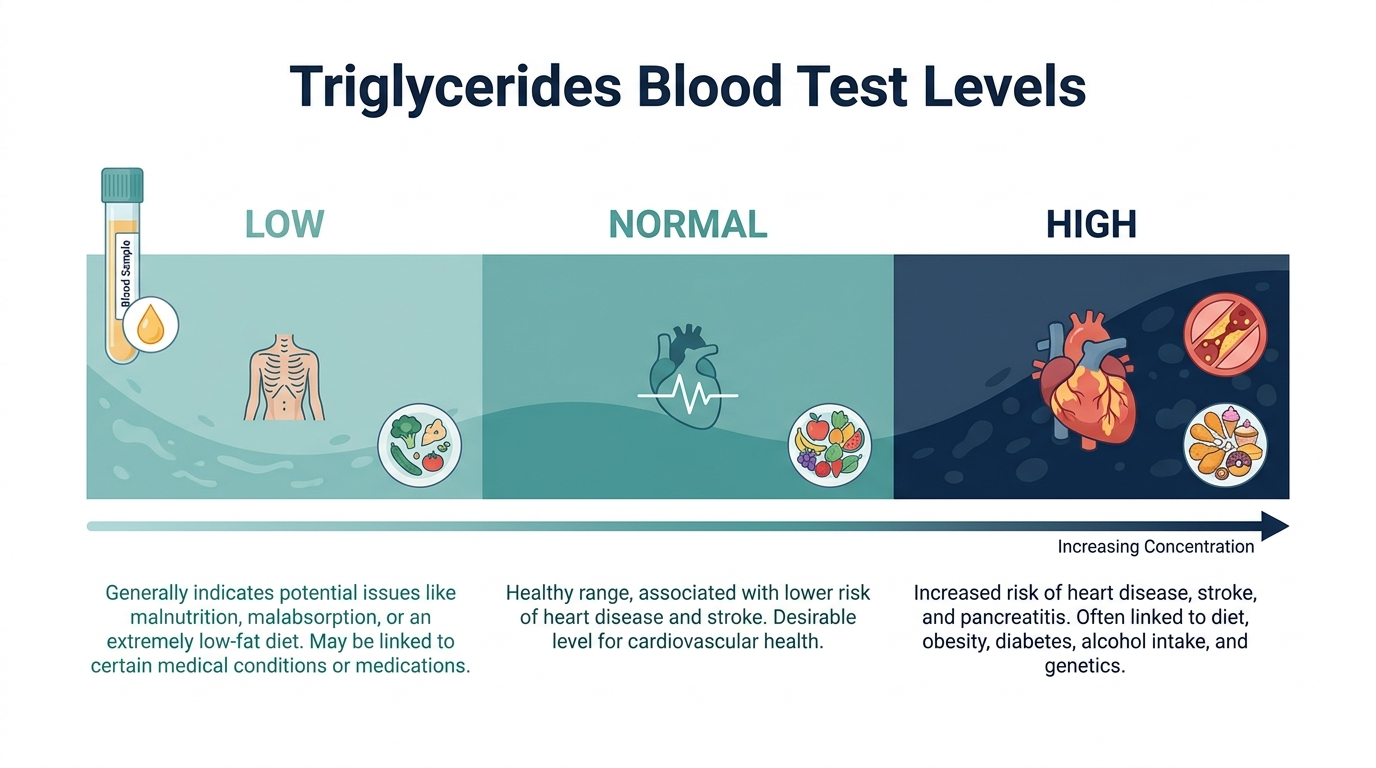
- Low triglycerides usually means a value under about 40 mg/dL, since a normal fasting triglyceride level is below 150 mg/dL (Cleveland Clinic).
- Mildly low triglycerides are often harmless and reflect a lean body, a low-fat or low-carb diet, or regular exercise, and they are not a recognized heart risk on their own.
- Very low triglycerides can sometimes flag an underlying problem such as an overactive thyroid, malnutrition, fat malabsorption, or a rare inherited condition, so the result should be read alongside your other labs and symptoms.
Most people open a lipid panel braced for a number that is too high. So a low triglyceride reading can feel confusing. In the large majority of cases it is reassuring, but in a minority it is a quiet clue that your body is not absorbing or storing fat the way it should. Here is how to tell which situation you are in.
Part of our Lipid Panel guide.
Low triglycerides on your lipid panel? See the complete cardiovascular picture behind that number. One at-home Superpower draw checks 100+ biomarkers, physician-reviewed.
What does a low triglyceride result mean, and what is the cutoff?
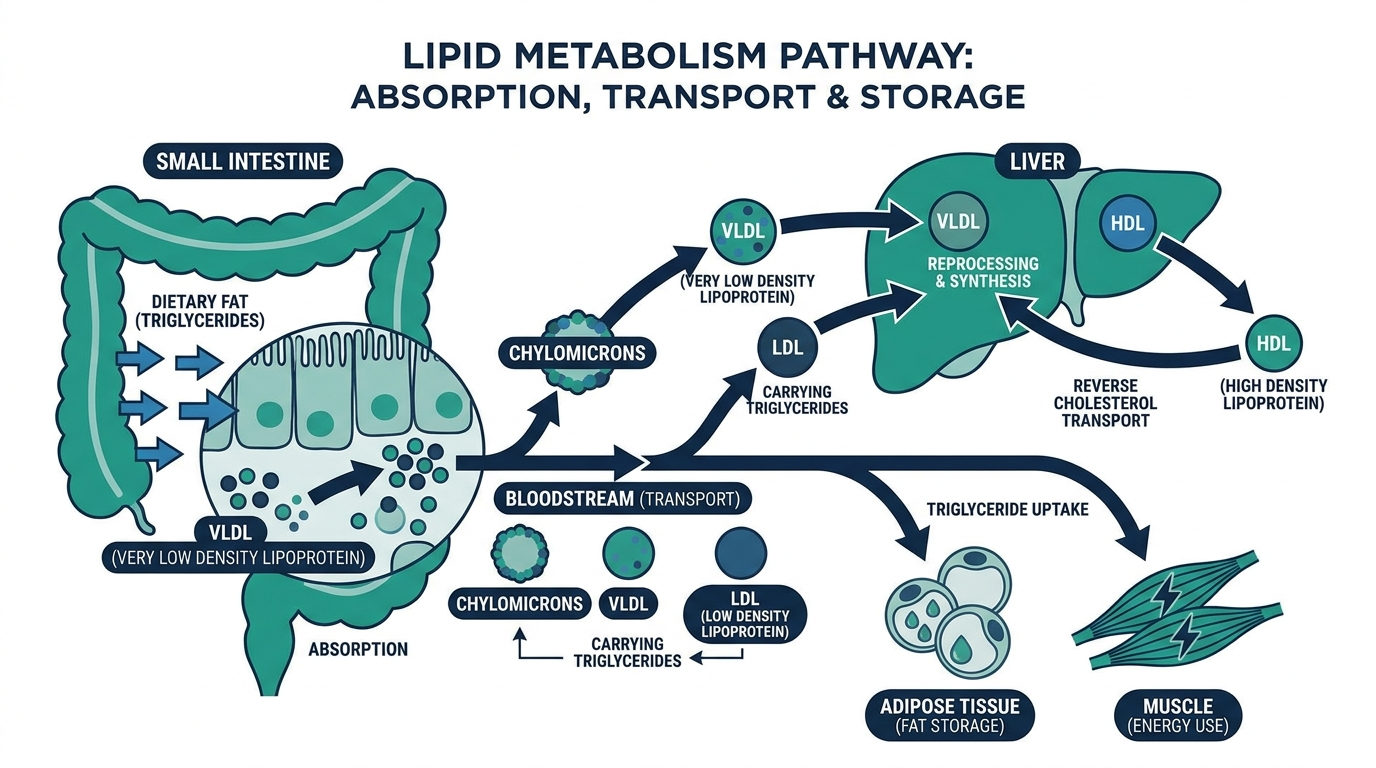
A low triglyceride result generally means your fasting value falls under roughly 40 mg/dL, because a normal level is defined as below 150 mg/dL (Cleveland Clinic). Triglycerides are the most common type of fat in your blood, and they store unused calories so your body can call on them for energy later. There is no formal “too low” diagnostic threshold the way there is for high triglycerides, which is part of why low values get little attention.
Here is the practical scale clinicians use:
- Normal: below 150 mg/dL.
- Considered low / optimal: below 100 mg/dL, which the Cleveland Clinic calls ideal.
- Notably low: under about 40 mg/dL, the point where a doctor may look for a cause.
A single low number is rarely alarming. The pattern across your whole lipid panel matters far more than one isolated value.
What causes low triglycerides?
Low triglycerides are most often caused by lifestyle and body composition, and less often by a medical condition. A common driver is simply eating a low-fat or very low-carbohydrate diet, since dietary fat and excess carbohydrate are the raw material your liver turns into triglycerides. Being lean and physically active lowers them too, because exercise burns circulating fat for fuel.
When the cause is medical, the usual suspects are:
- Hyperthyroidism: an overactive thyroid speeds up metabolism and burns through fats quickly, pulling triglycerides down (SiPhox Health).
- Malnutrition or undereating: when calories are scarce, the body depletes its fat stores for energy.
- Malabsorption: conditions such as celiac disease, Crohn disease, or chronic pancreatitis stop the gut from absorbing dietary fat properly.
- Inherited low lipids: rare genetic conditions such as familial hypobetalipoproteinemia, caused by APOB gene changes, keep both cholesterol and triglycerides low for life (HEART UK).
- Medications: some lipid-lowering and other drugs can push triglycerides down as a side effect.
Are there symptoms, or is it silent?
Low triglycerides themselves produce no symptoms and are silent, which is why they are almost always found by accident on a routine lipid panel rather than because someone felt unwell. The triglyceride number is not something you can feel.
What you may notice are signs of the underlying condition, if one exists. An overactive thyroid can bring unexplained weight loss, a racing heart, tremor, heat intolerance, and anxiety. Fat malabsorption from celiac or Crohn disease can cause diarrhea, pale or greasy stools, bloating, and fatigue. Because fat carries the fat-soluble vitamins A, D, E, and K, long-standing severe malabsorption or inherited low-lipid conditions can eventually lead to vitamin deficiencies that affect vision, bones, and nerves (HEART UK). If your triglycerides are very low and you have any of these symptoms, that combination is the real signal, not the lipid value alone.

When are low triglycerides actually dangerous?
Low triglycerides are not dangerous in themselves, and there is no established heart or stroke risk from having them low. The danger, when it exists, comes entirely from the cause behind a very low value, typically under about 40 mg/dL.
Concern rises when a low triglyceride level appears together with other red flags: unexplained weight loss, chronic diarrhea or greasy stools, low cholesterol across the board, or symptoms of an overactive thyroid. In that setting the number may be pointing at hyperthyroidism, malnutrition, or a malabsorption disorder that does need treatment (SiPhox Health). The inherited forms, although rare, matter because the long-term shortfall of fat-soluble vitamins can damage nerves and vision if it goes unaddressed. So the rule is simple: low and otherwise well is fine, while low plus symptoms deserves a closer look.
What should you do next, and when should you see a doctor?
If your triglycerides are mildly low and you feel well, the next step is usually nothing more than noting it and rechecking at your next routine panel, because for most people a low value is benign or even favorable. Make sure the test was done fasting, since eating beforehand and day-to-day variation can both move the number (Cleveland Clinic).
See a doctor sooner if any of the following apply:
- Your triglycerides are very low, under about 40 mg/dL, especially if your total and LDL cholesterol are also unusually low.
- You have unexplained weight loss, ongoing diarrhea, pale or greasy stools, or persistent fatigue.
- You have symptoms of an overactive thyroid such as palpitations, tremor, or heat intolerance.
- You eat very little or have a known gut condition such as celiac or Crohn disease.
Your clinician can order thyroid tests, check for malabsorption, and review the rest of your lipid panel to decide whether the low value means anything.

The insider nuance most reports skip
Here is the part that rarely makes it into a lab printout: low triglycerides are interpreted in context, not in isolation, because the same number can be a sign of excellent metabolic health in one person and a warning in another. A fit athlete on a clean diet and a person with untreated celiac disease can show the same low triglyceride value for completely opposite reasons.
What separates the two is the company the number keeps. Low triglycerides with normal cholesterol, normal weight, and no symptoms is the picture of good metabolic health, and many clinicians view triglycerides under 100 mg/dL as ideal. Low triglycerides alongside low cholesterol, weight loss, or gut symptoms is the version that warrants investigation. This is why a good clinician never reacts to the triglyceride line alone. They read it next to your cholesterol, your thyroid, your weight history, and how you actually feel.
How triglycerides fit into the rest of your lipid panel
Triglycerides never travel alone, and understanding how they connect to the other lines on your report explains why a low value can be reassuring. Triglycerides are carried through the blood inside particles called VLDL (very low-density lipoprotein), which the liver builds and releases. As those particles deliver their fat to tissue, they shrink and convert toward LDL, the so-called bad cholesterol. Because of this chain, a low triglyceride level often travels with a favorable overall lipid picture rather than a worrying one.
One practical detail matters here. Many labs do not measure your LDL cholesterol directly. Instead they estimate it using the Friedewald calculation, which divides your triglyceride number by five to approximate the cholesterol packed into VLDL. When triglycerides are low, that estimate is generally reliable. The opposite is where errors creep in: very high triglycerides make the calculated LDL inaccurate. So a low triglyceride value has a quiet bonus. It tends to make your reported LDL more trustworthy. When you look at your panel, read triglycerides next to total cholesterol, HDL, and LDL rather than in isolation, because the relationship between them tells the real story.
| Panel line | What it reflects | Why it matters with low triglycerides |
|---|---|---|
| Total cholesterol | All cholesterol carried in the blood | Low triglycerides plus low total cholesterol can hint at malabsorption or an inherited low-lipid state |
| HDL | Protective cholesterol | Normal or high HDL with low triglycerides is a healthy metabolic pattern |
| LDL | Cholesterol linked to plaque | Low triglycerides make the calculated LDL estimate more accurate |
| Non-HDL cholesterol | Total minus HDL | A broad risk marker that stays useful regardless of the triglyceride level |

Low-carb and ketogenic diets: a common and expected cause
One of the most frequent reasons a healthy adult sees a low triglyceride number today is dietary. Triglycerides respond strongly and quickly to carbohydrate intake, because the liver converts excess sugar and refined carbohydrate into triglycerides for storage. Cut the carbohydrate load, and the raw material for triglyceride production falls with it. People following low-carbohydrate, ketogenic, or simply low-sugar eating patterns commonly watch their triglycerides drop into the double digits.
This is worth calling out because it prevents needless alarm. If you have deliberately reduced sugar and refined carbohydrate, a low triglyceride reading is the expected result of that change, not a warning sign. It usually appears alongside a normal or even improved HDL, which together form a favorable pattern. The distinction that matters is intent and context. A low value you can explain through diet and that sits next to normal cholesterol and a normal weight reads very differently from a low value in someone who is unintentionally losing weight or eating poorly.
How day-to-day variation and testing conditions move the number
Triglycerides are among the most variable lines on a lipid panel, swinging more from meal to meal than cholesterol does. That variability is exactly why testing conditions deserve attention before you read anything into a low result.
- Fasting status: triglycerides rise after a fatty meal and fall during a fast. A value drawn after 8 to 12 hours without food is the cleanest baseline, and a low fasting number is more meaningful than a low post-meal one.
- Recent exercise: a hard workout in the day or two before the draw burns circulating fat and can pull triglycerides lower than your usual level.
- Alcohol: alcohol typically raises triglycerides, so someone who normally drinks and then abstained before testing may see a lower-than-usual value.
- Recent illness or reduced eating: a period of poor appetite depletes fat stores and can temporarily lower the number.
Because of this natural swing, clinicians put more weight on a consistent pattern across a few tests than on any single reading. If a surprising low value shows up once, repeating it under standard fasting conditions is often the most useful next step before assuming anything is wrong.
Low triglycerides in specific groups
Context also depends on who is being tested, since expected values shift across life stages and situations.
- Children and teenagers: pediatric reference ranges differ from adult ones, and a low value in a well, growing child is usually benign. Interpretation should always use the age-appropriate range printed on the report.
- Pregnancy: triglycerides normally rise substantially during pregnancy to support the growing baby, so a low value in pregnancy is unusual and worth mentioning to the clinician managing the pregnancy.
- Older adults: unintentional weight loss and reduced appetite become more common with age, so a newly low triglyceride level in an older adult who is losing weight deserves a closer look for an underlying cause.
- Athletes and very lean adults: low triglycerides are common and generally reflect an efficient, active metabolism rather than any problem.
The through-line is the same across every group. The number carries meaning only when read against the right reference range and the person’s overall health, not as a standalone figure.
What tests a doctor may add when very low triglycerides need explaining
When a triglyceride value is genuinely low and the clinical picture raises questions, the workup is aimed at the possible causes rather than the triglyceride itself. Knowing what may come next removes the mystery from that follow-up visit.
- Thyroid function tests: TSH and free T4 check for an overactive thyroid, since hyperthyroidism speeds metabolism and burns fat, pulling triglycerides down.
- Celiac screening: tissue transglutaminase antibodies help detect celiac disease, a common cause of fat malabsorption that can lower triglycerides and other nutrients.
- Nutritional markers: a doctor may check albumin, iron studies, and the fat-soluble vitamins A, D, E, and K when malabsorption or malnutrition is suspected, since long-standing fat malabsorption can deplete them.
- Full lipid review: looking at total and LDL cholesterol alongside triglycerides helps flag the rare inherited low-lipid conditions, in which all lipid values run low for life.
None of these are automatic. A clinician chooses among them based on your symptoms, weight history, and the rest of your labs. In a well person with no red flags, the honest answer is often that no further testing is needed at all.
If a cause is found, treating it usually normalizes the triglyceride number as a side effect. Managing an overactive thyroid, starting a gluten-free diet for celiac disease, or improving overall nutrition each restores the body’s ability to make and store fat normally, and triglycerides tend to drift back into the typical range as the underlying condition comes under control. In that sense, the low triglyceride value is most useful as a breadcrumb that helped point the way to the real issue, rather than as a problem to be treated directly.
The bottom line on a low triglyceride result
For the large majority of people, a low triglyceride reading is either neutral or a sign of good metabolic health, especially when it sits alongside a normal weight, normal cholesterol, and no symptoms. Levels under 100 mg/dL are widely regarded as ideal, and there is no recognized heart or stroke risk from having triglycerides low. The value becomes worth investigating only when it drops very low, roughly under 40 mg/dL, and is accompanied by warning signs such as unintended weight loss, digestive symptoms, broadly low cholesterol, or features of an overactive thyroid.
The practical rule to carry away is that context decides meaning. Read the triglyceride line next to the rest of your panel, confirm the test was done fasting, and pay attention to how you actually feel. If everything else looks healthy and you feel well, a low number is usually good news. If it travels with symptoms or other abnormal labs, that combination, not the triglyceride alone, is the reason to talk with your clinician. When in doubt, bring the full panel and a short list of any recent diet or weight changes to that conversation, since those details usually explain the number.
Questions patients most often ask about a low triglyceride result
In practice, the same handful of worries come up whenever a low triglyceride value appears on a report. Answering them directly clears up most of the anxiety before it starts.
- “Is lower always better?” Down to a point, yes. Low triglycerides are generally reassuring for cardiovascular risk, but a value that is unusually low, well beneath the typical reference range, is worth a second glance because it can reflect a cause rather than pure good luck, such as very low fat intake, malabsorption, or an overactive thyroid.
- “Do I need medication for it?” A low triglyceride number by itself is not something you treat. The figure is a clue, not a diagnosis. If it is low because of an underlying issue, that issue is what gets addressed, not the triglyceride line.
- “Could my diet have caused this?” Often, yes. A low-carbohydrate or ketogenic pattern, or simply eating very little in the days before the draw, commonly pulls triglycerides down. This is an expected effect rather than a warning sign on its own.
- “Should I retest?” Because a single reading is a snapshot that shifts with your last meal, recent alcohol, and how long you fasted, a repeat under consistent conditions is the sensible way to confirm whether a low value is real and persistent.
The unifying answer is that context decides meaning. A low triglyceride result read next to the rest of your lipid panel, your recent eating, and how you feel tells a far more useful story than the isolated number. When the value is only mildly low and everything else looks ordinary, it usually needs nothing more than a note in your record and a routine recheck at your next panel.
Turn what you just learned about triglycerides into action.
Superpower lets you test triglycerides and 100+ biomarkers from home, then re-check them over time so you can actually see progress, physician-reviewed at every step.
Frequently asked questions
Is a low triglyceride level good or bad?
For most people it is good or neutral. Mildly low triglycerides often reflect a lean body, a healthy diet, or regular exercise, and carry no known heart risk. It only becomes a concern when the value is very low and paired with symptoms or other abnormal labs.
What is considered a low triglyceride level?
Since normal is below 150 mg/dL, levels under about 40 mg/dL are usually considered low, and many clinicians treat below 100 mg/dL as ideal (Cleveland Clinic). There is no strict diagnostic cutoff for “too low” the way there is for high values.
Can low triglycerides mean a thyroid problem?
Yes. An overactive thyroid, or hyperthyroidism, speeds up metabolism and burns fat quickly, which can lower triglycerides. If your level is low along with weight loss, a racing heart, or tremor, your doctor may order thyroid tests.
Do I need to fast before a triglyceride test?
Fasting gives the most accurate triglyceride result, because eating raises the number temporarily. Many panels ask for an 8 to 12 hour fast. A low value on a fasting test is more meaningful than one taken after a meal.
Can low triglycerides cause vitamin deficiency?
Not directly. But the conditions behind very low triglycerides, such as fat malabsorption or rare inherited low-lipid disorders, can reduce absorption of fat-soluble vitamins A, D, E, and K over time (HEART UK), which is one reason a persistently very low value gets investigated.
Sources
- Cleveland Clinic, Triglycerides: Levels and Normal Range
- SiPhox Health, What causes very low triglyceride levels
- SiPhox Health, Are there any health concerns with low triglycerides
- HEART UK, Rarer Genetic Cholesterol Conditions
- InformedHealth.org, NCBI Bookshelf, In brief: Triglycerides
This article is for general educational purposes and is not medical advice. It cannot diagnose or treat you and does not replace your clinician. Always discuss your lab results and any health decisions with a qualified healthcare professional.
Related: find the right at-home biomarker test.
Vital Signs Today may earn a commission if you buy through links on this page. It does not affect our editorial assessments.