The night before a blood draw, the same question pops up in millions of kitchens: can I eat this, and if not, for how long? You stare at the clock, do the math backward from your morning appointment, and hope you got it right. Get it wrong by an hour and you might be told to come back another day, or worse, you act on a number that was never accurate to begin with.
Figuring out fasting hours is only half the prep. Want a test built to make the rest easy too? One at-home Superpower draw checks 100+ biomarkers, physician-reviewed.
Here is the part most people miss. Fasting is not a ritual you perform to please the lab. It exists because a few specific molecules in your blood spike sharply after you eat, and a clinician needs a clean baseline to read them. Once you understand which numbers those are, the whole thing stops being a guessing game.
How long to fast before a blood test?
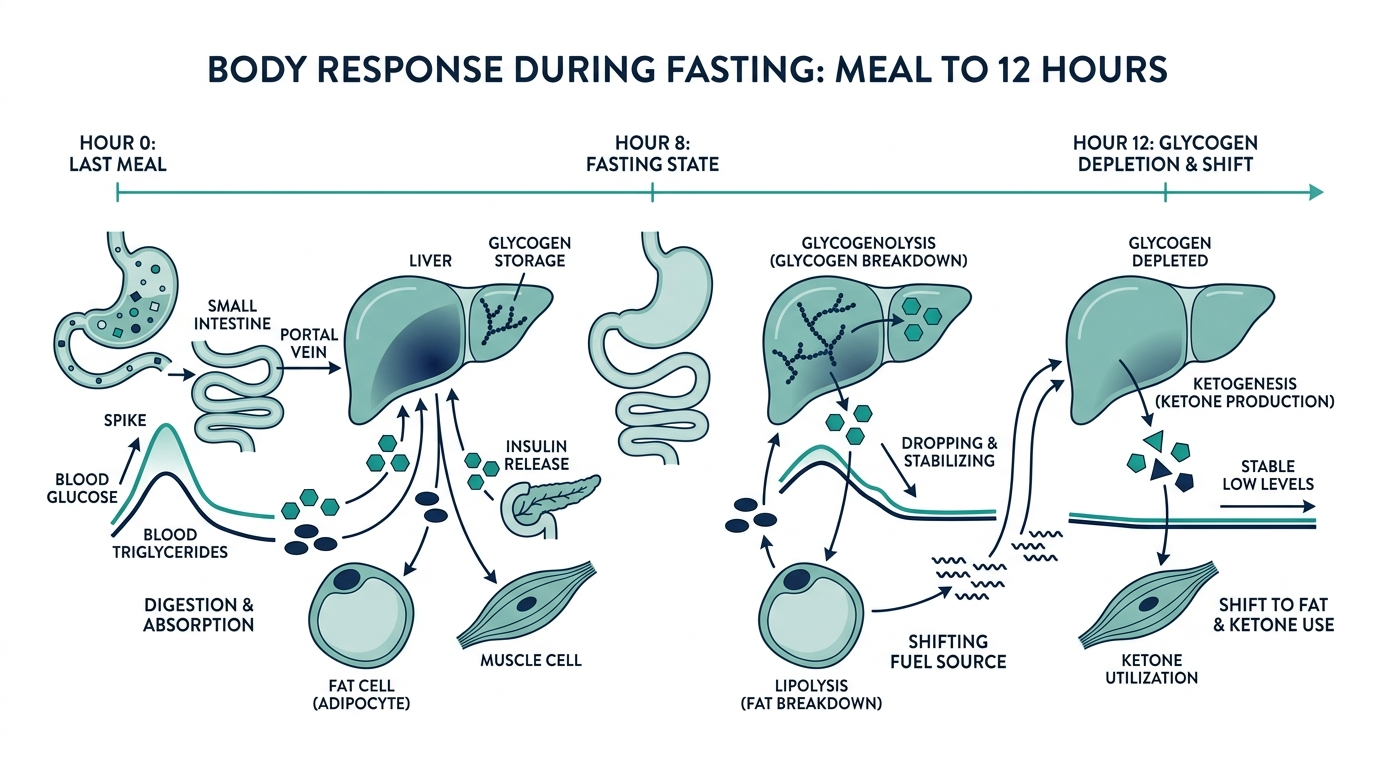
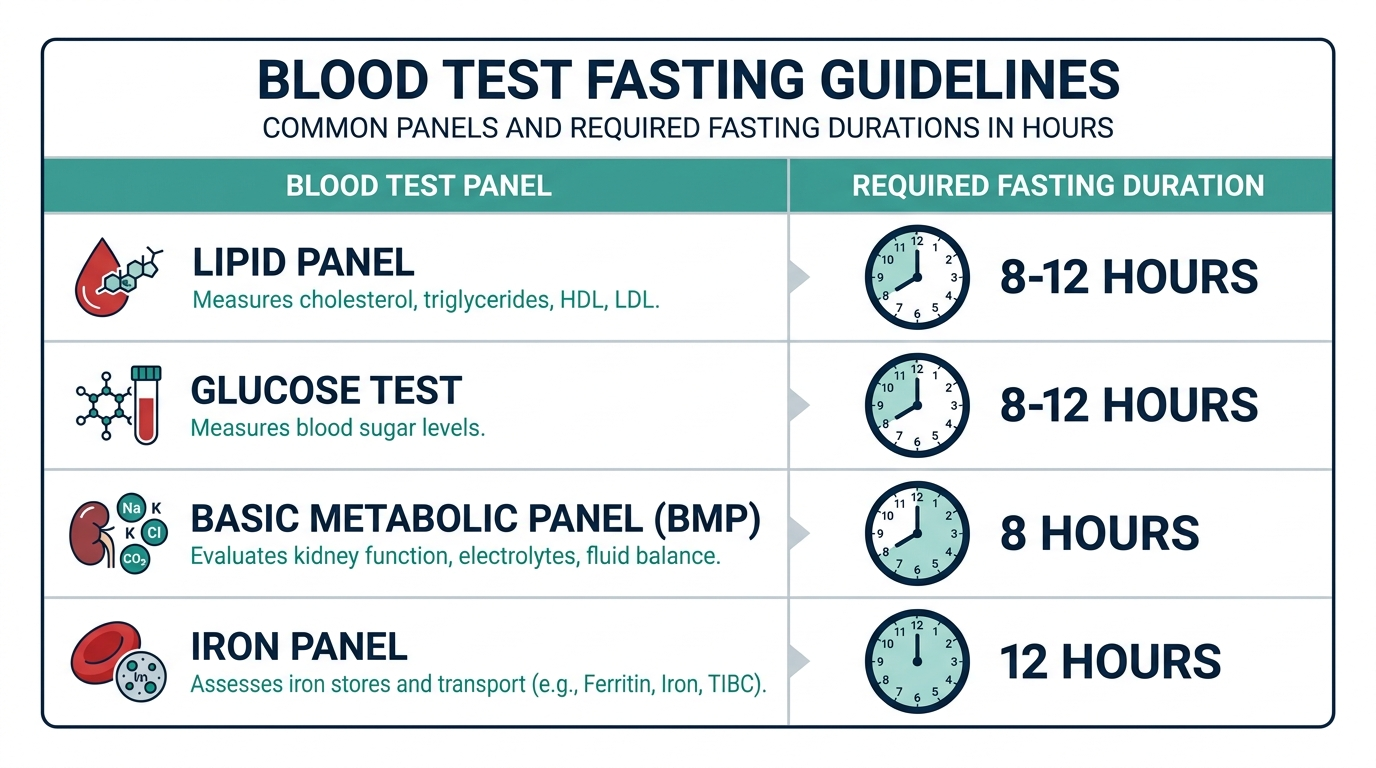
For most tests that require fasting, you need to go 8 to 12 hours without food or drink other than water (Cleveland Clinic). That is the window your clinician almost certainly means when they say “come in fasting.” Eight hours is the floor for many tests, and twelve is the upper end that some labs prefer for cholesterol work.
The reason the answer to how long to fast before a blood test lands in that 8 to 12 hour range is digestion. After a meal, your blood sugar and blood fats rise and then take several hours to settle back to baseline. Fasting clears that postprandial surge so the lab measures your true resting numbers rather than the leftovers of last night’s dinner. Most people simply book an early morning slot and let sleep cover most of the fast.
How long should you fast before a blood test for glucose?
For a fasting blood sugar test, the standard is at least 8 hours, and many labs use an 8 to 12 hour window (MedlinePlus). This is one of the tests where fasting genuinely changes the answer, because eating spikes your glucose within minutes and a non-fasting reading tells you almost nothing about how your body handles sugar at rest.
The fasting glucose result is read against tight thresholds. A normal fasting blood sugar is below 100 mg/dL, prediabetes runs from 100 to 125 mg/dL, and a result of 126 mg/dL or above on two occasions points to diabetes (Cleveland Clinic). Those cutoffs are only meaningful if you actually fasted. A bowl of cereal at 6 a.m. can shove a normal person into the prediabetes range on paper, which is exactly the kind of false alarm fasting is designed to prevent.
How long do you fast before a blood test for cholesterol?
Traditionally, a fasting lipid panel calls for 9 to 12 hours without food (MedlinePlus). The single fasting-sensitive number in that panel is triglycerides, the blood fats that climb steeply after a fatty meal and take hours to clear. Total cholesterol, HDL, and LDL barely move with eating, but triglycerides can swing enough to distort the whole report.
That said, the rules here have quietly shifted, and many people are now told they do not need to fast for a routine cholesterol check at all. More on that surprising turn in the insider section below, because it is the single most outdated piece of advice still floating around waiting rooms.
What can you drink or do while fasting?
Plain water is fine and actually encouraged, because it has no calories or sugar to skew your results and it keeps your veins easier to draw from (Cleveland Clinic). Staying hydrated is one of the few things that makes the blood draw itself go faster and smoother.
Almost everything else is off the table during the fast:
- Coffee, even black. Caffeine can shift your results, so skip it until after the draw, including unsweetened black coffee (Cleveland Clinic).
- Tea, juice, soda, and alcohol. Anything with calories, sugar, or caffeine breaks the fast.
- Chewing gum. It can stimulate digestion even without calories, so set it aside (Cleveland Clinic).
- Smoking and vigorous exercise. Both can affect digestion and certain readings during the fasting window (Cleveland Clinic).
Prescription medications are the common exception. Most should be taken as usual unless your clinician specifically tells you to hold one, so do not skip a daily pill just because you are fasting. When in doubt, ask before the appointment rather than guessing on the morning of.
Which blood tests actually require fasting?
Far fewer than people assume. The tests that genuinely depend on fasting are the ones measuring molecules that food moves quickly: blood glucose, the lipid panel for triglycerides, the basic metabolic panel, and certain liver tests such as gamma-glutamyl transferase (Cleveland Clinic).
A huge share of common blood work needs no fasting at all. A complete blood count, thyroid testing, most vitamin levels, and routine kidney and liver enzyme checks are typically unaffected by your last meal. The safest rule is simple: do not assume, and do not over-fast. If nobody told you to fast, you probably do not need to, but a quick call to confirm beats a wasted trip or a repeated draw.
The insider truth: you may not need to fast for cholesterol at all
Here is what most patients have never been told. For routine cholesterol screening, the requirement to fast is largely obsolete. A landmark 2016 joint consensus statement from the European Atherosclerosis Society and the European Federation of Clinical Chemistry recommended that non-fasting blood samples be used routinely for lipid profiles, reversing decades of standard practice (PMC, EAS/EFLM joint consensus statement).
The evidence behind that shift is the genuinely useful part. After a normal meal, triglycerides rise on average by only about 26 mg/dL, a change too small to matter for most risk decisions, and the other lipids barely budge (PMC, EAS/EFLM joint consensus statement). A large meta-analysis of more than 244,000 people found fasting and non-fasting lipid values track closely enough that fasting adds little for routine screening (PMC, fasting vs nonfasting meta-analysis). Some researchers now argue non-fasting testing should be the default standard, because it removes a barrier without sacrificing accuracy (PMC, nonfasting lipid testing).
So why does the waiting room still tell you to skip breakfast? Two real reasons. First, the consensus carved out an exception: if a non-fasting triglyceride level comes back very high, around 440 mg/dL or above, a fasting repeat is warranted (PMC, EAS/EFLM joint consensus statement). Second, if your clinician is tracking triglycerides over time or you have a genetic lipid disorder, fasting keeps every draw comparable. The practical move is to ask your specific clinician whether fasting is needed for your specific panel, rather than defaulting to a hungry morning out of habit. The number that flags an abnormal non-fasting triglyceride, by the way, is 175 mg/dL, slightly higher than the 150 mg/dL fasting cutoff to account for the meal (PMC, EAS/EFLM joint consensus statement).
What happens if you accidentally eat before the test?
If you broke your fast by mistake, tell the person drawing your blood before they take the sample. Honesty here is everything, because a fasting glucose or triglyceride result on a non-fasting body is not just slightly off, it can be misleading enough to trigger an unnecessary diagnosis or a missed one.
Depending on the test, you will usually either reschedule or have the draw flagged as non-fasting so your clinician can interpret it correctly. The mistake to avoid is staying quiet and letting an inaccurate fasting number enter your record. For non-fasting-sensitive tests like a complete blood count, a snack changes nothing, which is another reason knowing what actually requires fasting saves you stress.
A quick fasting guide, test by test
Rather than memorize rules, it helps to see the common tests laid out with whether fasting matters and why. Use this as a starting point, but always follow the specific instruction your clinician or lab gives you, since bundled panels and individual practices vary.
| Test | Fasting usually needed? | Why |
|---|---|---|
| Fasting blood glucose | Yes, at least 8 hours | Eating spikes blood sugar within minutes |
| Lipid panel (traditional) | Often 9 to 12 hours, but increasingly optional | Only triglycerides move much with food |
| Basic or comprehensive metabolic panel | Often yes | Includes glucose, which is fasting sensitive |
| Complete blood count (CBC) | No | Red and white cells and platelets are unaffected by a meal |
| Thyroid tests (TSH, T4, T3) | No | Not meaningfully changed by eating |
| Most vitamin levels | Usually no | Generally stable across a meal |
| Hemoglobin A1C | No | Reflects three-month average sugar, not the moment |
| Some liver tests such as GGT | Sometimes | Certain enzymes can shift after eating |
The pattern is clear. Fasting matters for the handful of tests measuring molecules that food moves quickly, chiefly glucose and triglycerides, and it is irrelevant for a large share of routine work. The A1C row is worth highlighting because people often assume it needs fasting like a glucose test, when in fact it captures your average sugar over roughly three months and can be drawn any time of day.
How to plan the fast around your day
The simplest way to fast without suffering is to let sleep do most of the work. A few practical habits make it painless and keep your results clean.
- Book the earliest morning slot you can. If your appointment is at 8 a.m. and you need a 10-hour fast, finishing dinner by 10 p.m. and sleeping through covers it with barely any waking hunger.
- Eat a normal dinner, not a feast, the night before. A very heavy, fatty meal can keep triglycerides elevated longer. A regular meal at your usual time is ideal.
- Keep drinking water. Staying hydrated overnight and in the morning makes your veins easier to find, which speeds up the draw and reduces the chance of a repeat stick.
- Bring a snack for afterward. Having something to eat right after the draw makes the fast feel shorter and helps if you tend to feel lightheaded.
- Take your regular medications unless told otherwise. Most daily prescriptions should continue on schedule. Do not skip a pill just because you are fasting, and ask ahead if you are unsure about a specific one.
Over-fasting is a mistake in the other direction. Going far longer than instructed, say 16 or 18 hours, does not make results more accurate and can actually dehydrate you or nudge certain values, so aim for the window you were given rather than the longest fast you can manage.
Special situations that change the fasting advice
The standard fasting rules assume a healthy adult. Several groups need a different approach, and getting this wrong can be more than an inconvenience.
- People with diabetes. Fasting while on insulin or certain glucose-lowering medications carries a real risk of low blood sugar. If you take these, ask your clinician how to handle medications and timing on a fasting morning, and never simply skip food and your usual dose without guidance.
- Pregnancy. A long fast can be harder to tolerate in pregnancy. Discuss the plan with your clinician, especially for glucose testing, which follows its own protocols during pregnancy.
- Children. Fasting a young child needs planning, ideally with an early appointment and a snack ready for immediately afterward. Follow the specific guidance from the pediatric provider.
- Older adults and anyone prone to dizziness. Prolonged fasting can cause lightheadedness. Keeping up water intake and having someone available to help after the draw is sensible.
- People on multiple medications. Some drugs are best taken with food, so a fasting draw can complicate the schedule. Confirm with your clinician whether to shift a dose to after the appointment.
The unifying rule for all of these is to ask before the appointment rather than improvising on the morning. A two-minute question to your clinic prevents both a wasted trip and a health risk.
Food is not the only thing that skews a blood test
Fasting gets all the attention, but several other pre-test factors can move your numbers, and knowing them rounds out the picture.
- Alcohol. Drinking in the day or two before a draw can affect blood sugar, triglycerides, and liver enzymes, so many clinicians advise avoiding alcohol before fasting labs even though it is not strictly part of the fast.
- Strenuous exercise. A hard workout shortly before the draw can transiently raise certain muscle and liver enzymes, making them look abnormal when nothing is wrong.
- Biotin supplements. The B vitamin found in many hair and nail supplements can interfere with certain lab immunoassays, including some thyroid and hormone tests, skewing results high or low. Tell your clinician if you take it and ask whether to pause it.
- Stress and poor sleep. Acute stress can nudge some values, and a few hormones follow a daily rhythm, which is part of why timing and consistency matter for tests you track over time.
- Dehydration. Being dry concentrates the blood and can nudge several values, and it also makes the draw harder, so water is genuinely helpful.
The point is that a clean fast is only one piece of an accurate result. Mentioning your recent alcohol, hard workouts, and supplements to your clinician helps them read the numbers correctly.
What fasting does not change, and common misconceptions
A few myths cause needless worry and unnecessary hunger. Clearing them up saves you both.
- “Every blood test needs fasting.” Most do not. A CBC, thyroid tests, A1C, and many vitamin levels are unaffected by your last meal. If nobody told you to fast, you probably do not need to, though a quick confirming call never hurts.
- “Longer fasting gives more accurate results.” It does not. Beyond the instructed window, extra hours add nothing and can dehydrate you or shift some values. Aim for the range you were given.
- “Black coffee is fine because it has no calories.” Caffeine can shift certain results, so plain water is the only safe drink during a true fast. Save the coffee for after the draw.
- “I should skip my medications while fasting.” Usually the opposite. Most daily prescriptions should continue on schedule, and skipping them can be risky. Ask about any specific drug rather than stopping on your own.
- “If I slipped and ate, I should stay quiet and hope it is fine.” Tell the person drawing your blood. For a fasting-sensitive test they will reschedule or flag it as non-fasting, which protects you from a misleading result entering your record.
The thread through all of it is the article’s core idea. Fasting is not a ritual, it is a way to give a few specific, food-sensitive molecules a clean baseline. Once you know which tests actually need it, the night before a blood draw stops being a guessing game.
When time of day matters more than fasting
Fasting controls what you have eaten, but for a handful of tests the clock on the wall matters just as much or more, because certain substances in the blood follow a daily rhythm. Knowing which tests these are prevents a confusing result from a perfectly good sample.
- Cortisol. This stress hormone peaks in the early morning and falls through the day, so it is deliberately drawn at specific times, often first thing in the morning. A cortisol level is read against the time it was taken, not just whether you fasted.
- Iron. Serum iron tends to be higher in the morning and lower later in the day, which is why morning collection is commonly preferred when iron is being carefully assessed.
- Testosterone. In men, testosterone also runs highest in the morning, so it is typically measured early to catch the peak and keep repeat tests comparable.
- Fasting glucose after an overnight fast. The classic fasting glucose is a morning test precisely because it pairs an overnight fast with a consistent time of day.
The practical lesson is that if you are tracking one of these over time, drawing it at a consistent time of day makes each result comparable to the last. When your clinician asks you to come in early, it is not always about fasting. Sometimes it is because the marker they care about is highest or most meaningful in the morning, and consistency is what lets them read a trend rather than noise.
The morning of your fasting draw, step by step
Even people who understand the science can find the actual morning stressful. A simple routine removes the guesswork and keeps the sample clean.
- Confirm the fast window the day before. Know exactly when your last food should be, count back from your appointment time, and finish dinner before that mark so sleep covers most of the fast.
- Drink water when you wake. A glass or two of plain water does not break the fast and makes your veins easier to draw from, which speeds up the stick and lowers the chance of a repeat.
- Skip the coffee, take your pills as usual. Leave caffeine until after the draw, but continue your regular prescriptions unless you were specifically told to hold one.
- Bring a snack and something to drink for right after. Eating promptly once the sample is taken shortens the felt length of the fast and steadies anyone who tends to feel lightheaded.
- Speak up about anything unusual. If you accidentally ate, took a supplement like biotin, drank alcohol the night before, or did a hard workout, tell the person drawing your blood so it can be noted and interpreted correctly.
Handled this way, a fasting draw becomes a routine errand rather than a source of anxiety. The fast does its quiet job of giving glucose and triglycerides a clean baseline, and everything else is just sensible preparation.
Don’t just read about your health, track it.
A single result is a snapshot. Superpower re-tests 100+ markers over time so you can watch them move as you change sleep, food, and training.
Frequently asked questions
How many hours should I fast before a blood test?
For most fasting tests, 8 to 12 hours without food or drink except water is the standard window (Cleveland Clinic). A fasting glucose test needs at least 8 hours, and a traditional cholesterol panel often asks for 9 to 12. Follow the exact instruction your clinician gives for your specific test.
Can I drink water while fasting for a blood test?
Yes. Plain water is allowed and encouraged because it has no calories or sugar to affect your results and it keeps you hydrated for an easier draw (Cleveland Clinic). Avoid coffee, tea, juice, and gum, which can all skew certain tests.
Can I drink black coffee before a fasting blood test?
No. Even black coffee with no sugar should be avoided while fasting, because caffeine has the potential to skew your results (Cleveland Clinic). Stick to water and have your coffee after the draw.
Do I really need to fast for a cholesterol test?
Often no. A 2016 expert consensus recommended non-fasting samples for routine lipid screening, since eating changes triglycerides by only about 26 mg/dL on average (PMC, EAS/EFLM joint consensus statement). Fasting is still used when triglycerides are very high or for people with genetic lipid disorders, so confirm with your clinician.
What if I accidentally ate before a fasting blood test?
Tell the person drawing your blood before the sample is taken. They will usually reschedule the test or label it non-fasting so your clinician can read it correctly, which protects you from a misleading fasting glucose or triglyceride result.
This article is for general educational purposes and is not medical advice. It cannot diagnose or treat you and does not replace your clinician. Always discuss your lab results and any health decisions with a qualified healthcare professional.
Related reading
Vital Signs Today may earn a commission if you buy through links on this page. It does not affect our editorial assessments.