Quick answer: How long does weed stay in your system depends almost entirely on how often you use it and which test is run. A standard urine test detects a single use for about 1 to 3 days, occasional use for 3 to 7 days, and daily use for 10 to 30 days or longer. Blood and saliva tests clear much faster (hours to a couple of days), while hair tests can flag use for up to 90 days. The test is not looking for THC itself but for a fat-stored metabolite called THC-COOH, which is why heavy users take so long to test clean.
How long does weed stay in your system by drug test type?
The detection window changes dramatically with the sample. A urine test, by far the most common for employment, has the widest window because it catches the metabolite long after the high is gone. Blood and saliva tests are short-window tests built to catch recent use, which is why police and workplace accident screens often use them. Hair sits at the far end and can reach back roughly three months.
Here is the part most people miss: a drug test is not measuring whether you are impaired right now. Urine and hair tests detect THC-COOH, an inactive metabolite your liver makes after THC breaks down. THC is fat-soluble, so it gets stored in fat tissue and leaks back into your bloodstream for days or weeks. That is the whole reason weed lingers far longer than alcohol or most other drugs.
| Test type | Single use | Occasional (a few times/week) | Daily/heavy use | What it actually detects |
|---|---|---|---|---|
| Urine | 1 to 3 days | 3 to 7 days | 10 to 30+ days | THC-COOH metabolite |
| Blood | Up to 12 hours | 1 to 2 days | Up to 7 days | Active THC, then metabolite |
| Saliva | Up to 24 hours | 1 to 3 days | Up to 3 days (sometimes longer) | Active THC in oral fluid |
| Hair | Often not detected | Up to 90 days | Up to 90 days | Metabolite bound in hair shaft |
These ranges are typical, not guarantees. A lab can shorten or stretch a window by adjusting its cutoff level (50 ng/mL is the common federal urine cutoff, but some labs use 20 ng/mL, which detects more). If you want the mechanics of how a sample becomes a result, here is how drug test results work and how long they take.
Why urine is the default for employment
Urine wins on three fronts: it is cheap, it is non-invasive, and its wide window means an employer is not forced to test the exact morning after use to catch a pattern. A blood draw would only flag someone who used in the last day or two, which is useless for a pre-employment screen scheduled a week out. That is why when people ask how long does weed stay in your system for a job, the urine numbers are the ones that matter.
When each test actually gets used
- Urine: pre-employment, random workplace, probation, federal DOT screens.
- Blood: DUI investigations, hospital trauma intake, research. Rarely for hiring because the window is so short.
- Saliva: roadside checks, post-accident workplace screens, situations where recent impairment is the question.
- Hair: some employers and legal cases that want a long lookback. Slower and pricier, and it misses the most recent 7 days because that hair has not grown out of the scalp yet.
What a positive on each test really tells an examiner
The same word, positive, means very different things by sample. A positive saliva or blood test is decent evidence of recent use, sometimes within hours, which is why those carry weight in DUI and post-accident cases. A positive urine test only says the person used at some point in the recent window, not when and not whether they were impaired on the job. A positive hair test says even less about timing, since it covers a three-month block.
Why does weed stay detectable so much longer than other drugs?
The simplest way to actually get this done
Superpower is a full-body lab membership that runs 100+ biomarkers, has each result reviewed by a doctor, and tracks your numbers year over year (about $199/year). It is what we point readers to when they would rather get one clean, complete draw than chase single tests one at a time. Here is superpower reviewed in full.
Because THC hides in fat. Most recreational drugs are water-soluble and flush out within a day or two. THC is the opposite. It binds to fat cells throughout your body, then slowly releases back into circulation, where your liver keeps converting it to THC-COOH. That metabolite is what shows up in urine for weeks after a heavy user’s last joint.
The half-life is the key idea. A single THC dose has a terminal half-life that can run from about 1 to 2 days in an occasional user, but in a chronic heavy user it stretches to 5 to 13 days because the body has a deep reservoir to empty. Each time fat releases stored THC, the liver re-metabolizes it, so the metabolite keeps reappearing in urine long after the person stopped using.
A few real consequences of this:
- People with more body fat can hold THC longer, all else equal.
- A sudden bout of intense exercise right before a test can briefly raise urine THC levels by mobilizing fat stores, the opposite of what you would expect.
- Edibles and high-potency concentrates load more THC into the system per use, extending the window compared with a single low-dose puff.
This is also why there is no clean linear formula. Two people who smoked the same amount on the same night can test clean days apart.
What THC-COOH actually is
When you use cannabis, the active compound is delta-9-THC, the thing that gets you high. Your liver does not store that. It converts THC first into an active metabolite (11-hydroxy-THC) and then into the inactive 11-nor-9-carboxy-THC, shortened to THC-COOH. That final metabolite does nothing to your brain, but it is fat-soluble, slow to clear, and easy for labs to measure. So the molecule that lingers and trips the test is not the one that ever made you feel anything. A failed urine test is evidence of past use, not current impairment, and that gap is at the center of every workplace cannabis debate. It is also why someone can pass a test for a faster-clearing drug they used last week while still failing for weed they last touched a month ago.
How do edibles compare to smoking for detection time?
Edibles generally stay detectable at least as long as smoking, and often longer, because of how they are processed. When you smoke or vape, THC hits your blood through the lungs and peaks fast, then falls. When you eat cannabis, it goes through the liver first, which converts a large share of it into 11-hydroxy-THC, a potent and longer-lasting metabolite. The high comes on slower, lasts longer, and the metabolite load your body has to clear is bigger.
Practically, this means a single strong edible can produce a detection window similar to or longer than a comparable amount smoked, especially in urine. The dose is also harder to control with edibles, so people routinely take in more THC than they planned, which lengthens clearance further. The table below sketches the difference for an otherwise occasional user.
| Method | Onset | Peak blood THC | Typical urine window (occasional use) |
|---|---|---|---|
| Smoking/vaping | Minutes | High and brief | 3 to 7 days |
| Edibles | 30 to 120 minutes | Lower peak, longer tail | 3 to 10 days (dose dependent) |
| Concentrates/dabs | Minutes | Very high | 5 to 10+ days |
The takeaway is not that one method is safe. It is that potency and total THC consumed drive the window, and edibles plus concentrates push more THC into the body per session than a casual puff of flower.
Why dose, not method, is the real driver
People fixate on smoke versus edible, but the bigger lever is total milligrams of THC. A 5 mg gummy and a 100 mg gummy are not the same event, and two hits of 12 percent flower are worlds apart from a fat dab of 80 percent concentrate. Hold the dose roughly constant, then the method differences (liver-first for edibles, lung-first for smoke) explain the rest. A heavy edible user and a heavy dabber both sit at the long end of every window, because the reservoir of stored THC they build has more to do with quantity and consistency than delivery.
What affects how long weed stays in your system?
Frequency of use is the single biggest factor, but several others stack on top of it. The honest summary: how long weed stays in your system is set mostly by things you cannot change quickly.
The factors that actually matter
- Frequency and duration of use. A first-time user and a daily user are not in the same universe. Chronic use builds up a reservoir of stored THC that takes weeks to deplete.
- Dose and potency. A few hits of low-THC flower clears faster than dabs, carts, or strong edibles.
- Body composition. More fat tissue means more storage and a longer tail.
- Metabolism and frequency of bowel movements. THC-COOH is partly cleared through stool, so a slow metabolism extends the window.
- The test’s cutoff. A sensitive 20 ng/mL urine screen catches what a 50 ng/mL screen misses.
How body fat changes the math
This is the factor people underestimate. THC partitions into adipose tissue, so a person with more body fat is storing more THC after the same dose and releasing it more slowly. Two friends can smoke the identical joint, and the leaner one may clear a urine test days before the other. It is not about willpower or hydration, it is storage capacity. This is also why crash dieting or fasting right before a test can backfire: rapid fat breakdown dumps stored THC back into circulation. Age, sex, and hydration nudge the timeline a little through their effect on metabolism and concentration, but none of them flips a heavy user into a light one.
The factors that do not
Detox drinks, niacin, cranberry juice, and “flushing” kits do not break down stored THC. At best they dilute a urine sample temporarily, which many labs catch by checking creatinine and specific gravity. A diluted or “adulterated” sample often counts as a failed or invalid test on its own. We go deeper into what genuinely moves the needle and what is pure myth in our guide on what actually affects drug test results.
How long does weed stay in urine for daily versus occasional users?
For urine, the spread is enormous and it tracks use frequency more than anything else. A genuine one-time user usually clears in 1 to 3 days. Someone who uses a few times a week typically tests positive for 3 to 7 days. A daily or near-daily user commonly stays positive for 10 to 15 days, and the heaviest chronic users have tested positive past 30 days, with documented cases stretching toward 6 to 7 weeks at sensitive cutoffs.
| Use pattern | Typical urine detection window | Outer edge at sensitive (20 ng/mL) cutoff |
|---|---|---|
| Single use (first time) | 1 to 3 days | Up to 4 days |
| Occasional (1 to 3 times/week) | 3 to 7 days | Up to 10 days |
| Frequent (4 to 6 times/week) | 7 to 14 days | Up to 21 days |
| Daily/chronic heavy | 10 to 30 days | 30 to 45+ days |
Worked example: the occasional weekend user
Say you used twice last week, smoked half a joint each time, and have a urine test in 8 days with no use in between. At a 50 ng/mL cutoff you are very likely clear, since occasional use mostly resolves inside a week. But if that same employer uses a 20 ng/mL lab cutoff, you are closer to the edge and a clean result is probable but not guaranteed. The fix is not a detox drink, it is the extra few days of margin.
Worked example: the daily user with two weeks notice
A daily user who stops the moment they learn of a test 14 days out is in a genuine gray zone. Many daily users clear by day 10 to 15, but a meaningful share do not, especially with higher body fat or strong product. If the stakes are real, 14 days is not a comfortable margin. This is the scenario where people reach for shortcuts, and it is exactly the scenario where shortcuts fail, because the reservoir of stored THC simply has not emptied yet.
Worked example: the chronic high-body-fat user counting on a month
Now the hardest case. Someone who has dabbed daily for a year, carries higher body fat, and has 30 days until the screen. The instinct is that a month is plenty. It often is not. At a sensitive 20 ng/mL cutoff, a slice of users in exactly this profile still test positive past four weeks, because fat keeps re-releasing THC faster than the body can finish clearing it. Assume the long end, stop immediately, stay lightly active, and accept that no product compresses this timeline.
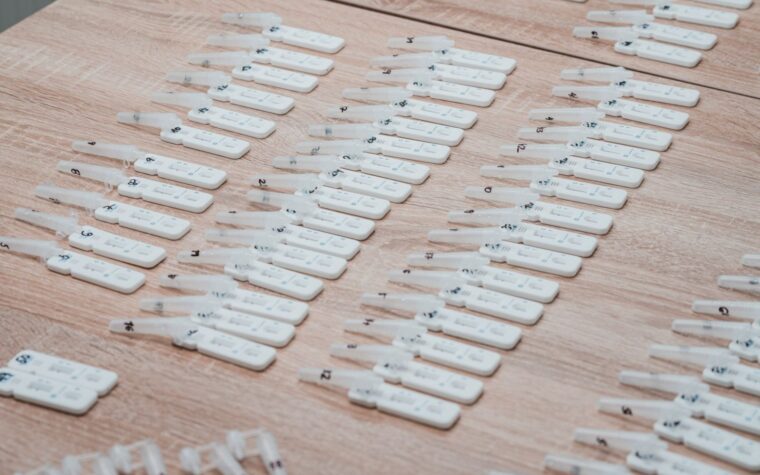
If you are testing yourself at home before a real screen, the line you see on a strip matters less than the cutoff it is calibrated to. A 50 ng/mL home strip can read negative while a 20 ng/mL lab test reads positive on the same urine. For how to interpret those strips correctly, see at-home drug test kits and their accuracy.
Can you speed up how fast weed leaves your body?
Not meaningfully, and anyone selling you a guaranteed fix is selling hope. Time and abstinence are the only reliable clearers. Drinking normal amounts of water, staying active in the days (not hours) before a test, and eating fiber to support stool clearance can help at the margins, but none of it dissolves the fat-stored THC overnight.
Two specific cautions worth repeating. First, do not exercise hard right before a test, since mobilizing fat can spike urine THC. Second, do not over-dilute your urine, because labs flag suspiciously watery samples. If you have a known test date, the only dependable plan is to stop using and give your body the days it needs.
What genuinely helps, at the margins
- Stop using as early as possible. Every extra day of abstinence is worth more than any product.
- Stay normally hydrated, not flooded. Over-hydration only dilutes and gets flagged.
- Eat fiber and keep regular bowel movements, since THC-COOH exits partly through stool.
- Keep light to moderate activity in the days before, then rest the 24 hours right before the test.
What to avoid in the final 24 hours
- Intense exercise or sauna sessions that mobilize fat right before the sample.
- Chugging water or detox drinks to dilute, which labs catch via creatinine and specific gravity.
- Adulterants and synthetic urine, which modern panels increasingly screen for and which can turn a fail into a fail plus a fraud finding.
If you are getting blood drawn anyway, it is often smarter to capture a full baseline at once rather than chase single tests one at a time. Here is how a full-body panel compares.
Common mistakes people make before a weed drug test
Most failed tests that surprise people come down to a handful of avoidable errors, not bad luck. The biggest one is assuming the high being gone means the metabolite is gone. It is not.
- Trusting a detox drink as a guarantee. These work, when they work at all, by temporary dilution, which is detectable and increasingly disqualifying.
- Working out hard the morning of the test. This can spike urine THC by releasing it from fat, the exact wrong move.
- Assuming edibles clear faster than smoke. They often clear slower because of liver metabolism.
- Reading a home strip without checking its cutoff. A negative at 50 ng/mL says nothing about a 20 ng/mL lab test.
- Ignoring full-spectrum CBD. Daily use of full-spectrum products with trace THC can build up and trigger a positive.
- Over-diluting to look clean. A watery, low-creatinine sample is often counted as invalid or a refusal.
- Treating first-morning urine as just another sample. It is the most concentrated of the day, so it carries the highest metabolite level. A later, normally hydrated sample reads lower, though never dilute on purpose.
Edge cases: medical cannabis, frequent flyers, and trace exposure
Several situations sit outside the simple frequency table.
Medical cannabis patients
A legal medical card protects you under state law, but it does not change biology and does not protect you from every employer, especially federal and DOT-regulated jobs, where a positive is still a positive regardless of a state recommendation. Medical patients are often daily, higher-dose users, which means their detection windows sit at the long end. Knowing your state and your employer’s policy matters as much as the chemistry here.
The chronic user who just quit
If you used daily for months and stopped, expect a long tail. Some heavy users test positive at sensitive cutoffs for 4 to 6 weeks. The body is emptying a reservoir, not flushing a single dose, and there is no safe way to rush it. Plan around the calendar, not around a product.
Secondhand smoke and CBD trace
Realistic passive exposure almost never causes a failed test at standard cutoffs, but extreme, unventilated, hours-long exposure is a different story. Full-spectrum CBD is the sneakier trap: legal products can contain up to 0.3 percent THC, and consistent use can accumulate enough metabolite to test positive even though you never intended to use cannabis.
DOT, probation, and minors
Regulated settings remove the gray area. DOT-covered roles (truck drivers, pilots, transit, pipeline) follow federal rules where cannabis is still prohibited and the 50 ng/mL urine cutoff with confirmation testing is standard, no medical exception applies. Probation and court-ordered testing often use lower cutoffs and frequent random schedules, the worst scenario for a heavy user since there is no time to clear. For minors, a positive on a home test is best handled as a health conversation, since timing and trace exposure can muddy the picture.
How testing labs turn your sample into a pass or fail
Understanding the lab process removes most of the false hope. Standard workplace urine testing is a two-step process, and both steps matter.
- Immunoassay screen. The first pass is a fast, cheap antibody-based test set to a cutoff, usually 50 ng/mL for THC-COOH in federal-style screens. Below the cutoff reads negative; at or above reads presumptive positive. This step can occasionally false-positive, which is why nothing is final yet.
- GC-MS or LC-MS confirmation. Any presumptive positive goes to a confirmatory test using mass spectrometry, which identifies the exact molecule and quantifies it. This step is extremely specific, so a confirmed positive is hard to argue with, and it is also why a poppy-seed or CBD explanation rarely survives confirmation for THC.
Labs also run validity checks on the sample itself: creatinine and specific gravity to catch dilution, pH and oxidants to catch adulteration, and temperature at collection to catch substitution. This is the machinery that makes detox drinks and synthetic urine far riskier than the marketing suggests, since a tampered sample can be reported as invalid or a refusal, which many employers treat the same as a fail. The cutoff is the line, and your only real control over where you land is how many days of genuine abstinence sit between your last use and the cup.
Which test should you worry about, and what to do
Match your plan to the test you are actually facing, because the right move for a saliva screen is different from the one for a urine screen.
- If it is a urine test (most likely): count backward from your last use and apply the frequency table. Occasional users want at least a week of abstinence, daily users want as many days as they can get and should not count on 14 being enough.
- If it is a saliva test: the window is short, often under a day for light use, so recent use is the only real risk. Avoid use in the 24 to 72 hours before.
- If it is a hair test: there is little you can do, since it looks back about 90 days. Detox shampoos are unreliable. The honest answer is that only long abstinence helps.
- If it is a blood test: this catches very recent use, so it is mostly relevant after an accident or a DUI stop rather than for hiring.
Across all of them, the controllable variable is time since last use. Everything else (body fat, metabolism, cutoff) is mostly fixed for your test date. If you are not sure which test you face, ask, because the difference between a saliva screen and a hair test changes whether you have any room to maneuver at all. And if a result carries real consequences for your health or employment, it is reasonable to talk to a clinician rather than guess.
FAQ
Does CBD show up on a drug test?
Pure CBD should not, because drug tests screen for THC and its metabolites, not CBD. The risk comes from full-spectrum CBD products that legally contain up to 0.3 percent THC. Used regularly, that trace THC can accumulate enough to trigger a positive.
How long does weed stay in your saliva?
Saliva tests have a short window, usually up to 24 hours for a single use and 1 to 3 days for frequent users. They are popular for roadside and post-accident screening precisely because they catch recent use rather than old metabolites.
How long does weed stay in your blood?
Active THC drops out of blood fast, often within 12 hours for occasional use, though metabolites can linger 1 to 2 days. Heavy daily users may show detectable THC in blood for up to a week. Blood is a recent-use test, which is why it shows up in DUI cases more than in hiring.
How long does weed stay in your hair?
Hair tests can detect cannabis use for up to 90 days, since the metabolite gets locked into the growing hair shaft. One quirk: hair testing usually misses the most recent week, because that hair has not yet grown out past the scalp to be cut and analyzed.
Do edibles stay in your system longer than smoking?
Usually yes, or at least as long. Eaten cannabis passes through the liver, which produces a longer-lasting metabolite, and edible doses are easy to overshoot. For the same casual user, an edible often produces a urine window equal to or longer than smoking.
Can secondhand smoke make me fail a drug test?
For a realistic test cutoff and normal social exposure, almost never. Failing from secondhand smoke requires extreme conditions, like hours in a small unventilated room full of heavy smoke. Standard 50 ng/mL screens are set well above what passive exposure produces.
Will drinking a lot of water help me pass?
It only dilutes your urine temporarily, and labs check for that by measuring creatinine and specific gravity. An overly watery sample is often flagged as diluted or invalid, which can count against you the same as a positive. Hydrate normally, do not flood.
Does exercising before a test help or hurt?
In the days before, light activity is fine. In the 24 hours right before, hard exercise can hurt, because burning fat releases stored THC back into your blood and can briefly raise urine levels. Rest the day before your sample.
Will a medical marijuana card stop me from failing?
No. A card legalizes your use under state law, but it does not change what shows up in the sample and does not bind every employer. Federal and DOT-regulated jobs still treat a THC positive as a positive, card or not. The chemistry is identical whether your use is medical or recreational.
Is there one accurate way to know if I am clear?
The most reliable check is an at-home urine test calibrated to the same cutoff your real test will use, run a day or two beforehand. No calculator can promise a clean result, since stored THC clears on a personal timeline that depends on your use history, body fat, and metabolism. When the result carries real stakes, build in extra days of margin. If you are unsure, it is reasonable to talk to a clinician about your situation.