
Last updated June 2026. Educational content, not medical advice. Talk to a licensed clinician before starting any hair loss treatment.
Short answer: Yes, several peptide types help with hair growth, and the evidence is more specific than most roundup articles admit. Topical copper peptides (GHK-Cu and AHK-Cu) have the deepest clinical track record. A 2025 combination protocol using GHK-Cu with minoxidil and dutasteride via microneedling produced a median 26.5% scalp area regrowth across seven patients after five monthly sessions, with zero adverse events, according to a study summarized by Hairgenetix. Multi-peptide blends like Capixyl and Procapil outperformed 5% minoxidil in a 106-patient randomized trial. That said, none of these are magic. The right peptide used in the right way makes a measurable difference. The wrong one, or an injectable research-chemical from an unverified vendor, risks your money, your scalp, and potentially more.
Peptides for hair growth depend on your underlying biology. What do your own nutrient and hormone markers show? One at-home Superpower draw checks 100+ biomarkers, physician-reviewed.
Why is every hair loss forum suddenly full of peptide talk?
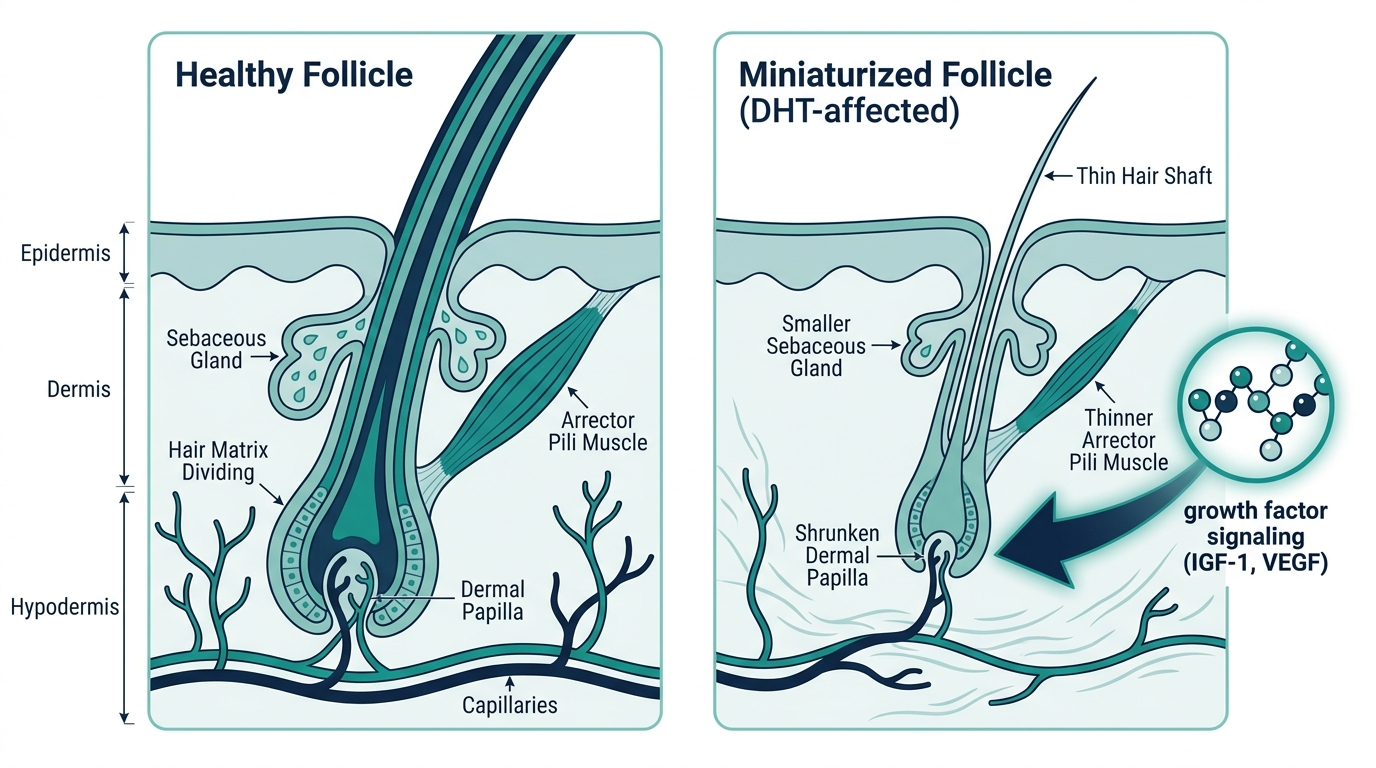
Androgenetic alopecia (pattern hair loss) affects an estimated 50 million men and 30 million women in the United States, and by some estimates, more than 80% of men and 50% of women will experience meaningful hair thinning at some point in their lives. The two FDA-approved topical standbys, minoxidil and finasteride, work for roughly 60% of users, but carry their own side-effect profiles that keep many people searching for alternatives.
Peptides entered the conversation because they look like a third lane: biological signaling molecules your body already recognizes, engineered or isolated to speak directly to the hair follicle. Unlike finasteride, they do not block systemic androgen production. Unlike minoxidil, they do not rely entirely on vasodilation.
The catch is that “peptide” is an umbrella term covering hundreds of different molecules with entirely different mechanisms. Asking “do peptides help hair growth” is a little like asking “do drugs treat disease.” The category is real; the answer depends entirely on which one.
What do peptides actually do to hair follicles?
Hair loss at the follicle level comes down to a few compounding problems: miniaturization of follicles driven by dihydrotestosterone (DHT), reduction of blood supply to the scalp, shortening of the anagen (active growth) phase, and inflammation around the follicle base.
Different peptide classes address different parts of that problem set.
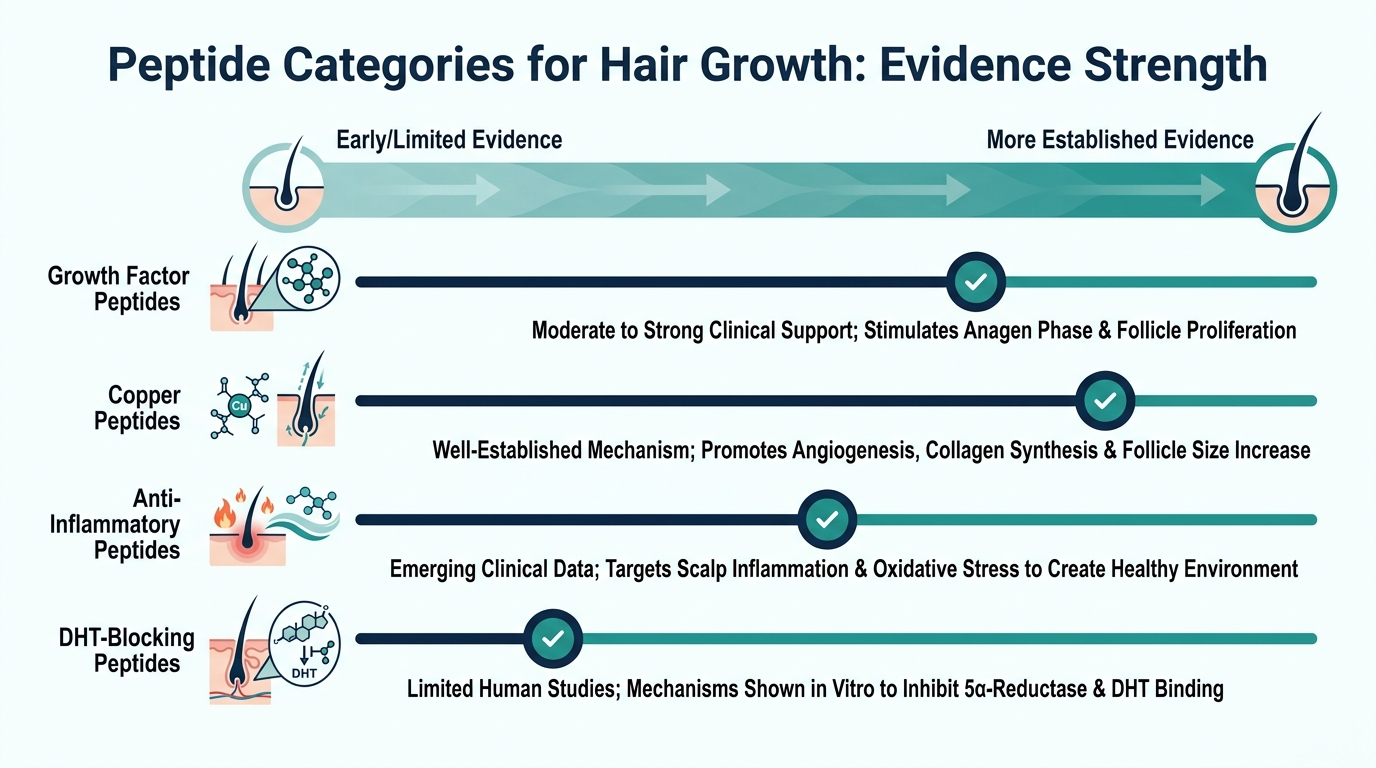
Copper peptides (GHK-Cu and AHK-Cu) are the most studied. GHK-Cu (glycine-histidine-lysine-copper) naturally occurs in human plasma, saliva, and urine. Topically, it upregulates vascular endothelial growth factor (VEGF), which increases blood vessel density around follicles. AHK-Cu (alanine-histidine-lysine-copper) is its close sibling, and copper ions in general can inhibit type 1 five-alpha reductase, the enzyme that converts testosterone to the hair-damaging DHT, by up to 90% in experimental tissue models. That dual action (angiogenic plus DHT-blocking) is why GHK-Cu serums produce results that look different from minoxidil-only protocols.
Acetyl tetrapeptide-3 (Capixyl’s active peptide) works upstream, in the extracellular matrix (ECM) of the scalp. According to manufacturer-funded lab data cited across multiple clinical reviews, it increases type III collagen expression by 65% and laminin expression by 285% in cell models. Those structural proteins anchor the follicle and support dermal papilla integrity. Whether the same numbers translate in a living scalp under daily conditions is less certain, but the direction of effect is consistent with measured clinical outcomes.
Biotinoyl tripeptide-1 (in Procapil) is sometimes called the “hair scaffold peptide.” It attaches to hair follicle proteins and has shown activity in DHT-related miniaturization pathways. In a pilot study of 18 subjects, 67% showed significant improvement in the anagen-to-telogen ratio after four months of twice-daily application.
Zinc thymulin is a nonapeptide originally isolated from the thymus, activated only when zinc is bound to it. It modulates inflammatory cytokines around the follicle and has been used in compounded topical sprays prescribed through licensed pharmacies for follicle restoration. Zinc itself is a potent inhibitor of five-alpha reductase activity, and the thymulin peptide adds a layer of immune regulation that pure minoxidil does not.
Full-body lab membership: 100+ biomarkers, doctor-reviewed, tracked over time.
Which specific peptides have real clinical evidence?
This is where it pays to read carefully, because the word “study” gets used loosely in hair-care marketing.
GHK-Cu and AHK-Cu: the strongest topical track record
The most rigorous recent data point on copper peptides specifically is the 2025 JAAD International case series involving seven male patients with moderate pattern hair loss (Norwood-Hamilton III to IV) who had already failed standard treatments. The protocol combined 0.5% minoxidil, 0.1% dutasteride, and 1.2% copper peptides delivered via a tattoo-machine microneedling device performing 1,890 needle perforations per second at 2mm depth. Five monthly sessions produced a median 26.5% scalp area regrowth, dropping the average SALT score from 40% to 7.5%. Five of seven patients (71.4%) crossed the threshold of 10% or greater regrowth. Zero adverse events occurred.
The honest caveat: this was a seven-patient series, not a large randomized controlled trial. The copper peptide was one ingredient in a combination protocol. Nobody can cleanly separate the copper peptide contribution from the microneedling delivery enhancement or the minoxidil. Personally, I think that distinction matters less to a person losing hair than the clinical community thinks it does. If the combination is safe and produces 26.5% median regrowth in patients who had already failed monotherapy, the combination is worth understanding.
For standalone topical copper peptide products, a published 120-participant trial of Hairgenetix’s 10% GHK-Cu + 5% AHK-Cu dual-peptide serum reported 93% reduction in shedding and a gain of roughly 12 hairs per cm² at 150 days. The higher concentrations (4% to 10%) appear to produce more robust outcomes than the 0.1% trace amounts found in many mass-market conditioners labeled “with copper peptides.”
The Redensyl-Capixyl-Procapil combination: the most clinically tested multi-peptide stack
A 2025 randomized trial of 106 men compared a three-ingredient peptide complex (Redensyl, Capixyl, and Procapil, commonly abbreviated RCP) against 5% minoxidil over 24 weeks. Researcher assessment scores favored RCP 64.7% to 25.5%; photographic evaluation scores favored RCP 88.9% to 60%. The RCP arm also reported fewer scalp-irritation events.
Do not read that as “peptides beat minoxidil, full stop.” The study population, formulation concentrations, and research design matter. What it does show is that certain peptide formulations at clinical concentrations are not just minor supplements to existing treatment; they can anchor a complete protocol.
Separately, Redensyl alone in a pilot of 26 males showed an average 9% increase in anagen (growing) hair and a 17% decrease in telogen (resting/shedding) hair after three months of once-daily use. Small, but directionally consistent.
| Peptide / Complex | Mechanism | Strongest Evidence | Typical Concentration |
|---|---|---|---|
| GHK-Cu | VEGF upregulation, angiogenesis, anti-inflammatory | 26.5% regrowth in combination microneedling series (2025) | 4% to 10% topical |
| AHK-Cu | 5-AR type 1 inhibition up to 90%, follicle repair | Companion to GHK-Cu in dual-peptide trials | 2% to 5% topical |
| Acetyl Tetrapeptide-3 (Capixyl) | ECM collagen/laminin synthesis, 5-AR modulation | 64.7% vs. 25.5% minoxidil in 106-patient RCP trial (2025) | 0.5% to 2% as Capixyl complex |
| Biotinoyl Tripeptide-1 (Procapil) | Follicle anchoring, DHT-related miniaturization | 67% improvement in anagen/telogen ratio at 4 months | 0.3% to 1% |
| Zinc Thymulin | Inflammatory cytokine modulation, follicle stem cell support | Compounded clinical use; limited independent RCT data | Compounded by Rx |
| Redensyl | Stem cell proliferation in outer root sheath | +9% anagen hair in 26-male pilot, 3 months | 1% to 3% |
How do peptides compare to minoxidil and finasteride?
This is the comparison most people actually want. Here is the honest read.
Minoxidil has 40 years of data behind it and remains the FDA-approved topical standard. The EXACT-1 trial of 5% topical minoxidil showed an increase of 18.3 non-vellus hairs per cm² at 24 weeks. It extends the anagen phase, partially by increasing potassium channel activity in follicle cells. Its main failure modes are scalp irritation (from the propylene glycol vehicle, often), diastolic hypotension at oral doses, and the notorious “shedding phase” at weeks three to eight that sends many users quitting before the plateau.
Finasteride (1mg oral) inhibits type 2 five-alpha reductase systemically, cutting serum DHT by about 70%. It works, particularly at the crown, but the post-finasteride syndrome debate and sexual side-effect profile keep many men off it. Dutasteride inhibits both type 1 and type 2 five-alpha reductase and is roughly 2.5 times more potent at DHT suppression, but carries the same systemic concerns.
Peptide serums are not trying to do the same thing. They are not a systemic hormone intervention. Their advantages are local specificity (the peptide acts at the scalp, not across the whole body), low side-effect profiles (mild irritation at most, no sexual dysfunction concerns), and complementary mechanisms that stack productively with minoxidil rather than competing.
The people seeing the best results in 2026 are not choosing between peptides and minoxidil. They are combining a quality copper-peptide serum with a low-dose topical minoxidil (0.5% to 1%) and skipping the systemic hormone drugs entirely, unless labs indicate a clear DHT-driven etiology.
Personally, if I were starting fresh with thinning hair and no contraindications, I would pull a full biomarker panel first to confirm DHT and inflammatory markers are actually the drivers, then layer a copper-peptide serum alongside low-dose topical minoxidil before touching finasteride. The systemic drugs are not off the table, but they deserve to come last, not first.
What about injectable research peptides for hair loss?
Some forums discuss subcutaneous or scalp-injected peptides like BPC-157 for scalp angiogenesis. A few things to know before you go looking for a vendor.
First, the mechanism argument has some internal logic. BPC-157 does support blood vessel formation (angiogenesis) in tissue repair models, and the scalp follicle is underperfused in androgenetic alopecia. But there is essentially no controlled clinical data on BPC-157 as a hair loss treatment. What exists are anecdotes, forum threads, and preclinical animal data.
Second, the legal lane for injectable BPC-157 is genuinely shifting. The FDA removed BPC-157 from its 503A Category 2 list on 22 April 2026, and HHS signaled that roughly 14 peptides may return to Category 1 (compoundable by licensed pharmacies) pending a Pharmacy Compounding Advisory Committee meeting set for July 2026. That means the path toward getting BPC-157 through a licensed clinic with a real prescription is opening. It does not mean grey-market research vendors are the right source.
Do not believe any vendor who offers injectable peptides for hair loss without a physician prescription and says it is “just for research.” That label does not protect you from what is in the vial. Independent testing platform Finnrick’s database has documented research-peptide purity dipping below 75% in samples that shipped alongside “certificate of analysis” documents. What you need to ask at a research vendor is not how good their reviews are. You need their batch-specific Certificate of Analysis from an independent lab (Janoshik Analytical, MZ Biolabs, or Colmaric Analyticals), HPLC purity at 96% or above, a mass-spec identity match, and a verification key you can confirm on the lab’s own website. If any of those are missing, the price does not matter.
For hair loss specifically, the evidence hierarchy runs: topical copper peptides first (best evidence, safest route), multi-peptide blends second, licensed compounded zinc thymulin through a telehealth clinic third, and experimental injectables only through that licensed clinical channel, when and if the regulatory lane fully opens.
Hydrolyzed type I & III collagen peptides, third-party tested, unflavored.
How to actually use a peptide serum for hair: what the product pages leave out
Most copper-peptide serum instructions say “apply to scalp, massage in.” That is accurate and undersells what makes the protocol work.
GHK-Cu and AHK-Cu are relatively small molecules that penetrate the stratum corneum reasonably well, especially compared to larger cosmetic peptides. But they penetrate a lot better when the scalp barrier is disrupted just slightly. That is why microneedling at clinical depth (1.5mm to 2mm) increased outcomes so dramatically in the 2025 case series. At home, a 0.5mm to 1mm dermaroller (used once a week, sterilized properly) produces enough micro-channels to meaningfully increase absorption without clinical risk.
Application timing matters too. The anagen phase is when the follicle is actively building hair, and the follicle is most metabolically responsive in that phase. Applying a serum once a day is more effective than a large dose twice a week. Consistency beats quantity.
One thing most serums do not warn users about: the initial increased shedding. Copper peptides can accelerate the transition of follicles from a prolonged, inefficient telogen phase into a fresh anagen cycle. This can trigger three to six weeks of increased visible shedding before regrowth starts. It is the same mechanism responsible for minoxidil’s early shedding, and it is a sign the follicles are responding, not failing. The people who quit in week four are the people who never see the outcome that starts in week eight.
Who should actually be using peptides for hair growth?
Peptide serums are not the right primary intervention for every kind of hair loss. The category genuinely helps is androgenetic alopecia (pattern hair loss) in both men and women, where follicle miniaturization and DHT sensitivity are the core drivers. There is also meaningful evidence for use in telogen effluvium, the diffuse shedding triggered by stress, illness, or nutrient deficiency, where the goal is shortening the telogen phase and stimulating follicular re-entry into anagen.
Where peptides are less likely to make a material difference: alopecia areata (an autoimmune condition that requires immune-modulating treatment), scarring alopecias (where the follicle itself is destroyed), and hair loss from active nutritional deficiency (fix the deficiency first, iron-deficiency anemia being the most common culpable one in women).
Myth worth busting: collagen peptides you take orally do not directly reach your scalp follicles and rebuild them. Oral collagen hydrolysates are broken down to amino acids during digestion and do not circulate as intact bioactive peptides. The mechanism for any oral benefit to hair is indirect, via improved amino acid availability for keratin synthesis, not via collagen peptide molecules traveling intact to the follicle. Topical delivery to the scalp is the evidence-backed route for the peptides discussed in this article.
Turn what you just learned into action.
Superpower lets you test 100+ biomarkers from home, then re-check them over time so you can actually see progress, physician-reviewed at every step.
FAQ
Do peptides actually regrow hair or just slow shedding?
Both, depending on the peptide and the protocol. GHK-Cu in combination microneedling protocols produced a measured median 26.5% scalp area regrowth in a 2025 case series, which is genuine regrowth. Procapil and Redensyl are primarily evidenced for improving the anagen-to-telogen ratio, which reduces shedding and improves density. A complete protocol addresses both.
How long does it take for peptide serums to show results?
Most published trials measure outcomes at 90 to 180 days (three to six months). Early shedding can occur at weeks three to six as follicles transition. Visible density improvements typically begin at weeks eight to twelve. Commit to at least four months before evaluating.
Can I use a copper-peptide serum with minoxidil at the same time?
Yes, and the evidence suggests they work better together. Minoxidil extends the anagen phase primarily through vasodilation. GHK-Cu adds VEGF-driven angiogenesis and DHT inhibition via five-alpha reductase suppression. They act through distinct enough mechanisms that combination generally outperforms either alone.
Are peptide serums safe for women with hair loss?
Yes. Topical copper peptides and multi-peptide blends like RCP are safe for women and are particularly relevant for female pattern hair loss, where DHT sensitivity differs from the male pattern. Unlike finasteride and dutasteride, topical peptides carry no systemic hormonal risk, making them usable during peri-menopause and menopause when hair loss accelerates.
What concentration of GHK-Cu is effective?
The clinical data supports concentrations in the 4% to 10% range for topical application. The trace amounts (under 1%) common in mass-market hair products marketed “with copper peptides” are insufficient for the effects documented in clinical studies. Look for products that publish the exact percentage, not just list GHK-Cu as an ingredient.
Is there a best time of day to apply a peptide hair serum?
No strong human data establishes a definitive best time. Practically, evening application after cleansing the scalp is favored by most protocols because it avoids sun-driven peptide degradation and lets the serum absorb overnight without being diluted by sweat. Consistency of daily application matters more than the exact hour.
Where can I get injectable peptides for hair growth safely?
Through a licensed telehealth clinic or compounding pharmacy with a physician prescription, not a research-chemical vendor. The regulatory lane for BPC-157 and zinc thymulin through licensed compounding pharmacies is opening in 2026 per FDA signals. Wait for the licensed route rather than sourcing from grey-market vendors whose product quality has no accountable verification chain.
Author: Vital Signs Today Editorial Team, [credential]”]. Educational content, not medical advice. Sources linked inline.
Hydrolyzed type I & III collagen peptides, third-party tested, unflavored.
Primary sources:
- Hairgenetix. “Copper Peptide Microneedling Hair Regrowth Study (2025).” https://hairgenetix.com/blogs/articles/copper-peptide-microneedling-hair-regrowth-2025-study
- PMC / Topical Alternatives for Hair Loss review. https://pmc.ncbi.nlm.nih.gov/articles/PMC12251978/
- Frontiers in Pharmacology 2026: Emerging pharmacotherapies for androgenetic alopecia. https://www.frontiersin.org/journals/pharmacology/articles/10.3389/fphar.2026.1776134/full
- MedlinePlus Genetics: Androgenetic alopecia. https://medlineplus.gov/genetics/condition/androgenetic-alopecia/
- AgeMD: BPC-157 FDA reclassification 2026. https://www.agemd.com/insights/longevity/rfk-bpc-157-fda-peptide-reclassification-2026
- Tressless: GHK-Cu and five-alpha reductase. https://tressless.com/learn/ghk-cu/what-is-ghk-cu-and-why-is-it-said-to-be-a-miracle-for-hair-1rqkj
- Scantifix: Zinc Thymulin mechanism. https://www.scantifix.com/blogs/news/zinc-thymulin-hair-loss-follicle-repair
- Finnrick independent peptide testing database. https://www.finnrick.com/
- Hairgenetix 2026 serum comparison. https://hairgenetix.com/blogs/articles/ghk-cu-hair-serum-comparison
Related reading
Vital Signs Today may earn a commission if you buy through links on this page. It does not affect our editorial assessments.