Best At-Home Iron and Ferritin Tests of 2026: 4 Services We Compared
We may earn a commission if you buy through links on this page. Here is our process.
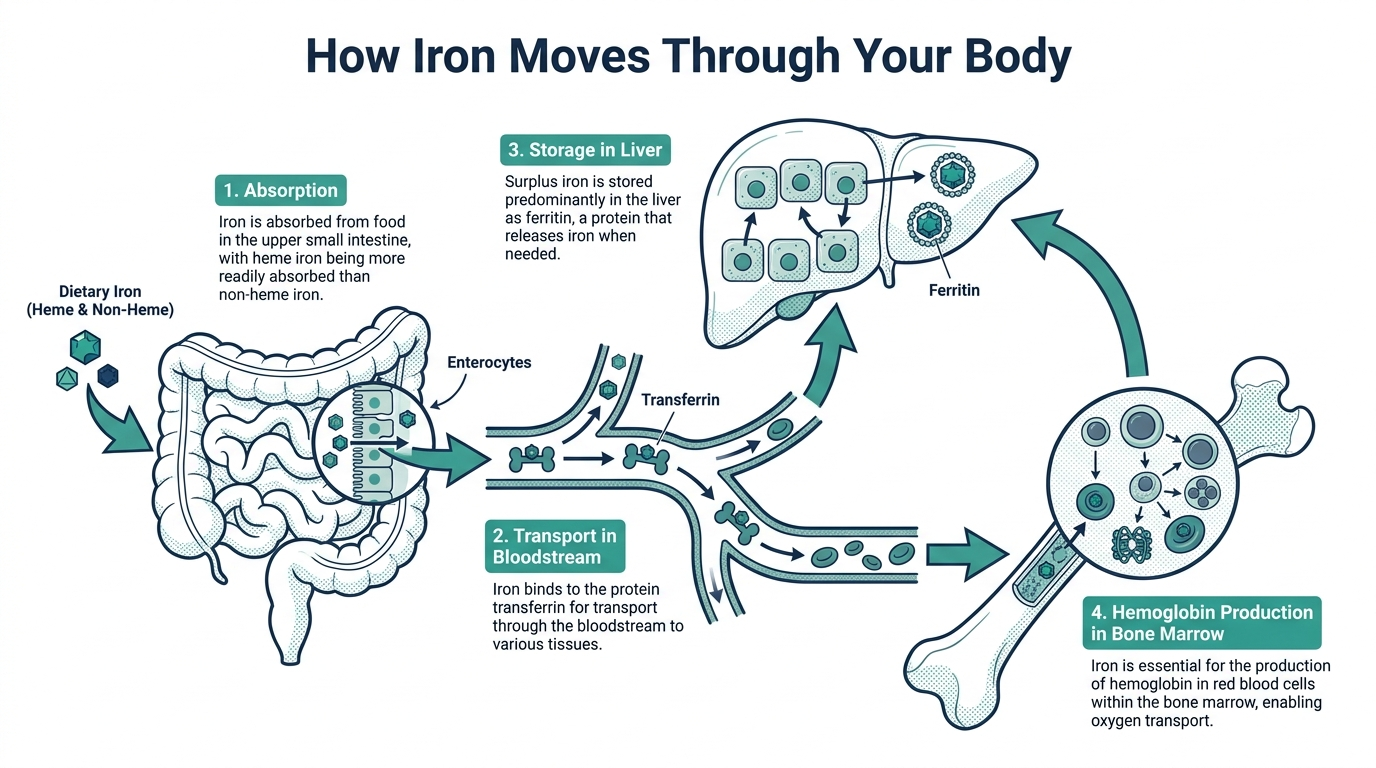
Low iron is one of the most common and most missed reasons people feel exhausted, foggy, and cold all the time. The catch is that a normal hemoglobin reading can hide a near-empty iron tank, because ferritin (your iron storage protein) often drops long before classic anemia shows up. An at-home iron and ferritin test lets you check both serum iron and ferritin without booking a doctor visit, then act on the numbers.
A normal hemoglobin can hide low iron stores completely. See your ferritin alongside 100+ other biomarkers. One at-home Superpower draw checks 100+ biomarkers, physician-reviewed.
We compared the major at-home options on what they actually measure, how accurate the lab is, and what you pay. Below are our four picks for 2026.
- Ferritin is the single most useful marker for catching early iron deficiency, so any iron test worth buying must include ferritin, not just serum iron and hemoglobin.
- For a one-time iron and ferritin check at the lowest cost, a single Everlywell panel from a CLIA-certified lab is the most direct option, while Superpower bundles iron, ferritin, and iron saturation inside a 100-plus biomarker membership for $199 per year.
- Finger-prick kits like SiPhox are convenient and HSA and FSA eligible, but a venous blood draw through a national lab remains the most reliable way to confirm an iron deficiency diagnosis.
A quick look at our top picks
- Best for a full-body picture (iron plus 100+ markers): Superpower
- Best single iron and ferritin panel: Everlywell
- Best premium twice-a-year tracking: Function Health
- Best fast finger-prick option: SiPhox Health
Comparison table
| Service | Best for | Price | Iron and ferritin? | VST score (out of 5) |
|---|---|---|---|---|
| Superpower | Full-body picture | $199/year | Yes (iron, ferritin, saturation) | 4.8 |
| Everlywell | Single iron panel | About $49 to $99 | Yes (dedicated panel) | 4.6 |
| Function Health | Twice-a-year tracking | $499/year | Yes (within 100+ tests) | 4.5 |
| SiPhox Health | Fast finger-prick | From about $95 | Yes (ferritin add-on) | 4.3 |
Superpower – Best for seeing iron inside a full-body picture
Superpower is our top pick when you want your iron and ferritin numbers in context with the rest of your health. It is a longevity-focused membership that runs a panel of more than 100 biomarkers, including total iron, ferritin, and iron saturation, plus a physician-reviewed dashboard that flags what is out of range and why.
Pros
- Iron, ferritin, and iron saturation are all included in the standard panel.
- 100-plus biomarkers for $199 per year is strong value per marker.
- Real venous blood draw plus an at-home option, reviewed by physicians.
- Derived metrics like a ferritin balance score add context most kits skip.
Cons
- It is a yearly membership, so it is overkill if you only want one ferritin reading.
- Pricing is higher in New York and New Jersey ($399 per year).
What makes Superpower stand out for iron specifically is that ferritin never sits in isolation. Because the panel also reads inflammation markers like CRP, the dashboard can tell you whether a high ferritin reflects healthy stores or just inflammation, which is a known trap when ferritin is read alone. That context is the difference between a number and an answer.
If your fatigue could be iron, thyroid, blood sugar, or vitamin D, paying once for the whole picture beats buying four separate kits. For most people checking iron because they feel off, this is the most useful starting point.
Pricing: $199 per year ($399 in NY and NJ), covering the full 100-plus biomarker panel.
Everlywell – Best for a single, low-cost iron and ferritin panel
Everlywell is the best choice if you want one dedicated iron and ferritin test and nothing more. Instead of a membership, you buy a specific panel as a one-time kit, collect your sample at home, and mail it to a CLIA-certified lab for results in a few days.
Pros
- Buy exactly the iron and ferritin panel you need, no subscription.
- Results processed by CLIA-certified labs.
- Clear instructions and physician-reviewed results.
- Frequent discounts and free shipping.
Cons
- Per-test cost is higher than a bulk membership if you test often.
- A single panel gives you less surrounding context than a full workup.
Everlywell offers both a focused ferritin test and a broader Iron, TIBC, and Ferritin panel. The combined panel is the one most people want, because TIBC and serum iron alongside ferritin help separate true iron deficiency from other causes. For a first check or a quick recheck after starting an iron supplement, this is the cleanest single purchase on this list.
The trade-off is context. A standalone iron panel tells you about iron and little else, so if your symptoms are vague, you may end up buying more kits. But if you already suspect iron and just want confirmation, Everlywell does exactly that for a fraction of a membership.
Pricing: roughly $49 to $99 depending on whether you choose the ferritin-only test or the full iron and ferritin panel. Check the current price before you buy.

Function Health – Best for premium twice-a-year tracking
Function Health is the premium pick if you want iron tracked twice a year inside a very deep workup. The membership runs more than 100 lab tests, including iron and ferritin, two times a year, with clinician review of every result.
Pros
- Iron and ferritin included within 100-plus tests, twice yearly.
- Clinician-reviewed results with trend tracking over time.
- Strong fit for people managing an ongoing condition.
Cons
- At $499 per year, it is the most expensive option here.
- Far more than you need for a one-off iron check.
Function Health earns its place for people who want to watch ferritin move over time rather than read it once. Because testing happens twice a year, you can see whether an iron supplement is actually refilling your stores between draws, which a single kit cannot show. For chronic fatigue cases where the cause is not obvious, that repeated, clinician-read depth is the draw.
For a simple iron question, though, the price is hard to justify. We list it as the depth-and-tracking option, not the everyday iron test.
Pricing: $499 per year for 100-plus lab tests twice annually.
SiPhox Health – Best for a fast finger-prick test
SiPhox Health is the best option if you want results fast and dislike mailing a vial of blood. It uses an at-home finger-prick or painless upper-arm collection device, is HSA and FSA eligible, and turns results around quickly.
Pros
- Painless at-home collection, no lab visit and no traditional needle draw.
- Ferritin available alongside 20-plus other biomarkers.
- HSA and FSA eligible with fast turnaround.
Cons
- Finger-prick samples can be more variable than a full venous draw.
- Ferritin may be an add-on rather than part of the base panel.
SiPhox is built around convenience. The collection device pulls a small sample from your upper arm in about five minutes, which makes it the easiest test here to actually complete. You can build a panel that includes ferritin along with cholesterol, thyroid, and inflammation markers, so it doubles as a light wellness check.
The honest caveat is sample type. For confirming an iron deficiency diagnosis your doctor will act on, a venous draw remains the gold standard, so treat SiPhox as a convenient screen rather than the final word. For a quick read on where your ferritin sits, it does the job.
Pricing: from about $95 depending on the panel and plan you choose. Confirm the current price and whether ferritin is included.
We compared 12 at-home testing services and reviewed exactly which iron markers each panel measures, whether ferritin is included by default, what lab certification stands behind the result, and how the sample is collected. We do not score a test on marketing claims. We score it on what it actually reports and how reliably it reports it.
How we picked
We ranked each service on four criteria, in this order of importance:
- Marker coverage: does it include ferritin, not just serum iron? Ferritin is the early-warning marker, so its absence is a deal-breaker.
- Lab quality: CLIA-certified labs and clinician or physician review of results.
- Collection reliability: venous draws score higher than finger-prick for diagnostic confidence.
- Value: cost per useful marker, not just sticker price.

What the markers on an iron panel actually mean
Buying the right test only helps if you can read the result. A full iron panel usually reports four numbers, and each answers a different question. Understanding them is what lets you tell true iron deficiency apart from a look-alike.
- Serum iron: the iron circulating in your blood at that moment. It swings a lot with what you ate and the time of day, so it is the least stable number on its own.
- Ferritin: your stored iron. This is the early-warning marker, because stores empty before circulating iron and hemoglobin fall. A low ferritin is the most specific sign of depleted iron.
- TIBC (total iron-binding capacity): how much capacity your blood has to carry iron, reflecting transferrin, the transport protein. TIBC tends to rise when iron is low, as the body makes more carriers to grab what little is available.
- Transferrin saturation: the percentage of that carrying capacity actually filled with iron, calculated from serum iron and TIBC. It gives a cleaner read on iron availability than serum iron alone.
Typical adult reference ranges, which vary by lab and by sex, run roughly as follows: ferritin about 30 to 300 ng/mL in men and about 15 to 200 ng/mL in women, transferrin saturation about 20 to 50 percent, and serum iron roughly 60 to 170 mcg/dL. Always read your own value against the range on your report, because assays and cutoffs differ between labs.
How to read your iron panel: worked scenarios
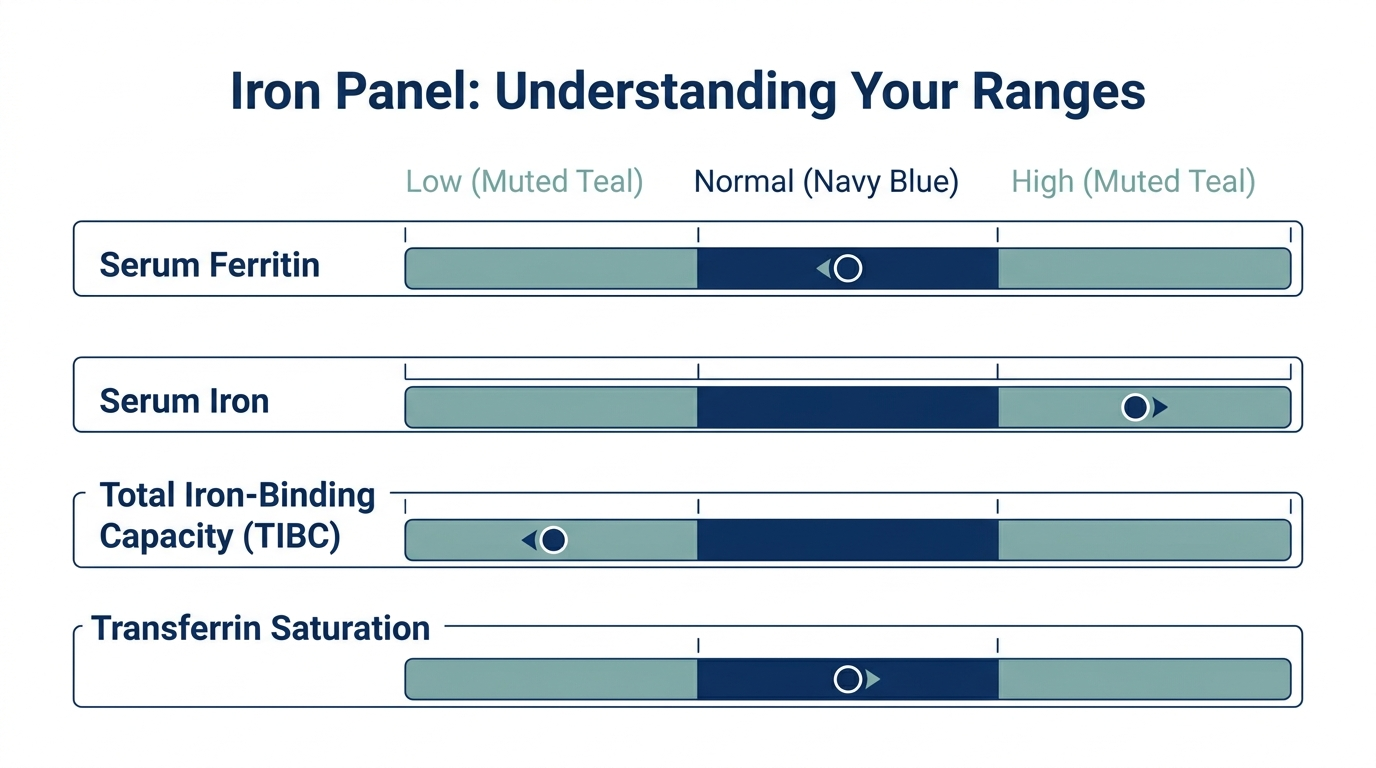
The power of a full panel is in the pattern, not any single number. A few common combinations show how a clinician would interpret them.
- Low ferritin, low transferrin saturation, high TIBC: the classic picture of iron deficiency. Stores are empty, saturation is low, and the body has ramped up carrying capacity to scavenge iron. This is the pattern that most often explains unexplained fatigue.
- Low or borderline ferritin with a normal hemoglobin: iron deficiency without anemia yet. This is exactly the early stage a ferritin test catches that a routine CBC misses, because the tank is draining before the classic anemia appears.
- Normal or high ferritin with low serum iron and low saturation: often points to inflammation or chronic disease rather than simple deficiency, because ferritin can be pushed up by inflammation even when usable iron is low.
- High ferritin with high transferrin saturation: can suggest iron overload and, when persistent, warrants evaluation for conditions like hemochromatosis.
This is why the best at-home tests report ferritin, TIBC, and saturation together, and why services that add an inflammation marker like CRP give a more trustworthy read.
The ferritin trap: why a normal or high number can mislead
The single biggest pitfall in iron testing is that ferritin is not only a storage marker. It is also an acute phase reactant, meaning it rises with inflammation, infection, recent illness, and some chronic conditions and liver problems. That creates a real trap: a person can be genuinely iron deficient yet show a normal or even elevated ferritin because inflammation is propping the number up.
The practical consequence is that a normal ferritin does not always rule out deficiency if there is inflammation in the picture. This is precisely where a panel that also measures CRP or another inflammation marker earns its keep, because it tells you whether to trust the ferritin at face value. If your ferritin looks fine but you still have textbook iron deficiency symptoms, this trap is a reason to bring the result to a clinician rather than to conclude your iron is fine.
Symptoms of low iron, and who is most at risk
Iron deficiency develops slowly, and the symptoms are easy to attribute to a busy life. Recognizing the cluster is what prompts people to test. Common signs include:
- Persistent fatigue and low energy that rest does not fix
- Feeling cold, especially in the hands and feet
- Shortness of breath or a pounding heart on exertion
- Pale skin, brittle nails, and hair shedding
- Poor concentration or brain fog
- Unusual cravings for ice or non-food items, a symptom called pica
- Restless legs at night in some people
Certain groups are at markedly higher risk and benefit most from checking iron and ferritin:
- Menstruating people, especially those with heavy periods, the most common cause in this group
- Pregnant people, whose iron needs rise substantially
- Vegetarians and vegans, since plant iron is absorbed less efficiently
- Endurance athletes, who can lose iron through several routes
- People with gut conditions such as celiac disease or inflammatory bowel disease that impair absorption
- Anyone with a source of slow blood loss, such as a gastrointestinal bleed
Iron overload: when the number is too high
Testing is not only about catching low iron. A persistently high ferritin with high transferrin saturation can signal iron overload, and the most important cause to know is hereditary hemochromatosis, a genetic condition in which the body absorbs too much iron over years. Left unchecked, excess iron can accumulate in the liver, heart, and other organs. Because early iron overload is silent, it is often first spotted as an unexpectedly high ferritin and saturation on a routine or at-home panel. If your results show that pattern, especially with a family history, it is worth a clinician evaluation rather than assuming higher iron is simply better.
How to prepare and what to do with an abnormal result
A few preparation steps make an iron result more reliable:
- Test in the morning: serum iron is higher and more standardized earlier in the day.
- Mind supplements: iron supplements can transiently raise serum iron, so many kits ask you to collect before your morning dose or to note when you last took iron. Follow the kit instructions.
- Note recent illness: a recent infection or inflammation can lift ferritin, so mention it when interpreting the result.
Once you have a result, act on the pattern rather than a single value:
- Low ferritin: talk to a clinician before self-treating. Iron supplements work, but they can cause side effects and can mask the reason you are low, so finding the cause of the loss matters as much as refilling the tank.
- Confirm a borderline finger-prick result: with a venous draw before making decisions, since capillary samples can be more variable.
- Recheck after treatment: ferritin refills slowly, often over months, so a repeat test after a few months tells you whether stores are genuinely recovering. This is where a service that tracks trends over time is more useful than a one-off kit.
- High ferritin and saturation: bring it to a clinician to rule out iron overload rather than ignoring it.
The through-line for every buyer is the same: pick a test that reports ferritin alongside serum iron, TIBC, and saturation, read the pattern rather than one number, account for inflammation, and confirm anything surprising with a clinician and a proper venous draw before you act on it.
Turn what you just learned into action.
Superpower lets you test 100+ biomarkers from home, then re-check them over time so you can actually see progress, physician-reviewed at every step.
Frequently asked questions
What is the difference between an iron test and a ferritin test?
A serum iron test measures iron circulating in your blood right now, which swings with what you ate that day. Ferritin measures your stored iron, so it is the better marker for catching deficiency early. The best panels report both.
Can an at-home test diagnose iron deficiency?
An at-home test can flag low ferritin and low iron and strongly suggest deficiency, but a formal diagnosis and treatment plan should come from a clinician. Use the result as the trigger to talk to your doctor, especially before starting iron supplements.
Do I need to fast before an iron test?
Many iron tests ask you to collect your sample in the morning before eating, because serum iron can rise after meals and after iron supplements. Follow the specific instructions in your kit, and note when you last took any iron.
Is a finger-prick iron test as accurate as a blood draw?
Finger-prick samples are convenient and good for screening, but a venous blood draw is still the most reliable method, especially for confirming a diagnosis. If your finger-prick ferritin comes back borderline, a follow-up venous test is worth it.
Which test is best if I just want to check my iron once?
A single Everlywell iron and ferritin panel is the most direct one-time option. If you suspect more than iron is going on, Superpower checks iron alongside 100-plus other markers for $199 per year, which is often better value than buying several separate kits.
The bottom line
If you only want to answer the iron question once, a single Everlywell iron and ferritin panel is the cleanest, lowest-cost choice. If your fatigue could have several causes and you want the full picture, Superpower checks iron, ferritin, and saturation inside a 100-plus biomarker membership for $199 a year, which is our overall top pick. Function Health suits people who want clinician-read depth twice a year, and SiPhox wins on speed and painless collection. Whichever you choose, make sure ferritin is on the report, because that is the number that catches low iron before it catches you.
Sources
- Athletech News, Superpower Blood Test Review 2026: athletechnews.com/superpower-blood-test-review
- Superpower biomarkers, Ferritin and Iron tests: superpower.com/biomarkers/ferritin-test
- Everlywell, Iron, TIBC and Ferritin panel explainer: everlywell.com
- Function Health pricing: functionhealth.com/pricing
- SiPhox Health, ferritin test and pricing: siphoxhealth.com/ferritin-test