
Quick answer: Function Health is worth it for people who want a comprehensive baseline of 100-plus biomarkers, get value from a physician-reviewed results dashboard, and will actually act on the data year over year. At $499 per year, the per-test cost is genuinely competitive with retail labs. It is not worth it if you are uninsured and price-sensitive, if you just need one or two targeted tests, or if you plan to ignore the results after the novelty wears off. For most people serious about preventive health, the $499 is defensible. For budget-conscious users who want a comparable panel, there are meaningfully cheaper options worth considering before you commit.
What do you actually get with a Function Health membership?
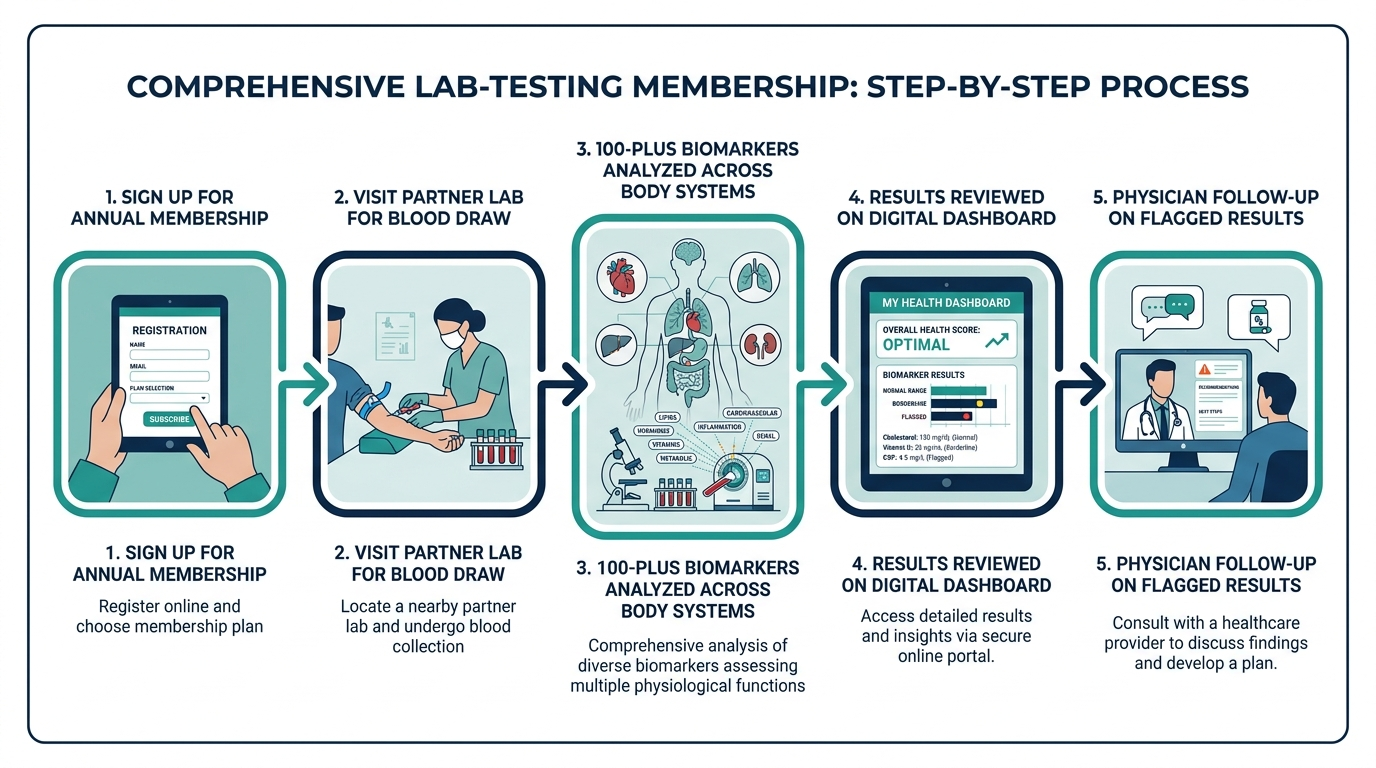
A standard Function Health annual membership includes a single comprehensive blood draw covering approximately 100 biomarkers, physician review of your results, and access to a longitudinal tracking dashboard. The draw is processed through Quest Diagnostics or regional lab partners, so the logistics are familiar: you book a local appointment, get one venipuncture, and results appear in your Function dashboard within a few days.
Weighing Function Health’s $499 price tag? See how a $199 alternative with 100+ biomarkers and physician review compares. One at-home Superpower draw checks 100+ biomarkers, physician-reviewed.
The biomarker list is genuinely broad. It covers a complete metabolic panel, lipid fractionation (including ApoB and Lp(a), which most standard panels skip), thyroid function (TSH plus free T3 and T4), complete blood count with differential, inflammatory markers like hsCRP and homocysteine, sex hormones, DHEA-S, insulin, heavy metals screening, and several cancer-screening markers including PSA and CA-125. That list reads like what an internist would order across three separate office visits.
Physician review is the feature Function markets hardest. A licensed physician reviews your results and flags anything outside optimal range, not just the standard lab reference interval. That distinction matters: a TSH of 3.8 mIU/L is technically within the lab reference range (0.4 to 4.5) but a savvy clinician might flag it for context given symptoms. Whether the physician review adds meaningful value depends heavily on how you use it. See our full function health review for a deeper look at how that review process actually works in practice.
The membership also includes a second draw at a reduced cost partway through the year, optional add-on panels (at extra charge), and the ability to share results with your own physician. For a complete breakdown of what add-ons cost, see function health add on test prices.

Is the $499 price actually competitive with retail labs?
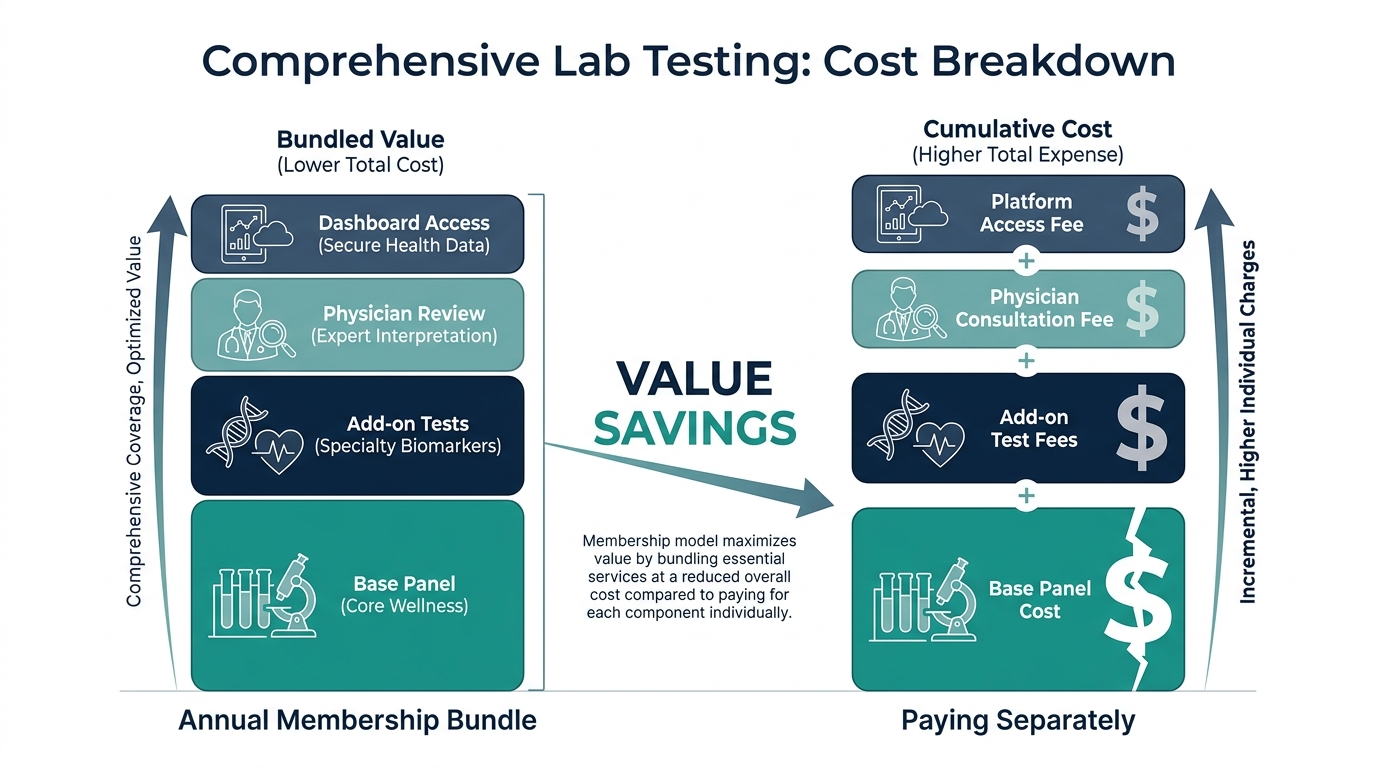
Yes, when you do the math honestly. Building an equivalent panel piecemeal at Quest or Labcorp out-of-pocket would cost between $800 and $1,800 depending on which tests you select and whether you use a direct-to-consumer ordering service. The table below shows what key Function Health biomarkers cost individually at retail cash pricing.
| Biomarker or Panel | Retail Cash Price (approx.) | Included in Function |
|---|---|---|
| Comprehensive Metabolic Panel | $20 to $45 | Yes |
| Lipid panel with LDL-C | $25 to $60 | Yes |
| ApoB | $40 to $80 | Yes |
| Lp(a) | $50 to $120 | Yes |
| hsCRP | $30 to $65 | Yes |
| Homocysteine | $40 to $90 | Yes |
| Full thyroid panel (TSH, fT3, fT4) | $80 to $180 | Yes |
| Testosterone total and free | $60 to $150 | Yes |
| Insulin | $30 to $65 | Yes |
| Heavy metals panel | $90 to $200 | Yes |
| DHEA-S | $35 to $75 | Yes |
| CBC with differential | $15 to $40 | Yes |
| PSA | $30 to $70 | Yes |
Add those up and you are looking at $545 to $1,240 for just this subset, before physician interpretation. Function Health charges $499 for all 100-plus markers plus that review layer. On pure per-biomarker math, the membership holds up.
The honest caveat: if your primary care physician already orders an annual labs panel through insurance, you may be double-paying for overlapping tests. Function Health does not accept insurance, and there is no mechanism to apply FSA or HSA dollars at checkout in most cases (check your plan rules, as some FSA administrators have approved it as a medical expense). For more detail on insurance dynamics, read does insurance cover function health.
What does Reddit actually say about whether Function Health is worth it?
Reddit discussions on Function Health are more nuanced than the company’s marketing suggests. The most common positive take: members who had never tested ApoB, Lp(a), or Lp-PLA2 were genuinely surprised to find cardiovascular risk markers their primary care doctor had never ordered. Several threads document members catching early thyroid dysfunction, elevated ferritin pointing to hemochromatosis, and borderline insulin resistance years before a diabetes diagnosis would have appeared.
The most common negative takes cluster around three issues. First, the physician review feels templated to some users: recommendations like “exercise more” or “consider a Mediterranean diet” appear regardless of individual results, and the review does not replace a conversation with your actual doctor. Second, some members report that their PCP either ignores or pushes back on Function results because the ordering physician is not their treating provider. Third, a segment of cost-conscious users on Reddit argue that the same panel is achievable for significantly less through direct-to-consumer lab ordering services, which is true if you are willing to do the comparison shopping yourself.
The honest consensus from threads with 50-plus upvotes: Function Health is worth it if you are in a DIY-health mindset and will research your results. It is less worth it if you expect the physician review to function like a clinical consultation.

Who should actually buy Function Health?
Function Health makes the most sense for four types of people. Biohackers and longevity-focused adults who want a dense baseline and will track changes year over year get obvious value. Adults over 40 who have never had a comprehensive panel and want to catch cardiovascular, thyroid, or hormonal issues before symptoms develop are a clear fit. High-earning professionals who value the single-draw convenience over piecing together orders are likely to find $499 reasonable given their hourly rate math. And people with a family history of heart disease, thyroid disease, or certain cancers who want to track risk markers beyond what insurance-driven annual physicals cover will find the panel genuinely useful.
Function Health is probably not worth it for adults under 30 without specific risk factors (a standard metabolic and lipid panel ordered through your physician covers the high-yield territory for far less), people who are already in active specialist care where the treating team orders its own labs, or anyone who finds lab data anxiety-inducing rather than motivating. Knowing your Lp(a) is elevated is only useful if you will do something about it.
How does Function Health compare to cheaper alternatives?
The most credible lower-cost alternative is Superpower, which runs a panel of 100-plus biomarkers with physician review for about $199 per year. That is a $300 annual savings for a functionally similar draw and result-review process. For readers who want a direct comparison, the superpower blood test review covers what is included and where the two services differ. The short version: Superpower’s biomarker list overlaps heavily with Function Health’s core draw, physician review is included, and the longitudinal dashboard is comparable. The main difference is that Function Health has been in market longer, has a larger clinical advisory profile, and offers a wider catalog of add-on tests.
The simplest way to actually get this done
Superpower is a full-body lab membership that runs 100+ biomarkers, has each result reviewed by a doctor, and tracks your numbers year over year (about $199/year). It is what we point readers to when they would rather get one clean, complete draw than chase single tests one at a time. Here is superpower reviewed in full.
Other alternatives worth knowing:
- Labcorp OnDemand / Quest MyQuest: Direct-to-consumer ordering, cash pricing, no membership. Good for targeted tests but assembly required.
- Everlywell: At-home finger-prick tests for a subset of hormones and metabolic markers. More convenient, but the biomarker density is lower and some tests are venipuncture anyway.
- LifeExtension.com blood panels: Deep biomarker lists at cash prices with no membership. Requires you to manage your own ordering and interpretation.
- InsideTracker: Similar price tier to Function Health ($299 to $699 depending on panel), strong longitudinal tracking, heavier emphasis on athletic optimization.
For a structured side-by-side, see our piece on the function health cost breakdown, which puts the membership price in context against each of these options.
What do people most often get wrong about Function Health?
The most common misconception is treating the physician review as equivalent to a clinical consultation with your own doctor. It is not. The reviewing physician has no access to your medical history, your current medications, or your symptoms. They are interpreting a single lab draw in isolation. That has value as a screen, but if something comes back flagged, the appropriate next step is bringing the results to a physician who knows you, not assuming the Function review is a diagnosis.
A second misconception: people assume Function Health catches disease early. What it catches is risk markers and out-of-range values. An elevated hsCRP tells you there is systemic inflammation. It does not tell you why. That downstream investigation happens with your PCP, a cardiologist, or a rheumatologist. Function gives you the data. It does not interpret cause.
Third, some members assume the annual draw is sufficient for ongoing monitoring. For people managing active conditions, metabolic disease, or hormonal therapy, quarterly or semi-annual draws may be clinically appropriate. Talk to a clinician about how often your specific markers need tracking given your situation.
Is Function Health worth it if you already have a good PCP?
Possibly yes, because what a good PCP orders through insurance and what Function Health includes are not the same list. Most insurance-driven annual wellness visits cover a basic metabolic panel, CBC, lipid panel (total cholesterol, LDL, HDL, triglycerides), and TSH. They rarely order ApoB, Lp(a), homocysteine, hsCRP, Lp-PLA2, DHEA-S, or full sex hormone panels unless you specifically request them and can justify the clinical indication.
The result is that many adults in their 40s and 50s have never seen their ApoB or Lp(a) despite carrying meaningful cardiovascular risk. Function Health closes that gap. The practical move if you already have a PCP: share your Function results at your next appointment and use them to drive a conversation about which findings warrant follow-up. The draw data is yours, and any clinician can review it.
If you want to compare what Function Health includes versus what a direct ordering service covers, function health add on test prices gives a clear picture of what the base membership includes and what costs extra.

Final verdict: is Function Health worth $499 per year?
For most people who are genuinely invested in preventive health, yes. The per-biomarker value is real, the panel catches markers that standard annual physicals miss, and the longitudinal tracking is the product’s strongest feature over multiple years. The weaknesses are real too: physician review is surface-level, insurance does not cover it, and there are cheaper options with comparable biomarker depth.
If you are on the fence about price, Superpower at $199 per year runs a comparable panel with physician review and is worth serious comparison before you pay the $499. If convenience, brand trust, and a wider add-on catalog matter to you, Function Health is justifiable. If pure biomarker-per-dollar is the metric, the math favors Superpower. For everything we know about how much does superpower cost versus Function, that comparison article lays it out clearly.
A Worth-It Self-Score You Can Run in Two Minutes
The worth-it question is personal, so instead of accepting a generic verdict, score your own situation. Give yourself one point for each statement that is true for you.
- I have a family history of cardiovascular disease, diabetes, thyroid disorder, or certain cancers.
- I have never had advanced markers like ApoB or Lp(a) measured.
- I intend to make a specific change this year (diet, medication, training) and want to measure its effect.
- I already have a clinician who will review results with me and act on findings.
- I will realistically log in, read the dashboard, and return for follow-up testing rather than checking once and forgetting.
- I can pay from an HSA or FSA, or the price is not a strain on my budget.
Four or more points, and a comprehensive membership is likely a good use of money for you. Two or three points, and a lower-cost single-draw option or a targeted panel probably delivers most of the value for less. Zero or one point, and you are likely paying for breadth and tracking you will not use, in which case a specific cash-pay test ordered when you have a specific question is the smarter spend. The score works because it measures the two things that actually drive value: your risk profile and your follow-through.
What to Do the Day Your Results Land
The most common way people waste a comprehensive panel is treating the results as the destination. The report is the beginning of the work, not the end. Run a simple sequence when your numbers arrive.
- Save the raw report. Download the full PDF and store it with your personal medical records so the data outlives any app subscription.
- Separate the flags from the trends. Note not only what is out of range today but also anything drifting in a concerning direction across draws, since directional movement inside the normal band is often the earliest useful signal.
- Triage by significance, not by color. A single mildly out-of-range value with no symptoms is different from a cluster of related markers moving together. Group results into functional systems before reacting to any one number.
- Book a conversation for anything meaningful. Bring the full report to a clinician who knows your history rather than self-treating from an app flag or an internet search.
- Write down two or three actions. The value of testing only materializes if it changes what you do. Decide on concrete next steps and set a date to retest the specific markers you are trying to move.
A panel that changes a behavior or catches a real problem early is worth far more than its price. A panel that produces a screenshot you never revisit is an expensive way to feel proactive.
Why Some Abnormal Flags Are Not Worth Panicking Over
A broad panel almost guarantees at least one value outside the reference range, simply because of how reference intervals are defined, and understanding this prevents costly, anxious over-reaction. Standard reference ranges are typically built to capture the middle 95 percent of a healthy population, which means roughly 1 in 20 results in a healthy person will fall outside the band by pure statistics, not because anything is wrong. Run 100 markers and a scattered flag or two is expected, not alarming.
Several everyday factors also push individual results out of range temporarily. Dehydration can concentrate the blood and nudge several markers up. A hard workout in the day or two before a draw can transiently raise muscle and liver enzymes and inflammatory markers. A recent illness elevates inflammation. Not fasting when a fasting value was expected skews glucose and triglycerides. High-dose biotin supplements can interfere with certain assays. The right response to a lone, mild, unexpected flag is usually to standardize your conditions and recheck that specific marker, not to launch an expensive cascade of follow-up tests. Persistent or markedly abnormal results are a different matter and warrant a clinician conversation. The skill is telling a statistical or situational blip apart from a real signal, which is exactly where a physician who knows your history earns their place.
Don’t just read about your health, track it.
A single result is a snapshot. Superpower re-tests 100+ markers over time so you can watch them move as you change sleep, food, and training.
FAQ
Is Function Health testing worth it for someone in their 30s?
It depends on your risk factors. If you have a family history of cardiovascular disease, thyroid disorders, or metabolic syndrome, getting a comprehensive baseline in your 30s is genuinely valuable. Without specific risk factors, a targeted panel ordered through a direct-to-consumer service (covering lipids with ApoB, thyroid, and CBC) at a fraction of the cost may be sufficient. The full Function Health membership is most defensible once you plan to track year-over-year trends.
What do you get with Function Health that you cannot get elsewhere?
The main differentiator is the combination of 100-plus biomarkers in a single draw with integrated physician review and a longitudinal dashboard designed to track trends. You can replicate the biomarker list elsewhere for less money, but the assembly and interpretation work is on you. Function Health bundles that into one product. The add-on catalog (including food sensitivity, gut microbiome, and advanced hormone panels) is also broader than most single-service competitors.
Does Function Health membership renew automatically?
Yes. Function Health operates as an annual subscription that auto-renews at the membership price in effect at renewal. The cancellation policy allows you to cancel before the renewal date to avoid the next charge. Check Function Health’s current cancellation terms before purchasing, as the exact window and refund policy have changed over time.
Can I use HSA or FSA funds to pay for Function Health?
This is genuinely unclear and depends on your plan administrator. Lab testing for diagnostic purposes is generally an HSA/FSA-eligible expense. However, some administrators categorize general wellness memberships differently. Function Health has historically not been a direct FSA/HSA merchant, meaning you may need to pay out of pocket and submit for reimbursement with your itemized receipt. Confirm with your plan administrator before purchasing.
Is the Function Health physician review done by a real doctor?
Yes. Function Health uses licensed physicians (MDs and DOs) to review results. What the review is not: a personal consultation, a diagnosis, or a prescription. The physician reviewing your labs has access to your results and basic profile but not your full medical history. The value is in flagging out-of-range markers and providing context for what they might mean, not in replacing your treating physician’s judgment.
How long does it take to get results from Function Health?
Most members receive results within 5 to 10 business days of their blood draw. The draw happens at a Quest Diagnostics or partner lab location. Processing time varies by biomarker panel, as some specialty tests (heavy metals, certain hormones) take longer than standard metabolic panels. Function Health notifies you when results are posted to your dashboard.
Is Function Health worth it compared to InsideTracker?
InsideTracker and Function Health are the two most commonly compared premium lab memberships. InsideTracker’s comparable panel runs $299 to $499 depending on which tier you select and has a stronger emphasis on athletic optimization and actionable goal-setting. Function Health’s panel goes deeper on cardiovascular and metabolic risk markers and has a wider add-on catalog. For general longevity and disease-risk monitoring, Function Health covers more ground. For fitness and performance optimization, InsideTracker’s interface is better suited to that use case.
Is there a discount or trial for Function Health?
Function Health occasionally offers promotional pricing through partner referral codes, but there is no standard trial tier or monthly billing option. The membership is paid annually at checkout. Verifying whether a current discount is active requires checking their site directly. We do not list codes because they change and expire. What does not change: the base biomarker panel and physician review are included in the standard annual price regardless of the promotional rate.
Vital Signs Today may earn a commission if you buy through links on this page. It does not affect our editorial assessments.