Last updated 18 June 2026. Educational content, not medical advice. Talk to a licensed clinician before starting any medication.
Short answer: Yes. Semaglutide is a 31-amino-acid synthetic peptide, specifically an analog of the human hormone glucagon-like peptide-1 (GLP-1). Novo Nordisk built it by taking the natural GLP-1 sequence, making two amino-acid swaps, and attaching a C18 fatty-acid chain to position 26 that anchors it to albumin in your bloodstream, extending its half-life from two minutes to approximately 168 hours. That single design move is why Ozempic and Wegovy only need to be injected once a week, while their predecessor liraglutide (Victoza, Saxenda) required a daily shot.
Semaglutide is engineered from your own GLP-1 hormone. Want to see how your natural metabolic markers compare? One at-home Superpower draw checks 100+ biomarkers, physician-reviewed.
What exactly is a peptide, and where does semaglutide fit?
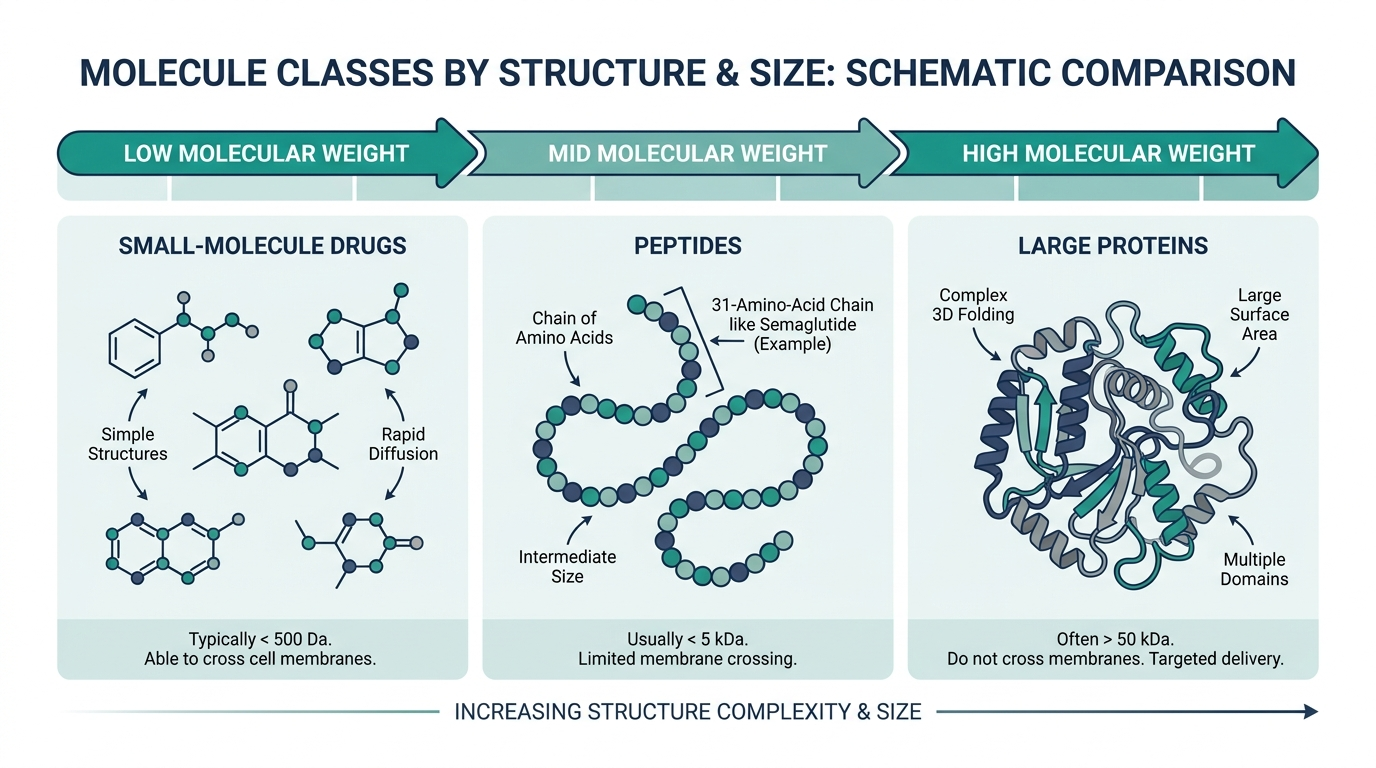
“Peptide” is one of those words that covers an enormous range of molecules, and that breadth confuses a lot of people who are trying to understand what they are taking. A peptide is any chain of amino acids linked by peptide bonds, but chains shorter than roughly 50 amino acids get the “peptide” label while longer chains are called proteins. By that definition, semaglutide, insulin, oxytocin, and the collagen powder in your morning coffee all qualify, and yet they are about as chemically different as things with the same label can be.
Three categories come up in any honest conversation about peptides for weight loss:
- Endogenous signaling peptides. These are short-chain hormones your body already makes. GLP-1, the molecule semaglutide mimics, is one. Native GLP-1 is only seven amino acids at its active form, released from intestinal L-cells when you eat, and cleared from the bloodstream in roughly two minutes by the enzyme DPP-4.
- Synthetic pharmaceutical peptides. These are lab-built analogs of endogenous peptides, engineered to survive longer and bind more tightly. Semaglutide, tirzepatide, and sermorelin are examples. They require a prescription because they are classified as drugs, not supplements.
- Supplement and cosmetic peptides. Collagen peptides, GHK-Cu copper peptides, and the “peptide serums” on Sephora shelves. These are largely unregulated, taken orally or applied topically, and work through different pathways. Lumping these into the same sentence as semaglutide is the source of a lot of misinformation.
So when someone asks “is semaglutide a peptide,” the accurate answer is yes, a pharmaceutical-grade synthetic peptide drug, and that classification is what separates it from every over-the-counter product also wearing the peptide label.
The actual chemistry: what makes semaglutide different from natural GLP-1
The simplest way to actually get this done
Superpower is a full-body lab membership that runs 100+ biomarkers, has each result reviewed by a doctor, and tracks your numbers year over year (about $199/year). It is what we point readers to when they would rather get one clean, complete draw than chase single tests one at a time. Here is superpower reviewed in full.
This is where the story gets interesting, and it is the part most explainer articles skip.
Native GLP-1(7-36) amide is a 30-amino-acid peptide with a plasma half-life of roughly 1.5 to 2 minutes. The enzyme DPP-4 cleaves it at position 2 almost immediately after secretion. Novo Nordisk’s scientists wanted the same receptor activation, but lasting a week. They solved it with three specific changes to the sequence, and each one does a precise job.
Change one: the Aib8 substitution. Position 8 in the native GLP-1 sequence holds an alanine residue. DPP-4 recognizes and cuts right there. Novo Nordisk replaced it with alpha-aminoisobutyric acid (Aib), a non-proteinogenic amino acid that creates steric hindrance the enzyme cannot grab. Result: semaglutide survives DPP-4 essentially intact.
Change two: the Lys34Arg substitution. Position 34 in the natural GLP-1 analog is a lysine. To prevent the fatty-acid chain from accidentally attaching at the wrong site, Novo Nordisk swapped that lysine for arginine, which cannot be acylated. This ensures the engineered fatty-acid linker attaches only at position 26.
Change three: the C18 fatty diacid chain at Lys26. This is the signature modification. A C18 fatty diacid is attached to lysine at position 26 via a spacer built from two molecules of 8-amino-3,6-dioxaoctanoic acid (ADO) and one gamma-glutamic acid. The result is a long hydrophilic arm that binds reversibly but tightly to serum albumin, the most abundant protein in blood. Albumin has its own recycling mechanism through FcRn receptors and a half-life of about 19 days. Semaglutide hitchhikes on that system, extending its effective half-life to approximately 155 to 184 hours across different patients, which is why a once-weekly injection maintains therapeutic levels throughout the week.
The result is a molecule with the molecular formula C187H291N45O59 and a molecular weight of roughly 4,113.58 Da, sharing 94% structural homology with native human GLP-1 but behaving entirely differently in the body.
One detail the marketing omits: because semaglutide is a peptide, your gut would destroy it if you swallowed it without special engineering. The original Ozempic and Wegovy formulations are subcutaneous injections specifically because the stomach’s proteases would chew through the amino-acid backbone. The oral version of semaglutide, Rybelsus for diabetes, uses an absorption enhancer (SNAC, sodium N-[8-(2-hydroxybenzoyl)amino]caprylate) to locally raise pH at the gastric mucosa and protect the peptide long enough for absorption.
Does the “peptide” label change how you should think about it?
Personally, I think the peptide label creates more confusion than clarity for most patients. Here is why that matters practically.
When wellness influencers talk about “running peptides,” they almost always mean research-chemical compounds like BPC-157, TB-500, or CJC-1295, ordered from grey-market vendors in unlabeled vials. When an endocrinologist talks about peptide therapy, they mean prescription drugs like sermorelin, tesamorelin, or semaglutide dispensed by a licensed pharmacy. The word “peptide” spans both, and the legal and safety situations are opposite.
Semaglutide sits firmly in the prescription drug category. It is manufactured under pharmaceutical Good Manufacturing Practice (GMP) standards using Fmoc solid-phase peptide synthesis (SPPS) followed by specialized fatty-acid conjugation and preparative HPLC purification. Each batch is tested for identity, purity, and potency before it reaches a pharmacy. The identity confirmation matters more than people realize: a compound can be 99% pure and still be entirely the wrong molecule if no mass spectrometry step confirms the sequence.
Do not believe anyone who claims that a vial of “semaglutide” from a non-compounding-pharmacy source is the same thing. Peptide synthesis requires exact amino-acid sequence assembly, correct fatty-acid conjugation at the right residue, and multi-stage analytical testing. Without those, you have an unknown peptide at an unknown concentration, and the FDA received more than 455 adverse event reports linked to compounded semaglutide in early 2025 alone, many involving dosing errors from self-administered multidose vials.
Full-body lab membership: 100+ biomarkers, doctor-reviewed, tracked over time.
What semaglutide actually does in the body
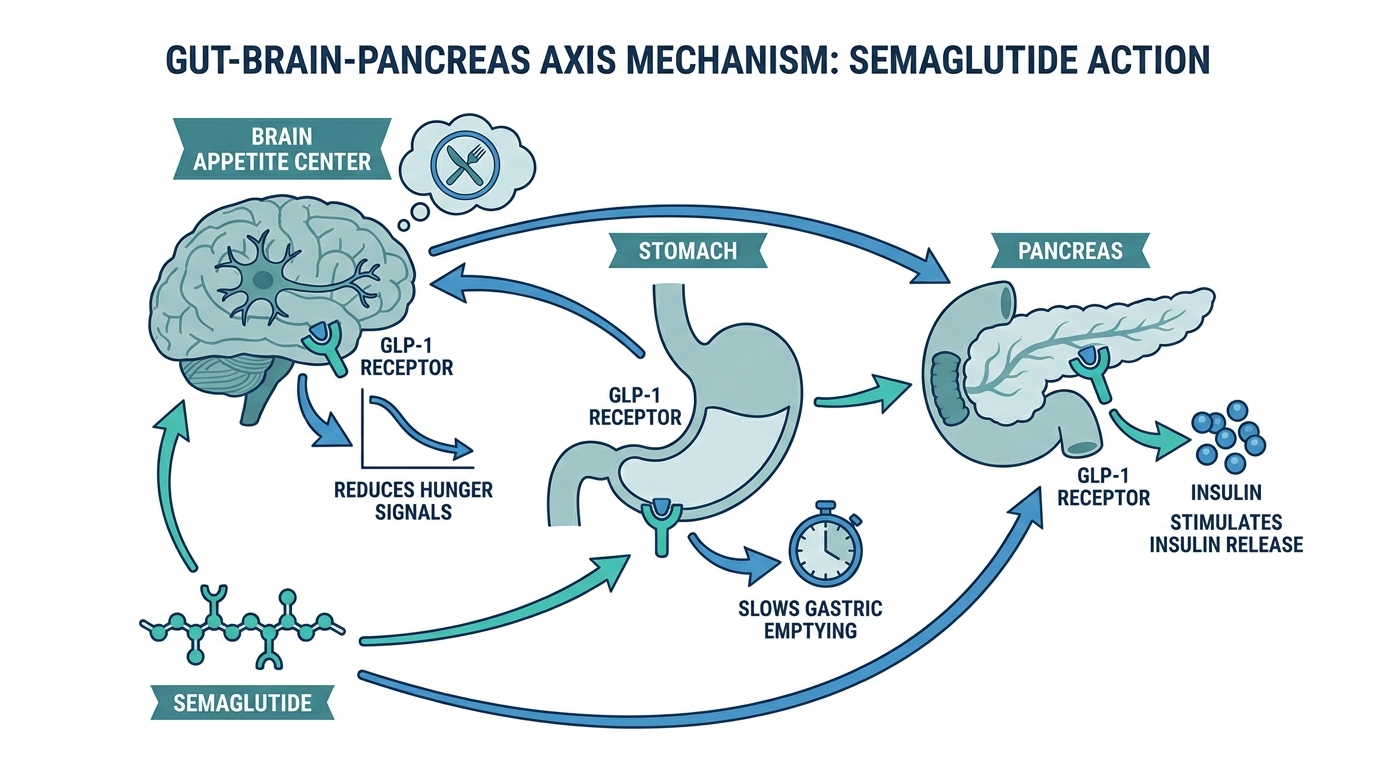
GLP-1 receptors are not just in the pancreas. They are distributed across the brain (especially the hypothalamus and brainstem), the stomach, the small intestine, the heart, and the kidneys. Semaglutide activates all of them, which is part of why its clinical effects are so broad.
The three primary effects that drive weight loss are well-documented:
Appetite suppression via the hypothalamus. Semaglutide crosses the blood-brain barrier (more accurately, it acts on circumventricular organs that sit outside the tight barrier) and activates GLP-1 receptors in appetite-regulating centers. Patients consistently report feeling full faster and thinking about food less, effects that show up within the first two weeks of treatment.
Slowed gastric emptying. Food moves more slowly from the stomach to the small intestine, which extends the feeling of fullness after a meal and blunts the post-meal glucose spike. This effect is stronger early in treatment and attenuates somewhat over time, while the appetite suppression tends to persist.
Improved insulin secretion and glucose sensing. Semaglutide stimulates insulin release in a glucose-dependent way, meaning it only drives insulin when blood sugar is elevated. That glucose-dependency is why hypoglycemia is rare in non-diabetic patients using semaglutide for weight management, unlike older diabetes drugs that push insulin release regardless of glucose level.
Those three mechanisms together explain the clinical results. The STEP 1 trial (n=1,961) showed a mean body-weight reduction of 14.85% at 68 weeks at the 2.4 mg dose, compared to 2.4% with placebo. The two-year STEP 5 trial showed 15.2% mean weight loss versus 2.6% with placebo. And the recent STEP UP trial, which tested the higher 7.2 mg dose in 1,407 adults with obesity, showed 20.7% mean weight loss at 72 weeks, with 33% of participants losing more than 25% of body weight. The FDA approved Wegovy HD (semaglutide 7.2 mg) for patients who have already tolerated the 2.4 mg dose.
Semaglutide vs. orforglipron: peptide vs. small molecule, and why it matters
In April 2026, the FDA approved orforglipron (Foundayo), developed by Eli Lilly, as the first oral small-molecule GLP-1 receptor agonist for weight management with no food or water restrictions. This approval put the semaglutide-is-a-peptide question into sharper focus, because the contrast illustrates exactly what the peptide structure costs and what it buys.
| Feature | Semaglutide (Ozempic / Wegovy) | Orforglipron (Foundayo) |
|---|---|---|
| Molecule class | 31-amino-acid synthetic peptide | Small molecule (nonpeptide) |
| Route | Subcutaneous injection (oral version available with fasting) | Oral tablet, no fasting required |
| Dosing frequency | Once weekly | Once daily |
| Half-life | ~168 hours | Shorter, daily dosing needed |
| Weight loss (pivotal trial) | 14.9% (STEP 1) to 20.7% (STEP UP) | ~15.6% in ATTAIN program |
| FDA approval | 2021 (Ozempic), 2021 (Wegovy) | April 2026 (weight management) |
| Manufacturing complexity | GMP peptide synthesis + fatty acid conjugation | Standard small-molecule synthesis |
| Storage | Refrigerated pen | Room temperature tablet |
| Insurance coverage | Covered for T2D; inconsistent for obesity | TBD at launch |
The practical trade-off is real. Because semaglutide is a peptide, the GI tract degrades it without help. That structural fact is why the most effective semaglutide formulations still require injection. Orforglipron, being a small molecule, survives oral digestion without enhancement and requires no fasting, which addresses the main adherence friction for injectable GLP-1 drugs. But the weekly vs. daily dosing difference matters for compliance, and semaglutide’s decade-long safety record is something orforglipron cannot yet match.
The compounding ban and what it means if you’re looking for semaglutide
Here is the part with real-world stakes that most “is semaglutide a peptide” articles skip entirely.
Because semaglutide is a peptide, it cannot be easily synthesized in a standard lab or sold as a supplement. It requires pharmaceutical-grade manufacturing. From 2022 through early 2025, compounding pharmacies legally produced and dispensed it during a period when the FDA had declared Ozempic and Wegovy in shortage. That window closed when the FDA declared the semaglutide shortage resolved in February 2025, and it has been contracting aggressively since.
Key 2025 to 2026 regulatory events:
- February 2025: FDA declares semaglutide shortage resolved, starting the clock on enforcement deadlines for 503A and 503B compounders.
- March 2026: FDA issues 50+ warning letters in a single wave to telehealth firms and compounding pharmacies, the largest single enforcement action in GLP-1 history. Hims, Ro, and similar platforms exited compounded semaglutide shortly after.
- April 30, 2026: FDA proposes to exclude semaglutide, tirzepatide, and liraglutide from the 503B Bulks List entirely, citing no clinical need for outsourcing facilities to compound these drugs. Public comment period closes June 29, 2026.
The result is that the “$99 to $150 compounded semaglutide” ads that proliferated through 2023 and 2024 are now mostly running on borrowed time or outside the rules. The FDA also reported more than 455 adverse events linked to compounded semaglutide by early 2025, many from dosing calculation errors, which underscores the risk of reconstituting a peptide drug without pharmacy oversight.
What remains legal and accessible: brand-name Ozempic and Wegovy through standard channels (retail cost $900 to $1,400 per month without insurance), telehealth prescriptions for branded semaglutide, and the new oral Wegovy pill at $149/month through Hims (which settled with Novo Nordisk and became a distribution partner in March 2026). For patients who cannot afford brand-name pricing, Novo Nordisk’s NovoCare assistance program provides Wegovy at $0/month for patients meeting income thresholds.
Insider note: the Hims-Novo settlement in March 2026 was a significant pivot. Hims went from actively suing to defend its right to compound to becoming a branded Wegovy distribution partner in about 90 days. That speed tells you something about where the legal and commercial wind is blowing.
Telehealth GLP-1 program with provider visits and pharmacy coordination.
How to access semaglutide legally in 2026: a practical map
The “peptide” classification of semaglutide has a direct legal consequence: because it is a drug, not a supplement, you cannot buy it over the counter. Here is what the lanes actually look like in mid-2026.
Lane 1: Brand-name through a licensed prescriber. This is the gold standard. Ozempic is approved for type 2 diabetes and cardiovascular risk reduction. Wegovy is approved for chronic weight management. Wegovy HD (7.2 mg) is newly approved for patients who have tolerated the 2.4 mg dose. These are available at any pharmacy with a valid prescription.
Lane 2: Telehealth platforms. Most major platforms pivoted after the compounding exit. Calibrate focuses on getting brand-name coverage through insurance. Noom Med prescribes through licensed physicians and works with major pharmacies. The Hims platform now distributes branded oral Wegovy at $149/month. Marek Health and Defy Medical offer branded GLP-1 access with monitoring programs. Expect to pay $149 to $400/month depending on dose and platform.
Lane 3: Patient assistance programs. Novo Nordisk’s NovoCare program offers Wegovy at $0/month for commercially insured patients who qualify and at reduced cost for uninsured patients. This is underutilized and worth checking before assuming semaglutide is unaffordable.
What is no longer a lane: Compounded semaglutide from telehealth platforms and most 503B outsourcing facilities. The enforcement window has closed. A small number of 503A pharmacies can still compound patient-specific formulations for documented medical need (such as allergies to brand-name excipients), but this is a narrow exception, not a workaround.
How semaglutide compares to other GLP-1 peptides
Semaglutide belongs to a family of GLP-1 receptor agonist peptides, and understanding where it sits in that family helps set expectations.
Liraglutide (Victoza for T2D, Saxenda for obesity): The predecessor. Also a GLP-1 peptide analog, but with a shorter fatty-acid chain (C16), giving a half-life of approximately 13 hours and requiring daily injection. Maximum weight loss in trials: 5 to 8% of body weight, substantially less than semaglutide. Largely supplanted for new patients.
Tirzepatide (Mounjaro for T2D, Zepbound for obesity): A dual GIP/GLP-1 receptor agonist peptide from Eli Lilly. 39 amino acids, larger than semaglutide. The SURMOUNT-1 trial showed 22.5% mean body-weight loss at 72 weeks, currently the highest of any approved obesity drug. FDA-approved, weekly injection.
Semaglutide (Ozempic / Wegovy): The current standard, with the longest clinical track record in GLP-1 obesity treatment. The STEP 5 two-year data showing sustained 15.2% weight loss at 104 weeks is something tirzepatide’s longer-duration data is still accumulating.
GLP-1 for reference: The endogenous peptide that started all of this. Two-minute half-life, no therapeutic application at all in its natural form.
Curious what your own levels look like?
Baseline 100+ biomarkers today and retest as life changes, all in one membership with physician review.
Frequently asked questions
Is semaglutide a natural or synthetic peptide?
Synthetic. Semaglutide is made through solid-phase peptide synthesis, not extracted from any biological source. It shares 94% sequence identity with the natural human GLP-1 hormone but is built entirely in a laboratory and modified in ways the natural hormone is not.
Can semaglutide be taken as a supplement?
No. Because it is a peptide, stomach acid and digestive enzymes would degrade it before it could be absorbed, and its effects depend on reaching specific receptors at therapeutic concentrations. It requires either injection or the specialized oral formulation (Rybelsus), both available only by prescription.
Why does semaglutide last a week when natural GLP-1 lasts two minutes?
The C18 fatty-acid chain attached at lysine-26 binds semaglutide reversibly to serum albumin, borrowing albumin’s own 19-day recycling mechanism. Combined with the Aib8 substitution that blocks DPP-4 cleavage, semaglutide achieves a half-life of roughly 155 to 184 hours versus the natural hormone’s 2 minutes.
Is semaglutide the same as Ozempic and Wegovy?
Yes, both brand names contain the same active peptide, semaglutide. Ozempic is the brand name for semaglutide approved to treat type 2 diabetes and reduce cardiovascular risk. Wegovy is the brand name approved for chronic weight management, at a higher maintenance dose (2.4 mg weekly, with a new 7.2 mg dose now approved) compared to Ozempic’s maximum dose of 2 mg weekly.
What is the difference between semaglutide and orforglipron?
Semaglutide is a peptide, orforglipron is a small molecule. Both activate the GLP-1 receptor and cause similar weight loss (around 15 to 21% for semaglutide, around 15.6% for orforglipron in the ATTAIN trials). The practical difference is route: orforglipron is a simple daily oral tablet with no fasting requirements, while the most effective semaglutide formulation is a once-weekly injection. The peptide structure of semaglutide is why oral dosing requires either special absorption technology (Rybelsus) or an injection.
Is compounded semaglutide still available in 2026?
In very limited circumstances. The FDA’s enforcement campaign from late 2024 through 2026 effectively ended widespread compounded semaglutide from 503B outsourcing facilities and most telehealth platforms. A narrow exception remains for 503A compounding pharmacies filling individual prescriptions for documented medical need. Brand-name options, including oral Wegovy at $149/month through some telehealth platforms, are now competitive in price with what compounded versions cost.
Does calling semaglutide a “peptide” mean it’s related to the research peptides sold online?
Only in the broadest chemical sense. Both semaglutide and research-use peptides like BPC-157 or CJC-1295 are chains of amino acids. But semaglutide is a prescription drug manufactured under GMP standards with confirmed identity, purity, and dose. Research peptides are sold “for laboratory use only,” are not tested for human use, carry no clinical oversight, and exist in a different legal and safety category entirely.
Author: Vital Signs Today Editorial Team, [credential]”]. Educational content, not medical advice. Sources linked inline.
Telehealth GLP-1 program with provider visits and pharmacy coordination.
Primary sources:
- Semaglutide overview, ScienceDirect Topics
- Semaglutide peptide sequencing case study, ResolveMass
- STEP 1 trial efficacy data, Novo Medlink
- STEP 5 two-year trial, Nature Medicine
- STEP UP trial, Applied Clinical Trials Online
- FDA GLP-1 compounding policy clarification
- FDA proposal to exclude semaglutide from 503B Bulks List
- Orforglipron FDA approval, Patient Care Online
- GLP-1 drug comparison, GoodRx
- Semaglutide SPPS synthesis overview, Semaglutide360
Want a real clinician to run the numbers, not a guess?
Joi + Blokes is a telehealth clinic that prescribes GLP-1 medication (Zepbound, compounded semaglutide and tirzepatide), hormone therapy (TRT, HRT), thyroid care, and peptides after a real lab panel and clinician review, with no membership or consult fee (prescriptions from about $59/month, lab panels from $149). If the scale will not budge, this is where you find out whether insulin, thyroid, or hormones are the real reason. Here is Joi + Blokes reviewed in full.
Related reading
Vital Signs Today may earn a commission if you buy through links on this page. It does not affect our editorial assessments.