
Last updated June 2026. Educational content, not medical advice. Peptides labeled “research use only” are not approved for human use by the FDA. Prescription peptides should only be used under the supervision of a licensed clinician. Talk to your provider before starting any injection protocol.
Short answer: The overwhelming majority of therapeutic peptides are injected subcutaneously (into the fatty layer just under the skin) using a 29- to 31-gauge, 0.5-inch insulin syringe, at a 45-degree angle for lean individuals or 90 degrees for those with more tissue, after reconstituting the freeze-dried powder with bacteriostatic water and using the correct concentration math to hit the target dose without a decimal error.
Most therapeutic peptides go in subcutaneously, under the skin. Before your next injection, want to know what your bloodwork actually shows? One at-home Superpower draw checks 100+ biomarkers, physician-reviewed.
Why does the injection route matter so much for peptides?
The answer comes down to how fast the molecule reaches your bloodstream, and for how long. Subcutaneous injection delivers the peptide into the interstitial tissue beneath your skin, where it absorbs gradually through the lymphatic and capillary networks. Intramuscular injection pushes the molecule into highly vascularized muscle, producing peak plasma concentrations roughly 30 to 40 percent higher within the first hour, but the subcutaneous route maintains therapeutic levels 18 to 24 hours longer because of slower, steadier lymphatic absorption (PeptideDeck).
For most peptides used in clinical and wellness settings, including GLP-1s (semaglutide, tirzepatide), sermorelin, BPC-157, and CJC-1295/Ipamorelin, the subcutaneous route is the standard. The protocols written by compounding pharmacies and the FDA-approved drug labels for Ozempic and Wegovy both specify subcutaneous administration. Intramuscular injection is reserved for specific clinical contexts and should only be used when a licensed clinician has specifically directed it. If your prescription or clinic materials say “SubQ,” that instruction is not optional fine print.
Full-body lab membership: 100+ biomarkers, doctor-reviewed, tracked over time.
What supplies do you actually need before the first injection?
Every legitimate clinic that dispenses injectable peptides ships the same five-item kit with the medication. If you are sourcing independently and any of these five are missing from your order, you are not set up to inject safely.
The five non-negotiable supplies:
- Bacteriostatic water (BAC water). 0.9% benzyl alcohol in sterile water. The benzyl alcohol is an antimicrobial preservative that gives reconstituted peptides their 28-day shelf life once refrigerated at 2 to 8 degrees Celsius. Sterile water without the preservative gives you a 24-hour window. That difference matters a great deal if you plan to draw from the same vial across multiple doses (Betterlife Lab).
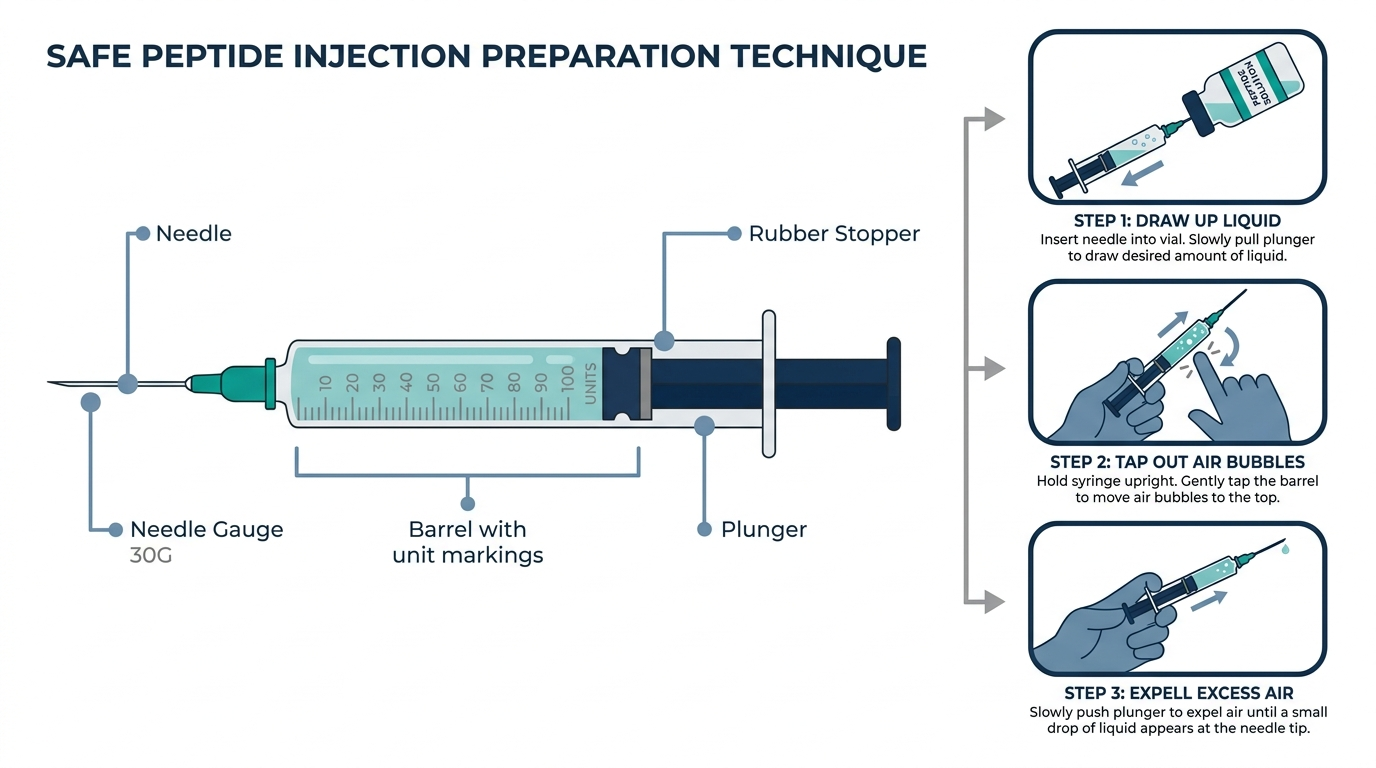
- Insulin syringes, 29- to 31-gauge, 0.5-inch, 1 mL (100-unit capacity). The 50-unit syringe (0.5 mL) is often preferred for small peptide doses because the markings are more spread out, giving more precision. A 30-unit syringe works for very small volumes. The 100-unit syringe is only needed if your dose volume exceeds 50 units.
- A larger drawing syringe or blunt needle. Used to draw the bacteriostatic water and transfer it into the peptide vial without dulling the fine injection needle.
- Alcohol prep pads, 70% isopropyl. Two per injection: one for the vial stoppers, one for the injection site. The alcohol swab must be allowed to dry fully before inserting a needle, which takes about 15 to 30 seconds. Injecting through wet alcohol introduces a small burning sensation and defeats the antiseptic step (WHO Injection Safety Guidelines).
- A sharps container. An FDA-cleared, puncture-resistant container with a one-way lid is the only safe home disposal method for used needles (FDA Sharps Disposal). Fill to the marked line, then dispose through a community drop-off program or mail-back service. Needles do not go in the trash.
Personally, the item most people skip is a proper sharps container. A recycled plastic bottle is not a substitute, and your municipal waste collector is not equipped to handle loose needles.
How do you reconstitute a peptide correctly?
Most peptides arrive lyophilized: freeze-dried into a white or off-white powder or cake at the bottom of a glass vial. The powder is stable for months or years when stored unopened in a refrigerator. The reconstitution step is where most mistakes happen, because the math controls every dose that follows.
Step-by-step reconstitution:
- Swab the stopper of the bacteriostatic water vial and the stopper of the peptide vial with separate alcohol pads. Wait for both to dry.
- Draw the target volume of bacteriostatic water into your drawing syringe.
- Insert the needle through the peptide vial stopper and angle the tip so the water runs slowly down the inside glass wall, not directly onto the powder. Direct pressure disrupts the peptide structure and creates foam you cannot draw through accurately.
- Gently swirl or roll the vial between your palms for 2 to 5 minutes until the powder is completely dissolved. Do not shake. Shaking forces air bubbles into the liquid and gives you froth instead of a clear solution.
- Inspect the solution. A properly reconstituted peptide is clear and colorless, or very slightly yellow. Cloudiness, floating particles, or significant color are signs to discard the vial.
The concentration math you cannot skip:
Your dose is meaningless without knowing the concentration you created. The formula is straightforward:
Concentration (mcg/mL) = Total peptide in vial (mcg) divided by bacteriostatic water added (mL)
A 5 mg (5,000 mcg) vial reconstituted with 2 mL of bacteriostatic water yields 2,500 mcg/mL. On a 100-unit (1 mL) syringe, each unit mark equals 0.01 mL. That means each unit on the syringe holds 25 mcg of peptide at this concentration.
The same vial reconstituted with 1 mL of water yields 5,000 mcg/mL, and each syringe unit holds 50 mcg.
One decimal place error in this calculation equals a ten-fold dosing mistake (Dosed / TrackPeptides). The syringe marks volume, not dose. “10 units” means 0.1 mL of whatever concentration is in the vial. The syringe has no way to know.
A myth worth busting: small air bubbles in a drawn syringe do not become an embolism risk in a subcutaneous injection the way they would in an intravenous one. The concern is accuracy, not air embolism. A 0.1 mL air bubble in a target dose of 0.5 mL is a 20% underdose. Draw 2 to 3 units extra, then push the plunger back to the exact target volume to expel bubbles before injecting.
How do you actually perform a subcutaneous injection?
The technique itself is a short, practiced motion. The details below reflect the standard clinical guidance used by telehealth platforms including Hone Health and the nursing procedure outlined in the MedlinePlus / NIH subcutaneous injection guide.
Site selection comes first. The four approved zones are:
- Abdomen: At least 2 inches (5 cm) from the navel in any direction. Avoid the midline directly above or below the belly button, where tissue is thinner. The abdomen offers the largest total area and the most consistent fat depth, making it the default for most people (PeptideNerds).
- Outer thigh: Front and outer surface only, in the middle third between knee and hip. The inner thigh has more blood vessels and nerves.
- Upper arm: The outer, fatty portion of the upper arm. Harder to reach for self-injection; best used when a second person is administering.
- Love handles / flanks: A large, often underused area many experienced injectors rotate into to give other zones time to rest.
Step-by-step injection:
- Wash hands thoroughly for 20 seconds.
- Swab the chosen injection site with an alcohol pad. Let it air dry completely.
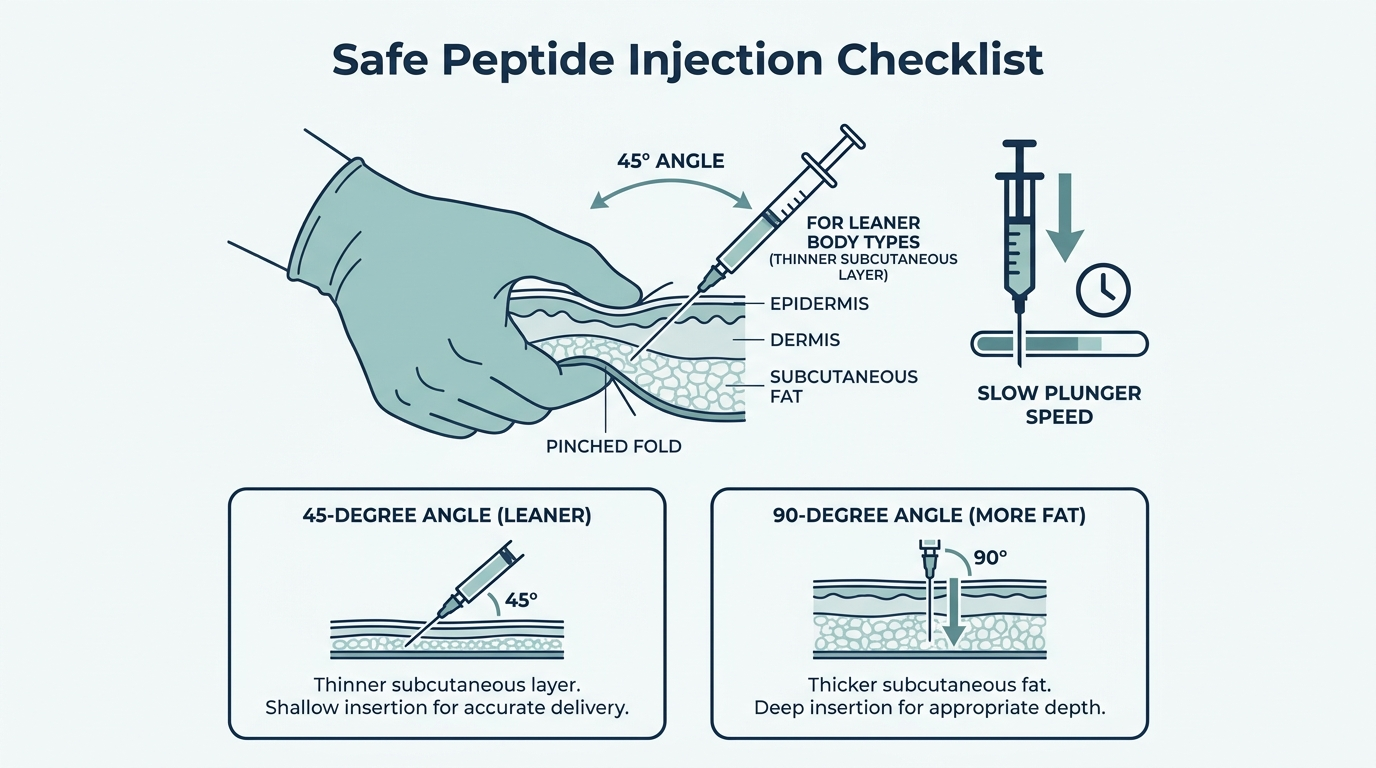
- Pinch 1 to 2 inches of skin and fat firmly between thumb and forefinger, lifting the subcutaneous layer away from the muscle beneath. This is the “pinch-inch” technique.
- Hold the syringe like a dart in your dominant hand. For individuals with less than 1 inch of pinchable tissue, insert at 45 degrees to avoid hitting muscle. For individuals with more than 1 inch of fat, 90 degrees is appropriate (MedlinePlus / NIH).
- Insert the full 0.5-inch needle with a single, smooth motion.
- Release the skin pinch before depressing the plunger.
- Inject the dose slowly over 3 to 5 seconds.
- Withdraw the needle at the same angle used to insert it. Apply gentle pressure with a clean pad; do not rub, as rubbing can push the peptide out of the subcutaneous layer.
- Cap the needle if recapping is unavoidable (use the single-hand scoop method only), then place it directly into the sharps container.
One rule that never changes: one needle, one syringe, one use. Reusing a needle dulls the tip within the first injection and increases the risk of infection and injection-site scarring. The CDC’s One and Only Campaign exists because needle reuse is a real vector for bloodborne pathogen transmission even in self-administration contexts (CDC Injection Safety).
What is site rotation and why does lipohypertrophy matter?
Lipohypertrophy is the firm, rubbery lump that develops when the same spot receives repeated injections. Scar tissue accumulates in the subcutaneous fat, and once formed, it changes how the peptide is absorbed: some doses absorb quickly through undamaged surrounding tissue, others barely absorb at all through the scar. The net effect is unpredictable blood levels from a dose you thought you knew (PMC Lipodystrophy Study).
The prevention protocol is simple: never return to the exact same injection point within 2 to 3 days minimum, and aim to wait at least 2 weeks before reusing the exact same spot. Keep injection points at least 1 inch apart within a zone.
A practical system: use the “clock method” for the abdomen. Picture a clock face centered on your navel. Each injection moves one clock position clockwise. For daily injectors, that gives 12 distinct spots before the cycle repeats. Alternate zones across the week: abdomen on weekdays, outer thigh on weekends, for example.
Do not believe the forum posts that say a small lump from an injection is “just swelling” and will disappear on its own. Minor, temporary swelling at the needle entry point is normal. A firm, persistent lump that does not resolve within 1 to 2 weeks is early lipohypertrophy, and continuing to inject into it compounds the problem.
Subcutaneous vs. intramuscular: when does the route actually change?
For the peptides most people are using, the short answer is: subcutaneous, almost always. The longer answer involves a few real exceptions.
| Peptide / Protocol | Typical Route | Why |
|---|---|---|
| Semaglutide (Ozempic, Wegovy) | SubQ | FDA-approved SubQ only; weekly dosing |
| Tirzepatide (Zepbound, Mounjaro) | SubQ | FDA label specifies SubQ; weekly |
| Sermorelin | SubQ | Slower release preferred for overnight GH pulse |
| BPC-157 (when clinically prescribed) | SubQ or IM near injury site | IM sometimes used for localized musculoskeletal issues |
| CJC-1295 / Ipamorelin | SubQ | Fasted SubQ injection preferred to mimic natural GH pulse |
| TB-500 (TB-4) | SubQ or IM | IM sometimes used in sports medicine contexts |
| NAD+ (high dose) | IV (clinic only) | IV drip for high-dose NAD+; SubQ for lower maintenance doses |
The take-home: if your prescription or clinic instructions specify SubQ, that is the correct route for your protocol. Switching to IM without clinical guidance does not “work better” in any general sense; it changes the pharmacokinetic profile in ways that affect timing and peak concentration, and that matters for protocols built around pulsatile GH release like CJC-1295/Ipamorelin.
How should reconstituted peptides be stored?
Lyophilized (unreconstituted) peptides store best in a freezer at minus 20 degrees Celsius for long-term stability, or in a refrigerator at 2 to 8 degrees Celsius for vials you plan to use soon. Keep them away from light; UV exposure degrades peptide bonds over time.
Once reconstituted with bacteriostatic water, store the vial in the refrigerator at 2 to 8 degrees Celsius. The shelf life is 28 days. Freezing a reconstituted peptide destroys it: ice crystals physically disrupt the peptide’s folded structure, and each freeze-thaw cycle reduces biological activity by an estimated 20 to 50 percent (Onyx Biolabs).
Date the vial the day you reconstitute it. Discard on day 29 regardless of how much is left. A partial vial of degraded peptide is not a savings.
When does a clinic beat DIY? The honest calculation
The supplies checklist, the reconstitution math, the dose calculation, the site rotation map, the storage protocol, the sharps disposal: all of that is what you take on when you handle peptide injections outside a clinical setting. It is not impossible. Millions of diabetic patients self-inject insulin daily with a comparable skill set.
The difference is accountability. An insulin patient has a pharmacist who dispensed the drug, a clinician who set the dose, and a clear label with the concentration already done. When anything goes wrong, there is a chain of licensed professionals who can diagnose whether the issue is the drug, the dose, or the technique. With a grey-market research vial, every link in that chain is you.
In 2026 the telehealth lane for legitimate peptides has expanded considerably. Platforms like Defy Medical, Marek Health, and Hone Health now prescribe sermorelin, NAD+, and FDA-approved GLP-1s through licensed compounding pharmacies, with virtual injection training included in the intake process. Pricing for peptide therapy programs typically runs $199 to $399 per month, all-in with labs and monitoring (Meto). That is meaningfully more than a grey-market vial. It is also the only route that includes a clinician, a pharmacy label, a correct dose, and someone to call if the injection site becomes infected.
The regulatory picture is also moving in a direction that makes the clinical route easier. In February 2026, HHS signaled that approximately 14 peptides, including BPC-157, TB-500, CJC-1295, and Ipamorelin, are expected to return to Category 1 status (permitted for compounding), pending a Pharmacy Compounding Advisory Committee meeting set for July 2026 (FDA Bulk Drug Substances). The grey-market justification for those specific peptides is shrinking by the quarter.
Full-body lab membership: 100+ biomarkers, doctor-reviewed, tracked over time.
Don’t just read about your health, track it.
A single result is a snapshot. Superpower re-tests 100+ markers over time so you can watch them move as you change sleep, food, and training.
Frequently asked questions
What gauge needle should I use for peptide injections?
For subcutaneous injection, use a 29- to 31-gauge needle, 0.5 inches long, in a 1 mL (100-unit) insulin syringe. A 31-gauge is slightly thinner and causes less discomfort, though the difference is minimal at SubQ depths. Do not use the same needle to draw from the vial as you use to inject: drawing with the injection needle dulls the tip before it enters your skin.
Can I inject peptides into muscle instead of fat?
For most peptides, subcutaneous is the correct and preferred route. Intramuscular injection produces a faster, higher peak plasma concentration, but shorter duration, and changes the pharmacokinetic profile that protocols are designed around. IM is only appropriate when a clinician has specifically indicated it, typically for localized musculoskeletal applications.
How do I calculate my dose volume from the concentration?
Divide your target dose in mcg by the concentration you created (mcg/mL). Example: target dose 250 mcg, concentration 2,500 mcg/mL. 250 divided by 2,500 = 0.10 mL = 10 units on a 100-unit syringe. Use a peptide dosing calculator as a double-check; one decimal error means a ten-fold dosing difference.
How long does a reconstituted peptide last in the fridge?
28 days when reconstituted with bacteriostatic water and stored at 2 to 8 degrees Celsius. Do not freeze a reconstituted peptide: ice crystals disrupt the peptide structure and each freeze-thaw cycle degrades activity by an estimated 20 to 50 percent. Write the reconstitution date on the vial.
What happens if I inject into the same spot every time?
You develop lipohypertrophy: scar tissue buildup in the subcutaneous fat that makes absorption unpredictable. Injecting into a hardened area means some doses absorb quickly through surrounding undamaged tissue, others barely absorb at all. The fix is strict site rotation, keeping injections at least 1 inch apart and not returning to the exact same point for at least 2 to 3 days.
Is it safe to inject peptides alone at home without clinical supervision?
The technique itself is learnable. The larger question is whether what you are injecting has been independently verified for purity and identity, whether your dose is appropriate for your physiology, and whether anyone is monitoring the outcome. Prescription peptides from a licensed telehealth clinic include all three. Research-grade vials do not include any of them. The safe route and the accessible route are increasingly the same route in 2026.
What do I do with used needles?
Place them immediately into an FDA-cleared sharps container, a rigid, puncture-resistant box with a one-way lid. Fill to the marked line, then dispose through a community sharps drop-off location, household hazardous waste program, or mail-back service. Never place loose needles in the trash or recycling.
Full-body lab membership: 100+ biomarkers, doctor-reviewed, tracked over time.
Author: [CAN XAC NHAN: ten + credential]. Educational content, not medical advice. Sources linked inline.
Primary sources
- PeptideDeck: Subcutaneous vs Intramuscular Injection for Peptides
- Dosed / TrackPeptides: How to Read an Insulin Syringe for Peptide Dosing
- Betterlife Lab: Bacteriostatic Water for Peptide Reconstitution (2026)
- PeptideNerds: Peptide Injection Sites and Rotation Guide (2026)
- MedlinePlus / NIH: Subcutaneous (SQ) Injections
- CDC: Safe Injection Practices and Your Health
- FDA: Sharps Disposal Containers
- WHO Best Practices for Injections and Related Procedures Toolkit (NCBI)
- Onyx Biolabs: Peptide Stability Guide, Freezer vs Refrigerator (2026)
- PMC: Lipohypertrophy and Insulin (Diabetes Technology Society)
- Meto: Peptide Therapy Providers in 2026 Compared
- FDA: Bulk Drug Substances Under 503A
Related reading
Vital Signs Today may earn a commission if you buy through links on this page. It does not affect our editorial assessments.